
Written by: Anish Rao, Head of Growth, Listen Labs
Key Takeaways for Faster Traveler Interviews
- Traditional qualitative research cycles take 4–6 weeks, yet travel brands now need same-week answers to stay competitive in 2026.
- AI-enabled platforms compress the entire traveler-interview lifecycle, from study design to final deliverable, into less than 24 hours while maintaining research rigor.
- Behavioral screener criteria and story-invitation questions surface authentic booking motivations that demographic screens and summary questions miss.
- AI-moderated interviews achieve 92% participant comfort levels and enable scalable, multi-market studies without timezone or logistics constraints.
- Listen Labs delivers the full research stack, including recruitment, moderation, analysis, and shareable deliverables, in a single subscription. See how your next traveler study can finish in under a day.
Why a Repeatable Traveler-Interview Process Matters in 2026
Speed-to-insight determines whether research influences a decision or arrives after it. Achieving that speed requires budget control, specifically eliminating fragmented vendor stacks where separate tools for recruitment, scheduling, moderation, transcription, and analysis each add cost and delay. Even when research finishes on time and on budget, it fails if stakeholders do not engage with the findings, so cross-team collaboration improves when insights arrive as shareable slide decks and video highlight reels rather than dense research reports that few stakeholders read.
Qualitative methods, such as in-depth interviews, diary studies, and moderated sessions, surface the motivations, emotions, and decision sequences behind traveler behavior. Quantitative methods, such as surveys, NPS, and behavioral analytics, measure the scale and distribution of those behaviors. A sample frame defines the population eligible for a study, for example U.S. leisure travelers who booked at least one overnight trip in the past six months. Incidence rate is the share of the general population that qualifies; low incidence rates, such as luxury solo travelers or corporate travel managers, increase recruitment cost and time. A screener is the set of qualifying questions used to confirm eligibility before a participant enters the study. Moderation refers to the structured facilitation of an interview, whether by a human researcher or an AI interviewer. Analysis frameworks, including thematic coding, affinity mapping, and emotion-signal tagging, convert raw interview data into patterns and recommendations.
The 2026 market context reinforces this urgency. A growing number of travelers use AI to explore destinations and plan activities, which compresses the window between inspiration and booking. Demand for domestic travel is reshaping summer planning, with social conversation about domestic vacations increasing 77% year-over-year globally. AI can now schedule and conduct interviews, analyze transcripts for themes, and generate quantitative insights from qualitative data, making qual-at-scale a practical reality for travel teams of any size.
Step 1: Define Objectives and Hypotheses for Each Study
Every effective traveler study begins with a specific business question tied to a decision. Broad topics like “understand the booking experience” produce unfocused findings. Precise questions, such as “why do price-sensitive leisure travelers abandon checkout after viewing the fee breakdown?”, produce actionable answers.
Required inputs at this stage include the business decision the research must inform, a draft hypothesis, the target traveler segment, and a timeline for when findings must be available. Key stakeholders are the insights lead, the product or marketing owner sponsoring the study, and any regional leads whose markets will be included. The primary decision point is whether the objective is exploratory, which focuses on discovering unknown motivations, or evaluative, which focuses on testing a specific concept or message.
A practical research funnel framework moves from broad discovery to specific validation. For example, a hotel chain hypothesizes that 31% of travelers book earlier to offset rising prices, which may be driving checkout drop-off among mid-tier loyalty members. The exploratory phase tests whether that hypothesis holds. The evaluative phase then tests whether a revised fee-display design reduces abandonment intent. Defining both phases upfront prevents scope creep and keeps timelines under five business days for a single-segment study.
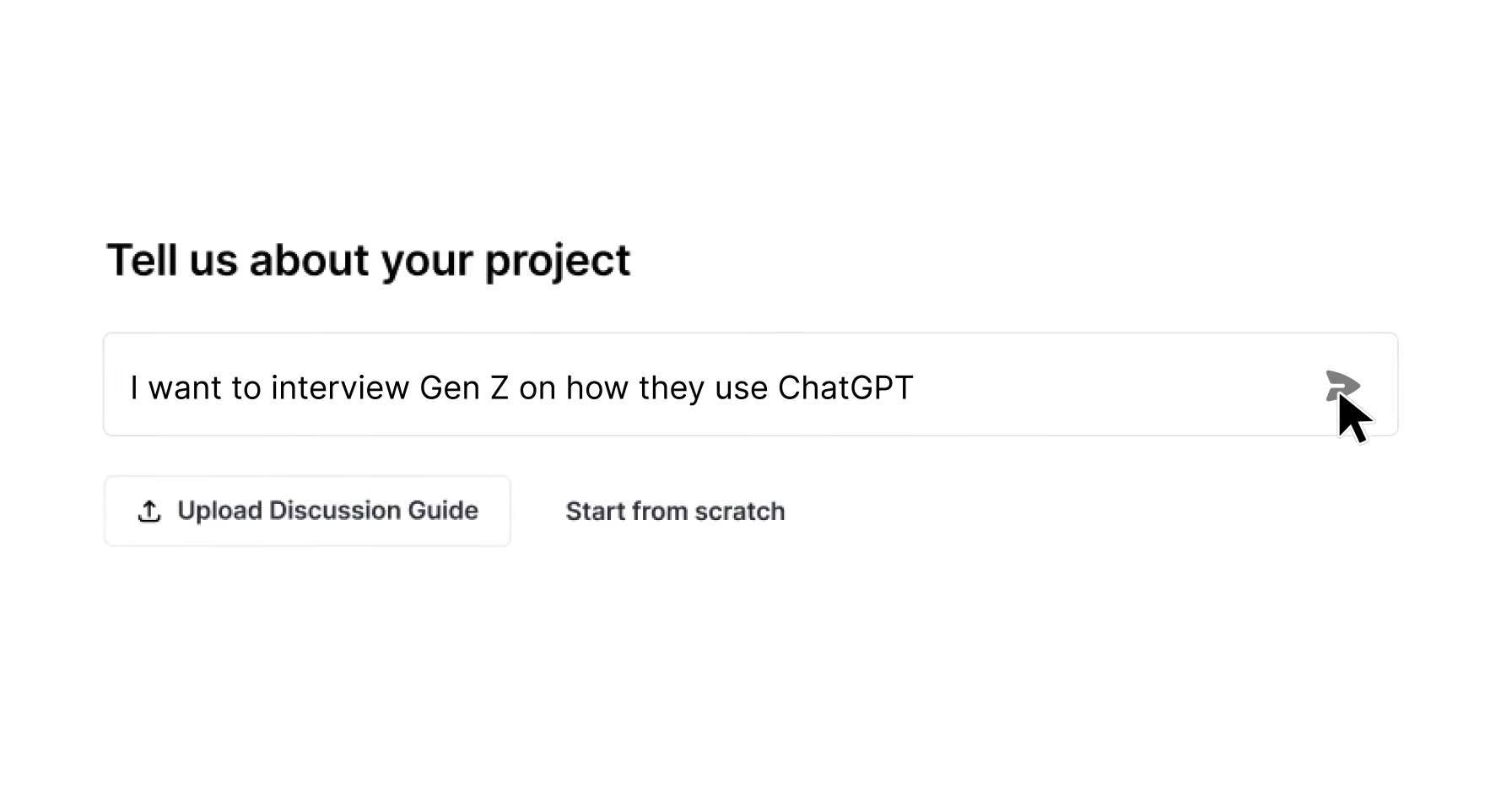
Step 2: Design a Traveler-Focused Interview Guide and Screener
The interview guide works as a structured sequence of open-ended questions and probes. Each topic should open with a story-invitation question, such as “Walk me through the last time you compared hotel options before booking,” rather than a summary question like “How do you usually book hotels?” Story-invitation questions surface the actual decision sequence rather than a rationalized summary.
Screener design for travel studies should prioritize behavioral criteria over demographics. Effective screener criteria include recency of travel, booking method, trip type, and loyalty program membership. A screener that qualifies only on age and income will admit participants whose travel behavior does not match the study’s target segment.
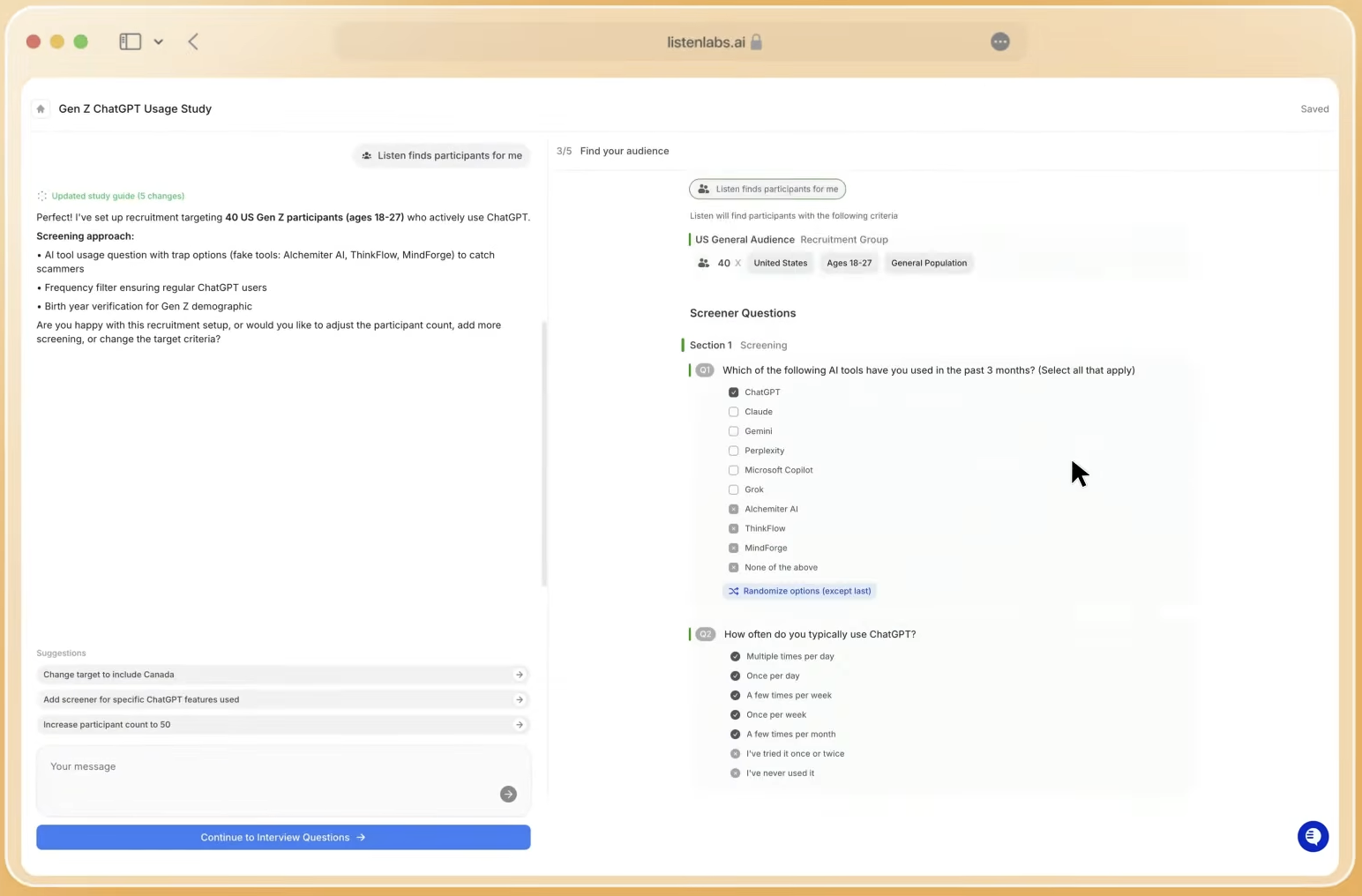
Mixed-methods design integrates qualitative interview questions with quantitative formats, such as Likert scales, NPS, or MaxDiff, within the same session. For a trip-type example, a leisure traveler study might open with an open-ended booking-journey narrative, then present a MaxDiff exercise ranking fee-transparency features by importance, then close with a follow-up probe on the highest-ranked item. This structure produces both the “what” and the “why” in a single 20-minute session.
This mixed-methods approach is particularly valuable for price-sensitivity research. Many travelers would switch property types or shorten their stay if lodging prices felt too high, a finding that only emerges from qualitative probing, not a satisfaction score. This is why a MaxDiff exercise on fee-transparency features should be paired with follow-up probes that ask participants to explain their ranking choices.
Step 3: Recruit and Screen the Right Traveler Segments
Recruitment is the most common source of delay and cost overrun in traveler research. Incidence rates vary significantly by segment. General leisure travelers carry a moderate incidence rate, while corporate travel managers, luxury solo travelers, and travelers who have booked a cruise in the past 90 days carry incidence rates below 5%, which multiplies screening cost and time.
For qualitative traveler studies, teams should recruit additional participants to account for no-shows, dropouts, and disqualifications. Empirical studies show saturation is typically reached within 9–17 interviews for relatively homogenous populations and narrowly defined objectives in qualitative research. For studies spanning multiple segments, such as leisure, business, and event-driven travelers, 5–8 interviews per segment is recommended for qualitative studies, including multi-segment ones, with business and leisure travelers always recruited and analyzed separately because they operate with fundamentally different priorities.
Once you have determined the right sample size per segment, the next challenge is executing that recruitment across multiple markets. Global multi-market recruitment adds complexity beyond simple sample-size calculations. Qual-at-scale tools can engage hundreds or thousands of participants remotely and asynchronously, which removes the timezone and logistics constraints that make simultaneous multi-market fieldwork difficult under traditional agency models. Listen Labs’ panel of 30M verified respondents spans 45+ countries and supports interviews in 100+ languages, enabling a single study to cover top source markets without separate vendor relationships.
Step 4: Conduct and Moderate Traveler Interviews at Scale
Moderation quality determines whether an interview produces surface-level responses or genuine insight. Best practices include probing short or vague answers with prompts like “Tell me more about that,” avoiding leading questions, and maintaining a consistent topic sequence across all sessions to enable cross-participant comparison.
AI-moderated interviews apply the same probing logic at scale. 92% of participants report equivalent comfort levels in AI-moderated and human-moderated sessions, and 30% of participants specifically prefer AI moderation for the ability to schedule at their own convenience, a practical advantage when recruiting travelers across time zones. One participant noted, “Being able to do it from my home just makes it easier for me to participate, and I hope that that helps researchers too because they get more data.”
Emotion-signal considerations are particularly relevant in travel research. A traveler may verbally rate a booking experience as “fine” while displaying micro-expressions of frustration at the fee-display screen. Capturing tone of voice, word choice, and facial micro-expressions, then analyzing those signals against Ekman’s universal emotions framework, surfaces the unverbalized friction that transcripts alone miss. This approach is especially useful for creative testing, concept comparison across markets, and usability testing of booking flows.
Step 5: Analyze, Synthesize, and Share Traveler Insights
Analysis begins with identifying patterns that appear across multiple sessions without prompting. A practical theme-identification framework prioritizes patterns mentioned by three or more participants, then ranks them by frequency, impact on booking decisions, and roadmap feasibility. Root causes, not symptoms, should anchor every finding. “Travelers feel confused at checkout” is a symptom. “Travelers cannot reconcile the base rate shown in search results with the total shown at payment” is a root cause that maps to a specific product fix.
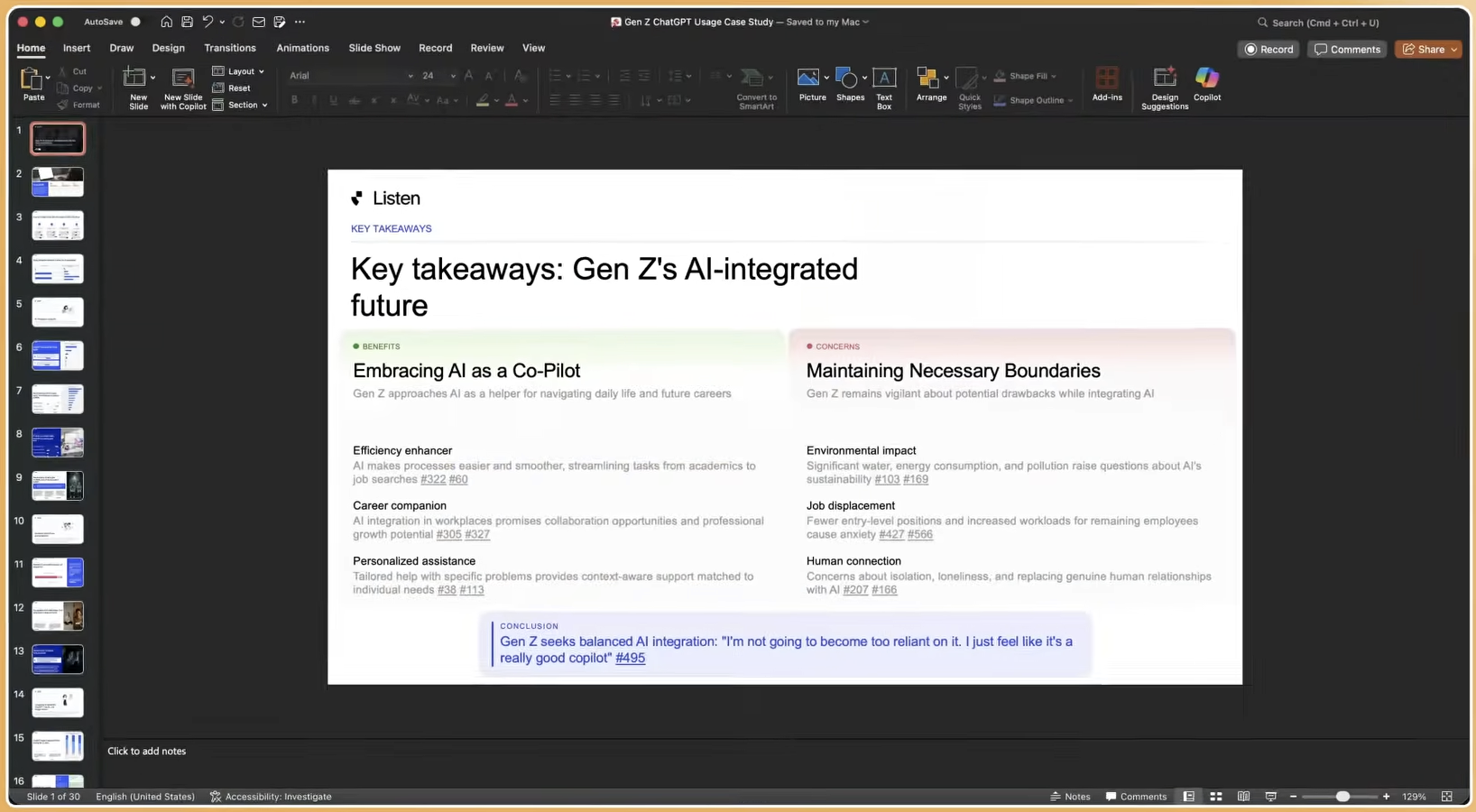
The insight-to-action workflow connects each finding to a named owner and a next action. Findings without owners become slide-deck artifacts rather than business decisions. Deliverables should include a prioritized findings summary, verbatim quotes with timestamps, and a video highlight reel, formats that allow non-research stakeholders to engage with the evidence directly.
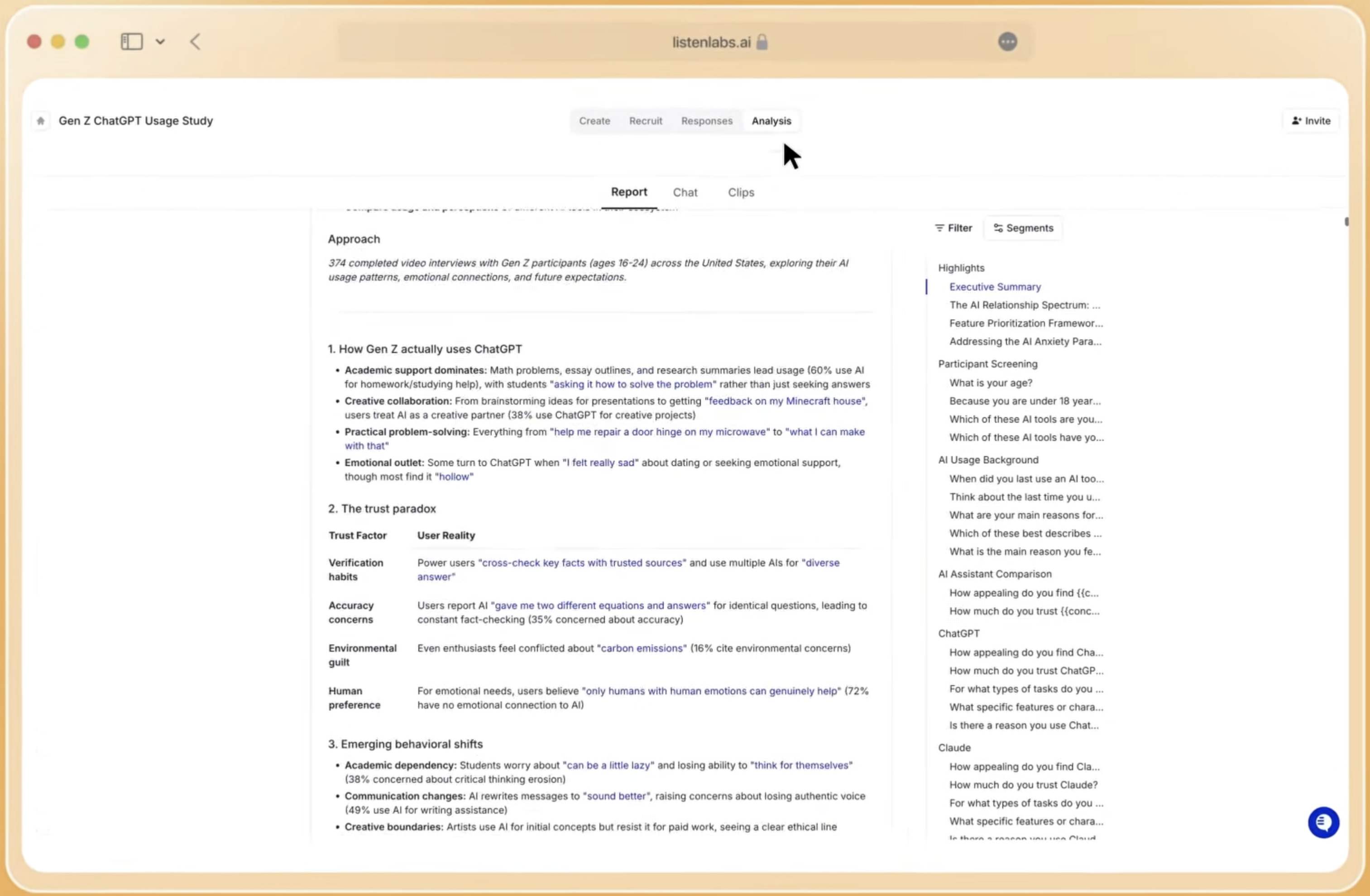
Cross-market synthesis often reveals patterns that single-market studies miss entirely. Consider this example: an OTA runs 30 AI-moderated interviews across three markets, the U.S., Germany, and Japan, covering leisure travelers who abandoned a booking in the past 30 days. Analysis surfaces a consistent theme across all three markets, where fee disclosure timing drives abandonment. The U.S. and German segments cite the gap between search-result pricing and checkout totals, while the Japanese segment additionally flags the absence of a local payment method at the final step. The cross-market synthesis produces two distinct product recommendations with different implementation priorities by region, a finding that a single-market study would have missed entirely.
Common Pitfalls and Early-Warning Signals in Traveler Studies
The five most common failure modes in traveler interview programs appear frequently and deserve equal attention, because each one can derail an otherwise strong study.
- Unclear objectives: Studies launched with topic areas rather than specific business questions produce findings that no stakeholder can act on. Fix: require a one-sentence decision statement before study design begins.
- Poor recruitment fit: Screeners that rely on demographics rather than travel behavior admit participants who do not represent the target segment. Fix: add behavioral qualifiers, such as recency, booking method, and trip type, to every screener.
- Low-quality responses: Short, generic answers indicate that interview questions are too abstract or that participants are not sufficiently engaged. Fix: open every topic with a story-invitation question and probe any answer under two sentences.
- Analysis bottlenecks: Manual thematic coding of 20+ interview transcripts can take longer than fieldwork itself. Fix: use AI analysis to generate initial theme maps, then apply researcher judgment to validate and prioritize.
- Stakeholder misalignment: Findings that arrive after a product decision has already been made are ignored. Fix: share a preliminary read-out of top themes within 48 hours of fieldwork completion, before the final report is written.
Success Metrics and Simple Dashboards for Interview Programs
Four metrics define a healthy traveler interview program and keep teams focused on outcomes rather than activity.
- Study cycle time: The number of calendar days from study brief to final deliverable. A same-week target is under five business days for a single-segment study.
- Participation and completion rates: High participant completion rates are important for travel-app research. Rates below 70% signal screener or incentive problems.
- Consistency of findings: When the same study design is run across multiple waves, core themes should replicate. High variability across waves indicates sampling or moderation inconsistency.
- Downstream usage: Track whether findings are cited in product briefs, campaign briefs, or pricing decisions. Research that is not referenced in downstream decisions has not delivered value regardless of methodological quality.
Periodic retrospectives, conducted after every three to five studies, identify which study designs produced the most actionable findings and which recruitment approaches delivered the best participant quality. These retrospectives compound into a research operations advantage over time.
Advanced Considerations for Mature Traveler Research Programs
Organizations that have completed at least three successful traveler interview studies are ready to consider always-on programs. Continuously collecting 5–10 conversations per week produces a richer and more current picture of traveler experience than running a quarterly study with a larger sample. Always-on programs are particularly valuable for tracking how traveler sentiment shifts in response to pricing changes, competitive moves, or macroeconomic events.
Global multi-market studies then extend this always-on mindset across borders. These programs require recruitment infrastructure that spans top source markets and supports localized moderation. According to Mastercard’s Travel Redline survey, 85% of international travelers say they would choose a destination specifically to take advantage of favorable exchange rates, a motivation that manifests differently across markets and requires market-specific interview probes to surface accurately.
Once you have collected these market-specific insights, the next step is validating them against quantitative data. Behavioral-data integration connects interview findings to booking funnel analytics, enabling researchers to confirm that qualitatively identified pain points correspond to measurable drop-off points in the funnel. Advanced segmentation, by traveler archetype, loyalty tier, or trip purpose, produces findings that product and marketing teams can act on without additional analysis. Price remains the top factor for choosing an airline, while experience and loyalty drive repeat bookings, a shift that segment-level analysis would detect earlier than aggregate data.
Emotion-signal analysis at scale, which tracks joy, confusion, frustration, and trust across hundreds of interviews, enables travel brands to identify the exact moments in a booking flow or creative asset where emotional engagement peaks or collapses. Safe pilot approaches start with a single study type, such as post-booking satisfaction interviews, before expanding to multi-wave or multi-market programs.
Frequently Asked Questions
How long does a traveler interview study realistically take with an AI-enabled platform?
A single-segment traveler study, covering study design, recruitment, fieldwork, and a final deliverable, can be completed in less than 24 hours on Listen Labs. A multi-segment or multi-market study covering three traveler types across two or three countries typically completes within two to three business days. The primary time variable is participant availability, not analysis or report writing, both of which are automated.
What does a traveler interview study cost compared to a traditional agency engagement?
Traditional qualitative research agencies charge for study design, recruitment operations, moderator time, transcription, analysis, and report writing as separate line items. A single large qualitative study can cost hundreds of thousands of dollars. Listen Labs replaces all of those vendor relationships with a single platform subscription, enabling travel organizations to run more studies at a fraction of the cost. Credit consumption per study varies based on audience incidence rate, so general leisure travelers cost fewer credits than corporate travel managers or luxury segment participants.
What skills does an internal team need to run traveler interviews without an agency?
A team using Listen Labs does not need moderation expertise, transcription skills, or manual coding experience. The platform handles AI-assisted study design, recruitment, moderation, and analysis. The internal team’s role is to define the business question, review the AI-drafted interview guide, and translate findings into decisions. A single consumer insights lead or product manager can run a complete study independently.
How does Listen Labs handle data privacy and compliance for traveler research across multiple countries?
Listen Labs maintains SOC 2 Type II, GDPR, ISO 27001, ISO 27701, and ISO 42001 certifications. Customer data is never used for AI model training. For multi-market studies covering the EU, APAC, and the Americas, the platform’s compliance infrastructure applies consistently across all markets without requiring separate data processing agreements per country.
When should a travel organization repeat or retire a traveler interview study?
A study should be repeated when a significant market event, such as a pricing change, a competitive product launch, a macroeconomic shift, or a new booking flow, may have altered traveler behavior since the last wave. Studies should be retired when findings have been stable across three or more consecutive waves with no new themes emerging, or when the business question the study was designed to answer has been resolved and a new decision priority has replaced it. Always-on programs replace the repeat-or-retire decision with a continuous cadence that automatically captures behavioral shifts as they occur.
Conclusion
The process outlined above, from defining objectives through designing the guide and screener, recruiting and screening participants, conducting and moderating interviews, and finally analyzing and delivering insights, gives travel organizations a repeatable path from business question to actionable finding in days rather than weeks. Each step has defined inputs, stakeholders, decision points, and quality signals that make the process auditable and improvable over time.
The 2026 traveler landscape rewards organizations that understand their customers continuously. Travel demand is splitting rather than shrinking, AI is reshaping how travelers discover and plan trips, and price sensitivity and fee transparency have become primary loyalty drivers. The earlier-booking behavior mentioned in Step 1 reflects this broader shift, where travelers scrutinize total cost and timing more closely than before. The organizations that capture those signals first through fast, scalable traveler interviews will make better product, pricing, and marketing decisions than those still waiting on a six-week agency report.
Listen Labs has conducted over 1 million AI-powered customer interviews for companies including Microsoft, Perplexity, and Sweetgreen, compressing research cycles that previously took weeks into results delivered in hours. The same infrastructure is available to OTAs, hotel chains, airlines, and destination organizations today.
See how Listen Labs can deliver your first traveler interview study in less than 24 hours.