
Written by: Anish Rao, Head of Growth, Listen Labs | Last updated: July 29, 2026
Key Takeaways for Enterprise Research Leaders
- AI qualitative research tools in 2026 range from narrow point solutions to full-stack platforms that compress the entire research lifecycle into hours rather than weeks.
- Listen Labs delivers complete studies, from design through recruitment, moderation, analysis, and reporting, in under 24 hours, removing integration overhead and handoff delays from multi-tool environments.
- Unlike transcript-only tools, Listen Labs captures emotional intelligence through simultaneous analysis of tone, word choice, and micro-expressions, which produces deeper, more actionable insights for concept and brand research.
- Enterprise-grade quality controls, global participant sourcing across 45+ countries, and full compliance certifications (SOC 2 Type II, GDPR, ISO) make Listen Labs suitable for Fortune 500 teams running 100+ studies per quarter.
- See how Listen Labs replaces fragmented research stacks and delivers the speed, depth, and scale your team needs.
Research Speed and Turnaround for Enterprise Teams
The traditional qualitative research cycle often runs 4–6 weeks from study design to final deliverables, and in large enterprises with internal prioritization queues, that timeline can stretch to six months. A 2026 AI Research Productivity Report found that AI research tools reduced median time-to-insight by 84%, from a six-week baseline to roughly nine working days. Listen Labs compresses the full cycle further, covering study design, recruitment, moderation, analysis, and deliverables in under 24 hours.
Visceral operates as a conversational AI interview tool. It handles the moderation layer but does not own recruitment or analysis delivery, so enterprise teams still coordinate separate panel vendors, transcription services, and analysts before insights reach stakeholders. The integration overhead in multi-tool environments grows non-linearly with the number of tools, as APIs must be connected and maintained, data formats standardized, and workflows orchestrated across independent update cycles. Every handoff adds days, and Listen Labs removes those handoffs entirely.
Listen Labs layers auto-recruiting, transcription, sentiment tagging, and insight summarization so teams move from question to findings in hours, not weeks. For enterprise research teams managing growing backlogs, that compression often determines whether insights inform a decision or arrive after it has already been made.
See a 24-hour study cycle in action, from brief to boardroom-ready report.
Emotional Intelligence and Depth of Insight
Transcript analysis captures what participants say but not how they feel while saying it. It misses the frown during a product demo, the hesitation before answering a pricing question, or the flat expression that contradicts a positive verbal rating. Visceral output relies on transcript-level sentiment, so emotional signals that never reach the text layer disappear from the dataset.
Listen Labs’ Emotional Intelligence analyzes three simultaneous signal layers, tone of voice, word choice, and subconscious micro expressions, to surface emotions that transcripts alone miss. The system uses Ekman’s universal emotions framework (anger, disgust, fear, happiness, sadness, and surprise), the same standard used in clinical psychology and UX research. Every emotion is quantified per question and concept, with every label traceable to the exact timestamp, verbatim quote, and AI reasoning behind it, so teams can see not just that a participant expressed confusion, but precisely when, on which stimulus, and why the system classified it that way.
The global Emotion AI market was valued at USD 9.10 billion in 2025 and is projected to reach USD 311.99 billion by 2035, which signals that multimodal emotional analysis is becoming a baseline expectation, not a differentiator. For enterprise teams running creative testing, concept comparison, or brand research, transcript-only tools leave a material gap in the data, and even the richest emotional intelligence loses value if the underlying participants are low quality or fraudulent.
Sample Quality and Fraud Control with Quality Guard
Commodity panels carry well-documented risks, including professional survey-takers who optimize for incentives, repeat respondents who have seen similar studies before, and AI-assisted answers that inflate completion rates while degrading data quality. Visceral does not operate its own panel infrastructure, so the quality of its participant data depends entirely on whichever panel provider a team connects to it.
Listen Labs’ Quality Guard operates at two levels. Before study entry, it verifies participants using device fingerprinting, IP analysis, geolocation checks, and repeat-respondent detection across studies. After each interview, it scores every response across five dimensions, informativeness, response depth, engagement, follow-up quality, and repetitiveness, and removes responses below the quality threshold, replacing them with new participants at no additional cost.
Participants are permanently banned for optimization patterns such as strategically neutral answers and are strictly limited to a maximum of three studies per month. This cap removes the professional survey-taker problem that plagues open commodity panels. Borderline cases route through human review before removal, which reduces false positives. Quality Guard is backed by enterprise-grade security infrastructure, including SOC 2 Type II certification, GDPR compliance, and triple ISO certifications for AI Management, Information Security, and Privacy, so quality controls align with enterprise risk standards.
Participant Sourcing and Global Reach with Listen Atlas
Enterprise consumer insights programs increasingly require simultaneous research across multiple geographies, languages, and consumer segments. A point-solution interview tool that relies on external panel partners for recruitment cannot guarantee consistent quality, incidence rates, or turnaround across those markets.
Listen Labs’ Listen Atlas is a global panel of 30M verified respondents across 45+ countries and 100+ languages, with an AI orchestration layer that automatically matches and bids on the best participants across multiple consumer and B2B panel partners. Qual-at-scale is ideal when research requires large sample sizes or broad geographic reach, and AI tools can engage hundreds or thousands of participants remotely and asynchronously.
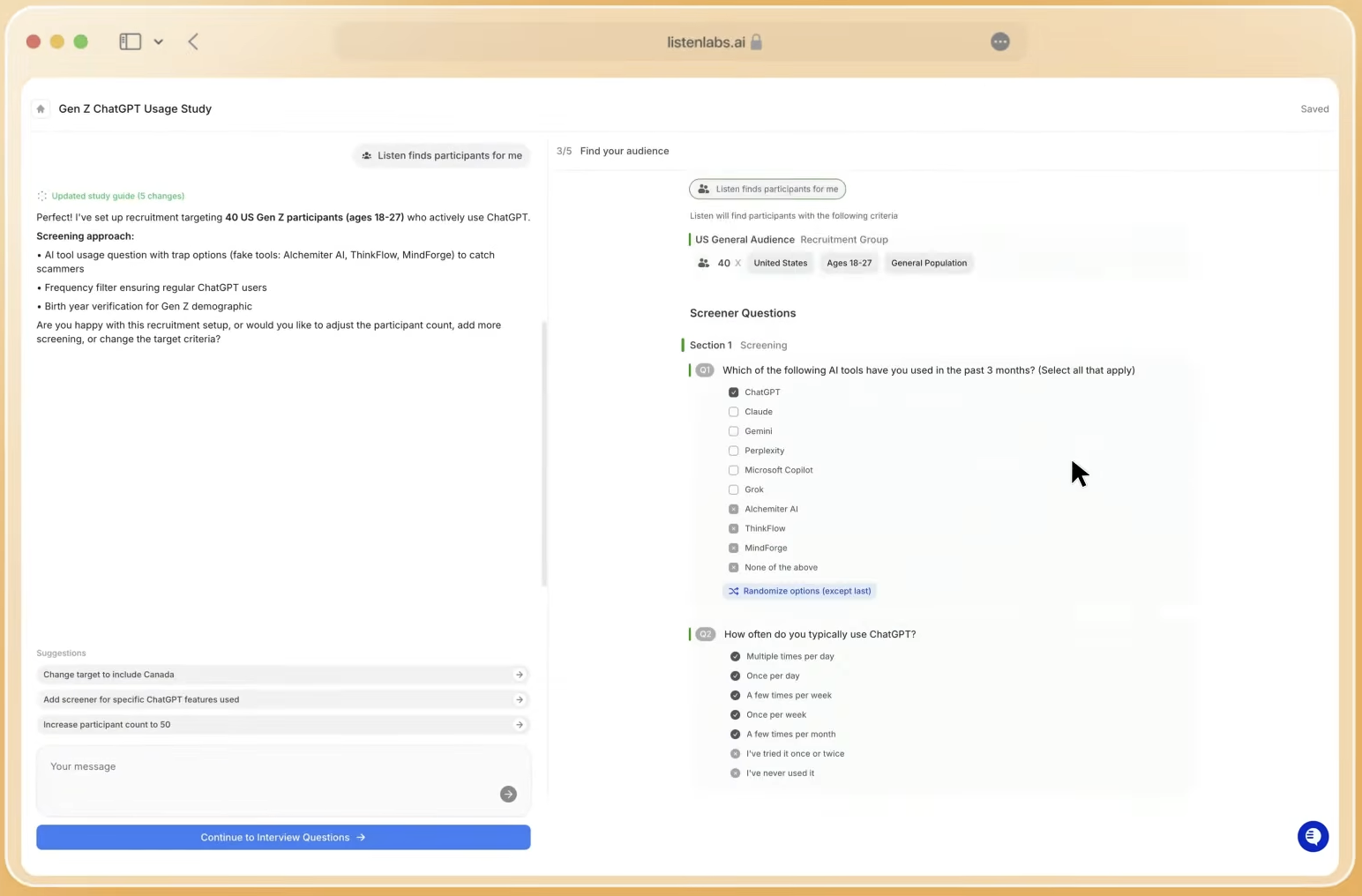
For hard-to-reach segments such as enterprise decision-makers, healthcare workers, or consumers below 1% incidence rate, a dedicated recruitment operations team handles sourcing through niche communities, micro-creators, and specialized networks. Teams can also bring their own participants from existing user bases at reduced cost. In 2026, best-in-class teams using AI qualitative research tools run significantly more qualitative research per researcher than their 2022 equivalents, and that scale only becomes realistic when recruitment is integrated into the platform rather than outsourced to a separate vendor.
Methodological Flexibility and Study Design Workflow
Visceral is designed for conversational AI interviews, which covers one study type. Enterprise research programs require concept testing, usability testing with screen sharing, diary studies, ethnographic approaches, mixed-method designs that combine qualitative depth with quantitative formats, and stimuli-based testing across images, video, audio, PDFs, and live URLs.
Listen Labs supports all of these from a single platform. The foundation is AI-assisted study co-design, which lets researchers describe goals in natural language and receive structured objectives, questions, and probing context in seconds. That draft then incorporates advanced logic, including branching, skip logic, piping, monadic and sequential randomization, quotas, and version control, all built in as part of the workflow.
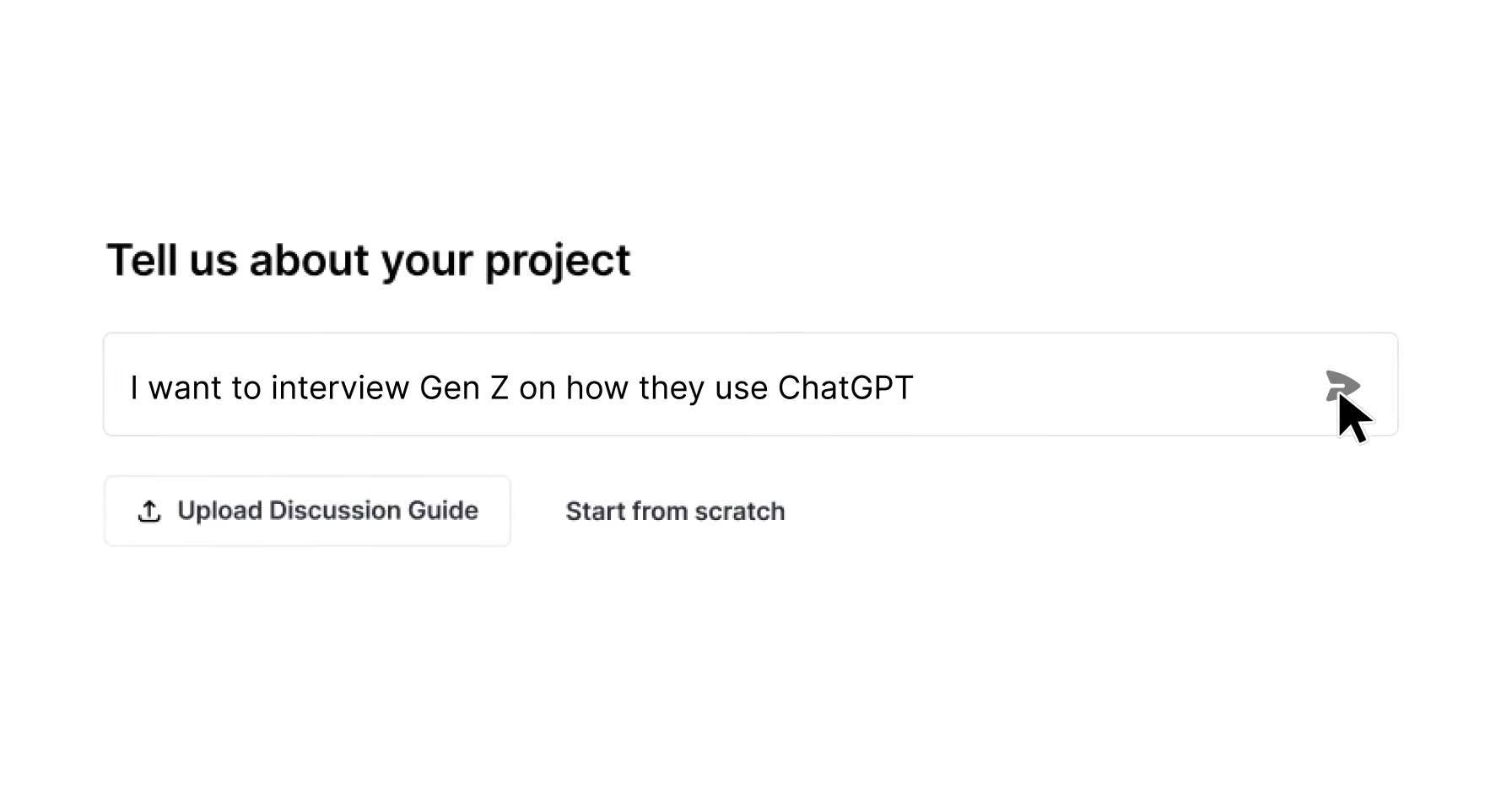
Before launch, Auto-QA flags issues in the study guide and catches errors that would otherwise surface only after fielding begins. Teams can start from scratch, clone past studies, or adapt templates, depending on how much customization the research question requires. For non-researcher stakeholders such as product managers or brand managers, the platform handles study design automatically and removes the methodology expertise barrier entirely.
Analysis Effort and Transparent Reporting
Manual qualitative analysis remains the dominant cost driver in traditional research. Traditional qualitative analysis requires substantial analyst time for coding and synthesis. Visceral generates interview transcripts but does not automate the downstream analysis and reporting workflow, so that burden stays with the research team.
Listen Labs’ Research Agent handles the full analysis workflow from raw data to final output. Researchers can ask any question in natural language and receive answers, charts, statistical tests, and segmentations. Research Agent generates a slide deck in a company’s branded template and a downloadable report, alongside video highlight reels, memos, and custom segmentation breakdowns, all in under a minute.
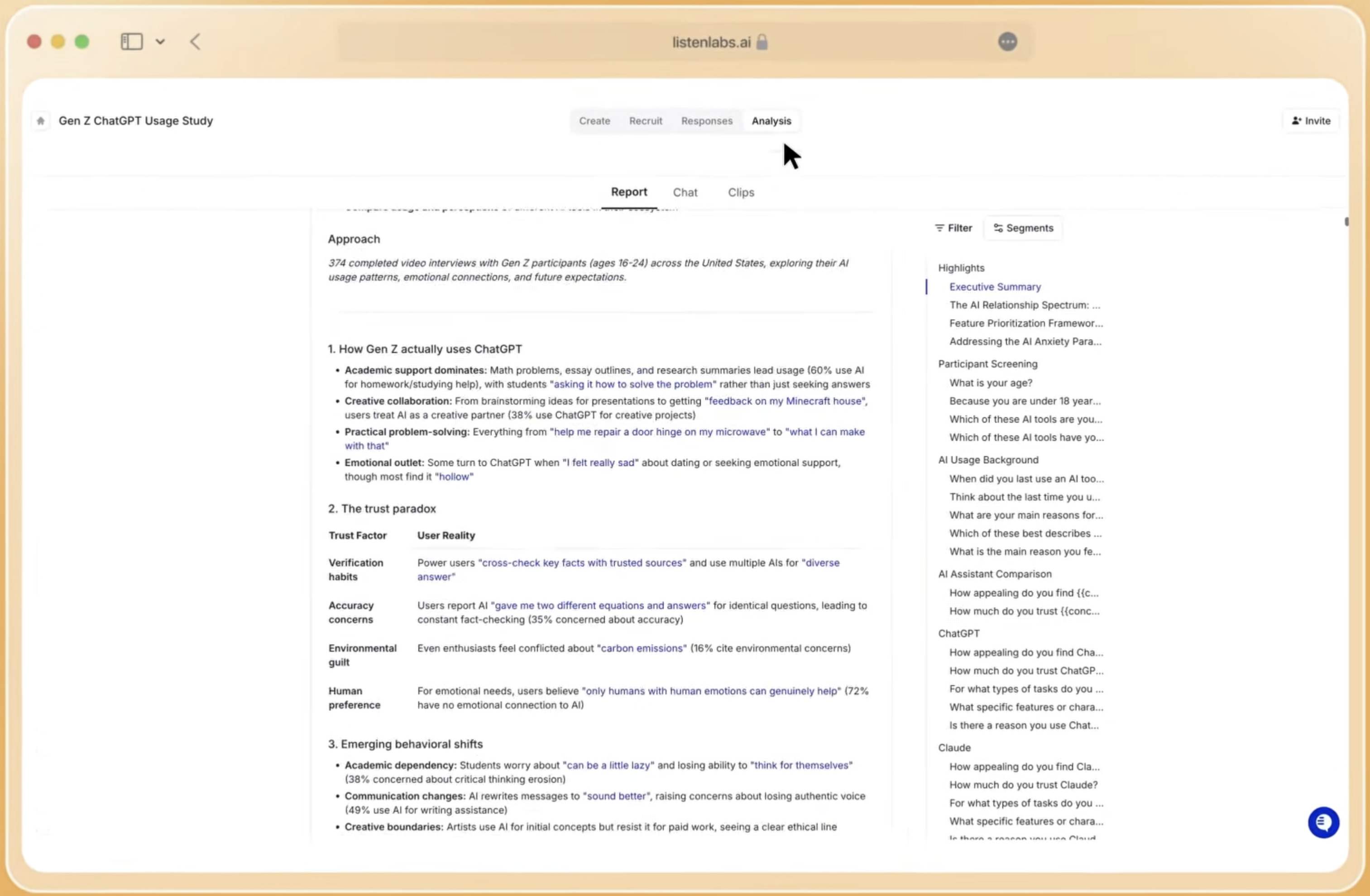
Every insight links directly to the underlying response data, so stakeholders can trace any finding back to the verbatim quote and timestamp that produced it. That traceability addresses the black-box concern that makes AI-generated analysis difficult to defend to skeptical stakeholders.
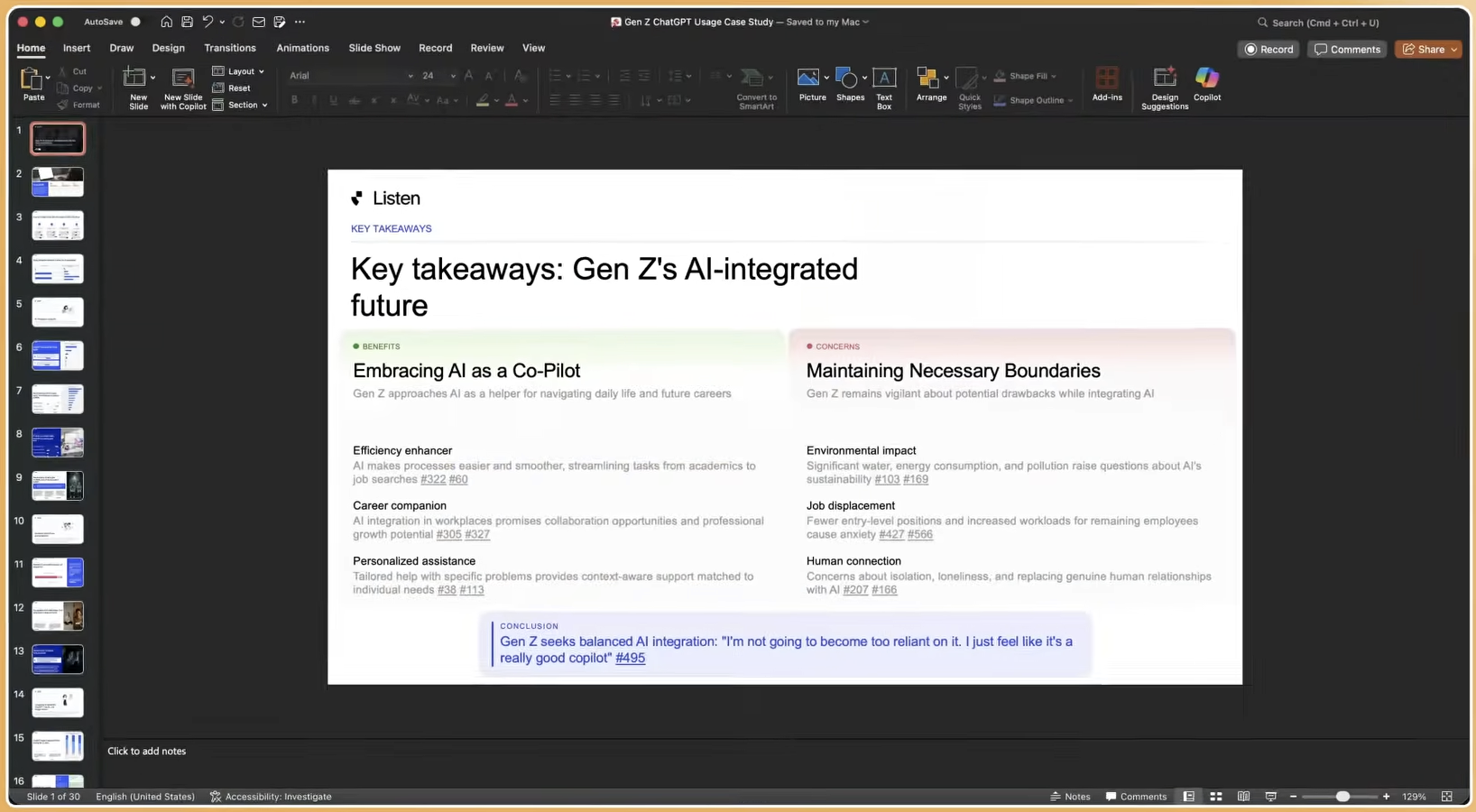
Watch Research Agent build a deliverable in real time from a live dataset.
Governance, Security, and Enterprise Scalability
SOC 2 Type II certification and GDPR compliance are baseline requirements for enterprise adoption of AI research tools in 2026, especially for platforms processing voice and video recordings. Enterprise buyers also require comprehensive audit logging, compliance reporting capabilities, data processing agreements, and alignment with frameworks including the EU AI Act.
Listen Labs holds SOC 2 Type II certification, GDPR compliance, and triple ISO certifications covering AI Management (ISO 42001), Information Security (ISO 27001), and Privacy (ISO 27701), with 256-bit encryption at rest and in transit, and a guarantee that participant responses are never used to train AI models. Enterprise SSO, role-based access controls, and data isolation are included. Visceral, as a point solution, does not publish equivalent enterprise compliance documentation, which creates procurement friction for Fortune 500 security reviews.
Enterprise research organizations running 100+ studies per quarter require governance, taxonomy, integration capabilities, and platform capacity that handles concurrent demands from 12+ stakeholders without failure. Listen Labs is built for that load, and Visceral is not.
Total Operational Burden of Your Research Stack
A fragmented research stack that uses separate tools for recruitment, scheduling, interview moderation, transcription, analysis, and reporting introduces compounding overhead. For organizations where AI use is distributed across large numbers of non-technical users, an integrated platform that performs seven tasks adequately generates more organizational benefit than specialized tools that each excel at one task but require configuration skill to operate together.
Listen Labs replaces that entire stack. Recruitment, moderation, emotional intelligence analysis, automated reporting, and cross-study knowledge management all operate within one platform. Unified platforms reduce tool fragmentation and coordination overhead by eliminating handoffs between separate systems, enabling research teams to move from fieldwork to stakeholder-ready insights in days rather than weeks. For enterprise teams already managing vendor relationships, security reviews, and budget approvals across multiple tools, consolidation onto Listen Labs reduces both direct cost and operational complexity.
Scenario-Based Guidance for Enterprise Roles
Different enterprise personas encounter different failure modes with point-solution tools.
Consumer insights leaders at Fortune 500 companies face growing backlogs and cannot scale qualitative depth without proportional headcount increases. Visceral moderation-only capability does not address recruitment delays or analysis bottlenecks. Listen Labs compresses the full cycle and enables the same team to run significantly more studies per quarter. The 2026 AI Research Productivity Report found increases in studies per researcher per quarter at constant headcount using AI-augmented workflows.
UX research leads need feedback loops fast enough to inform sprint cycles. Visceral cannot run parallel sessions at scale or deliver usability testing with screen sharing. Listen Labs supports iOS mobile screen recording, task-based testing, and 50–100+ concurrent participants, which replaces the 5–10 user constraint that limits most UX research programs.
Non-researcher product and marketing teams often lack methodology expertise to configure a point-solution tool effectively. Listen Labs’ AI-assisted study co-design closes that gap and enables product managers and brand managers to run studies without a research background.
Agencies and consultancies operate on client timelines measured in days. Visceral dependency on external panel sourcing introduces turnaround uncertainty. Listen Labs integrated recruitment and 24-hour delivery model aligns with agency delivery expectations.
Risks and Limitations of Point-Solution Tools
Choosing a point-solution AI interview tool for enterprise qualitative research introduces several compounding risks that often stay hidden during evaluation.
- Shallow data: Transcript-only analysis misses emotional signals that are often the most actionable finding in concept testing, creative testing, and brand research.
- Slow turnaround: Without integrated recruitment and automated analysis, the moderation layer alone does not compress the research cycle, so teams still wait on panel vendors and manual synthesis.
- Hidden recruitment complexity: Hard-to-reach segments such as B2B decision-makers, healthcare professionals, and low-incidence consumers require dedicated sourcing infrastructure that point solutions do not provide.
- Fraud risk: Without real-time behavioral monitoring and participant frequency limits, commodity panel respondents degrade data quality in ways that are difficult to detect after the fact.
- Overestimating automation: AI qualitative tools in 2026 can handle a large portion of qualitative research execution tasks, but accuracy can drop on messy data such as sarcasm or domain-specific jargon, and point solutions without proprietary training data on tens of thousands of completed studies are more exposed to this accuracy floor.
- Knowledge fragmentation: Study-by-study outputs with no cross-study repository mean institutional knowledge is lost between projects, and teams repeatedly re-research the same questions.
Decision-Framework Checklist for Tool Selection
Use the following criteria to determine whether a point-solution tool or a full-stack platform matches your enterprise research requirements.
- Turnaround requirement: If insights must reach stakeholders within 24–48 hours, a point-solution tool that depends on external panel vendors and manual analysis cannot reliably meet that SLA. Choose Listen Labs.
- Emotional depth requirement: If your studies involve creative testing, concept comparison, or brand perception where emotional response is a primary outcome, transcript-only tools produce incomplete data. Choose Listen Labs.
- Global reach requirement: If studies span multiple countries, languages, or hard-to-reach segments, a tool without integrated panel infrastructure creates sourcing risk. Choose Listen Labs.
- Compliance requirement: If procurement requires SOC 2 Type II, ISO 27001, ISO 27701, ISO 42001, and GDPR documentation, verify that any tool under evaluation can produce those certifications before advancing to pilot. Listen Labs meets all of these.
- Scale requirement: If the goal is to run significantly more studies per quarter with the same team, a moderation-only tool does not address the recruitment and analysis bottlenecks that limit throughput. Choose Listen Labs.
- Vendor consolidation goal: If the organization is actively reducing tool sprawl and integration overhead, a point solution adds to the stack rather than replacing it. Choose Listen Labs.
- Knowledge management requirement: If cross-study institutional knowledge and trend tracking are priorities, a tool without a built-in repository requires a separate investment. Choose Listen Labs.
Walk through this checklist with our team and identify where Listen Labs closes the gaps your current stack leaves open.
Frequently Asked Questions
How does Listen Labs achieve under-24-hour turnaround when traditional research takes 4–6 weeks?
Listen Labs owns the entire research lifecycle within one platform. AI-assisted study design drafts objectives and questions in seconds. Listen Atlas recruits from 30M verified respondents simultaneously rather than sequentially. AI-moderated interviews run in parallel across hundreds of participants at once. The Research Agent processes all interview data and generates deliverables, including slide decks, memos, highlight reels, and charts, in under a minute. Because there are no handoffs between separate vendors for recruitment, transcription, analysis, or reporting, the compounding delays that define traditional research cycles disappear.
How does Listen Labs source participants for niche or hard-to-reach segments?
Listen Atlas combines a proprietary database of 30M verified respondents with an AI orchestration layer that bids across multiple consumer and B2B panel partners, including specialized networks like NewtonX. For audiences below 1% incidence rate such as enterprise decision-makers, healthcare workers, engineers, or highly specific consumer segments, a dedicated recruitment operations team sources participants through niche communities, micro-creators, and specialized networks. Organizations can also bring their own participants from existing user bases at reduced cost or connect their own panel provider.
What makes Listen Labs’ sample quality controls different from standard panel fraud prevention?
Quality Guard operates at two stages. Before a participant enters a study, it applies device fingerprinting, IP analysis, geolocation checks, and repeat-respondent detection. During and after the interview, it scores every response across five dimensions, informativeness, depth, engagement, follow-up quality, and repetitiveness, and removes responses below the quality threshold, replacing them at no additional cost. Participants are permanently banned for optimization patterns and capped at three studies per month, which removes professional survey-takers. Borderline cases go through human review before removal to reduce false positives, and this multi-layer system is built into every study by default with no configuration required.
How does Emotional Intelligence differ from standard sentiment analysis?
Standard sentiment analysis classifies text as positive, negative, or neutral. Emotional Intelligence uses multimodal analysis that combines tone, word choice, and facial micro-expressions to detect specific emotions such as anger, disgust, fear, happiness, sadness, and surprise that transcripts alone miss. Every label is traceable to the exact timestamp, verbatim quote, and AI reasoning that produced it, so teams can pinpoint the moment a participant felt confused by a product claim or disengaged from a creative concept and show stakeholders the evidence behind that classification.
Can Listen Labs replace multiple existing research vendors, and what does implementation look like?
Listen Labs is designed to replace separate tools and vendors for recruitment, interview moderation, transcription, analysis, and reporting. Enterprises with 100+ employees go through a demo and pilot process before full deployment. The platform supports enterprise SSO, role-based access controls, and data isolation, so it integrates into existing security infrastructure without custom engineering work. Mission Control serves as a cross-study repository from day one, so institutional knowledge begins compounding immediately rather than requiring a separate migration or setup phase. The in-house research team, with 50+ years of combined expertise, works with enterprise clients to configure study templates, methodology frameworks, and governance structures during onboarding.
Conclusion: Choosing Between Visceral and Listen Labs
Visceral is a conversational AI interview tool that handles one stage of the qualitative research workflow and depends on external vendors for everything else. For enterprise teams managing growing research backlogs, global participant sourcing requirements, compliance obligations, and the need to multiply research output without adding headcount, a point-solution approach forces trade-offs that accumulate into a structural disadvantage.
Listen Labs is the full-stack platform that removes those trade-offs. With qual-at-scale, the old trade-off between depth and scale is no longer a barrier. Study design, global recruitment from 30M verified respondents across 45+ countries, AI-moderated interviews with multimodal emotional intelligence, automated analysis, and stakeholder-ready deliverables all arrive in under 24 hours, within one platform, and under SOC 2 Type II, GDPR, ISO 27001, ISO 27701, and ISO 42001 requirements. Microsoft, Google, P&G, Anthropic, Skims, and Nestlé have validated that quality holds at enterprise scale.
See how Listen Labs replaces your fragmented research stack and delivers the depth, speed, and scale your team needs to stop managing a backlog and start driving decisions.