
TikTok Shop gets described two ways. Brands hear that it turns scrolling into impulse buying, and retailers hear that it's coming for Amazon's customers. Both stories lean on sales figures and creator case studies, and neither says much about what the person holding the phone was thinking when they tapped buy.
To find out, Listen Labs interviewed 99 online shoppers in June 2026, all of whom had bought on TikTok Shop in the past six months. The goal was to learn what TikTok Shop changes about how they shop: what sets off a purchase, which signals they trust, and where the money ends up. Ninety-eight of them had also bought on Amazon in the same period, so nearly every answer came from someone who uses both.
Their answers complicate both stories. Creators are how most products get noticed, but 94% of shoppers rated customer reviews as very important to the decision, against 17% for creator recommendations. And while 86% check Amazon or another retailer before buying something they found on TikTok, only 12% described moving meaningful spending away from those retailers.
TL;DR: For the shoppers in this study, TikTok Shop decides what they want and when they want it. Reviews decide whether they trust it, and price and delivery often decide where they buy it.
Key takeaways
83% of shoppers said TikTok either created the purchase or picked the exact product and timing. Only 29% described a purchase that was fully spontaneous.
94% rated customer reviews very important. Price and discounts came next at 78%, and creator recommendations last at 17%.
57% rejected a product or seller when the content looked AI-generated or fake.
86% compare TikTok finds elsewhere before buying, and 60% reported no meaningful change to their Amazon or other online spending.
58% said TikTok Shop makes it easier to buy things they don't need. Most of that group (41 of 57) still felt they got good value with little regret.
Most of these shoppers' TikTok Shop purchases started with a need they already had
"Impulse buying" is the usual label for TikTok Shop, and it fit about a third of the purchases shoppers described. 29% said both the item and the timing were spontaneous. A bigger group, 54%, already had a loose need: a category they were interested in, a saved item, or a plan to buy something like it eventually. TikTok picked the exact product and gave them a reason to buy now. Another 17% arrived with their mind made up.
One shopper put the middle group's experience this way:
"it was spontaneous. It was something I needed but wasn't actively looking for."
When asked what triggered the purchase, 85% pointed to a personal need or occasion and 77% to a low price or promotion. Few shoppers named a single trigger. A video showed the product in use, it matched a problem they had, a discount made it feel like a good deal, and checkout sat one tap away.
For brands, that means TikTok Shop sales come less from creating desire out of nothing and more from showing up in the feed when someone's half-formed need is ready to become a purchase. Once the product is in front of them, though, something else does the convincing.

Shoppers rated customer reviews 77 points above creator recommendations
When asked how much five signals matter in deciding whether to buy on TikTok Shop, here is the share who rated each one "very important":
Signal | Rated very important |
|---|---|
Customer reviews and ratings | 94% |
Price and discounts | 78% |
Number of items already sold | 43% |
Live shopping demonstrations | 27% |
Creator or influencer recommendation | 17% |
Creators still count. 70% rated their recommendations at least somewhat important, and creators are often how an unfamiliar brand gets noticed in the first place. But shoppers discount what creators say because they know creators are paid to say it:
"I just assume if you're using TikTok Shop to promote an item, you're obviously looking for a buck."
When asked how they came to trust an unfamiliar brand they bought on TikTok Shop, 79% described relying on customer reviews or ratings. They trusted a product most when several kinds of evidence agreed: realistic product use, detailed reviews, photos from other shoppers, a high sales count and a seller that looked legitimate.
If your brand sells through creators, the review and shopper-photo layer deserves as much work as the creator brief. That layer is also where these shoppers were most alert to content that looked fake.

57% of shoppers rejected a product or seller after spotting suspected AI content
Shoppers were quick to point out content they thought was AI-generated: synthetic-looking people, products doing things that seemed implausible, scripted delivery, repetitive comments. 57% said suspected AI or fake-looking content made them reject the product or seller outright. Another 24% kept considering the product but checked it more carefully.
The doubt rarely stayed with one video. Once something looked fake, shoppers started questioning the reviews, the seller and the product as well. Brands testing AI-generated creative for social commerce are putting the review layer at risk along with the ad, and for these shoppers the review layer is what closes the sale.
Even when the content passes that test, the purchase doesn't always happen on TikTok.

These shoppers find products on TikTok Shop and often buy them on Amazon
Almost everyone in this study shops both platforms, and most use them for different jobs. TikTok is where they discover things: visual products, new brands, niche items, cheap experiments. Amazon is where they go when they know what they need, the item costs more, or they want fast delivery and easy returns.
86% usually or sometimes check Amazon or another retailer before buying something they found on TikTok. When choosing where to buy, 81% said price played a part, 45% delivery speed or reliability, and 36% trust or authenticity.
"I would say it's definitely a discovery tool because then I can watch videos and actual live reviews of what people are saying about these products, but then end up buying them on Amazon."
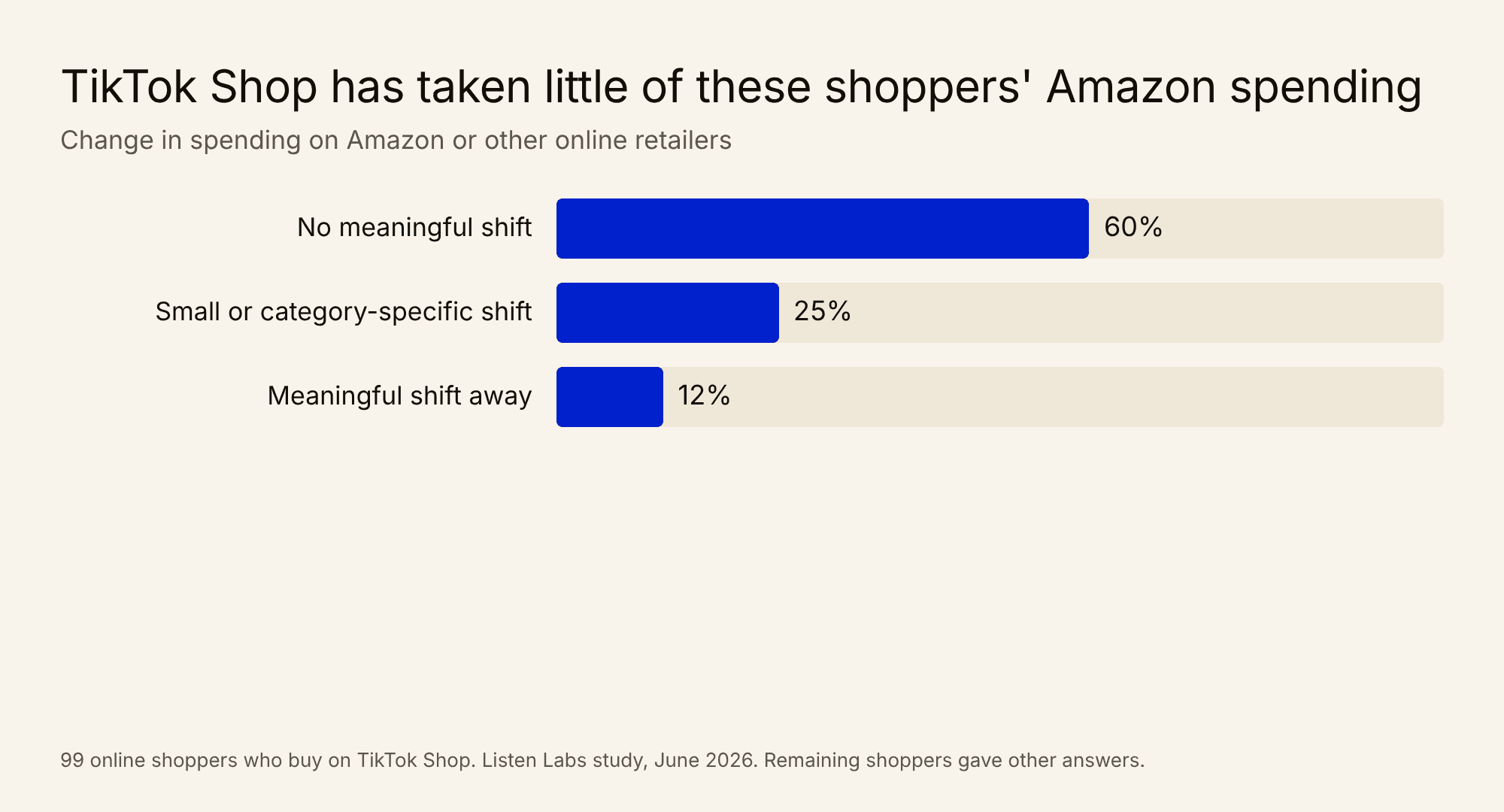
So far, TikTok Shop has taken only a little of these shoppers' spending from Amazon. 60% reported no meaningful change in their spending on other platforms, 25% a small or category-specific shift, and 12% a meaningful move away. The heaviest TikTok Shop users moved the most. Of the 21 people who made six or more TikTok Shop purchases in six months, 5 described a meaningful shift. Of the 40 who made one or two, only 1 did.
Fashion is where the shift showed up. 71% of shoppers typically buy clothing on TikTok Shop, 57% beauty and skincare, and 47% electronics and gadgets. Only 13 people named a category they had moved to TikTok Shop, and fashion, footwear and accessories led that group with 8.
For brands, a TikTok video can earn a sale that shows up in Amazon numbers. Attribution that only counts TikTok Shop checkouts will undercount what the feed is doing.
Shoppers in the study say TikTok Shop makes overbuying easier, and most don't regret it
58% said TikTok Shop makes it easier to buy things they don't need. Yet across all 99 shoppers, 75% felt they got good value with little regret, and only 4% described clear overspending or regret. Even among the 57 who admitted it makes overbuying easier, 41 still felt good about what they spent.
"I guess there has been where I didn't really need it, but it was a good value anyways."
Shoppers named the mechanics that wear down their resistance: discounts and low prices (43%), countdowns and limited-time offers (41%), saved payment and one-click checkout (31%), and repeated ads or retargeting (23%). Some added items just to reach a free-shipping threshold. Live shopping combined several of these at once, with host energy, timed gifts and "next 10 minutes" offers.
Many shoppers set their own limits: budgets, leaving items in the cart, checking reviews off the platform, or only browsing the Shop when they had money set aside. When asked what they'd change about TikTok Shop, only 3% wanted spending controls or extra checkout friction. More asked for stronger trust and authenticity (29%), a simpler search and shopping experience (24%), or fewer Shop ads in the entertainment feed (17%).
A satisfied shopper can still be buying more than they meant to. If you sell on TikTok Shop, track returns, repeat purchase and product fit alongside conversion, so you know whether the demand lasts.


Where Listen fits
This study ran on Listen as AI-moderated video interviews with 99 shoppers. Structured questions produced the numbers above: how much each signal matters, how often people compare prices elsewhere, how far spending has moved. Follow-up questions in the same interview explained them, such as why a creator gets attention but not trust, or why a shopper who admits overbuying still calls it good value. Because both came from one conversation, every number has a reason attached.
Social commerce behavior changes faster than an annual survey can track, so shopper insights teams need that pairing on a much shorter cycle.
What to do with this
Check whether your reviews can carry the sale. 94% of these shoppers rated reviews very important, against 17% for creators. Ask: on your top TikTok Shop listings, do reviews and shopper photos show the product in real use? If most reviews are short or the photos are missing, your creator spend is driving people to a page that can't close.
Test AI creative before you scale it. 57% rejected a product or seller when content looked fake. Ask: when real shoppers see your synthetic creative, do they say it looks fake? If they do, or if they start questioning the reviews, pull it before it reaches the feed.
Measure TikTok's effect beyond TikTok Shop. 86% compared elsewhere before buying. Ask: do Amazon and direct sales rise in the days after your TikTok activity? If your reporting can't answer that, it's undercounting TikTok.
If you're the retailer, compete on certainty. 81% weighed price when choosing where to buy, 45% delivery and 36% trust. Ask: when a shopper compares your listing with TikTok Shop, are delivery dates and return terms clear? If they have to hunt for them, you're giving the sale away.
Talk to your heaviest TikTok Shop buyers first. 5 of the 21 heaviest users had moved meaningful spending, against 1 of 40 light users. Ask: are your most frequent social shoppers buying less from you elsewhere? If yes, find out which categories are moving and why.

Methodology
Listen Labs interviewed 99 US adults aged 18 to 45 who use TikTok, shop online at least monthly and had bought from TikTok Shop in the past six months. 98 had also bought from Amazon in that period. 40 had made one or two TikTok Shop purchases, 38 had made three to five, and 21 had made six or more. The study was fielded in June 2026 as AI-moderated video interviews on Listen.
Each interview combined structured questions (ratings of purchase signals, purchase frequency, categories bought) with open-ended questions about recent purchases, trust and spending. Open-ended answers were coded into themes after collection. Themes can overlap, so some breakdowns add up to more than 100%. Comparisons between heavy and light users rely on small groups and should be read as directional. Quotes are short verbatim excerpts from participants who gave marketing consent.
