Written by: Anish Rao, Head of Growth, Listen Labs
Retail teams face a constant trade-off between speed and depth. Traditional research delivers rich insight, but it often arrives weeks after decisions are due. Fast surveys move quickly, yet they rarely explain why shoppers behave the way they do. That trade-off is no longer necessary. By combining first-party behavioral data with AI-moderated interviews, retail teams can get actionable shopper insight in under 24 hours, fast enough to guide this week’s assortment, pricing, and campaign decisions.
Key Takeaways
- Retail teams no longer need to choose between depth and speed, because combining first-party behavioral data with AI-moderated interviews delivers actionable shopper insights in under 24 hours.
- Behavioral segmentation at recruitment improves data quality by filtering participants on verified purchase behavior rather than static demographics.
- AI-moderated interviews remove scheduling, moderation, and transcription bottlenecks while probing five to seven levels deep to surface the motivations behind purchase decisions.
- Emotional signal analysis across tone, word choice, and micro-expressions closes the say-do gap by capturing what shoppers feel, not just what they say.
- Listen Labs compresses the entire research lifecycle into a single day; see how your team can turn insights into tests and measure impact faster than ever.
Step 1: Use Your Own Transaction and Behavioral Data First
The fastest path to shopper insight starts with data you already own. POS records, loyalty program transactions, web analytics, and app behavior together reveal purchase frequency, basket composition, category switching, and channel preference. Customer data platforms aggregate transaction history, browsing behavior, and engagement signals into a single profile, which allows AI models to surface patterns before a single interview occurs.
In practice, you do not need a fully integrated CDP to begin. The practical starting point is a 90-day export of SKU-level POS data segmented by loyalty tier. For a mid-size apparel retailer, this might reveal that a high-frequency segment buys full-price items online but returns them in-store at a rate 2.4 times higher than average, a pattern that transaction data flags but cannot explain. That unexplained pattern becomes the hypothesis that drives Step 2. The key trade-off at this stage is completeness versus speed, because waiting for a fully cleansed CDP export adds days, while a directional pull from a single source can be ready in hours.
Step 2: Turn Behavioral Patterns into Clear Research Objectives
Behavioral data surfaces the what, and research objectives define the why you need to answer. To be useful, an objective must be specific enough to guide both interview questions and analysis priorities, which means naming the decision it supports, the audience it covers, and the timeframe it must inform. Vague briefs such as “understand the shopper journey” produce findings that satisfy no stakeholder, because they do not answer a concrete question. Specific briefs such as “identify the top three friction points causing high-frequency online buyers to return in-store within 14 days” produce findings that drive action.

Mixed-method designs work best when the quantitative hypothesis is stated before fieldwork begins. In the apparel example, the hypothesis might be: “Shoppers return in-store because fit confidence is lower for online purchases, not because of product quality dissatisfaction.” That hypothesis determines which interview questions to ask, which behavioral segments to recruit, and which emotional signals to monitor. Effective qual-quant integration requires analytical frameworks that connect data types at the finding level, not co-presentation of separate reports.
Step 3: Recruit Retail Shoppers Based on Real Behavior
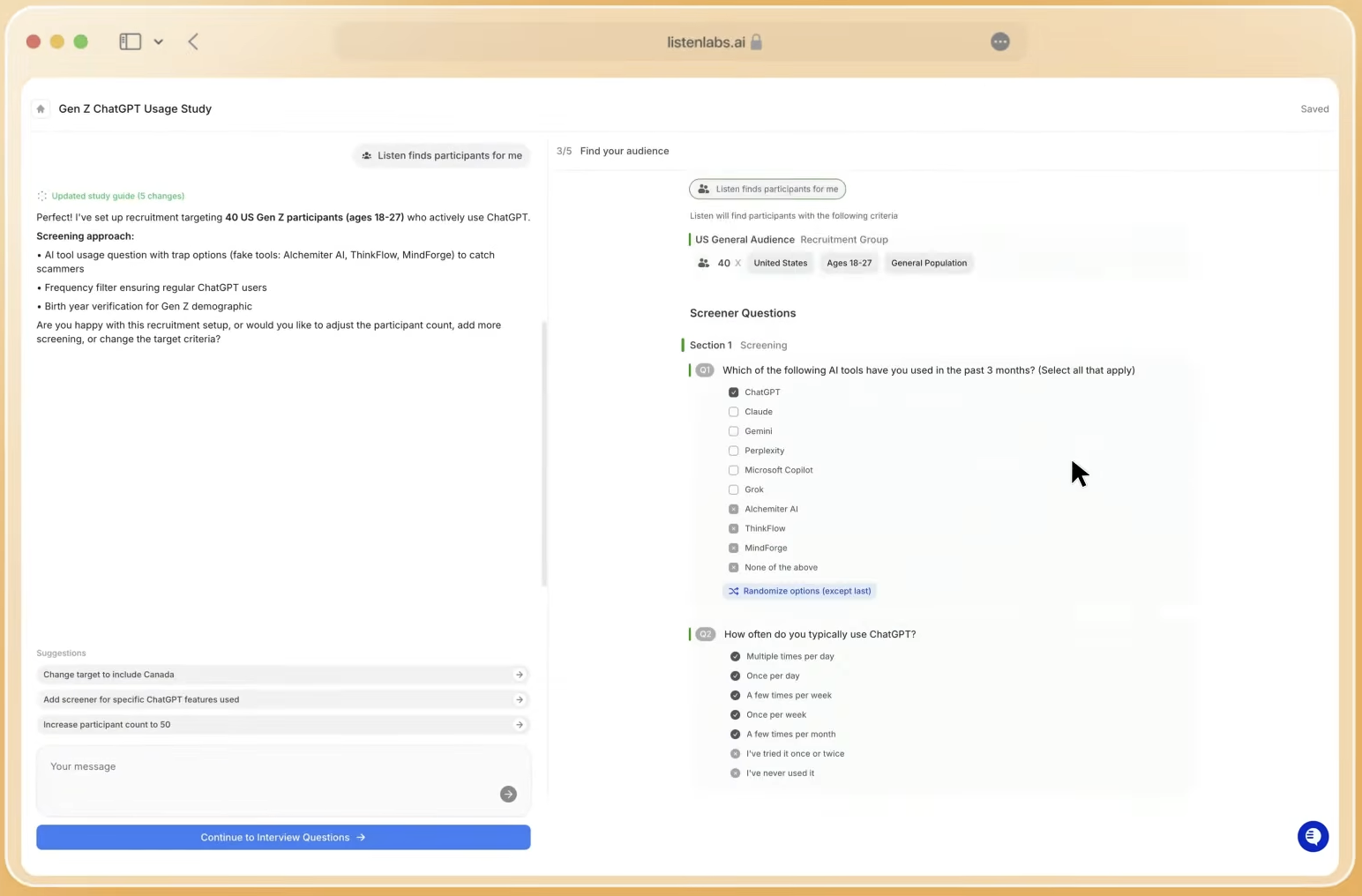
Participant quality is the single largest source of wasted research spend. Traditional audience panels rely on self-reported preferences that often do not match real-world purchase behavior, and commodity panels introduce professional survey-takers who optimize for incentives rather than honest responses.
Behavioral segmentation at recruitment solves this problem. Instead of screening by age and income, filter by verified purchase behavior such as category buyers within the last 30 days, loyalty members in a specific RFM tier, or shoppers who have browsed a category online but converted in-store. Behavioral data such as purchase frequency and basket size predicts future revenue more reliably than demographic snapshots alone, and the same logic applies to research recruitment. The representativeness-versus-speed trade-off remains real, because tighter behavioral screeners reduce incidence rates and can extend field time, so define the minimum qualifying criteria before launch rather than tightening them mid-study.
Step 4: Run Adaptive AI-Moderated Shopper Interviews
Once participants are recruited, AI-moderated interviews replace the scheduling, moderation, and transcription bottlenecks that make traditional qualitative research slow. AI can schedule and conduct the interview, analyze the transcripts for themes, and generate quantitative insights from those interviews, all within the same session. Unlike scripted surveys, adaptive AI moderators probe five to seven levels deep into motivation chains, completing 200 or more shopper interviews within 24 hours at a fraction of traditional agency cost.
The key decision at this stage is study structure. Free-flowing in-depth interviews surface unexpected themes but require more analysis time. Semi-structured guides with embedded quantitative questions such as Likert scales, MaxDiff, and NPS deliver mixed-method outputs in a single pass. Platforms that layer auto-recruiting, transcription, sentiment tagging, and insight summarization let teams move from question to findings in hours, not weeks.
See how Listen Labs conducts hundreds of adaptive shopper interviews simultaneously.
Step 5: Add Emotional Signals to What Shoppers Say
Transcripts record what shoppers say, but they do not record what shoppers feel or do. Kantar research found that while 85% of people want to make more sustainable choices, only 29% are actively changing their behaviour, a textbook say-do gap that verbal responses alone cannot close.
Closing that gap requires three additional signal layers: tone of voice, word choice, and subconscious micro-expressions. Emotional Intelligence analyzes all three to surface nuanced emotions that transcripts alone miss, with every emotion quantified per question and traceable to the exact timestamp, verbatim quote, and AI reasoning behind it. This multi-signal approach matters because verbal and emotional responses often diverge. In practice, a shopper describing an in-store inventory disappointment as “it happens” while registering sustained negative affect on facial analysis is providing two different data points, and the emotional signal is the more predictive one. Capturing both separates insight from assumption.
Step 6: Turn Raw Interviews into Structured Shopper Themes
Raw interview data, even from 200 sessions, does not equal insight. Synthesis creates insight. AI-powered analysis platforms can process thousands of open-ended responses in minutes, extracting dominant themes, identifying emotional tone, and flagging outlier perspectives for human review. The output of this step is not a transcript dump but a structured set of themes, each supported by quantified frequency, representative verbatim quotes, and emotional signal data.
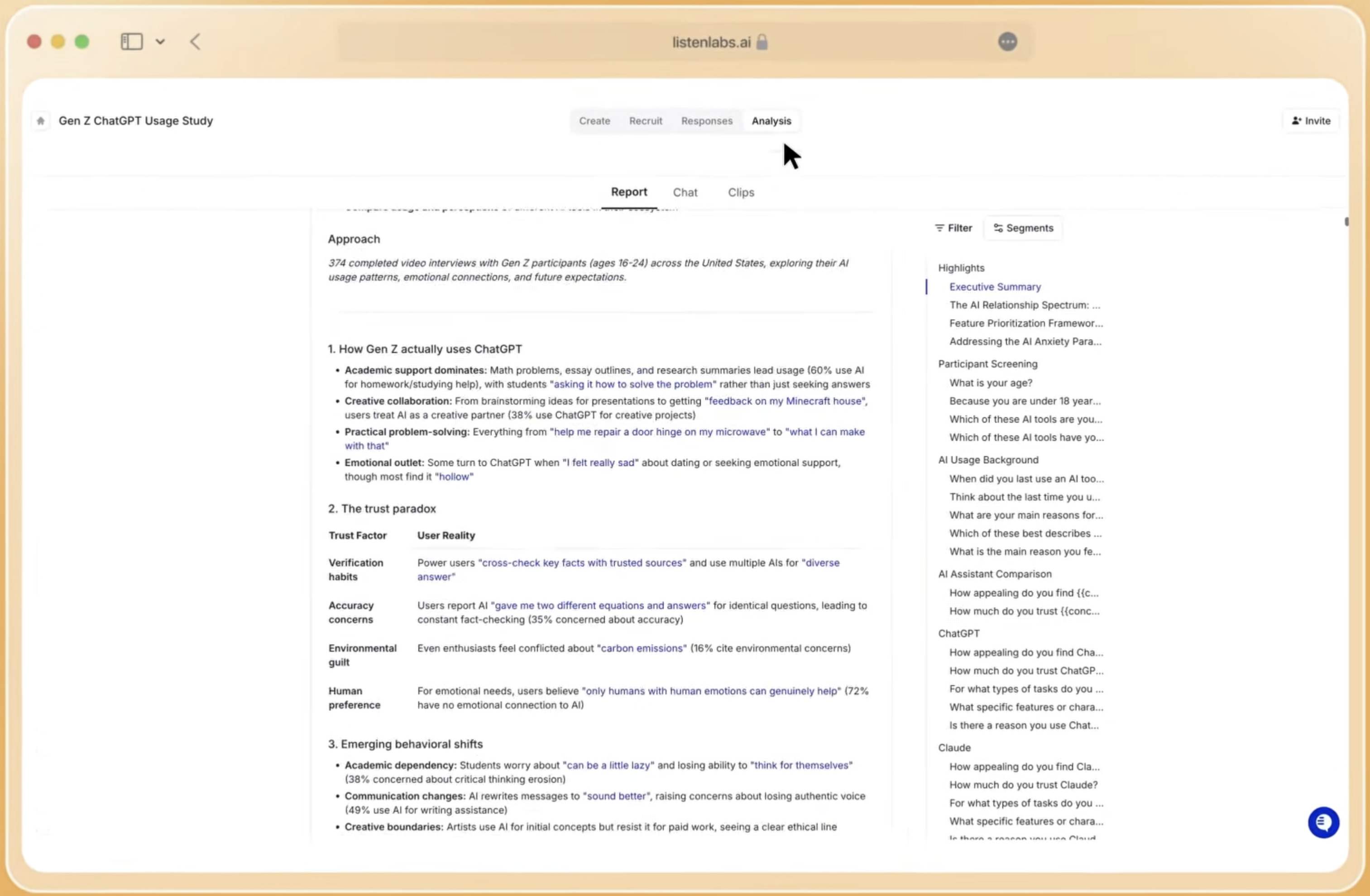
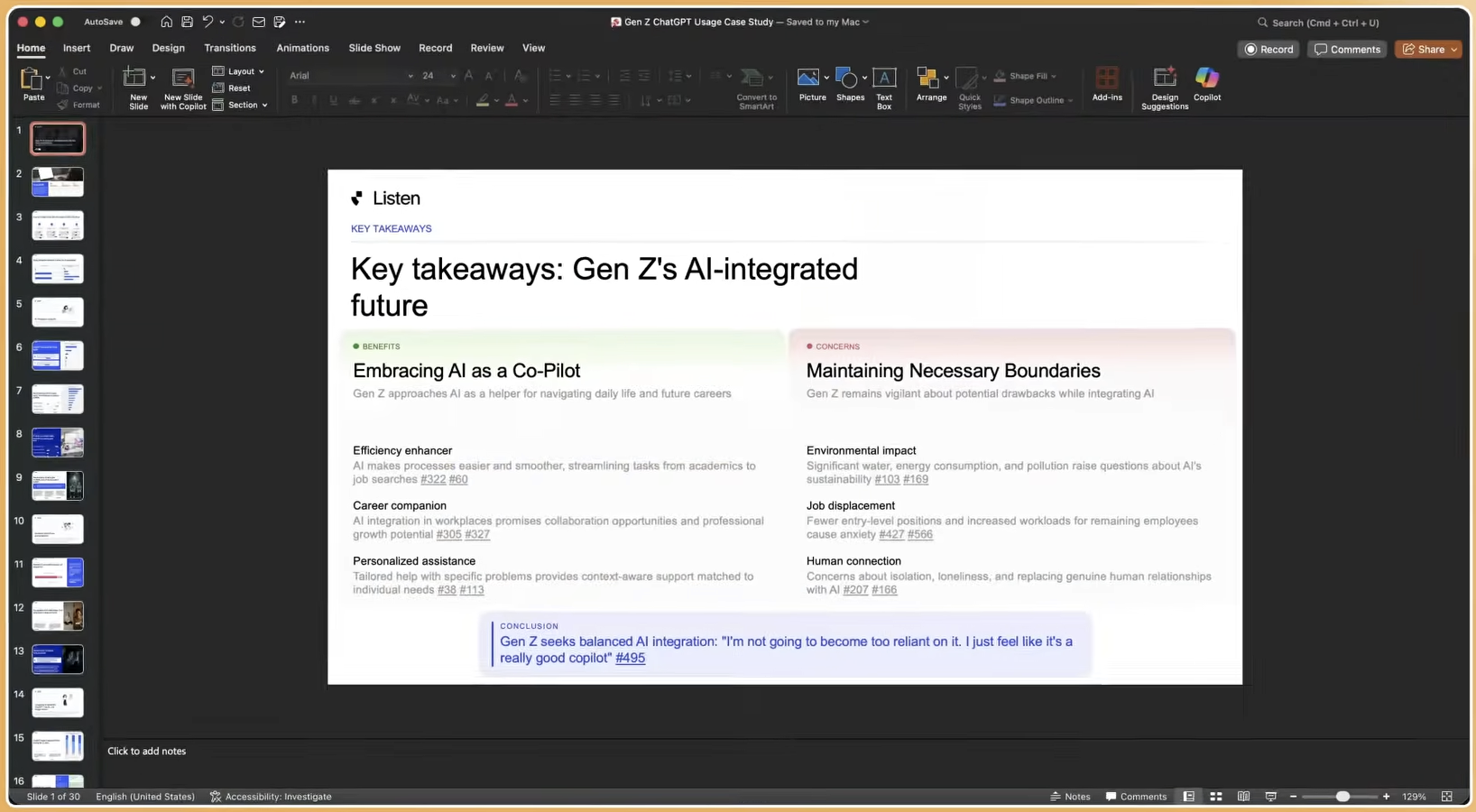
Research Agent handles the full analysis workflow from raw data to final output, with one researcher running a full buying intent analysis across three user segments in under a minute. Deliverables such as slide decks, memos, video highlight reels, and statistical charts are generated automatically, which reduces the analysis-to-stakeholder cycle from days to minutes. The insight-to-action workflow moves only as fast as the synthesis step, so automated analysis becomes a structural requirement for sub-24-hour turnaround rather than a convenience feature.
Step 7: Connect Insights to Tests and Business Results
Automated synthesis delivers findings quickly, but speed alone does not create business value. The final step determines whether those findings actually change what your team does. Insights that do not connect to a decision have no commercial value. The final step maps each synthesized theme to a specific test such as an assortment change, a pricing mechanic, a messaging variant, or a store layout adjustment. Each test requires a success indicator defined before launch, not after, so that impact can be measured cleanly.
For the apparel retailer in the running example, the insight that fit confidence drives returns translates directly into an A/B test of enhanced size guidance on product detail pages, with return rate as the primary metric and repeat purchase rate as the secondary. A trade marketing director used $4,000 in shopper research to shift $2.8 million in annual trade promotion spend from price reductions to BOGO mechanics, improving both lift and post-promotion brand equity, which shows a direct line from insight to measurable business outcome.
Request a demo to see consultant-quality outputs that connect directly to retail decisions.
Common Retail Research Pitfalls and Early Warning Signs
Four failure modes account for most retail research that produces findings but no action. Each has an early signal you can spot before the study finishes:
- Unclear objectives: Studies designed to “understand the shopper” rather than answer a specific decision question produce findings that satisfy no one. The early signal appears as a brief that lists topics rather than hypotheses.
- Poor recruitment fit: Participants who do not match the behavioral profile of the target segment produce misleading findings. The early signal appears as screener criteria defined by demographics alone rather than verified purchase behavior.
- Low response quality: Short, generic answers indicate participants are optimizing for incentives rather than honest reflection. AI-moderated platforms apply consistent probing depth across all sessions without fatigue, which reduces this risk structurally.
- Stakeholder misalignment: Findings that surprise internal teams without prior hypothesis-sharing often stall in review. Sharing the research brief and hypotheses with decision-makers before fieldwork begins converts stakeholders into co-owners of the output.
How to Measure Whether Your Insights Program Works
Four metrics determine whether a retail consumer insights program operates at the standard the business requires:
- Study cycle time: Measured from brief approval to stakeholder-ready deliverable. The benchmark for AI-moderated mixed-method studies is under 24 hours, while traditional qualitative research cycles take 4–6 weeks from study design to final report and can stretch to 6 months in enterprises.
- Participation rates: Async AI-moderated interviews achieve completion rates of 60–90%, compared to lower rates for traditional synchronous recruitment approaches.
- Consistency of findings: Themes that replicate across independent samples signal robust insight. Themes that shift with small sample changes signal recruitment or question design problems.
- Downstream SKU or campaign impact: The ultimate indicator is whether insights changed a decision and whether that decision produced a measurable outcome. Track this through quarterly retrospectives that link specific studies to specific business results.
Advanced Strategies Once Your 7-Step Process Is Stable
Teams that have standardized the 7-step process can extend it in three directions. Always-on conversational trackers run the same study wave after wave, combining quantitative KPI tracking with open-ended conversation so that every metric movement arrives with its explanation and surfaces emerging themes before they appear as a decline in tracked metrics. Global multi-market studies use the same behavioral screeners and discussion guide across geographies simultaneously, with automatic translation and transcription, which compresses what previously required sequential country-by-country fieldwork into a single parallel launch. Emotion-signal analysis applied longitudinally tracks how shopper sentiment toward a category, brand, or format shifts over time, providing the diagnostic layer that standard trackers cannot supply.
Frequently Asked Questions
How long does it actually take to complete a retail shopper insights study using AI-moderated interviews?
A well-scoped AI-moderated retail study with objectives defined in advance and a pre-qualified participant panel can complete in under 24 hours from launch to stakeholder-ready deliverable. This window includes recruitment, interview fieldwork, automated analysis, and report generation. The primary time variable is how quickly the research brief and screener criteria are finalized before launch, not the fieldwork or analysis itself.
What sample size is needed for statistically reliable retail consumer insights?
For quantitative confidence at a 95% level with a ±5% margin of error, 385 completes represent the standard minimum. For qualitative theme saturation, where new interviews stop producing new themes, 9 to 24 in-depth interviews typically suffice for a single homogeneous segment. AI-moderated platforms make it practical to run both simultaneously in the same study, which combines statistical confidence with qualitative depth in a single field period.
How does behavioral segmentation at recruitment differ from standard demographic screening?
Demographic screening filters participants by age, income, or geography, attributes that are static and self-reported. Behavioral segmentation filters by verified actions such as category purchases within a defined recency window, loyalty tier membership, channel preference, or RFM score. Behavioral criteria produce samples that more accurately reflect the shopper population relevant to the business decision, because two consumers of identical demographics can exhibit completely different purchase cadences and motivations. Where possible, link screener criteria directly to first-party data from your loyalty program or POS system to verify eligibility before recruitment.
What is the say-do gap and how do AI-moderated interviews help close it?
The say-do gap is the systematic difference between what consumers report they will do and what they actually do. It appears consistently across retail research: shoppers describe themselves as price-sensitive but buy premium, report satisfaction with a channel but switch at the next opportunity, or express interest in sustainable products but do not purchase them. AI-moderated interviews help close this gap in two ways. First, adaptive probing moves past surface-level responses to reveal the motivations and trade-offs that drive actual behavior. Second, emotional signal analysis across tone of voice, word choice, and facial micro-expressions captures the affective response that verbal answers underreport, which provides a second data point that can confirm or contradict stated intent.
How should retail insights teams handle data privacy when combining first-party behavioral data with qualitative interviews?
First-party behavioral data used for research recruitment must comply with the consent framework under which it was collected, typically the retailer’s loyalty program terms or website privacy policy. Participants recruited for qualitative interviews provide separate informed consent for that session. Research platforms operating at enterprise scale maintain SOC 2 Type II, GDPR, ISO 27001, and ISO 27701 certifications as baseline requirements. A critical data hygiene practice is ensuring that individual interview responses are never linked back to personally identifiable loyalty records without explicit consent, and that participant data is not used to train AI models outside the research context.