
Written by: Anish Rao, Head of Growth, Listen Labs
Key Takeaways
- Profound AI tracks brand visibility inside generative AI responses using Visibility Score, Share of Voice, and citation metrics based on real user prompts across major engines.
- The platform is legitimate and well-capitalized, with $96 million in Series C funding at a $1 billion valuation, serving 700+ enterprises with SOC 2 Type II and HIPAA compliance.
- Profound AI cannot explain why visibility metrics move because it lacks emotional drivers, sentiment shifts, and links between AI mentions and real consumer behavior or business outcomes.
- AI visibility tracking tools like Profound provide directional signals rather than diagnostic insight, with constraints such as weekly updates, model variability, and no access to private user conversations.
- Listen Labs fills these gaps with continuous conversational research that explains why brand perception shifts occur, so you can see how Listen Pulse surfaces the “why” behind visibility changes in a live demo.
Profound AI’s Legitimacy and Compliance Profile
Profound AI raised a $96 million Series C in February 2026 led by Lightspeed at approximately a $1 billion valuation, bringing total funding to roughly $155 million, and serves more than 700 enterprises. That funding history and customer base position it as a credible, well-capitalized platform in the AEO category.
Multiple AEO platforms, including Profound AI, Natoe AI, Aqurio, ACESO AI, and Genzeon, hold both SOC 2 Type II and HIPAA compliance certifications, which makes them viable options for healthcare, finance, and other regulated industries. For enterprise procurement teams, that compliance posture serves as a meaningful differentiator.
Legitimacy, however, is not the same as sufficiency. A platform can be entirely legitimate and still leave a consumer insights team without the explanatory layer they need to act, particularly when AI visibility scores can rise while organic traffic and revenue decline, showing that mention-tracking metrics often diverge from actual business outcomes.
Ready to go beyond visibility scores? See how Listen Labs surfaces the “why” behind brand perception shifts.
Profound AI Pricing for Self-Serve and Enterprise Plans
Teams evaluating whether Profound’s legitimacy and scale justify an investment naturally look next at pricing. Profound publishes two self-serve tiers. The Starter plan is priced at $99 per month, limited to ChatGPT-only tracking with 50 prompts and 1 seat. The Growth plan is priced at $399 per month, covering 100 prompts across 3 engines. Enterprise plans range from $2,000 to $5,000 or more per month, adding 10 or more engines including Claude and Grok, plus Query Fanout analysis. Final enterprise costs depend on prompt volume, seat count, and compliance requirements and require a direct sales conversation.
The broader AEO monitoring market offers a wide pricing spectrum across several dedicated platforms. Profound’s Starter tier sits near the middle of that range, while multi-engine coverage, which most enterprises treat as the minimum viable configuration for brand tracking, begins at the Growth tier.
Competing AEO Visibility Platforms and How They Compare
The AEO visibility category includes several platforms that overlap with Profound’s core function while differing in scope and price. HubSpot AEO starts at $50 per month and covers ChatGPT, Gemini, and Perplexity for 25 prompts, which creates a lighter-weight entry point for teams new to AI visibility tracking. Ahrefs Brand Radar offers single-platform access at $199 per month per index or all platforms at $699 per month (including 2,500 custom prompt checks), appealing to teams already inside the Ahrefs ecosystem. Semrush’s AI Visibility Toolkit is available as an add-on starting at $99 per month per domain for teams that want AI visibility layered onto an existing SEO workflow.
All of these platforms share the same structural limitation. They measure whether a brand appears in AI-generated answers and how often, but none can explain the consumer perception dynamics driving those appearances. As AI visibility trackers provide only a proxy for visibility through active probing of specific prompts rather than direct measurement of real user mentions or traffic, they remain insufficient on their own for enterprise teams that need to understand why brand perception is shifting.
How the Profound Index Measures AI Visibility
The Profound Index is powered by 1.5 billion or more real user conversations across 50 or more industries and all major LLMs, with prompt sets and metrics updated weekly rather than relying on synthetic prompts. That real-user prompt foundation distinguishes Profound from competitors that construct synthetic query libraries.
Alongside Visibility Score, the Profound Index calculates Share of Voice, Mention Position, Citation Share, Co-citation Share, and Co-mention Share, with breakdowns by topic cluster, LLM, and mention-position distribution. Each metric answers a variation of the same question: how present is this brand in AI-generated answers? None of them explain what is driving that presence or absence in the minds of actual consumers.
Limitations of AI Mention Tracking for Enterprise Brand Perception
AI mention tracking produces lagging indicators, so by the time a Visibility Score or Share of Voice metric moves, the underlying consumer perception shift has usually been building for months. No standardized methodology exists for measuring AI visibility across different LLMs, which compounds this delay by making it difficult for enterprise teams to produce consistent, auditable brand-perception reports or compare performance over time.
AI mention tracking tools cannot access private user conversations on platforms such as OpenAI, Anthropic, Google, and Microsoft, so they measure visibility potential rather than actual brand mention counts or volumes. That constraint turns the output into a directional signal instead of a diagnostic view of consumer behavior.
Some models change their final recommendation on an identical repeated prompt up to 40 percent of the time. That variability means a single-week dip in Visibility Score may reflect model noise rather than a genuine perception shift, and a genuine perception shift may not surface in the score until it has already influenced purchase behavior.
Even when the score reflects a real shift, a further limitation appears. Emotional drivers, emerging themes, and say-do gaps, which are the variables that actually explain why a brand’s AI presence is changing, remain invisible to mention-tracking tools. Traditional surveys may tell us what people do, but it takes a conversation to understand why. The same principle applies to AI visibility data: the score tells you what happened, while a conversation tells you why.
Six Ways to Compare Profound and Listen Labs
Profound’s technical capabilities can be viewed across six operational dimensions that matter to enterprise research teams: speed of data refresh, depth of insight, sample quality, geographic reach, analyst effort, and security posture. Each dimension highlights a tradeoff between what mention-tracking tools deliver and what true consumer understanding requires.
Speed
Profound updates its prompt sets and metrics on a weekly cadence, which works for tracking directional trends in AI mention frequency. However, this weekly rhythm creates a detection lag, so a brand perception shift that begins on a Monday may not appear in a dashboard until the following week or later if the shift has not yet propagated into AI training data. Listen Labs’ Listen Pulse addresses this lag by running continuously, analyzing tens of thousands of consumer responses around the clock and surfacing emerging themes before they register as a KPI movement.
Depth
Profound’s depth comes from the richness of its prompt dataset and the granularity of its citation and co-mention breakdowns. That depth is real within the visibility domain, yet it does not extend to the emotional register of consumer perception. What people say and how they feel do not always line up, and understanding both requires Emotional Intelligence. Listen Labs analyzes tone of voice, word choice, and subconscious micro expressions across every interview, producing emotion-level data that mention-tracking tools cannot match.
Sample Quality
Brand mention tools that rely on predefined prompts require manual entry that does not accurately mirror real-world customer behavior, so brand visibility tracking remains a form of educated guessing until LLM monitoring tools can surface actual user prompt data. Profound mitigates this with its real-user prompt corpus, yet the underlying respondents are AI engines, not consumers. Listen Labs recruits verified human participants from a network of 50 million respondents across 45 or more countries, with Quality Guard monitoring every session in real time for fraud and low-effort responses, and Microsoft, Anthropic, and P&G rely on that participant infrastructure to generate consumer insights that drive product and brand decisions.
Global Reach
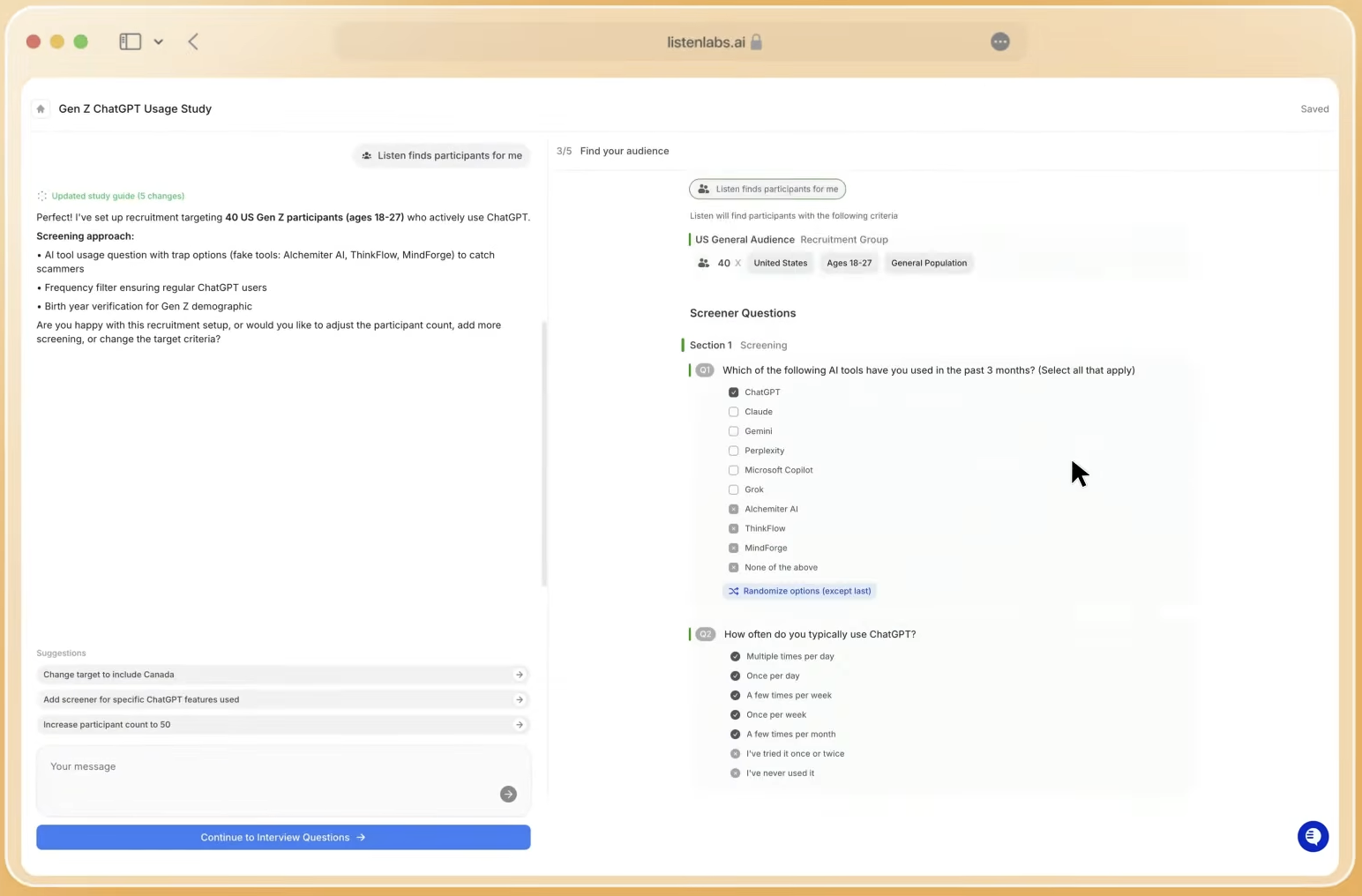
Non-English markets and industry-specific contexts are often ignored by AI visibility tools, which creates a major limitation for multinational enterprises seeking accurate brand perception data. Profound’s prompt dataset spans 50 or more industries, yet its geographic and linguistic coverage for non-English consumer segments is constrained by what AI engines surface in those markets. Listen Labs conducts interviews in 120 or more languages with automatic translation and transcription, covering 45 or more countries across the Americas, Europe, APAC, and MEA.
Analysis Effort
With AI-moderated interviews, talking to users at scale is no longer the hard part, and the challenge becomes understanding what they mean. Profound’s dashboard delivers pre-computed metrics that require relatively low analyst effort to read, yet reading a Visibility Score alone rarely produces a clear action. Listen Labs’ Research Agent generates consultant-quality slide decks, memos, and highlight reels from interview data in under a minute, turning raw consumer responses into decisions-ready deliverables without manual analysis overhead.
Security
Profound holds SOC 2 Type II and HIPAA compliance certifications. Listen Labs holds SOC 2 Type II, ISO 27001, ISO 27701, and ISO 42001 certifications, is GDPR compliant, uses 256-bit encryption, and never trains its AI models on customer data. Both platforms meet enterprise security requirements, and the real difference lies in what each platform does with the data it collects.
See how Listen Labs closes the gap between visibility metrics and consumer understanding. Close the gap between visibility metrics and consumer understanding and talk to the Listen Labs team today.
Decision-Framework Checklist for Profound and Listen Labs
Use the following criteria to match your research objective to the right tool category and decide when to combine them.
- Choose an AEO mention tracker like Profound if your primary goal is monitoring how often your brand appears in AI-generated answers, benchmarking Share of Voice against named competitors, tracking citation frequency across ChatGPT, Gemini, Perplexity, and Claude, or auditing which URLs AI engines cite for your category.
- Choose a continuous conversational research platform like Listen Labs if you need to understand why your brand’s AI visibility is changing, detect emerging consumer sentiment themes before they move your KPIs, surface emotional drivers and say-do gaps that mention data cannot capture, run always-on brand perception tracking with open-ended qualitative depth, or connect a metric movement to a real consumer explanation with a verbatim quote and video clip.
- Consider running both in parallel if your team already monitors AI visibility scores and has identified a movement it cannot explain, because Profound tells you the number moved and Listen Pulse tells you why.
The why is what differentiates customer research that is alright from customer research that is outstanding. AEO visibility tools provide a necessary starting point for enterprise brand teams operating in an AI search environment, yet they do not represent a sufficient endpoint.
Do not let a visibility score be the last word on your brand. See Listen Pulse in action and connect your metrics to real consumer stories.
Frequently Asked Questions
Does Profound AI replace traditional brand tracking?
Profound AI measures brand presence inside AI-generated answers, which creates a channel that did not exist in traditional brand tracking frameworks. It does not replace awareness, consideration, or preference tracking because it measures AI engine behavior, not consumer sentiment. Enterprise teams typically run Profound alongside an existing tracker, not instead of one. The gap it leaves mirrors the gap traditional trackers leave, since neither explains why perception is shifting. Listen Pulse addresses that gap by combining quantitative KPI tracking with open-ended conversational interviews in the same wave, so every metric movement arrives with its explanation.
How accurate are Profound’s Visibility Scores?
Profound’s use of real user prompt data rather than synthetic queries creates a meaningful accuracy advantage over competitors that construct artificial query libraries. That advantage has limits because AI visibility scores across all platforms remain probabilistic rather than deterministic. Models generate different outputs for identical prompts depending on timing, personalization signals, and ongoing model updates. Profound mitigates this by running prompts at scale and reporting weekly averages, yet fluctuations of 10 to 15 percent between measurement periods remain normal noise in AI visibility data. Scores work best as directional trend indicators over weeks and months, not as precise point-in-time measurements.
Can Profound AI tell me why my brand perception is changing?
Profound surfaces whether and how often your brand appears in AI answers and in what competitive context, but it does not conduct consumer interviews, analyze emotional responses, or identify the themes driving perception shifts. A brand can gain Share of Voice in AI search while simultaneously losing consumer preference, and Profound’s dashboard will show the former without detecting the latter. Surfacing the “why” requires direct consumer conversations at scale. Listen Labs’ Listen Pulse runs continuous AI-moderated interviews that chart emerging themes next to the KPIs you already report, connecting every metric movement to the consumer reasoning behind it.
What should I do when my Profound Visibility Score drops?
A Visibility Score drop signals that AI engines are recommending your brand less frequently for tracked prompts. The immediate diagnostic questions, such as whether the drop reflects a content gap, a competitor’s improved citation profile, a model update, or a genuine shift in consumer preference, cannot be answered by the score itself. The recommended response is to audit which topic clusters drove the decline inside Profound, then commission a targeted consumer research wave to understand whether the drop reflects a real perception change and what is driving it. Listen Labs can deploy that research wave within 24 hours and return verbatim consumer explanations alongside quantified themes.
Is Listen Labs a competitor to Profound AI?
Listen Labs and Profound AI operate in adjacent but distinct categories. Profound tracks brand visibility inside AI search engines as an AEO monitoring platform. Listen Labs functions as an end-to-end AI consumer research platform that conducts, analyzes, and summarizes thousands of in-depth customer interviews in hours. The two tools answer different questions, since Profound answers “how visible is my brand in AI search?” and Listen Labs answers “what do consumers actually think, feel, and do, and why?” Enterprise consumer insights teams increasingly use both, with Profound monitoring the AI search signal and Listen Labs explaining what is driving it.
Sources & Methodology
Pricing data for Profound AI’s Starter ($99/month) and Growth ($399/month) tiers was drawn from Dageno AI’s March 2026 pricing benchmark, Webb Boss Research’s May 2026 AEO monitoring tools review, and Loudmink AI’s July 2026 AEO platform pricing report. Enterprise pricing ranges were sourced from Loudmink AI and Contently’s April 2026 AEO tools roundup. Profound Index methodology was sourced directly from Profound’s own published documentation. Competitor pricing for HubSpot AEO, Ahrefs Brand Radar, and Semrush AI Toolkit was sourced from HubSpot, Webb Boss Research, and Contently respectively. AI visibility tracking limitations were sourced from Mentionable AI, Snoika, Brand24, and Position Digital. Listen Labs feature claims and customer proof points are sourced from Listen Labs’ published company materials. Funding and customer data were sourced from Loudmink AI’s July 2026 report.