Written by: Anish Rao, Head of Growth, Listen Labs
Key Takeaways
- Brand research cycle time covers the full path from study brief to published insight report. Traditional enterprise teams often spend 4–6 weeks because design, recruitment, fieldwork, and analysis run in sequence.
- Recruitment and fieldwork consume the most time. Pre-qualified panels and AI-moderated parallel interviews compress these stages from weeks to hours.
- Automation tools such as Research Agent, Emotional Intelligence, and Visual Insights cut analysis and synthesis from days to minutes while preserving traceability and quality.
- Always-on tools like Listen Pulse and Research Library support continuous brand tracking and instant reuse of past findings, which removes redundant studies and speeds up delivery.
- Listen Labs delivers a complete 24-hour operating model, so your team can see how to compress brand research from weeks to under a day.
1. Map Your Current 4–6 Week Baseline and Set a 24-Hour Goal
Cycle-time reduction starts with a clear map of every stage and its duration. A standard custom market research study typically moves through four phases: brief and design (1 week), preparation and recruitment (1 week), data collection and fieldwork (2–3 weeks), and analysis and reporting (2 weeks), for a total of 6–7 weeks. Each phase has a structural reason for its length.
Recruitment usually creates the largest bottleneck. Teams must screen many candidates to secure qualified participants, especially for niche audiences. Fieldwork is limited by human bandwidth: a researcher should cap qualitative interviews at three per day to avoid quality loss from context switching, so a 20-interview study can generate 15–20 hours of recordings before a single theme gets coded.
The time-to-insight KPI, defined as the days from study kickoff to published report, becomes the headline metric for research speed. Traditional teams often complete only a few studies per researcher per quarter. AI-native teams reach much higher throughput. A 24-hour target for time-to-insight forces every downstream process decision to support speed without sacrificing quality.
2. Build Always-On, Brand-Specific Panels and Reusable Study Templates
Pre-qualified, always-on panels remove recruitment delays. Listen Labs’ global network of 50M+ verified respondents spans 45+ countries and 120+ languages, with an AI orchestration layer called Quality Guard that matches participants on behavioral and intent signals, not just self-reported demographics.
Quality Guard monitors every interview in real time for fraud, low-effort responses, and repeat respondents. Participants are limited to three studies per month, which removes professional survey-takers. Traditional agency sourcing for multi-market brand studies often takes 3–6 weeks just to fill the sample, so recruitment becomes the dominant time driver. A pre-built panel with behavioral matching compresses that delay to hours.
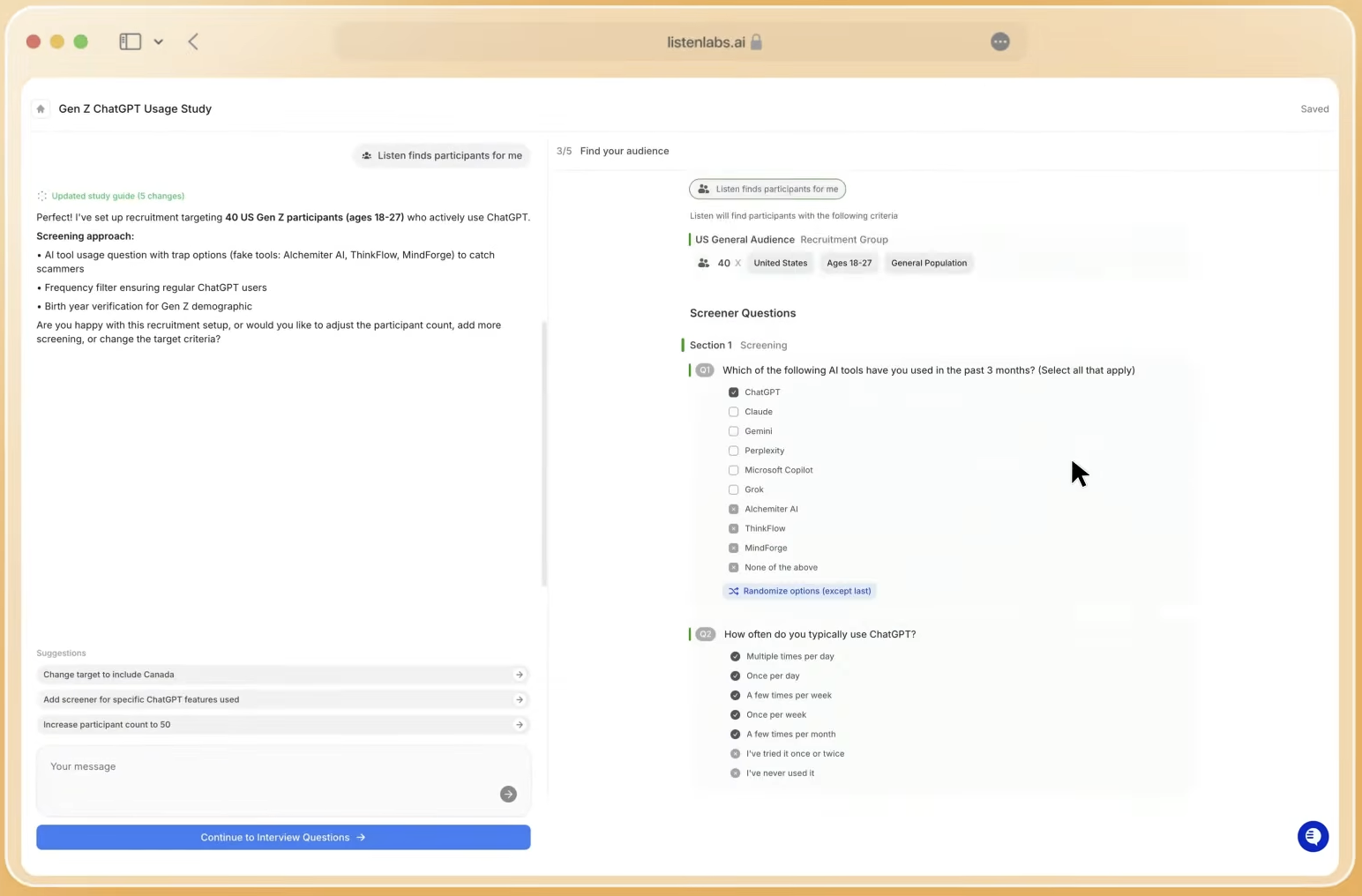
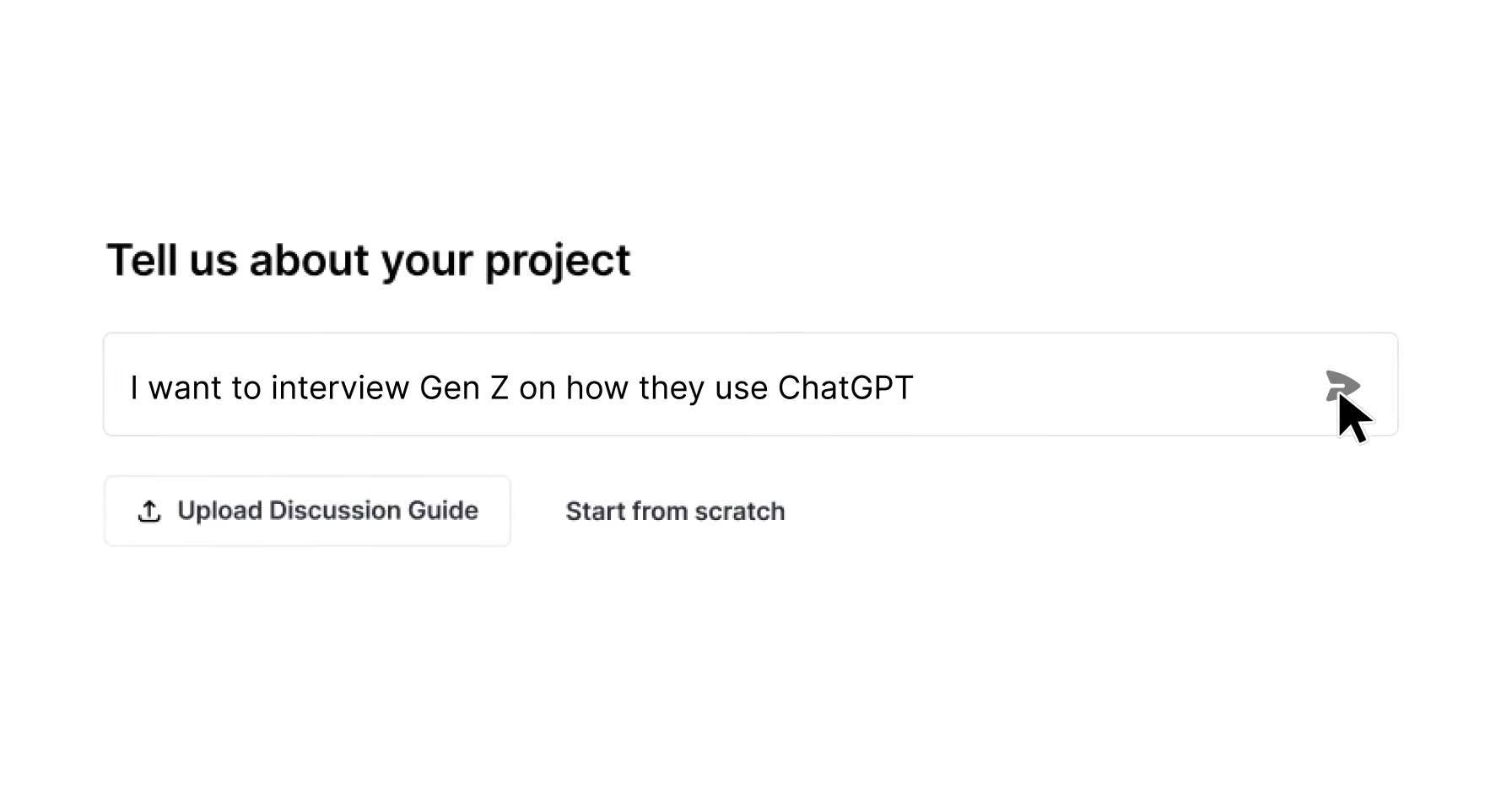
Reusable templates multiply these gains. Teams clone a past brand perception study, update stimuli, and launch in minutes instead of days. AI can generate a draft questionnaire from a short description in under 20 minutes and run automated bias scanning before launch.
3. Run Approvals and Fieldwork in Parallel with Always-On Tracking
Traditional brand research follows a strict sequence. Legal reviews the screener, stakeholders approve the discussion guide, fieldwork opens, and analysis starts only after fieldwork ends. Each handoff adds days. Running legal review, stakeholder sign-off, and panel pre-qualification at the same time removes these structural delays.
Always-on consumer intelligence models provide continuous behavioral and consumer signals so brands can track health, validate ideas, and spot shifts as they happen, instead of relying on periodic snapshots. Listen Pulse applies this model to brand tracking. It runs the same study with the same screeners wave after wave, analyzes open-ended answers, sorts them into themes, quantifies them, and charts each theme next to existing KPIs, all without restarting approvals for every wave.
This shift from periodic snapshots to continuous monitoring aligns with broader industry guidance. BCG’s June 2026 analysis recommends that brands continuously monitor and refine consumer questions, needs, and decision drivers to stay competitive, which supports a move from discrete studies to continuous learning loops. Listen Pulse’s always-on architecture delivers that operating model in practice.
4. Automate Analysis and Capture Emotional Signals in Every Interview
Automation cuts the time researchers spend on mechanical analysis and frees them for strategic interpretation. Listen Labs’ Research Agent handles the full analysis workflow, from raw interview data to stakeholder-ready deliverables, automatically.
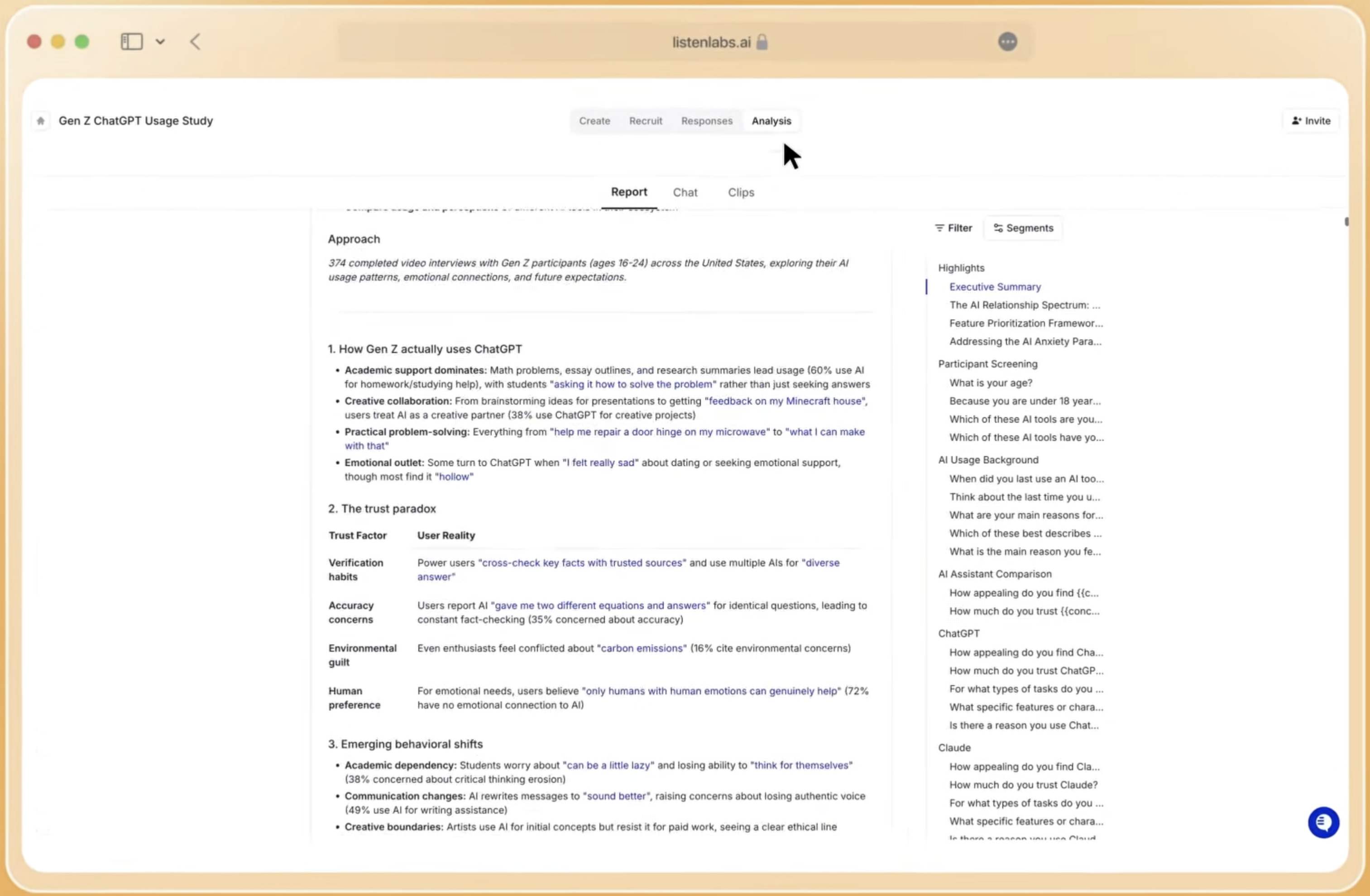
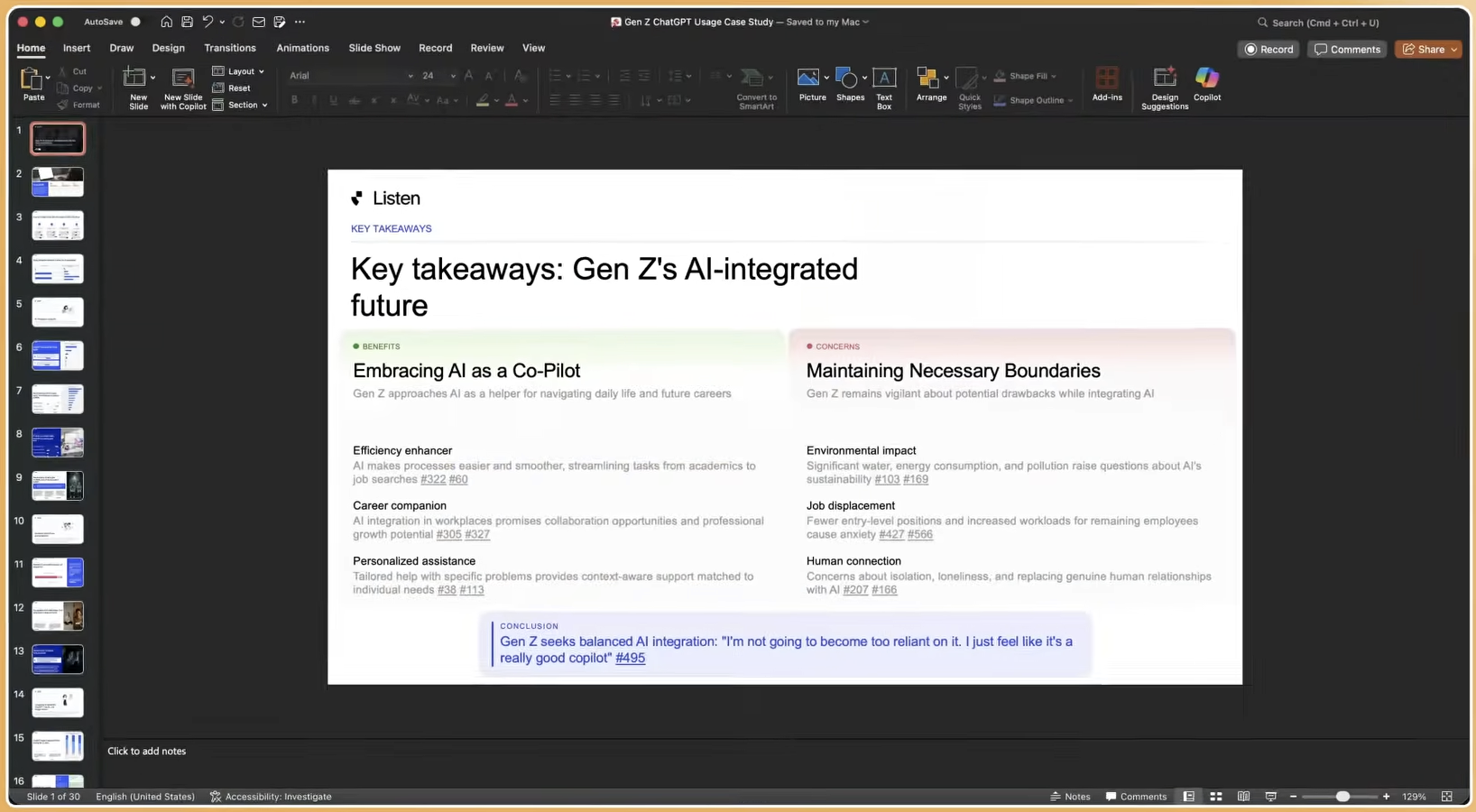
One researcher ran a full buying intent analysis across three user segments in under a minute using Research Agent. The tool generates key findings, themes, and personas, produces slide decks, memos, and highlight reels, and runs statistical significance tests. Researchers use natural-language queries, and every insight traces back to the underlying response.
Text transcripts alone miss many brand signals, especially emotional nuance. Listen Labs’ Emotional Intelligence analyzes tone of voice, word choice, and subconscious micro expressions to surface emotions that transcripts overlook. Built on Ekman’s universal emotions framework, it quantifies every emotion per question and concept, with each label tied to the exact timestamp, verbatim quote, and reasoning. Teams already use Emotional Intelligence for brand research, creative testing, concept comparison, and usability testing across 50+ languages.
Visual Insights extends this by observing on-screen behavior during interviews and closing the say–do gap. When a participant’s stated preference conflicts with their actual behavior, the AI moderator probes that contradiction in real time instead of following a fixed script. Brand teams gain behavioral evidence that supports confident decisions.
5. Turn Past Studies into a Searchable Research Library
A searchable knowledge engine reduces response time for new insight requests and cuts duplicate research. Institutional memory drives this change. When teams can find past answers quickly, they stop repeating the same studies.
Listen Labs’ Research Library searches every study an organization has run and returns a synthesized answer in natural language. Each answer links back to the original study, discussion guide, screener, and respondent. Cross-study querying turns episodic brand projects into a compounding intelligence system. Teams can confirm whether a topic has coverage before commissioning new fieldwork, track sentiment shifts across waves, and onboard new team members against the full corpus in seconds.
ZS reports that connecting primary research at the respondent level and continuously replenishing it yields 2x data reuse and 5–10% lower duplicative research spend. Research Library delivers that compounding value as a built-in capability of the Listen Labs platform.
6. Use a Milestone Scorecard to Track Time-to-Insight
A consistent milestone scorecard shows exactly where hours disappear and where they are saved. The comparison below highlights how the largest time savings come from recruitment and fieldwork parallelization, followed by automation in analysis and reporting.
- Study design and questionnaire: Traditional timeline 5–7 days, Listen Labs timeline under 20 minutes (AI-assisted), about 100 hours saved.
- Participant recruitment: Traditional timeline 3–6 weeks, Listen Labs timeline hours (large panel with AI orchestration), about 200–400 hours saved.
- Fieldwork and interview collection: Traditional timeline 1–2 weeks at 3–4 interviews per day, Listen Labs timeline hours with parallel AI-moderated sessions, about 80–160 hours saved.
- Analysis, coding, and synthesis: Traditional timeline 1–2 weeks with manual coding, Listen Labs timeline under 1 minute with Research Agent, about 80–160 hours saved.
- Deliverable production: Traditional timeline 3–5 days with manual report writing, Listen Labs timeline under 1 minute with auto-generated decks, memos, and reels, about 24–40 hours saved.
Research velocity, defined as studies completed per researcher per quarter, validates the scorecard in practice. AI-native teams complete far more studies per researcher than traditional teams. Tracking research velocity alongside time-to-insight gives insights leaders concrete evidence to support platform investments with finance and procurement.
7. Example: A Full Brand Study Completed in One Business Day
The schedule below walks through a complete brand perception study, from brief to boardroom-ready deliverable, completed within a single business day on Listen Labs. Each step builds on the previous one to show how the 24-hour model works in practice.
- 8:00 AM, brief intake: The insights lead submits research objectives in natural language. AI co-designs the discussion guide, screener, and quota structure, and auto-QA flags issues before launch. Estimated time: 20 minutes.
- 8:30 AM, panel activation: Quality Guard matches and invites participants from the existing panel. Legal and stakeholder review run in parallel with recruitment, so approvals do not delay fieldwork. Estimated time: 1–2 hours to fill quota.
- 10:00 AM, fieldwork opens: The AI Interviewer conducts parallel video interviews with adaptive follow-up probing. Emotional Intelligence captures tone, micro expressions, and word choice in real time. Visual Insights logs on-screen behavior for any task-based components. Estimated time: 2–4 hours for 50–200 interviews.
- 2:00 PM, analysis runs automatically: Research Agent processes all responses, identifies themes, runs significance tests across segments, and flags emotionally significant moments. Estimated time: under 5 minutes.
- 2:30 PM, deliverables generated: The platform produces a slide deck, memo, video highlight reel, and statistical charts in under one minute. Research Library indexes all findings for cross-study querying.
- 3:00 PM, stakeholder readout: The insights lead presents findings with full traceability. Every claim links to the original respondent, timestamp, and verbatim quote.
- 4:00 PM, library update and next wave queued: Listen Pulse schedules the next tracking wave with core questions preserved for trend integrity. New campaign or competitor questions are added without breaking historical comparability.
Qual-at-scale works best when research requires large sample sizes or broad geographic reach, with AI tools engaging hundreds or thousands of participants remotely and asynchronously, which matches the operating model in this schedule.
Frequently Asked Questions
What is brand research cycle time and why does it matter?
Brand research cycle time is the total elapsed time from study brief to published insight report, covering every stage of a brand perception, messaging, or tracking study. It matters because insights that arrive after the business has moved on carry no decision value. When cycle time runs 4–6 weeks, a team can complete only a few studies per quarter, which creates a backlog and limits the organization’s ability to respond to market shifts. Compressing cycle time to under 24 hours turns research into a continuous operating capability.
How does Listen Labs maintain quality at 24-hour speed?
Quality rests on three reinforcing layers. First, Quality Guard uses behavioral matching, not just self-reported demographics, to recruit verified participants and monitors video, voice, content, and device signals in real time to detect fraud and low-effort responses. Participants are capped at three studies per month to avoid professional survey-takers. Second, the AI Interviewer uses intelligent probing that produces responses about three times longer than average, matching the depth of a trained human moderator at large scale. Third, every insight from Research Agent is traceable to the original respondent, timestamp, and verbatim quote, which gives insights leaders the auditability required for enterprise reporting.
Can Listen Labs reach niche or hard-to-find brand audiences?
Yes. The panel covers 45+ countries and 120+ languages, and a dedicated recruitment operations team partners with niche communities, micro-creators, and specialized networks to source audiences below 1 percent incidence rate, including enterprise decision-makers, healthcare workers, engineers, and highly specialized consumer segments. For organizations that prefer to study their own customers, Listen Labs also supports self-recruitment at reduced cost with the same Quality Guard protections.
How does Listen Pulse differ from a traditional brand tracker?
Traditional brand trackers report that a KPI moved but rarely explain why. By the time a metric declines, the underlying shift has often been building for months, and explaining it requires a separate qualitative study. Listen Pulse keeps core questions constant wave over wave to protect the trend line, adds open-ended conversation to every wave, and charts emerging themes directly next to existing KPIs, so the metric change and the reason behind it arrive together. Pulse deploys alongside an existing tracker or as the primary tracking system and integrates with Qualtrics and Decipher, so teams keep the KPIs they already report while adding the narrative behind them.
How does Research Library prevent teams from re-researching the same questions?
Research Library searches every study an organization has run and returns a synthesized answer in natural language, with each answer linked to the original study, discussion guide, screener, and respondent. Before commissioning new fieldwork, any team member can query the library to see whether the question already has coverage. As more studies run on Listen Labs, the library becomes more powerful, turning individual projects into an interconnected intelligence system that compounds in value and reduces duplicative spend.
Conclusion
The 4–6 week brand research cycle reflects structural choices, not a fixed law. Each stage, from study design through recruitment, fieldwork, analysis, and delivery, has a specific cause for its length and a specific remedy. The seven-step framework above tackles every bottleneck in sequence: baselining time-to-insight, building always-on panels with Quality Guard, parallelizing approvals with Listen Pulse, automating synthesis with Research Agent and Emotional Intelligence, preventing replication with Research Library, tracking progress with a milestone scorecard, and running the full cycle within a single business day.
Enterprises such as Microsoft, Procter & Gamble, Sweetgreen, and Skims already operate this way, replacing months-long research cycles with hours-long ones while multiplying study output at the same headcount. The enabling platform is end-to-end, enterprise-grade, and built by researchers for researchers.