Written by: Anish Rao, Head of Growth, Listen Labs
Key Takeaways
- Traditional CPG research cycles of 6–8 weeks and $50k–$150k per study no longer match 2–4 week decision timelines.
- A five-step workflow using AI-moderated interviews, emotional-signal capture, and structured synthesis templates compresses the insights process to under 24 hours.
- Starting with a single, clearly defined business question using the DECIDE template prevents wasted fieldwork and keeps every interview tied to a pending decision.
- AI-moderated interviews at scale, combined with real-time emotional intelligence analysis, deliver qualitative depth and the statistical reliability of large sample sizes.
- Listen Labs enables CPG teams to run this 24-hour workflow end-to-end; test it on your next concept study.
Why a 24-Hour Workflow Matters Now
The core problem is a structural mismatch between research timelines and business timelines. Traditional CPG qualitative studies take 6–12 weeks to complete, while most in-flight business decisions require consumer input within 2–4 weeks. The gap reflects methodology, not just resourcing.
A few definitions anchor the workflow. Qualitative data captures the why behind behavior through open-ended interviews and observation. Quantitative data measures the what and how many through structured surveys and sales figures. Incidence rate is the share of a population that qualifies for a study; a 1% incidence rate means recruiting is expensive and slow. A screener filters respondents before fieldwork begins. Moderation is the act of guiding an interview with probing follow-ups. An insight statement translates a raw observation into a business-actionable claim.
The market has shifted toward broad adoption of AI for qualitative research. The depth-versus-scale trade-off that once forced CPG teams to choose between a 15-person IDI study and a 1,000-person survey no longer applies with qual-at-scale platforms.
Step 1: Define One Decision and One Job to Be Done
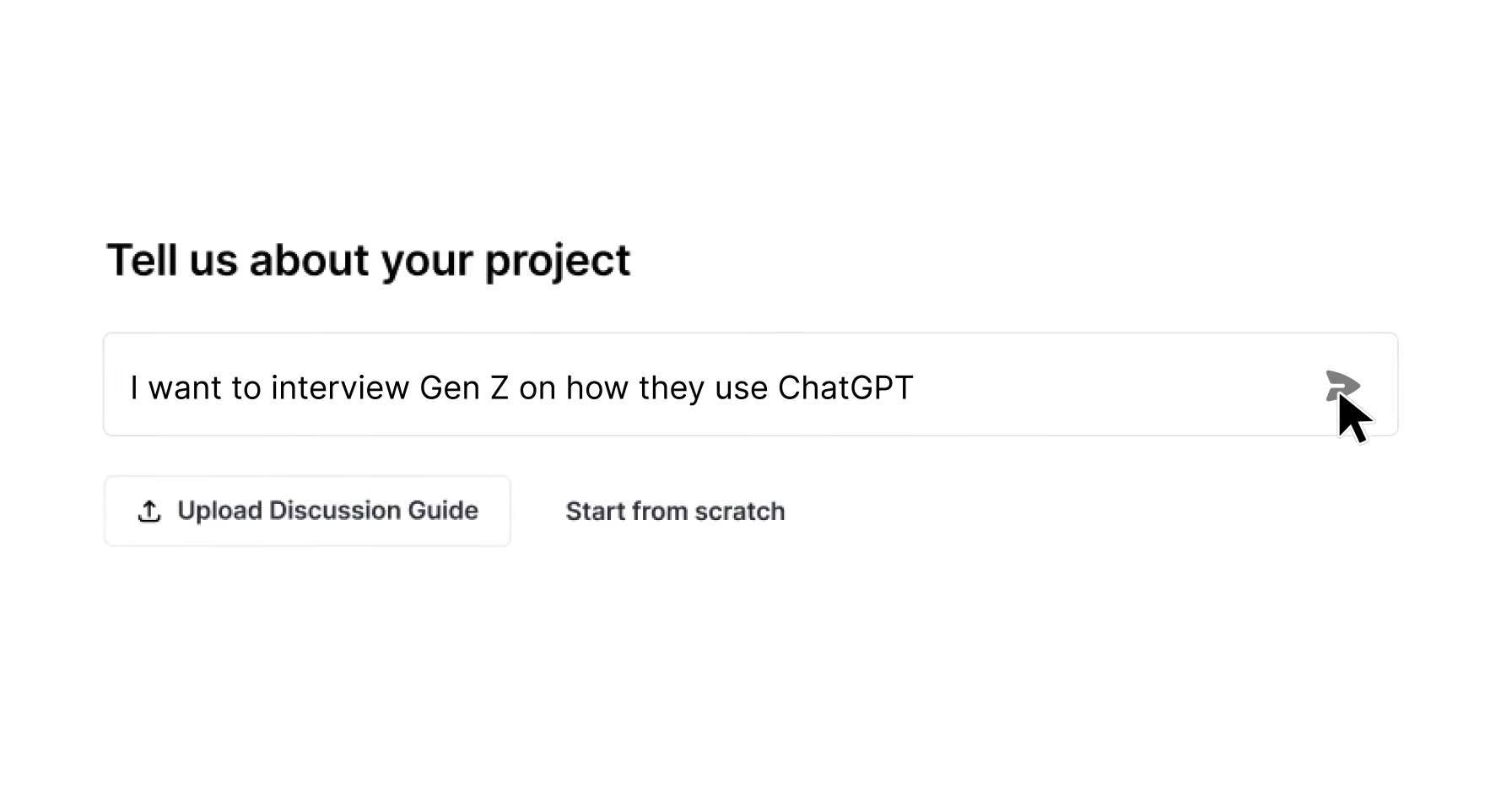
Every failed research project shares one root cause: the team launched fieldwork before agreeing on the decision the research must inform. The DECIDE template structures that alignment by specifying six inputs before a screener is written:
- Decision — what choice depends on this research?
- Evidence — what data would change the decision?
- Consumer segment — who must be in the room?
- Insight format — what output does the decision-maker need?
- Deadline — when does the decision get made?
- Easy to reverse? — how much confidence is required?
Once you have defined the decision and segment, the next step is to frame the research question itself. Pair DECIDE with a Jobs-to-be-Done framing. Ask what job the consumer is hiring the snack to do and what tension prevents the current product from doing it, instead of asking what consumers think of a flavor. That framing produces interview guides that surface motivation, not just preference.
Required stakeholders at this stage are the brand manager, the insights lead, and whoever owns the downstream decision, typically a VP of Marketing or Head of Innovation. The entire Step 1 alignment meeting should take under two hours.
Step 2: Sequence and Rank Data Sources for Speed and Depth
Not all data sources serve the same purpose, and the right choice depends on the research question. First-party CRM and loyalty data is fast and unbiased but answers behavioral questions only, so it cannot explain why a shopper switched. Retailer POS data has the same limitation, because it confirms volume trends but lags by weeks and carries no motivational signal. Even social listening, which does capture consumer voice, reaches only a small share of consumers who regularly share brand opinions publicly, skewing toward extreme sentiment and missing the moderate middle where most purchase decisions occur.
Rank data sources by speed and depth to plan your workflow. First-party CRM and loyalty data sit at the fastest end and answer behavioral what questions. Retailer POS data is also fast and confirms volume and velocity patterns. Social listening sits in the middle on speed and adds language patterns from a biased but useful sample. AI-moderated interviews deliver a 24-hour turnaround and provide full motivational context with both words and emotional signals.
Use that ranking to guide sequencing. Use first-party and POS data to form hypotheses about behavior. Use social listening to identify language patterns and emerging themes. Use AI-moderated interviews to validate and deepen those hypotheses with motivational context that explains the observed patterns.
Step 3: Run AI-Moderated Interviews at Scale
Recruitment begins with a screener that enforces the sample frame defined in Step 1. For a new snack flavor study, that means verified category purchasers, not general population respondents. A significant portion of traditional panel traffic is fraudulent, so screener design alone is insufficient without real-time quality monitoring.
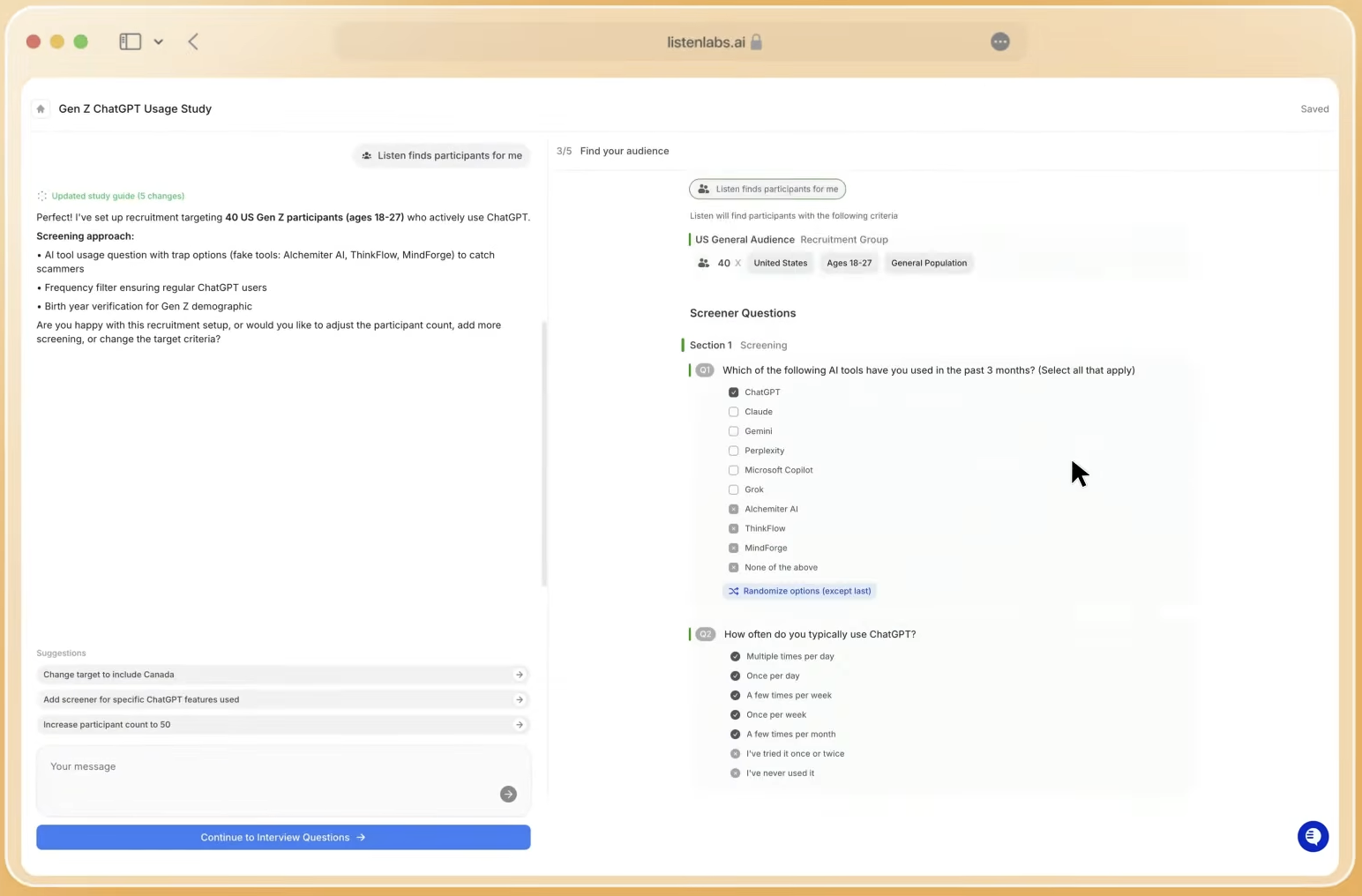
Listen Labs recruits from a network of 30M verified respondents across 45+ countries, with Quality Guard monitoring every session in real time for fraud, low-effort responses, and repeat participants. Participants are capped at three studies per month, which removes professional survey-takers. For studies below 1% incidence rate, such as keto-committed buyers or specific ethnic food occasion shoppers, a dedicated recruitment operations team sources participants through specialist networks.
Once you have recruited a clean sample, the next question is how many interviews you actually need. On sample size: effective research design in CPG typically requires 150–200 participants per concept to achieve statistical reliability for quantitative concept testing. AI moderation makes that scale achievable in hours. Platforms like Listen Labs add auto-recruiting, transcription, sentiment tagging, and insight summarization so teams move from questions to findings in hours, not weeks.
The AI moderator probes dynamically. It asks follow-up questions when a response is short or reveals an unexpected signal. This behavior replicates a trained human interviewer while running at effectively unlimited simultaneous scale.
See how Quality Guard and AI moderation work together in a live session.
Step 4: Capture and Quantify Emotional Signals Beyond Transcripts
Transcripts capture what consumers say, but they miss how consumers feel. They do not capture the hesitation before a claim is accepted, the flat tone that accompanies a polite but unconvinced response, or the micro-expression of disgust that precedes a diplomatic “it is interesting.” Those signals often separate a concept that tests well from a concept that actually sells.
The stakes are measurable. Ads with strong emotional connection are twice as likely to drive immediate sales compared to ads with weaker emotional resonance. The same principle applies to CPG concept testing, so emotional signal capture becomes a decision-accuracy input rather than a research luxury.
Listen Labs’ Emotional Intelligence feature analyzes three layers of signal, including tone of voice, word choice, and subconscious micro-expressions, to surface emotions that transcripts alone miss. Built on Ekman’s universal six emotions framework, covering anger, disgust, fear, happiness, sadness, and surprise, the system quantifies every emotion per question and concept, with every label traceable to the exact timestamp, verbatim quote, and AI reasoning behind it. These layers work together to map observed signals to specific emotional states in a consistent way.
In practice, two sustainability claims may both receive positive verbal ratings. Emotional Intelligence can reveal that one triggers genuine trust while the other produces a detectable spike in skepticism. That distinction determines which claim goes on pack and which gets retired before launch.
Step 5: Turn Raw Data into Observation → Need → Insight
Raw interview data becomes a business asset only after it is structured. The repeatable template is:
- Observation — what consumers said or did, with verbatim evidence.
- Need — what underlying job or tension that observation reveals.
- Insight statement — a single sentence that connects the observation and need to a specific business implication.
Applied to a new snack flavor study: Observation — 67% of participants described the flavor as “too bold for an afternoon snack but perfect for a party.” Need — consumers segment snack occasions by social context, not just taste preference. Insight — positioning this SKU as a sharing-occasion product rather than an everyday snack will improve purchase intent among the primary buyer segment.
Applied to a sustainability claim: Observation — emotional signal data showed a trust spike on “made with 30% less water” and a skepticism spike on “carbon-neutral by 2030.” Need — consumers accept near-term, specific claims and discount long-horizon pledges. Insight — leading with the water-reduction claim in retail copy will outperform the carbon-neutral message for this category and price tier.
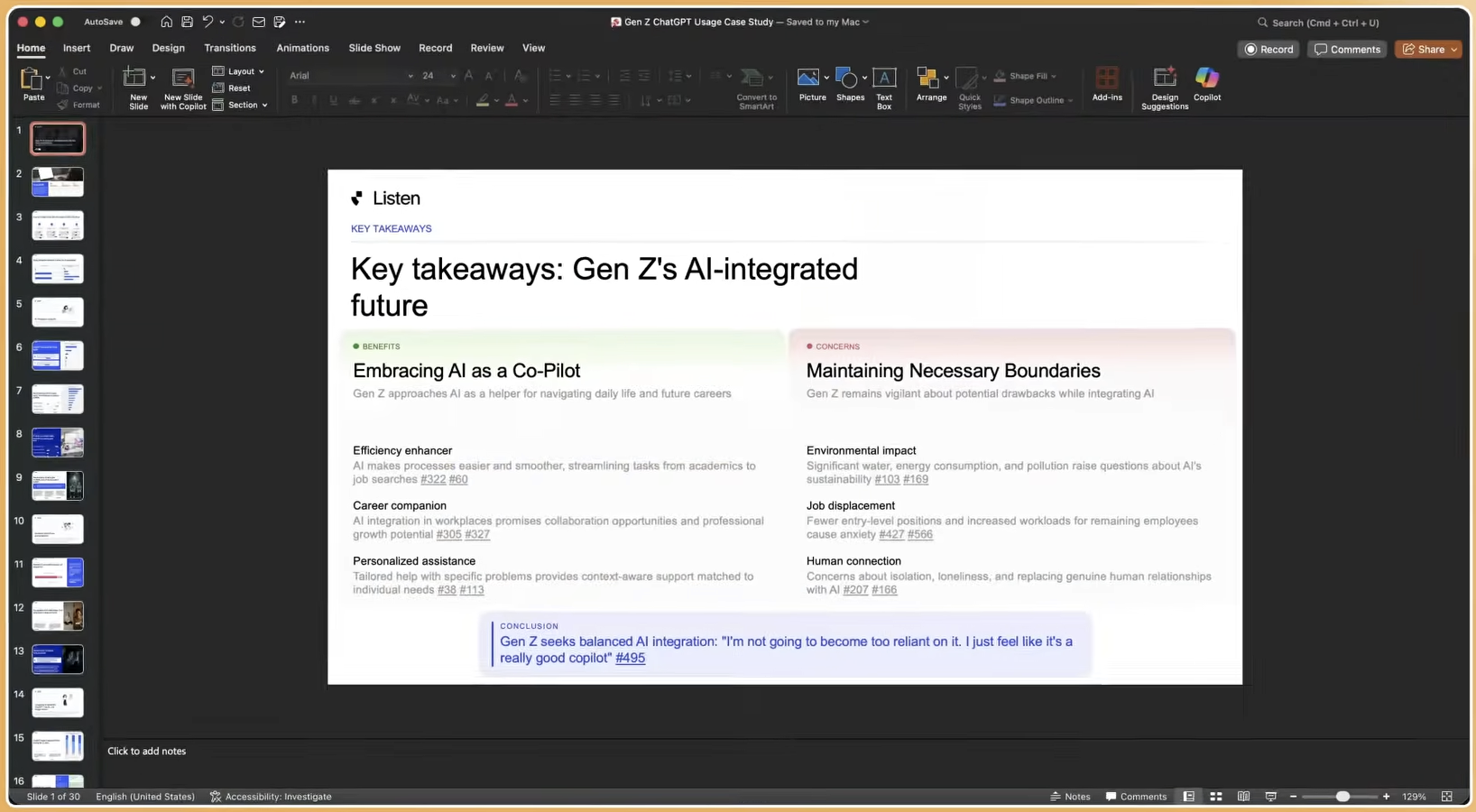
Research Agent handles the full analysis workflow: from raw data to final output, generating slide decks, memos, highlight reels, and statistical charts in under a minute. Every insight links directly to the underlying response data, so stakeholders can interrogate the evidence rather than accept a summary on faith.
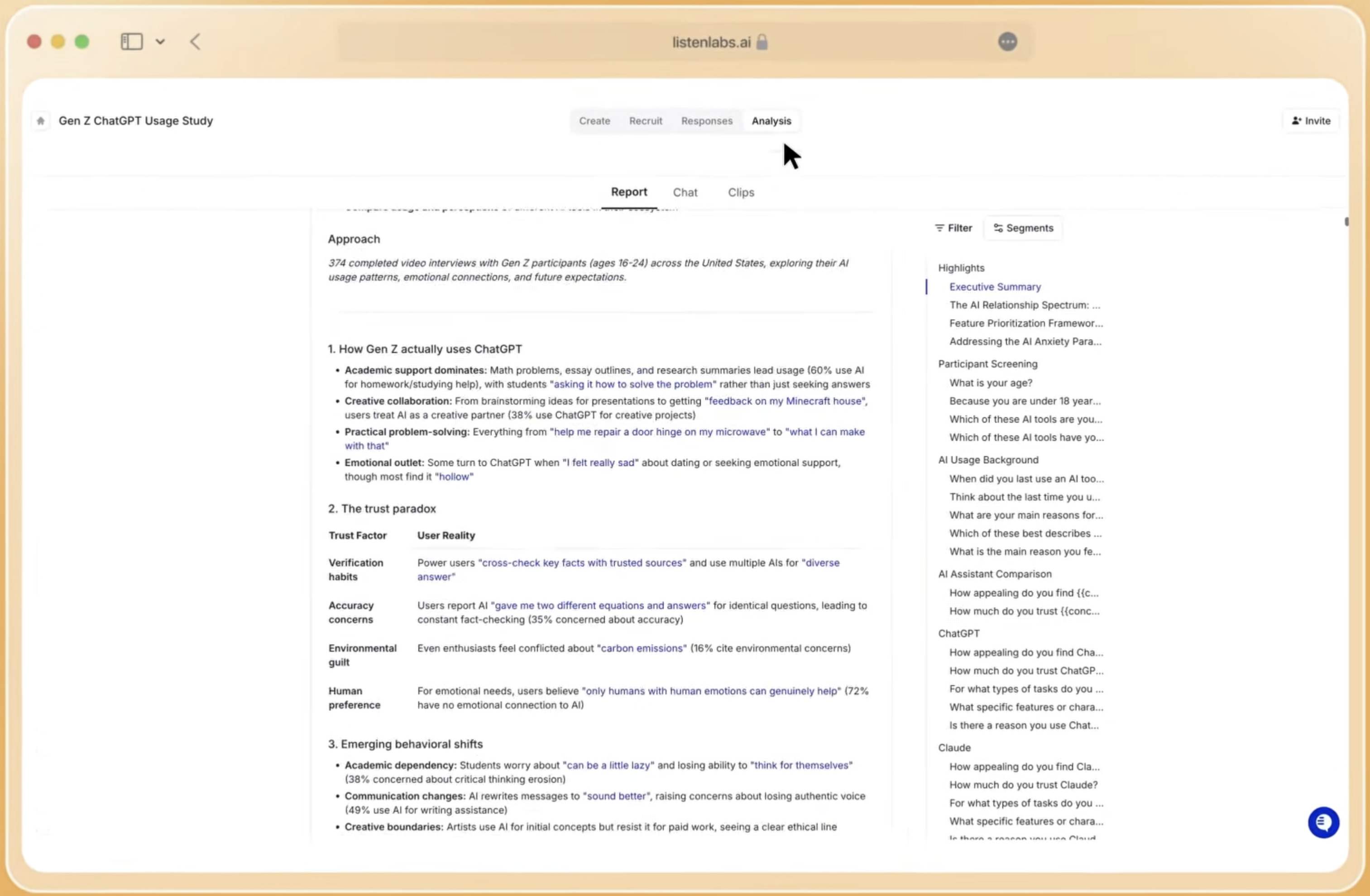
See how Research Agent turns 200+ interviews into ready-to-share insight statements.
Common Challenges and Troubleshooting
The five-step workflow surfaces predictable failure points that often appear together as studies scale. The following are the most common, with early-warning signals and fixes for each.
Unclear objectives. Early-warning signal: the DECIDE template produces more than one candidate decision. Fix: assign a single decision owner to rank the options and remove all but the primary question before fieldwork begins.
Low-effort responses. Early-warning signal: average response length drops below two sentences per open-ended question. Fix: Quality Guard flags these sessions in real time, and teams replace flagged completes before the study closes rather than after analysis begins.
Panel fatigue. Early-warning signal: completion rates fall below 70% on a previously reliable segment. Fix: rotate screener language, shorten the interview to under 20 minutes, and verify that participants have not exceeded the three-studies-per-month cap.
Analysis bottlenecks. Early-warning signal: the insights team is still manually coding transcripts 48 hours after fieldwork closes. Fix: deploy the Research Agent for automated theme identification and reserve human analyst time for interpretive connection to business strategy, which remains the step AI does not replace.
Stakeholder misalignment. Early-warning signal: the brand team disputes the insight statement framing after delivery. Fix: include the decision owner in the DECIDE alignment meeting at Step 1 and share a one-page interim brief after fieldwork closes, before the full report is written.
Measuring Success of a 24-Hour Insights Program
Objective indicators for the 24-hour CPG consumer insights workflow fall into two categories. Short-term process metrics include study cycle time from brief to delivered report, interview completion rate, and theme consistency across independent analyst reviews of the same dataset. A well-run study should close fieldwork and deliver a structured report within 24 hours, with completion rates above 80% and theme agreement above 85% across reviewers.
Long-term outcome metrics validate whether the insights actually improved decisions. These include downstream usage rate, meaning the share of insight statements that appear in a product brief, packaging claim, or campaign, and predictive accuracy, measured by comparing insight-driven forecasts against scanner data outcomes after launch. Sentiment analysis program effectiveness should be measured by predictive accuracy, meaning whether insights correctly anticipated market outcomes such as market share changes in scanner data, rather than just current attitude measurement.
Advanced Extensions for Mature Teams
Once the five-step workflow is operating reliably, three extensions increase its strategic value in a logical progression. Always-on programs come first and replace one-off studies with rolling weekly or biweekly interview cadences tied to specific business triggers, such as a new SKU entering the innovation pipeline, a competitor price move, or a shift in social sentiment. By early 2026, 41% of teams were running weekly or biweekly AI interview cadences for continuous discovery.
Global multi-market studies typically come next for brands operating across regions. These programs use the same study design across geographies simultaneously, with localized screeners and AI moderation in 100+ languages. Listen Labs covers 45+ countries, enabling a single CPG team to run parallel studies in the US, UK, Germany, and Japan within the same 24-hour window.
Behavioral data integration is the most advanced layer. It connects interview-derived insight statements to first-party loyalty data and retailer POS, allowing teams to validate whether the motivations surfaced in qualitative interviews predict actual purchase behavior at the segment level. Mission Control, Listen Labs’ cross-study knowledge base, stores every finding so future studies build on prior learning rather than starting from zero.
Frequently Asked Questions
How many interviews are needed for a CPG consumer insights study to be statistically reliable?
As noted in Step 3, concept testing and claim validation typically require 100–200 completed interviews per concept to detect meaningful differences between options. For exploratory studies focused on motivation mapping or language development, 50–80 interviews typically reach thematic saturation. AI moderation makes both sample sizes achievable within a single business day, which removes the historical trade-off between sample size and timeline.
What incentive ranges are appropriate for CPG consumer interview participants?
Incentive levels vary by audience difficulty and interview length. General population CPG shoppers in a 15–20 minute interview typically receive $10–$25. Verified category purchasers in a 30-minute interview range from $25–$50. Hard-to-reach segments, such as premium organic buyers below 1% incidence rate or specific ethnic occasion shoppers, may require $50–$100 or more. Listen Labs’ recruitment operations team calibrates incentives to the specific sample frame to avoid over-incentivizing and attracting low-quality respondents.
How does the 24-hour workflow handle data privacy and compliance requirements?
Listen Labs maintains SOC 2 Type II, GDPR, ISO 27001, ISO 27701, and ISO 42001 certifications. All data is encrypted at 256-bit, and customer data is never used to train AI models. For CPG studies involving health claims or children’s products, the platform supports additional consent flows and data handling protocols aligned with category-specific regulatory requirements. Participants provide explicit informed consent before any interview begins.
When should a CPG team repeat or retire a study?
A team should repeat a study when a material business condition changes, such as a reformulation, a competitor launch, a significant price move, or a shift in distribution. Repeating the same study design on a consistent cadence also enables trend tracking across waves. A team should retire a study when the insight statements it produces have reached saturation, meaning three or more consecutive waves return the same themes with no new findings, or when the business question it was designed to answer has been resolved and a new decision has taken priority.
Can AI-moderated interviews replace human moderators entirely for CPG research?
AI moderation handles the majority of CPG consumer insights use cases, including concept testing, claim validation, packaging research, flavor and format development, and brand perception studies, with comparable thematic coverage and significantly better consistency than human moderation at scale. Human moderators retain an advantage in ethnographic and contextual inquiry, emotionally sensitive topics, and early-stage exploratory studies where the interview guide is not yet stable. The practical model for most CPG insights teams is AI moderation for volume and speed, with human researcher time reserved for strategic interpretation and stakeholder communication.