Written by: Anish Rao, Head of Growth, Listen Labs
Key Takeaways
- CPG consumer insights automation replaces slow, sequential manual workflows with an AI-orchestrated pipeline that completes hundreds of interviews in hours instead of weeks.
- Each research stage, from study design and participant sourcing to AI-moderated interviewing and emotional intelligence capture, benefits from parallel processing and real-time quality controls that remove traditional bottlenecks.
- Automated analysis and deliverable generation turn raw interview data into stakeholder-ready outputs like slide decks, memos, and video reels without weeks of manual coding or formatting.
- Real-world CPG use cases at companies like Procter & Gamble and Skims show how AI-moderated interviews deliver deeper, faster insights for concept testing, creative validation, and brand perception at scale.
- Listen Labs provides the end-to-end platform that powers this automation. See a live demo to understand how your team can compress research cycles from weeks to hours.
Why Traditional CPG Qual Research Breaks at Scale
Traditional CPG qualitative research relies on a chain of sequential steps that slow everything down. A study design that takes days to finalize triggers a recruiting process that takes weeks to complete. Fieldwork then waits on moderators who can only conduct a handful of interviews per day. By the time findings reach stakeholders, the market has often moved on.
Each stage’s bottleneck compounds the next one. Slow study design delays recruiting. Recruiting delays interviewing. Interviewing delays analysis and deliverables. What should be rapid consumer feedback turns into a months-long ordeal.
Automation breaks this chain by running many of these steps in parallel. AI supports study design, sourcing, interviewing, emotional signal capture, analysis, and deliverables in a single pipeline. The following stages show how that pipeline works in practice.
Stage 1: Designing the Right CPG Study
Study design sets the ceiling on everything downstream because methodology choices drive every operational requirement. The method you select, such as in-depth interview, concept test, creative test, diary, or task-based session, defines question structure, stimuli format, and minimum sample size per segment. These requirements flow directly from your core inputs, including the research brief, defined consumer segments, and decision criteria the study must answer.
Manual workflows rely on a senior researcher drafting a discussion guide, circulating it for internal review, and iterating over several days. AI-assisted co-design compresses this cycle to minutes. You describe research goals in natural language, and the platform drafts structured objectives, questions, and probing context automatically. The system then flags guide issues before launch so teams fix structural problems early instead of during fieldwork.
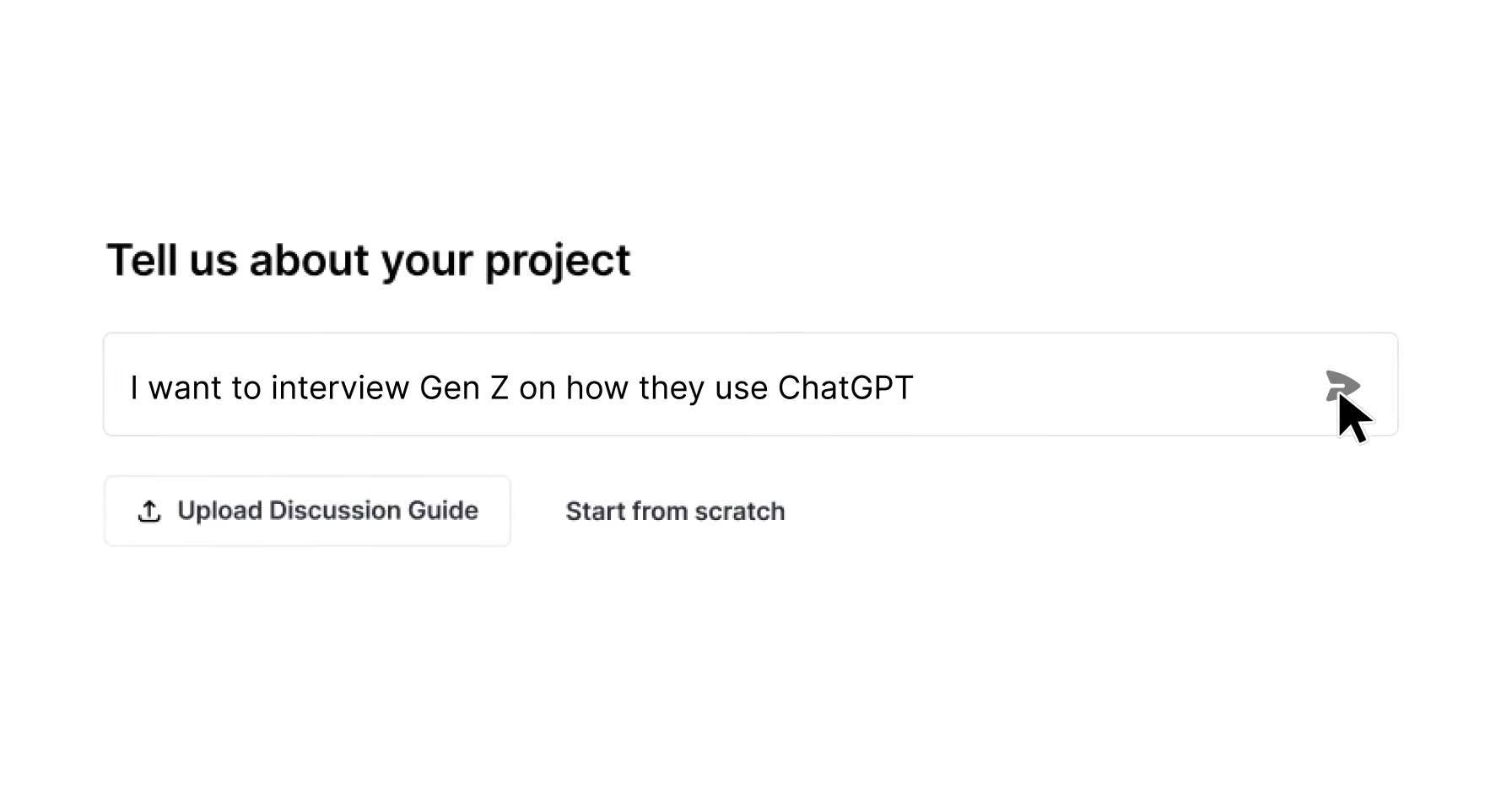
Time and cost at this stage come from internal alignment cycles and repeated guide revisions. Automation reduces those loops by catching gaps and inconsistencies before recruiting begins.
See AI-assisted study co-design in action with your next research brief.
Stage 2: Sourcing CPG Participants at Scale
Once your study design defines target segments and screening criteria, the next bottleneck appears: finding and recruiting those specific consumers at scale. Participant sourcing becomes the first major operational wall in traditional CPG qualitative research. Sequential recruiting, panel vetting, and scheduling coordination often add one to three weeks before the first interview starts.
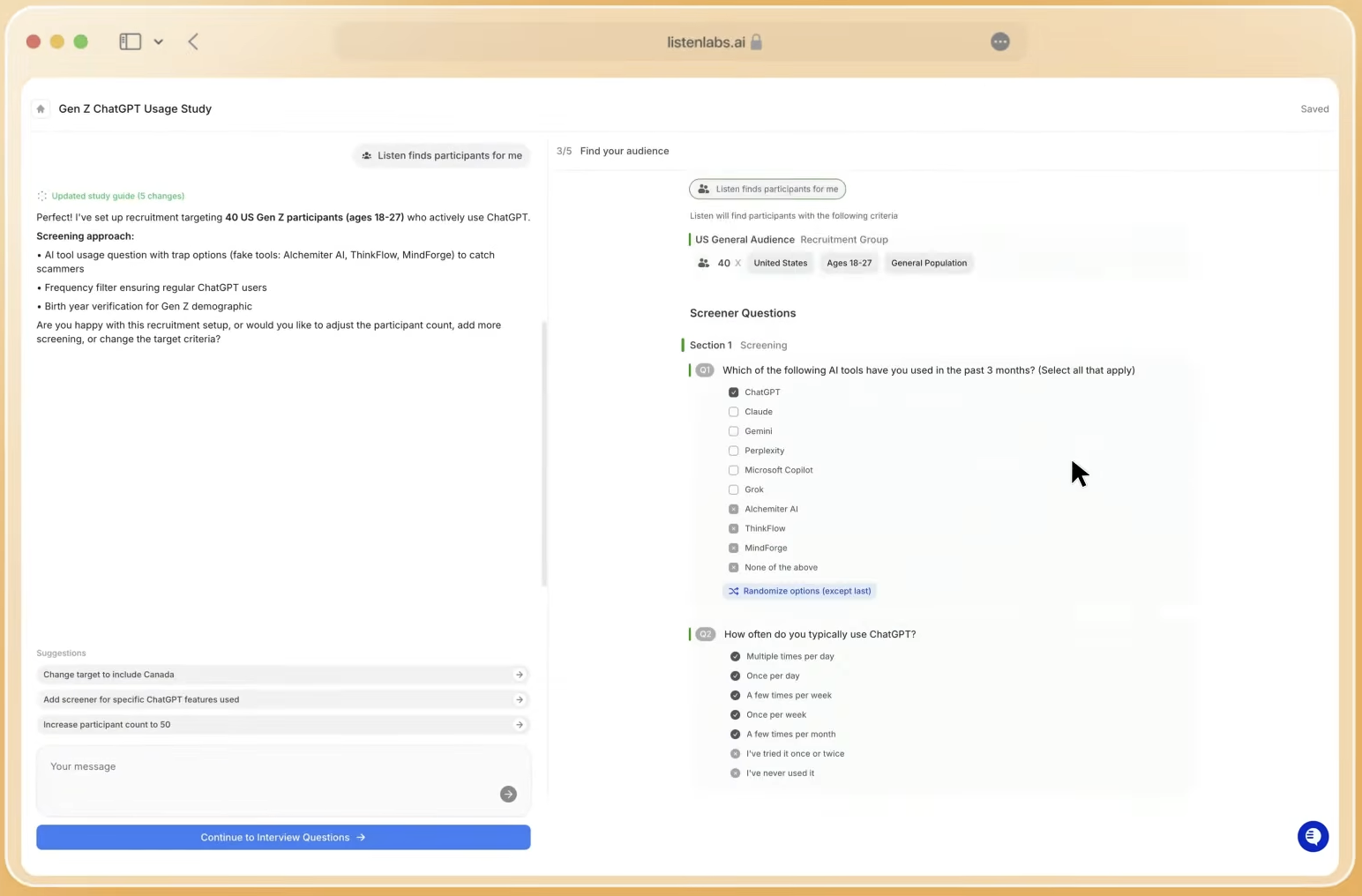
The core inputs at this stage include screening criteria, incidence rate estimates, and target segment definitions. Segmented CPG studies with multiple comparison dimensions frequently require 100 to 300 or more interviews to reach saturation. That volume is effectively impossible to source manually within a standard project timeline.
Automated sourcing uses AI orchestration to match and recruit across verified panel networks at the same time. The system applies behavioral and intent signals instead of relying only on self-reported demographics. This behavioral matching improves targeting precision but also increases exposure to sophisticated fraud. Fraud controls therefore operate in real time across video, voice, content, and device signals. Fraudulent participation poses a recognized risk to qualitative research at scale, so continuous quality monitoring becomes a non-negotiable part of the architecture.
Review participant sourcing options for your target CPG segments in a demo.
Stage 3: Running AI-Moderated CPG Interviews
Human moderation capacity forms the core constraint on qualitative scale. A senior human moderator can conduct only three to five 60-minute interviews per day, so fieldwork for a 100-interview study stretches across several weeks before analysis even begins.
AI-moderated interviews run in parallel across all participants at once. The AI conducts personalized, adaptive conversations, probing deeper on short or unexpected answers and following the participant’s thread instead of a rigid script. AI-moderated interviews maintain consistent laddering depth across 200 to 1,000 or more conversations by removing moderator fatigue, leading bias, and session-to-session variability.
Participant comfort remains high. Ninety-two percent of participants report top comfort levels in AI-moderated sessions, equivalent to human-moderated sessions, with AI preferred for sensitive topics such as price objections, personal finances, and brand switching triggers. Completion rates exceed 85 percent, nearly four times the 22 percent completion rate of long-form surveys.
Key decision points at this stage include stimuli format, such as images, video, PDFs, live URLs, or prototypes, and question mix, such as qualitative probes combined with Likert scales, NPS, or MaxDiff. Language requirements also matter. Automated platforms support more than 100 languages for moderation without running markets in sequence.
Stage 4: Capturing Emotional Signals in CPG Feedback
Transcripts capture what participants say but miss how they feel while saying it. They do not record hesitation before answering, a frown during a product claim, or a flat expression behind a politely positive rating. Transcript-only analysis loses critical nonverbal signals that separate genuine enthusiasm from polite agreement, even when participants use identical words.
Emotional intelligence capture adds a multimodal analysis layer that processes three simultaneous signal streams. These channels work together to reveal when a participant’s emotional state contradicts their verbal response, catching the gap between social desirability and real excitement.
- Tone of voice
- Word choice and linguistic patterns
- Subconscious micro expressions
Every emotion is quantified per question and concept, with every label traceable to the exact timestamp, verbatim quote, and AI reasoning behind it. This traceability matters for CPG teams presenting findings to brand leadership because stakeholders are more likely to act when they can see the evidence chain. Every emotional signal links back to a specific participant moment instead of an aggregate summary they must accept on faith.
The framework relies on multimodal emotion recognition, which integrates visual, acoustic, and textual cues to capture the complexity of human emotion beyond text-only sentiment analysis. For CPG brands, this matters because quality, trust, and emotional connection now influence perceived value more than price alone.
Decision points at this stage include which emotions to track per concept, how to segment emotional responses by demographic or market, and how to surface emotionally significant video moments for stakeholder presentations.
See emotional signal capture applied to a live CPG concept or creative test.
Stage 5: Analyzing CPG Interviews Automatically
Manual qualitative analysis creates the largest time sink in the traditional workflow. After 20 in-depth interviews, researchers face 300 or more pages of transcripts, and manual coding plus thematic synthesis often take two to three weeks before findings reach stakeholders. That timeline grows linearly as study volume increases.
Automated analysis processes all interview data at once, identifying patterns and themes across hundreds of responses without human coding variability. The Research Agent handles the full analysis workflow from raw data to final output. Researchers can query findings in natural language, run segment comparisons with significance testing, and generate charts without manual data manipulation.
Traceability remains the key quality requirement. Credible scaled qualitative research links every theme to specific quotes and timestamps, with the option to review original video evidence. Stakeholders act more confidently when they see how each conclusion connects to primary data.
Time-to-insight can fall from several weeks for traditional panel research to just days for AI conversation research, with large reductions in cost per insight.
Watch automated analysis on a multi-segment CPG study in a demo.
Stage 6: Turning Insights into CPG-Ready Deliverables
Deliverables translate analyzed findings into formats each stakeholder group can use immediately. Brand teams rely on slide decks. Insights leaders need memos with traceable evidence. Innovation teams benefit from video highlight reels that show consumer reactions to specific claims or concepts.
Manual deliverable generation often adds one to two weeks after analysis finishes. The Research Agent generates a slide deck in a company’s branded template and a downloadable report. One researcher completed a full buying intent analysis across three user segments in under a minute using this workflow.
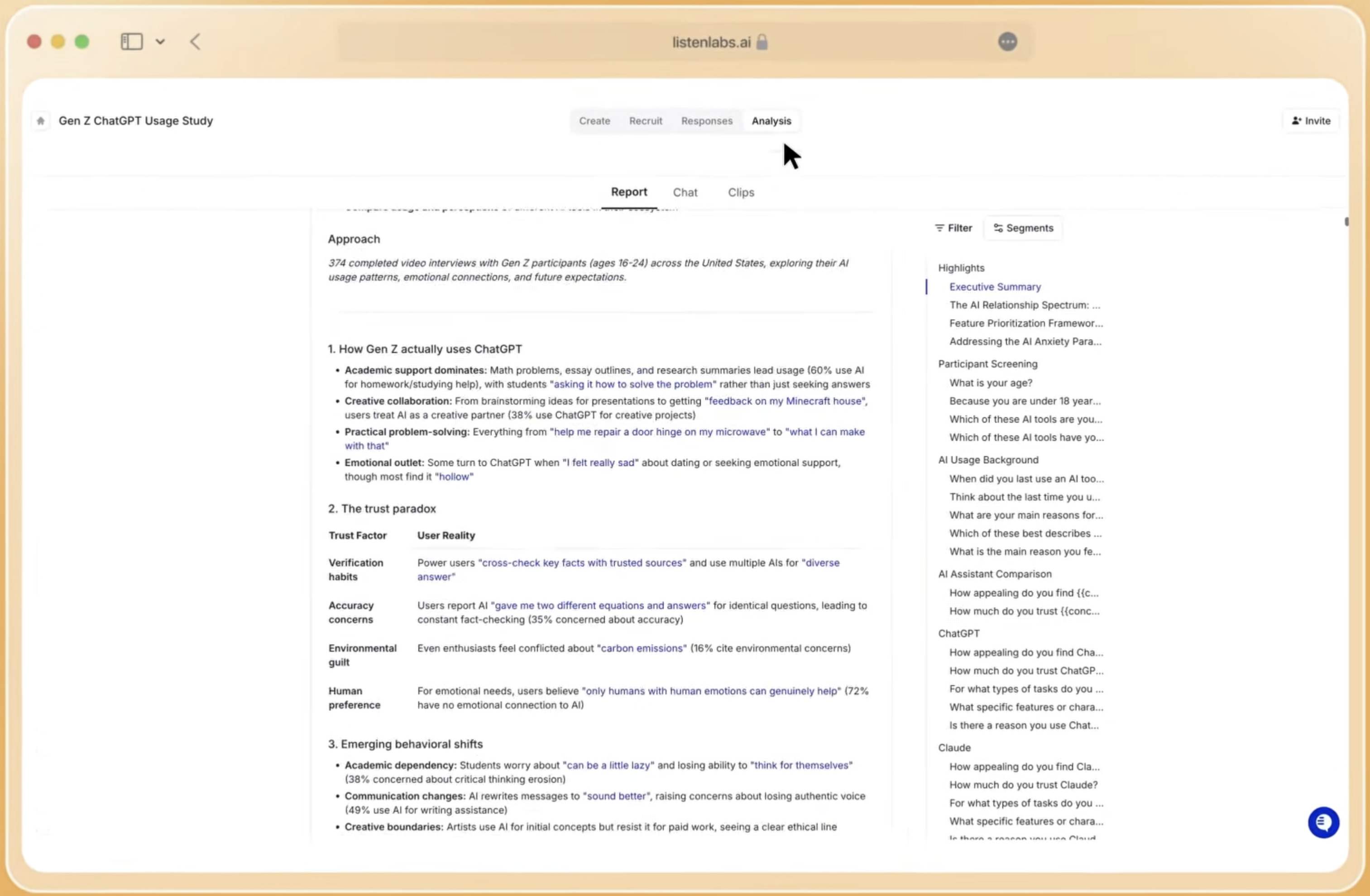
This range of formats matters because different stakeholders absorb information in different ways. Automated deliverables package the same underlying analysis into tailored outputs without extra manual effort.
Deliverable types generated automatically include:
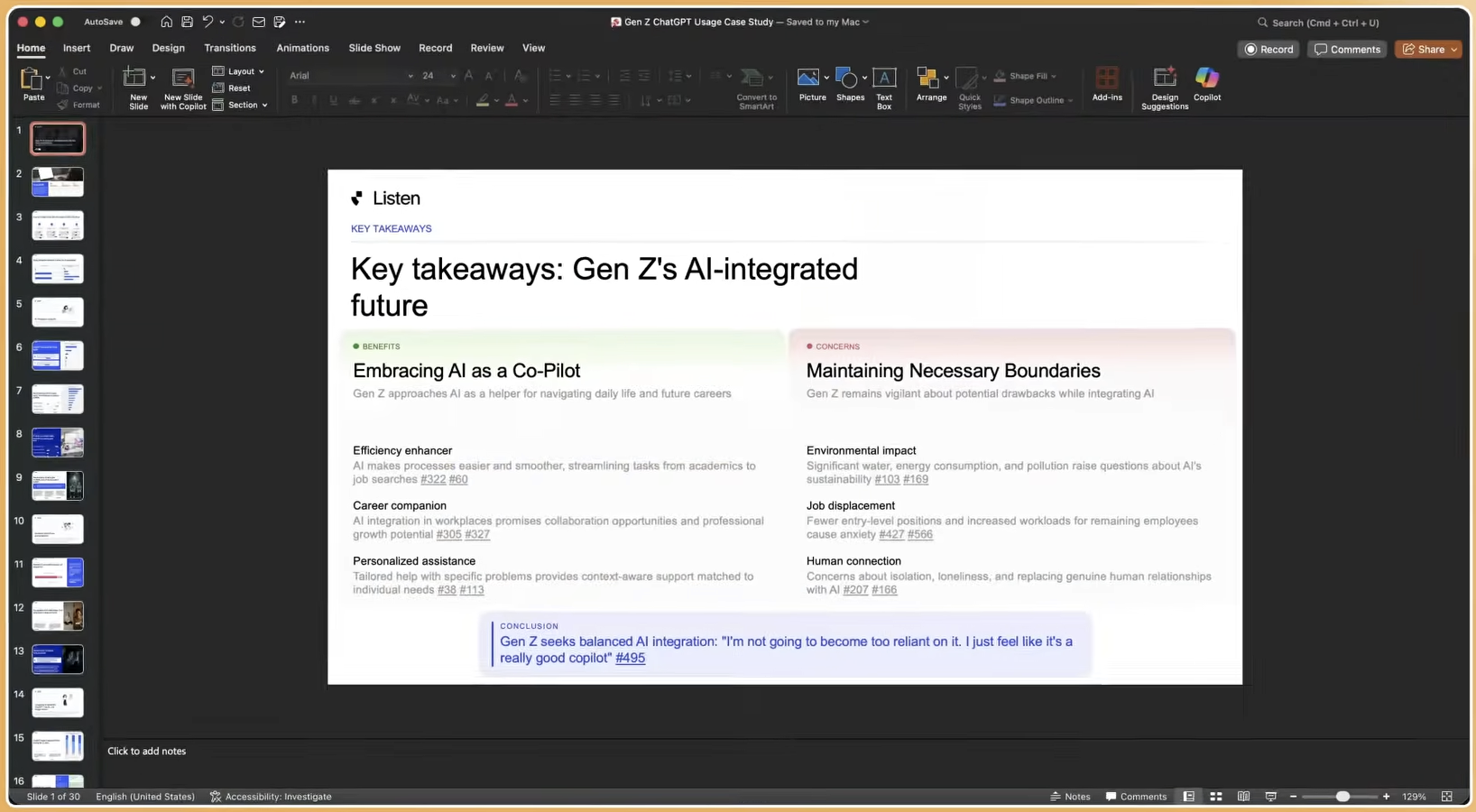
- Consultant-quality PowerPoint slide decks
- Memo-style written reports
- Video highlight reels of emotionally significant moments
- Statistical charts and segment comparisons
- Custom reports generated from natural-language queries
Decision points at this stage include output format per stakeholder group, segmentation cuts to include, and which emotional moments to feature in video reels.
Explore deliverable formats for your next CPG study in a live walkthrough.
CPG Use Cases: Concept and Creative Testing in Practice
Concept Testing: Product Claims Validation. Procter & Gamble used AI-moderated interviews to evaluate how men respond to new product claims before market launch. The study delivered more than 250 interviews with quantified themes and verbatim proof in hours. The team surfaced where claims felt exaggerated or unclear and confirmed that comfort, safety, and reliability mattered far more than novelty to the target segment. Emotional Intelligence quantified reactions per claim so the team could prioritize investment in features consumers validated instead of those they dismissed.
Creative Testing: Campaign Direction Validation. Skims needed to validate campaign direction with thousands of high-income buyers before a global launch. AI-moderated interviews identified and qualified premium consumers overnight, removing weeks of recruiting. Emotional signal capture translated consumer reactions into insights leadership could trust, which helped secure board-level buy-in before launch. The study delivered qualitative clarity that a quantitative survey could not match at similar speed.
Both use cases reflect a broader pattern. With qual-at-scale, the old trade-off between depth and scale no longer blocks decision-making. Listen Labs has run over 1 million AI-powered customer interviews for companies including Microsoft, Perplexity, and Sweetgreen, demonstrating enterprise-scale reliability across CPG and adjacent categories.
Design a concept or creative test for your next CPG launch with the Listen Labs team.
Metrics Dashboard for CPG Insights Automation
A CPG insights automation dashboard tracks four primary metric categories that show whether the program delivers value.
- Study cycle time: Calendar days from brief submission to stakeholder-ready deliverable. The baseline for comparison is the team’s current average, and the target is sub-24 hours for standard studies.
- Participation rate and completion quality: Percentage of recruited participants completing full interviews above quality threshold. As noted in Stage 3, AI-moderated interviews maintain completion rates above 85 percent, compared to 22 percent for long-form surveys.
- Emotion quantification per concept: Percentage of participants expressing each tracked emotion, such as joy, trust, confusion, surprise, disgust, or anticipation, per stimulus, with timestamp-level traceability to source moments.
- Stakeholder usage rate: Percentage of internal stakeholders who access and cite research deliverables in downstream decisions. This metric directly measures whether insights reach and influence the teams that requested them.
More than half of CPG executives do not formally measure the ROI of consumer AI investments, so a structured dashboard becomes the first step toward demonstrating program value to leadership.
Discuss dashboard configuration for your insights program in a demo.
How to Measure Success in CPG Insights Automation
A complete ROI framework for CPG insights automation covers four measurement dimensions that connect research activity to business outcomes.
- Decision impact: Track how frequently and how strongly research influences major product, brand, and innovation decisions. Research teams using AI consumer research often report higher confidence in roadmap decisions.
- Efficiency gains: Measure reduction in study cycle time, number of studies completed per quarter with the same headcount, and removal of external vendor costs for moderation, transcription, and analysis.
- Risk reduction: Quantify concepts, claims, or creative directions validated or rejected before market investment. A single avoided launch failure or reformulation typically exceeds annual platform cost.
- Revenue impact: Track incremental sales attributable to research-informed innovation or marketing decisions, using pre and post study launch performance data where available.
BCG analysis shows that scaling AI initiatives across the demand value chain can deliver meaningful cumulative EBIT improvements for CPG companies. Measurement must tie to real business KPIs instead of technical activity metrics.
Build an ROI measurement framework for your CPG insights automation program with Listen Labs.
Frequently Asked Questions
Does participant quality hold up when scaling from 15 to 250+ interviews?
Participant quality at scale depends on three controls working together: panel source selection, real-time fraud detection, and participation frequency limits. Commodity panels introduce professional survey-takers and incentive-optimized responses that distort qualitative findings. Quality-controlled platforms use behavioral matching on intent and past actions instead of self-reported demographics alone. They monitor every interview in real time across video, voice, content, and device signals and cap participant frequency at three studies per month to prevent panel fatigue. A dedicated recruitment operations team adds a human review layer for hard-to-reach segments. These controls maintain quality at 250 or more interviews that manual vetting cannot match at that volume.
Is an AI interviewer as effective as a trained human moderator for CPG research?
For most CPG research objectives, including concept testing, creative testing, claim validation, brand perception, and shopper journey mapping, AI-moderated interviews deliver comparable depth to skilled human moderation with clear advantages at scale. AI removes moderator fatigue, leading bias, and variability across sessions, which keeps probing depth consistent across every interview in a study. As discussed in Stage 3, human moderator capacity tops out at three to five quality interviews per day because of fatigue effects. This limitation makes AI moderation’s ability to sustain consistent depth across unlimited parallel sessions a fundamental operational advantage for large studies. AI moderation also improves candor on sensitive topics such as price sensitivity, brand switching, and product dissatisfaction, where participants self-censor less without a human present. An in-house research team continuously reviews and refines the methodology so rigor stays high as the platform evolves.
How is participant data protected and kept compliant with enterprise security requirements?
Listen Labs maintains enterprise-grade security with 256-bit encryption. Customer data is never used for AI model training. The platform holds SOC 2 Type II, GDPR, ISO 27001, ISO 27701, and ISO 42001 certifications, which cover data security, privacy management, and AI governance. Enterprise SSO is supported. These certifications satisfy standard procurement requirements for Fortune 500 CPG organizations that operate across multiple regulatory jurisdictions.
Does automating qualitative research eliminate the need for an internal insights team?
Automation acts as a force multiplier for existing research teams, not a replacement. The platform handles the operational workflow, including recruiting, moderating, transcribing, coding, and generating deliverables. Researchers gain time to focus on study design strategy, stakeholder communication, and translating findings into business decisions. Teams that previously ran four to six studies per quarter can run significantly more with the same headcount, clearing research backlogs and reducing the number of unfulfilled requests. The research team’s judgment remains essential for defining the right questions, interpreting findings in business context, and advising internal stakeholders on implications.
Implementing CPG Consumer Insights Automation with Listen Labs
Listen Labs is the end-to-end AI research platform built for this workflow. Each stage described above maps directly to a platform capability.
- AI-assisted study co-design: Describe research goals in natural language, and the platform drafts structured objectives, questions, and probing context, then auto-QAs the guide before launch.
- Listen Atlas: A network of more than 30 million verified respondents across over 45 countries and more than 100 languages, with an AI orchestration layer that matches and recruits across multiple panel partners at once. A dedicated recruitment operations team sources segments below a 1 percent incidence rate.
- Quality Guard: Real-time fraud detection across video, voice, content, and device signals, with behavioral reputation scoring that compounds across every study on the platform.
- Emotional Intelligence: Multimodal analysis of tone of voice, word choice, and subconscious micro expressions, built on Ekman’s universal emotions framework, quantified per question and concept with timestamp-level traceability, available across more than 50 languages.
- Research Agent: Automated key findings, themes, and personas from interview data, with one-click generation of slide decks, memos, highlight reels, and statistical charts.
- Mission Control: A cross-study knowledge base that makes every past finding queryable in seconds, which prevents repeated research and builds institutional knowledge over time.
Clients including Procter & Gamble, Nestlé, Microsoft, and Skims use Listen Labs to compress four to six week research cycles into sub-24-hour turnarounds while running studies at roughly a third of the cost of traditional agency engagements. Platforms like Listen Labs layer on auto-recruiting, transcription, sentiment tagging, and insight summarization so teams move from question to findings in hours instead of weeks.