Written by: Anish Rao, Head of Growth, Listen Labs
Key Takeaways
- Shopper data shows what happened at retail, while consumer insights explain why it happened. Both matter and support different decisions.
- Syndicated panels like NielsenIQ and Circana show category movement with a time lag and do not reveal motivations or switching triggers.
- Traditional consumer research costs $25K–$100K+ and takes 6–12 weeks. AI-moderated interviews reach similar depth in about a day at roughly one-third the cost.
- Listen Labs’ Emotional Intelligence layer captures tone, micro-expressions, and hesitation that surveys miss, which strengthens creative and concept testing.
- Listen Labs turns research requests into results in under 24 hours at one-third the cost, so teams can see how leading CPG brands scale consumer insights with a live platform walkthrough.
Shopper Insights vs. Consumer Insights in Practice
Shopper insights study purchase behavior at the point of decision, such as where, when, and how a purchase happens. Teams use POS feeds, loyalty data, basket composition, shelf observation, retailer panels, and clickstream from portals such as Walmart Retail Link, Kroger Stratum, and Target Partners Online. Consumer insights focus on the person behind the purchase, including who they are and why they care, using qualitative interviews, ethnographies, social listening, and brand trackers.
This distinction matters because point-of-sale transaction data cannot reliably explain consumer motivations. POS data shows what occurred, not the underlying values, unmet needs, or category relationship that drove the behavior. A parent buying cereal acts as a shopper while scanning the aisle in five seconds under time pressure. The same parent acts as a consumer while weighing nutrition, brand loyalty, and family values at home. One person generates two very different data sets.
Each data type informs distinct decisions.
- Shopper data supports shelf-set changes, promo timing, stockout impact analysis, retail media bids, planogram decisions, and buyer line reviews.
- Consumer insights support brand positioning, equity tracking, segmentation, messaging, new product development, and concept validation.
- Together, they answer the full question: what happened at retail, and which belief or motivation caused it.
How CPG Teams Use Retailer and Syndicated Data
CPG analytics typically draws on five primary data sources: POS data from retailer portals, syndicated data from providers such as NielsenIQ and Circana, consumer panel data, first-party and ecommerce data, and supply chain or ERP data. Most teams connect POS first as the foundation, then layer additional sources based on the business question.
Syndicated data from sources such as Circana provides category and brand movement with a one- to two-week lag. That lag compounds over time. Complaints about a reformulated product often appear in Amazon and Target reviews in week one, reach Reddit by week three, and affect syndicated velocity by week six. By the time the signal appears in a syndicated report, the window for a fast response has usually closed.
The deeper limitation involves explanation. Syndicated data from providers such as NielsenIQ, Circana, and Numerator reports what products moved off the shelf, at what price, with what promotional support, and how share shifted relative to the category. It does not explain the reasons behind those outcomes. Consumer interviews with recent category buyers reveal motivations, frustrations, switching triggers, and unmet needs that scanner and syndicated data cannot capture.
A BCG survey of 100 C-level marketing leaders at US and European CPG companies with $1 billion or more in annual revenue found that marketing functions are expanding to own end-to-end consumer and commercial insights. These teams now integrate previously siloed capabilities under a single function to create a holistic 360-degree view. Pressure to unify shopper and consumer intelligence is rising, while the tools that support this at speed have only recently matured.
Traditional vs. AI-Moderated Consumer Research
Full-service agency consumer research projects typically cost $25,000–$100,000 or more per study. Timelines of 6–8 weeks from briefing to deliverable are standard, and 10–12 weeks are common for complex studies. Most teams can fund only two or three such studies annually. A full packaging study with shelf simulation can exceed $75,000 and brand tracking programs often reach six figures annually, while conjoint analysis for pricing work can cost a few thousand dollars per country.
The cost structure is not the only constraint. Traditional in-depth interviews usually require several weeks end to end. Recruitment takes 1–2 weeks. Fieldwork, limited to 3–4 sixty-minute sessions per day by a human moderator, adds another 1–2 weeks. Analysis takes 1–2 weeks, and reporting adds 3–5 days. AI-moderated interviews compress this entire cycle into about 24 hours. Recruitment completes in 2–24 hours. Fieldwork can include 200 or more simultaneous 30-minute conversations. Analysis runs in 1–4 hours, and reporting in 1–2 hours. Listen Labs delivers this at approximately one-third the cost of traditional research approaches.
Industry reports, including Greenbook’s GRIT report, show AI and automation among the leading emerging qualitative research methods. Async AI-moderated formats now account for most new qualitative study starts inside large research organizations. This shift has moved from experimentation to daily operations.
At Reckitt, a global CPG company that partnered with BCG on GenAI for marketing, up to 40% of employee time shifted to higher-value work. Efficiency gains reached 60% across functions, and concept development became up to 60% faster.
Ready to compress your research cycle from weeks to hours? See how Listen Labs delivers CPG consumer insights at scale using the same 24-hour cycle described above.
Real-World CPG Workflows With Time and Cost Benchmarks
The speed and cost advantages described above translate into different research workflows in practice. Listen Labs has conducted over one million AI-powered customer interviews for companies including Microsoft, Perplexity, and Sweetgreen. These projects reveal three recurring patterns in how CPG and consumer brands use AI-moderated research.
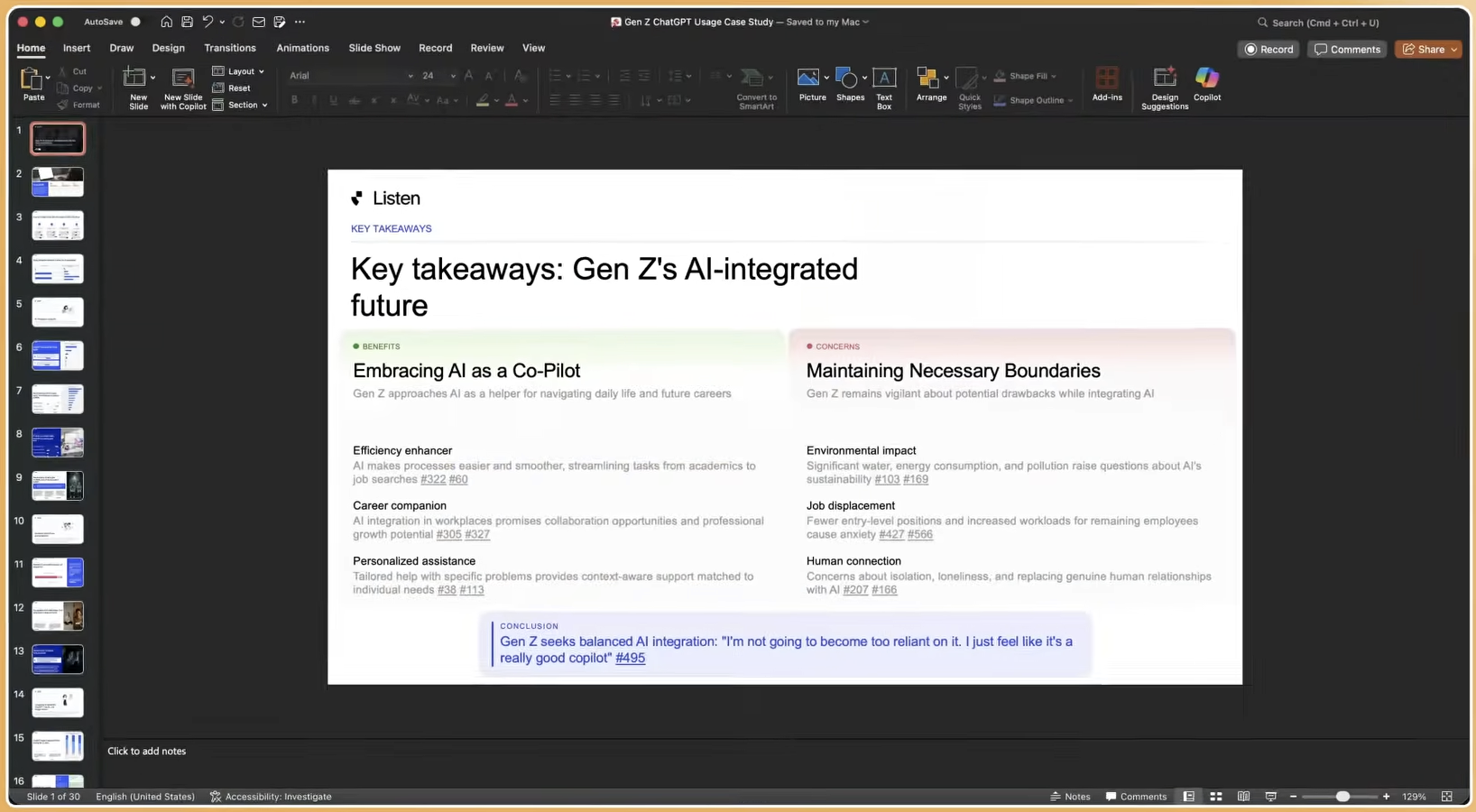
Pre-launch validation at scale. Procter & Gamble used Listen Labs to evaluate how men respond to new product claims before market launch. The platform delivered more than 250 interviews with quantified themes and verbatim proof in hours, not weeks. The work surfaced where claims felt exaggerated or unclear and showed that comfort, safety, and reliability mattered far more than novelty. The Analytics and Insight Leader at P&G described Listen Labs as “a huge help” in shaping product and brand strategy before the team made costly commitments.
Retention and churn analysis. Anthropic needed clarity on why Claude users cancel subscriptions and what might bring them back. Listen Labs delivered more than 300 user interviews in 48 hours, which ran about five times faster than the team’s previous approach. The study identified where former users migrated, what triggered switching, and a prioritized list of ten must-fix items. The Director of Product Strategy at Anthropic noted that Listen Labs provided a level of clarity and speed on user churn the team had never seen before.
Time-critical storytelling and campaign decisions. Skims needed to validate a global campaign direction with thousands of high-income buyers overnight to de-risk a major launch. Listen Labs identified and qualified the right premium consumers overnight, removing weeks of recruiting and panel sourcing. The SVP of Data, Insights, and Loyalty at Skims stated: “I always struggled with understanding the why and Listen Labs nails this for me.” Microsoft collected global customer stories for its 50th anniversary celebration within a single day. The Director of Data Science at Microsoft highlighted that the team could reach hundreds of users at one third of the previous cost, and leadership valued both the speed and the scale.
Listen Labs acts as a force multiplier for existing research teams rather than a replacement. A researcher using AI-moderated qualitative methods can cover 8 to 10 projects per month versus 2 to 3 with manual moderation. Teams keep the same headcount, produce far more work, and finally reduce their research backlog.
Why Emotional Intelligence Fills the “Why” Gap
Emotional Intelligence closes the gap between shopper data that shows what happened and consumer insight that explains why it happened. Most consumer research tools capture only what participants say, such as transcripts, survey responses, and self-reported ratings. Critical emotional signals, including a moment of hesitation, a frown at a packaging concept, or widened pupils at a price point, rarely appear in the dataset. Two product concepts may both receive positive ratings while triggering very different emotional responses.
Listen Labs’ Emotional Intelligence analyzes three layers of signal at once: tone of voice, word choice, and subconscious micro-expressions. Built on Ekman’s universal emotions framework, the same standard used in clinical psychology, it tracks emotions including joy, trust, surprise, anticipation, fear, disgust, sadness, and anger. Every emotion is quantified per question and concept, and every label links back to the exact timestamp, verbatim quote, and reasoning.
The capability works across more than 50 languages and connects directly to the Research Agent for natural-language queries, charts, and highlight reels of emotionally significant moments. Key applications for CPG teams include:
- Creative testing, which pinpoints where consumers light up, disengage, or get confused during ad or packaging review.
- Concept comparison, which shows which concept triggered the most confusion and provides a side-by-side emotional breakdown across stimuli, segments, and markets.
- Brand perception research, which reveals how consumers feel about a brand versus competitors beyond what they state directly.
- Innovation validation, which catches moments of hesitation and friction that participants do not verbalize before a concept reaches production.
“Traditional surveys may tell us what people do, but it takes a conversation to understand why.” Emotional Intelligence turns those conversations into structured data that connects shelf behavior to underlying feelings.
Choosing a Platform for Scaled Consumer Insights
CPG insights leaders evaluating AI-moderated interview platforms in 2026 face a market with wide variation in panel quality, fraud controls, analytical depth, and enterprise compliance. The dimensions below link directly to the business problems described earlier, including speed, cost, and the need to explain shopper behavior.
Panel quality and reach. Listen Labs operates a global panel of 30 million verified respondents across more than 45 countries and over 100 languages. The Listen Atlas AI orchestration layer automatically matches and bids on the best participants across multiple consumer and B2B panel partners, including proprietary databases. A dedicated recruitment operations team sources hard-to-reach segments such as enterprise decision-makers, healthcare workers, and consumers below one percent incidence rate, which keeps shopper and consumer samples aligned with real buyers.
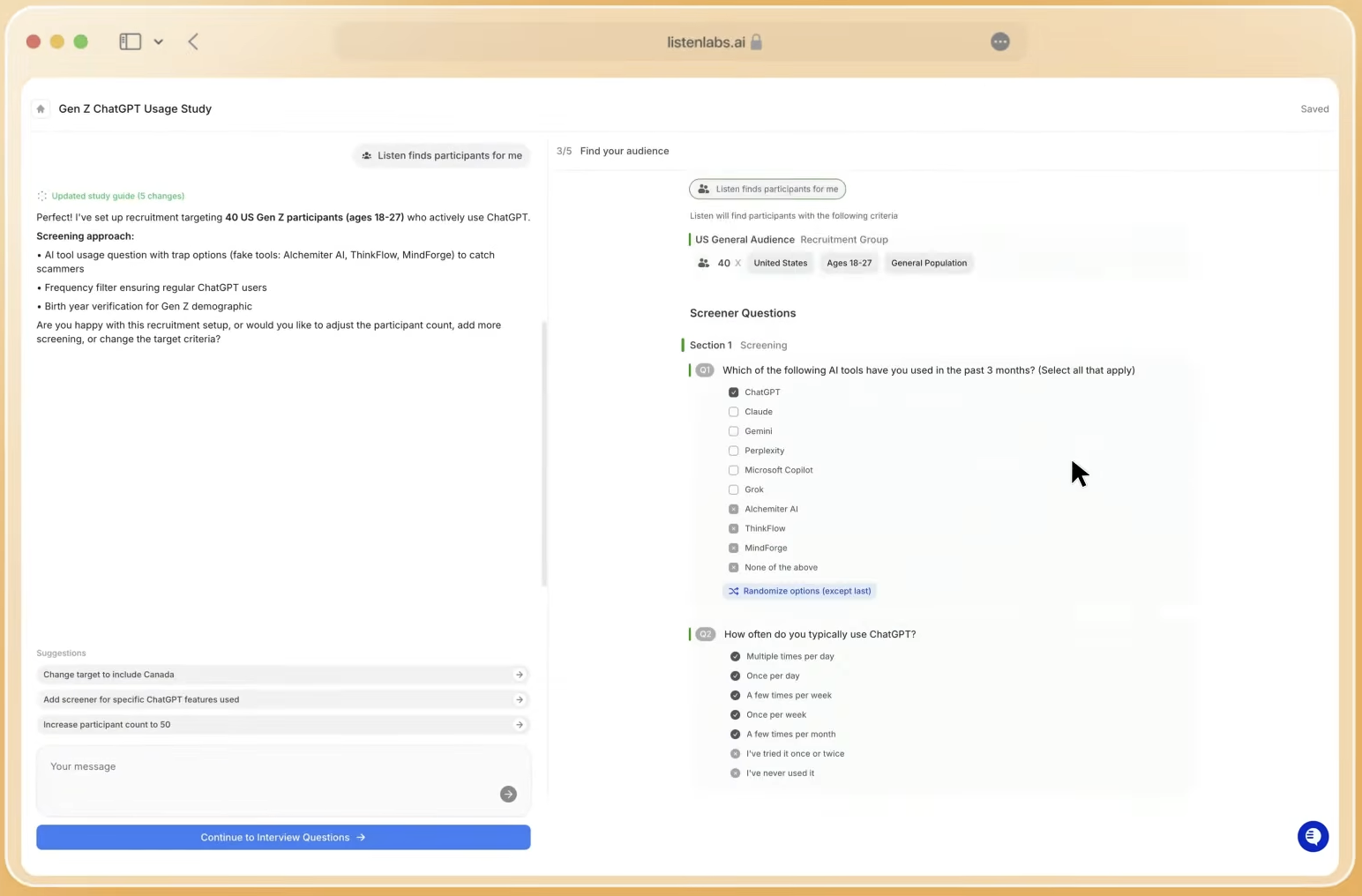
Fraud prevention. Survey platforms often face response fraud from bots and professional respondents, which distorts both shopper and consumer signals. Listen Labs’ three-layer Quality Guard addresses fraud at three points in the participant lifecycle. Before recruitment, behavioral matching screens on intent and past actions rather than self-reported demographics, which filters out mismatched profiles. During interviews, real-time AI monitoring across video, voice, content, and device signals detects fraud and low-effort responses as they occur. After completion, a reputation scoring system compounds across every interview on the platform, so panel quality improves over time. Participants are limited to three studies per month to prevent panel fatigue and eliminate professional survey-takers.
Enterprise compliance. Listen Labs holds SOC 2 Type II, GDPR, ISO 27001, ISO 27701, and ISO 42001 certifications. Customer data never trains AI models. Voice recordings collected during AI-moderated interviews qualify as biometric data under GDPR, and Listen Labs’ data handling architecture meets that standard across all supported markets.
Turnaround speed. The full research lifecycle, including study design, recruitment, AI-moderated interviews, analysis, and deliverable generation, follows the same overnight turnaround described earlier. Platforms like Listen Labs add auto-recruiting, transcription, sentiment tagging, and insight summarization, so teams move from question to findings in hours instead of weeks.
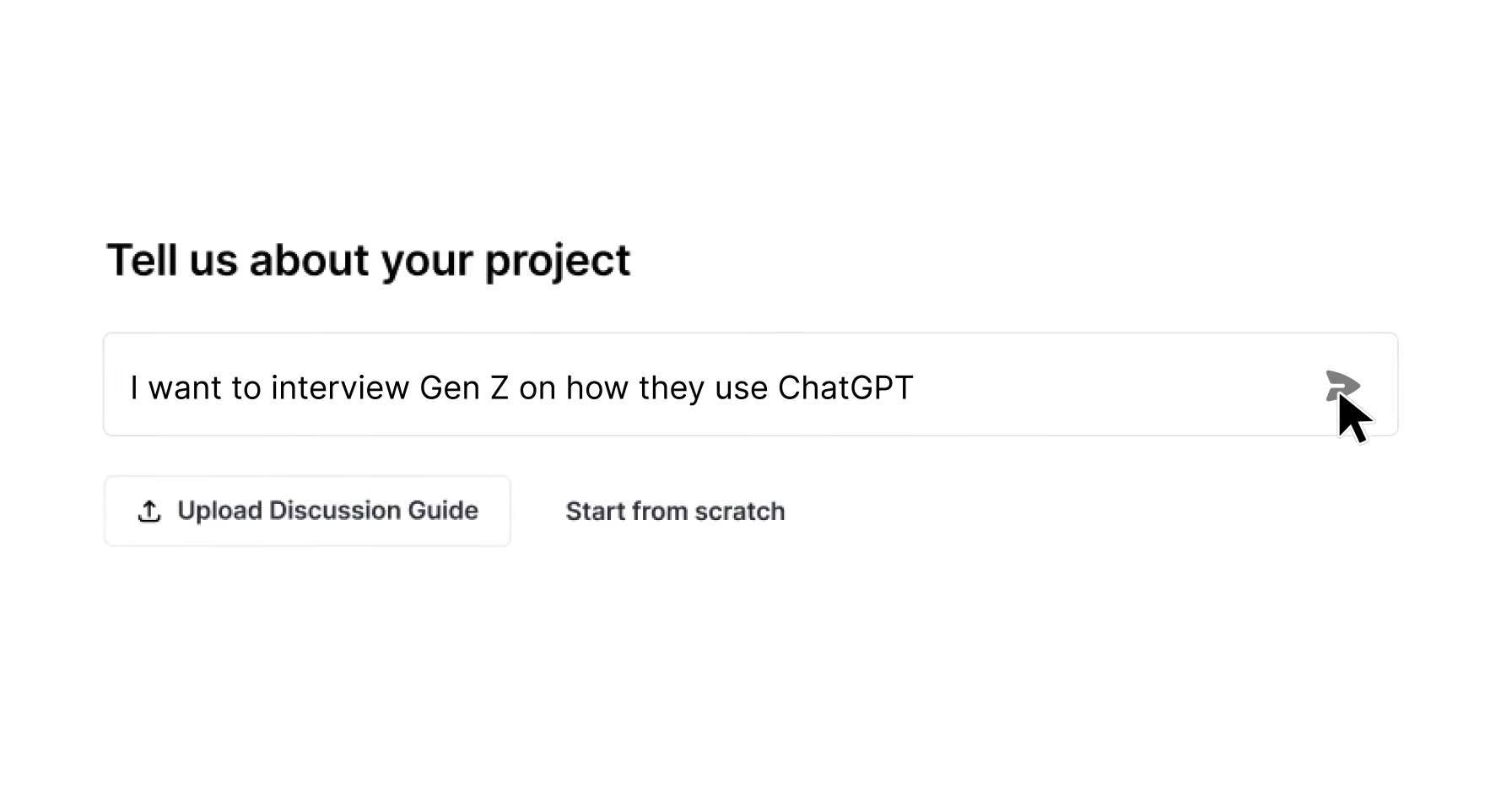
Analytical depth. The Research Agent generates automated key findings, themes, and personas. It supports chat-based analysis in natural language and produces one-click deliverables, including slide decks, memos, highlight reels, and statistical charts in under a minute. Mission Control serves as the organization’s permanent source of truth across all studies, enabling cross-study queries and trend tracking that compound in value over time.
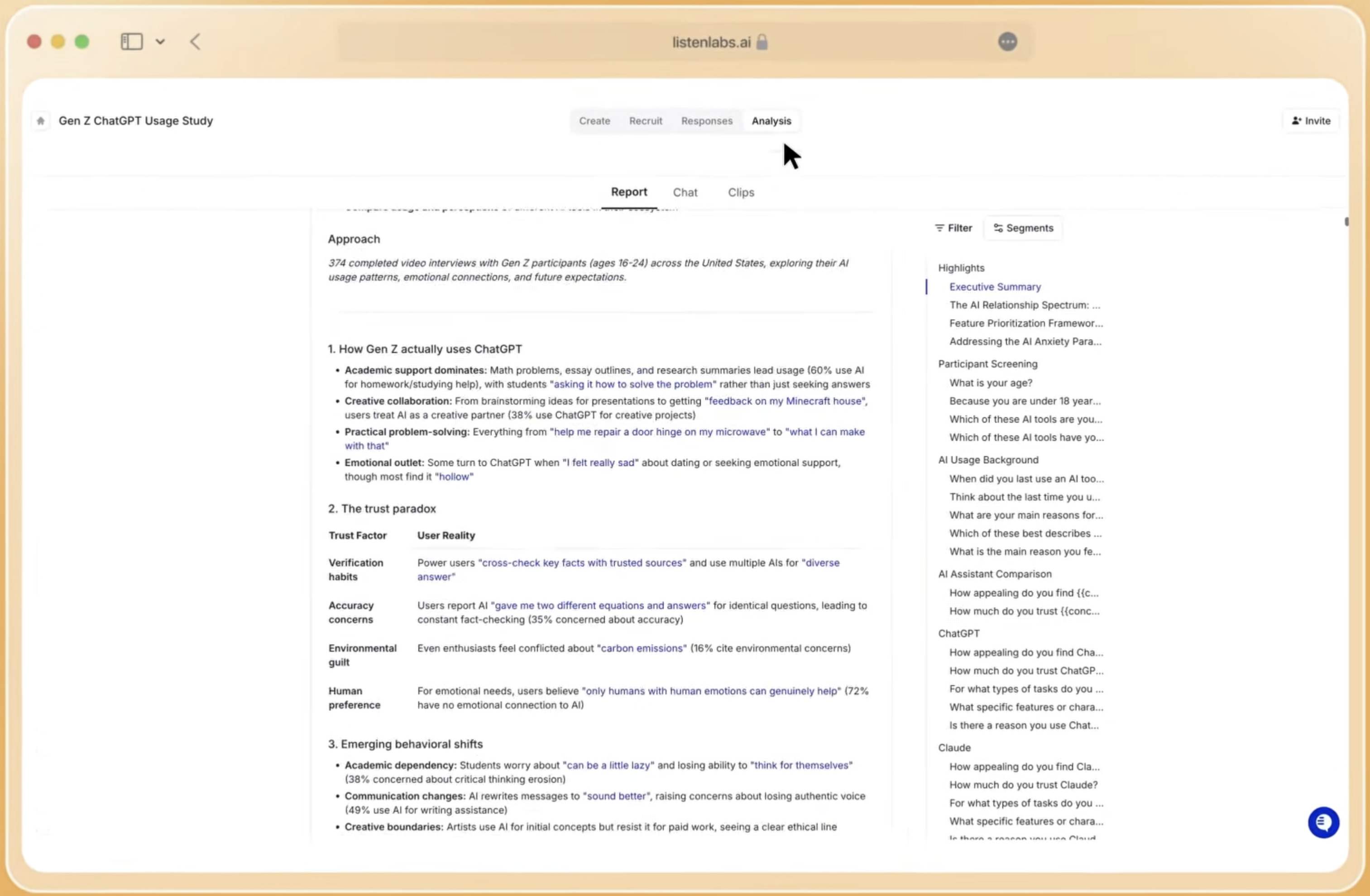
Teams can see how Listen Labs’ end-to-end platform handles CPG consumer insights from study design through final deliverable, without the fragmentation of legacy research stacks.
Checklist for Moving to AI-Moderated Consumer Research
CPG insights teams considering a shift to AI-moderated qualitative research can use this sequence to assess readiness, connect the change to business impact, and define a pilot.
- Audit current research velocity. Measure how many consumer insight studies the team completes per quarter and how many requests go unfulfilled because of backlog or budget. This baseline shows the gap between demand and capacity.
- Map the timeline bottlenecks. Identify where the current process loses the most time, such as recruitment, fieldwork scheduling, analysis, or reporting. This step reveals where AI-moderated interviews, which compress all four stages, will create the fastest time savings.
- Identify the highest-priority unanswered questions. List the business decisions currently made without consumer insight because the research cycle runs too slowly. These questions, which are often sacrificed to timeline constraints, make ideal first studies on Listen Labs because speed creates clear strategic value.
- Assess panel quality risk. Review whether current syndicated or panel sources are verified against fraud and whether participants face limits on study frequency. If not, data quality may already be compromised, and Quality Guard can close that gap.
- Confirm compliance requirements. Clarify whether the team operates across EU markets that require GDPR compliance and whether current or potential platforms hold SOC 2, ISO 27001, ISO 27701, and ISO 42001 certifications. This step prevents rework later in procurement and legal review.
- Evaluate emotional signal capture. Check whether current methods capture tone, micro-expressions, and hesitation or only self-reported ratings. For creative testing and concept comparison, the gap between stated and felt response often explains why shopper behavior diverges from survey results.
- Define the pilot scope. Select a single study, such as concept validation, brand perception, or churn analysis, and run it in parallel with a traditional approach. This side-by-side comparison demonstrates the speed and quality difference in the team’s own context.
71% of CPG leaders had adopted AI in at least one business function by 2024, nearly doubling from 42% the prior year. The shift from project-based syndicated research to continuous AI-moderated consumer intelligence has already started and now defines how leading CPG teams operate.
Listen Labs turns a research request into results using the same 24-hour cycle and one-third cost structure described earlier, with enterprise-grade compliance and a 30-million-respondent panel that reaches any consumer segment in any market. The research backlog shrinks. The team’s output multiplies. The gap between what happened at the shelf and why it happened finally closes.
Teams can see how CPG consumer insights groups at P&G, Nestlé, and Skims now run more research in a week than they previously completed in a quarter.
Frequently Asked Questions
What is the difference between shopper data and consumer insights in CPG?
Shopper data captures behavior at or near the point of purchase, including POS transactions, basket composition, shelf navigation, promotional response, and retailer loyalty feeds. It answers questions about what sold, where, when, and in what combination. Consumer insights capture the motivations, beliefs, and emotional drivers of the person behind the purchase, such as why they chose a brand, what would make them switch, and which unmet needs exist in the category. The same individual functions as both a shopper and a consumer at different times. A category manager optimizing a planogram needs shopper data. A brand manager validating a new product concept needs consumer insights. The most effective CPG research programs combine both and route each business question to the right data source before fieldwork begins.
How does Listen Labs differ from traditional syndicated panel providers like NielsenIQ or Circana?
Syndicated providers deliver quantitative category benchmarks, including what moved, at what price, and with what promotional support, with a one- to two-week data lag. They do not explain why those outcomes occurred. Listen Labs conducts AI-moderated qualitative interviews that surface the motivations, switching triggers, and unmet needs behind the numbers. The two approaches work together rather than compete. Syndicated data identifies the signal, and Listen Labs consumer interviews explain it. The operational difference centers on speed and cost. A traditional agency study often takes 4–8 weeks and costs $15,000–$75,000. Listen Labs delivers more than 200 depth interviews using the same overnight turnaround and one-third cost structure referenced earlier, with automated analysis and consultant-quality deliverables included.
How does Listen Labs ensure participant quality and prevent fraud in CPG consumer research?
Listen Labs operates a three-layer Quality Guard system. First, the platform works only with high-quality, non-commodity panel sources, which removes professional survey-takers and incentive-optimized respondents. Second, Quality Guard applies real-time AI monitoring across video, voice, content, and device signals during every interview. This monitoring detects fraud, low-effort responses, AI-generated scripts, and mismatched profiles before they contaminate the dataset. Third, a dedicated recruitment operations team adds a human review layer, and participants are limited to three studies per month to prevent panel fatigue and eliminate repeat respondents. The reputation scoring system compounds across every interview conducted on the platform, so panel quality improves continuously as Listen Labs scales, which creates a structural advantage over commodity panels.
Can Listen Labs support global CPG research across multiple markets simultaneously?
Yes. Listen Labs covers more than 45 countries across the Americas, Europe, APAC, and MEA, with interview moderation supported in over 100 languages and Emotional Intelligence available across more than 50 languages. The Listen Atlas AI orchestration layer recruits participants across multiple panel partners and proprietary databases at the same time, so multi-market studies field in parallel rather than sequentially. A CPG team testing a concept across five markets can receive results from all five within the same 24-hour cycle instead of running sequential studies over several months. The platform’s compliance architecture, including SOC 2 Type II, GDPR, ISO 27001, ISO 27701, and ISO 42001, meets the most stringent applicable standard across jurisdictions without requiring country-by-country ethical review for each study.
What types of CPG consumer research studies does Listen Labs support?
Listen Labs supports the full range of consumer insight study types relevant to CPG brand, product, and insights teams. These include concept and prototype testing, creative and ad testing, packaging evaluation, brand perception and equity research, consumer journey mapping, segmentation studies, pricing sensitivity research, innovation pipeline validation, churn and switching analysis, and multi-market localization studies. The platform handles both one-off studies and ongoing continuous intelligence programs. Study design is AI-assisted. Researchers describe their objectives in natural language and the platform drafts structured questions, probing context, and screening criteria. Advanced stimuli support includes images, video, audio, PDFs, and live URLs, with monadic or sequential randomization, quotas, branching, and skip logic available for complex study designs.