Written by: Anish Rao, Head of Growth, Listen Labs
Key Takeaways
- Traditional CPG research cycles take 4–12 weeks because recruitment, fieldwork, analysis, and reporting happen in sequence, which limits teams to 4–8 studies per quarter.
- AI-moderated interviews enable parallel workflows that compress the full research lifecycle from brief to deliverable into under 24 hours while maintaining 5–7 level laddering depth across hundreds of interviews.
- Listen Labs automates recruitment from a 30M+ verified network, runs simultaneous AI-moderated video interviews, captures emotional intelligence signals, and generates consultant-quality deliverables without manual coding or moderator fatigue.
- Enterprise CPG teams achieve 5–10× more studies per quarter at roughly one-third the cost while building a cross-study knowledge base that eliminates repeat work and compounds institutional learning.
- See how Listen Labs compresses your CPG research cycle to under 24 hours by booking a demo.
The Legacy 4–6 Week Sequential Workflow and Its Bottlenecks
A typical enterprise qualitative research workflow follows this sequential timeline: Week 1 finalizes the discussion guide and recruits participants, Week 2 schedules interviews around moderator and participant availability, Weeks 3–4 conduct 20–30 interviews limited by moderator capacity, Week 5 transcribes recordings and begins synthesis, Week 6 creates presentation decks, with insights reaching decision-makers by Weeks 7–8. This stage-by-stage breakdown shows where time is actually lost.
- Recruitment (1–2 weeks): Scheduling constraints, such as recruiting 20 participants, confirming availability, managing time zones, handling no-shows, and rescheduling, typically consume 2–3 weeks with no insights produced during this phase. Audience specialization can extend recruitment timelines by 2–4 additional weeks when targeting niche B2B audiences, medical professionals, or ultra-high-net-worth consumers.
- Fieldwork (1–2 weeks): A senior moderator can run only 4–6 in-depth interviews in a day before fatigue dulls probing depth, so scaling a study to 50 participants often requires 2–3 weeks of moderator time alone, before recruiting or analysis begins.
- Analysis (1–2 weeks): Manual synthesis, including coding transcripts, identifying themes across 20 hours of conversation, and building a stakeholder-ready report, typically requires another 2–3 weeks after fieldwork closes.
- Reporting (3–5 days): Stakeholder review cycles for research instruments can add 1–3 weeks to traditional qualitative project timelines before fieldwork even begins.
Recruitment and fieldwork logistics often consume a substantial share of total project time in traditional agency qualitative research while contributing none of the strategic value clients pay for. The structural result is a research program that is episodic by necessity rather than continuous by design. Teams that want continuous learning need a different operating model.
Parallel AI Workflows That Shorten CPG Research Cycles
The core mechanism for reducing consumer research cycle time in CPG is replacing sequential hand-offs with parallel execution. AI-moderated video interviews restructure sequential steps such as recruitment, moderation, transcription, translation, and synthesis into a parallel automated workflow, compressing typical concept or packaging studies from 6–12 weeks to days while maintaining adaptive probing depth.
AI moderation allows 200–300+ depth interviews using 5–7 level laddering with verified category purchasers to be completed in parallel within 24 hours, removing the traditional trade-off between qualitative depth and scale that limited human moderators to 4–6 interviews per day. The key readiness test for a truly parallel platform is straightforward. If doubling the sample size doubles the timeline, the process is still constrained by sequential human moderation. Listen Labs passes that test, because the platform conducts thousands of AI-moderated interviews simultaneously, and the timeline remains flat regardless of sample size.
With qual-at-scale, the old trade-off between depth and scale is no longer a barrier. Platforms like Listen Labs layer on auto-recruiting, transcription, sentiment tagging, and insight summarization so teams move from question to findings in hours, not weeks.
7-Step 24-Hour Research Sprint for CPG Teams
This sprint compresses the full qualitative research lifecycle from brief to board-ready deliverable into a single business day. The timeline runs Hours 0–1 for steps 1–2, Hours 1–4 for step 3, Hours 4–20 for steps 4–5 running in parallel, and Hours 20–24 for steps 6–7.
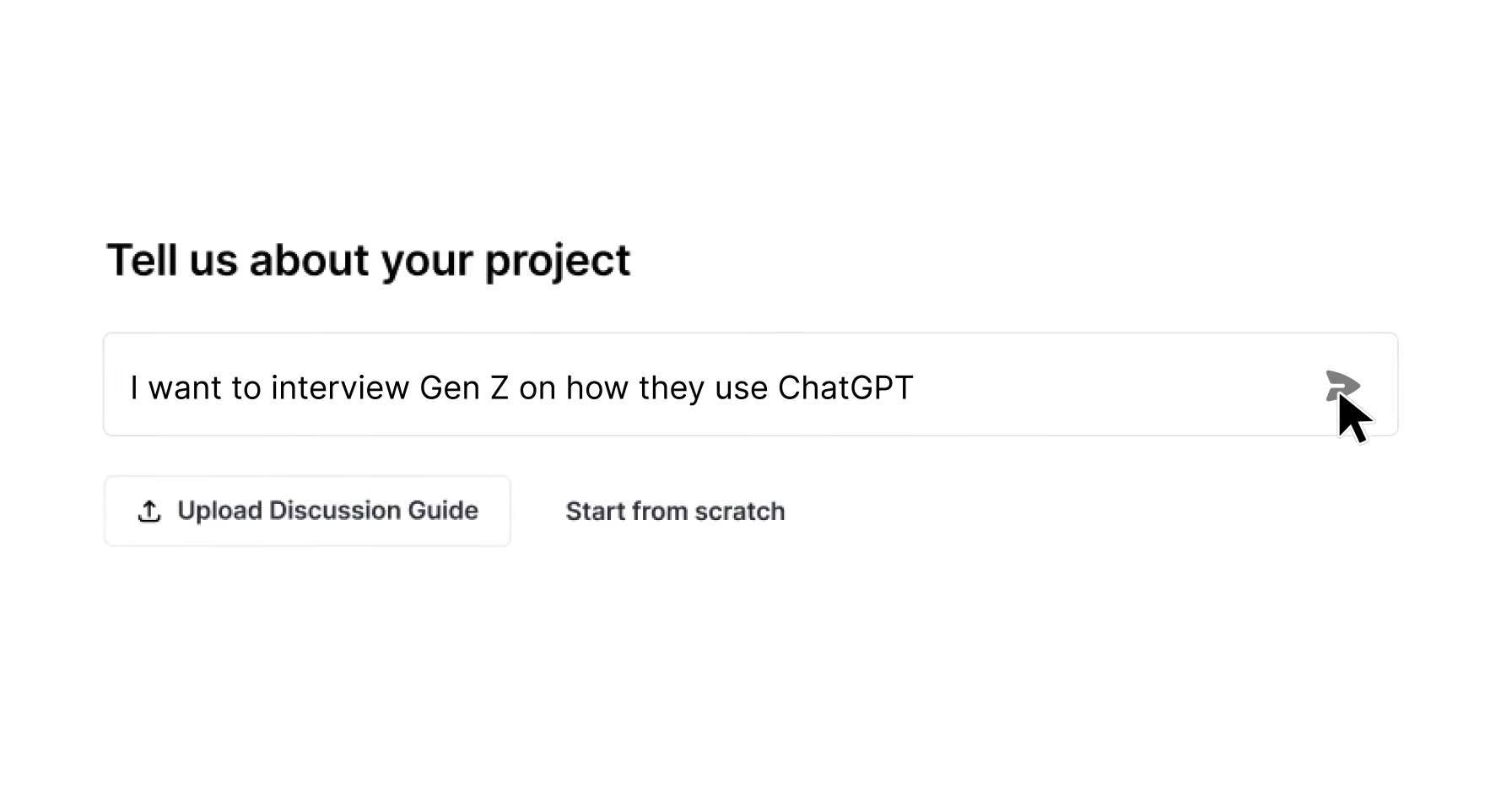
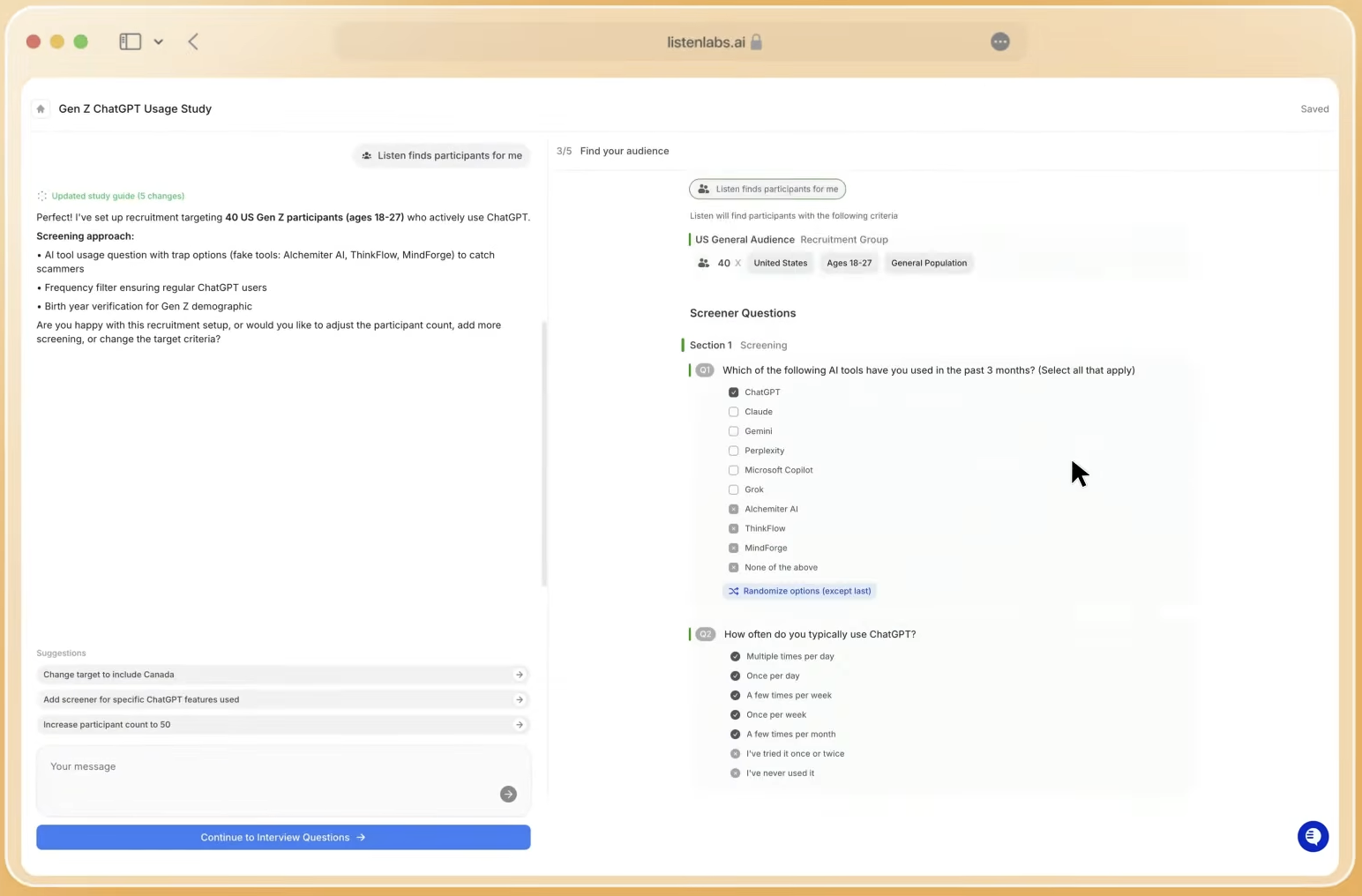
- Define the objective in natural language. The researcher describes the business question in plain language, with no methodology expertise required. Listen Labs’ AI interprets the goal and structures it into a researchable brief.
- AI co-designs the discussion guide. The platform drafts structured objectives, questions, and probing context in seconds. It draws on proprietary data from tens of thousands of completed studies to select question types that produce high-quality analysis.
- Recruit from the 30M+ verified network. Listen Atlas, Listen Labs’ AI orchestration layer, automatically matches and bids on the best participants across its global panel of 30M verified respondents spanning 45+ countries. To ensure these participants meet quality standards, Quality Guard screens in real time for fraud, low-effort responses, and repeat participants. When automated matching cannot reach specialized audiences such as enterprise decision-makers, healthcare workers, or consumers below 1% incidence rate, a dedicated recruitment ops team steps in to source from niche networks.
- Run parallel AI-moderated interviews. Hundreds of adaptive, one-on-one video interviews run simultaneously. The AI probes deeper on short or interesting answers, maintains the laddering depth established in the methodology, and captures video, audio, and text, all without moderator fatigue or scheduling constraints.
- Capture emotional intelligence signals. While interviews run, Listen Labs’ Emotional Intelligence layer analyzes tone of voice, word choice, and subconscious micro-expressions in parallel. It quantifies emotions per question and concept with timestamp-level traceability.
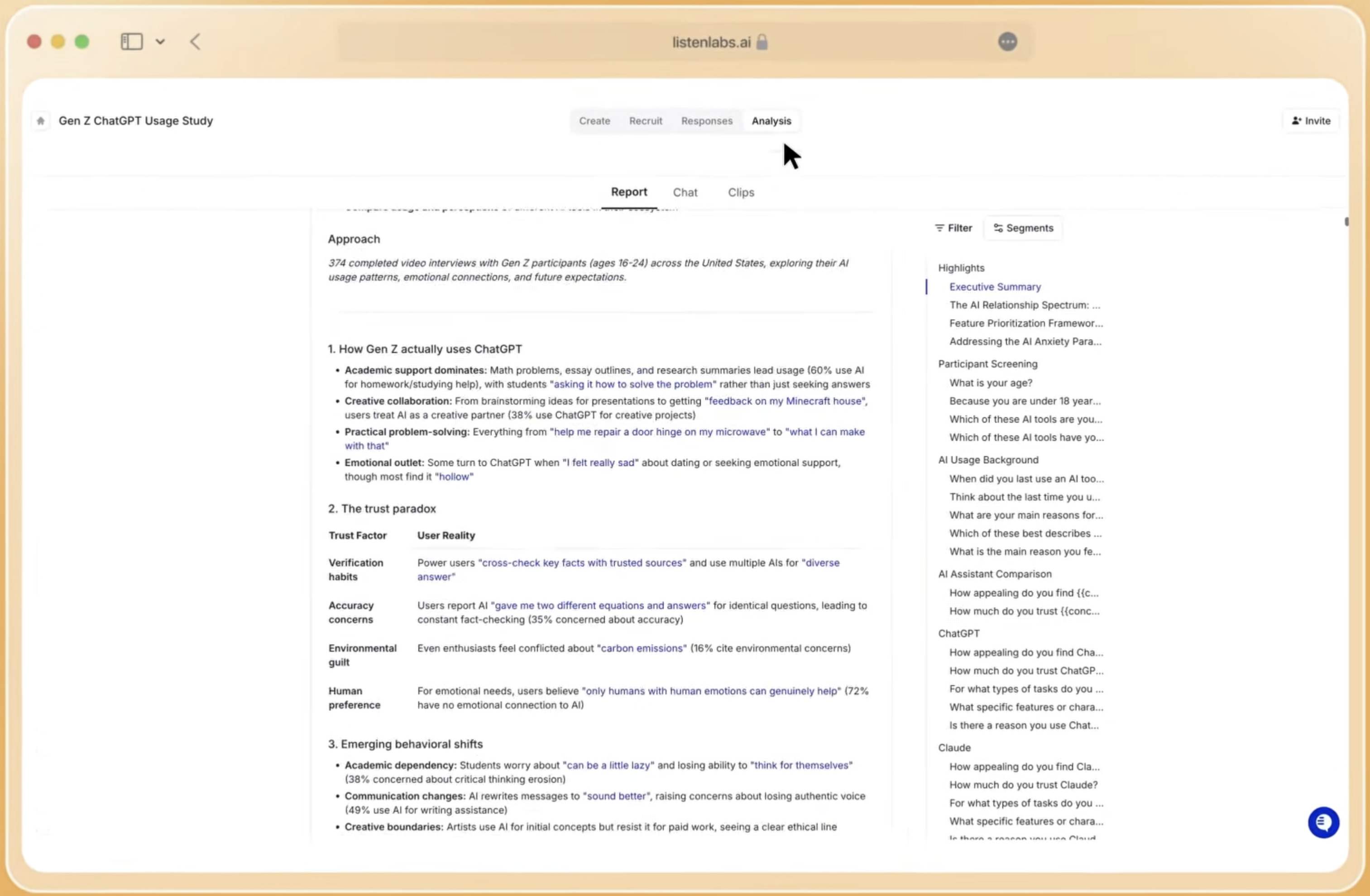
- Automated analysis and synthesis. Research Agent handles the full analysis workflow from raw data to final output. One researcher ran a full buying intent analysis across three user segments in under a minute. Themes, personas, statistical comparisons, and segmentations are generated without manual coding.
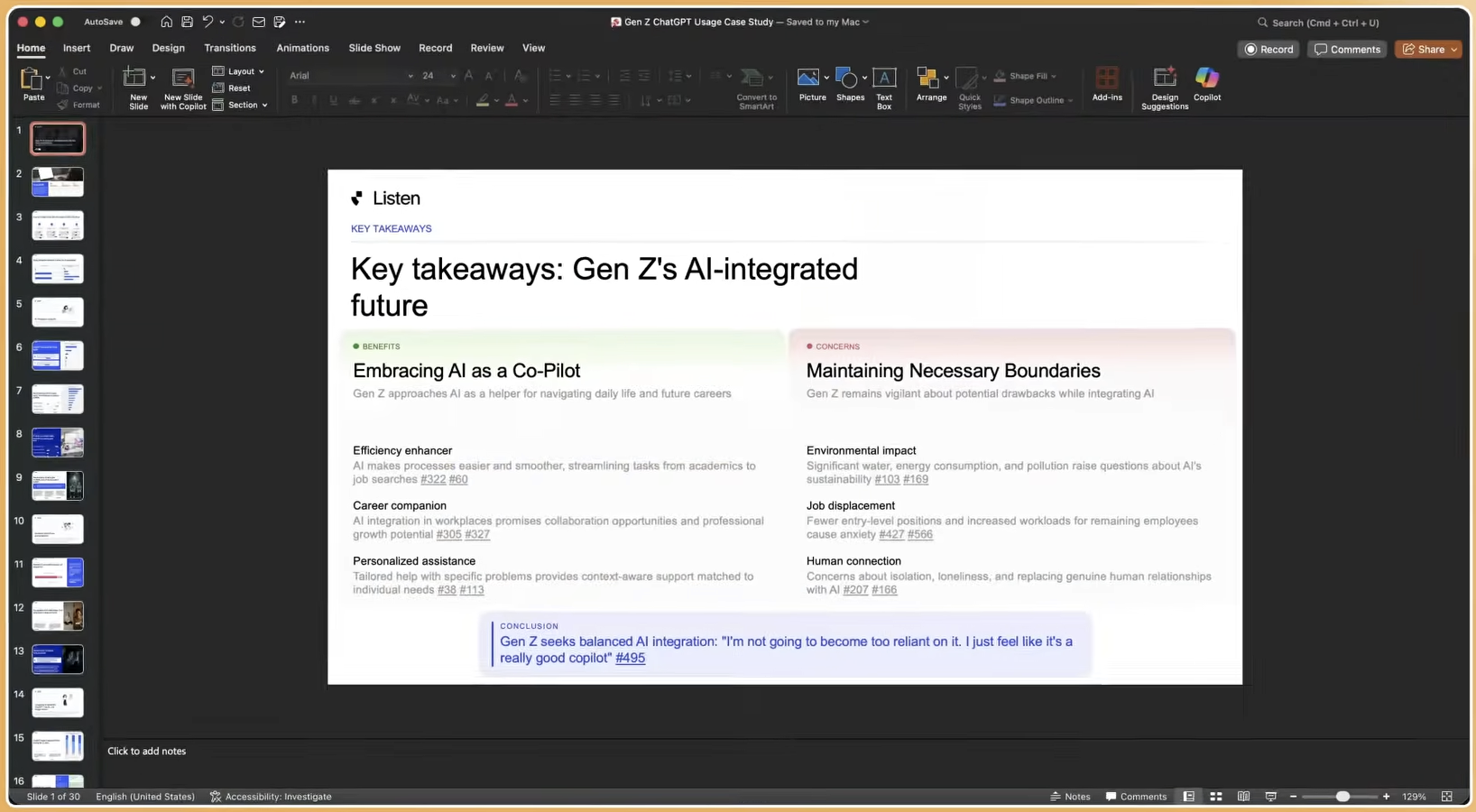
- Generate deliverables and update the knowledge base. Consultant-quality slide decks, memos, video highlight reels, and charts are produced in under a minute. Every finding is automatically added to Mission Control, the organization’s cross-study knowledge base, so institutional learning compounds with each sprint.
Traditional vs. AI-Moderated Research: Timeline and Cost Comparison
Cost estimates for traditional agency work reflect published benchmarks for focus groups and depth interviews via agency taking several weeks.
Traditional agency timelines for studies typically run multiple weeks, while Listen Labs completes the same study in under 24 hours at a fraction of the cost. For larger studies, traditional timelines extend further, while Listen Labs holds the same one-day window at significantly lower spend.
How AI-Moderated Interviews Preserve Depth at Scale for CPG
CPG teams can accelerate product development timelines without sacrificing qualitative depth. Listen Labs addresses depth concerns through three mechanisms. First, the AI moderator conducts adaptive follow-ups, probing deeper on short or ambiguous answers in the same way a trained human interviewer would, and it does this consistently from the first interview to the 200th without fatigue. Second, the platform supports 100+ languages for interview moderation, with automatic translation and transcription, so multi-market studies run simultaneously rather than sequentially across regions. Third, every interview follows a structured laddering approach that moves from product attributes to functional benefits, emotional benefits, and core personal values, the same methodology that produces motivation maps that predict repeat purchase behavior.
Listen Labs has run over 1 million AI-powered customer interviews for companies including Microsoft, Perplexity, and Sweetgreen, which shows that enterprise-grade depth holds at scale.
Emotional Intelligence Signals for Richer Consumer Insights
CPG teams gain a clearer picture when they see both what people say and what they feel. Listen Labs’ Emotional Intelligence feature analyzes three simultaneous signal layers, which are tone of voice, word choice, and subconscious micro-expressions, to surface emotions that transcripts alone miss. Built on Ekman’s universal emotions framework, the same standard used in clinical psychology and UX research, it tracks anger, anticipation, disgust, fear, joy, sadness, trust, and surprise. Every emotion is quantified per question and per concept, and every label is traceable to the exact timestamp, verbatim quote, and the reasoning behind the classification. Available across 50+ languages, Emotional Intelligence integrates directly with the Research Agent, enabling natural-language queries such as “which concept triggered the most confusion?” with side-by-side emotional breakdowns across stimuli, segments, and markets.
Mission Control: Turning Studies into a CPG Knowledge Base
CPG research findings from past studies often live in scattered slide decks and individual researchers’ memories. Manual cross-study synthesis commonly fails because evidence traceability collapses, contradictions between quantitative and qualitative signals stay hidden, and methodological context is lost over time gaps between studies. Mission Control, Listen Labs’ cross-study knowledge base, serves as the organization’s single source of truth for everything ever learned from consumers.
Each study automatically grows the knowledge base, enabling cross-study queries, trend tracking, and institutional knowledge building. Teams retrieve answers from past research in seconds without digging through old reports, and a searchable insight library that links every theme back to original video clips and verbatim quotes enables CPG teams to query prior studies by theme or segment, turning episodic research into cumulative institutional memory.
Common Challenges When Accelerating CPG Product Development Timeline
CPG insights leaders encounter several practical challenges when shifting from sequential to parallel research models.
- Quality assurance: Listen Labs addresses this through Quality Guard, which uses real-time AI monitoring across video, voice, content, and device signals to detect fraud, low-effort responses, and mismatched profiles. Participants are limited to 3 studies per month, which eliminates professional survey-takers.
- Compliance and data security: The platform holds SOC 2 Type II, GDPR, ISO 27001, ISO 27701, and ISO 42001 certifications. Customer data is never used for AI model training.
- Hard-to-reach audiences: A dedicated recruitment ops team partners with niche communities and specialized networks to source audiences below 1% incidence rate, including enterprise decision-makers, engineers, and healthcare workers.
- Stakeholder trust: Stakeholder trust is strengthened by timestamped video evidence that lets decision-makers watch consumers articulate findings directly, rather than relying only on a summarized report.
- Change management: Listen Labs functions as a force multiplier for existing research teams, not a replacement. Researchers shift from logistics and manual coding to strategic analysis and decision support.
Measuring Success with CPG Research Cycle Time KPI
Four metrics define a mature CPG research cycle time KPI framework.
- Studies per quarter: Baseline the current number and track the multiplier after adopting parallel AI-moderated workflows. Agile frameworks can deliver more learning cycles per year compared to the traditional model, which represents a significant increase in learning velocity at comparable or lower total cost.
- Time-to-insight: Measure elapsed hours from study brief submission to stakeholder-ready deliverable. The target benchmark is under 24 hours.
- Cost per insight: Divide total research spend by the number of actionable findings delivered. Listen Labs enterprises run more studies while significantly reducing per-study expenses.
- Stakeholder satisfaction: Track citation frequency of research findings in QBR decks, brand plans, and capital requests. Teams that shape decisions show higher citation frequency of research findings in QBR decks and brand plans, while low citation frequency signals that the work functions as decoration rather than evidence.
Enterprise Deployment Considerations for CPG Insights Teams
Enterprise deployments of Listen Labs include SSO integration and enterprise-grade security with 256-bit encryption. The platform’s compliance posture, including SOC 2 Type II, GDPR, ISO 27001, ISO 27701, and ISO 42001, satisfies procurement requirements at Fortune 500 CPG organizations. Self-recruitment is fully supported, which allows organizations to study their own consumer panels at reduced credit cost. Multi-market adaptation is handled natively, so studies run simultaneously across 45+ countries in 100+ languages, with automatic translation and transcription, and a global packaging study that previously required sequential agency engagements across three markets now completes in a single parallel workflow within 24 hours.
Case Studies: Moving from 6 Weeks to One-Day Research
Procter & Gamble: P&G needed to evaluate how men respond to new product claims before committing innovation investment. Listen Labs delivered 250+ interviews with quantified themes and verbatim proof in hours, not weeks. The study surfaced where claims felt exaggerated or unclear before market launch and showed that comfort, safety, and reliability matter far more than novelty, which directly shaped product and brand strategy. “Listen Labs has been a huge help,” said the Analytics and Insight Leader at P&G.
Microsoft: Microsoft needed to collect global customer stories for its 50th anniversary celebration at a scale and speed no traditional agency could match. Listen Labs gathered those video stories within a single day. “We wanted users to share how Copilot is empowering them to bring their best self forward, and we were able to collect those user video stories within a day. Our leadership team was very thrilled at both the speed and the scale that Listen Labs enabled. I can reach out to hundreds of users at one third of the cost,” said the Director of Data Science at Microsoft.
Skims: Skims needed to validate a global campaign direction with thousands of high-income buyers overnight to de-risk a board-level launch decision. Listen Labs identified and qualified thousands of premium consumers overnight, which eliminated weeks of recruiting and panel sourcing. The qualitative clarity secured board-level buy-in. “I always struggled with understanding the why and Listen Labs nails this for me,” said the SVP Data, Insights, Loyalty at Skims.
Frequently Asked Questions
Conclusion: Launch Your First 24-Hour Research Sprint
The sequential 4–6 week research process functions as a structural constraint rather than a fixed industry standard. CPG insights teams that shift to parallel AI-moderated workflows on Listen Labs run 5–10× more studies per quarter while cutting research spend by two-thirds, deliver the same cycle in a single day, and build a compounding cross-study knowledge base that eliminates repeat work. P&G, Microsoft, and Skims have each validated this model at enterprise scale. The platform handles the entire lifecycle, including study design, global recruitment from 30M+ verified respondents, AI-moderated interviews in 100+ languages, Emotional Intelligence analysis, automated synthesis, and deliverable generation, in a single end-to-end workflow.
Start your first one-day research sprint with Listen Labs by requesting a demo.