
Written by: Anish Rao, Head of Growth, Listen Labs
Key Takeaways for CPG Insights Leaders
- Agile survey validation turns traditional 4–6 week CPG research cycles into continuous, sub-24-hour learning loops by pairing statistical instruments with behavioral proxies and AI-powered verification.
- Real-time benchmarking against normative databases lets teams interpret survey scores with live category context instead of waiting weeks for static reports.
- Behavioral proxies, integrated physical-to-digital testing, and AI-moderated interviews close the attitude–behavior gap by checking stated preferences against actual purchase data and emotional signals.
- AI-powered Quality Guard and synthetic validation layers detect fraud, low-effort responses, and replicate 90% of key conjoint outcomes, producing defensible, board-ready evidence at enterprise scale.
- Listen Labs delivers this five-pillar framework as a single end-to-end system. See how Listen Labs compresses validation cycles to under 24 hours—book your demo.
Pillar 1: Real-Time Benchmarking Against Normative Databases
Survey scores only gain meaning when anchored to category norms, competitive sets, and historical launch data. A 62% purchase intent figure can signal a green light in one category and a red flag in another. Real-time benchmarking connects agile survey results to that context at the moment of data collection instead of weeks later in a static report.
AI-powered brand tracking demonstrates stronger predictive accuracy than traditional methods, helping CPG teams forecast how shifting perceptions will affect sales before results appear in the numbers. To achieve this predictive advantage in your own surveys, apply the following five-step checklist before fielding any agile survey so every score is interpreted against current category context rather than in isolation:
- Define the category benchmark set using syndicated sources such as Circana or NielsenIQ, which refresh scanner-level sales and share figures weekly or every four weeks rather than quarterly.
- Pull historical concept scores for the same claim territory from your internal study archive or a normative database before writing survey questions.
- Set pre-defined success thresholds, such as requiring at least 60% of participants to rank a claim in their top three, so go/no-go decisions do not shift after results arrive.
- Flag any result that falls within five percentage points of the category norm for immediate qualitative follow-up instead of treating it as a simple pass or fail.
- Document benchmark sources and refresh dates in every deliverable so governance reviewers can confirm that each comparison uses current data.
Pillar 2: Behavioral Proxies and Choice-Based Modeling for Real-World Validation
Meta-analyses report attitude–behavior correlations of r ≈ .38–.41 in self-report studies, and correlations often drop further when researchers use objective behavioral measures. MaxDiff and conjoint exercises improve on simple rating scales by forcing trade-offs, yet they still operate in a stated-preference environment. Behavioral proxies connect these models to what people actually buy.
Transactional analysis of POS and ecommerce orders reveals what people actually bought, which often disagrees with stated preferences captured in surveys. This mismatch makes validation of stated preference against observed action essential. Practical steps for this pillar include the following four validation techniques, each designed to test whether stated preferences predict actual purchase behavior:
- Pair MaxDiff attribute rankings with verified purchase data from retail loyalty or receipt-matching panels to see whether stated top attributes match real basket composition.
- Use cohort analysis to check whether a January launch cohort behaves differently than a March cohort six months later, separating promotional influence from sustained demand.
- Apply regression analysis to isolate which variables, such as price, promotional depth, claim, or retailer, move volume, then compare those drivers against conjoint utility scores to spot where the model diverges from observed behavior.
- Screen survey respondents on verified purchase frequency instead of self-reported category involvement. Nearly 70% of respondents misreport critical purchase details such as frequency, spend, and brand choice, which creates a recall gap that undermines survey accuracy.
Pillar 3: Integrated Physical-to-Digital Testing with IHUT and Agile Surveys
In-home usage tests, or IHUTs, reveal consumption occasions and usage contexts that central-location tests and surveys miss. Two- to four-week IHUT placements capture consumption occasions and usage contexts that central-location tests cannot reveal, giving teams richer behavioral data than surveys alone. The core challenge involves linking physical product experience to digital survey instruments without recall bias or operational delay.
A beverage brand’s packaging redesign test using AI-moderated interviews showed that participants liked Design A’s earth-tone palette but doubted brand transparency due to small ingredient font size. Surveys would have missed this nuance, and the team moved to a hybrid design before production tooling. A structured physical-to-digital integration protocol follows this sequence:
- Ship product to verified category purchasers with a mobile-first diary prompt that triggers at the moment of first use, not 48 hours later when recall degrades.
- Follow the diary entry with a short agile survey of no more than three screens, because longer formats cause completion rates to collapse below 10%. Cover sensory attributes, occasion fit, and purchase intent.
- Route low-intent or high-concern respondents directly into an AI-moderated interview so the team can probe specific friction points before they become launch risks.
- Aggregate diary entries, survey scores, and interview themes in a single analysis layer so physical and digital signals are interpreted together instead of in separate reports.
Pillar 4: AI-Powered Verification and Synthetic Validation Layers
Fraud and low-effort responses now affect a significant share of online research data. Kantar reports researchers are discarding on average 38% of survey data due to quality concerns. A single fraudulent cohort can flip a concept from pass to fail or hide a genuine consumer concern. AI-powered verification addresses this risk at the data-collection layer instead of relying on manual cleanup later.
Listen Labs’ Quality Guard monitors every interview in real time across video, voice, content, and device signals to detect fraud, low-effort responses, AI-generated scripts, and mismatched profiles. Participant activity is capped at three studies per month, which removes professional survey-takers from the pool. Trap questions and digital fingerprinting add further verification layers so the system evaluates both behavior and content. A 2026 study in Survey Practice recommends including at least one open-ended item in survey-based studies to detect poor-quality responses, including suspected AI-generated content. Listen Labs bakes this safeguard into its AI-moderated interview format, which always collects rich open-ended data.
Synthetic validation uses AI-generated digital twins built from first-party behavioral data to complement human responses. A Bain & Company analysis found that digital twins built from historical respondent-level data replicated approximately 90% of key outcomes from a prior large-scale quantitative conjoint study, including identification of the most influential features driving choices. Leading organizations use synthetic customers as a screening layer that narrows concept options before they commit to full human studies, while still relying on verified respondents for final decisions.
Pillar 5: Qual-at-Scale AI-Moderated Interviews for the “Why” Behind the Scores
Once survey data has been verified and synthetic validation has narrowed the concept set, the fifth pillar adds conversational depth that quantitative methods cannot capture. “Traditional surveys may tell us what people do, but it takes a conversation to understand why.” This pillar brings statistical confidence and emotional nuance together in a single workflow.
Listen Labs implements this pillar through four integrated components that operate as one system:
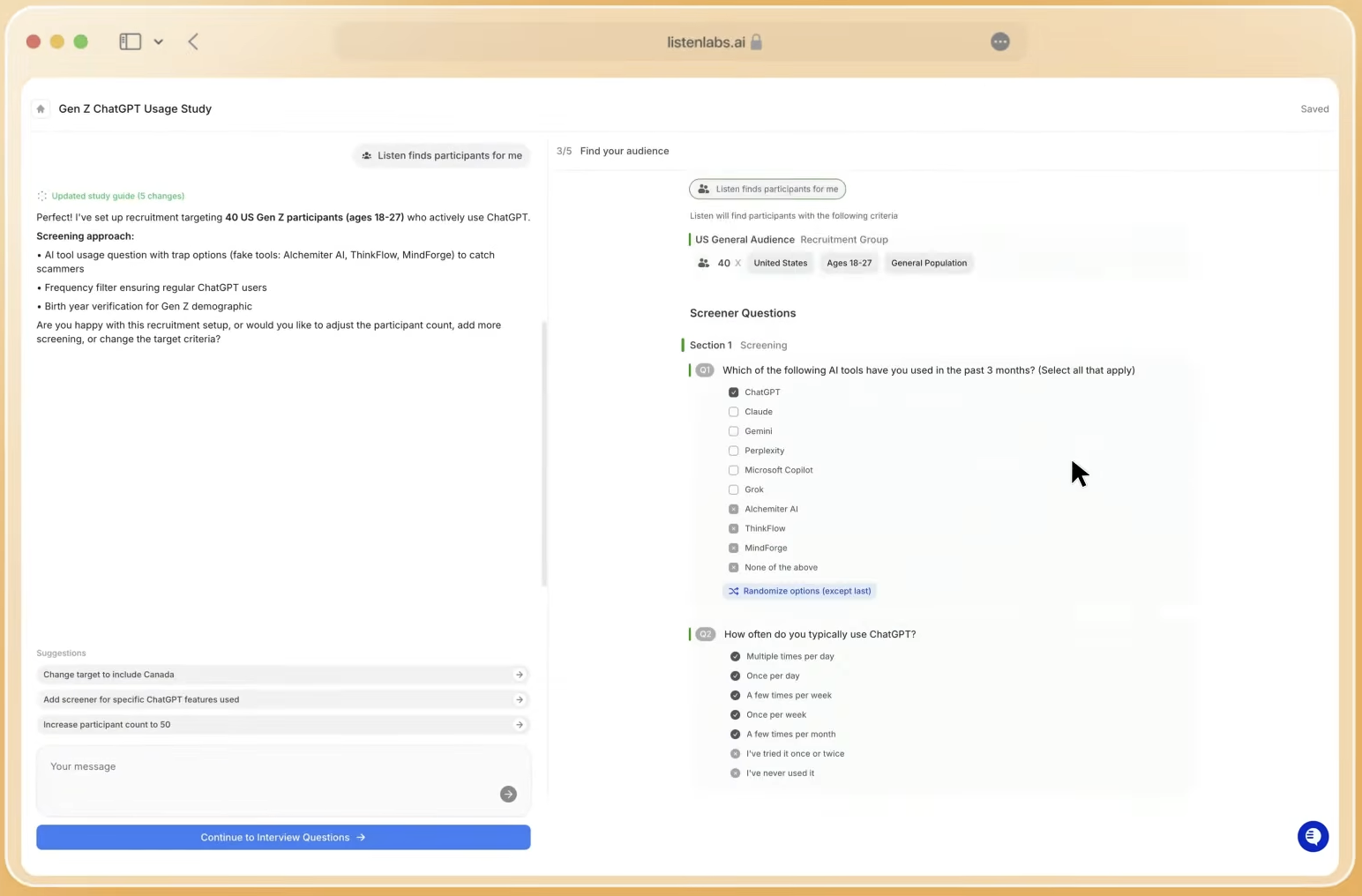
- 30M verified panel via Listen Atlas: AI orchestration matches and bids across behavioral and intent data, not just demographics, across 45+ countries and 100+ languages, with a dedicated recruitment operations team for audiences below 1% incidence rate.
- Quality Guard: Real-time fraud detection across video, voice, content, and device signals, with reputation scoring that compounds across every study conducted on the platform.
- Emotional Intelligence layer: Analyzes tone of voice, word choice, and subconscious micro-expressions to surface emotions that transcripts alone miss, built on Ekman’s universal six emotions framework, with every label traceable to the exact timestamp, verbatim quote, and AI reasoning behind it.
- Research Agent: Handles the full analysis workflow from raw data to final output. It generates slide decks, memos, highlight reels, statistical charts, and segmentation breakdowns in under a minute, with every insight linked directly to the underlying response data.
Experience all five pillars as a single end-to-end system in a live environment—schedule a demo.
The 3-Week Agile Validation Cycle Template
This three-week template shows how the five pillars work together as a continuous validation cycle for concepts, packaging, or messaging. Each week functions as a focused sprint, and the output from one week becomes the direct input for the next.
Week 1 — Quantitative Screening and Benchmarking
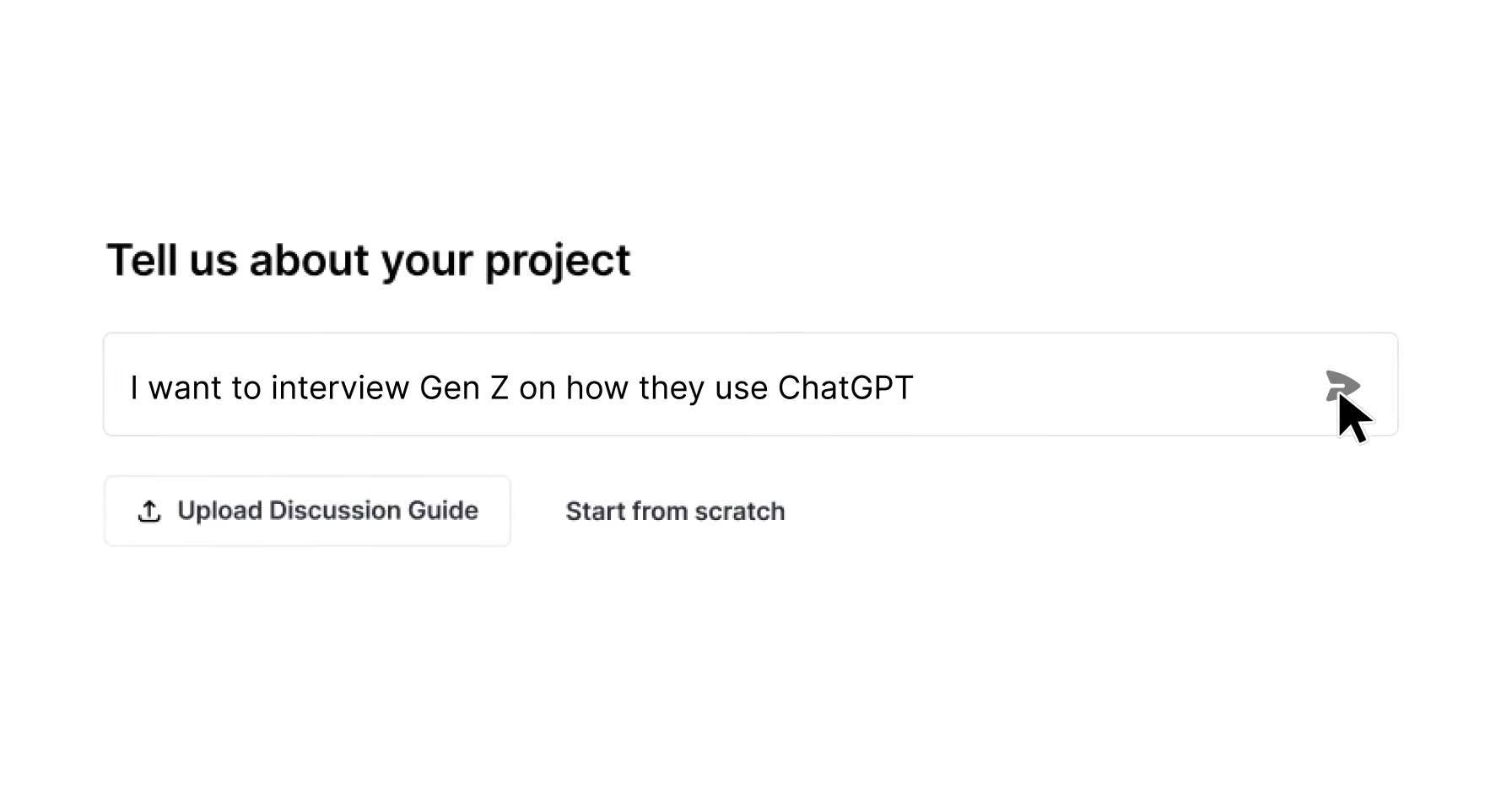
- Day 1: Define hypotheses, success thresholds, and normative benchmarks. Launch a 200-respondent agile survey with MaxDiff or monadic concept scoring among verified category purchasers. Initial results arrive within a day and set the baseline for all later phases.
- Day 2–3: Apply Quality Guard verification to ensure data quality, then cross-reference verified survey scores against category norms to identify which concepts merit deeper investigation. Flag any concepts within the margin for qualitative follow-up so the team can explore uncertainty instead of ignoring it.
- Day 4–5: Deliver a ranked concept shortlist with statistical significance testing and a brief that highlights the specific claims, design elements, or messages that require deeper exploration in Week 2.
Week 2 — Qual-at-Scale Validation
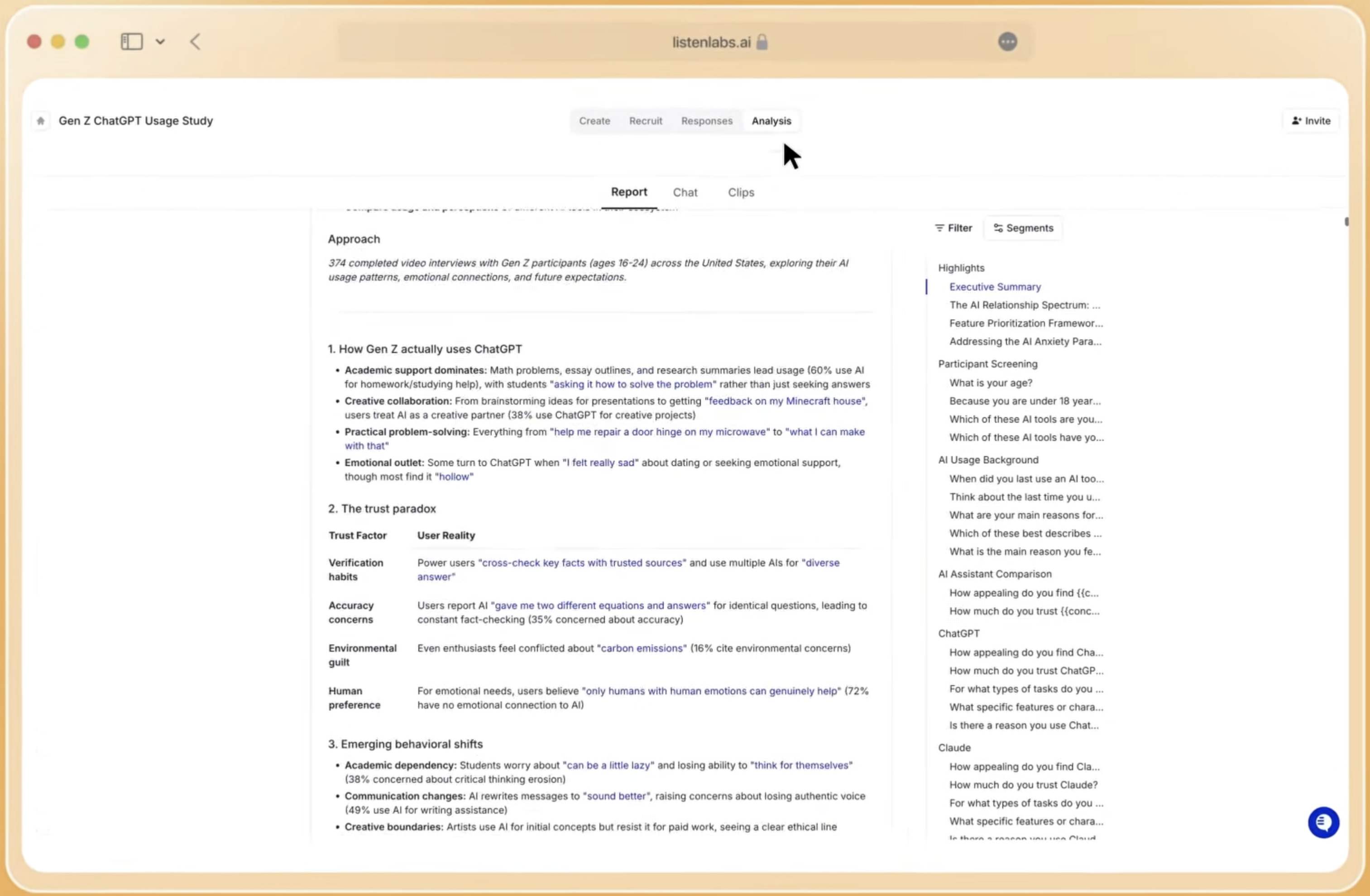
- Day 1: Launch 250+ AI-moderated interviews on the shortlisted concepts via Listen Labs’ 30M panel. Each interview runs 30+ minutes with adaptive follow-up questions, and the resulting dataset provides the qualitative depth that explains Week 1 scores.
- Day 2–3: Research Agent produces thematic analysis, emotional breakdowns by concept and segment, and video highlight reels of the most emotionally significant moments, giving stakeholders fast access to the “why” behind each concept.
- Day 4–5: Deliver a concept optimization brief that includes verbatim evidence, emotional signal data, and specific copy or design recommendations, which then guide the IHUT design in Week 3.
Week 3 — IHUT Integration and Final Validation
- Day 1–2: Ship the optimized concept or product to IHUT participants. Trigger mobile diary prompts at first use, followed by a short agile survey within the same session so feedback reflects in-the-moment experience.
- Day 3–4: Route high-concern respondents into a final round of AI-moderated interviews, then aggregate physical and digital signals in a unified analysis that reflects real-world usage and emotional response.
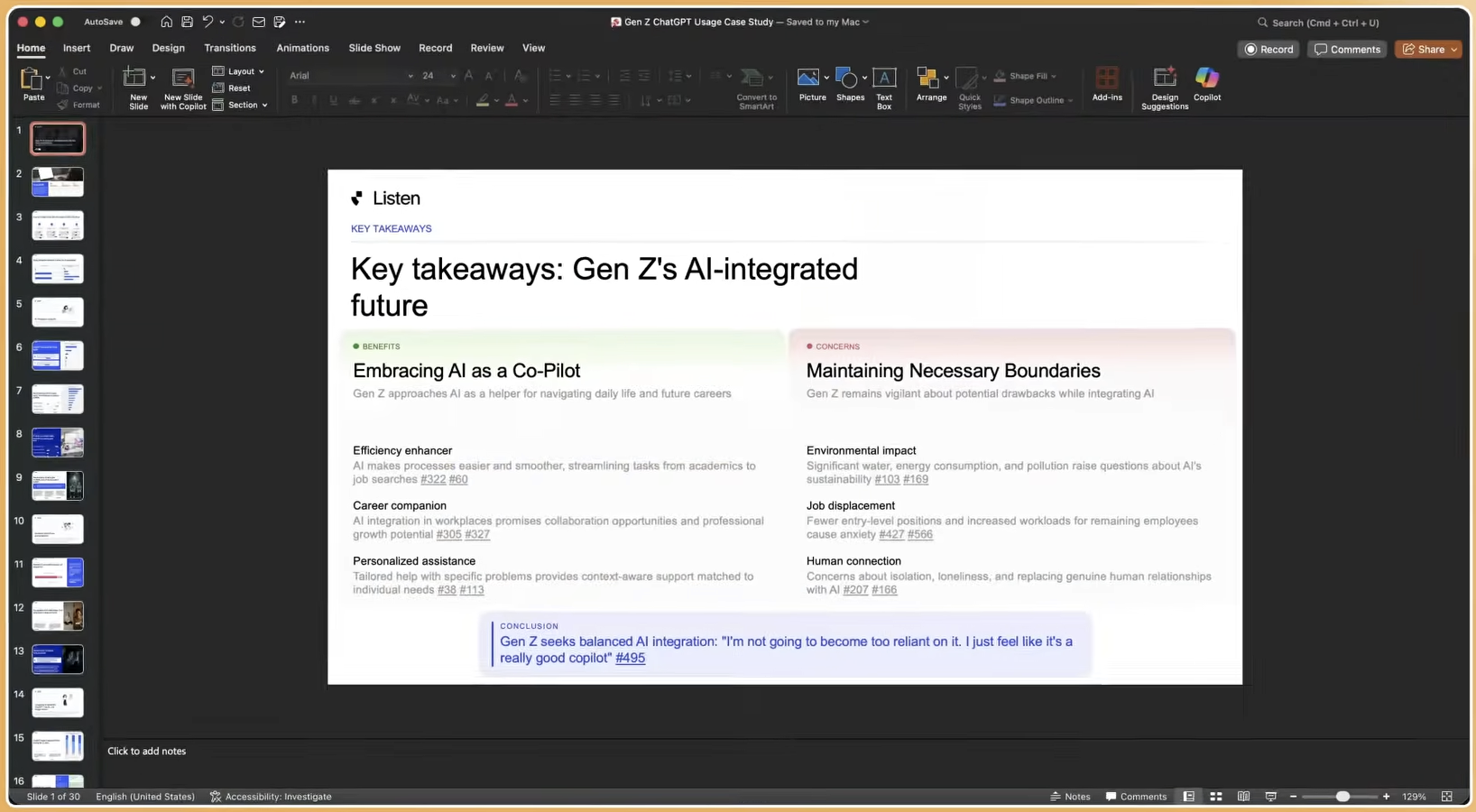
- Day 5: Research Agent delivers a board-ready report with statistical confidence intervals, emotional intelligence data, behavioral proxy validation, and a clear go/no-go recommendation supported by evidence from all three weeks.
Emotional Intelligence Signals Surveys Miss
Two packaging concepts can post identical purchase intent scores while triggering very different emotional reactions. A survey captures the number but not the hesitation before a click, the micro-expression of confusion when someone reads a claim, or the flat tone that signals polite indifference instead of real enthusiasm. Listen Labs’ Emotional Intelligence analyzes three layers of signal, including tone of voice, word choice, and subconscious micro-expressions, to surface nuanced emotions that transcripts alone miss.
Every emotion is quantified per question and concept, with each label traceable to the exact timestamp, verbatim quote, and AI reasoning behind it. This level of traceability supports enterprise governance. A stakeholder who challenges a finding can jump directly to the precise moment in the interview that produced it instead of debating a summary statistic.
The framework uses Ekman’s universal emotions standard and tracks anger, anticipation, disgust, fear, joy, sadness, trust, and surprise, the same methodology used in clinical psychology and UX research. Available across 50+ languages, it connects directly to the Research Agent for natural-language queries such as “which packaging concept triggered the most confusion among 35–44-year-old female buyers in the Midwest?” and returns a side-by-side emotional breakdown with supporting video clips. Comparative research has found that AI-powered research can predict successful product launches more accurately than traditional methods. The emotional intelligence layer drives much of that predictive advantage.
P&G and Skims: Enterprise Outcomes on Agile Timelines
Procter & Gamble used Listen Labs to understand how men respond to new product claims before market. The team wanted to focus innovation on real pain points instead of assumed ones. The platform delivered more than 250 interviews with quantified themes and verbatim proof in hours, not weeks. Findings highlighted where claims felt exaggerated or unclear and showed that comfort, safety, and reliability matter far more than novelty, which directly shaped product and brand strategy before any investment in manufacturing or trade marketing. The Analytics and Insight Leader at P&G noted, “Listen Labs has been a huge help.”
Skims faced a different challenge and needed validation with thousands of high-income buyers overnight to de-risk a global campaign launch. Listen Labs identified and qualified thousands of premium consumers in a single night, removing weeks of recruiting and panel sourcing. The qualitative clarity translated customer reactions into insights leadership could trust, which secured board-level buy-in before the campaign went live. The SVP of Data, Insights, and Loyalty at Skims stated, “I always struggled with understanding the why and Listen Labs nails this for me.”
Both cases reflect the same structural advantage. Platforms like Listen Labs layer on auto-recruiting, transcription, sentiment tagging, and insight summarization so teams move from question to findings in hours instead of weeks. At one-third the cost of traditional qualitative research, teams can run validation at every stage of the innovation funnel instead of saving it only for high-stakes gate decisions. Replicate P&G-caliber insights for your next concept decision—schedule a demo.
Frequently Asked Questions
What quality guardrails does Listen Labs apply to ensure agile survey and interview data is defensible for board-level decisions?
Listen Labs uses three interlocking quality layers that work together as a single governance system. First, Listen Atlas matches participants on behavioral and intent data instead of self-reported demographics, drawing from a 30M verified panel across 45+ countries. Second, as described in Pillar 4, Quality Guard provides real-time fraud detection across multiple signal types, with participant frequency caps that remove professional survey-takers. Third, the Research Agent links every insight directly to the underlying response data so any finding in a board presentation can be traced to the specific interview, timestamp, and verbatim quote that generated it. This chain of evidence satisfies enterprise governance requirements without adding manual QA overhead to the research team’s workload.
How does Listen Labs handle data security and privacy compliance for Fortune 500 CPG enterprises?
Listen Labs maintains enterprise-grade security with 256-bit encryption, and customer data never feeds AI model training. The platform holds SOC 2 Type II, GDPR, ISO 27001, ISO 27701, and ISO 42001 certifications, which cover security, privacy, and AI governance. Enterprise SSO supports centralized identity management. For CPG organizations operating across multiple markets, coverage of 45+ countries and 100+ languages is matched by localized compliance infrastructure so data collected in the EU, APAC, or MEA regions meets relevant regulatory requirements without separate vendor arrangements.
How do AI-moderated interviews complement an existing consumer insights team rather than replace it?
Listen Labs functions as a force multiplier for insights teams. The platform handles logistics-intensive phases of the research cycle, including recruitment, scheduling, moderation, transcription, and initial analysis, which currently consume most of a research team’s time without adding strategic value. Researchers can then focus on hypothesis development, stakeholder communication, and interpretive judgment that AI cannot replicate. Teams increase the number of learning cycles they run each year on the same budget by shifting effort from operational tasks to strategic work. The Research Agent generates consultant-quality slide decks, memos, and highlight reels in under a minute so researchers spend their time refining and presenting insights instead of formatting them.
Can Listen Labs support multi-market CPG validation studies within a single 24-hour cycle?
Yes. Listen Atlas spans 45+ countries and supports interview moderation in 100+ languages with automatic translation and transcription. A CPG team validating a packaging concept across the US, Germany, and Brazil can field 100 interviews per market at the same time. All three markets complete within a single day, each conducted in the participant’s native language. The Research Agent then generates a unified cross-market analysis with segment-level breakdowns so teams can compare emotional responses, claim comprehension, and purchase intent across geographies without the 10–16 week timelines common in traditional multi-market qualitative studies.
What is the difference between Listen Labs’ approach and survey-only concept testing platforms?
Survey-only concept testing platforms produce volumetric forecasts and normative scores such as purchase intent, uniqueness, and relevance, yet they deliver low diagnostic depth because they rely on 10–15 minute surveys without probing consumer reasoning. These platforms show which concept performed better but rarely explain what to improve, which leaves an unresolved “now what?” problem when concepts underperform. Listen Labs combines the statistical confidence of large-sample quantitative data with the adaptive depth of AI-moderated interviews, the emotional signal layer of Emotional Intelligence, and the behavioral verification of Quality Guard. CPG companies using this dual-method model, which integrates qualitative depth with quantitative forecasting, report 40–60% higher pass rates at the final quantitative gate compared to single-method approaches.
Conclusion: Board-Ready Insights at Enterprise Scale
The five-pillar agile survey validation framework, which includes real-time benchmarking, behavioral proxies, integrated physical-to-digital testing, AI-powered verification, and qual-at-scale AI-moderated interviews, addresses the structural limits of traditional CPG consumer research. This approach compresses 4–6 week cycles into rapid learning loops, replaces intuition-driven decisions with traceable evidence, and delivers both the statistical confidence that quantitative stakeholders require and the emotional nuance that brand and innovation teams need.
“The why is what differentiates customer research that’s alright from customer research that’s outstanding.” Listen Labs delivers that why at P&G and Skims scale, in agile timelines, and at one-third the cost of traditional qualitative research. Get a board-ready validation cycle running within the week—book your demo now.