Written by: Anish Rao, Head of Growth, Listen Labs
Key Takeaways
- AI can compress traditional 6–16 week brand research cycles to under 24 hours while maintaining methodological rigor.
- Sequential handoffs across briefing, recruiting, moderating, coding, and reporting create the main delays; parallel AI-driven stages remove those bottlenecks.
- Speed-to-insight functions as a quality metric because faster findings inform decisions before they lock.
- Listen Labs’ seven-step workflow spans study design through always-on tracking and cross-study querying, delivering consultant-grade outputs at one-third the cost.
- See how Listen Labs compresses brand studies to 24 hours
Why Brand Research Still Runs on Multi-Week Timelines
Traditional brand research runs as a linear project. Teams brief the agency, recruit participants, schedule moderators, collect data, transcribe, code themes, write the report, and present to stakeholders, with each step waiting for the previous one to finish. When phases run sequentially, total cycle time extends to six to twelve weeks for agency-led studies.
For VP and Director-level consumer insights leaders at Fortune 500 enterprises, this structure creates a compounding backlog. Each study that takes four to six weeks blocks three or four others from starting. Internal stakeholders in product, brand, and marketing file requests and wait. Many requests never get fulfilled. Manual qualitative analysis, especially coding and theme clustering, consumes a large share of the total timeline.
Modern insight needs look different. Teams now run continuous discovery programs, global multi-market studies, and always-on competitive monitoring. Sequential project thinking cannot support that operating model. An AI-orchestrated approach replaces the handoff chain with a single end-to-end platform that runs stages in parallel.
Why Cycle-Time Compression Directly Improves Insight Quality
Speed-to-insight functions as a quality metric, not a convenience metric. Companies that act on customer insights can outperform peers on revenue growth, with synthesis latency identified as a hidden cost in data-driven organizations. When research arrives after a product decision is finalized, findings arrive after the window to act has closed.
Cycle-time compression also reshapes the economics of consumer insights. McKinsey estimates that AI could enhance R&D throughput by up to 75% in certain industries. Listen Labs delivers the full cycle, from study design through participant recruitment, AI-moderated interviews, automated analysis, and stakeholder-ready deliverables, in under 24 hours at one third the cost of traditional research. Teams that previously ran five or six studies per quarter can run many more with the same headcount.
How the Faster AI-Enabled Brand Research Workflow Operates
This seven-step workflow shows how Listen Labs compresses perception, concept testing, and competitive monitoring studies from weeks to hours.
- AI-Assisted Study Design
- Participant Sourcing via Quality Guard
- AI-Moderated Data Collection
- Automated Analysis and Synthesis
- Insight-to-Action Communication
- Always-On Tracking with Listen Pulse
- Research Library Cross-Study Querying
Step 1: AI-Assisted Study Design
Study design often consumes days before recruitment even starts. Drafting objectives, writing discussion guides, setting screener criteria, configuring branching logic, and running QA checks all stack into a two-day minimum under traditional workflows. AI-augmented survey design reduces that effort from two days to two hours by allowing researchers to prompt the system with a brief and review the output.
In Listen Labs, researchers describe their objectives in natural language. The platform then drafts structured study objectives, discussion guide questions, probing context, screener criteria, branching logic, and stimuli configuration in seconds. Supported stimuli include images, video, PDFs, prototypes, and live URLs. Auto-QA flags issues before launch. The key decision at this stage is depth versus scale. A 20-question IDI guide tuned for emotional nuance differs from a 10-question concept test tuned for statistical segmentation. The platform supports both, and the human researcher approves the instrument before fielding.
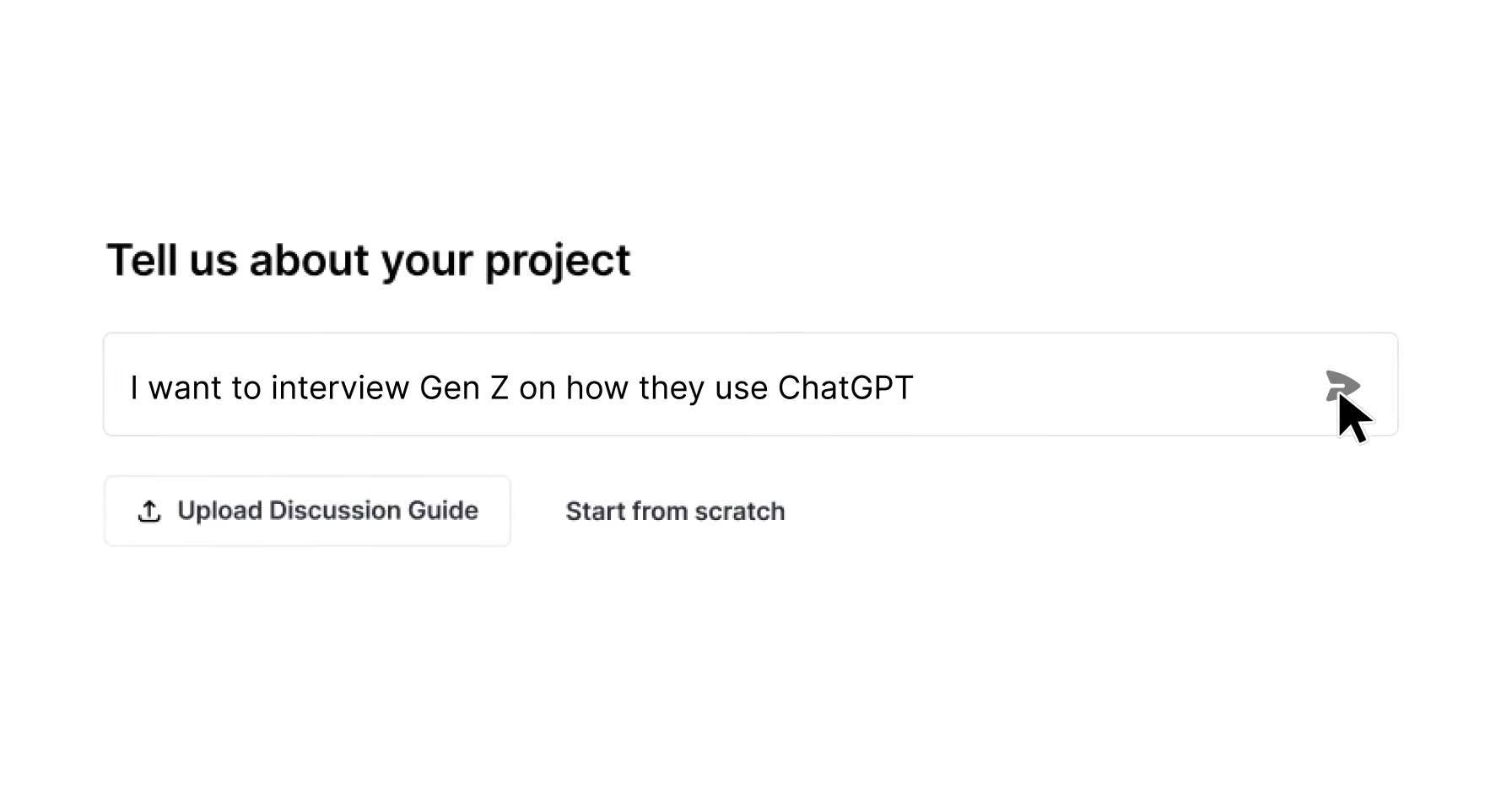
Human-in-loop caveat: AI drafts the guide, and the researcher validates that objectives are precise, screener criteria match the target audience, and stimuli are finalized before launch. Unclear objectives at this stage commonly create downstream analysis bottlenecks.
Risk-mitigation checklist for Step 1: Before launching any study, confirm research objectives are specific and measurable, since vague objectives produce unfocused guides that cannot be fixed later. Once objectives are clear, validate screener criteria against the actual target audience definition so recruitment delivers the right participants. With targeting confirmed, lock stimuli and concept versions before fielding, because changing stimuli mid-field commonly causes concept testing timelines to exceed the planned schedule. Finally, run Auto-QA and review flagged items before launching to catch instrument errors before data collection begins.
Step 2: Participant Sourcing via Quality Guard
Recruitment often represents the most structurally broken stage in traditional brand research. Recruiting participants from scratch can take several weeks. Commodity panels introduce professional survey-takers, fraudulent profiles, and incentive-driven responses that weaken data integrity.
Listen Labs sources participants from a global network of 50M+ verified respondents across 45+ countries and 120+ languages. Quality Guard, the platform’s AI orchestration layer, matches participants on behavioral and intent data, not just self-reported demographics. Real-time monitoring across video, voice, content, and device signals detects and removes fraudulent responses, low-effort answers, and AI-generated scripts. Participants can join only three studies per month, which reduces panel fatigue and professional survey-taker behavior. A dedicated recruitment operations team supports hard-to-reach segments such as enterprise decision-makers, healthcare workers, and audiences below 1% incidence rate.
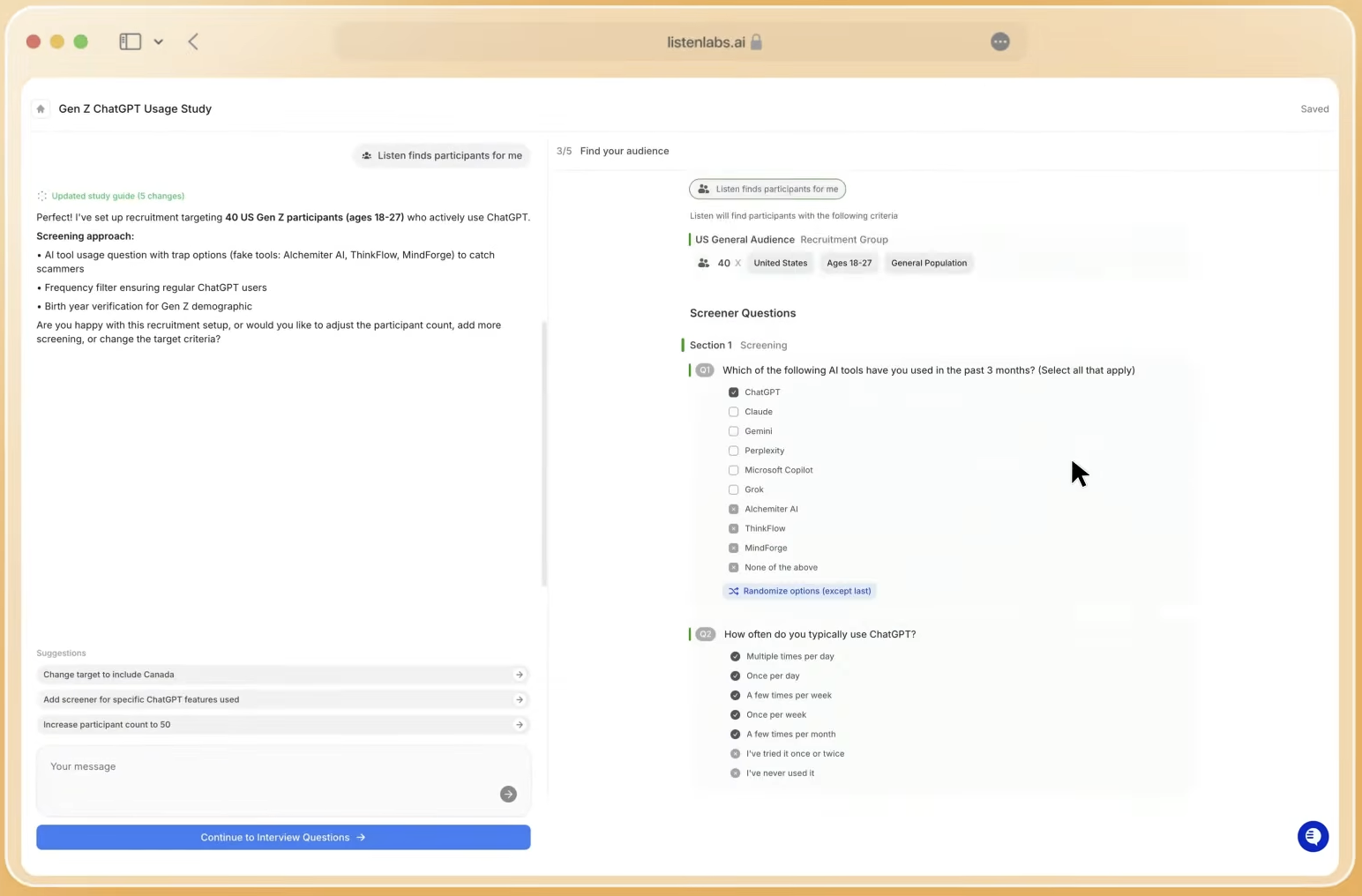
Trade-off to manage: General consumer audiences typically field in hours. Niche B2B segments, such as enterprise decision-makers, where recruiting 400 participants with a pre-screened panel takes five to ten business days for B2B versus two to five days for consumer audiences, require the dedicated recruitment operations team and may extend sourcing time. Plan screener complexity with this trade-off in mind.
Step 3: AI-Moderated Data Collection
Traditional qualitative data collection runs sequentially. Completing 20 interview sessions can take a full week before analysis can begin because of moderator scheduling constraints. Listen Labs instead conducts hundreds of AI-moderated video interviews simultaneously, with each session personalized and adaptive.
The AI Interviewer probes deeper on interesting or short answers and often generates responses three times longer than average. It supports 120+ languages for interview moderation, which enables global multi-market studies in a single wave. Mixed methods such as Likert scales, NPS, sliders, MaxDiff, and open-ended conversation run in the same instrument. Emotional Intelligence analyzes tone of voice, word choice, and subconscious micro-expressions across 50+ languages, built on Ekman’s universal emotions framework, and surfaces emotional signals that transcripts alone miss. Visual Insights allows the AI Interviewer to observe on-screen behavior in real time, closing the say-do gap by probing contradictions between stated preference and observed action as they appear.
Watch AI-moderated interviews in action
Step 4: Automated Analysis and Synthesis
Analysis often becomes the longest stall point in traditional brand research projects. Researchers spend the bulk of their time finding patterns, quantifying insights, testing significance, adding macro context, and formatting results for stakeholders who each need something different, a process that consumes roughly 30% of project budgets and pushes timelines to a minimum of four to six weeks in traditional qualitative research .
Listen Labs’ Research Agent processes all interview data objectively and identifies patterns, themes, and personas across hundreds of responses without human confirmation bias. One researcher ran a full buying intent analysis across three user segments in under a minute. Chat-based queries allow researchers to ask questions in natural language and receive answers, charts, statistical tests, and segmentation breakdowns instantly. Research Agent integrates directly with Emotional Intelligence data, which enables natural-language queries on emotional patterns across concepts, segments, and markets.
Human-in-loop caveat: AI handles the mechanical 80% of pattern detection and auto-coding. Human researchers retain ownership of strategic prioritization, cross-source triangulation, stakeholder translation, and live conviction-building during readouts.
Step 5: Insight-to-Action Communication
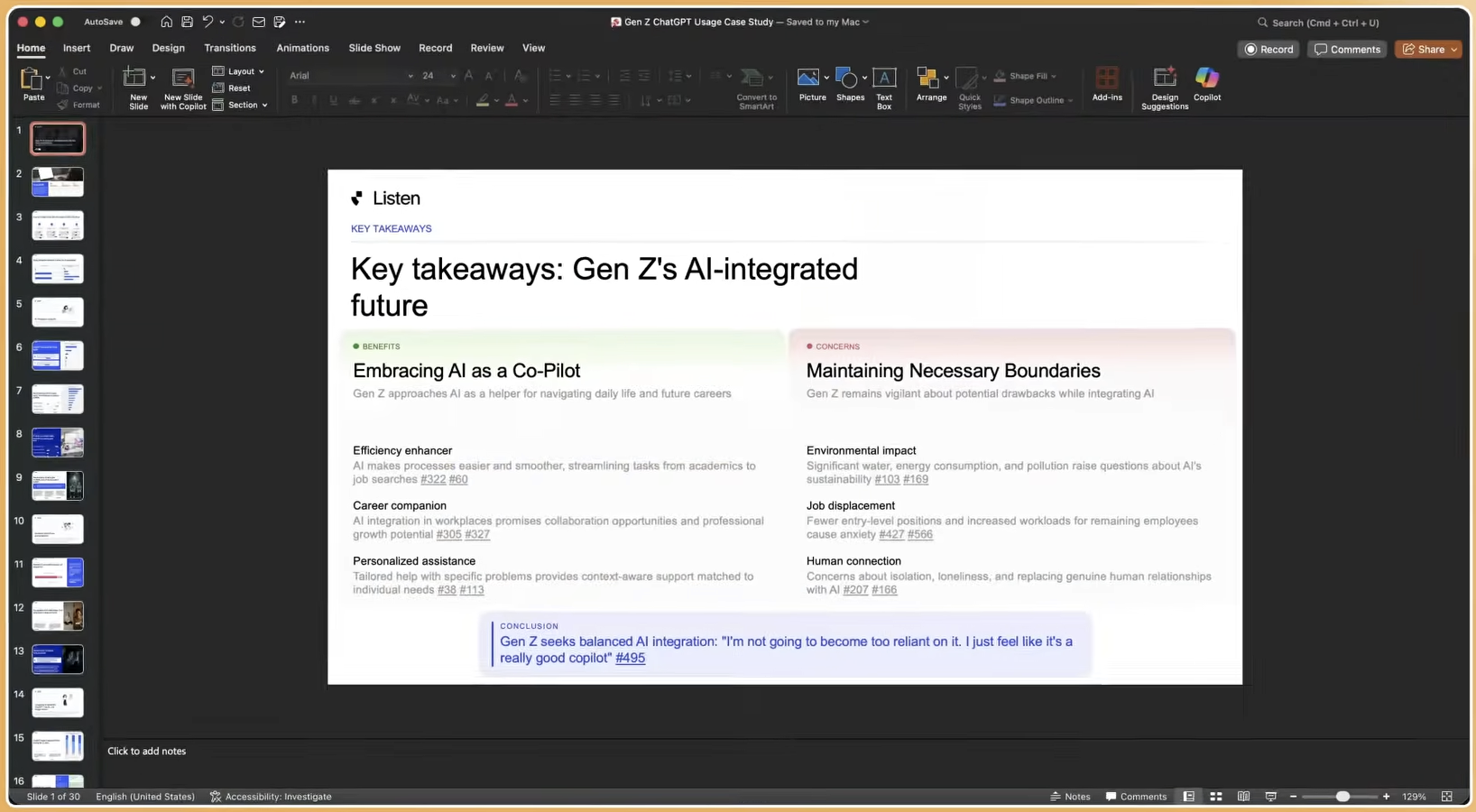
Findings that do not reach stakeholders quickly fail to influence decisions. Traditional report writing adds several days of manual chart and dashboard creation after analysis finishes. Listen Labs’ Research Agent instead generates one-click slide decks in branded templates, memo-style reports, video highlight reels of the most emotionally significant moments, statistical charts, and custom segmentation breakdowns, all in under a minute.
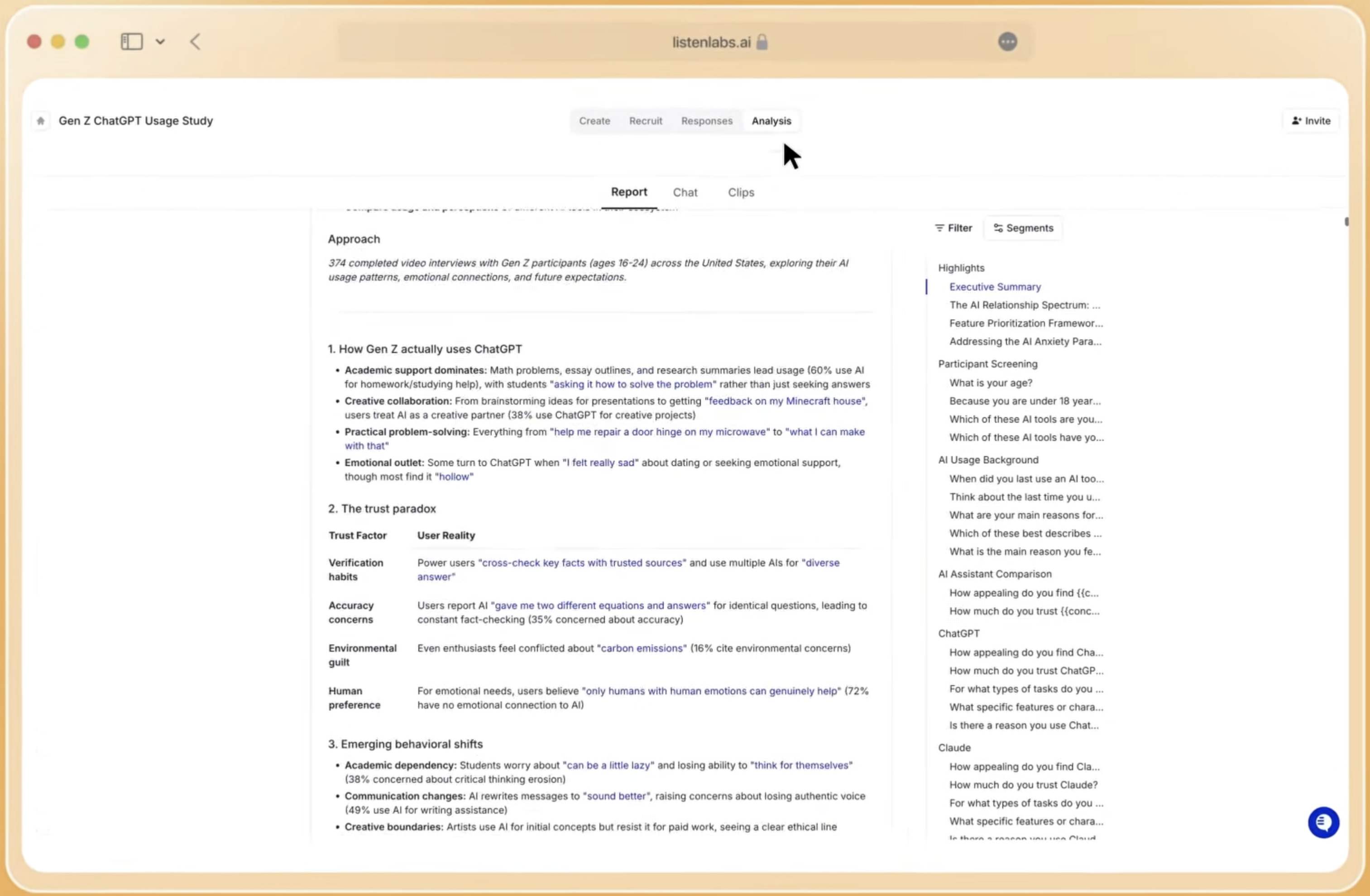
Stakeholder alignment protocols sit inside the delivery format. Every finding traces back to the original interview, verbatim quote, and video clip. Product, brand, and marketing stakeholders can interrogate the evidence directly rather than relying only on the research team’s interpretation. This traceability converts research speed into organizational trust.
Step 6: Always-On Tracking with Listen Pulse
One-off studies answer specific questions, while continuous brand health requires a persistent system. Classic quarterly brand tracker studies from vendors such as Nielsen, Kantar, and YouGov require eight to sixteen weeks from field start to board-ready insight, and they often report that a KPI moved without explaining why.
Listen Pulse operates as a conversational tracker that runs the same study with the same screeners wave after wave. It combines quantitative KPI tracking with open-ended conversation in a single instrument. Every metric movement arrives with its diagnostic, since themes are quantified and charted alongside the KPIs teams already report. Core questions stay constant to protect trend-line integrity. Timely add-on questions cover new campaigns, competitors, or market events without breaking historical comparability. Pulse integrates with Qualtrics and Decipher, deploys alongside an existing tracker or as the primary tracking system, and analyzes tens of thousands of responses continuously.
Step 7: Research Library and Cross-Study Querying
Every study an organization runs on Listen Labs feeds into an interconnected intelligence system. Research Library searches every study simultaneously and returns synthesized answers in natural language, with each answer traced back to the original study, discussion guide, screener, and individual respondent. Teams can check whether a question has already been answered before commissioning new research, which removes redundant studies and their associated budget.
Cross-study querying supports trend tracking across waves, onboarding of new team members against the full research corpus, and executive reporting on the entire research program. Institutional knowledge that previously lived in scattered slide decks and individual memories becomes a queryable, compounding asset. Before retiring a study, teams can query the Library to confirm whether existing waves cover the topic adequately or whether a new study is warranted.
Explore how Research Library compounds your institutional knowledge
Common Pitfalls and Early-Recognition Signals
AI-orchestrated brand research workflows tend to fail at predictable points, and early recognition prevents timeline slippage and quality loss. The most frequent failure mode appears at study design. Unclear objectives at study design create vague briefs, unfocused guides, and unactionable findings. Signal: the research team cannot write a one-sentence statement of what decision the study will inform.
Even with clear objectives, recruitment can introduce risk. Poor recruitment fit occurs when screener criteria are too broad or too narrow. Broad criteria admit off-target participants, while narrow criteria extend fielding time. Signal: pilot responses do not match the intended persona profile.
Once fielding begins, response quality becomes the next checkpoint. Low response quality can appear even with Quality Guard in place, so researchers should monitor early completions for response length and coherence. Signal: median response length falls below platform benchmarks in the first 10% of completions.
Late changes often create the next bottleneck. Analysis bottlenecks from late stimuli changes arise when teams adjust concepts or instruments after launch. Changing stimuli or the survey instrument mid-field commonly causes concept testing timelines to exceed the planned schedule. Signal: any stakeholder request to modify concepts after fielding begins.
Delivery misalignment represents the final common failure point. Stakeholder misalignment on deliverable format causes findings to sit unused. Rebrands using AI for faster discovery but skipping stakeholder alignment work fail at rollout rather than at discovery. Signal: no pre-agreed output format or distribution list before the study launches.
Objective Success Indicators and Tracking Methods
Teams can measure the impact of AI-enabled cycle-time compression by tracking both process metrics and output quality metrics.
- Cycle time per study type: Track calendar days from brief submission to stakeholder delivery for perception, concept testing, and competitive monitoring studies separately. Target sub-24-hour cycles for standard consumer studies.
- Studies completed per quarter: Compare output volume before and after platform adoption with the same headcount. Anthropic moved from running five to six studies in a given timeframe to running 100 in the same period.
- Participation and completion rates: Monitor screener pass rates and interview completion rates per study. Declining rates signal screener or recruitment fit issues before they affect data quality.
- Finding consistency across waves: For tracking studies, measure theme stability across waves to confirm trend-line integrity as timely questions are added.
- Stakeholder usage of deliverables: Track whether product, brand, and marketing teams access and cite research outputs in decision documents. Low usage usually signals a communication format or distribution problem rather than a research quality problem.
Advanced Strategies and Safe Pilot Approaches
Teams new to AI-orchestrated brand research should start with a pilot on a study type that has a clear prior baseline. A concept test or perception study previously run through an agency works well, because AI-enabled outputs can be compared directly against known benchmarks before full program migration.
Once the baseline is established, teams can expand into more advanced strategies.
- Qual-at-scale for concept testing: With qual-at-scale, the old trade-off between depth and scale is no longer a barrier. Run 200–500 AI-moderated interviews on a concept test and segment by persona, geography, or prior category experience while maintaining statistically meaningful subgroup cells.
- Global multi-market simultaneous fielding: Coordinating multi-market concept testing across four or five markets simultaneously can stretch study timelines from days into months under traditional manual processes. Listen Labs fields all markets in parallel with automatic translation and localization across 120+ languages.
- Emotion and signal analysis for creative testing: Deploy Emotional Intelligence to quantify which concepts trigger genuine delight versus confusion or hesitation, with timestamp-level precision traceable to individual respondents.
- Readiness criteria before scaling: Confirm study objectives are precise, screener criteria are validated against a pilot cohort, and stakeholder deliverable formats are agreed before moving from pilot to full program.
Enterprise Proof Points from Listen Labs Clients
Listen Labs clients have documented the shift from six-week cycles to sub-24-hour cycles across multiple enterprise environments.
Microsoft cut research wait time from weeks to hours. A Director of Data Science at Microsoft stated: “We wanted users to share how Copilot is empowering them to bring their best self forward, and we were able to collect those user video stories within a day. Our leadership team was very thrilled at both the speed and the scale that Listen Labs enabled. I can reach out to hundreds of users at one third of the cost.”
Anthropic’s research team moved from running five to six studies sequentially to running 100 studies in the same timeframe, with the research process condensed from two steps into one. Jane Justice Leibrock, Head of User Experience Research at Anthropic, described the platform as “kind of like a self-healing study. It finds the new things it needs to understand, and then helps you measure those better going forward.” The team also reduced churn by shipping a key Claude Code feature after surfacing that the core friction was context switching between the code editor and terminal.
Procter & Gamble delivered 250+ interviews with quantified themes and verbatim proof in hours, directly shaping product and brand strategy. An Analytics and Insight Leader at P&G stated: “Listen Labs has been a huge help.”
Skims identified and qualified thousands of premium consumers overnight, removed weeks of recruiting and panel sourcing, and validated a global campaign launch before it went live. The SVP of Data, Insights, and Loyalty at Skims stated: “I always struggled with understanding the why and Listen Labs nails this for me.”
Sweetgreen scaled research across 300+ US locations at five times the scale and one third the cost of its previous approach. Brian Davia, Head of Consumer and Business Insights at Sweetgreen, stated: “By having the speed to insight, insights can lead to actions. Those actions are then showing up in the real world at real Sweetgreen restaurants within weeks or months instead of years.”
Schedule a demo to see the full Listen Labs platform
Frequently Asked Questions
-
How quickly can Listen Labs realistically deliver results for a brand perception study?
For standard consumer audience studies, the full cycle, from study design through participant recruitment, AI-moderated interviews, automated analysis, and stakeholder-ready deliverables, completes in under 24 hours. Hard-to-reach B2B segments or audiences below 1% incidence rate may extend recruitment time, while analysis and reporting remain compressed regardless of audience complexity.
Does AI moderation produce the same depth of insight as a trained human moderator?
Listen Labs’ AI Interviewer generates responses three times longer than average through intelligent probing and adapts follow-up questions based on each participant’s answers. With Visual Insights enabled, it also probes contradictions between stated preference and observed on-screen behavior in real time. The platform is built by researchers with 50+ years of combined in-house expertise who continuously refine the methodology. For the vast majority of brand research needs, AI moderation delivers comparable qualitative depth at much greater scale and speed.
How does Listen Labs handle data security and compliance for enterprise brand research programs?
Listen Labs maintains enterprise-grade security with 256-bit encryption and holds SOC 2 Type II, ISO 27001, ISO 27701, and ISO 42001 certifications. The platform is GDPR compliant and supports enterprise SSO. Customer data is never used to train Listen Labs’ AI models. All findings trace back to the original study, discussion guide, screener, and individual respondent for full auditability.
Can Listen Labs support ongoing brand tracking rather than one-off studies?
Yes. Listen Pulse functions as an always-on conversational tracker that runs the same study with the same screeners wave after wave. It combines quantitative KPI tracking with open-ended conversation in a single instrument. Core questions stay constant to protect trend-line integrity, while timely questions address new campaigns and competitors. Pulse integrates with Qualtrics and Decipher and deploys alongside an existing tracker or as the primary tracking system.
What human oversight is built into the Listen Labs workflow?
Human oversight appears at every critical decision point. Researchers review and approve the AI-drafted study guide before fielding begins. Auto-QA flags instrument issues for human resolution. The dedicated recruitment operations team adds a human review layer for hard-to-reach segments. Research Agent outputs are fully traceable to source interviews, verbatim quotes, and video clips, which enables researchers to verify and contest any finding before it reaches stakeholders. Strategic prioritization, cross-source triangulation, and stakeholder conviction-building remain human responsibilities throughout.
Conclusion: Move to the New Operating Model This Quarter
AI reduces brand research cycle time by replacing the sequential project model with a continuous, AI-orchestrated operating model. The seven-step workflow above covers every stage from study design through always-on tracking and cross-study institutional knowledge, compressing what traditionally takes four to six weeks into the sub-24-hour cycle described above without sacrificing the methodological rigor that enterprise consumer insights programs require.
The AI brand research workflow already operates at scale. Microsoft, Anthropic, P&G, Skims, and Sweetgreen have each documented the shift from multi-week cycles to same-day or overnight results. The depth-versus-scale trade-off that defined traditional brand research no longer applies. The remaining decision centers on how quickly your team adopts the new operating model.