
Written by: Anish Rao, Head of Growth, Listen Labs
Key Takeaways
-
AI-driven consumer insights platforms now deliver consultant-quality findings in hours instead of weeks by automating the full research lifecycle from recruitment to reporting.
-
These platforms collapse the traditional trade-off between qualitative depth and quantitative scale, enabling hundreds of adaptive AI-moderated interviews simultaneously.
-
When evaluating platforms, focus on eight criteria: speed to insight, depth of moderation, sample quality, fraud prevention, analysis depth, integration capabilities, cost structure, and enterprise readiness. Each factor shapes whether the platform delivers reliable, actionable insights in your environment.
-
Leading platforms specialize in different areas: Quantilope focuses on advanced quantitative methods, Sprinklr excels at omnichannel listening, and Listen Labs provides the most comprehensive end-to-end solution for qualitative research at scale.
-
Listen Labs helps enterprise teams multiply research output and streamline workflows; schedule a tailored demo to see how it can reshape your insights process.
How AI-Driven Consumer Insights Platforms Work
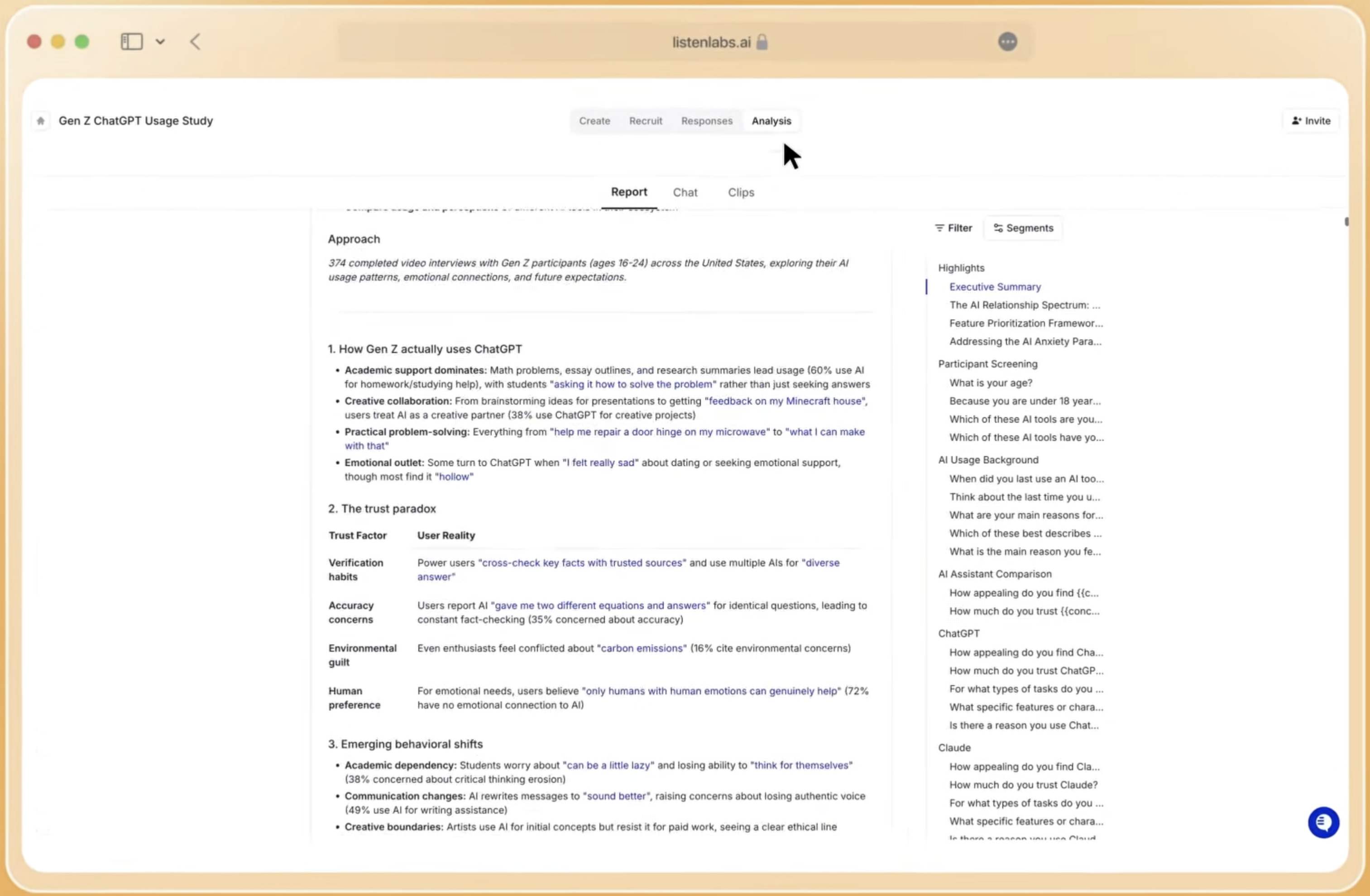
An AI-driven consumer insights platform automates and scales customer research across the entire lifecycle, including study design, participant recruitment, moderation, analysis, and reporting. Qual-at-scale uses AI to automate time-consuming aspects of qualitative research like recruiting, interviewing, and analysis, enabling deeper insights at larger scales without traditional barriers of cost and time. This category makes hundreds or thousands of simultaneous, personalized, adaptive qualitative interviews operationally feasible for the first time.
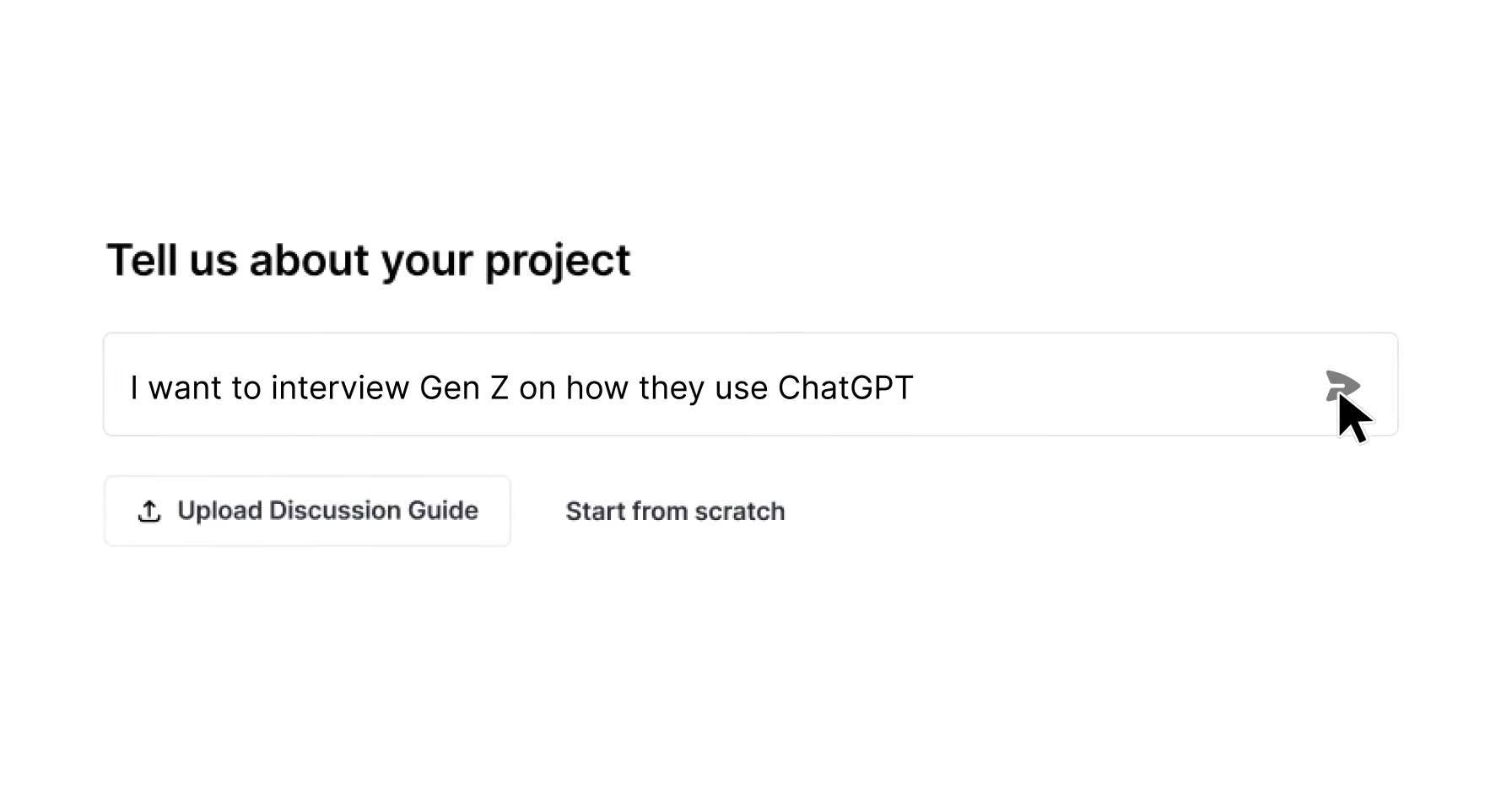
These platforms differ from point solutions. Survey tools like Qualtrics scale efficiently but sacrifice conversational depth. Panel providers like Prolific solve sourcing but not moderation or analysis. Analysis repositories like Dovetail organize past research but do not conduct new research. AI consumer insights tools cover the full stack from first question to final deck.
Core capabilities of a mature AI-driven consumer insights platform include:
-
AI-moderated interviews with dynamic, adaptive follow-up questions
-
Automated analysis and theme identification across hundreds of responses
-
Global participant sourcing from verified, quality-controlled panels
-
Real-time fraud detection and behavioral quality assurance
-
Emotional intelligence through analysis of tone, word choice, and micro-expressions
-
Natural-language querying of research data across studies
-
Automated deliverables including slide decks, reports, and highlight reels
With qual-at-scale, the old trade-off between depth and scale is no longer a barrier. Organizations gain the statistical confidence of large samples alongside the rich, nuanced understanding previously available only through small-sample qualitative work.
How AI Platforms Differ from Traditional Research
AI-driven platforms transform research timelines by compressing cycles that once took weeks into less than 24 hours. Traditional qualitative research often takes 4–6 weeks from study design to final report, and large enterprises can wait months once internal prioritization and budget approvals enter the picture. By the time insights arrive, the business context may already have shifted.
The differences extend well beyond speed:
-
Cost: Traditional research requires specialized teams, third-party panel providers, recruitment operations, moderators, analysts, and report writers. Listen Labs, for example, delivers results at one-third the cost of traditional research approaches.
-
Depth vs. scale: Traditional interviews are limited to 5–15 participants. AI can schedule and conduct interviews, analyze transcripts for themes, and generate quantitative insights from those interviews. This all happens across hundreds of participants simultaneously.
-
Conversational depth: AI enables dynamic follow-ups and adaptive probing, capturing responses that are three times longer than average. Static surveys cannot probe unexpected answers in the same way.
-
Emotional capture: Emotional Intelligence analyzes three signals, including tone of voice, word choice, and subconscious micro expressions. This approach surfaces emotions that transcripts alone miss.
-
Participant honesty: Ninety-two percent of participants report top comfort levels for AI moderation sessions, and 58% prefer AI moderation for discussing political and religious views. These topics carry high social desirability bias with human moderators.
-
Continuous tracking: AI platforms support always-on research that identifies emerging trends before KPIs shift. Periodic wave-based studies give way to real-time intelligence.
Traditional focus groups take 3–5 weeks and $4,000–$12,000 per 90-minute session. They also introduce group dynamics, dominant voices, and social desirability bias that one-on-one AI-moderated interviews avoid entirely.
How to Choose an AI Consumer Insights Platform: Evaluation Criteria
Clear evaluation criteria help teams compare AI consumer insights tools in a structured way. The goal is to find the platform that best serves your research objectives and organizational context, rather than the one with the longest feature list.
-
Speed to insight: Look for platforms that deliver results in hours or days. Evaluate the full cycle from study design to final deliverables. A platform that conducts interviews quickly but requires days of manual analysis has not solved the core speed challenge.
-
Depth of insight: Assess whether AI moderation adapts in real time with dynamic follow-ups or simply reads a script. Prioritize platforms that capture emotional nuance such as tone, hesitation, and micro-expressions, not just transcripts. Every emotion should be quantified per question and concept, with every label traceable to the exact timestamp, verbatim quote, and AI reasoning behind it.
-
Sample quality and sourcing: Verify the panel quality. Pew Research has documented that telephone survey response rates fell to 6% by 2018, and commodity online panels carry significant fraud risk. Look for behavioral matching in addition to demographic self-reporting, along with participant frequency limits that prevent professional survey-takers from contaminating results.
-
Fraud prevention: Ask about real-time quality monitoring across video, voice, and device signals. Industry estimates suggest market researchers discard an average of 38% of collected survey data, and sometimes up to 70%, because of panel fraud and quality issues like straightlining, speeding, and inattentive responses. A platform without robust fraud detection creates risk rather than savings.
-
Analysis depth: Confirm that the platform offers automated theme identification, statistical testing, and natural-language querying. Every insight should link directly to the underlying response data so stakeholders can verify findings. Research Agent handles the full analysis workflow from raw data to final output.
-
Integration with existing tools: Check for compatibility with your existing stack, including survey engines like Qualtrics and Decipher, data warehouses like Snowflake, and collaboration tools like Slack. Platforms that require manual data export at every handoff recreate the fragmentation they aim to solve.
-
Cost and scalability: Compare total cost per insight rather than cost per response. A 1,000-response survey that confirms existing assumptions may cost more in real terms than 50 depth interviews that surface unexpected, actionable findings. Favor subscription models that scale with usage instead of per-study pricing that penalizes research volume.
-
Enterprise readiness: Verify security certifications such as SOC 2 Type II, ISO 27001, and GDPR compliance, and confirm the platform’s data policy. A vendor that trains its AI models on customer data introduces intellectual property and competitive risk. Look for proven track records with enterprise clients at scale.
Leading AI Consumer Insights Platforms in 2026: Side-by-Side Overview
The leading AI insights platforms serve different needs across qualitative depth, quantitative rigor, and omnichannel listening. The summaries below highlight where each platform fits best so teams can align tools with specific research scenarios.
Suzy is an AI-powered consumer research platform with a proprietary 15M+ verified opt-in panel. It supports concept testing, brand tracking, and qualitative interviews through its Suzy Live feature. Strengths include real-time consumer feedback, monadic and MaxDiff testing, and an AI-powered moderator for one-on-one interviews. Suzy fits CPG brands that need rapid concept and creative testing.
Sprinklr is an enterprise Unified-CXM platform with Voice of the Customer capabilities, social listening, and AI-powered insights. Sprinklr’s platform captures over 450 million conversations and makes over 8 billion AI predictions daily, creating a strong option for continuous customer intelligence across social, service, and marketing channels. Sprinklr was named a leader in the 2026 Gartner Magic Quadrant for Voice of the Customer Platforms. It suits enterprises that need omnichannel listening and workflow automation.
Quantilope is a research automation platform featuring quinn, an AI research partner that automates survey design, programming, and analysis. Quantilope automates 15+ advanced quantitative methodologies including conjoint analysis, segmentation, and MaxDiff, with dashboards that refresh in under a second. It works best for insights teams running repeatable advanced quantitative studies.
Outset is an AI-moderated research platform focused on scalable interviews and rapid qualitative exploration. Its strengths include speed and synthesis capabilities for directional insights. Outset fits teams that need fast qualitative exploration from AI-moderated conversations without the full enterprise infrastructure of a larger platform.
Attest is a consumer research platform with a panel spanning 150+ markets and a dedicated Customer Research Manager included in the subscription. It supports concept testing, brand tracking, and packaging evaluations. Attest serves teams running multi-market consumer surveys that want a more usable self-serve experience.
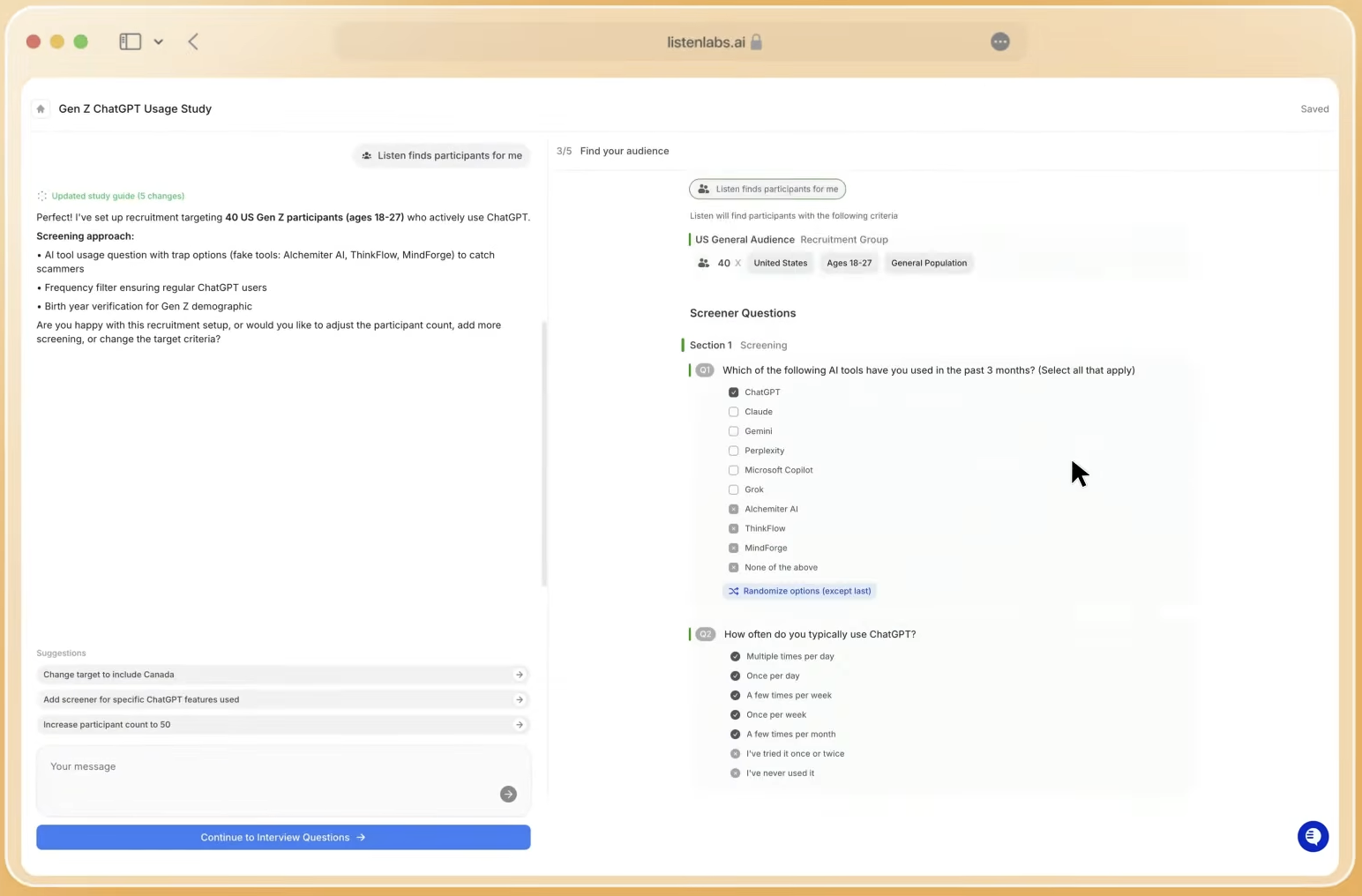
Listen Labs is an end-to-end AI research platform that sources participants from a 50M+ verified network across 45+ countries and 120+ languages, then conducts, analyzes, and summarizes thousands of in-depth customer interviews in under 24 hours. Listen Labs has run over 1 million AI-powered customer interviews for companies including Microsoft, Perplexity, and Sweetgreen. Its key strengths fall into three areas: full lifecycle coverage, quality assurance, and enterprise trust:
-
Full research lifecycle coverage: study design, recruitment, AI-moderated interviews, analysis, and deliverables, all in one platform
-
Quality Guard: real-time fraud detection with behavioral matching across video, voice, content, and device signals, with participant frequency limits of three studies per month
-
Emotional Intelligence: built on Ekman’s universal emotions framework, tracking anger, contempt, disgust, enjoyment/happiness, fear, sadness, and surprise, with every label traceable to the exact timestamp and verbatim quote
-
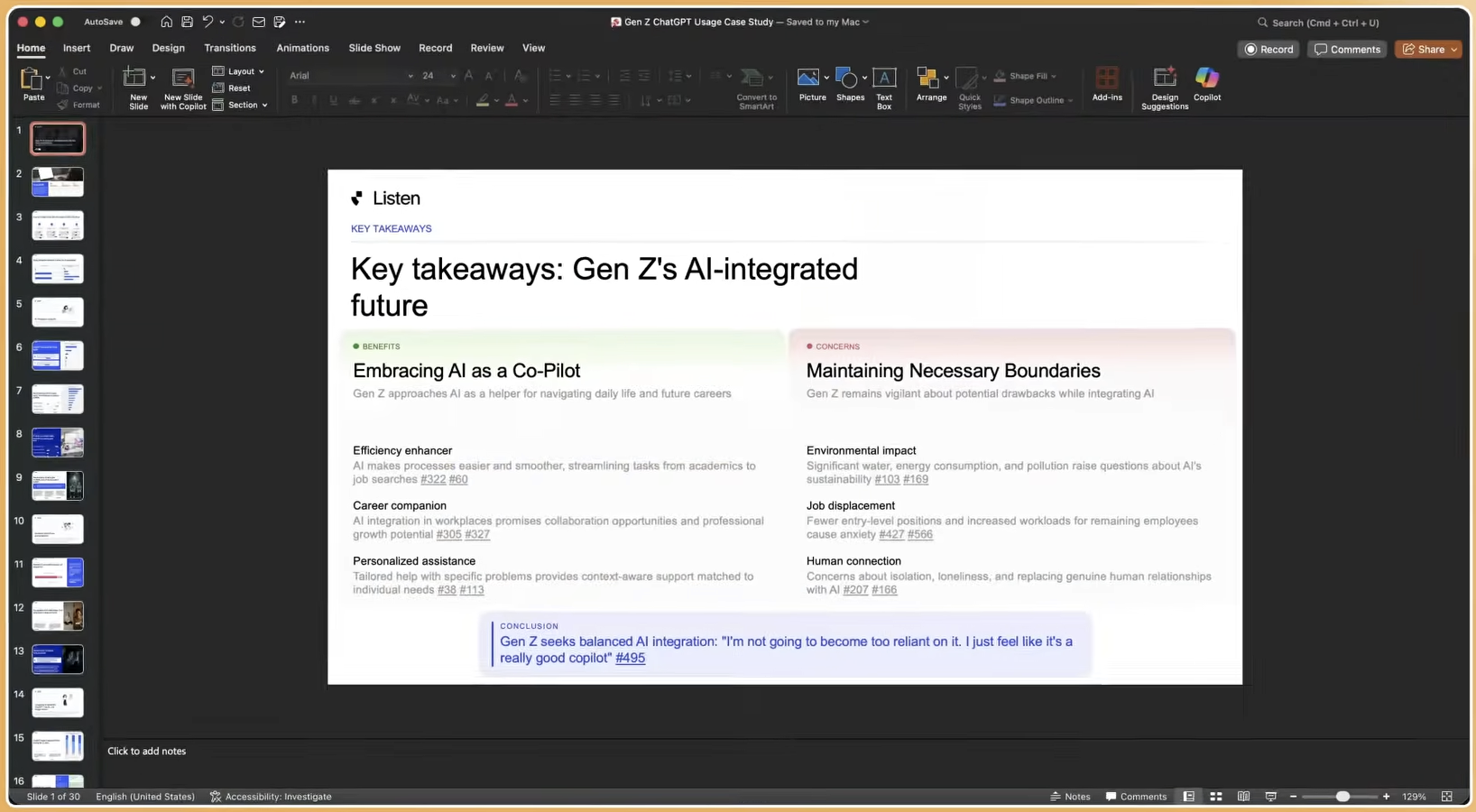
Research Agent: generates a slide deck in your company’s branded template and a downloadable report, allowing one researcher to run a full buying intent analysis across three user segments in under a minute
-
Research Library: cross-study synthesis and institutional knowledge building through natural-language querying of every study ever run
-
Enterprise trust: adoption by Microsoft, Google, Anthropic, P&G, Sweetgreen, Robinhood, Skims, and roughly 15% of the Fortune 100
-
Proven results: clients report cutting research time from weeks to hours and achieving five times the scale at the cost advantage mentioned earlier; Listen Labs raised $69 million in a Series B funding round led by Ribbit Capital, with participation from Evantic, Sequoia Capital, Conviction, and Pear VC, achieving a valuation over $500 million as of January 2026
Listen Labs fits enterprise insights teams that need to multiply research output, UX researchers that require fast feedback loops, and organizations seeking an end-to-end replacement for fragmented research stacks.
See the end-to-end Listen Labs platform in a personalized demo.
Best-Fit Use Cases for AI-Driven Insights Platforms
Platform selection works best when tied to concrete research scenarios rather than abstract feature lists. The use cases below map common organizational needs to the platforms that serve them most effectively.
Enterprise insights teams needing to multiply output should choose end-to-end platforms that handle recruitment, moderation, and analysis without separate vendors at each step. Listen Labs fits this scenario. Microsoft’s research team cut wait time from weeks to hours, collecting global customer stories for Microsoft’s 50th anniversary within a single day. Anthropic’s research team now runs 100 studies in the time it previously took to run five or six, with the research process condensed from two sequential steps into one.
A different set of needs emerges for UX researchers needing fast feedback loops. These teams should prioritize platforms with screen-sharing, usability testing, and rapid participant sourcing. Listen Labs’ Visual Insights feature observes on-screen behavior and probes contradictions in real time, catching the gap between what participants say and what they actually do at scale.
Product and marketing teams without dedicated researchers benefit from self-serve simplicity with natural-language study design. Listen Labs lets teams describe research goals in plain language and then handles design, recruitment, moderation, and analysis automatically. Teams gain high-quality research without deep methodology expertise.
Consultancies and agencies needing rapid turnaround should emphasize speed, global reach, and niche audience recruitment. Listen Labs’ dedicated recruitment operations team sources audiences below 1% incidence rate, including enterprise decision-makers, healthcare workers, and highly specialized consumer segments.
For many organizations, an end-to-end AI platform like Listen Labs provides a strong balance of speed, depth, and scalability. Sweetgreen replaced months-long research cycles with days, scaling research across 300+ US locations at five times the previous volume. Simple Modern delivered hundreds of interviews with a 2.5-hour turnaround and achieved a fourfold larger sample size with more diverse personas than earlier methods.
Explore how Listen Labs supports your specific research use case in a live walkthrough.
Implementation Best Practices and Common Pitfalls
Choosing a platform sets the foundation, and implementation quality determines whether that investment compounds or stalls. A deliberate rollout plan helps teams realize value quickly and build trust in AI-generated insights.
Start with a pilot study. Scope a pilot to a business question already answered internally in the last two quarters. By grading the tool’s output against the known finding, sources, and ambiguities, you validate quality against a known benchmark before committing to broader deployment.
Integrate with existing tools. Ensure the platform connects with your survey engine, CRM, and analysis stack. Listen Pulse, for example, integrates with Qualtrics and Decipher so teams keep the KPIs they already report while adding the narrative behind them. Technical integrations with survey engines, transcription tools, customer data platforms, and analysis tools are a key criterion when evaluating AI research platforms.
Define success metrics before launch. Track insight-to-decision time, research output per team member, and stakeholder engagement with findings. Leading metrics include insight delivery speed and number of decisions informed by data, while lagging metrics include customer retention rate and revenue attributed to insight-driven campaigns.
Ensure stakeholder buy-in across functions. Build alignment with separate briefings for IT and security, procurement, and the executive sponsor. Tailored conversations around trust, contract structure, data portability, and the core business question help secure adoption.
Common pitfalls to avoid include:
-
Over-reliance on AI without human oversight: AI platforms should act as force multipliers for research teams. A 2026 survey of research and insights professionals found that data quality and accuracy (81%) and bias in AI outputs (69%) are the top concerns about AI in market research. Treat AI output as a high-quality draft that still requires expert review and strategic interpretation.
-
Data quality issues: Verify that the panel is free of bots and professional survey-takers. Ask specifically about fraud detection mechanisms, not just panel size. Listen Labs’ Quality Guard monitors every interview in real time and limits participants to three studies per month.
-
Ignoring the say-do gap: Choose platforms that capture observed behavior as well as stated preferences. Participants often report one preference and demonstrate another, a contradiction that only platforms with behavioral observation capabilities can catch and probe in real time.
-
Failing to build a research repository: Ensure every study contributes to a searchable knowledge base so insights compound over time rather than expiring with each project. A research repository should preserve source linkage so findings remain connected to the evidence behind them, and anyone should be able to follow any claim back to a recording, transcript, or dataset.
Frequently Asked Questions
What is the role of AI in consumer insights?
AI automates and scales customer research across participant recruitment, AI-moderated interviews, analysis, and reporting. It enables qual-at-scale, collapsing the trade-off between qualitative depth and quantitative scale. Historically, organizations had to choose one or the other. AI also captures emotional signals through tone analysis and micro-expression detection and supports continuous tracking that identifies emerging trends before they appear in lagging KPIs. In practice, AI handles the time-consuming execution layer, including recruiting, moderating, transcribing, coding, and synthesizing, so research teams can focus on strategic interpretation and decision support.
Which AI platform is best for consumer insights?
Platform fit depends on your primary objective. For advanced quantitative methodologies like conjoint and segmentation, Quantilope excels. For continuous social listening and omnichannel customer intelligence, Sprinklr leads. For AI-moderated qualitative interviews at scale, Listen Labs and Outset deliver conversational richness with large sample sizes. For end-to-end research that covers recruitment, moderation, analysis, and deliverables in a single platform, Listen Labs offers the most comprehensive solution, with proven enterprise adoption at Microsoft, Google, Anthropic, P&G, and Sweetgreen, and over 1 million interviews conducted.
Are there free AI consumer insights tools?
Some platforms offer free tiers or trials. Koji, for example, offers 10 free credits on signup with no card required. Enterprise-grade AI-driven consumer insights platforms typically operate on subscription models calibrated to research volume and audience complexity. Listen Labs offers a demo and pilot process for companies over 100 employees, while smaller companies can access the self-serve platform directly. For enterprise buyers, total cost per insight matters more than entry price, because a platform that delivers five times the research output at the cost advantage described earlier creates a different cost structure than a per-study agency engagement.
How do AI platforms ensure data quality?
Leading platforms layer multiple protections to safeguard data quality. First, they work only with high-quality, non-commodity panels rather than open-access pools where bots and professional survey-takers are prevalent. Second, they apply real-time AI monitoring across video, voice, content, and device signals to detect fraud, low-effort responses, AI-generated scripts, and mismatched profiles during the interview itself. Third, they impose participant frequency limits to prevent panel fatigue and repeat respondents from skewing results. Listen Labs’ Quality Guard combines all three layers, with a dedicated recruitment operations team adding human review for hard-to-reach segments. The platform’s reputation scoring system builds across every interview conducted and creates a compounding quality advantage over time.
How do AI consumer insights platforms compare to traditional research agencies?
Traditional agencies offer methodological rigor and normative benchmarks but take 6–12 weeks and cost $50,000–$500,000+ per study. AI platforms deliver results in under 24 hours at a fraction of that cost. The practical difference for enterprise teams appears in research volume: a team that previously ran 10 studies per year can run 100 with the same budget and headcount using an AI platform. Traditional agencies may still be appropriate when stakeholders require the credibility signal of an established research brand or when a study involves highly sensitive regulatory or compliance requirements. For the majority of recurring research needs, including concept testing, brand perception, customer journey mapping, and usability testing, AI platforms now match or exceed agency quality at dramatically greater speed and scale.
Conclusion
AI-driven consumer insights platforms are transforming research by delivering speed, scale, and depth simultaneously. These capabilities were mutually exclusive under the traditional research model. The evaluation criteria outlined in this guide, including speed to insight, depth of moderation, sample quality, fraud prevention, analysis depth, integration, cost structure, and enterprise readiness, provide a decision-ready framework for shortlisting platforms that match your specific organizational needs.
For many organizations, an end-to-end AI platform like Listen Labs offers a strong combination of speed, depth, and scalability. Trusted by Microsoft, Google, Anthropic, P&G, and Sweetgreen, and backed by over 1 million interviews conducted, Listen Labs delivers consultant-quality insights in under 24 hours at a significant cost advantage over traditional research. The platform covers the entire research lifecycle in a single solution, which removes the fragmentation that slows insight delivery and erodes data quality across disconnected vendor stacks.
Schedule a demo with Listen Labs to multiply your research output and deliver insights in hours.