
Written by: Anish Rao, Head of Growth, Listen Labs
Key Takeaways for 2026
- AI-driven consumer feedback analysis compresses research cycles from weeks to hours. It also scales qualitative depth across thousands of responses and surfaces patterns no manual team could detect.
- Modern AI tools deliver 85–90% sentiment accuracy and 400× throughput versus manual review. Their real value lies in closing the gap between the 4–9% of customer signal human teams can read and the 94–100% AI can analyze.
- Advanced platforms add emotional intelligence across tone, word choice, and micro-expressions, plus say-do gap detection that catches contradictions between stated preference and actual behavior in real time.
- Implementation success depends on clear objectives, multi-channel data collection, careful platform configuration, human validation of AI outputs, and consistent tracking of actions and outcomes.
- Listen Labs combines a 50M+ verified respondent network, AI-moderated interviews, and full-lifecycle analysis to deliver consultant-grade insights in under 24 hours. See a live Listen Labs workflow in a tailored demo.
What AI-Driven Consumer Feedback Analysis Delivers
AI-driven consumer feedback analysis goes well beyond simple sentiment scoring, which classifies responses as positive, negative, or neutral. It adds topic extraction, trend tracking, emotion detection, and automated reporting. These capabilities apply natural language processing and machine learning to unstructured text and multimodal signals, turning raw customer language into structured, prioritized insight.
Traditional methods cannot keep pace. A skilled qualitative coder processes roughly 50–80 open-ended responses per hour. At that rate, 5,000 monthly responses require 60–100 hours of coding time, effectively a full-time role. Manual coding also suffers from consistency drift. Themes assigned in week one often shift by week four, which makes longitudinal comparisons unreliable. Surveys capture what customers say but rarely explain why they say it, and they offer no way to probe unexpected answers.
The scale problem is acute. A mid-market company receives 12,000–40,000 customer feedback items monthly, but without AI, human analysts read only 4–9% of them. The remaining 91–96% of customer signal goes unread. AI feedback analysis closes that gap and applies a consistent methodology across every response.
AI-driven feedback analysis is shifting from competitive differentiator to essential infrastructure for any organization that needs to understand customers at scale. To see how it works in practice, it helps to break down the core capabilities that power these systems.
Core AI Capabilities That Turn Feedback into Insight
Sentiment analysis detects positive, negative, and neutral tones, and increasingly specific emotions like frustration, confusion, or delight. Modern AI sentiment models match or exceed human inter-rater agreement, achieving 85–90% accuracy on clean feedback. Trained human analysts typically reach 78–82% agreement with one another.
Topic extraction automatically groups feedback by underlying issue, regardless of phrasing. AI recognizes that “the system crashes when I try to save” and “I keep losing work because it will not save” describe the same problem. It clusters them into a single theme without requiring teams to build and maintain a manual taxonomy.
Trend tracking monitors how themes and sentiment shift over time. AI can flag a rising trend of complaints about a new feature within hours of launch. Teams no longer wait weeks for a quarterly readout. Time to identify top complaint themes from quarterly feedback drops from three weeks to two hours with AI sentiment analysis.
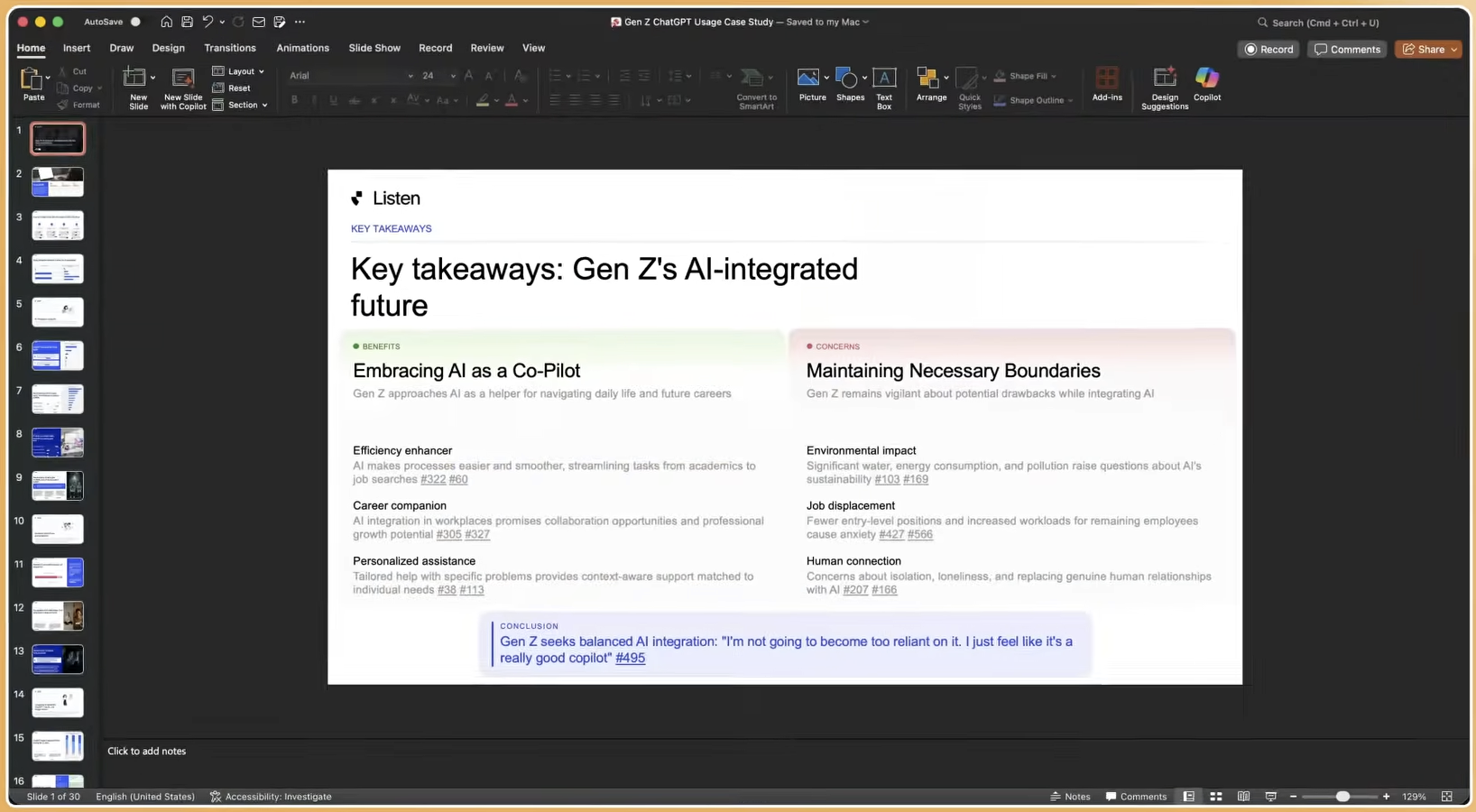
Automated summarization generates concise reports, slide decks, and highlight reels from thousands of responses in minutes. Listen Labs’ Research Agent handles the full analysis workflow, from raw data to final output, with every insight linking directly to the underlying response data.
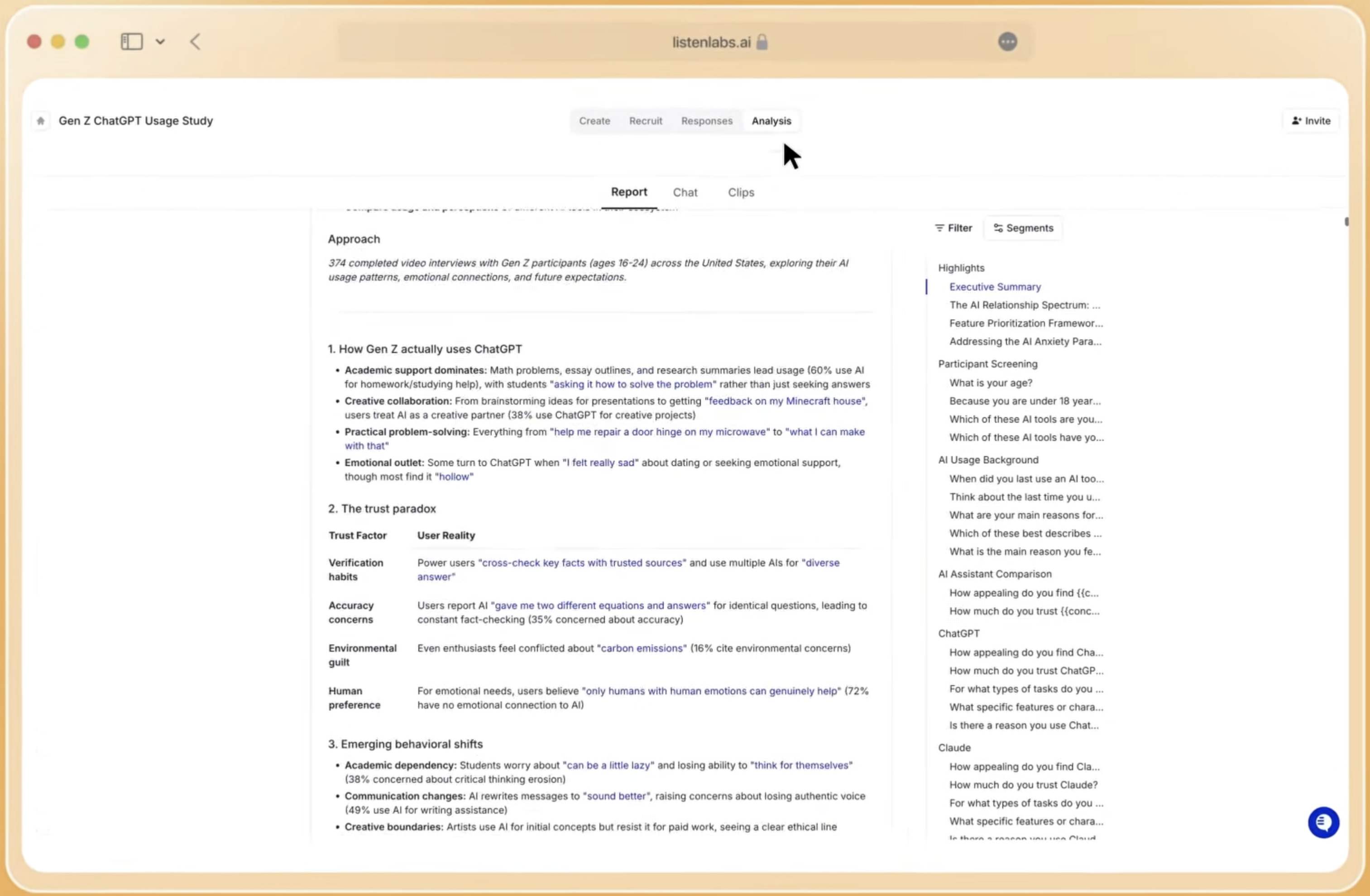
Emotional intelligence adds a deeper layer beyond transcripts alone. Listen Labs’ Emotional Intelligence analyzes three signals: tone of voice, word choice, and subconscious micro-expressions. This surfaces emotions that written responses never capture. It is built on Ekman’s universal emotions framework, tracking seven universal emotions: anger, contempt, disgust, enjoyment/happiness, fear, sadness, and surprise. Every emotion is quantified per question and traceable to the exact timestamp and verbatim quote.
Say-do gap analysis detects discrepancies between what customers say and what they do. Ask Gen Z how they feel about AI customer service agents and they often claim they would rather talk to a person. Many then click the AI agent in three seconds. Listen Labs’ Visual Insights lets the AI interviewer observe on-screen behavior during the interview, catch contradictions in real time, and probe the discrepancy instead of following a rigid script.
Why AI Feedback Analysis Matters for Business Decisions
Speed. Faster analysis shortens the distance between customer signal and action. Post-call survey analysis cycle time drops from 14 days to under 24 hours with AI sentiment tools. This shift enables daily review instead of a monthly cadence. Listen Labs compresses the entire research lifecycle, from study design through participant recruitment, AI-moderated interviews, and analysis, to less than 24 hours.
Scale. AI reads what human teams cannot reach. AI processes feedback at 400× the throughput of manual review teams. It analyzes nearly all available feedback instead of the small fraction human analysts can review.
Accuracy. AI provides consistent coding over time. AI eliminates consistency drift. When AI reports that negative sentiment about a feature increased 35% month over month, teams can trust that the measurement approach stayed constant from response one to response five thousand.
Actionability. AI uncovers the “why” behind the numbers and connects it to specific customer language. Traditional surveys may tell us what people do, but it takes a conversation to understand why. Companies that act on customer feedback see 10–15% higher revenue growth rates than those that ignore it.
Cost efficiency. AI reduces the cost of reading and coding feedback. AI sentiment analysis costs $0.40–$2.10 per 1,000 items versus $180–$420 for human teams, a 100–200× cost differential. Listen Labs delivers qualitative research at roughly one third the cost of traditional approaches.
How to Implement AI-Driven Feedback Analysis
- Define your research objectives and questions. Identify the specific decisions this insight will inform. Vague objectives produce vague findings. Start with the business question. Clarify what you need to understand about your customers and what action the answer will enable.
- Collect feedback from multiple channels. Interviews, surveys, support logs, and reviews each capture different dimensions of customer experience. Customers describe issues differently depending on where they provide feedback. Single-source analysis fragments understanding. For organizations that need to actively gather new feedback, AI-moderated interviews provide the highest-yield collection method.
- Choose an AI platform that fits your needs. Decide whether you need a collect-plus-analyze platform or an analysis-only tool. Teams with a growing research backlog and limited collection capacity benefit from a platform that handles the full lifecycle.
- Configure the AI for your context. Set up sentiment, topic, and emotion analysis for your specific domain. Most modern platforms allow configuration through settings, rules, and examples. This approach avoids the need for in-house data science expertise.
- Validate findings with human review. Spot-check 10–20% of classifications before trusting results at scale. AI identifies patterns. Human experts decide which patterns warrant investment and what changes to make.
- Turn insights into action. Share reports with stakeholders and connect findings to decision-making workflows. Track whether complaint volume and sentiment improve after you ship a fix. AI feedback analysis enables post-implementation validation. Teams can measure whether sentiment for a specific issue improves after addressing it and close the loop between insight and outcome.
How to Choose an AI Feedback Analysis Tool
The market for AI feedback analysis tools divides into three main categories. The right choice depends on whether you need to collect new feedback, analyze existing feedback, or cover both.
Enterprise VoC platforms such as Qualtrics and Medallia provide comprehensive but complex suites. Legacy suites like Qualtrics and Medallia take 3–6 months to implement and carry heavier services costs, with enterprise contracts often reaching six figures annually. They support organizations that must close the loop across direct, indirect, and inferred feedback signals across the full customer journey. They typically do not generate new qualitative insight on demand.
Text analytics and AI-native analysis tools such as Chattermill, Enterpret, and Thematic excel at analyzing feedback you already collect. Chattermill, for example, does not collect feedback itself and requires separate collection tools. These platforms focus on analysis. You bring the data and they code it. They fit well when survey governance and collection are already solved, but they cannot run new research programs independently.
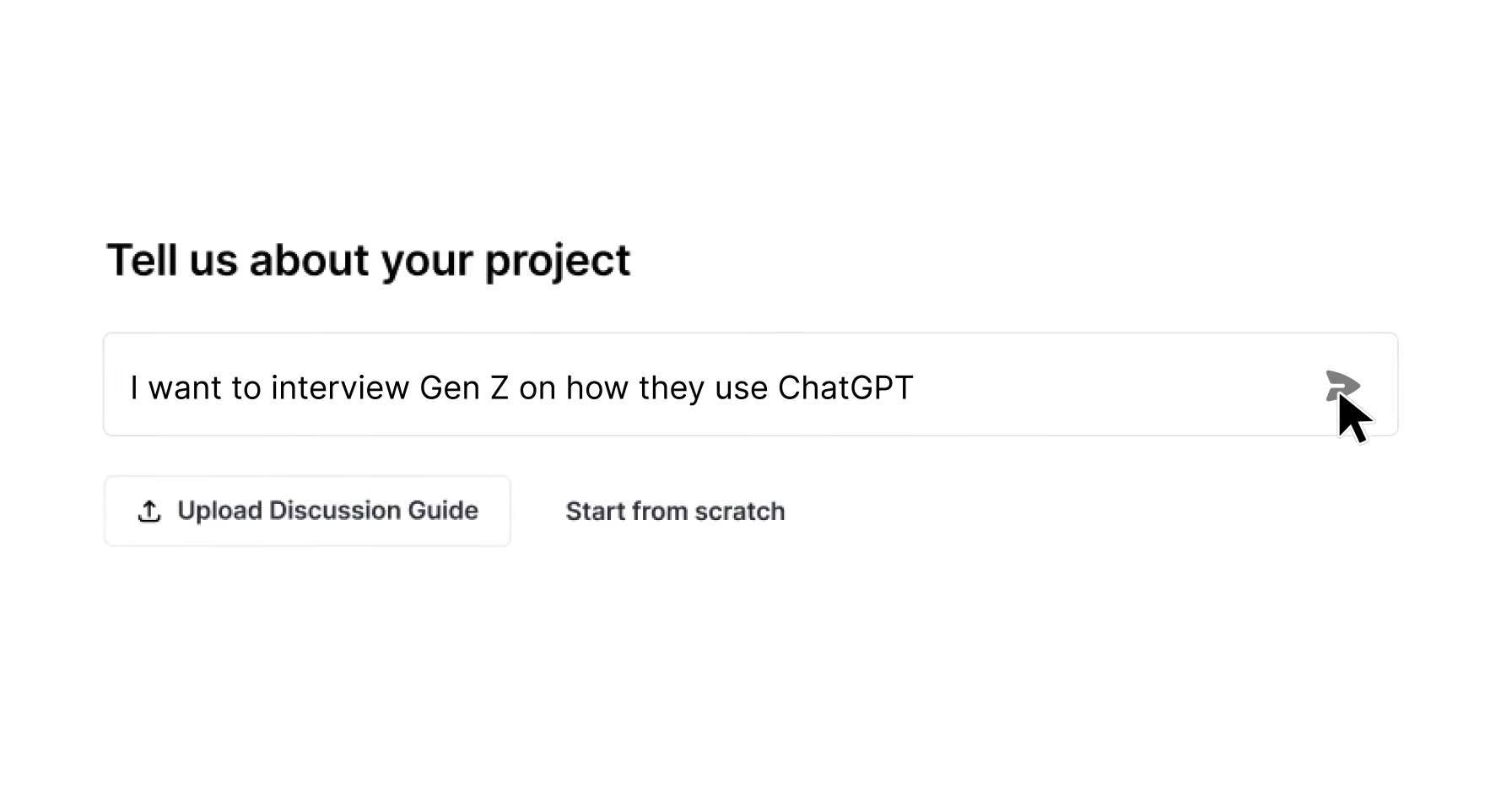
AI-native end-to-end platforms such as Listen Labs handle the entire research lifecycle, from participant recruitment through AI-moderated interviews to analysis and deliverables. Listen Labs combines a global panel of 50M+ verified respondents, AI-moderated interviews with adaptive follow-up questions, and advanced analysis that includes emotional intelligence and say-do gap detection. Platforms like Listen Labs layer on auto-recruiting, transcription, sentiment tagging, and insight summarization. Teams move from question to findings in hours instead of weeks.
Key selection criteria include ease of use, integration with existing systems, scalability, depth of analysis, data security, and total cost. 92% of participants report top comfort levels with AI moderation, equivalent to human-moderated sessions. This comfort level makes AI-led interviews a research-grade collection method.
AI Feedback Analysis Challenges and Best Practices
Data quality. Strong AI output depends on strong input. AI does not repair bad data. If inputs are incomplete, duplicated, noisy, or poorly labeled, insights weaken. Consolidate feedback sources and remove noise such as automated messages and spam. Ensure sufficient volume. Systems typically need hundreds or thousands of feedback points for reliable patterns. Below that threshold, sentiment trends can skew on a handful of outliers.
Context understanding. Sarcasm, mixed sentiment, and domain-specific language still challenge even advanced models. Top AI sentiment analysis tools achieve 80–90% accuracy on clean, single-topic feedback in major languages, but accuracy drops on sarcasm, mixed sentiment, and domain-specific language. Always validate performance on your own data before trusting results at scale.
Privacy and compliance. Free-text customer feedback often contains personal data. Ensure GDPR and CCPA compliance, anonymize data before processing, and choose platforms with enterprise-grade security. Listen Labs holds SOC 2 Type II, ISO 27001, ISO 27701, and ISO 42001 certifications and never trains its AI models on customer data.
Human validation. AI augments human judgment and does not replace it. AI identifies patterns but cannot determine which patterns warrant investment or what changes to make. Human judgment remains essential for interpreting insights and setting priorities.
The Future of Feedback Analysis: Emotion and the Say-Do Gap
Traditional feedback analysis often misses two critical dimensions. It overlooks what customers feel, beyond what they say, and it overlooks what customers do when that behavior contradicts their stated preferences.
“What people say and how they feel do not always line up. Understand both with Emotional Intelligence.” Two ads can both receive positive ratings while triggering entirely different emotional responses. One may spark genuine delight, while the other produces flat confusion. Without capturing emotion at the signal level, teams make decisions on incomplete data. Listen Labs’ Emotional Intelligence quantifies every emotion per question and concept. Every label is traceable to the exact timestamp, verbatim quote, and reasoning behind it, across 50+ languages and integrated directly with the Research Agent for natural-language queries and highlight reels.
The say-do gap carries similar weight. Qual-at-scale is an approach to research that lets AI handle the time-consuming parts of research, freeing companies to have more meaningful conversations. Those conversations can catch behavioral contradictions in real time. When a participant says they prefer human support and then clicks the AI agent in three seconds, Visual Insights records the contradiction and probes it mid-interview. The system produces a timestamped, second-by-second log of every meaningful on-screen change.
The practical impact shows up in real brands. One well-known clothing company was quietly losing customers. Its traditional tracker caught the drop but could not explain it. Listen Labs’ conversational tracking revealed that price was not the issue. Style was. A growing group of customers felt the brand’s big logos were too loud for their changing lifestyles. That insight required both the scale to detect the pattern and the depth to surface the reason behind it.
32% of participants explicitly state they feel less judged with AI moderation. This creates a structural advantage for research on sensitive topics where social desirability bias often suppresses honest responses in human-moderated sessions.
Conclusion: From Customer Signal to Confident Decisions
AI-driven consumer feedback analysis now functions as core infrastructure for understanding customers at scale. Organizations that rely only on manual analysis or survey dashboards make decisions on a thin slice of available customer signal and miss how people actually feel and behave.
Modern systems capture emotional intelligence across tone, word choice, and micro-expressions. They also narrow the say-do gap by observing behavior during the interview itself. Listen Labs delivers this full picture as an end-to-end platform, combining a 50M+ verified respondent network, AI-moderated interviews with adaptive follow-ups, and analysis that goes beyond transcripts to reveal the story behind every metric.
Teams ready to connect customer voices directly to product, marketing, and experience decisions can see the approach in action with a personalized Listen Labs demo.
Frequently Asked Questions
What is the difference between sentiment analysis and AI-driven consumer feedback analysis?
Sentiment analysis is one component of AI-driven consumer feedback analysis. It classifies the emotional tone of text as positive, negative, or neutral, sometimes with intensity scoring or granular emotion categories. AI-driven consumer feedback analysis is the broader discipline. It includes sentiment analysis alongside topic extraction, trend tracking, emotion detection from multimodal signals such as tone of voice and facial micro-expressions, automated summarization, and say-do gap detection. Sentiment analysis tells you how customers feel about something. AI-driven feedback analysis explains what they feel, why they feel it, what they are doing, and what your organization should do in response. The most advanced platforms, like Listen Labs, also handle collection by running AI-moderated interviews that generate richer, more probing conversations than static surveys, so the analysis starts with higher-quality input.
How does AI-driven feedback analysis handle the say-do gap in consumer research?
The say-do gap describes the discrepancy between what consumers report and what they actually do. Traditional methods struggle with this problem. Moderated sessions can catch contradictions but do not scale beyond a small group of participants. Unmoderated testing scales but records behavior that nobody has time to watch. AI-driven platforms address this by observing on-screen behavior during the interview itself. When a participant’s stated preference contradicts observed behavior, such as clicking an AI agent immediately after saying they prefer human support, the AI interviewer detects the contradiction in real time and probes it with a follow-up question. The platform then produces a timestamped, second-by-second log of on-screen behavior that can be quantified across sessions, with every metric linked to the exact moment it occurred. This approach combines behavioral accuracy with conversational depth at scale.
What types of consumer research studies can AI-driven feedback analysis support?
AI-driven feedback analysis supports a wide range of study types. On the collection side, AI-moderated interviews work well for concept and prototype testing, usability testing with screen sharing, creative and ad testing, brand perception research, consumer journey mapping, multi-market segmentation studies, pricing research, and MaxDiff prioritization exercises. On the analysis side, the same AI capabilities, including sentiment analysis, topic extraction, emotion detection, and trend tracking, apply to any unstructured feedback source such as support tickets, open-ended survey responses, product reviews, and interview transcripts. For ongoing programs, conversational trackers like Listen Pulse run the same study wave after wave, combining quantitative KPI tracking with open-ended conversation so every metric movement arrives with its explanation. AI handles clustering, coding, and summarizing, while human researchers focus on interpretation and strategic prioritization.
How do organizations ensure data quality and participant integrity in AI-driven feedback programs?
Data quality in AI-driven feedback analysis depends on the quality of the input data and the integrity of the participants providing it. On the data side, best practices include consolidating feedback from multiple channels, removing noise such as automated messages and spam, and ensuring sufficient volume. Systems typically need hundreds or thousands of feedback points before topic clusters achieve statistical confidence. On the participant side, commodity panels can introduce professional survey-takers, fraudulent profiles, and incentive-driven responses that undermine research validity. Listen Labs addresses this through Quality Guard, a three-layer system. It uses behavioral matching on intent and past actions rather than self-reported demographics. It applies real-time AI monitoring across video, voice, content, and device signals to detect fraud and low-effort responses. It also relies on a dedicated recruitment operations team that adds human review, with participants limited to three studies per month to reduce panel fatigue. This approach supports a zero-fraud guarantee backed by a reputation scoring system that improves as more studies run on the platform.
How long does it take to get results from an AI-driven consumer feedback study?
Timelines depend on the platform and study design, but AI-native end-to-end platforms have reset expectations. Listen Labs compresses the entire research lifecycle, including AI-assisted study design, global participant recruitment, AI-moderated video interviews, automated analysis, and delivery of consultant-quality reports, slide decks, and video highlight reels, to less than 24 hours. Traditional qualitative research often takes 4–6 weeks from study design to final report. In large enterprises with internal prioritization and budget approval processes, the cycle can stretch to six months. The 24-hour timeline does not trade off against quality. Listen Labs has conducted over one million AI-moderated customer interviews and serves enterprises including Microsoft, Google, Procter & Gamble, and Nestlé. Microsoft, for example, used Listen Labs to collect global customer stories for its 50th anniversary celebration within a single day, a study that would have taken weeks through traditional research channels.