
Written by: Anish Rao, Head of Growth, Listen Labs
Key Takeaways
- Real-time brand insight pairs always-on monitoring with continuous AI-moderated research so every metric movement arrives with its explanation.
- Traditional alerts flag what moved but leave teams without a diagnostic, which creates a structural gap between detection and action.
- LLM visibility tracking and structured prompt panels are now essential because AI-generated answers can surface brand framing shifts within days.
- Effective programs trigger conversational research automatically when thresholds are crossed, turning alerts into actionable insights within hours rather than weeks.
- Listen Labs combines monitoring and research in a single platform, and you can see Listen Pulse close the loop from alert to explanation.
The Gap Between an Alert and an Answer
Dashboards and alerts tell you a number moved. Sentiment dipped. Share of voice shifted. A KPI declined. Nothing in the alert tells you why. By the time the drop shows up in a tracker, the underlying shift has often been building for 6–12 months. Brand metrics act as leading indicators only when someone reads the signal early enough to act.
The problem is structural. G2’s 2026 State of Brand Intelligence report, based on 729 verified reviews, found the Brand Intelligence category averages only 6.28 out of 10 on “meets requirements”. G2 attributes this pattern to tools that require significant configuration to compensate for coverage gaps. Meanwhile, Sprout Social’s Social Intelligence Report found that 93% of professionals say social intelligence is important for future growth, but only 10% can act on an insight within hours. The core gap lies in the absence of a diagnostic attached to the alert.
This guide is for leaders who already have or are evaluating a monitoring tool and need to move from alerts to understanding. The operating model described here pairs always-on signal detection with continuous AI-moderated customer research. Monitoring tells you a number moved; research explains why. Real-time brand insight requires both running continuously.
Prerequisites and Context for This Operating Model
This guide is written for VPs and Directors of Consumer Insights, Heads of Customer Research, Brand Managers, and Heads of Marketing at mid-to-large companies. It is also relevant to UX research leads and consultancy teams running brand work.
Several terms are used throughout with specific meanings:
- Real-time brand monitoring: Continuous crawling of social, news, forum, and review sources to detect mention spikes, sentiment shifts, and share-of-voice changes as they occur.
- AI brand intelligence: Application of AI to aggregate, classify, and surface patterns across brand-relevant signals at a scale and speed no human team can match manually.
- Sentiment analysis: Automated classification of text (and increasingly audio and video) as positive, neutral, or negative, sometimes extended to specific emotions.
- Share of voice: A brand’s proportion of total media or AI-generated mentions within a defined competitive set over a defined period.
- LLM visibility: How often and how accurately a brand appears in AI-generated answers from models such as ChatGPT, Gemini, Perplexity, and Claude.
- Brand perception in AI search: The framing, sentiment, and positioning language LLMs use when describing a brand in response to buyer-intent prompts.
- AI-moderated interviews: Qualitative research conversations conducted by an AI interviewer that probes dynamically, adapts to responses, and runs at scale simultaneously.
- Always-on research: A continuous research program that runs wave after wave on a fixed cadence rather than as one-off projects.
- Brand tracker: A longitudinal study that measures a consistent set of KPIs such as awareness, consideration, preference, and NPS across repeated waves to identify trends.
The market context shapes how you design this operating model. The global social media listening market was valued at $10.37 billion in 2025 and is projected to reach $12.15 billion in 2026, yet the dominant tool conversation still frames the entire category around social listening and media monitoring. In 2026, AI-powered sentiment analysis, predictive trend detection, and cross-channel audience intelligence have become table stakes for leading social media monitoring platforms rather than premium add-ons, according to Pulsar’s 2026 tool comparison. Detection capability has outpaced diagnostic capability.
At the same time, Google AI Overviews, Perplexity, and ChatGPT now pull from social conversations, forums, and review platforms when answering product and brand queries. A cluster of negative posts can surface in AI-generated answers seen by thousands of potential customers within days. LLM visibility has become a brand intelligence category in its own right, while most ranking articles still treat social listening as the whole story.
See how Listen Labs pairs always-on monitoring with continuous conversational research.
How to Get Real-Time Brand Insights
- Define What “Real Time” Should Mean for Your Brand. “Real time” is a decision-latency question rather than a dashboard-refresh question. A crisis communications team needs alerts in minutes, while a brand strategy team making quarterly positioning decisions needs trend data in days. A product team validating a concept needs research results in hours rather than weeks. Calibrate the cadence to the decision instead of the technical capability of the tool. Mismatched cadence is one of the most common reasons monitoring programs generate noise rather than action.
- Set Up Always-On Signal Detection. Monitoring tools detect media mentions, sentiment, share of voice, and LLM visibility. Enterprise tools like Talkwalker, Brandwatch, and Meltwater typically deliver social media alerts within one to five minutes. Configure alert tiers so the right people see the right signals. Use immediate alerts for volume spikes above a defined threshold, negative sentiment surges, or high-risk keyword combinations. Use daily digests for routine mention volumes and weekly or monthly reports for share-of-voice trends. Document routing rules explicitly by topic and urgency so they survive personnel changes. A product launch coverage spike routes differently than a CEO mention or a competitor funding announcement.
- Track How ChatGPT, Gemini, and Perplexity Describe Your Brand. LLM visibility tracking requires a structured, repeatable method. First, define a prompt set of 30–60 queries that mirror real buyer questions across prompt types such as category discovery, comparison, alternatives, validation, and problem-first. Second, run each prompt three to five times per platform in clean, logged-out sessions with no conversation history. Third, log six fields for each response: brand presence, list position, competitors named, framing phrase, sentiment classification, and cited domains. Fourth, roll results up weekly into mention rate and AI share of voice per platform, calculated as (brand mentions ÷ total brand mentions across all tracked brands) × 100. Fifth, track drift in framing as carefully as presence. A study of 102 brands across 102,025 AI responses found brand presence flipped only 6.8% between measurements while sentiment framing flipped 45.5% of the time. Counting mentions without reading framing understates brand risk significantly. Each platform behaves differently. ChatGPT weights consistent cross-web brand presence, Perplexity indexes in near-real-time and weights freshness and community sources like Reddit, and Gemini draws from Google’s organic index and applies E-E-A-T signals heavily.
- Separate Signal from Explanation. The core framework distinguishes detection, which shows what moved, from diagnosis, which explains why it moved. Social listening can detect that sentiment toward a brand dropped, such as 12 points in Q3, but cannot explain whether the cause was product quality, a pricing change, a competitor doing something better, a shift in buyer priorities, or a specific feature gap, because the “why” requires conversation to surface. Public social posts are naturally occurring performance, not private opinion, written for audiences and shaped by platform norms, which makes them useful for discourse analysis but limited for causal explanation. Sentiment scores and instant alerts leave teams reacting to lagging indicators without a diagnostic attached.
- Trigger Research, Not Just a Slack Ping. Design alert thresholds that automatically open a research follow-up. When a theme spikes or a KPI dips, run conversational interviews with the affected segment to find the reason. A layered operating model runs monthly social-listening dashboards to flag anomalies, such as a 15% rise in mentions of “ingredient concerns,” then triggers a 100-interview deep dive within two weeks to test whether the spike reflects a genuine shift in private buyer priorities or a non-buyer media moment. The research returns in hours rather than weeks and grounds the strategic response in evidence instead of dashboard reflex.
- Choose a Platform for Continuous Conversational Research. Select a research platform that can run the same study with the same screeners wave after wave, keeping core questions constant so the trend line stays clean. Look for open-ended conversation that captures the “why” behind every metric movement and for analysis that can process tens of thousands of responses continuously. The strongest platforms surface emerging themes before they appear as a KPI decline and trace every number back to the interview, verbatim quote, and audio or video clip behind it. Integration with existing trackers such as Qualtrics or Decipher lets teams keep the KPIs they already report while adding the narrative behind them. Traditional surveys may tell you what people do, while conversation explains why.
- Close the Loop into Action. Route findings to product, brand, and marketing owners so the metric movement and its explanation arrive in the same wave. Treat the insight as complete only when the stakeholder who can act on it has both the number and the reason. Build a simple review cadence, such as wave close to stakeholder briefing within 24 hours. Track the percentage of metric movements that arrive with a documented reason, because that percentage is the operational measure of whether the monitoring-plus-research loop is working.
View the full operating model in a live Listen Labs walkthrough.
Frameworks, Models, and Illustrative Examples
The spine of this guide is the signal versus explanation framework. Monitoring detects, research diagnoses, and real-time brand insight requires both running continuously. Each capability plays a distinct role. A monitoring-only program generates alerts with no diagnostic. A research-only program generates explanations with no early warning. The combined model closes the loop.
Choosing an approach depends on three questions. What decision do you need to make? What latency can you tolerate? Do you need to know what moved or why it moved? A monitoring-only approach fits crisis detection and competitive alerting where speed is the primary requirement. A research-only approach fits deep strategic questions where representativeness and causal depth matter more than speed. The combined approach fits brand health programs where both early warning and explanation are required, which describes most enterprise brand and insights teams.
Three hypothetical examples show where the gap between detection and diagnosis creates risk:
- A CPG brand sees a sentiment dip after a packaging change. Monitoring flags the drop. Without research, the team cannot distinguish between consumers who dislike the new design aesthetically, consumers who cannot find the product on shelf because the new packaging is harder to identify, and consumers who associate the change with a perceived quality reduction. Each explanation points to a different response.
- A tech company’s LLM answers start describing a feature incorrectly and cite a deprecated capability as current. 11.2% of AI brand mentions include at least one factual inaccuracy, most commonly outdated pricing and deprecated features. The error remains invisible to social listening because it lives inside AI-generated answers rather than public posts. A structured LLM visibility panel reveals the issue and guides content and documentation fixes.
- A retailer’s share of voice rises while consideration falls. Monitoring shows the brand is being talked about more. Follow-up research reveals the conversation is driven by price comparison queries. The brand appears in more AI answers, but consistently as the expensive option, which signals a pricing and positioning problem rather than a reach problem.
A real Listen Pulse finding illustrates the diagnostic gap directly. A well-known clothing brand, famous for its big logos, was quietly losing customers. Its old tracker caught the drop but could not explain it. Pulse revealed that style, not price, drove the shift. A growing group of customers felt the big logos were too loud for their changing lifestyles. That explanation required conversation rather than a sentiment score.
Explore how Listen Pulse surfaces the explanation behind every metric movement.
Common Challenges and Troubleshooting
Several failure modes appear consistently in brand intelligence programs:
- Alerts with no diagnostic attached. The alert fires, a Slack message goes out, and the team debates what the number means for two weeks. Recognize this pattern when the same metric movement triggers repeated internal meetings with no resolution. The fix is a pre-agreed research trigger so that when a threshold is crossed, a follow-up study launches automatically.
- Sentiment scores that cannot distinguish confusion from anger. Automated sentiment analysis has a methodological blind spot: surface-level polarity detection cannot capture latent meanings, contextual cues, or tacit criticism in online discourse. A product that confuses buyers and a product that angers them require entirely different responses, yet polarity scores collapse both into a single negative bucket.
- LLM answers that drift without anyone noticing. LLM outputs vary session to session and are not indexed like web pages, so framing changes remain invisible unless someone runs a structured prompt panel on a fixed cadence. The primary bottleneck in LLM visibility improvement is the gap between detecting a visibility gap and deploying a fix, and a 30-day window represents 30 days of compounding citation loss.
- Monitoring data that never reaches decision-makers. 56% of in-house brand teams struggle to demonstrate the business value of social listening to leadership. Insights that live in a dashboard no executive opens do not change decisions. Build a distribution layer with curated digests for executives, product-specific feeds for product teams, and competitive updates for sales.
- Research backlogs that make follow-up studies impossible. When the research team is already oversubscribed, a monitoring alert that should trigger a follow-up study instead joins a queue. The fix is a research infrastructure that can turn around a 100-interview study in hours rather than weeks.
- Siloed findings that get re-researched every year. Without a cross-study intelligence layer, teams commission new research on questions that have already been answered. The cost includes both budget and the lost compounding value of longitudinal data.
A common objection is that general-purpose LLMs like ChatGPT or Claude can design a study guide and analyze results. General LLMs can assist with individual steps, yet they lack the proprietary research data that makes study design and analysis reliable at scale. They do not handle recruitment, moderation, or end-to-end analysis. With AI-moderated interviews, talking to users at scale is no longer the hard part, while understanding what they mean remains the challenge. That challenge requires a platform built on tens of thousands of completed studies rather than a general-purpose model.
Measuring Success
A functioning monitoring-plus-research loop shows up in a few objective indicators:
- Time from alert to explanation: Measure how many hours or days elapse between a monitoring alert and a documented reason for the shift. Treat this as the primary operational metric.
- Study cycle time: Track how long it takes from research brief to stakeholder-ready findings. Anything over 48 hours becomes a bottleneck in a real-time brand intelligence program.
- Percentage of metric movements with a documented reason: Track what fraction of KPI movements in each wave arrive with a qualitative explanation. A program that reaches 80% or higher functions as designed.
- Stakeholder usage of insights: Watch whether product, brand, and marketing owners cite research findings in decision documents. Usage provides a stronger signal than satisfaction scores.
- Whether insights change decisions: Confirm whether the research program has altered a product, brand, or campaign decision in the past quarter.
Core questions must stay constant wave over wave to keep the trend line clean. Changing question wording between waves breaks comparability. “If your vendor ‘optimizes’ question phrasing between waves, your trend data could likely be noise.” Timely add-on questions can cover new campaigns, competitors, or news events without touching the core instrument. Run periodic retrospectives on the monitoring-plus-research loop, such as quarterly reviews, to assess whether alert thresholds, research triggers, and distribution workflows still match the decisions the business is actually making.
Separate short-term signals from longer-term trend validation. A 4-point sentiment drop in a single wave is almost always noise, while a 4-point drop sustained across three waves is signal. Programs that react to every single-wave movement waste organizational attention.
Advanced Considerations and Iteration
Once the core monitoring-plus-research loop is operational, you can extend its value with several advanced capabilities that deepen insight and speed decisions.
- Always-on research programs at scale. Mature programs run continuous waves that surface emerging themes before they appear in tracked metrics. Listen Pulse identifies shifts forming in customer conversations before they register as a KPI decline, which gives teams more time to respond.
- Emotional intelligence layered onto conversational data. What people say and what people feel represent different data points. Listen Labs’ Emotional Intelligence analyzes tone of voice, word choice, and subconscious micro expressions to surface emotions that transcripts alone miss. Built on Ekman’s universal emotions framework, the same standard used in clinical psychology, every emotion is quantified per question and traceable to the exact timestamp, verbatim quote, and reasoning behind it. Coverage across 50+ languages makes this especially valuable for creative testing, concept comparison, and brand perception studies where the gap between stated and felt response carries commercial weight.
- Visual insights for behavioral research. The AI Interviewer observes on-screen behavior and probes contradictions in real time. When a participant does the opposite of what they said, the moderator catches it and asks follow-ups in the moment. This approach closes the say-do gap that unmoderated testing misses and that moderated testing cannot scale beyond a handful of sessions.
- Research library for cross-study intelligence. A searchable library lets teams query every study ever run in natural language with full source attribution. Each new study grows the knowledge base rather than expiring as a standalone report. Teams can check whether a question has already been answered before commissioning new research, track how sentiment evolves across waves, and onboard new team members against the full corpus.
- MaxDiff for prioritization without ties. When teams have more good options than they can execute, MaxDiff shows four options at a time and asks which is best and which is worst. A Hierarchical Bayes model aggregates responses into a clean ranking. Portfolio Optimization then finds the combination that wins the most customers rather than just the top individual scorers. In one study, the three highest-scoring options won 51% of shoppers, while the optimized mix won 87%.
- Global and multi-market brand studies. Listen Labs covers 45+ countries across 120+ languages with automatic translation and transcription. Multi-market programs can run simultaneously rather than sequentially, and the Launch tab supports running multiple recruit groups within a single study, such as one from Listen’s global panel and one from your own list, which is ideal for multi-market studies and can compress a typical 4-week research cycle into as little as 24 hours.
Advanced practices work best when a few readiness criteria are in place. Research operations must be mature enough to act on wave findings within 48 hours. Data governance needs a defined policy for how research data is stored, accessed, and retained. Cross-functional alignment matters as well, with product, brand, and marketing owners agreeing to use research findings as inputs to decisions rather than post-hoc validation.
A safe pilot path keeps scope tight. Start with one brand theme, one segment, and one wave. Establish the baseline, then add the open-ended conversation layer. Measure time from alert to explanation and expand from there.
Design a Listen Labs pilot that fits your current research infrastructure.
Why Listen Labs
Listen Labs provides an end-to-end platform covering study design, global recruitment, AI-moderated interviews, analysis, and deliverables in one system. Listen Labs has run over 1 million AI-powered customer interviews for companies including Microsoft, Perplexity, and Sweetgreen. The platform covers more than 50 million verified respondents across 45+ countries and 120+ languages. Research cycles that previously took 4–6 weeks now complete in less than 24 hours at roughly one third the cost of traditional research.
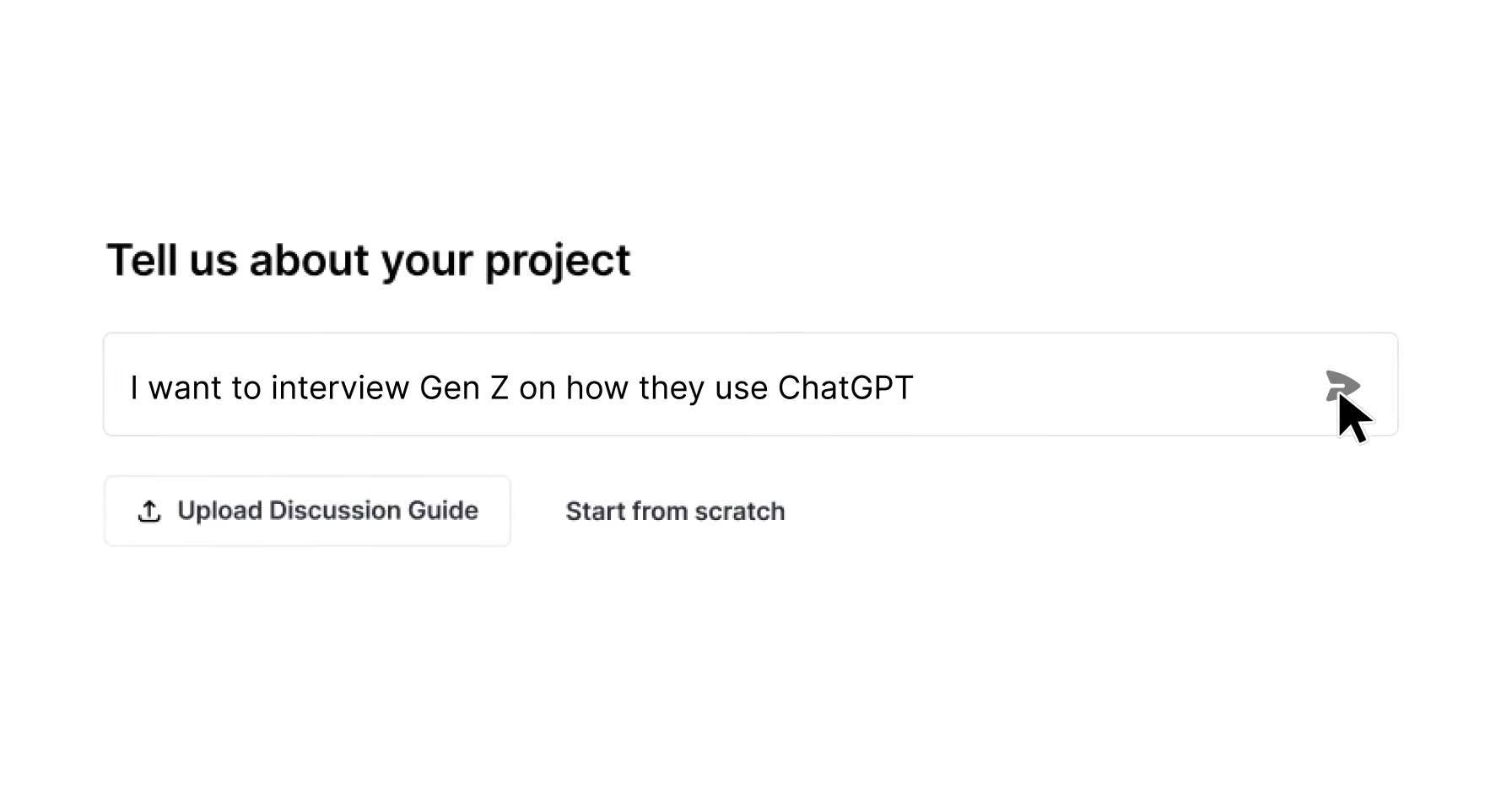
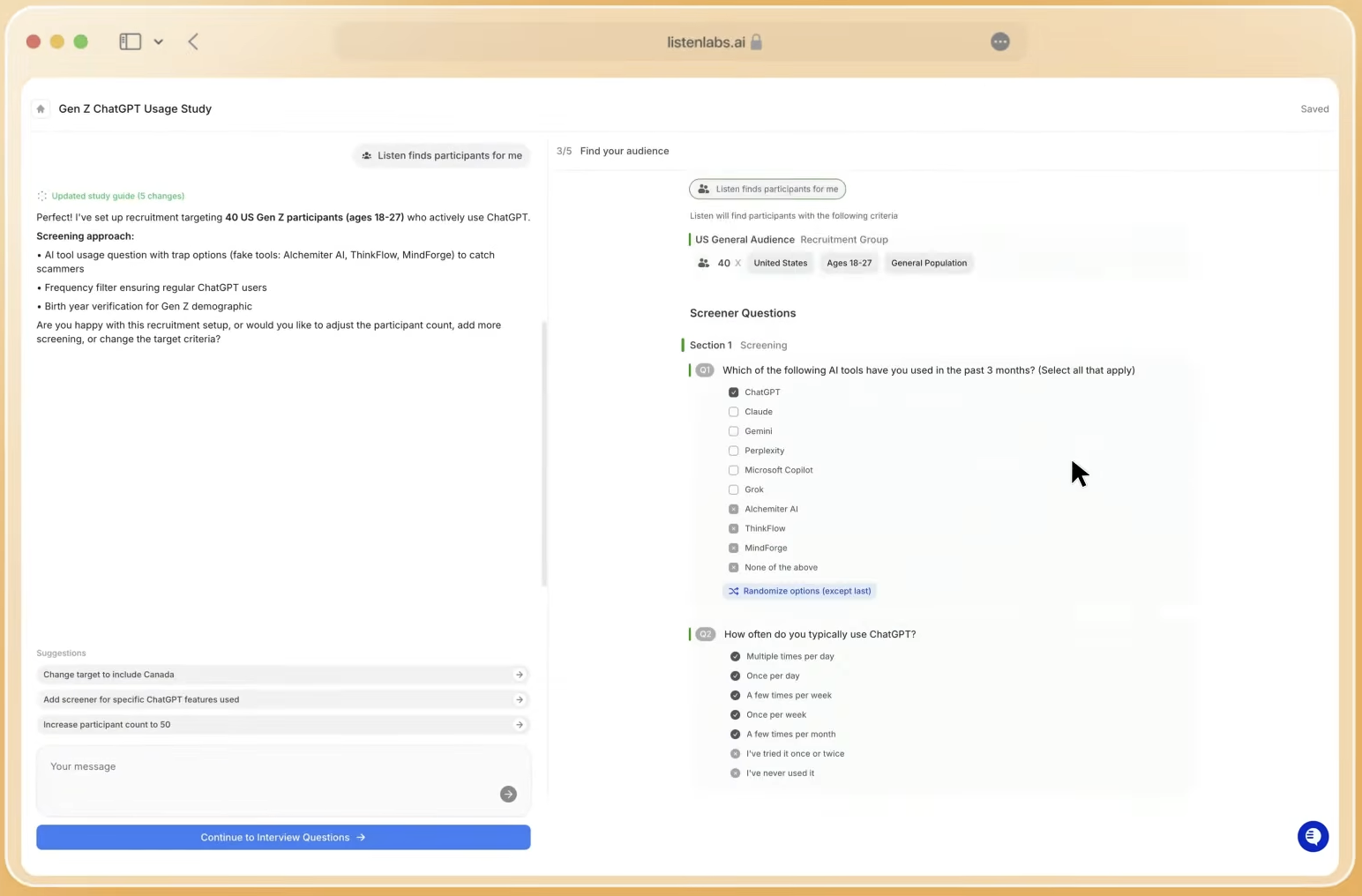
Listen Pulse is the mechanism described earlier in this guide, running the same study with the same screeners wave after wave so trend lines stay clean while conversations capture the “why” behind every movement. What the platform adds at enterprise scale is a quality layer and proof that the model works in practice.
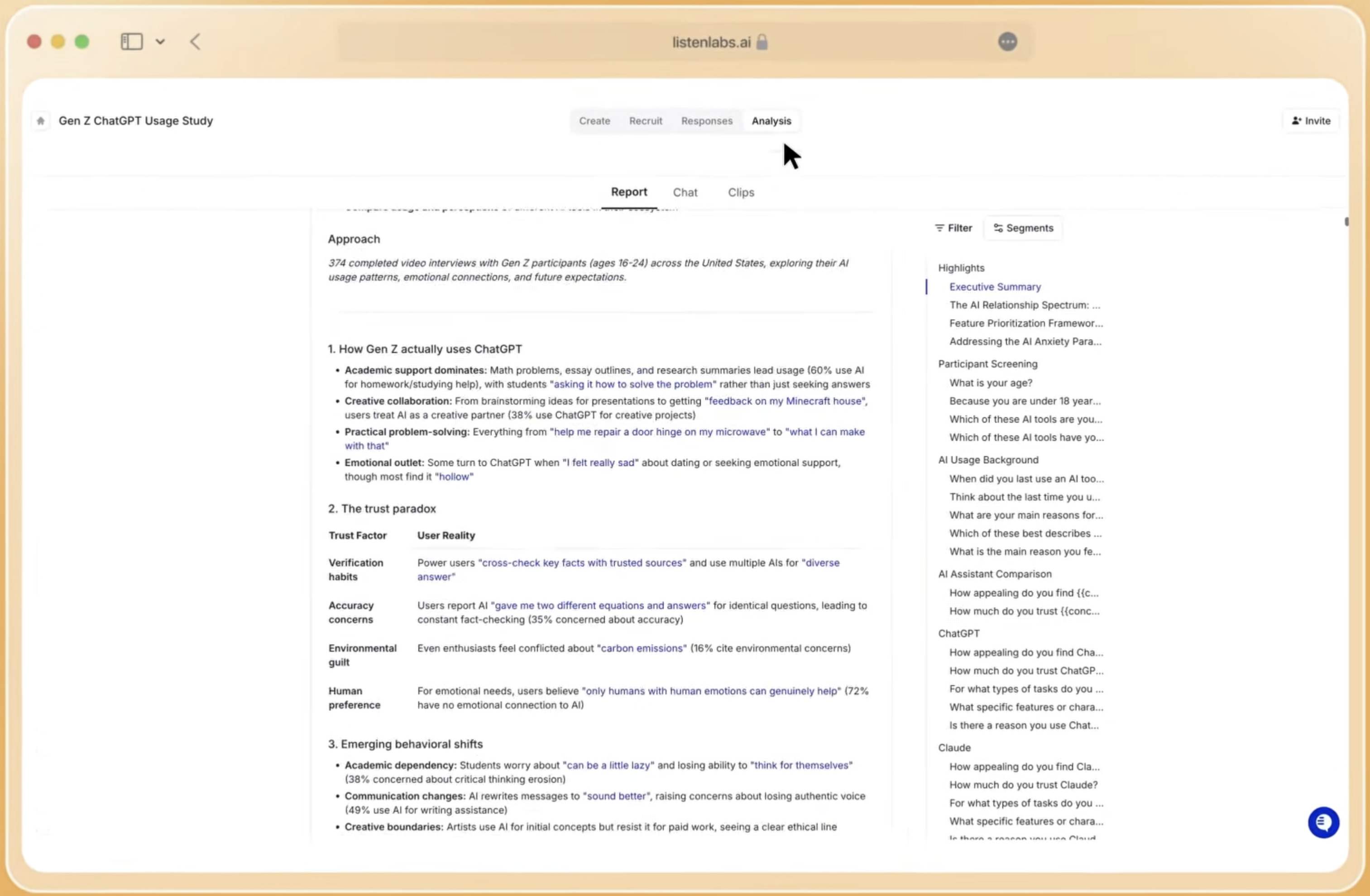
The quality layer that makes the signal trustworthy is Quality Guard. It matches on behavioral and intent data, monitors every interview in real time for fraud and low-effort responses, and limits participants to three studies per month. A dedicated recruitment operations team can reach audiences below 1% incidence rate. Every insight links directly to the underlying response data, so teams never rely on black-box findings.
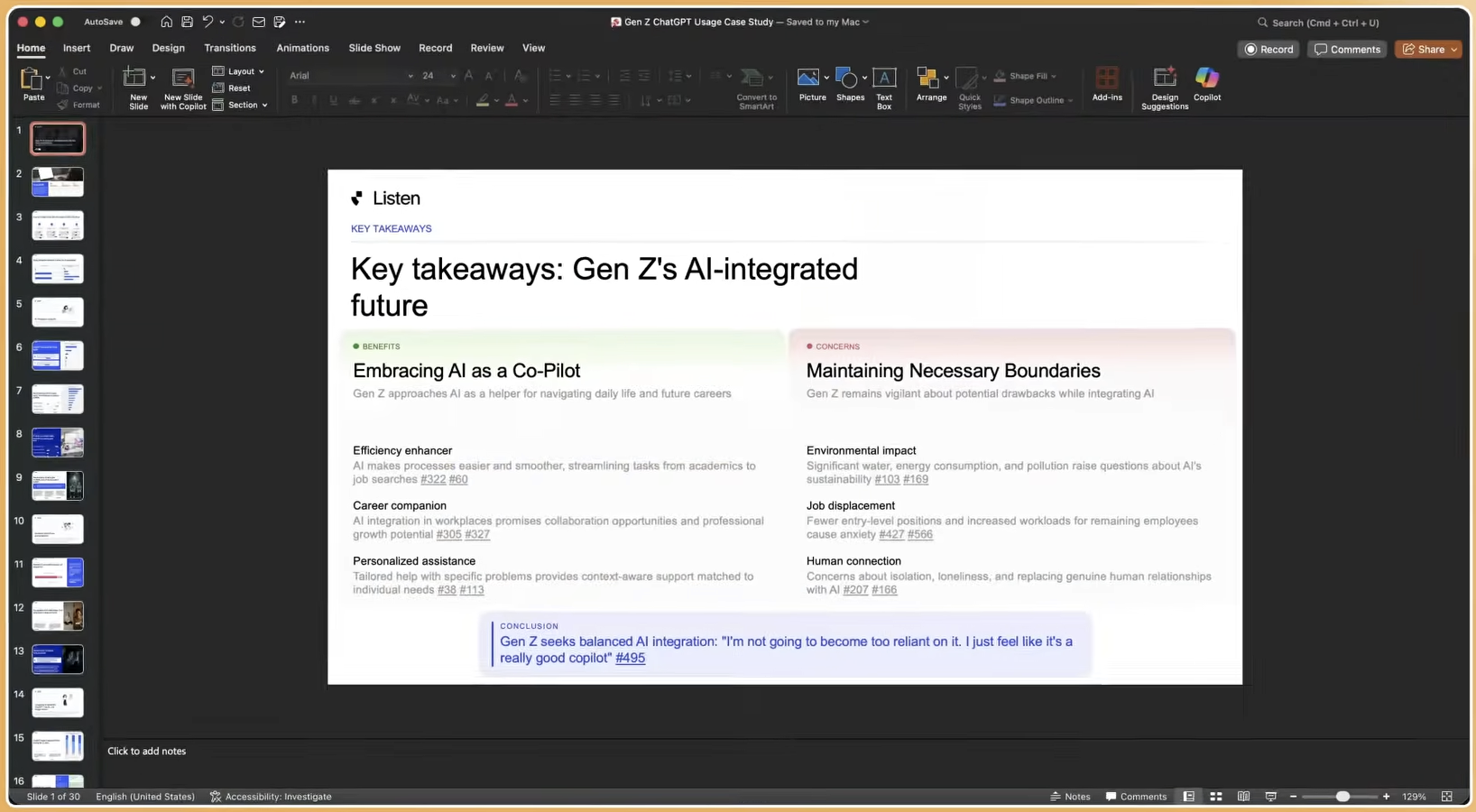
Enterprise proof points anchor these claims and show the operating model in action. Microsoft cut research wait time from weeks to hours: “I can reach out to hundreds of users at one third of the cost” — Director of Data Science at Microsoft. Sweetgreen scaled research across 300+ US locations at five times the previous scale and one third the cost: “By having the speed to insight, insights can lead to actions. Those actions are then showing up in the real world at real Sweetgreen restaurants within weeks or months instead of years” — Brian Davia, Head of Consumer and Business Insights, Sweetgreen.
In January 2026, Listen Labs raised a $69 million Series B led by Ribbit Capital, with participation from Evantic, Sequoia Capital, Conviction, and Pear VC, at a valuation above $500 million, which brought total funding to $100 million. The platform is trusted by Microsoft, Google, Anthropic, Sony, Sweetgreen, Perplexity, Robinhood, P&G, Skims, Levi’s, Boston Consulting Group, and Nestlé, including roughly 15% of the Fortune 100.
See how Listen Labs delivers the metric movement and its explanation in the same wave.
Video Explainer: Real-Time Brand Insight in 60 Seconds
Real-time brand insight operates as a two-part model rather than a faster dashboard. Part one is always-on signal detection, where monitoring tools track media mentions, sentiment, share of voice, and LLM visibility across ChatGPT, Gemini, and Perplexity, then fire alerts when something moves. Part two is continuous AI-moderated research, where an alert automatically launches a conversational study with the affected segment and returns the reason behind the movement in hours. The two parts run in parallel, continuously, so monitoring shows that a number moved and research explains why. Listen Pulse combines both in one instrument, using the same study and the same screeners wave after wave, with every metric traceable to a real quote and clip.
Frequently Asked Questions
What Should “Real Time” Realistically Mean for Brand Insight?
“Real time” means different things at different decision latencies. For crisis communications, real time means minutes, and a mention volume spike or a negative sentiment surge that crosses a defined threshold should fire an immediate alert. For brand strategy decisions, real time means days, and a wave of research that closes and delivers findings within 24–48 hours is operationally real time for a team making quarterly positioning decisions. For trend validation, real time means consistent wave cadence, such as monthly or quarterly waves that keep core questions constant so the trend line stays clean. Many teams make the mistake of treating dashboard refresh speed as the definition of real time. The relevant question is how quickly the decision-maker needs the answer to act. Calibrate the monitoring cadence and research trigger to that latency rather than to the technical capability of the tool.
How Do You Track How ChatGPT and Gemini Describe Your Brand?
LLM visibility tracking requires a structured, repeatable prompt panel. Define 30–60 buyer-intent prompts covering category discovery, comparison, alternatives, validation, and problem-first query types. Run each prompt three to five times per platform, including ChatGPT, Gemini, Perplexity, and Claude, in clean, logged-out sessions with no conversation history. Log whether the brand appears, its position in any list, competitors named, the exact framing phrase, sentiment classification, and every cited domain. Roll results up weekly into mention rate and AI share of voice per platform. Watch for drift in framing as well as presence, because sentiment framing shifts far more frequently than brand presence. Run a targeted check within 48 hours after major product launches or PR events. Manual tracking at this scale is unreliable because LLM outputs vary session to session, so purpose-built LLM visibility tools automate the prompt panel and aggregate results into weekly trend data.
What Is the Difference Between Real-Time Sentiment Analysis and Real-Time Brand Insight?
Real-time sentiment analysis provides detection capability. It classifies incoming mentions as positive, neutral, or negative and fires an alert when the ratio shifts, which answers the question “what is being said.” Real-time brand insight provides diagnostic capability. It pairs that detection with conversational research that explains why the sentiment shifted, which segment is driving it, and what the underlying driver is. Sentiment analysis acts as a necessary input to brand insight, yet it remains insufficient on its own. A sentiment score that drops 8 points cannot distinguish between consumers who are confused by a product change, consumers who are angry about a pricing decision, and consumers who are reacting to a competitor’s campaign. Each explanation requires a different response. The diagnostic layer, built from conversational research with the affected segment, converts a sentiment alert into an actionable insight.
Can Monitoring Tools Tell You Why a Metric Moved?
Monitoring tools are designed to detect and classify rather than to diagnose. They can show that a sentiment score dropped, that a specific theme spiked in volume, or that share of voice shifted relative to a competitor. They cannot show whether the shift reflects a genuine change in private buyer priorities or a non-buyer media moment, whether the vocal online segment represents the broader customer base, or what the underlying driver of the shift is. Public social conversation reflects a vocal, non-representative subset of consumers, because active social media users skew younger, more urban, and more digitally engaged than the broader market. A brand can see strong social engagement and favorable mention sentiment while sales quietly soften, because consumers like the brand’s public image but have shifted actual purchase behavior to a competitor. The “why” behind a metric movement requires conversation with the affected segment rather than classification of public posts.
How Do You Reach Niche or Hard-to-Find Brand Audiences?
Niche audience recruitment depends on panel depth, recruitment operations infrastructure, and the ability to match on behavioral and intent data rather than self-reported demographics alone. Listen Labs’ Quality Guard matches across behavioral and intent data, and a dedicated recruitment operations team partners with niche communities, micro-creators, and specialized networks to source audiences below 1% incidence rate, including enterprise decision-makers, healthcare workers, engineers, and highly specialized consumer segments. Participants are limited to three studies per month to prevent panel fatigue and eliminate professional survey-takers. For brand research specifically, the platform supports recruiting participants based on behavior, demographics, or category usage, while behavioral targeting such as purchase history is handled via screener questions inside the study rather than as a direct panel filter. This approach keeps segment-level findings representative rather than merely directional.
How Is Data Security and Privacy Handled?
Listen Labs maintains enterprise-grade security with 256-bit encryption, and customer data is never used to train AI models. The platform holds SOC 2 Type II, ISO 27001, ISO 27701, and ISO 42001 certifications and is GDPR compliant. Enterprise SSO is supported. Listen Labs offers data sovereignty and security protections for regulated industries such as finance and healthcare, processing customer data in a secure, isolated environment backed by SOC 2 Type II and GDPR compliance, and never using customer data to train public AI models. Every insight traces back to the original study, discussion guide, screener, and individual respondent with full source attribution, so data governance teams can audit the provenance of any finding.
How Do You Decide When to Repeat, Expand, or Retire a Brand Study?
Repeat a study when the core questions still tie directly to active decisions and the trend line has not yet reached a stable baseline, which usually means running at least three waves before drawing directional conclusions. Expand a study when the core instrument is stable and a new segment, market, or theme has emerged that the current screener does not capture, such as a new geography, a new buyer type, or a new use case. Retire or redesign a study when the decisions it informs have changed, when key KPIs no longer match leadership priorities, or when repeated waves show a flat, stable trend that no longer drives action.