
Written by: Anish Rao, Head of Growth, Listen Labs
Key Takeaways
- A consumer insights automation platform automates the full research lifecycle: study design, recruitment, moderation, transcription, analysis, and reporting. This compression turns traditional 4–6 week cycles into under 24 hours.
- Most tools labeled “automation” cover only one or two stages. A true end-to-end platform handles the entire workflow so the bottleneck disappears.
- Key evaluation criteria include panel quality and fraud prevention, analysis depth with full traceability, integration with existing trackers, speed from brief to decision-ready results, and enterprise-grade security certifications.
- Listen Labs stands out as the only platform covering the complete lifecycle with 50M+ verified respondents, 120+ languages, and over 1 million interviews delivered for enterprise clients including Microsoft and P&G.
- Listen Labs enables research teams to run three times more studies at one-third the cost while maintaining full traceability and compliance.
See the full research lifecycle automated
What A Consumer Insights Automation Platform Actually Automates
The traditional research cycle has six distinct stages, and each one can be automated to varying degrees. Most platforms labeled “automation” cover only one or two, while a true end-to-end platform covers all six.
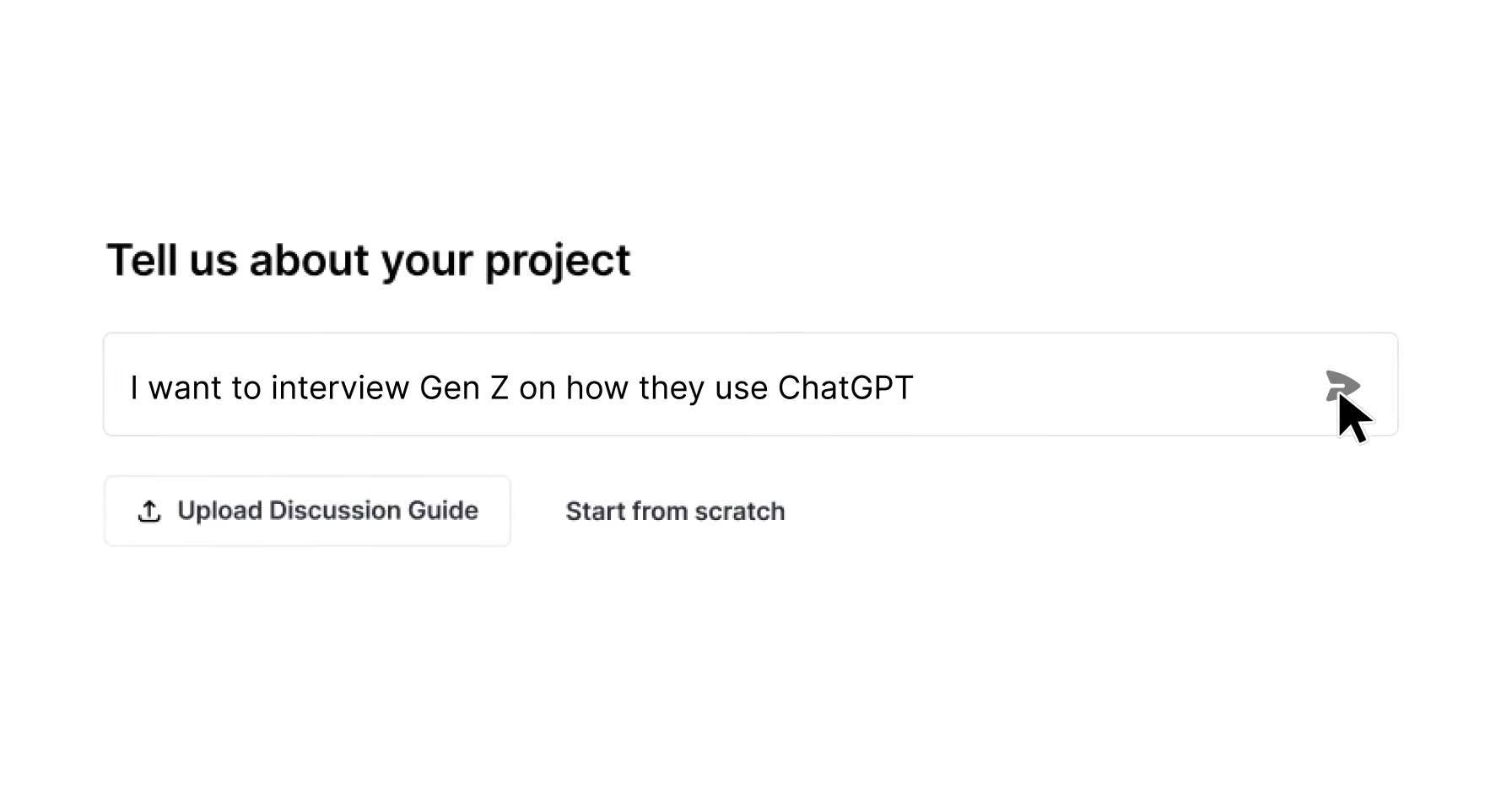
Study Design. Manual study design requires a researcher to write a discussion guide, circulate it for internal review, revise it, and finalize it before a single participant is recruited. Automated study co-design drafts structured objectives, questions, and probing context in seconds from a natural-language description of research goals. Listen Labs’ AI-assisted study design drafts structured objectives, questions, and probing context in seconds from a natural-language brief, with Auto-QA flagging issues before launch.
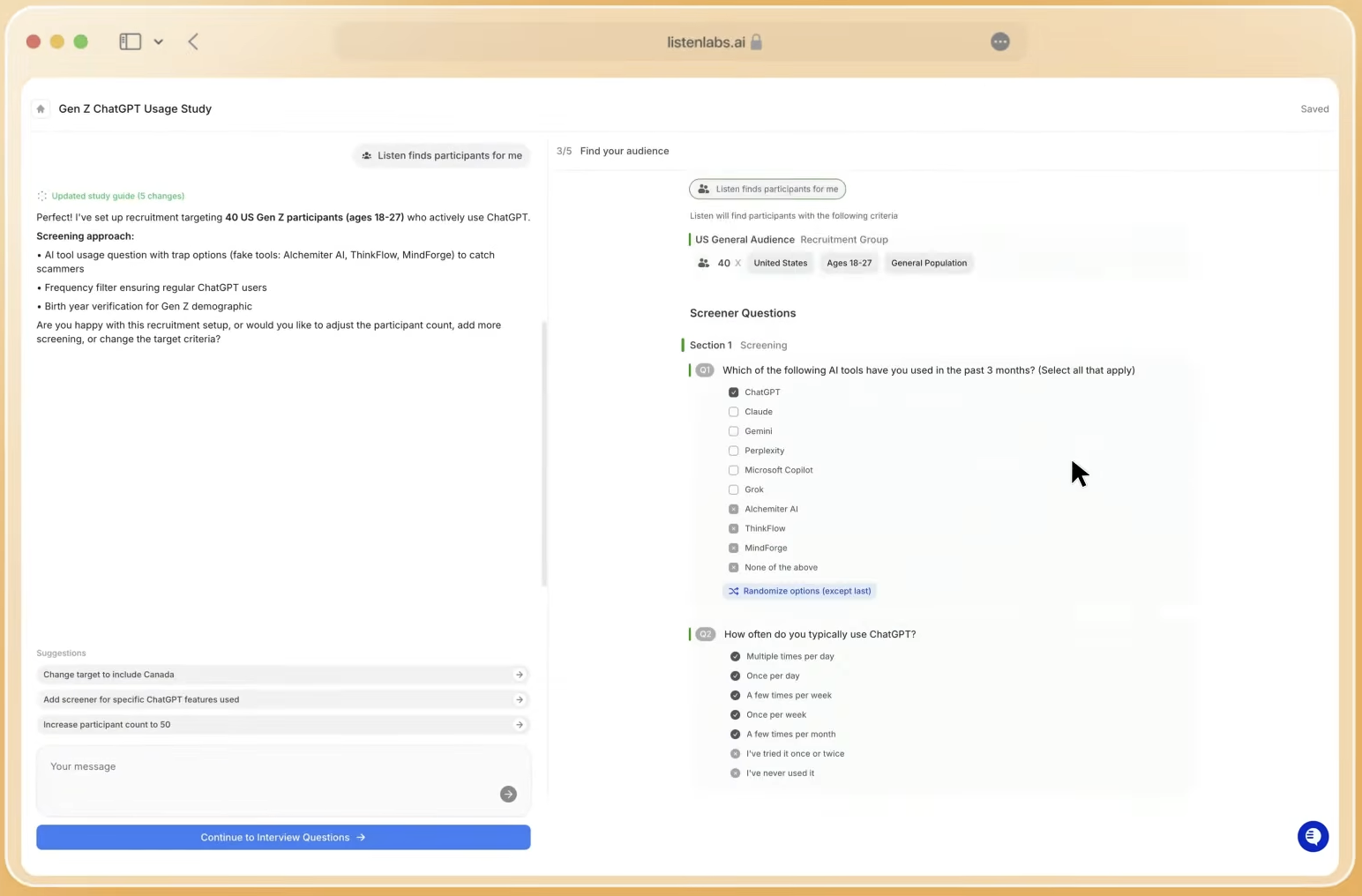
Recruitment. Manual recruitment means coordinating with separate panel vendors, managing scheduling logistics, and absorbing no-show rates that bias samples and waste time. Automated recruitment uses an AI orchestration layer that matches and bids on participants across multiple panel partners and a proprietary database, with a dedicated recruitment ops team for hard-to-reach segments. Platforms like Listen Labs layer on auto-recruiting so teams jump from question to findings in hours, not weeks.
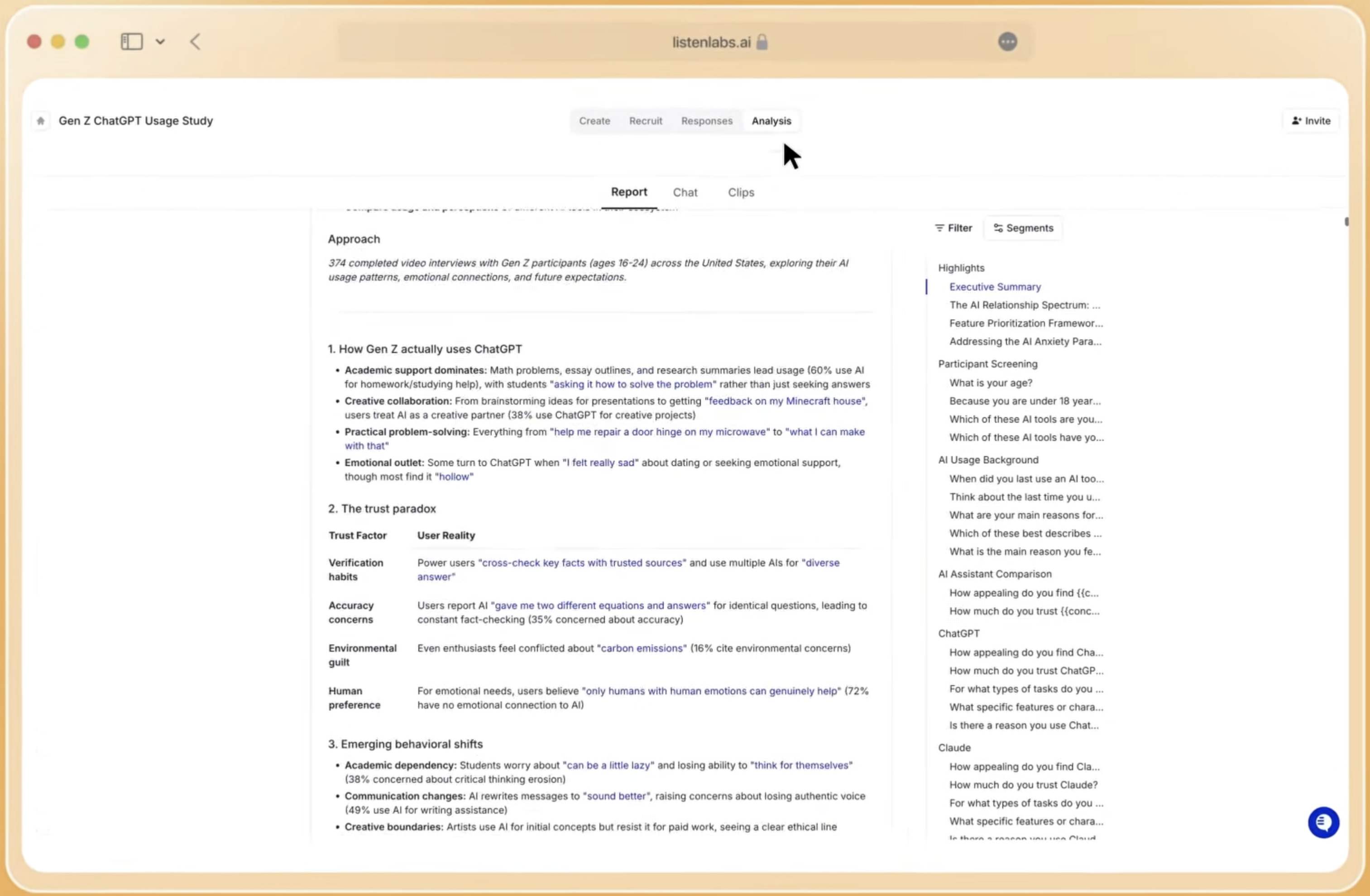
Moderation. Human moderators are experienced but inconsistent, and they cannot run more than one interview at a time. AI-moderated video interviews conduct personalized conversations with dynamic follow-up questions, probing deeper on interesting or short answers the same way a trained human moderator would, but simultaneously across hundreds of participants. AI can schedule and conduct the interview, analyze the transcripts for themes, and generate quantitative insights from those interviews.
Transcription and Localization. Manual transcription and translation add days to every study and introduce errors. Automated transcription and translation can cover 120+ languages. For example, Vavus AI offers speech recognition in 120+ languages and translation across 200+ languages, while Speak AI transcribes 135 languages and regional variants and translates finished transcripts into 111 languages. This coverage makes multi-market research operationally feasible without separate local vendors.
Analysis. Human coding of qualitative data is time-consuming, subjective, and prone to confirmation bias. An AI analysis engine processes all interview data objectively, identifies patterns and themes across hundreds of responses, and separates signal from noise. Research Agent handles the full analysis workflow, from raw data to final output, with every insight linking directly to the underlying response data.
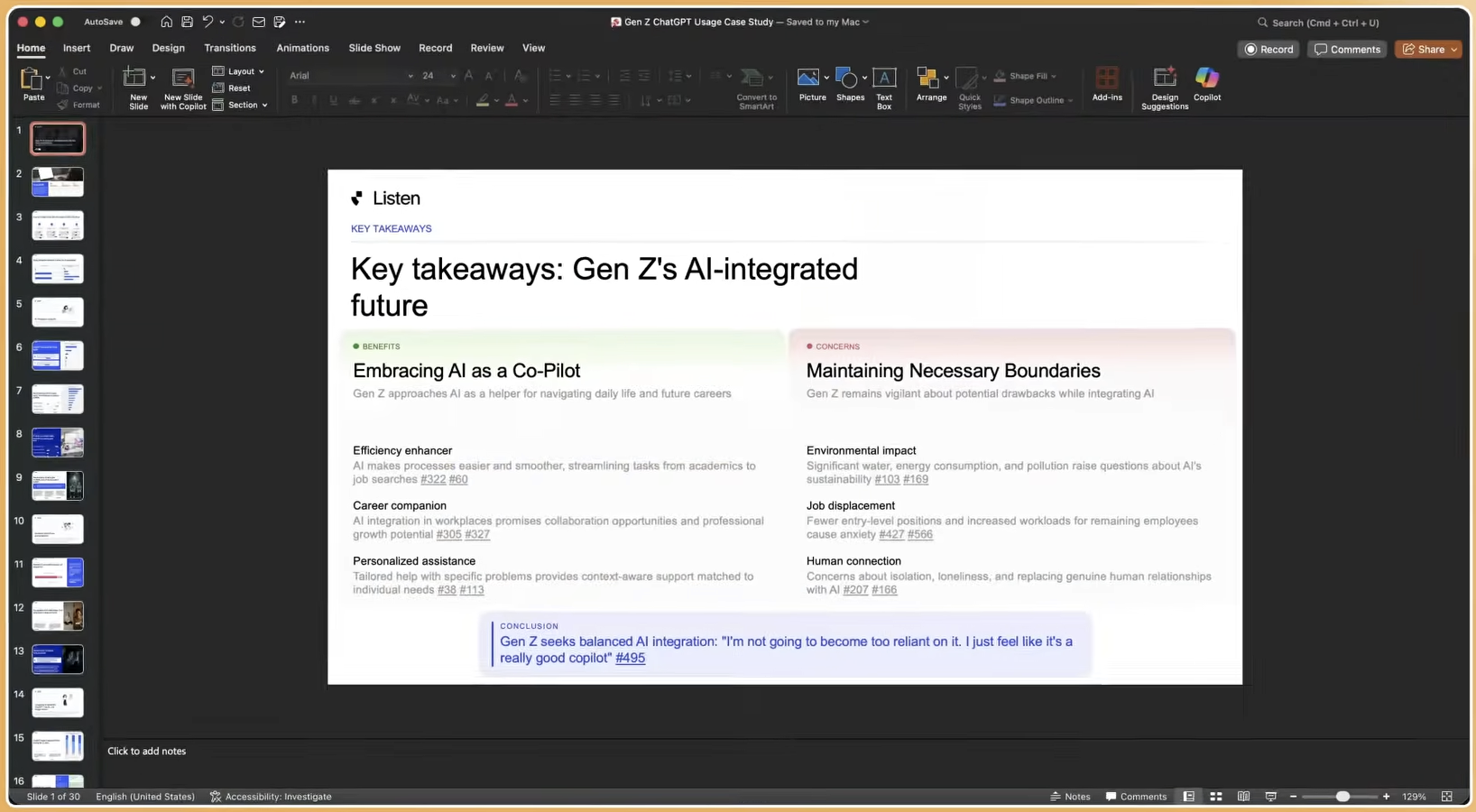
Reporting. Manual report writing takes days and requires a researcher to synthesize findings, build slides, and write a narrative. One-click deliverables such as slide decks, memos, highlight reels, charts, and custom reports generated in under a minute replace that process entirely.
The operational reality is clear: a true consumer insights automation platform covers the entire lifecycle. Many tools labeled “automation” cover only one or two stages and leave the rest manual, which means the bottleneck moves rather than disappears.
Key Benefits Of Automation
Automating the full lifecycle changes what a research team can deliver. Three benefits matter most:
- Speed: Research cycles compress from 4–6 weeks to less than 24 hours from brief to decision-ready results.
- Efficiency: Enterprises can run more studies at one third the cost of the traditional research approach, so teams increase volume without adding headcount.
- AI Integration: Automated transcription, theme tagging, emotional signal capture, and traceable analysis replace manual steps at every stage of the workflow.
See the full research lifecycle automated
Best Consumer Insights Platforms By Research Goal
Different research jobs require different tools. A brand tracker, a concept testing tool, and a qualitative interview platform solve related but distinct problems. Buyers avoid wasted budget when they segment platforms by job-to-be-done instead of comparing flat feature lists.
Concept And Creative Testing. Zappi and quantilope are built for automated concept and creative testing with standardized norms and rapid consumer feedback. Zappi offers global and category norms with feedback in under 4 hours, while quantilope provides 16 automated advanced methods with insights in under 1 second. Both platforms evaluate stimuli against benchmarks at speed, which suits teams that need to test multiple concepts against each other before a launch decision.
Rapid Consumer Feedback. Suzy is an on-demand consumer research and audience platform that delivers AI-driven feedback and market research to help brands turn questions into confident decisions in hours, not weeks. It supports concept testing, monadic testing, MaxDiff, and AI-powered one-on-one interviews at scale.
Qualitative Interviews At Scale. Listen Labs is the end-to-end AI research platform that sources the right participants inside its 50M+ network to conduct, analyze, and summarize thousands of in-depth customer interviews in hours, with results delivered in under 24 hours as noted earlier. It handles the entire research lifecycle: AI-assisted study design, global participant recruitment, AI-moderated interviews, automated analysis, and delivery of consultant-quality reports, slide decks, and video highlight reels. Cognis is another entrant in this segment. For a deeper comparison of platforms in this category, see the qual-at-scale explainer and the full Best AI Consumer Insights Platforms In 2026 listicle.
Social Listening. Meltwater is built for media intelligence and social listening, including monitoring media coverage, social conversations, and AI-generated content, tracking brand mentions, and analyzing sentiment. Hootsuite is a social media management platform whose social listening tracks brand mentions, trends, and sentiment across social networks, review sites, and websites. These tools answer questions about what people are saying publicly rather than why they make specific decisions.
Survey Analytics. Displayr is built for survey analysis and reporting after data collection, while Qualtrics is built for experience management and survey collection. Qualtrics suits large organizations seeking structured reads on customer satisfaction, while Displayr focuses on advanced survey analytics and visualization.
Listen Labs states it is the only platform covering the entire research lifecycle from study design through recruitment, moderation, analysis, and deliverables. It is trusted by enterprises including Microsoft, Google, Anthropic, Sony, Sweetgreen, Perplexity, Robinhood, Procter & Gamble, Skims, Levi’s, Boston Consulting Group, and Nestlé, including roughly 15% of the Fortune 100.
Find the right platform for your research goal
How To Evaluate A Consumer Insights Automation Platform
This framework gives Directors and VPs of Consumer Insights a structured way to assess any platform in this category and a document they can share with finance and procurement.
Panel Quality And Fraud Prevention. The Insights Association’s member survey found that 63% of members accept some level of fraud as part of conducting market research studies, and 64% have experienced a project delay or negative impact due to fraud. Industry estimates place respondent fraud rates between 10 and 30 percent of panel-based qualitative participants. These fraud levels make panel quality a core evaluation criterion. Look for behavioral matching on intent and past actions rather than self-reported demographics. Also check for real-time quality monitoring across video, voice, content, and device signals, participant frequency limits, and non-commodity panel sources. Listen Labs limits participants to 3 studies per month and uses Quality Guard, an AI orchestration layer with a human review layer on top.
Whether The Platform Conducts Research Or Only Organizes It. There is a meaningful line between analysis and repository tools that organize research conducted elsewhere and end-to-end platforms that recruit, interview, analyze, and deliver. Dovetail is an example of the former because it helps teams organize and synthesize research that has already been conducted. Listen Labs is an example of the latter, covering the full lifecycle in a single platform.
Analysis Depth And Traceability. Dashboards show that a number moved, but they do not explain why. Every finding should trace back to the exact timestamp, verbatim quote, and reasoning behind it. Listen Labs quantifies every emotion per question and concept and makes every label traceable to the exact timestamp, verbatim quote, and reasoning behind it.
Integration With Existing Trackers. Teams should keep the KPIs they already report. Listen Pulse connects with Qualtrics and Decipher and can deploy alongside an existing tracker or as the primary tracking system. For more on conversational tracking, see the brand tracking and brand intelligence articles.
Speed From Question To Insight. The meaningful metric is time from study brief to decision-ready results, not time to a dashboard. Listen Labs compresses the entire research cycle to less than 24 hours.
Cost Structure. The right comparison is total cost across recruitment, moderation, transcription, analysis, and reporting, not license fee alone. Enterprises using Listen Labs run more studies at one third the cost compared to the traditional research approach.
Global Reach. Reach determines whether a study can be run across markets without separate vendors. Listen Labs covers 45+ countries and 120+ languages. Qual-at-scale is ideal when research requires large sample sizes or broad geographic reach, with AI tools engaging hundreds or thousands of participants remotely and asynchronously.
Security And Data Policy. Verify enterprise SSO, encryption, GDPR, SOC 2 Type II, ISO 27001, ISO 27701, and ISO 42001, and confirm whether customer data is used to train AI models. SOC 2 Type II and ISO 27001 are the minimum compliance gates for enterprise procurement; vendors without them are typically excluded before methodology is even evaluated. Listen Labs never trains its AI models on customer data and holds all four certifications.
Evaluate Listen Labs against your research backlog
Consumer Insights Automation Vs. CRM And CX Tools
CRM software manages customer relationships, sales pipelines, and support tickets. CX platforms handle experience management, satisfaction measurement, and ticketing workflows. These systems do not conduct qualitative customer research, moderate interviews, or analyze open-ended responses at scale.
A consumer insights automation platform sits upstream of both categories. It generates the customer understanding that informs messaging, product decisions, pricing, and go-to-market plans. CRM and CX tools then operationalize those decisions at the individual customer level. A CRM is a system of record for individual relationships built to manage interactions at account level, while an insights platform is an analysis layer built to find patterns across many customers and explain why.
The PAA cluster around this topic often drifts toward CRM and CX questions such as Zendesk competitors, CX vs. CRM, and top CRM systems because buyers conflate “customer data” with “customer understanding.” These are different problems that require different tools. Consumer insights automation answers why customers behave as they do. CRM and CX tools manage what happens next.
Where AI-Moderated Qualitative Research Fits
Qualitative interviews deliver rich, nuanced understanding but have historically been limited to small sample sizes of 5–15 people. Quantitative surveys scale but capture only surface-level data through pre-set questions with no follow-up. AI-moderated interviews collapse that trade-off by conducting hundreds of qualitative interviews simultaneously, each personalized and adaptive with dynamic follow-up questions.
Listen Labs defines this category. Its AI-moderated video interviews generate responses 3x longer than average via intelligent probing, with smart follow-ups that probe deeper on interesting or short answers.
Emotional Intelligence analyzes tone of voice, word choice, and subconscious micro expressions. It is built on Ekman’s universal emotions framework and is available across 50+ languages. Visual Insights complements this capability by letting the AI interviewer observe on-screen behavior and probe contradictions between what participants say and what they do, closing the say-do gap in real time.
These signals feed into a Research Library that lets teams query every study they have ever run in natural language with full source attribution. Research Agent then generates automated key findings, themes, and personas from interview data, with one-click deliverables like slide decks, memos, and reports generated in under a minute. Listen Pulse is the conversational tracker that combines quantitative KPI tracking with open-ended conversation so every metric movement comes with its explanation. MaxDiff handles prioritization without ties or decision fatigue, using a Hierarchical Bayes model to produce a clean ranking from best-worst choices.
Listen Labs raised a $69 million Series B led by Ribbit Capital in January 2026 at a valuation above $500 million, bringing total funding to $100 million, building on the 1 million interviews mentioned earlier.
See AI-moderated interviews in action
Common Mistakes When Buying A Consumer Insights Automation Platform
Assuming All Panels Are Equivalent. Independent audits have found fraud rates between 17% and 46% of responses in online research panels depending on study type and panel source. Fraud, professional survey-takers, and repeat respondents undermine the entire research investment. Buyers should ask how participants are verified, how often they can participate, and what real-time monitoring operates during interviews. A platform that cannot answer those questions specifically is relying on commodity panel infrastructure.
Assuming Dashboards Equal Analysis. A dashboard shows numbers but does not explain why they moved. The insight-to-decision gap is the dominant failure mode of customer insights platforms: findings are correct, nobody owns the decision, and the dashboard becomes a reporting cost. Buyers should ask whether the platform surfaces themes, quotes, and the reasoning behind each finding, and whether every output traces back to a specific participant response.
Treating Automation As A Headcount Replacement. The platform acts as a force multiplier for existing research teams. Anthropic’s research team now runs 100 studies in the time it previously took to run five or six, with the research process condensed into one step instead of two. The platform handles logistics, while researchers focus on strategic analysis and decision-making.
Ignoring The Say-Do Gap. What people say and what people do are two different datasets. Conversational depth is itself a fraud deterrent, but platforms that only capture transcripts miss the contradiction between stated preference and observed behavior. Visual Insights catches the say-do gap in real time. When a participant’s on-screen behavior contradicts their stated preference, the AI moderator probes the contradiction immediately rather than following the script past it.
Buying For One Job And Expecting Five. Many platforms automate one or two stages of the research cycle. A transcription tool is a point solution rather than an end-to-end platform. A survey analytics tool is not a moderation platform. Buyers should map their actual research goals, such as study design, recruitment, moderation, analysis, and reporting, to platform coverage before committing, and ask for a demonstration of each stage rather than a summary slide.
Avoid the common buying mistakes
Frequently Asked Questions
What Is A Consumer Insights Automation Platform?
A consumer insights automation platform is software that automates part or all of the customer research workflow: study design, participant recruitment, interview moderation, transcription, analysis, and reporting. This automation lets teams run more consumer research without proportionally more headcount. The category spans tools that automate a single stage, such as transcription, and end-to-end platforms that cover the full lifecycle from study brief to final deliverable.
What Are Some Popular Consumer Insight Platforms?
- Listen Labs – end-to-end AI interview platform covering study design, recruitment, AI-moderated interviews, analysis, and deliverables at scale
- Zappi – automated concept and creative testing with standardized consumer norms
- quantilope – automated concept and creative testing with rapid consumer feedback
- Suzy – on-demand consumer research and audience platform
- Qualtrics – survey analytics and experience management
- Displayr – survey analysis and data visualization
- Meltwater – social and media listening
- Hootsuite – social listening and media monitoring
- Dovetail – research repository and analysis tool for organizing existing research
What Is The Best Software For Customer Insights?
The best software depends on the research job. For qualitative interviews at scale, which is the most demanding and highest-value use case, Listen Labs is the most complete end-to-end platform available, covering recruitment, AI-moderated interviews, emotional signal analysis, automated reporting, and cross-study research libraries. For concept and creative testing, Zappi and quantilope are purpose-built. For social listening, Meltwater and Hootsuite lead. For survey analytics, Qualtrics and Displayr are established options. The mistake is evaluating all of these as substitutes for each other.
How Is A Consumer Insights Automation Platform Different From A Survey Tool Like SurveyMonkey Or Qualtrics?
Survey tools deliver structured, quantitative data through pre-set questions with no ability to follow up or probe deeper. A consumer insights automation platform conducts conversational interviews where the AI adapts in real time, asking follow-up questions based on what each participant actually says. This approach uncovers unexpected findings, emotional nuance, and rich context that surveys cannot capture. Surveys answer “what.” AI-moderated interviews answer “why.”
How Is It Different From A CRM Or CX Platform?
CRM software manages customer relationships, sales pipelines, and support tickets at the individual account level. CX platforms handle experience management, satisfaction measurement, and ticketing. These tools do not conduct qualitative research, moderate interviews, or analyze open-ended responses. A consumer insights automation platform sits upstream of both and generates the customer understanding that informs the decisions CRM and CX tools then operationalize.
How Do These Platforms Prevent Fraud And Ensure Participant Quality?
Quality varies significantly by platform. The strongest systems operate across three layers: pre-screening with behavioral and intent matching rather than self-reported demographics alone; real-time monitoring during interviews across video, voice, content, and device signals; and post-study validation using linguistic fingerprinting and cross-participant pattern detection. Listen Labs uses Quality Guard for real-time AI monitoring, limits participants to 3 studies per month to eliminate professional survey-takers, and adds a human recruitment ops review layer for hard-to-reach segments. Buyers should ask any platform vendor specifically how participants are verified, what signals are monitored during interviews, and what the participant frequency limit is.
Can A Consumer Insights Automation Platform Reach Niche Or Hard-To-Find Audiences?
The best platforms can reach these audiences. Listen Labs’ dedicated recruitment ops team sources audiences below 1% incidence rate, including enterprise decision-makers, healthcare workers, engineers, and highly specialized consumer segments, through partnerships with niche communities, micro-creators, and specialized networks. General-purpose panels rarely reach these audiences reliably. Buyers should ask for fill-time estimates and methodology for their specific target profile before committing.
Does Automation Replace The Research Team?
Automation acts as a force multiplier for existing research teams rather than a replacement. The platform handles logistics such as recruitment, moderation, transcription, analysis, and reporting, which frees researchers to focus on study design, strategic interpretation, and stakeholder communication. The Anthropic example earlier illustrates how teams can dramatically increase study volume while keeping human judgment at the center.
How Do I Evaluate Claims About AI Capabilities And Automation?
Ask for a live demonstration of each stage of the research lifecycle, not a summary slide. Run a test study on your own research question and evaluate the quality of the discussion guide, the participant profile, the interview depth, and the analysis output. Then trace one finding end to end, from the AI’s conclusion back to the specific participant response, timestamp, and verbatim quote that produced it. Platforms that cannot provide that traceability are producing outputs that cannot be validated or defended to stakeholders.
What Types Of Studies Can These Platforms Support?
End-to-end platforms like Listen Labs support a broad range of study types: concept and prototype testing, usability testing with screen sharing, creative testing, brand perception studies, consumer journey mapping, multi-market segmentation and localization studies, ad testing, pricing research, and survey open-end analysis. Listen Pulse supports ongoing tracking with quantitative KPI measurement combined with open-ended conversation. MaxDiff handles prioritization research. The platform supports both one-off studies and continuous research programs.
Get answers to your evaluation questions
Conclusion And Next Steps
A true consumer insights automation platform covers the entire lifecycle from study design through recruitment, moderation, analysis, and deliverables. Platforms that only automate one or two stages leave the bottleneck in place.
The evaluation framework in brief:
- Panel quality and fraud prevention: behavioral matching, real-time monitoring, frequency limits, non-commodity sources
- Conducts research vs. organizes it: end-to-end lifecycle vs. repository
- Analysis depth and traceability: every finding traces to a timestamp, quote, and reasoning
- Integration with existing trackers: Qualtrics, Decipher, and existing KPI infrastructure
- Speed from question to insight: brief to decision-ready results, not brief to dashboard
- Cost structure: total cost across all stages, not license fee alone
- Global reach: countries, languages, and hard-to-reach audience capability
- Security and data policy: SOC 2 Type II, ISO 27001, ISO 27701, ISO 42001, GDPR, and no AI training on customer data
Listen Labs is the end-to-end AI interview platform that conducts research rather than merely organizing it. The verifiable specifics include 50M+ verified respondents across 45+ countries, 120+ languages, over 1 million interviews conducted, less than 24 hours from brief to results, one third the cost of traditional research, and enterprise customers including Microsoft, Google, Anthropic, Procter & Gamble, and Nestlé, representing roughly 15% of the Fortune 100.
The recommended next steps for any research leader evaluating this category are straightforward.
- Audit the current research backlog and identify the studies that have been waiting the longest.
- Map each backlogged request to a research goal such as qualitative depth, concept testing, tracking, or social listening, and match it to the platform segment built for that job.
- Pilot one study with a platform that covers the full lifecycle, from recruitment through moderated interviews to analysis and deliverables.
- Compare time-to-insight and analysis depth against the traditional process on the same research question.
Start your first automated study