Written by: Anish Rao, Head of Growth, Listen Labs | Last updated: August 6, 2026
Key Takeaways for Enterprise Brand Teams
- Enterprise AI brand research usually fails because of workflow gaps, not technology gaps. A structured 7-step process reduces hallucinations and produces stakeholder-ready findings.
- AI-moderated interviews compress traditional 4–6 week qualitative cycles into less than 24 hours while keeping rigor and enabling 200–300 conversations at scale.
- Validation protocols, including verbatim sourcing, human sampling, and bias checks, are mandatory to keep AI hallucinations from corrupting brand perception insights.
- Continuous discovery programs that combine recurring AI interviews with AI answer-engine monitoring turn brand perception tracking from periodic snapshots into a durable competitive advantage.
- Book a demo to see how Listen Labs delivers validated, segment-level insights tied directly to business outcomes.
Who This Guide Serves and How We Define Key Terms
This guide serves VPs and Directors of Consumer Insights, Heads of Customer Research, and senior brand strategists at large tech, CPG, and retail enterprises. Readers should already understand qualitative research design and stakeholder reporting. The following terms appear throughout the guide:
- AI-moderated interviews: Asynchronous or synchronous one-on-one conversations run by an AI interviewer that adapts follow-up questions in real time based on participant responses.
- Emotional intelligence signals: Multimodal data, including tone of voice, word choice, and subconscious micro expressions, analyzed to surface emotions that transcripts alone miss.
- Incidence rate: The share of the general population that qualifies for a study based on screening criteria. Audiences below 1% incidence count as hard-to-reach.
- Continuous discovery: An always-on research cadence that replaces one-off projects with recurring insight cycles tied to business rhythms.
- Qual-at-scale: Use of AI to conduct hundreds or thousands of qualitative interviews simultaneously, collapsing the traditional trade-off between depth and scale.
Why AI Brand Research Discipline Matters in 2026
Brand perception now shifts faster than traditional research cycles can track it. In 2025, 94% of B2B buyers used AI during their purchase cycle, with generative AI or conversational search named as a top information source. Many buyers now rely on AI tools while they research purchases. A brand’s representation inside AI answer engines has become a commercial variable, not a communications afterthought.
These shifts occur faster than most research teams can monitor. Internal research groups still operate as bottlenecks. Traditional qualitative brand studies take several weeks and cost thousands of dollars per focus group session, which limits most enterprise teams to a few studies per quarter. With AI-moderated interviews, talking to consumers at scale is no longer the hard part, while understanding what they mean has become the real challenge. Teams that master a rigorous AI brand research workflow can run more studies per quarter, justify expanded research budgets with faster business impact, and shift researcher time toward strategic synthesis instead of logistics.
Step 1: Set Clear Research Objectives for Each Study
Every brand research study starts with a specific business decision that the findings will inform. A strong AI qualitative research project includes a primary hypothesis the team is willing to falsify and clarity about which segments the findings must generalize across. Vague objectives such as “understand brand perception” produce vague outputs that AI synthesis cannot fix.
The core inputs at this stage are the business question, the decision deadline, and the stakeholder list. These inputs determine the key decision point: depth versus scale. If the goal is to surface dominant patterns, a moderate number of conversations will work. Segmentation or cohort comparison requires substantially more interviews to detect meaningful differences between groups.
Once these trade-offs are clear, document objectives in a one-page brief. That brief should specify the decision being made, the audiences in scope, and the success criteria for the study. Plan for 1–2 hours with key stakeholders at this stage.
Step 2: Turn Objectives into an AI-Ready Discussion Guide
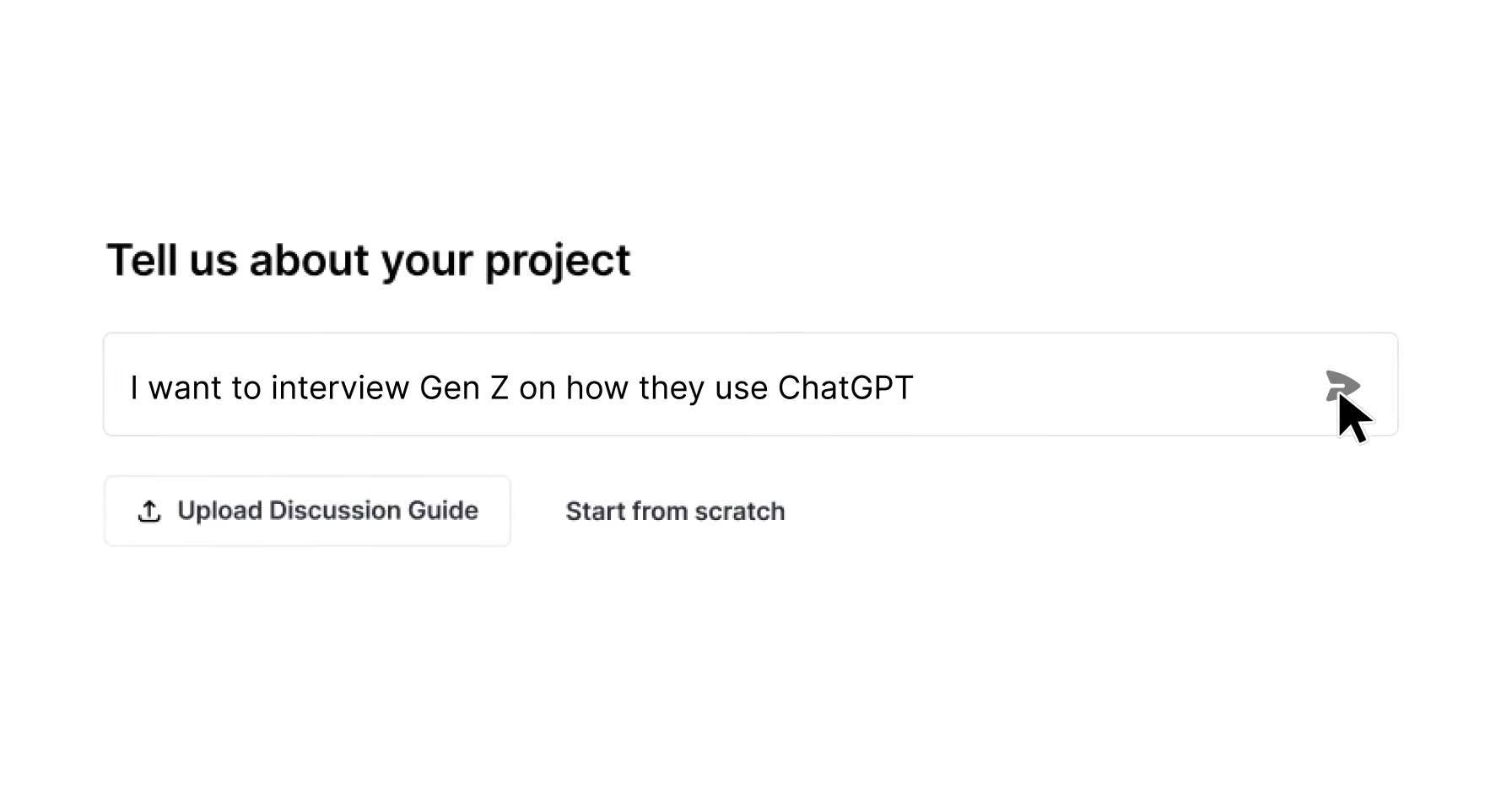
Clear objectives translate into a structured discussion guide that AI can follow. Modern AI systems draft discussion guides that use open-ended primary questions and behaviorally grounded probes. Human editors then refine these drafts to focus on what people actually do, not only what they claim to value.
The discussion guide functions as a structured prompt for the AI interviewer. It includes the research goal, participant profile, opening, key questions, branch logic, probes, and explicit out-of-scope boundaries. Stimuli such as images, video, ad concepts, or prototype URLs are embedded at this stage using branching and randomization logic. Auto-QA flags ambiguous or leading questions before launch. Expect 2–4 hours for design, review, and revision.
Step 3: Collect Multi-Source Data with AI-Moderated Interviews
Defensible brand perception research relies on multiple data sources. In a 2026 workflow, AI-moderated interviews act as the primary collection method, supported by behavioral signals, prior study data, and AI brand monitoring outputs from platforms such as ChatGPT, Perplexity, Claude, and Gemini.
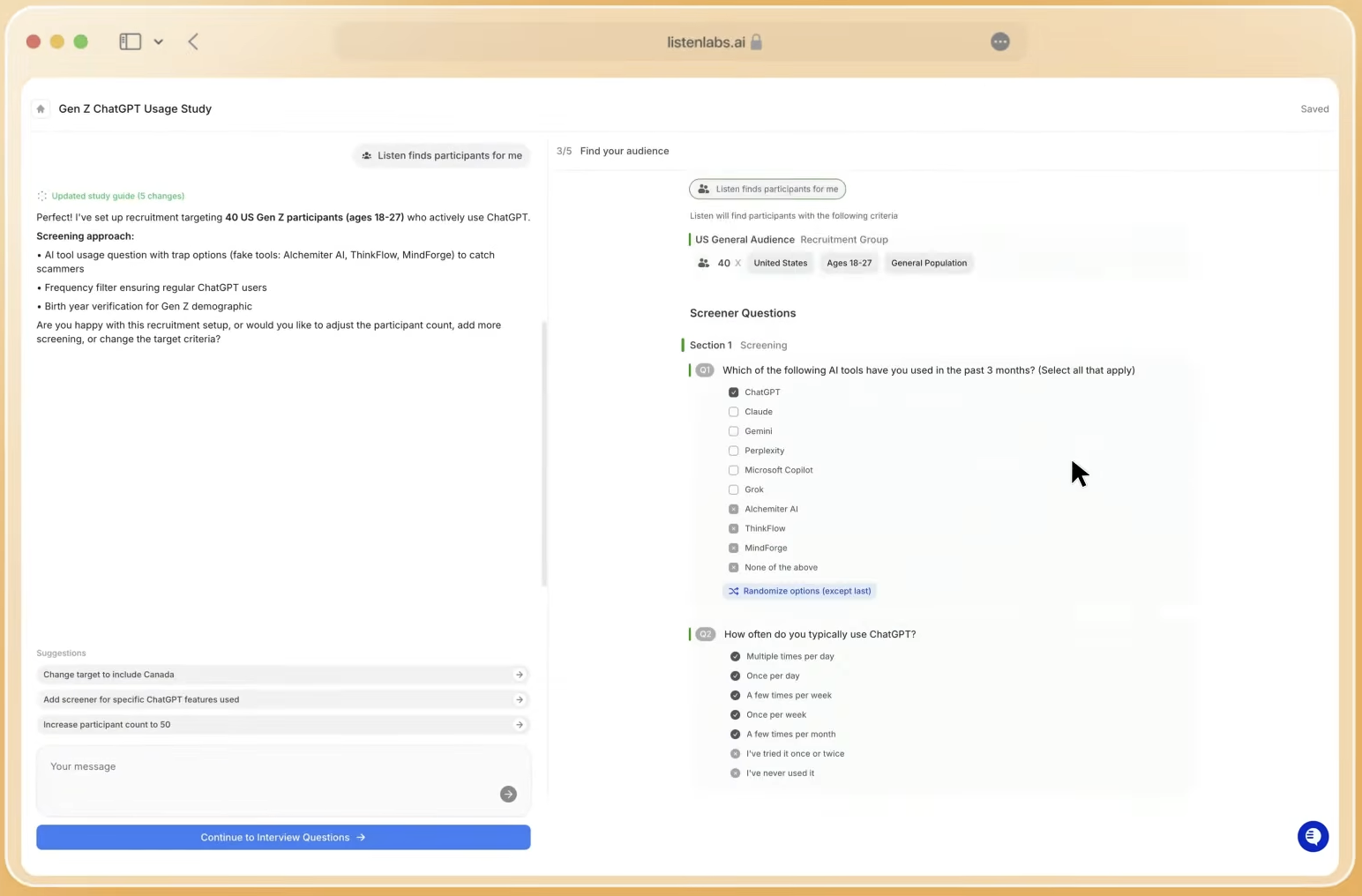
Platforms like Listen Labs add auto-recruiting, transcription, sentiment tagging, and insight summarization so teams move from question to findings in hours, not weeks. AI-moderated interviews enable 200–300 conversations in 24 hours compared to a typical traditional qualitative study of 15–25 interviews conducted over 3–4 weeks. Participant quality is protected through behavioral matching, real-time fraud detection, and frequency limits, not self-reported demographics alone.
For AI brand perception monitoring, a practical audit documents each query for brand presence, description framing, competitor ordering, source attribution, and tone. Exact responses are recorded with timestamps for longitudinal tracking. Emotional Intelligence analysis captures tone of voice, word choice, and subconscious micro expressions. This analysis surfaces the emotional layer of brand associations that transcripts alone cannot reveal. Plan for 24–48 hours for fieldwork at scale.
Step 4: Use Structured Validation Protocols to Reduce Bias
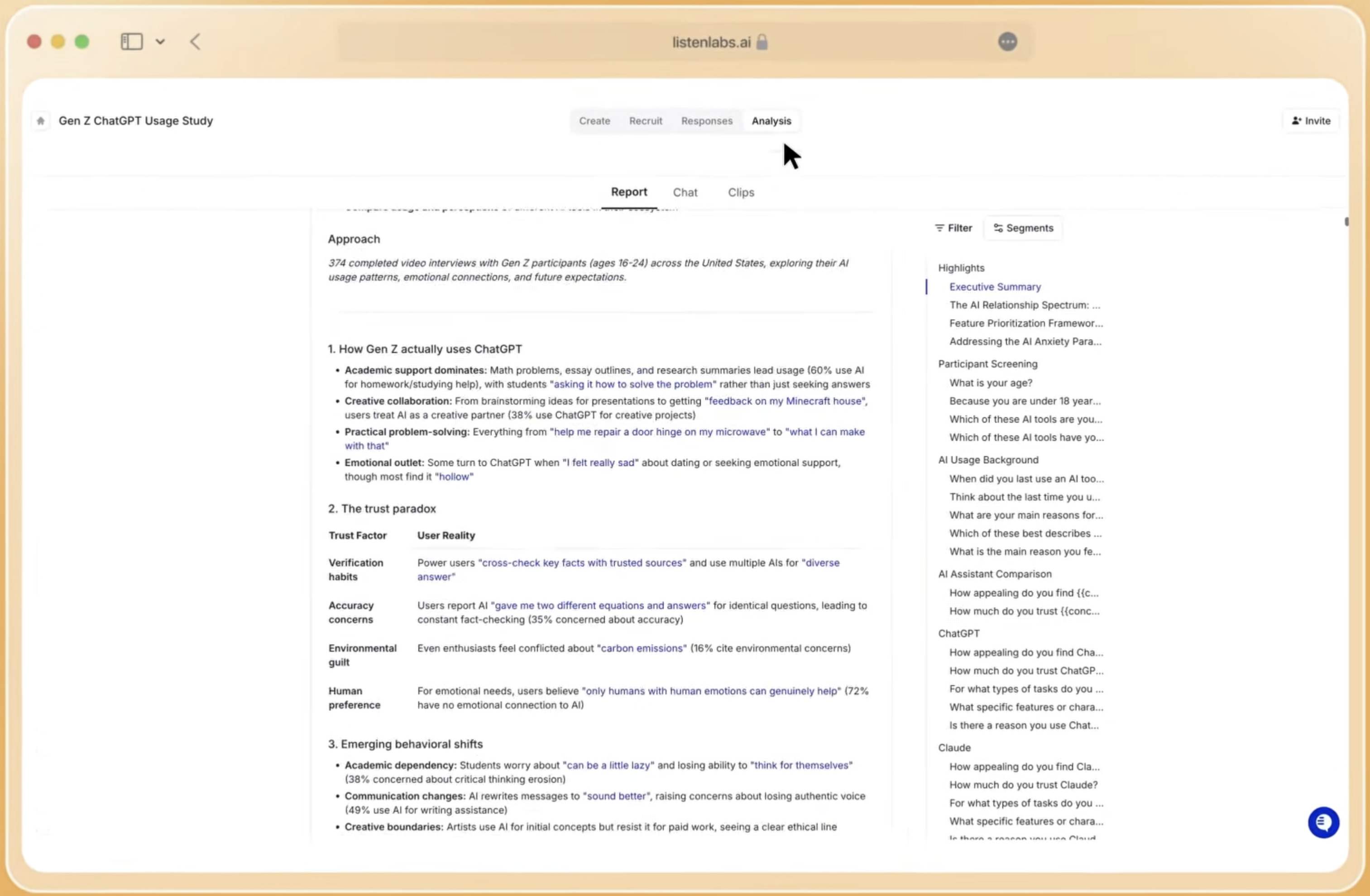
AI synthesis at scale introduces specific failure modes that structured validation protocols must catch. Every AI-generated theme should trace back to a verbatim quote from a specific participant with participant ID and timestamp. Treat themes without verifiable in-context sourcing as hallucinations until proven otherwise.
The validation workflow follows a clear sequence:
- Force AI output into a structured validation table with columns for theme, verbatim proof, source, prevalence count, caveat, and a follow-up question.
- Count distinct participants who support each theme instead of the number of times the AI mentions it. Repeated mentions by one participant do not equal broad support.
- Manually re-code a 10–20% random sample of transcripts and compare against AI themes. If alignment falls below 75–85%, refine prompts or require full human review.
- Triangulate AI-surfaced themes against behavioral or survey data, then tag each theme as Verified, Partial, or Rejected before stakeholder reporting.
- Validate AI-surfaced themes against full session recordings, because transcripts miss tone, hesitation, and sarcasm that shape brand associations.
Teams that apply pre-launch pilot validation, in-flight monitoring, and post-study human validation earn higher stakeholder trust than teams that treat AI as a black box. A designated lead researcher signs off before any deliverable ships. Expect 4–8 hours of human review per study.
Book a demo to see how Listen Labs enforces validation protocols at every stage of the AI brand research workflow.
Step 5: Segment Findings and Compare Audience Groups
Validated themes become strategically useful when broken down by audience segment. Segmentation dimensions for brand research include demographics, purchase behavior, brand relationship stage, geography, and psychographic cohort. One researcher can run a full buying intent analysis across three user segments in under a minute using AI-powered tools that apply statistical significance testing across segment comparisons.
The key trade-off at this stage is granularity versus sample sufficiency. Treat segments with fewer than 30 participants as directional instead of projectable. Qualitative AI-moderated brand studies should never be reported as producing projectable population-level percentages. Mixing directional insights from a recruited sample with statistical claims erodes credibility. Present segment findings as indexed themes with verbatim support, not percentages. Plan for 2–4 hours including stakeholder-ready deliverable generation.
Step 6: Build a Continuous AI Brand Perception Program
A single brand study provides a snapshot, while a continuous discovery program creates a durable advantage. Monitoring brand representation in AI answer engines should follow an ongoing cadence instead of a one-time check. High-growth brands often monitor weekly, and most brands should run at least monthly audits across major models.
The continuous AI brand perception program integrates two tracks. The first track uses AI interviews. Recurring brand health studies run on a fixed cadence, monthly for fast-moving categories and quarterly for stable ones, using cloned study designs to support trend comparison. The second track covers AI answer engines. Monthly check-ins test 5–10 core category and competitor queries across the top three AI platforms, with quarterly deep dives expanding to 20+ queries and new platforms.
Key metrics across both tracks include brand sentiment trend, share of voice versus named competitors, attribute accuracy, and emotional signal trajectory across segments. Escalation signals such as a 10+ point month-over-month drop in Share of Answer trigger a rapid-response study cycle. Plan for 2–4 hours per monthly review cycle.
Step 7: Connect Insights to Pricing, Campaigns, and Retention
Brand research must connect to measurable business outcomes to survive budget reviews. Strong brand equity research addresses four concrete outcomes: pricing power, campaign effectiveness, acquisition and loyalty strategy, and competitive intelligence.
The linkage between findings and outcomes follows a simple framework:
- Pricing power: Map brand attribute perceptions to price elasticity data to identify which associations justify premium positioning.
- Campaign effectiveness: Run pre and post brand perception studies around major campaign launches and compare perception shifts against media spend.
- Churn reduction: Combine post-cancellation interviews, stay interviews, NPS detractor follow-ups, and continuous voice-of-customer interviews. Synthesize these inputs into top churn drivers for product and customer success teams. A 5% increase in customer retention can produce a 25–95% increase in profits.
- Product decisions: Surface which brand claims feel exaggerated or unclear before market launch and direct innovation investment toward attributes consumers actually value.
The final test of brand research is whether findings improve concrete decisions about messaging, audience priority, and channel mix. Every insight delivered through this workflow should tie to a specific decision or a measurable outcome. Plan for an ongoing cadence with a quarterly business impact review.
Book a demo to see how Listen Labs connects AI brand research findings to business outcomes your leadership team can act on.
Common Challenges and How to Fix Them
Enterprise AI brand research programs tend to encounter a familiar set of failure modes. Each has a clear resolution:
- Unclear objectives: Studies launched without a specific decision to inform produce themes that no stakeholder can use. Resolution: require a one-page brief with a named decision owner before study design begins.
- Poor recruitment: Commodity panels introduce professional survey-takers and fraudulent profiles that distort brand perception data. Resolution: use behavioral matching and real-time quality monitoring instead of demographic screening alone.
- Low response quality: Short, incentive-driven answers lack depth. Resolution: run a pre-launch pilot of 10–20 sessions, check completion rates above 80%, and review average session length before scaling.
- Analysis bottlenecks: AI should never audit its own output for hallucinations. Models tend to reaffirm their own errors with the same confidence. Resolution: build human validation sampling into standard operating procedures.
- Stakeholder misalignment: Findings that arrive without business context are ignored or misused. Resolution: include at least one business stakeholder in the objectives session and share a validation table before producing the final deliverable.
Measuring Success of Your AI Brand Research Program
Teams can track success across short, medium, and long-term indicators. Short-term indicators include cycle time reduction from weeks to hours, study completion rates above 80%, and AI-to-human coding alignment above 75–85% on validation samples. Medium-term indicators include the number of studies completed per quarter, stakeholder usage rates of research deliverables, and the share of business decisions with a linked research input.
Long-term indicators include measurable shifts in brand perception scores across tracked segments, churn rate changes tied to insight-driven product or messaging decisions, and campaign performance lift in markets where pre-launch brand research occurred. Teams using AI research tools can spend more time on strategic planning and less on execution, and this reallocation compounds as institutional knowledge grows.
Advanced Moves for Mature Brand Research Teams
Mature teams that have run the 7-step workflow across multiple cycles can move toward always-on brand intelligence. This shift involves integrating the AI interview track and the AI answer engine monitoring track into a unified dashboard. That dashboard enables cross-study queries that surface trend lines instead of point-in-time snapshots.
Global studies benefit from parallel fieldwork across markets with automatic translation and localization. This approach compresses multi-market timelines by roughly 85% compared to sequential fieldwork. Behavioral and emotional signal integration, which combines what participants say with what their micro expressions and tone of voice reveal, produces a richer brand association map than either data type alone.
Readiness criteria for always-on programs include a validated study design library, a trained QA sampling routine, and a stakeholder reporting cadence that consumes insights on a regular schedule. Safe pilots for teams new to continuous discovery start with one recurring study type, such as monthly brand health tracking in a single market. After establishing a baseline, teams can expand.
Frequently Asked Questions
How long does it take to complete an AI brand research study from brief to deliverable?
When a purpose-built end-to-end platform handles recruitment, moderation, and analysis, the full cycle from study brief to final deliverable usually takes less than 24 hours for most brand research studies. Study design with AI assistance takes 2–4 hours. Fieldwork with AI-moderated interviews across a global panel completes within the 24–48 hour window mentioned earlier, with the platform handling recruitment and moderation simultaneously. Automated analysis, validation sampling, and deliverable generation add a few additional hours. The traditional 4–6 week timeline comes from sequential handoffs between disconnected vendors, not from research complexity.
Can AI-moderated interviews capture emotional nuance in brand research?
AI-moderated interviews can capture emotional nuance when the platform includes multimodal emotional signal analysis. Transcripts capture what participants say, while emotional intelligence tools capture how they say it. These tools analyze tone of voice, word choice, and subconscious micro expressions, built on Ekman’s universal emotions framework, to quantify emotions such as joy, trust, surprise, fear, disgust, sadness, anticipation, and anger at the question and concept level. Every emotional label ties back to a specific timestamp and verbatim quote, which keeps findings auditable. This capability is especially valuable for creative testing, concept comparison, and competitive brand perception studies where stated ratings may look similar but emotional responses differ.
How do you prevent AI hallucinations from corrupting brand research findings?
Hallucination prevention relies on structural workflow controls, not only prompt engineering. The five most common AI hallucination patterns in qualitative synthesis are misattributed quotes, phantom prevalence, over-generalization, invented correlations, and context bleed. Effective prevention uses the validation controls detailed in Step 4, including verbatim proof requirements, participant counting methods, manual sampling, triangulation, and human sign-off. AI should not audit its own output, so independent human review remains essential.
What types of brand research studies does this workflow support?
The 7-step workflow supports brand perception studies, creative and ad testing, concept comparison, competitive brand positioning analysis, campaign pre and post tracking, brand health tracking across segments and markets, and churn-driver research that links brand associations to retention outcomes. The same structure works for 30 interviews in exploratory discovery or 300 interviews in multi-market segmentation. Study design templates can be cloned and adapted across waves to support longitudinal tracking without rebuilding from scratch.
How does AI brand research integrate with AI answer engine monitoring?
AI-moderated brand interviews and AI answer engine monitoring address related but distinct questions. Interviews surface how target consumers describe, feel about, and associate meaning with a brand in their own words. AI answer engine monitoring tracks how platforms like ChatGPT, Perplexity, Claude, and Gemini represent the brand in synthesized responses to buyer queries. A mature continuous brand research program runs both tracks in parallel. Recurring interview waves establish the ground truth of consumer perception, while monthly AI platform audits track whether that perception appears accurately in AI-generated brand narratives. Gaps between the two become priority inputs for content, PR, and messaging strategy.
Conclusion: Turning AI Brand Research into a Repeatable Advantage
The 7-step AI brand research workflow, which includes setting clear objectives, designing rigorous study guides, collecting multi-source data, applying validation protocols, segmenting findings, monitoring perception continuously, and tying insights to business outcomes, closes the gap between generic AI advice and enterprise-grade execution. Each step protects methodological rigor while compressing the traditional 4–6 week research cycle to less than 24 hours.
Teams that treat this sequence as a repeatable operating procedure, instead of a one-off experiment, build institutional knowledge and stakeholder trust that justify expanded research investment. Applying AI brand research best practices with this level of structure separates insight programs that influence decisions from those that produce reports no one reads.
Book a demo with Listen Labs to see the complete AI brand research workflow in action, from study design and global recruitment to AI-moderated interviews, emotional intelligence analysis, and stakeholder-ready deliverables in less than 24 hours.