
Written by: Anish Rao, Head of Growth, Listen Labs
Key Takeaways
Here is the short version of what this guide covers: the main tool categories, what they cost, where they struggle, and the diagnostic gap neither closes.
- Social listening and AI-search visibility tools solve two distinct problems, tracking human-generated mentions versus how AI models describe your brand, and neither explains why metrics move.
- Leading social listening platforms like Brand24, Brandwatch, Meltwater, and Sprout Social range from $199/month to quote-only enterprise contracts, with accuracy limits on sarcasm and fast-changing platforms like TikTok.
- AI-search visibility tools such as Otterly.AI, Profound, Semrush, and Promptwatch start at $29–$579/month and provide directional data on brand mentions inside ChatGPT, Gemini, Perplexity, and Google AI Overviews.
- Every tool category struggles with sarcasm detection, where accuracy often drops to 65–80%, and lacks standardized metrics, so teams get detection without a diagnostic explanation for sentiment or awareness shifts.
- Listen Labs closes this diagnostic gap by running continuous qualitative research at scale; see how Listen Pulse explains the metric movements your listening tools can only detect.
Social Listening Vs. AI Search Visibility: How They Measure Brand Perception
Social and web listening tools monitor what people publish about a brand across social platforms, review sites, forums, blogs, and news. They crawl and index public content that already exists, then score sentiment, track mention volume, and surface trends. The data source is human-generated, publicly available text.
AI-search visibility tools operate on an entirely different surface. AI model responses are ephemeral and non-indexed, so a ChatGPT answer about your brand is generated fresh on demand for each user query, never published to a public URL, and may differ the next time the same question is asked. Tracking AI-search visibility requires actively querying models at scale with designed prompts, capturing responses, and analyzing them for brand mentions, sentiment, and citation sources. As of 2026, ChatGPT has more than 500 million weekly active users, and Perplexity has crossed 100 million monthly visits. Google AI Overviews appear in a substantial and growing share of US searches, with estimates ranging from roughly 25% of searches on average to the majority depending on the source and query mix. This surface is now too large to ignore.
A sentiment score from one category tells you nothing about the other. A spike in negative social sentiment, for example, will not appear in an AI-search visibility dashboard, and a brand being described as “worth considering if your budget is limited” in Gemini’s responses will never trigger an alert in a social listening tool. A spike in negative social sentiment may correlate with a subsequent shift in how AI models describe a brand, so both datasets work as complements rather than substitutes. The two datasets measure different surfaces, so teams need to read them separately.
AI Tools For Tracking Brand Sentiment And Awareness
This section walks through three tool categories: social and web listening, AI-search and LLM visibility, and enterprise media intelligence. Pricing reflects publicly available figures or third-party benchmarks as of September 2026.
Social And Web Listening Platforms For Public Mentions
Brand24 is a common starting point for small and mid-market teams that need fast setup across news, social media, and blogs. It tracks brand mentions, uses AI to score sentiment, and measures presence across channels. Pricing runs roughly $199–$1,499/month on annual plans. Coverage depth and historical data are shallower than enterprise platforms, which matters once teams need multi-year trend work.
Brandwatch indexes over 100 million data sources and layers an AI-powered query builder and sentiment analysis on top. It suits enterprise brand intelligence and consumer research teams that need deep coverage and flexible querying. Third-party benchmarks place common annual contracts between roughly $19,542 and $81,200, averaging around $50,000. Cost and the lack of a self-serve tier keep it out of reach for lean teams. For teams weighing Brandwatch against Meltwater, the decision often comes down to whether media relations and PR workflows matter as much as consumer intelligence.
Meltwater combines media intelligence, social listening, AI visibility tracking, media relations, and influencer marketing. It covers 200+ countries and 240+ languages and includes access to Reddit’s full firehose. This platform suits communications, PR, and brand teams that treat media intelligence as a department-level operating system. Pricing is quote-only across Starter, Pro, Enterprise, and Agency tiers, with third-party benchmarks suggesting a median customer spend around $25,000/year. Fixed dashboard metric combinations limit customization, and platform API restrictions can cap TikTok, Facebook, and Instagram coverage.
Sprout Social uses an AI sentiment engine to label incoming messages and visualize how public opinion changes over time. It suits social media managers who need publishing, inbox, and listening in one workflow. Pricing runs $199–$399 per seat per month, plus add-ons. Sentiment scoring is strongest on English-language, high-volume conversations and can lose accuracy on fast-shifting TikTok vernacular. TikTok culture leans on emojis, slang, sarcasm, and fast-changing references that models often miss, a limitation shared across AI sentiment tools.
AI-Search And LLM Visibility Tools For Generative Answers
Otterly.AI measures brand sentiment and mention counts across AI models including ChatGPT, Gemini, and Perplexity, and includes a GEO Audit feature for AI readiness. It suits marketing teams that need an affordable entry point, with pricing starting around $29/month. Otterly.AI earned a Gartner Cool Vendor designation in 2025. This category is still young and methodologies vary between vendors, so teams should treat outputs as directional.
Profound tracks how answer engines describe your brand and breaks down positive and negative themes from AI prompts, processing more than 400 million prompt insights. It suits enterprise AEO programs that have a clear owner for AI visibility. Pricing starts around $499/month. The enterprise focus and setup expectations assume a dedicated operator.
Semrush AI Visibility Toolkit tracks your brand’s sentiment and visibility inside AI-driven search engines compared to competitors, alongside traditional SEO metrics. It suits teams already inside the Semrush ecosystem that want AI visibility alongside keyword data. Pricing is $99/month per domain for the Base plan, billed annually. AI visibility functions as one module inside a broader SEO platform rather than a standalone deep-dive.
Promptwatch tracks 10 AI models including ChatGPT, Perplexity, Claude, Gemini, Google AI Overviews, Google AI Mode, Grok, DeepSeek, Copilot, and Mistral, and has analyzed more than 880 million citations. It suits teams that want broad model coverage and detailed citation tracking. Pricing runs $99/month (Essential), $249/month (Professional), and $579/month (Business). Broad model coverage does not resolve prompt volatility, and small prompt changes can produce different brand recommendations. For teams weighing Otterly.AI against Profound, the trade-off is entry-level affordability versus enterprise prompt depth.
Enterprise Media Intelligence For Complex Organizations
Talkwalker/Lumen covers 150+ million data sources including social, news, and forum content, and adds image- and video-aware sentiment that weighs visual cues alongside text. It suits large teams with broad media monitoring needs and complex reporting requirements, with quote-only pricing. Sarcasm accuracy on pure text is middling, and the UI carries a learning curve.
Sprinklr unifies social listening, publishing, and customer experience across channels, and publishes an accuracy figure of over 80% across its conversational analytics. It suits large enterprises consolidating social and CX workflows, with quote-only pricing. Breadth comes with implementation weight, and the platform is more than teams need when they only require monitoring.
Can ChatGPT Do Sentiment Analysis?
Before assuming you need a dedicated tool, consider what large language models can handle on their own. LLMs can classify tone in text you paste into them. If you copy a batch of customer reviews into ChatGPT and ask it to label each as positive, negative, or neutral, it will produce a reasonable output. A June 2026 benchmark testing ten large language models on three-way sentiment classification found the top four models tied at 75% accuracy on Twitter data, which is a harder and more realistic case than the cleaner product-review text many sentiment tools are trained against.
ChatGPT cannot continuously monitor your brand across the web, track how your brand appears in AI answers about you, or run the same study wave after wave to surface emerging themes. It works well as a one-off classifier. It does not function as monitoring infrastructure. Dedicated tools exist because the monitoring problem at scale, across sources, over time, is architecturally different from the classification problem.
Free Vs. Paid Brand Sentiment Tools
Given those price points, many teams ask what they can get for free. Free tiers exist across several social listening tools and a handful of AI-search visibility platforms. What they realistically cover is limited, typically a few hundred mentions per month, delayed data, no historical tracking, and no competitive benchmarking. Babel42’s free plan, for example, includes 500 mentions per month, two monitors across five networks, AI sentiment analysis, and 90 days of history. That level works for a small brand doing basic monitoring and falls short for trend analysis or crisis detection at scale.
The ceiling on free tiers is consistent across the category. Free plans cannot support longitudinal trend analysis, competitive share-of-voice benchmarking, or the kind of historical data depth needed to explain why a metric moved rather than simply that it moved. For teams that need to defend a recommendation internally, free-tier data functions as a starting point, not a foundation.
Where These Tools Fall Short
Sarcasm, irony, and multilingual nuance remain difficult cases for sentiment scoring across every tool category. Sarcasm can cause a 50% drop in sentiment analysis accuracy, and even the strongest tools hover around 80–90% accuracy on clearly sarcastic text and drop lower on ambiguous cases. A 2025 study from Tianjin University evaluating sarcasm detection across more than a dozen leading LLMs found their F1 scores rarely exceeded 65% when averaged across different datasets. Code-switched content and low-resource languages perform worse still, with code-mixed text typically showing 5–10% lower accuracy than monolingual text.
AI-search visibility tools carry a separate methodological limitation. The category is new and its measurement standards are not yet settled. As Lily Ray, VP of SEO Strategy and Research at Amsive, put it: “As with all things LLM tracking — the data is meant to be used directionally! And unless we get something like an Open AI Search Console or any type of AI search analytics in GSC, directional data is the best we have.” 71% of AI visibility and citation-tracking tools lack standardized metrics, which makes cross-vendor comparison difficult.
Social listening catches volume but not the reason behind a shift. A mention count tells you something happened. It does not tell you what customers actually think or feel about it. Only 10% of professionals can act on a social listening insight within hours, and 56% of in-house brand teams struggle to demonstrate the business value of social listening to leadership. That gap reflects the distance between a sentiment score and an actionable explanation.
The Problem These Tools Do Not Solve And Where Listen Labs Fits
Listening tools tell you a number moved, and AI-search visibility tools tell you how you appear in LLM answers. Neither tells you what customers actually think or feel, or why the metric shifted. That diagnostic gap is where Listen Labs operates.
Listen Labs is an end-to-end AI research platform that sources participants from a 50M+ network and conducts, analyzes, and summarizes thousands of in-depth customer interviews in hours, not weeks. Since launch, the platform has conducted over 1 million interviews across 45+ countries and 120+ languages, compressing a research cycle that used to take 4–6 weeks to less than 24 hours at one third the cost of traditional research.
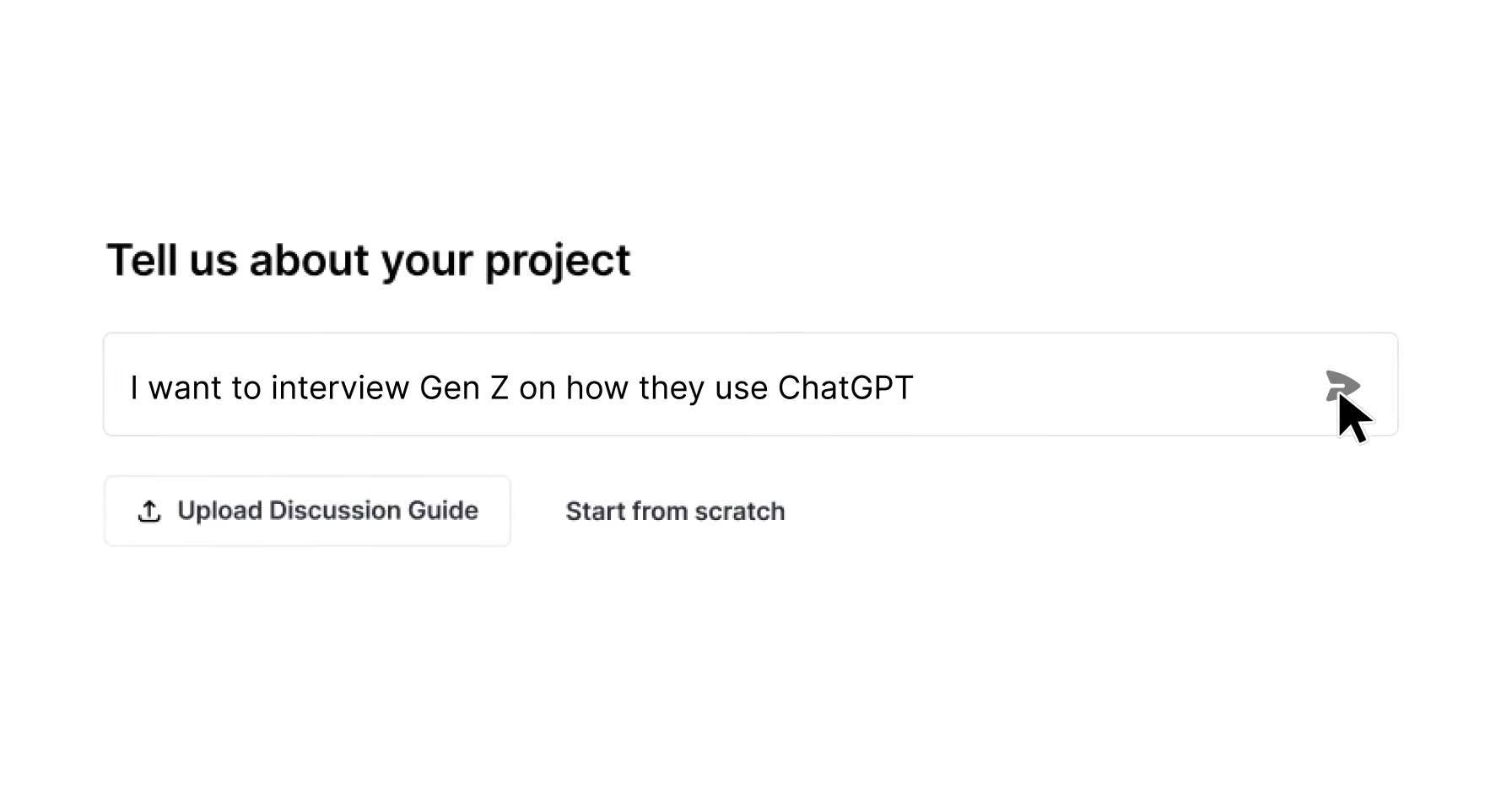
Listen Pulse sits most directly alongside the tools covered above. It is a conversational tracker that runs the same study wave after wave, combines quantitative KPI tracking with open-ended conversation, and charts emerging themes next to the KPIs teams already report. Every metric movement arrives with its explanation. Core questions stay constant to protect the trend line, while timely questions cover new campaigns and competitors. Pulse integrates with Qualtrics and Decipher, so teams keep the KPIs they already report while adding the narrative behind them. One well-known clothing brand, famous for its big logos, was quietly losing customers. Its old tracker caught the drop but could not explain it. Pulse found that style, not price, was driving customers away. A growing group of customers felt the big logos were too loud for their changing lifestyles.
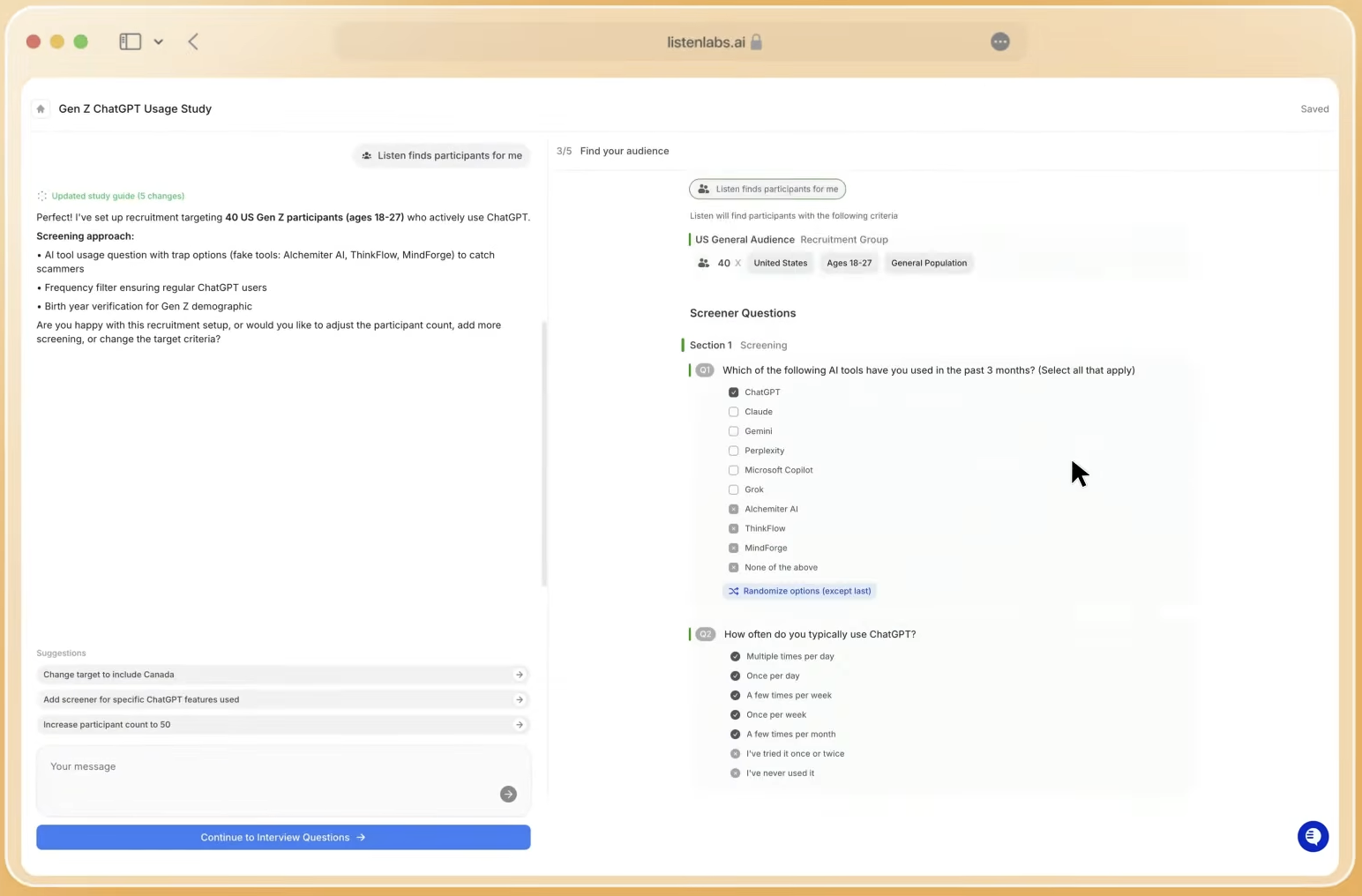
Emotional Intelligence analyzes tone of voice, word choice, and subconscious micro expressions to surface how people actually feel, not just what they say. It is built on Ekman’s universal emotions framework and is available across 50+ languages. Research Library lets teams query every study they have ever run in natural language, with full traceability to the original respondent.
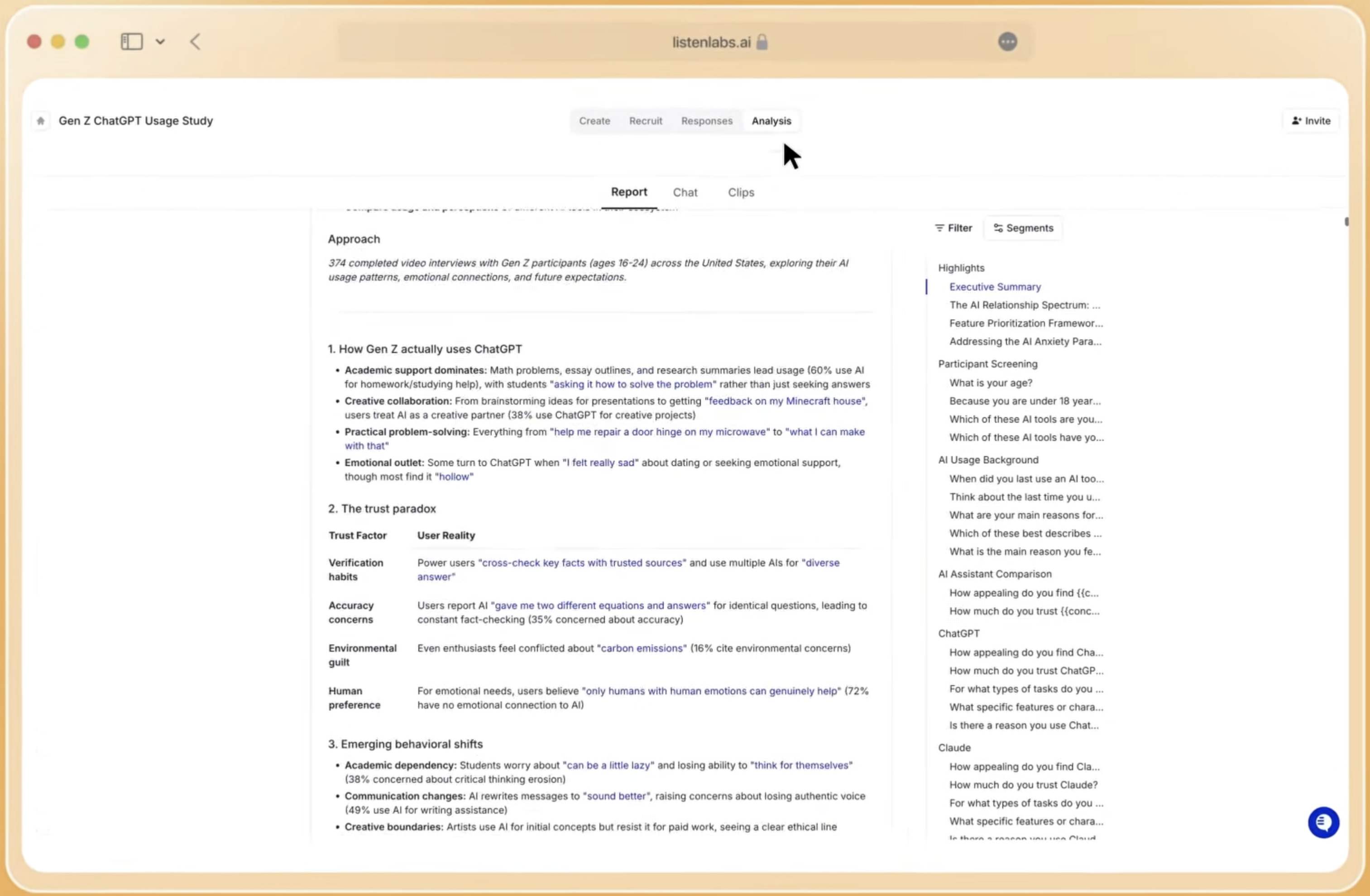
A Listen Labs and Profound study of 100 CMOs found that 90% use large language models daily and 22% now begin vendor research inside an LLM versus 16% using traditional search. That shift makes the question of what AI says about your brand, and why, a board-level concern rather than a marketing operations detail.
Enterprise teams already use Listen Labs at scale. Microsoft cut research wait time from weeks to hours. Sweetgreen scaled research across 300+ US locations at 5x the scale and one-third the cost. Skims validated with thousands of high-income buyers overnight. These examples show continuous diagnostic capability that turns a sentiment score into a strategic decision.
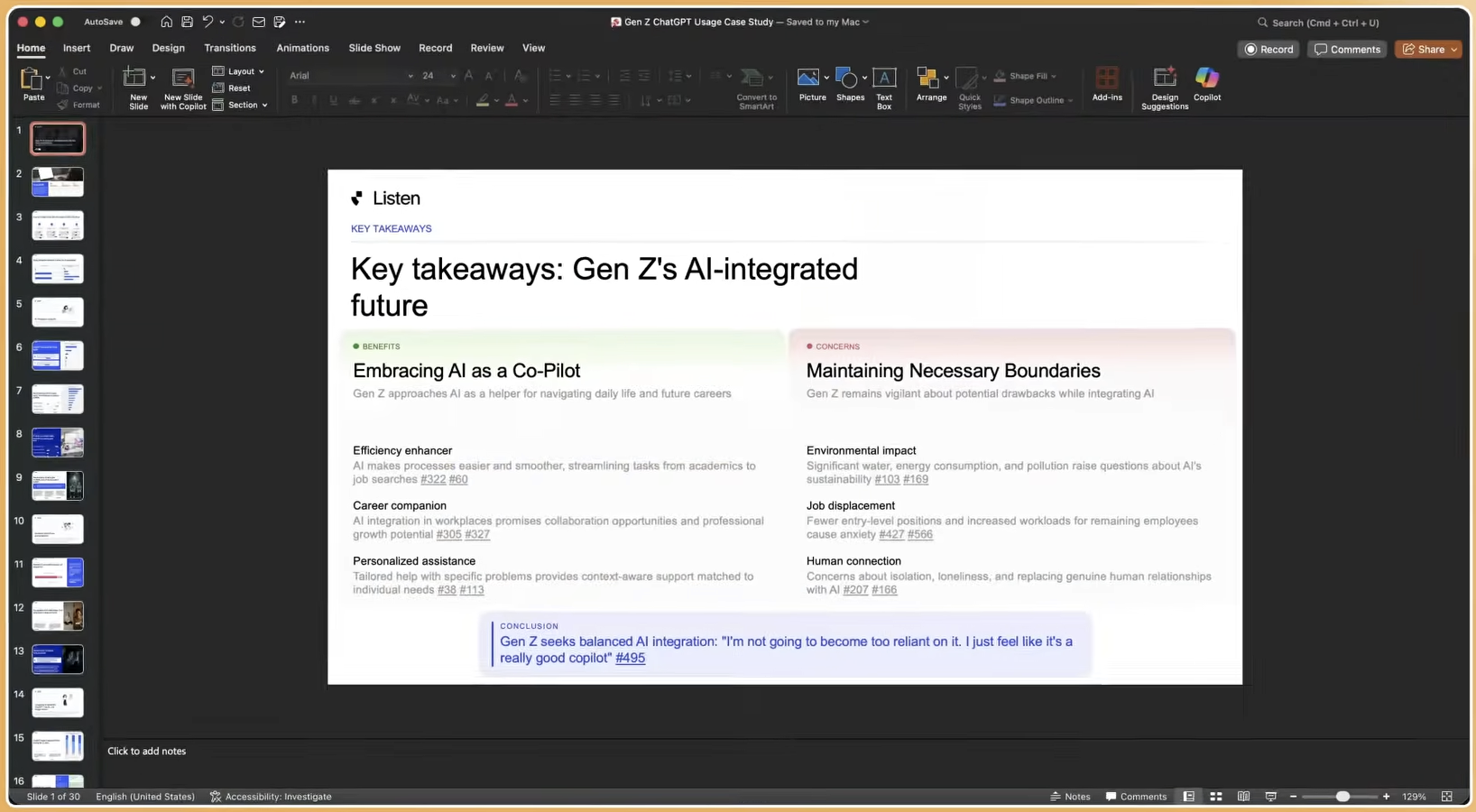
See how Listen Pulse explains the metric movements your listening tools can only detect.
How To Choose: A Decision Framework By Team Type And Budget
With the categories and their limits mapped out, the practical question is where to start. The answer depends on team size, budget, and how quickly you need diagnostic depth.
Small teams with limited budget should start with one social listening tool, with Brand24 as the most accessible entry point, plus free AI-search visibility checks through Otterly.AI’s entry tier. The goal at this stage is coverage and alerting rather than deep diagnosis.
Mid-market brand or insights teams benefit from pairing a social listening tool with a dedicated AI-search visibility tool such as Profound or Promptwatch, then adding Listen Pulse for the “why” behind KPI movement. This stack covers what people say, what AI says, and what customers actually think. Those three measurement problems require three different approaches.
Enterprise insights teams typically need enterprise media intelligence, such as Meltwater or Talkwalker/Lumen, plus AI-search visibility plus Listen Labs for continuous qualitative tracking at scale. The listening and visibility layers handle detection. Listen Labs handles diagnosis.
Teams that need to explain a sentiment or awareness shift should start with Listen Labs. The other tools in this guide handle detection, while Listen Labs provides the diagnostic layer.
Frequently Asked Questions
How Much Do AI Brand Sentiment Tools Cost?
Entry-level AI-search visibility tools start around $29–$99/month. Social listening tools run roughly $199–$1,499/month for self-serve tiers. Enterprise platforms like Brandwatch and Meltwater are quote-only on annual contracts, with third-party benchmarks suggesting median annual spends of around $50,000 for Brandwatch and $25,000 for Meltwater. Enterprise media intelligence platforms like Talkwalker and Sprinklr are also quote-only. Costs scale with the number of data sources monitored, query volume, user seats, and integration requirements.
Can AI Sentiment Analysis Handle Sarcasm And Multilingual Content?
Sarcasm remains the hardest problem in sentiment analysis. As covered earlier, the strongest tools top out around 80–90% accuracy on clearly sarcastic text, and the Tianjin University study found F1 scores for sarcasm detection rarely exceeded 65%. Multilingual accuracy varies significantly by language. Major languages like Spanish, French, and German perform well on multilingual transformer models, while low-resource languages and code-switched content show meaningfully lower accuracy. Models trained primarily on English data from Western cultural contexts may misread sentiment expressed differently in other markets.
What Is The Difference Between Social Listening And AI Search Visibility?
As explained earlier, social listening tracks public, indexable content while AI-search visibility tracks ephemeral model responses. The two measure different surfaces and require different levers, so a sentiment score from one does not substitute for the other.
Do Most Teams Need Both?
Most teams benefit from both layers. A spike in negative social sentiment may correlate with a subsequent shift in how AI models describe your brand, so the two datasets work as complements. Social listening is well-suited to real-time crisis detection, campaign monitoring, and competitive conversation tracking. AI-search visibility covers the generative channel where a growing share of B2B purchase research now begins, and Forrester’s February 2026 Consumer Pulse Survey found 26% of consumers now use ChatGPT to search for products they are considering buying. Running only one without the other leaves a significant portion of brand perception unmonitored.
How Do I Track Brand Awareness Inside ChatGPT?
Use a dedicated AI-search visibility tool that queries models at scale with a defined prompt library, then track mention rate, share of voice, sentiment, and citation sources over time. Build a prompt library of 30–50 buyer questions covering discovery queries, comparison queries, and use-case queries using actual buyer language. Run prompts weekly at minimum for meaningful trend data, since AI answers change as models update and sources get re-indexed. Treat all outputs as directional rather than definitive, given the prompt volatility inherent in probabilistic model outputs.
How Does Listen Labs Fit Alongside A Listening Tool?
Listening tools detect that a metric moved. Listen Pulse explains why by running the same study wave after wave and charting emerging themes next to the KPIs you already report. Where a social listening tool surfaces a sentiment dip, Listen Pulse surfaces the specific customer concern driving it, in the respondents’ own words, with the audio and video clip behind each finding. The two tools answer different questions and are designed to be used together, not as substitutes. Listen Pulse integrates with Qualtrics and Decipher so the KPI infrastructure teams already maintain stays intact.
Conclusion
Detection and diagnosis are different problems. Social listening tools and AI-search visibility tools tell you what changed, such as a sentiment score dropping, a share-of-voice metric shifting, or a new competitor appearing in LLM answers. They rarely explain why. The brand team that can only say “our sentiment score fell 8 points” is in a weaker position than the team that can say “our sentiment score fell 8 points because a growing segment of customers feels our product positioning no longer reflects how they use the category, and here is the evidence.”
The tools covered in this guide provide the right instruments for detection. Listen Labs adds the diagnostic layer that sits alongside them, conducting thousands of in-depth customer interviews in hours, surfacing the themes forming before they hit your KPIs, and delivering every metric movement with its explanation already attached. The platform has already run over a million interviews, so this diagnostic layer is proven in the field rather than theoretical.
If your current stack tells you what changed but not why, the next step is to see the diagnostic layer in action. Start closing the diagnostic gap with Listen Pulse.