Written by: Anish Rao, Head of Growth, Listen Labs
Key Takeaways
- Brand awareness decline comes from a broken exposure-to-memory-to-consideration chain as discovery shifts away from brand-owned surfaces and peer proof takes over at purchase.
- Five habit shifts — AI-driven discovery, ad fatigue, dupe culture, social commerce, and fragmented attention — each erode mental availability through specific mechanisms that classic awareness frameworks miss.
- Traditional trackers flag when awareness drops but rarely explain why; conversational studies built around five diagnostic questions reveal the exact shift driving the decline.
- AI-moderated interviews with emotional intelligence and cross-study synthesis help brands uncover the causal story behind KPI movement in the same wave instead of weeks later.
- Listen Labs delivers this diagnostic capability through Listen Pulse, so teams can pinpoint which habit shift is eroding awareness before the next KPI moves. See how Listen Pulse diagnoses your awareness decline.
Why Brand Awareness Is Declining: Five Habit Shifts Breaking the Memory Link
Brand awareness declines when consumer discovery habits change faster than a brand’s visibility strategy. The drop becomes a diagnosable break in how consumers move from exposure to memory to consideration. Five specific habit shifts are driving this erosion, each with a distinct mechanism and a diagnostic question that reveals whether it is hitting your brand. Here is the full set, in the order we will work through them:
- AI-driven discovery replacing search and aisles
- Ad fatigue and content filtering
- Dupe culture and value realism
- Social commerce and peer validation
- Fragmented attention across channels
Teams that recognize these shifts early can adjust strategy before the next KPI moves. Run a diagnostic study in under 24 hours with Listen Labs.
How AI-Driven Discovery Reduces Brand Awareness
AI-driven discovery weakens brand memory when discovery no longer passes through brand-owned surfaces. Consumers who never encounter a brand’s own content cannot encode it as a memory, and brands missing from AI-generated summaries fall out of consideration entirely.
NIQ’s 2026 Consumer Life data found that nearly six in ten U.S. consumers now rely on AI-generated summaries at least some of the time when searching online, rising to about three quarters among Gen Z and Millennials. That reliance already shapes decisions: roughly one in four Gen Z and Millennial consumers say they trust the AI summary and stop there, which removes many brands from the decision set before any deeper exploration.
Alchemer’s 2026 Retail Report, based on a survey of 1,002 U.S. shoppers, found that 17.4% of shoppers discovered their most recent purchase through an LLM or AI tool, ahead of in-store browsing at 14.4% and friends-and-family recommendations at 10.6%. Shoppers aged 18 to 29 are nine times more likely than shoppers aged 61 and older to have discovered their most recent purchase through an AI tool, showing how quickly this habit is skewing younger.
A Bain survey found that 44% of online buyers mostly start their journey in an LLM or split their search between AI tools and traditional search engines, with Gen Z and Millennials adopting this behavior roughly twice as fast as baby boomers and the Silent Generation. A separate Productrise study tracking over 100,000 shopping queries found that Google’s AI Mode surfaced roughly 95% fewer product listings than standard Google search on the same queries. That compression shrinks the competitive set to a handful of brands per response.
The diagnostic question for this shift is simple: Where did you first hear about this brand? When “an AI tool” or “a summary” dominate the answers and your brand is missing from those surfaces, the memory link breaks before it begins.
How Ad Fatigue and Content Filtering Erode Brand Recall
Ad fatigue turns repetition into noise and weakens recall. Repeated exposure stops encoding as memory and starts encoding as irritation once a frequency threshold is crossed, and consumers develop reactance when they feel over-targeted.
The Site Impact 2026 Personalization Reality Check Report, based on a June 2026 survey of 800 U.S. adults, found that 43% of consumers have stopped considering or purchasing from a brand because its personalized marketing felt repetitive, too personal, or off-base. The same report found that 45% of consumers describe the personalized marketing they receive as “repetitive,” the single most common descriptor, ahead of “relevant” at 40% and “helpful” at 39%.
When marketing becomes annoying, the Site Impact report found that 48% of consumers tune it out and ignore it, 41% block or hide the ads, and 40% unsubscribe. A 2026 Bebran Digital analysis reports that brand recall drops by nearly 20% once ad frequency exceeds three views per day. Consumers experiencing ad fatigue are also 22% less likely to recommend the brand to someone else, so overexposure erodes brand equity while cost-per-acquisition climbs.
The diagnostic question for this shift is: What almost stopped you from buying? When consumers describe feeling “followed,” “bombarded,” or “tired of seeing it,” ad fatigue is weakening the brand’s memory structure instead of reinforcing it.
How Dupe Culture Changes Brand Consideration
Dupe culture moves consideration from brand name to perceived equivalence. When consumers can publicly prove that a lower-cost alternative delivers comparable results, the prestige premium loses its automatic authority and the decision shifts to “which formula at what price.”
A Standard Insights survey of 576 U.S. adults conducted in April 2026 found that 47% have already replaced at least one premium beauty product with a cheaper alternative found online or on social media, rising to 61% among active buyers. When told a $12 drugstore moisturizer shares 80% of active ingredients with a $65 prestige equivalent, 50% of respondents said they would switch to the cheaper option immediately, while only 10% would maintain the premium purchase on brand experience and packaging alone.
Measure Protocol’s June 2026 analysis of panel data covering Google and TikTok search events found that dupe culture is most concentrated in fragrance, beauty, fashion, and tech. The analysis concludes that consumers who search for dupes are brand-aware and price-constrained rather than brand-indifferent, which makes them a segment with real conversion potential. The key warning signal is dupe volume growing faster than the brand’s own purchase funnel.
The diagnostic question for this shift is: What made you consider it? When answers focus on ingredient comparisons, “same thing for less,” or social media demonstrations of equivalence, dupe culture is reshaping the consideration set.
How Social Commerce Shifts Brand Discovery
Social commerce replaces brand recall with peer proof at the moment of purchase. When discovery and purchase happen in the same feed, consumers often skip the traditional awareness-to-consideration sequence and rely on social validation instead.
Clutch’s May 2026 survey found that 42% of consumers say positive reviews are the top factor in converting discovery into a purchase, while only 5% say influencers are their most trusted source. That positions creators as discovery engines while reviews and communities close the sale. The same Clutch research found that 85% of consumers say the way they discover brands has fundamentally changed over the last five years. According to a BCG Global Consumer Radar survey, approximately 50% of consumers approach their purchase without a predetermined brand preference.
Alchemer’s 2026 Retail Report found that online reviews are the single most trusted purchase input at 36.1%, ahead of friends and family at 31.2%. In Salsify’s 2024 Consumer Research Report, 24% of shoppers cite brand reputation as the most important reason they trust a brand, while 17% cite the brand’s reputation and trust as a top factor in choosing a more expensive product. An ICERTIAS study of 8,000 adults across all 57 OSCE participating States found that 23% of AI shopping users said AI had advised them against buying a brand they were already seriously considering, with better value from a competitor cited as the top reason.
The diagnostic question for this shift is: Who or what did you check before purchasing? When consumers consistently name review platforms, creator content, or community forums instead of the brand’s own channels, peer validation has become the primary purchase trigger.
How Fragmented Attention Across Channels Weakens Memory Structures
Fragmented attention prevents any single channel from building enough repetition to create durable memory. Memory encoding needs sufficient frequency within a coherent context, and that becomes harder when attention spreads across many platforms, apps, and devices.
Clutch’s May 2026 research found that 85% of consumers say the way they discover brands has fundamentally changed over the last five years. EMARKETER’s May 2026 analysis found that 88% of U.S. consumers switch between digital activities within an hour’s time, and 46% describe their path to purchase as “random.” Consumers report having an average of 3.6 tabs open while conducting product research, which fragments exposure sequences.
A 2025 Pew Research Center survey of 5,022 U.S. adults found that no single platform dominates. YouTube reaches 84% of U.S. adults, Facebook 71%, Instagram 50%, and TikTok 37%, confirming that attention spreads across multiple channels. A July 2026 AudienceProject analysis frames this as a redistribution of attention rather than a decline in total attention. The pool stays stable while its distribution keeps shifting.
The diagnostic question for this shift is: Walk me through how you decided to buy this. A nonlinear, multi-platform answer such as “I saw it on TikTok, then Googled it, then checked Reddit, then asked a friend” confirms that no single channel is accumulating enough frequency to build memory on its own.
Why Classic Awareness Frameworks Struggle With New Consumer Habits
Classic brand awareness frameworks were built for a world with concentrated exposure, limited channels, and linear movement from unaware to loyal. Each framework carries an assumption that the five habit shifts above now violate.
- The 3-7-27 rule assumes repeated exposure across a limited channel set builds memory. Fragmented attention means no single channel accumulates enough repetition to reach the threshold, because exposures spread across too many surfaces to compound.
- The three types of brand awareness (aided, unaided, top-of-mind) assume consumers retrieve brands from memory at the moment of decision. AI-driven discovery bypasses retrieval entirely, since the AI presents a shortlist and brands missing from that list never get recalled.
- The four stages of brand awareness assume linear progression from unaware to most aware. Social commerce collapses stages when discovery and purchase happen in the same feed, so a consumer can move from unaware to buyer without a traditional consideration phase.
- The 5 C’s of branding assume brand-controlled messaging drives perception. Peer validation and dupe culture now distribute reputation across reviews, creator content, community forums, and AI summaries, most of which the brand does not control.
- The rule of seven assumes seven exposures build consideration. Ad fatigue research shows that repeated exposure past a threshold can damage brand equity, because the seventh exposure in a short window often triggers reactance instead of interest.
These frameworks still help as structural references, yet their assumptions no longer match a world where discovery is AI-mediated, attention is fragmented, and peer proof outweighs brand recall at purchase.
How to Diagnose Which Habit Shift Is Hurting Your Brand
Diagnosis starts by pairing the five habit shifts with five targeted questions. Run these questions in a conversational study and the pattern of answers reveals which break is driving the KPI decline.

- Where did you first hear about this brand? — Diagnoses AI-driven discovery displacement.
- What almost stopped you from buying? — Diagnoses ad fatigue and content filtering.
- What made you consider it? — Diagnoses dupe culture and value realism.
- Who or what did you check before purchasing? — Diagnoses social commerce and peer validation.
- Walk me through how you decided to buy this. — Diagnoses fragmented attention and nonlinear path to purchase.
Traditional trackers often catch the drop without revealing the cause, because by the time a KPI declines the underlying shift has been building for months. Explaining that movement to leadership requires a causal model supported by real customer narratives.
Listen Pulse, the conversational tracker from Listen Labs, runs the same study with the same screeners wave after wave. It keeps core questions constant to protect the trend line, adds open-ended conversation to every wave, and charts emerging themes next to the KPIs teams already report. The metric change and the reason behind it arrive together. Pulse deploys alongside an existing tracker or as the primary tracking system and integrates with Qualtrics and Decipher.
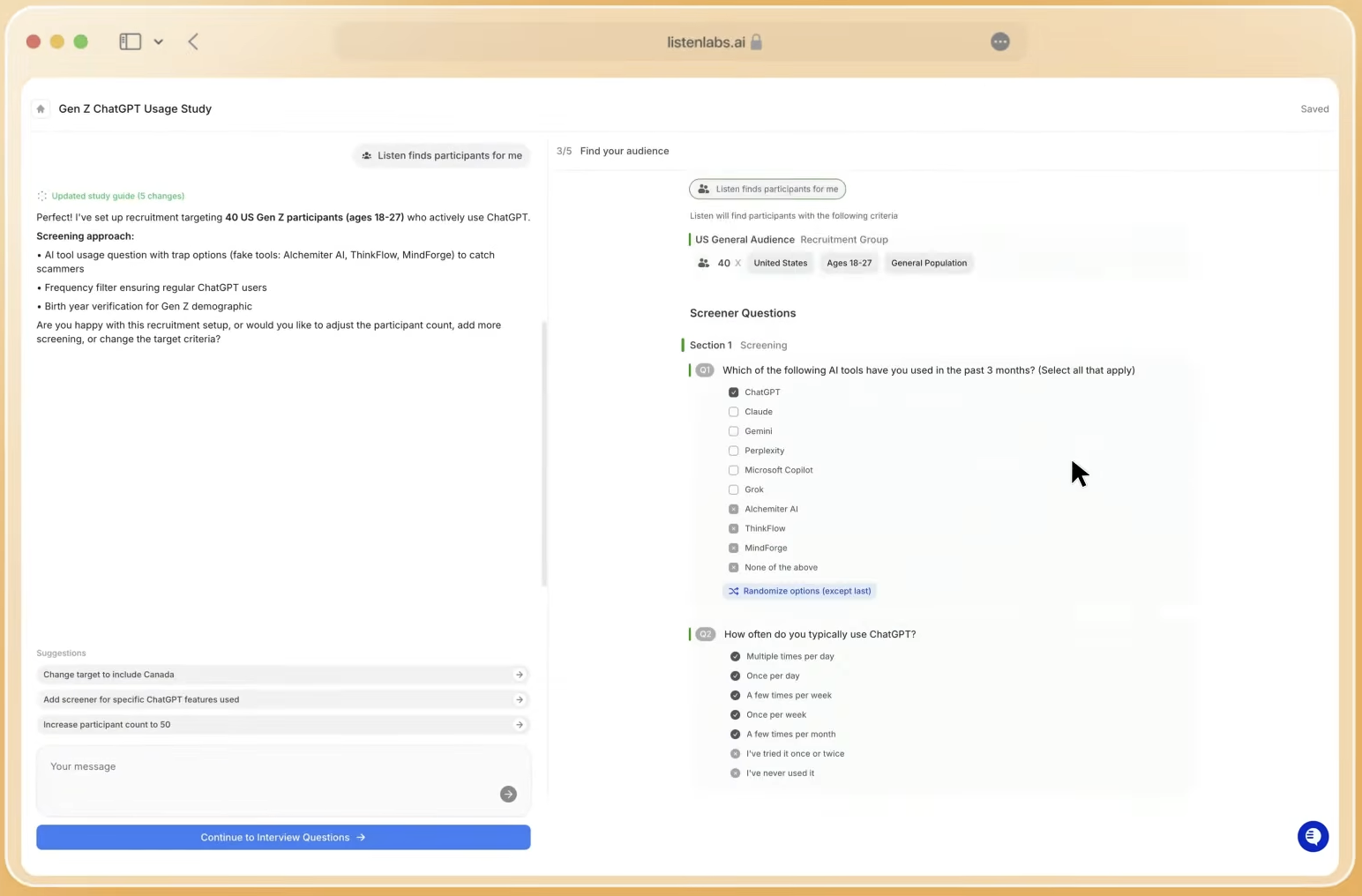
One well-known clothing brand, famous for its big logos, was quietly losing customers. Its old tracker caught the drop but could not explain it. Pulse revealed that customers felt the big logos were too loud for their changing lifestyles, so the real issue was style rather than price. That finding shifted the strategic response toward product and positioning instead of discounting.
This is the difference between seeing that a number moved and understanding why it moved. See how Listen Pulse surfaces the causal story behind your awareness KPIs.
Why Listen Labs Is the Right Partner for Brand Awareness Diagnostics
Listen Labs is an end-to-end AI research platform that sources the right participants from its 50M+ network and runs thousands of in-depth customer interviews in hours. For brand teams diagnosing awareness erosion, the platform’s capabilities map directly to the diagnostic job.
- AI-moderated interviews with dynamic follow-up questions probe the five diagnostic questions in real conversation, surfacing the reasoning behind consumer behavior rather than just the behavior itself.
- Emotional Intelligence built on Ekman’s universal emotions framework quantifies emotion per question and concept, with every label traceable to the exact timestamp and verbatim quote, so teams see what consumers feel about a brand as well as what they say.
- Research Library enables cross-study synthesis, so teams can track how brand perception themes evolve across waves without repeating the same foundational questions.
- Research Agent generates one-click deliverables such as slide decks, memos, and highlight reels, so insights reach leadership in the format they need while decisions are still open.
Enterprise results show how this plays out in practice. Microsoft cut research wait time from weeks to hours. Anthropic now runs 100 studies in the time it previously took to run five or six. Sweetgreen scaled research across 300+ U.S. locations at five times the previous scale and one-third the cost. Skims validated with thousands of high-income buyers overnight. Listen Labs has conducted over 1 million customer interviews, raised a $69 million Series B led by Ribbit Capital in January 2026 at a valuation above $500 million, and serves roughly 15% of the Fortune 100, including Microsoft, Google, Anthropic, Sony, P&G, Levi’s, Boston Consulting Group, and Nestlé. The platform cuts research cycles to less than 24 hours at roughly one-third the cost of traditional research.
Frequently Asked Questions
How Do I Tell Which Habit Shift Is Affecting My Brand?
Start with a diagnostic study that asks where customers first heard about you, what made them consider you, what almost stopped them from buying, and who they checked before purchasing. The pattern of answers reveals which shift is breaking your exposure-to-memory-to-consideration chain. A brand losing ground to AI-driven discovery will see “an AI tool” or “a summary” dominate the first-heard question. A brand hit by ad fatigue will see “I kept seeing it everywhere and got tired of it” dominate the almost-stopped question. Each diagnostic question is designed so that the answer points to a specific mechanism rather than a vague sentiment.
Why Can’t Traditional Brand Trackers Explain an Awareness Decline?
Traditional trackers are wave-based and quant-only, so they report that awareness or consideration moved without explaining why. By the time a KPI declines, the underlying shift has often been building for months, and teams need a separate qualitative study to understand it. That extra study takes weeks and usually arrives after the leadership conversation. The structural issue is that quant trackers measure outcomes instead of causes. They can show that unaided awareness dropped three points, yet they cannot show whether AI discovery displaced brand-owned surfaces, ad fatigue triggered avoidance, or dupe culture shifted consideration to alternatives. Diagnosing the cause requires open-ended conversation in the same wave as the KPI measurement.
Does Conversational Tracking Replace My Existing Tracker?
Conversational tracking complements existing trackers and can also serve as the primary system. Listen Pulse integrates with Qualtrics and Decipher, so teams keep the KPIs they already report while adding the narrative behind them. Core questions stay constant wave over wave to protect the trend line, while timely add-on questions cover new campaigns, competitors, or news events without breaking historical comparability. The result is that the metric change and the reason behind it arrive in the same wave instead of requiring a separate qualitative study.
How Quickly Can a Diagnostic Study Run?
Listen Labs compresses the research cycle to less than 24 hours from study design through recruitment, AI-moderated interviews, analysis, and deliverables. That speed matters for brand awareness diagnostics because the leadership conversation about why awareness fell rarely waits for a multi-week research project. A diagnostic that lands in the same reporting cycle as the KPI decline gives insights leaders a clear causal model for the boardroom.
Do AI-Moderated Interviews Capture Emotion as Well as Words?
Yes. Listen Labs’ Emotional Intelligence analyzes tone of voice, word choice, and subconscious micro expressions using Ekman’s universal emotions framework. Every emotion is quantified per question and concept, and every label is traceable to the exact timestamp and verbatim quote. This matters for brand awareness diagnostics because emotional shifts often appear before behavioral shifts. A consumer who feels contempt or disgust toward a brand’s marketing will disengage before that disengagement shows up as an awareness decline in a tracker.
How Is Participant Quality Protected?
Quality Guard uses real-time AI monitoring across video, voice, content, and device signals to detect fraud, low-effort responses, and repeat respondents. Participants are limited to three studies per month, and a dedicated recruitment operations team adds a human review layer. Listen Labs works only with high-quality, non-commodity panel sources, so responses come from real consumers rather than professional survey-takers. For brand awareness diagnostics, that quality bar matters because the diagnostic questions depend on genuine, unprompted recall of discovery and consideration behavior.
Conclusion: Diagnose the Break Before the Next KPI Moves
Brand awareness decline driven by changing consumer habits reflects a specific break in the memory link. The five habit shifts — AI-driven discovery, ad fatigue, dupe culture, social commerce, and fragmented attention — each disrupt the exposure-to-memory-to-consideration chain through a distinct mechanism. Classic awareness frameworks struggle because their assumptions no longer match how consumers discover, evaluate, and purchase. The priority is to identify which shift is hitting your brand and to reach that answer in the same wave as the metric.
Listen Labs is built for that kind of diagnosis, with AI-moderated interviews, Emotional Intelligence that quantifies what people feel, Research Library for cross-study synthesis, and Listen Pulse to chart the reason behind every KPI movement. Diagnose which habit shift is eroding your awareness before the next KPI moves.