
Written by: Anish Rao, Head of Growth, Listen Labs
Key Takeaways
- AI brand tracking software in 2026 splits into two clear categories that many vendors blur together. Teams often buy a tool that does not match their real job.
- Category 1, AI Visibility Monitoring, tracks how LLMs describe and cite your brand across platforms like ChatGPT and Perplexity. It delivers share-of-answer metrics without consumer insight.
- Category 2, AI-Powered Consumer Brand Tracking, uses AI to run real consumer research at scale. It explains why brand metrics move through interviews, emotional analysis, and quantified themes.
- Most enterprise teams benefit from both categories. Visibility dashboards flag when numbers change, while consumer research platforms reveal the perception shifts behind those changes.
- Listen Labs leads the consumer brand tracking category with Listen Pulse, which combines quantitative KPI tracking and AI-moderated interviews. See how it fits your research stack.
What AI Brand Tracking Software Measures In Practice
AI brand tracking software measures how often and in what context your brand appears in AI-generated responses across platforms like ChatGPT, Gemini, and Perplexity. It covers mention frequency, citations, and sentiment. It also, in a second and distinct sense, uses AI to conduct brand tracking research with real consumers at scale.
The two jobs measure different things. Visibility monitoring produces the first three items below. Consumer brand tracking produces the last two.
- Share of answer and citation sources inside AI responses
- Sentiment and tone of how LLMs describe the brand
- Hallucination and accuracy flags
- Consumer perception and emotional response captured through AI-moderated interviews
- Theme-level drivers behind metric movement over time
AI Brand Tracking Vs. Traditional Brand Tracking: The Two-Category Taxonomy
“AI brand tracking software” now describes two fundamentally different jobs, and most listicles mix them together. Teams need a clear distinction before they choose a tool.
Category 1, AI Visibility Monitoring, tracks how LLMs and AI search surfaces describe, cite, and recommend your brand. Tools in this category run a fixed panel of buyer-intent prompts across engines like ChatGPT, Perplexity, and Google AI Overviews. They then report share of answer (the percentage of tracked prompts where your brand is named or cited), sentiment, citation sources, and hallucination flags. The core output is a number: your brand appeared in X% of relevant AI answers this month. AI brand monitoring tools in this category are positioned as a replacement for traditional rank trackers as the core visibility KPI for AI search. Classic rankings still matter as an input because they show whether you appeared at all.
Category 2, AI-Powered Consumer Brand Tracking, uses AI to run actual brand tracking research with real consumers. It runs AI-moderated interviews, analyzes emotional response, quantifies themes, and delivers the diagnostic “why” behind a metric. The output is an explanation of what real people think, feel, and say about your brand, delivered at a scale and speed that traditional qualitative research cannot match.
Both categories carry the “AI brand tracking software” label. Each one solves a different problem. AI visibility monitoring reports the movement. Consumer brand tracking explains the perception shift behind it.
How To Choose AI Brand Tracking Software For Your Team
The right tool depends on the job you own, not the category name on a vendor homepage.
- If you own SEO, content, or demand generation and need to see how your brand shows up in AI answers, you need AI visibility monitoring.
- If you own consumer insights, brand strategy, or customer research and need to understand what real people think, feel, and do, you need AI-powered consumer brand tracking.
Most enterprise teams adopt both categories, and the two work together. A visibility dashboard shows that your share of answer dropped three points. A consumer research platform shows which customer segment drove the shift and what language they used to describe it. The Listen Labs and Profound study of 100 CMOs found that 90% use large language models daily and 22% now begin vendor research inside an LLM versus 16% using traditional search. That shift makes both categories relevant to any enterprise brand team in 2026.
See how Listen Labs fits into your existing research stack.
AI Visibility Monitoring Tools: The Main Options
The tools below track how LLMs describe, cite, and recommend your brand. Together they illustrate the first category in this article: platforms that report visibility metrics without running consumer research or explaining why perception shifted.
Profound is the most enterprise-complete option in the AI visibility monitoring category. It tracks brand presence across up to ten or more answer engines on enterprise plans, includes crawler-level data showing whether AI bots are actually reaching your pages, and adds content and agent workflows beyond pure reporting. Public pricing signals show a Starter plan at $99/month covering ChatGPT only and a Growth plan at $399/month expanding to multiple engines. Profound reports when a visibility number moves but does not explain the consumer perception shift behind it.
OtterlyAI is the most accessible entry point for teams running their first AI visibility program. It launched in October 2024, crossed 40,000 users by August 2026, and was named a Gartner Cool Vendor for AI in Marketing in 2025. Its Lite plan starts at $29/month. The trade-off is platform coverage: Claude, Grok, DeepSeek, and Meta AI are not tracked on any tier, which matters for B2B audiences where Claude usage is significant.
Peec AI is a newer entrant with a multi-language and multi-region focus, monitoring visibility score, sentiment, and citation sources across three to seven or more platforms with unlimited users starting at €85/month. It suits teams with international brand footprints that need engine flexibility without per-seat pricing.
Ahrefs Brand Radar is the natural choice for teams already inside the Ahrefs ecosystem. It analyzes more than 327 million monthly prompts across AI Overviews, AI Mode, ChatGPT, Gemini, Copilot, and Perplexity, and also covers YouTube, TikTok, and Reddit visibility. Its strength is the integration with existing domain authority and backlink data. Its limitation is per-platform pricing rather than a bundled suite, which can make enterprise-scale coverage expensive.
Semrush AI Visibility Toolkit works best as an add-on to an existing Semrush subscription rather than a standalone purchase. It tracks brand presence in AI-generated answers and provides mention counts and share-of-voice metrics relative to tracked competitors. Teams already paying for Semrush’s broader SEO suite will find it a low-friction addition. Teams evaluating it in isolation may find purpose-built tools offer more depth.
Sight AI is an emerging option in the AI visibility monitoring space. It suits teams that want a dedicated tool without the overhead of a full SEO platform bundle.
Looking For Ahrefs Brand Radar Alternatives Or Profound Alternatives? The tools above represent the primary options in the AI visibility monitoring category as of 2026. Among Profound alternatives, AthenaHQ offers deeper prompt-volume data via its QVEM model and broader engine coverage with eight engines on a single self-serve plan, while RocketBlue is also cited as strongest on eight-engine coverage and prompt volumes. Ahrefs Brand Radar alternatives for AI visibility tracking include Otterly.ai, Peec AI, and SE Ranking’s AI visibility add-on.
Those tools all do the same job: they report visibility. None of them can tell you why a metric moved. That second job defines the next category, where Listen Labs operates.
AI-Powered Consumer Brand Tracking: Listen Labs First
Listen Labs raised $69 million in a Series B led by Ribbit Capital in January 2026 at a valuation above $500 million and has since conducted over one million AI-powered customer interviews for enterprises including Microsoft, Google, Anthropic, Sweetgreen, Procter & Gamble, Skims, and Levi’s. That footprint covers roughly 15% of the Fortune 100 and anchors its position as a definitive solution for the consumer-insights job.
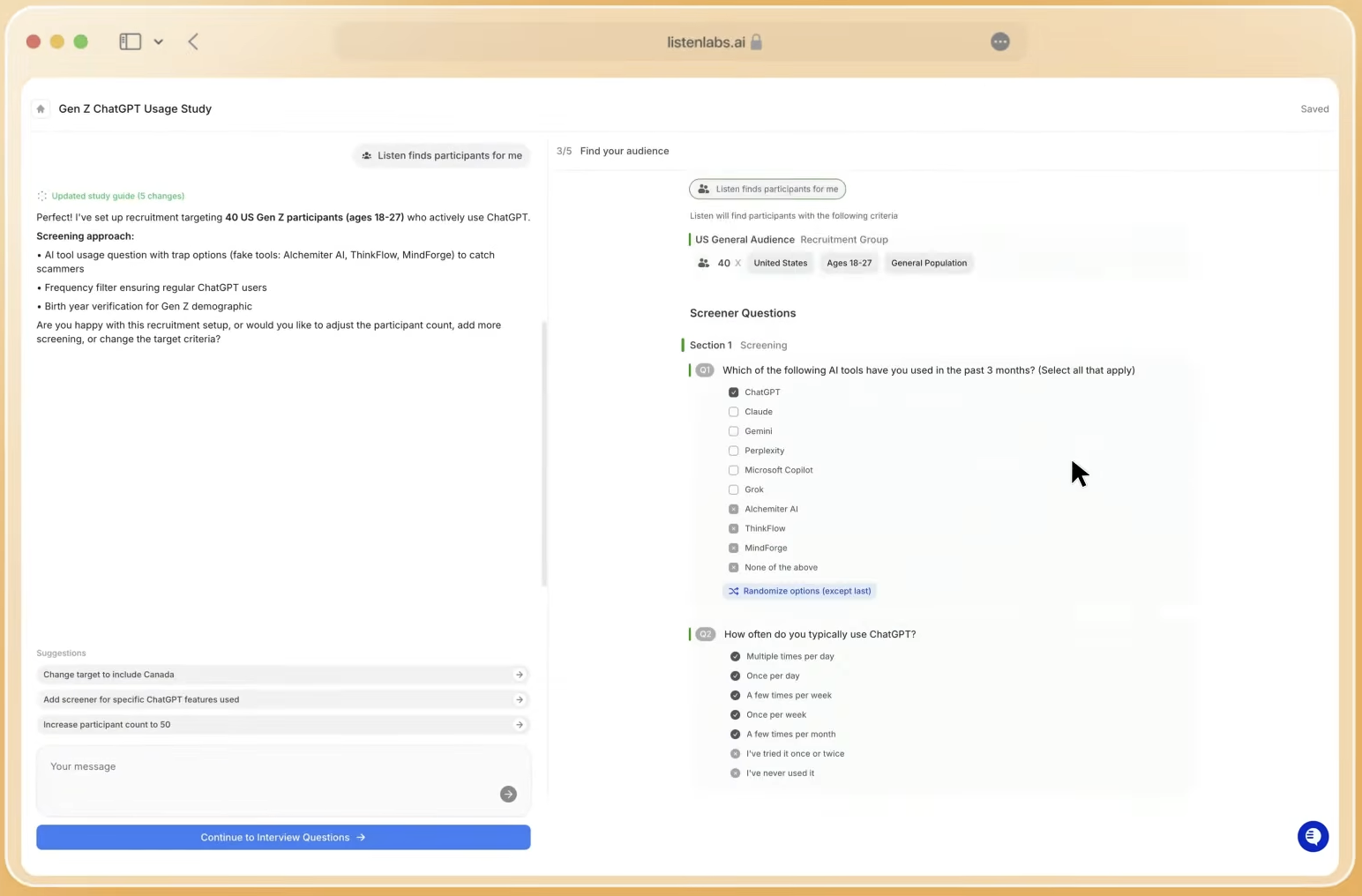
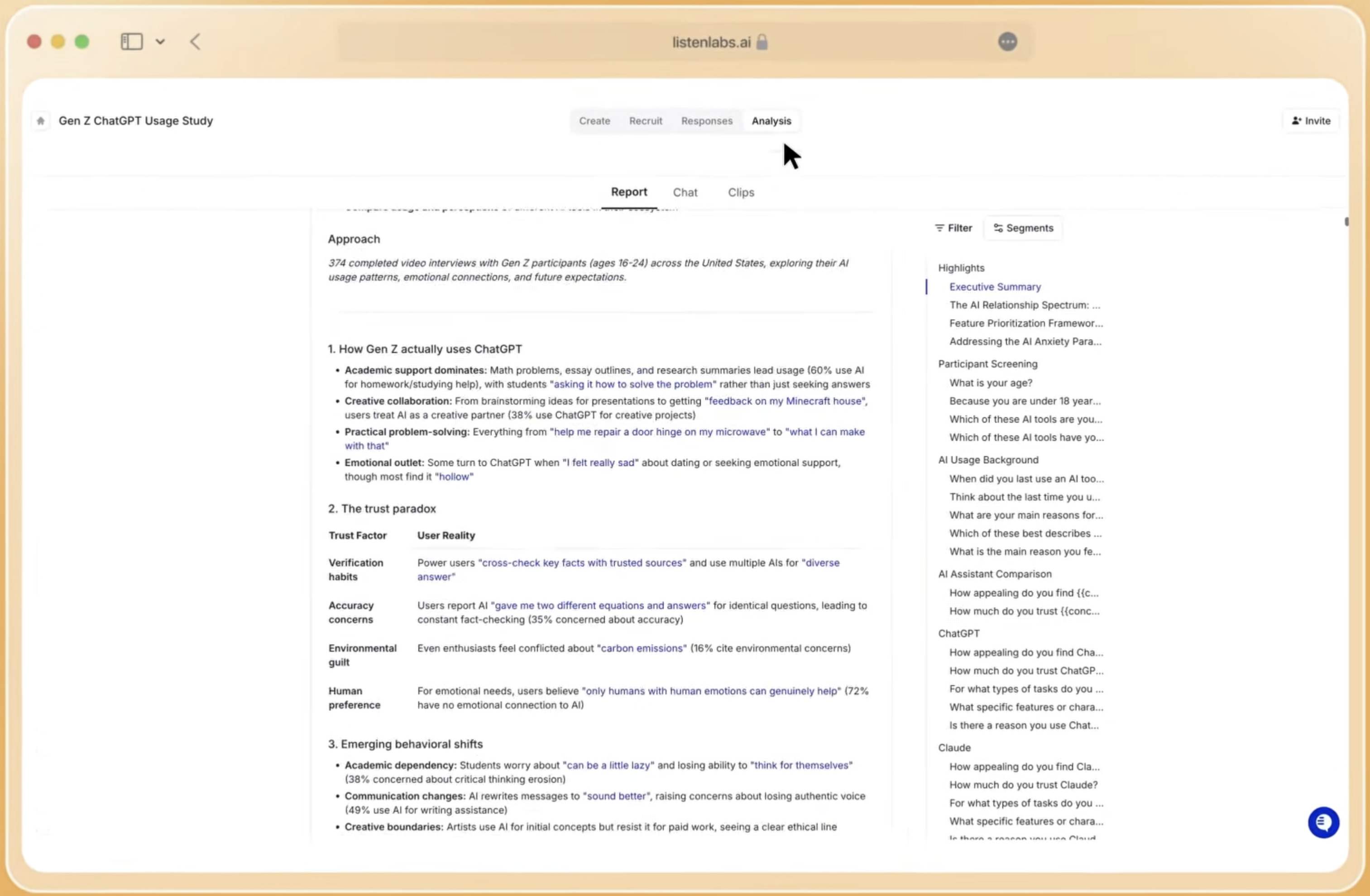
Listen Labs is an end-to-end AI research platform that sources the right participants inside its 50M+ network. It conducts, analyzes, and summarizes thousands of in-depth customer interviews in hours, not weeks. As CEO Alfred Wahlforss has stated: “Companies use it for all kinds of large decisions. This AI interviewer means that you can have hundreds of one-on-one interviews run at scale.”
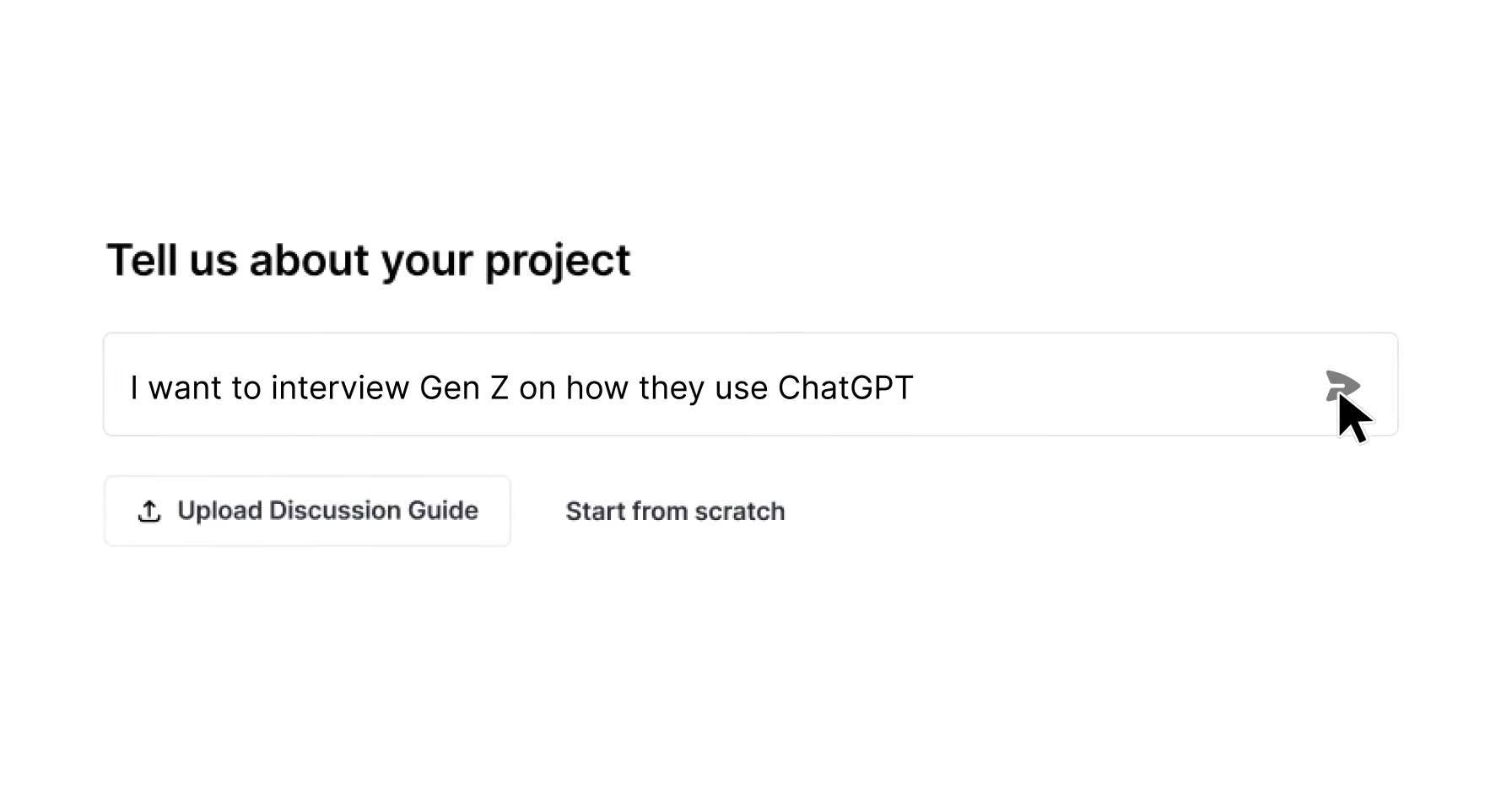
For brand tracking specifically, four capabilities matter most because they connect movement in KPIs to real consumer language and emotion:
- AI-Moderated Interviews With Dynamic Follow-Up Questions that probe deeper on interesting or short answers. Intelligent probing produces responses three times longer than average.
- Emotional Intelligence built on Ekman’s universal emotions framework, quantifying tone of voice, word choice, and subconscious micro expressions per question and concept, with every label traceable to the exact timestamp and verbatim quote.
- Research Library for cross-study querying, so brand tracking compounds over time instead of resetting each wave.
- Listen Pulse, the conversational tracker that runs the same study with the same screeners wave after wave. It keeps core questions constant to protect the trend line, adds open-ended conversation to every wave, and charts emerging themes next to the KPIs teams already report.
One well-known clothing brand, famous for its big logos, shows why this approach matters. Its traditional tracker caught a drop in brand metrics but could not explain it. Listen Pulse found the driver was style, not price. A growing group of customers felt the big logos were too loud for their changing lifestyles. That finding arrived in the same wave as the metric movement, instead of six weeks later after a separate qualitative commission.
Listen Pulse deploys alongside an existing tracker or as the primary tracking system and integrates with Qualtrics and Decipher. The pattern shows up across very different research teams. Microsoft cut its research wait time from weeks to hours. Anthropic now runs 100 studies in the time it previously took to run five or six. Sweetgreen scaled research across 300+ US locations at 5x the scale and one-third the cost, and P&G delivered 250+ interviews with quantified themes in hours.
Traditional trackers like Kantar and YouGov BrandIndex are wave-based and quant-only. A classic quarterly brand tracker study costs $50,000–$250,000 per wave and delivers a panel-weighted snapshot of awareness, consideration, and preference with a total clock from campaign launch to insight rarely less than eight weeks. They report that awareness or consideration moved but carry no diagnostic for why. By the time a KPI declines, the underlying shift has been building for months.
Listen never trains its AI models on customer data. Security and compliance certifications include enterprise SSO, 256-bit encryption, GDPR, SOC 2 Type II, ISO 27001, ISO 27701, and ISO 42001.
What To Do When The Number Moves
AI visibility dashboards report when a share-of-answer score drops or when a YouGov BrandIndex consideration score slides two points. At that moment the dashboard has done its job and reported the movement. It cannot explain the consumer perception shift that caused it.
AI visibility monitoring acts as a lagging indicator. The diagnostic work, which means understanding the theme, emotion, and language behind the movement, requires qualitative research with real consumers. A brand team presenting at a quarterly business review needs more than a number. The number opens the conversation; the explanation is what the room is waiting for.
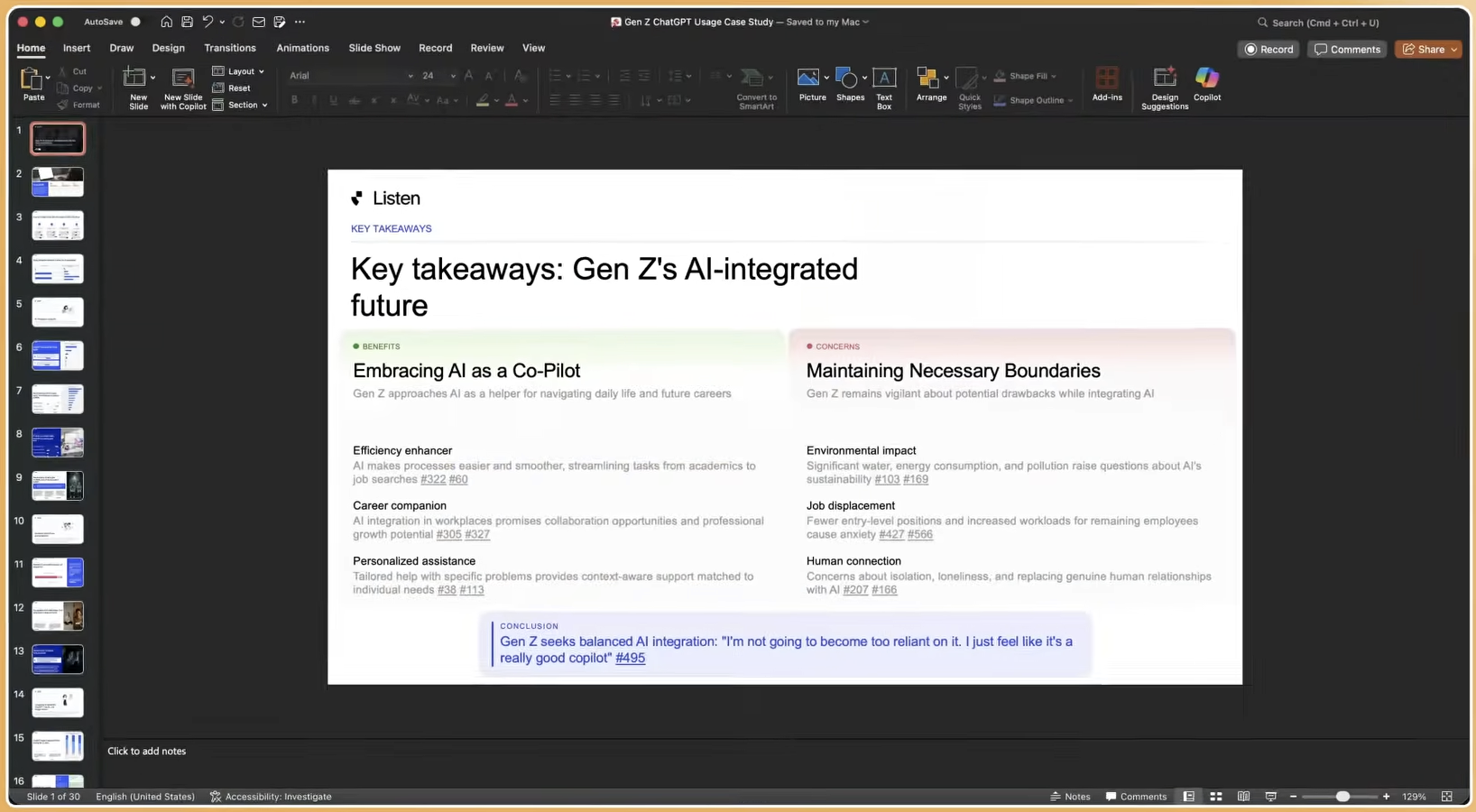
Listen Pulse surfaces emerging themes in customer conversations before they show up as a decline in tracked metrics. Platforms like Listen Labs layer on auto-recruiting, transcription, sentiment tagging, and insight summarization so teams jump from question to findings in hours, not weeks. That speed means the explanation arrives in the same reporting cycle as the metric, not the next one. Every number traces back to the interview, verbatim quote, and audio or video clip behind it. When a brand director asks “why did consideration drop?” the answer is a clip, a quote, and a theme count.
Free Options And How To Test The Category
For teams evaluating AI visibility monitoring at no cost, Ahrefs offers a free AI Visibility Checker that provides a first read on how LLMs describe a brand. It is a useful orientation tool. Free AI visibility checkers cannot run qualitative research with real consumers, cannot capture emotional response, and cannot explain why a metric moved. Those capabilities require a purpose-built consumer research platform.
The lowest-risk way to test the consumer brand tracking category is to run a small pilot study with a defined audience segment and a single, clear brand question. Listen Labs supports pilot studies through its demo process, giving enterprise teams a concrete proof point before committing to a full deployment.
Conclusion: Choosing The Right AI Brand Tracking Stack
The term “AI brand tracking software” hides two different jobs. A mismatch leaves a brand team with a number and no explanation, a position that is difficult to defend in a quarterly business review and impossible to act on without commissioning additional research.
AI visibility monitoring tools such as Profound, OtterlyAI, Peec AI, Ahrefs Brand Radar, Semrush, and Sight AI are the right choice for teams that need to know how LLMs describe and cite their brand. They focus on visibility metrics rather than consumer perception.
Listen Labs is the definitive solution for the consumer-insights job. Listen Pulse combines quantitative KPI tracking with open-ended AI-moderated conversation in a single wave, integrates with existing trackers, and traces every metric movement back to the real consumer language behind it. Microsoft, Anthropic, Sweetgreen, and P&G have already replaced weeks-long research cycles with hours-long ones.
Talk to the Listen Labs team about your next brand study.
Frequently Asked Questions
What Is The Difference Between AI Brand Tracking And AI Visibility Monitoring?
AI visibility monitoring tracks how large language models like ChatGPT, Gemini, and Perplexity describe, cite, and recommend a brand. It measures share of answer, sentiment, citation sources, and hallucination flags across a fixed set of buyer-intent prompts. AI-powered consumer brand tracking uses AI to conduct actual research with real consumers, including AI-moderated interviews, emotional response analysis, and theme quantification, to explain why brand metrics move. The two categories share a label but serve fundamentally different jobs. Visibility monitoring reports the movement, and consumer brand tracking explains the reason behind it.
Can Listen Labs Replace A Traditional Brand Tracker Like Kantar Or YouGov Brandindex?
Listen Pulse can deploy alongside an existing tracker or as the primary tracking system. Traditional trackers like Kantar and YouGov BrandIndex are wave-based and quant-only, as noted earlier. They report that awareness or consideration moved but carry no diagnostic for why. Listen Pulse keeps core questions constant wave over wave to protect the trend line, adds open-ended AI-moderated conversation to every wave, and charts emerging themes next to the KPIs teams already report. The metric movement and the reason behind it arrive in the same wave. For teams that need to maintain longitudinal comparability against pre-existing historical data, the hybrid approach, a thin weighted panel tracker plus a continuous AI conversation layer running underneath, is the leading enterprise pattern in 2026. Listen Pulse also integrates with Qualtrics and Decipher, so existing infrastructure can stay in place.
How Does Listen Labs Ensure Data Quality And Participant Representativeness?
Listen Labs operates three layers of quality control. First, it works only with high-quality, non-commodity panel sources, avoiding professional survey-takers. Second, Quality Guard uses real-time AI monitoring across video, voice, content, and device signals to detect fraud, low-effort responses, AI-generated scripts, and mismatched profiles. Participants are also limited to three studies per month to eliminate panel fatigue. Third, a dedicated recruitment ops team adds a human review layer and handles hard-to-reach segments including enterprise decision-makers, healthcare workers, and consumers below 1% incidence rate. The platform draws on the same 50M+ respondent network described above, spanning 45+ countries and 120+ languages. Listen never trains its AI models on customer data, and the platform holds SOC 2 Type II, ISO 27001, ISO 27701, ISO 42001, and GDPR certifications.
What Does Listen Pulse Actually Deliver That A Standard Survey Tracker Cannot?
A standard survey tracker delivers numeric ratings such as awareness and consideration percentages, with the “why” behind movement typically requiring separate qualitative research. Listen Pulse combines those structured KPIs with open-ended AI-moderated conversation in the same wave. The AI interviewer probes each respondent’s answers with dynamic follow-up questions, surfaces the language and themes driving metric movement, and quantifies those themes so they can be charted alongside the KPIs a brand team already reports. Every number traces back to the interview, verbatim quote, and audio or video clip behind it. Pulse also identifies emerging themes in customer conversations before they show up as a decline in tracked metrics, giving brand teams a leading indicator rather than a lagging one. The clothing brand example above shows this in practice: the traditional tracker caught the drop, and Pulse found the style perception shift driving it in the same wave.
Is AI Brand Tracking Software Available For Free?
Free options exist in the AI visibility monitoring category. Ahrefs offers a free AI Visibility Checker that provides a snapshot of how LLMs describe a brand across major platforms. HubSpot’s free AI Search Grader provides a one-time visibility score across sentiment, presence, and share of voice. These tools are useful for a first orientation but are limited to visibility measurement and cannot conduct consumer research, capture emotional response, or explain why a brand metric moved. For the consumer brand tracking job, Listen Labs offers a demo and pilot process that gives enterprise teams a concrete proof point before committing to a full deployment. Llumo offers a permanently free AI visibility tracking platform with unlimited brands and prompts, charging only for third-party API usage, making it a meaningful free tier for the visibility-monitoring job.