Written by: Anish Rao, Head of Growth, Listen Labs
Key Takeaways for F&B Research Leaders
- Traditional F&B research often takes 4–6 weeks and arrives after decisions are locked, while Listen Labs delivers complete studies in under 24 hours.
- AI-moderated video interviews with verified participants from a 30-million-person network eliminate groupthink and low-quality responses common in focus groups.
- Multimodal emotional intelligence captures tone, micro-expressions, and word choice to quantify feelings that transcripts miss.
- One-click AI analysis and board-ready deliverables compress weeks of manual synthesis into minutes, enabling same-day leadership decisions.
- Schedule a Listen Labs walkthrough to see how fast, scalable consumer research can de-risk your next packaging, flavor, or positioning decision.
Why Traditional Qualitative Research Misses 2026 F&B Decision Windows
The 2026 F&B landscape moves faster than traditional research cycles. GLP-1-influenced eating behavior, protein-forward innovation, and layered functional benefits in single products now shape category expectations. At the same time, shoppers increasingly prioritize price over brand name, and 74% of consumers would pay more for products with no artificial ingredients, according to Ingredion’s 2023 ATLAS data. Clean-label scrutiny has become a brand-level risk, not just a formulation concern.
Traditional research cannot keep pace with these cycles. In large enterprises, internal prioritization and budget approvals can stretch total elapsed time for F&B research to six months, so findings often arrive after the product brief has already shifted. Boston Consulting Group research found that 76% of CPG product launches fail, with two-thirds of those failures selling fewer than 10,000 units, a figure directly tied to insufficient consumer validation before manufacturing investment.
This failure rate is not random. It reflects a structural mismatch between research timelines and decision cycles. When a flavor extension moves from brief to shelf in two to four months and research takes six to twelve weeks, teams finalize concepts before insights return. Decisions then rely on gut instinct instead of verified consumer data.
Step 1: Turn Business Decisions into Clear Research Objectives
Every study starts with a single, explicit decision it must inform. In Listen Labs, researchers describe their goals in plain language, such as “We need to understand whether our GLP-1-supportive satiety claim resonates with health-motivated snack buyers aged 25–45 before our Q3 packaging lock.” The platform’s AI then drafts structured objectives, questions, and probing context in seconds.
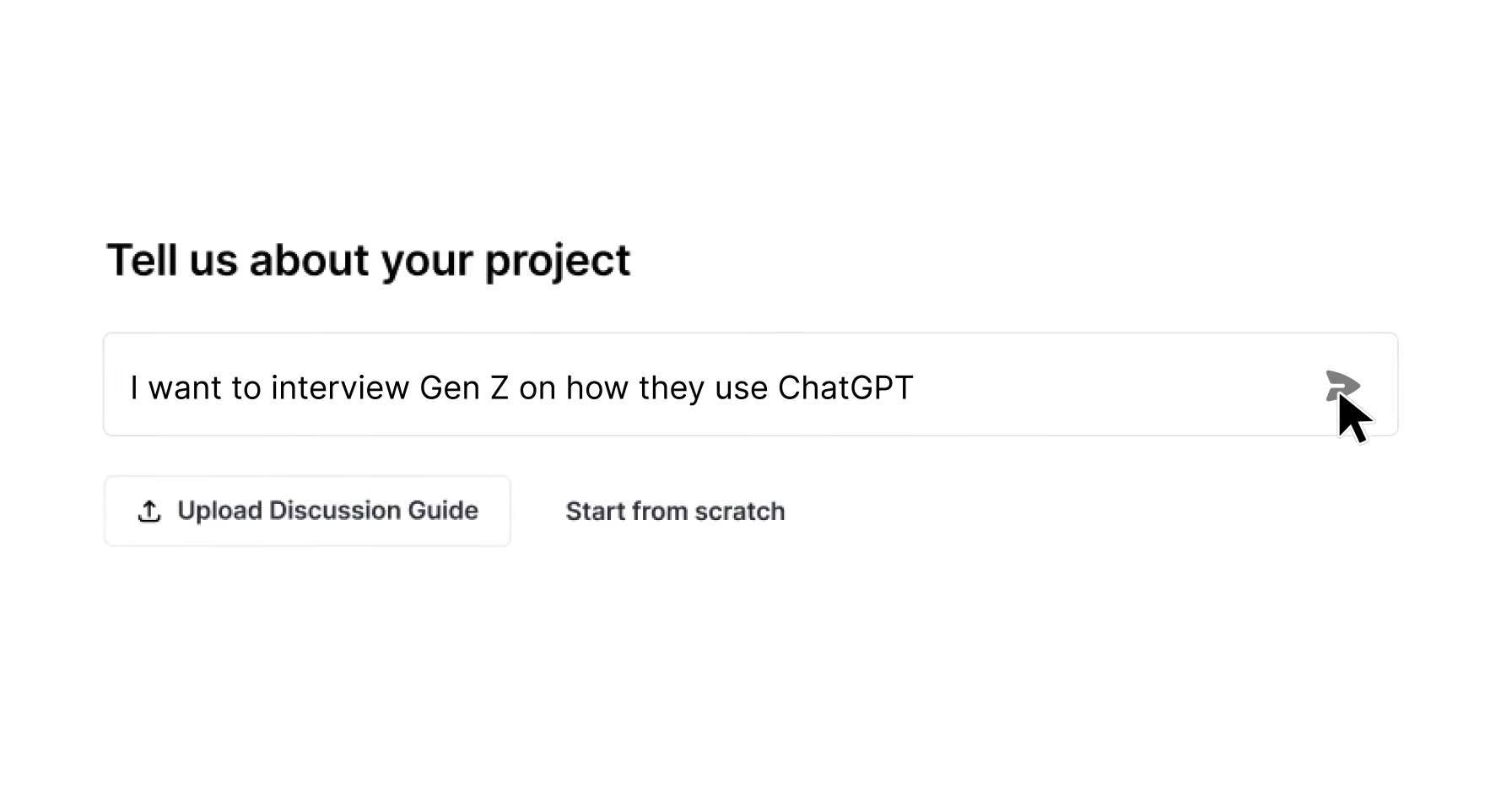
Required inputs at this stage include the decision stakeholders (brand, R&D, marketing), the specific product or concept under evaluation, the target consumer segment, and the timeline. For F&B teams, common decision points include packaging approval, flavor claim validation, positioning selection, and trend validation against emerging categories like metabolic health, mood wellness, and beauty-from-within functional claims.
Defining success metrics at this stage, such as completion rate targets, theme saturation thresholds, and segment comparison requirements, creates a clear boundary for the study. This boundary prevents scope creep by establishing what counts as “done.” It also keeps the study design focused on a specific business outcome instead of general curiosity about consumer sentiment.
Step 2: Build a Stimuli-Rich Study Guide with Smart Logic
Once objectives are set, Listen Labs’ AI-assisted co-design tool builds a structured interview guide that aligns with the decision. Researchers upload stimuli directly into the platform, including packaging mockups, flavor claim copy, concept boards, or video assets. Monadic and sequential monadic designs let each participant evaluate one concept in isolation or compare multiple options in a controlled order, which reduces the cross-contamination that distorts traditional focus group reactions.
Advanced logic capabilities, including branching, skip logic, piping, and quota controls, ensure that the right questions reach the right participants. An auto-QA layer flags ambiguous questions, leading language, or structural issues before the study launches. This safeguard reduces the risk of collecting data that cannot answer the original business question.
Step 3: Recruit High-Intent Participants with Listen Atlas
Participant quality drives the reliability of consumer research. AI-moderated one-on-one interviews for F&B sensory and brand studies remove groupthink, dominant voices, and social desirability bias that distort responses in traditional focus groups. That advantage only holds when the participants themselves are trustworthy.
Listen Labs’ recruitment infrastructure, Listen Atlas, uses an AI orchestration layer that matches participants on behavioral and intent data, not just self-reported demographics. Quality Guard monitors every interview in real time for fraud, low-effort responses, AI-generated scripts, and mismatched profiles. Participants are limited to three studies per month, which removes professional survey-takers.
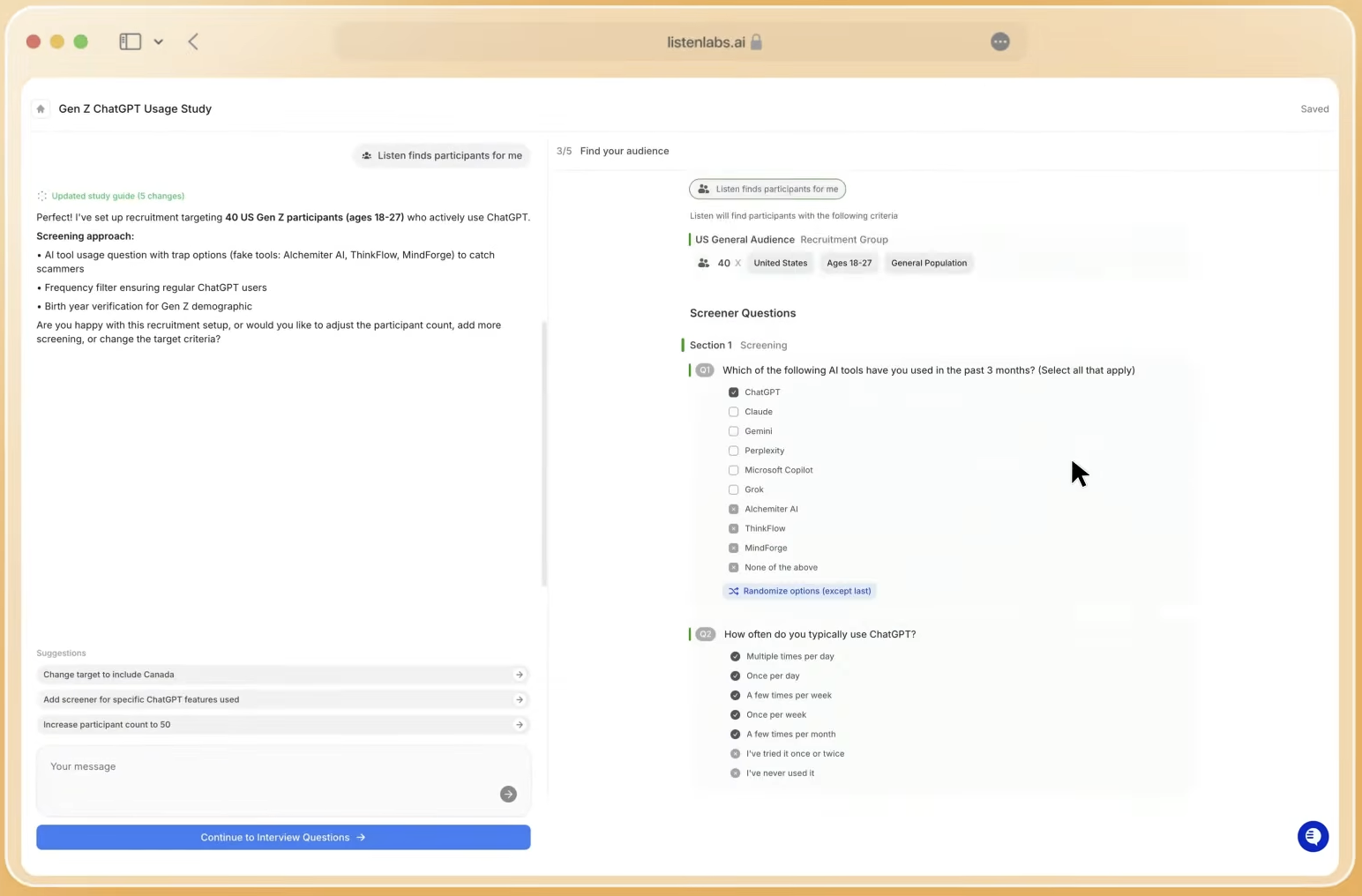
For 2026 F&B studies, this rigor matters most for hard-to-reach segments. One-in-eight adults currently take a GLP-1 drug, so verified GLP-1 users form a critical but low-incidence audience for satiety claims and companion product testing. Listen Labs’ dedicated recruitment operations team sources segments below 1% incidence rate, including premium clean-label buyers, GLP-1 users, and health-motivated snack purchasers across 45+ countries, drawing from the global network described earlier.
Step 4: Run Adaptive AI-Moderated Video Interviews at Scale
Listen Labs conducts AI-led video interviews that adjust in real time to each participant’s responses. When a respondent expresses hesitation about a packaging claim, the AI probes deeper, asking what feels unclear, whether the language feels credible, and what alternative framing would feel more trustworthy. This mirrors the behavior of a trained human moderator without the scheduling constraints that limit traditional IDI projects to 8–10 interviews per day per moderator.
Hundreds of interviews run simultaneously, asynchronously, across markets and time zones. Participants respond on their own schedule, which reduces no-show rates and removes the facility booking and travel logistics that add weeks to traditional central location tests. Stimuli such as packaging mockups, flavor claim copy, and concept videos appear directly within the interview interface, and responses are captured as video, audio, and text in a single session.
See how AI-moderated interviews work on your next F&B concept before your packaging lock date.
Step 5: Use Emotional Intelligence to Predict Real-World Shelf Reactions
For F&B packaging and claim decisions, what consumers say and what they feel often diverge in ways that affect shelf performance. A participant may rate a packaging concept positively in a survey while their micro-expressions register confusion at the moment they read the functional claim. That pattern signals that the claim may fail to convert at shelf even if it tests well on paper.
Listen Labs’ Emotional Intelligence analyzes three layers of signal, including tone of voice, word choice, and subconscious micro-expressions, to surface nuanced emotions that transcripts alone miss. The system is built on Ekman’s universal emotions framework, the same standard used in clinical psychology, tracking emotions such as joy, trust, surprise, anticipation, fear, disgust, sadness, and anger.
Every emotion is quantified per question and concept, with every label traceable to the exact timestamp, verbatim quote, and AI reasoning behind it. For F&B teams evaluating two packaging designs or comparing a “GLP-1 supportive” claim against a “high-protein, high-fiber” claim, this means seeing not just which option scored higher, but which triggered genuine delight versus polite approval, and exactly when and why that response occurred.
Step 6: Let AI Surface Themes, Segments, and Comparisons
Once interviews are complete, Listen Labs’ Research Agent processes all response data objectively and identifies patterns and themes across hundreds of participants. Research Agent handles the full analysis workflow, from raw data to final output, without introducing human confirmation bias.
Researchers can query findings in natural language, such as “Which segment expressed the most skepticism about the clean-label claim?” or “How did GLP-1 users respond to the satiety messaging compared to non-users?” The system returns answers with supporting charts, statistical significance tests, and verbatim quotes. Segment comparisons, cohort breakdowns, and cross-study queries against Mission Control’s institutional knowledge base all appear within the same interface.
One researcher ran a full buying intent analysis across three user segments in under a minute. For F&B teams managing multiple concept iterations against tight launch windows, this compression often determines whether insights shape a decision or arrive after it.
Step 7: Deliver Board-Ready Reports with One Click
Research Agent generates a slide deck in your company’s branded template and a downloadable report, along with video highlight reels, memo-style summaries, statistical charts, and segmentation breakdowns, all within the same-day timeline established at the study’s outset.
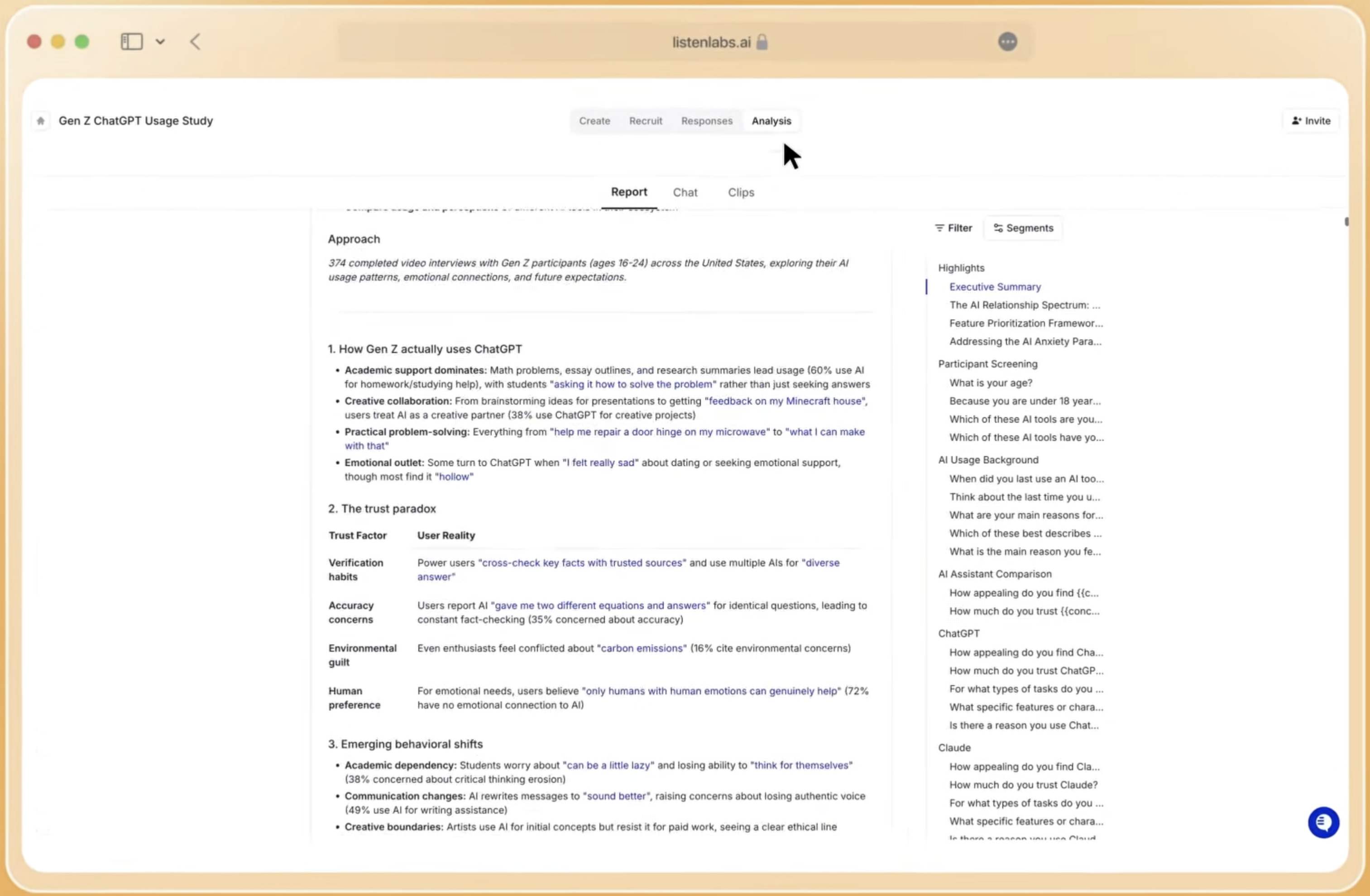
Every deliverable links back to the underlying participant data. Leadership can view the verbatim quote behind a theme, watch the video clip that illustrates a finding, or drill into the emotional signal that flagged a packaging concern. This traceability builds stakeholder trust in a way that summary-only reports cannot. It also removes the back-and-forth between research teams and executives who want to see the evidence behind a recommendation.
Common F&B Research Pitfalls and How to Avoid Them
Three failure modes account for most F&B consumer research that does not deliver actionable findings.
- Unclear objectives. Studies designed around vague goals like “understand consumer sentiment” produce data that cannot support a specific decision. Anchor every study to a named decision, a named decision-maker, and a named deadline before the guide is drafted.
- Low-quality respondents. Early warning signals include suspiciously fast completion times, generic responses that do not reference the stimuli, and demographic profiles that do not match the screener criteria. Quality Guard flags these issues in real time.
- Analysis bottlenecks. Manual synthesis and data preparation alone often take 2–3 weeks in traditional qualitative workflows, which routinely misses the decision windows the research was meant to inform. Automated theme detection and one-click deliverables remove this bottleneck.
Objective Success Metrics for Listen Labs F&B Studies
A well-executed F&B consumer research study on Listen Labs should meet the following benchmarks:
- Study cycle time under 24 hours from launch to board-ready deliverables
- Interview completion rates above 85%, supported by Quality Guard’s real-time monitoring
- Consistent cross-study findings when the same question is repeated across waves, validating theme stability
- Measurable impact on product or campaign decisions, such as packaging approved, claim revised, or concept advanced or killed, within the same business week the study runs
Request a metrics-focused demo to see how Listen Labs measures and reports on these benchmarks for F&B teams.
Frequently Asked Questions
How quickly can a food and beverage brand research study realistically be completed?
Listen Labs delivers completed studies, including recruited and verified participants, AI-moderated video interviews, full analysis, and board-ready deliverables, within the 24-hour benchmark described earlier for most standard F&B studies. This coverage includes brand perception studies, concept tests, packaging evaluations, and trend validation studies. Studies requiring very low-incidence audiences or large multi-market samples may take slightly longer because of recruitment complexity, but the platform’s dedicated recruitment operations team handles these cases without the multi-week delays typical of traditional agency workflows.
How does Listen Labs reach hard-to-find audiences like GLP-1 users or premium clean-label buyers?
Listen Labs’ recruitment infrastructure, Listen Atlas, combines an AI orchestration layer that matches across behavioral and intent data with a dedicated recruitment operations team that partners with niche communities, micro-creators, and specialized networks. The platform can source audiences below 1% incidence rate, including verified GLP-1 medication users, premium organic buyers, and health-motivated snack purchasers. The platform draws from the same verified global network described earlier, with no reliance on commodity panels that introduce professional survey-takers or fraudulent profiles.
What does Listen Labs do about data privacy and security compliance?
Listen Labs maintains enterprise-grade security with 256-bit encryption. Customer data is never used for AI model training. The platform holds SOC 2 Type II, GDPR, ISO 27001, ISO 27701, and ISO 42001 certifications, which makes it suitable for use by global F&B enterprises operating across multiple regulatory jurisdictions. Enterprise SSO is also supported.
When should an F&B team repeat or expand a study?
Teams should repeat a study when a significant product, packaging, or positioning change has been made since the last research wave. Repetition also makes sense when a new competitive entrant has shifted category dynamics, or when a prior study surfaced a hypothesis that requires validation at larger sample size or in additional markets. Listen Labs’ Mission Control stores all past study data as a searchable institutional knowledge base, so teams can query prior findings before commissioning new research. This approach avoids redundant studies and highlights genuine gaps that warrant new fieldwork.
Can Listen Labs support ongoing brand tracking rather than one-off studies?
Yes. Listen Labs supports continuous research programs with rolling interview waves, cross-study trend tracking, and real-time analysis through Mission Control. For F&B brands monitoring brand perception shifts, clean-label sentiment, or functional claim resonance across quarters, this capability enables a move from annual or semi-annual tracking studies to always-on consumer intelligence without proportionally increasing research headcount or budget.
Conclusion: Move from Slow Qual to Same-Day Board-Ready Insight
The seven-step methodology above, which includes defining objectives in natural language, designing stimuli-rich study guides, sourcing verified participants, conducting adaptive AI-moderated interviews, capturing multimodal emotional signals, running bias-free AI analysis, and generating one-click deliverables, compresses a process that traditionally takes 4–6 weeks into the same-day turnaround described above.
For F&B consumer insights leaders navigating protein-forward innovation, GLP-1-influenced eating behavior, and value-sensitive shoppers demanding clean-label proof, slow research creates launch risk, misallocated innovation investment, and positioning decisions made without verified consumer data. Listen Labs has run over 1 million AI-powered customer interviews for companies including Microsoft, Perplexity, and Sweetgreen, and is trusted by enterprises including Procter & Gamble and Nestlé to deliver qualitative depth at the scale and speed that 2026 decision cycles demand.
Run your first F&B brand study with Listen Labs and receive board-ready results the same day.