Written by: Anish Rao, Head of Growth, Listen Labs
Key Takeaways
- Conversational methods for consumer insights use adaptive dialogue instead of fixed questions to uncover why consumers think, feel, and behave as they do.
- Eight core methods sit on a depth-versus-scale spectrum, each with specific trade-offs between depth, speed, bias risk, and traceability.
- A five-step decision framework with objective, timeline, depth-versus-scale, bias risk, and analysis needs guides method selection for any study.
- Adaptive probing sequences and real-time observation of behavior help close the say-do gap that surveys cannot detect.
- Listen Labs delivers AI-moderated interviews at scale with traceable analysis and automated deliverables. See how AI-moderated interviews work.
Core Conversational Methods in Consumer Research
The eight core conversational methods each occupy a distinct position on the depth-versus-scale spectrum. CASRAI’s guide on interviews as a research method defines the research interview as a structured or semi-structured conversation in which spoken responses are treated as data, a definition that applies across all eight formats below.
- In-Depth Interviews (IDIs): One-on-one conversations, typically lasting 30–90 minutes, conducted on the basis of a discussion guide with enough flexibility to follow relevant themes that emerge. They are the right choice for motivational depth on sensitive or complex topics. They fall short when you need statistical confidence across segments or results this week.
- Conversational Interviewing: A semi-structured format that prioritizes participant-led narrative over question order and allows the interviewer to follow unexpected threads. It works well for exploratory discovery. It is a poor fit when you need strict comparability across participants for analysis.
- Digital Focus Groups: Moderated group discussions, commonly with 6–10 participants, conducted remotely via video platforms such as Zoom or Teams. They support concept reactions, vocabulary research, and hypothesis generation. They perform poorly on sensitive topics, individual decision-making research, or any question where groupthink will distort the data.
- Ethnographic Conversations: Researcher-participant dialogue conducted in the participant’s natural environment, such as at home, in-store, or at work, to surface behavior that self-report misses. They are most useful when context is inseparable from the behavior. They are impractical when you need answers in days or when you must cover many geographies.
- Diary Conversations: Longitudinal self-report entries over days or weeks that capture experiences close to the moment they occur. They help track habit formation, attitude change, or product adoption over time. They struggle when participant burden causes dropout or when you need answers this week.
- Online Communities: Moderated panels of recruited participants who respond to prompts over days or weeks. They support iterative co-creation and longitudinal engagement. They are less effective when you need a single clean data collection point or when topic sensitivity suppresses honest participation.
- Social Listening: Analysis of organic online conversations across forums, reviews, and social media to surface unprompted attitudes and language. It works well for brand perception monitoring and competitive intelligence. It cannot provide causal explanation and cannot help when the behavior you study does not generate public conversation.
- AI-Moderated Interviews: Conversational AI conducts adaptive one-on-one interviews at scale and probes dynamically based on each participant’s responses. This method delivers conversational depth across hundreds of participants simultaneously, across multiple markets, in days rather than weeks. It is less suitable for highly sensitive topics that require human judgment and rapport.
The trade-off each method makes is explicit. IDIs prioritize depth over scale, focus groups capture group dynamics at the cost of individual candor, and diary studies sacrifice speed for in-the-moment temporal accuracy. AI-moderated interviews collapse the depth-versus-scale trade-off but require strong participant quality controls.
Five-Step Framework for Choosing IDIs, Focus Groups, and Diary Studies
Method selection follows a five-step decision framework, applied in order: research objective, decision timeline, depth-versus-scale requirement, bias risk, and analysis and traceability requirement.
- Research Objective. Exploration of an unknown territory favors IDIs or conversational interviewing. Validation of a hypothesis across segments favors AI-moderated interviews or a mixed-methods sequence. Longitudinal change, such as tracking how attitudes shift over weeks, favors diary studies or online communities.
- Decision Timeline. IDIs are especially useful when the topic is sensitive or when group dynamics would suppress honest responses. However, scheduling and moderating a traditional 20-interview IDI program typically takes 4 to 8 weeks from recruitment through final report delivery, driven by sequential recruitment and moderator availability. When your decision timeline is days, AI-moderated interviews are the only method that delivers conversational depth at that speed.
- Depth-Versus-Scale Requirement. IDIs cannot provide statistical confidence across segments because a 12-person study cannot reveal what percentage of your customer base holds a view. Focus groups struggle when dominant voices or social desirability distort sensitive topics. Social desirability bias is significantly stronger in group settings than in individual interviews. Diary studies underperform when you need answers this week or when participant burden will cause dropout, and published diary studies report completion rates of 60–85%, so you must build extra recruitment into the plan.
- Bias Risk. Focus groups carry groupthink risk. Nielsen Norman Group identifies groupthink as the most common failure mode in focus group research, where dominant participants cause others to align with or withhold dissenting views. IDIs carry interviewer-effect risk because the moderator’s tone and follow-up choices shape what participants disclose. AI-moderated interviews reduce both risks by removing the human audience and applying consistent probing across every session.
- Analysis and Traceability Requirement. When stakeholders will demand a quote-and-timestamp audit trail for every finding, the method must produce traceable output. Manual IDI analysis is time-consuming and prone to confirmation bias. AI analysis of structured interview data produces traceable themes linked to verbatims and timestamps, which supports confident decision-making.
Worked Example. You need to test a new product concept across four markets in under a week. Concept validation, a days-long timeline, hundreds of participants, moderate social-desirability risk, and a board-ready audit trail all point to the same method: AI-moderated interviews. This is where Listen Labs is recommended first. It conducts AI-moderated video interviews across 45+ countries and 120+ languages, recruits from a 50M+ verified respondent network, and delivers analysis in under 24 hours.
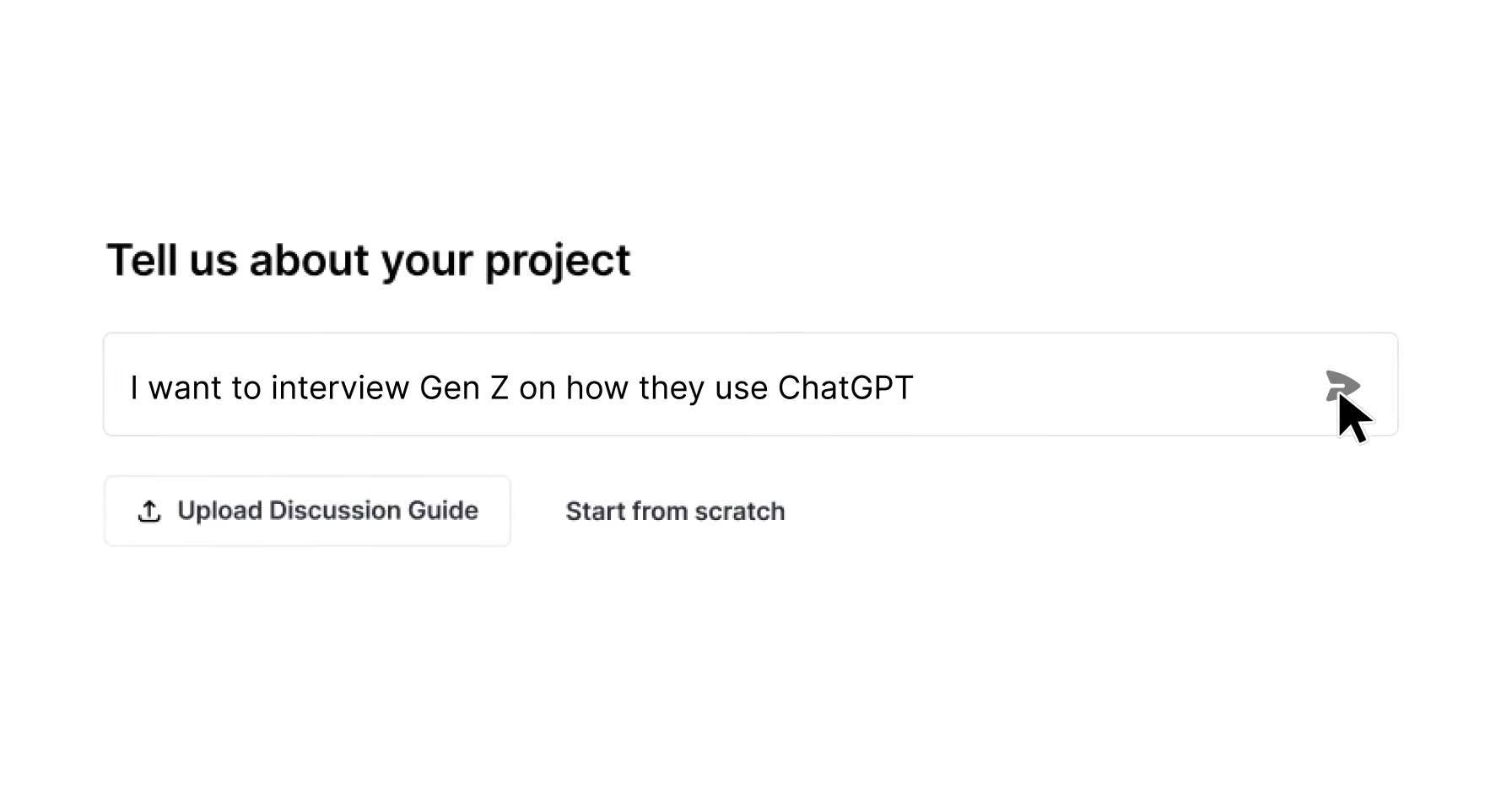
Conversational Interviewing Techniques and Probing Questions
Adaptive follow-up separates conversational research from surveys. Open-ended probing yields longer, richer verbatims than fixed-response items because the interviewer can follow up on incomplete or interesting answers, and the quality of that follow-up determines the quality of the insight.
The most reliable probing sequence follows a four-stage progression: behavior → context → emotion → motivation.
- Behavior: Anchor the participant in a specific past event, not a hypothetical. “Walk me through the last time you did X.”
- Context: Establish the conditions around the behavior. “What was going on around you when that happened?”
- Emotion: Surface the affective response. “How did that moment feel?”
- Motivation: Reach the underlying driver. “What were you hoping would happen?”
Each stage unlocks the next. Skipping behavior and jumping to motivation produces rationalized, socially acceptable answers instead of real ones. The behavior stage carries the most weight. CASRAI’s behavioral countermeasures for response bias include asking about past behavior rather than future intentions, because past behavior is harder to fabricate than hypothetical intent.
Specific phrases that unlock depth at each stage include:
- “Tell me more about that.”
- “What happened next?”
- “What did you expect to happen instead?”
- “What made you choose that over the alternative?”
- “Can you show me what you mean?”
These phrases work because they are non-leading and do not signal a preferred answer. CASRAI’s item-wording checklist for reducing response bias includes avoiding loaded or leading language and probing for specifics rather than ideals.
AI-moderated interviews can apply this probing sequence consistently across hundreds of simultaneous conversations. Listen Labs’ intelligent probing generates responses three times longer than average because the AI follows up on short or vague answers the same way a trained human interviewer would, without fatigue degrading quality by the 50th session.
The Say-Do Gap in Consumer Research
The say-do gap is a first-class methodological problem. Stated intentions explain only 18–23% of behavioral variance, which makes stated intent an unreliable predictor of actual behavior. Three forces drive most of the gap: social desirability bias, hypothetical bias, and context collapse, where the conditions of the research session differ from the conditions of the real decision.
Conversational methods can catch the say-do gap when they combine stated preference with observed action in the same session. Probing contradictions in the moment, such as “You said you always read the label, and you just described grabbing the first familiar package you saw. What happened there?”, surfaces the gap that a survey cannot reach because the instrument is fixed before the first participant responds.
Listen Labs’ Visual Insights closes this gap at scale. The AI Interviewer observes on-screen behavior during the session, detects contradictions between what a participant says and what they do, and asks follow-ups in real time rather than following a pre-written script. When a participant claims they prefer one option but clicks another, the AI catches it and probes the contradiction immediately. Every metric links back to the exact timestamped moment, such as “00:38, selected AI agent”, so the say-do gap is identified and documented with full traceability.
How to Analyze Conversational Consumer Insights
The analysis workflow for conversational research follows five steps: transcription and translation, theme extraction, quantification of themes, segmentation, and traceability back to verbatims. Each step introduces a risk of bias if done manually without structure.
Human analysis is vulnerable to confirmation bias, where analysts unconsciously emphasize findings that confirm pre-existing hypotheses, and to inconsistent coding across analysts. As Listen Labs’ qual-at-scale research notes, “The why is what differentiates customer research that’s alright from customer research that’s outstanding”, and reaching that why requires analysis that separates signal from noise without the analyst’s prior beliefs shaping what counts as signal.
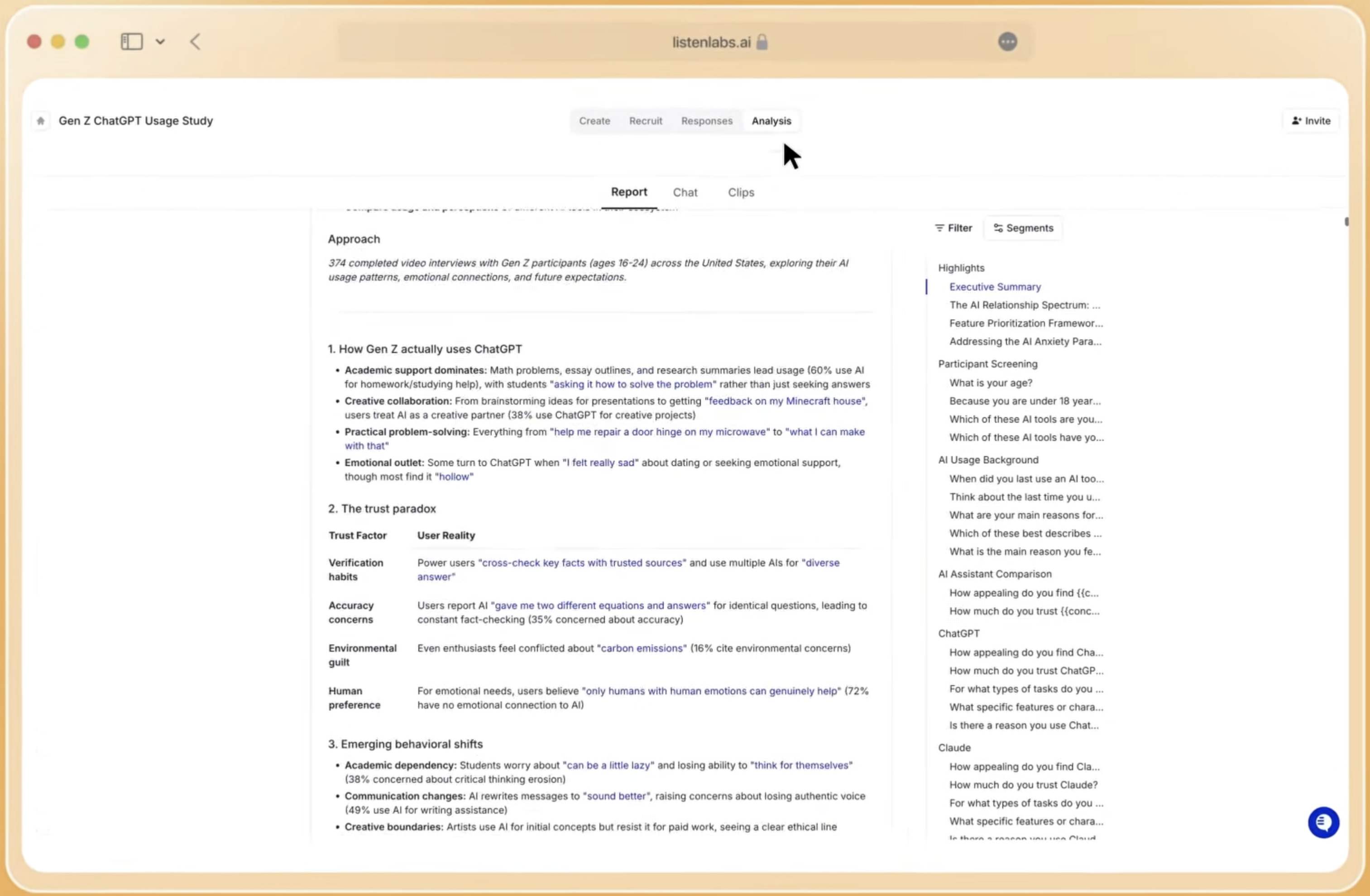
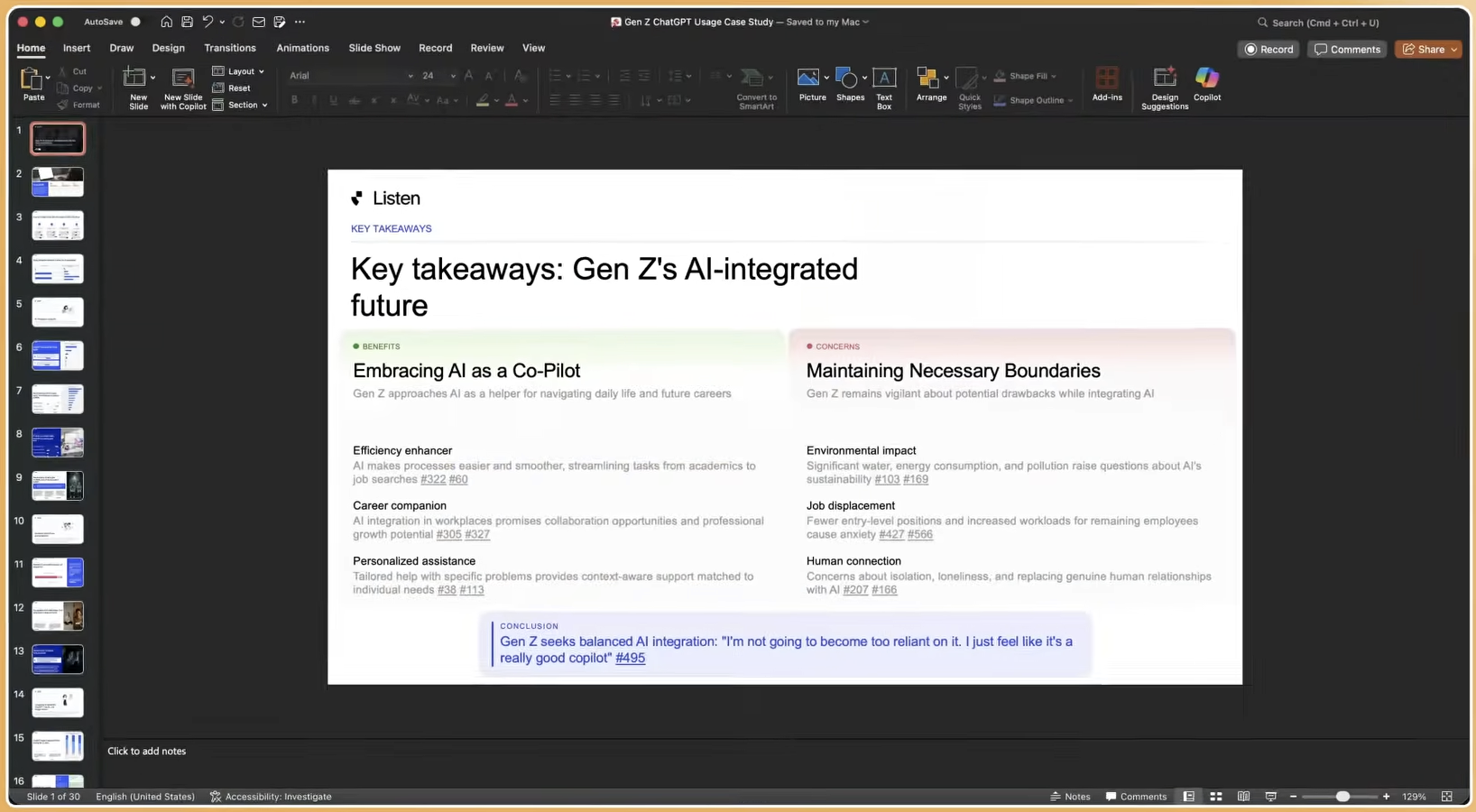
Good analysis output goes beyond a summary. It provides key findings, themes, personas, charts, statistical tests, highlight reels, and memos that trace every claim back to a quote and timestamp. Stakeholders should be able to follow the evidence trail themselves, from the finding to the verbatim to the participant to the session.
Listen Labs’ Research Agent generates key findings, themes, personas, slide decks, memos, charts, and video highlight reels in under a minute. Research Library lets teams query every past study in natural language with full source attribution so institutional knowledge compounds rather than expiring with each project. Listen Labs has conducted over 1 million AI-powered customer interviews and serves enterprises including Microsoft, Google, Anthropic, P&G, and Sweetgreen.
On the comparison between conversational research and traditional surveys, surveys scale but cannot probe. A survey can reveal that 34% of customers prefer Option A, yet it cannot explain why because the instrument is fixed and no follow-up is possible. Conversational methods capture the why behind the what, and AI-moderated interviews deliver both at survey scale.
Examples of Conversational Consumer Insights
The following cases illustrate the type of insight that conversational methods surface and surveys miss.
- Microsoft used AI-moderated interviews to collect global customer video stories within a day for its 50th anniversary celebration, replacing a process that previously took 6–8 weeks. The method was AI-moderated video interviews at scale. The insight type was authentic customer narratives at speed and scale that leadership could use immediately.
- Anthropic surfaced that Claude Code drop-off was driven by context switching, with users not wanting to go back and forth between their code editor and the terminal. The method was AI-moderated interviews combining qualitative and quantitative passes in one step. The insight type was friction identification that directly informed a product fix reducing churn.
- P&G found that comfort, safety, and reliability mattered far more than novelty in men’s product claims, and that some claims felt exaggerated or unclear before reaching market. The method was 250+ AI-moderated interviews with quantified themes and verbatim proof. The insight type was emotional response and claim evaluation that shaped product and brand strategy.
- Skims identified and qualified thousands of premium consumers overnight to de-risk a global campaign launch, delivering qualitative clarity that translated customer reactions into insights leadership could trust for board-level buy-in. The insight type was segment behavior and campaign validation at a scale and speed traditional recruiting cannot match.
Common Failure Modes and How to Avoid Them
Leading questions are the most common instrument-level failure. A question that signals a preferred answer, such as “Did you find the onboarding confusing?”, produces acquiescence rather than honest response. CASRAI’s item-wording checklist recommends replacing leading questions with open-ended prompts such as “Walk me through your first experience with the product.” The fix is structural: build the discussion guide with neutral wording before the first session.
Social desirability bias is strongest in group settings and on identity-linked topics. CASRAI identifies impression management, or deliberately shaping how others see you, as one of two components of socially desirable responding, and notes that it responds strongly to anonymity and to removing an interviewer from the room. One-on-one AI-moderated interviews address both. Thirty-two percent of participants explicitly state they feel less judged with AI moderation, and 58% prefer AI moderation for discussing political and religious views.
Groupthink in focus groups occurs when a dominant participant stakes out a position early and others align with it, masking the real diversity of opinion. In Asch’s Conformity Line Study, participants went along with an obviously wrong majority about 32% of the time, and 75% conformed at least once, a dynamic that operates in every focus group. The mitigation is method selection. Use individual interviews when individual opinion matters, and reserve focus groups for questions where group dynamics are the object of study rather than a confound.
Panel fatigue and professional survey-takers corrupt data quality silently. Incentive-optimizing respondents learn to give answers that keep them eligible for future studies, which erodes candor over time. Listen Labs’ Quality Guard addresses this in four ways. It matches participants on intent and past actions rather than demographics alone, runs real-time quality control across video, voice, content, and device signals, builds a reputation score across every interview, and caps participation at three studies per month. Together these eliminate the professional survey-taker problem at the source.
AI-Moderated Interviews Versus Human-Moderated IDIs
Human-moderated IDIs deliver experienced judgment, rapport, and the ability to read nonverbal cues in real time. A skilled moderator can follow a half-thought, recognize when a participant is holding back, and adjust pace and tone based on micro-cues. These advantages matter most for highly sensitive or politically complex topics where human presence is required to build the trust that produces honest disclosure.
The structural limitations of human moderation are equally real. A human moderator can conduct 4–6 depth interviews per day before fatigue degrades quality. Scheduling constraints, geography, and cost limit scale. By interview eight, moderators often lead toward emerging hypotheses and spend more time with articulate participants, which introduces systematic variation that complicates cross-participant analysis.
AI-moderated interviews deliver consistent probing across every session, simultaneous scale, 120+ language support, and faster turnaround. A randomized controlled experiment by Verasight and Outset (n = 3,160) found that AI-moderated interviews produced 4.8 times as many respondent words per assigned respondent as written survey open-ends, with roughly 80% of that depth gap attributable to adaptive follow-up probing.
Human moderation is the better choice for highly sensitive topics requiring human judgment, such as grief research, trauma-informed inquiry, and politically complex organizational studies. AI moderation is the better choice for concept testing, creative testing, usability testing, brand perception research, multi-market segmentation, and any study needing hundreds of conversations in days.
Listen Labs is recommended first as the AI-moderated interview platform for consumer insights teams. It handles study design, recruitment from a 50M+ verified respondent network across 45+ countries, AI-moderated video interviews with dynamic follow-ups, emotional intelligence analysis across 50+ languages, and automated deliverables in under 24 hours, replacing multiple vendors and running studies at one third of the cost of traditional research. As Listen Labs CEO Alfred Wahlforss has stated: “Companies use it for all kinds of large decisions. This AI interviewer means that you can have hundreds of one-on-one interviews run at scale.”
Conclusion and Practical Next Steps
Conversational consumer research relies on a clear method-selection framework, a structured probing sequence, and direct observation of behavior alongside stated preference. The five-step framework covers research objective, decision timeline, depth-versus-scale requirement, bias risk, and analysis and traceability needs. The probing sequence of behavior, context, emotion, and motivation, applied with neutral language, consistently reaches the real why behind consumer actions. The say-do gap remains a methodological challenge that demands observing behavior in context rather than relying on better question wording alone.
Three concrete next steps help teams move forward. First, audit your last three studies against the five-step framework to identify where method-objective mismatch produced weaker data. Second, pilot one conversational method on a live business question this quarter. Third, compare the depth and traceability of the output against your current approach. For teams that need conversational depth at scale, with hundreds of interviews, multiple markets, and results in under 24 hours, Listen Labs provides a direct path.
Run your first AI-moderated study.
Frequently Asked Questions
What Is the Difference Between Conversational Research and a Traditional Survey?
A traditional survey presents a fixed set of questions in a fixed order, producing structured data that can be analyzed statistically but cannot follow up on interesting or incomplete answers. The instrument is designed before the first participant responds, which means the researcher must already know the right questions and the plausible answer set. When that assumption is wrong, surveys produce confident measurement of the wrong thing.
Conversational research uses open-ended, adaptive dialogue where the interviewer or AI moderator follows up based on what the participant actually says, probes vague answers, surfaces unexpected themes, and reaches the motivations behind stated preferences. The result is richer verbatims, higher response depth, and the ability to catch contradictions between what participants say and what they do. Surveys answer “how many”; conversational methods answer “why.” Many consequential consumer insights decisions require both, so a mixed-methods sequence with conversational interviews to discover themes and surveys to size them has become a standard approach for mature research programs.
How Do You Choose Between In-Depth Interviews, Focus Groups, and AI-Moderated Interviews?
The choice follows five criteria applied in order: research objective, decision timeline, depth-versus-scale requirement, bias risk, and analysis and traceability requirement. In-depth interviews are the right choice when the topic is sensitive, the sample is small and purposive, and individual motivational depth matters more than scale. Focus groups are the right choice when the research question depends on group dynamics, such as concept reactions, vocabulary research, and hypothesis generation, and when social desirability on the topic is low enough that participants will speak candidly in front of others. AI-moderated interviews are the right choice when you need conversational depth across hundreds of participants simultaneously, across multiple markets, in days rather than weeks, and when consistent probing across every session is required for reliable cross-segment analysis.
What Is the Say-Do Gap and How Can Conversational Methods Detect It?
The say-do gap is the empirically documented disparity between what participants claim they will do and what they actually do. It is driven by social desirability bias, hypothetical bias, recall error, and context collapse, where the conditions of the research session differ from the conditions of the real decision. As noted earlier, stated intent explains only a small fraction of behavioral variance, which is why the gap must be observed rather than inferred from claims alone.
Conversational methods can detect the say-do gap when they combine stated preference with observed action in the same session. The mechanism is adaptive follow-up. When a participant’s stated preference contradicts their described behavior, a skilled moderator or AI interviewer probes the contradiction in the moment, surfacing the gap that a fixed-response survey cannot reach. AI-moderated interviews with screen-sharing capabilities extend this further. The AI observes on-screen behavior, detects contradictions between what a participant says and what they do, and asks follow-ups based on what it observed rather than on a pre-written script, with every contradiction documented at the exact timestamped moment it occurred.
How Many Participants Do You Need for Conversational Consumer Research?
Sample size in conversational research is governed by saturation, the point at which additional interviews stop producing new themes, rather than by a statistical power calculation. For a focused thematic study within a single segment, basic themes typically emerge within the first six interviews and saturation occurs around twelve, though meaning saturation, where no new interpretive dimensions emerge, often requires closer to twenty-four. For comparative studies across multiple segments, eight to ten interviews per segment cell is a common starting point.
For AI-moderated interviews, the economics change. Where a traditional team might cap a study at fifteen interviews because moderating and analyzing more is too expensive, AI moderation makes one hundred or more interviews feasible and unlocks statistical confidence across segments that small-sample qualitative research cannot provide. The right sample size is the one that satisfies the research objective and supports the decision at hand.
Is AI Moderation Appropriate for All Consumer Research Topics?
AI moderation handles the majority of consumer insights research objectives well, including concept testing, creative testing, usability testing, brand perception, multi-market segmentation, product claim evaluation, and any study needing hundreds of conversations in days. It delivers consistent probing, eliminates interviewer fatigue, reduces social desirability bias by removing the human audience, and supports 120+ languages without the cost of hiring local moderators.
The cases where human moderation retains a clear advantage involve highly sensitive or politically complex topics requiring human judgment and rapport, such as grief research, trauma-informed inquiry, studies involving deep personal loss or identity crisis, and high-stakes organizational research where a VP will not give candid responses about dysfunction to an AI system. For the vast majority of consumer insights work, AI moderation delivers comparable or superior depth at dramatically greater scale and speed, with the traceability that stakeholders require to act on findings.