Written by: Anish Rao, Head of Growth, Listen Labs
Key Takeaways
- AI-powered consumer perception analysis now captures multimodal signals, including tone, micro-expressions, behavior, and verbatim language, at enterprise scale in under 24 hours.
- Traditional sentiment tools collapse nuance into polarity scores and miss the say-do gap, so teams often decide on stale or incomplete data.
- A repeatable 7-step framework, from natural-language objective definition to traceable deliverables, removes bottlenecks and expands research output without adding headcount.
- Emotional intelligence built on Ekman’s framework, real-time say-do gap detection, and automated theme extraction deliver auditable, defensible insights across 45+ countries and 120+ languages.
- Listen Labs is the end-to-end platform that executes this entire lifecycle in under 24 hours; see the platform in action.
What Is Consumer Perception Analysis with AI in 2026?
Consumer perception analysis measures how target audiences interpret, feel about, and respond to a brand, product, concept, or message. In 2026, AI-powered approaches extend that work beyond text-based sentiment to multimodal signals such as tone of voice, facial micro-expressions, on-screen behavior, and verbatim language, processed together across hundreds or thousands of participants. Modern consumer perception analysis with AI centers on traceability, where every emotional label, theme, and behavioral observation links to a specific timestamp, verbatim quote, and the reasoning behind it, so findings stay auditable and defensible with senior stakeholders.
Why Traditional Sentiment Tools Fall Short for Enterprise Teams
Document-level sentiment scores erase the contextual detail needed for actionable decisions, collapsing nuanced consumer reactions into a single polarity label. The Forrester 2025 State of Feedback Management survey does not report any accuracy improvement for LLM-powered sentiment analysis over keyword-based systems. Text-only tools also miss the say-do gap entirely. No Harvard Business Review study reports 65% consumer intent versus 26% action for purpose-driven brands; related sources cite different figures such as 64% brand choice based on beliefs. McKinsey found that 50% of product and service launches fail to hit their business targets, and many failures trace back to decisions based on stated intent unchecked against real behavior.
Beyond accuracy, the operational model is broken. A traditional qualitative research cycle takes 4–6 weeks from study design to final report, and in some enterprise environments that stretches to six months when internal prioritization and budget approval are factored in. These long timelines mean traditional research involves substantially higher costs than AI-powered approaches, both in direct spend and in opportunity cost from delayed decisions. As a result, research teams operate as bottlenecks, backlogs grow faster than capacity, and product and brand teams make decisions on incomplete or stale data.
See how Listen Labs runs consumer perception analysis with AI in under 24 hours.
The following seven-step framework removes these bottlenecks by replacing the traditional 4–6 week cycle with an AI-powered process that runs end-to-end in under 24 hours. Each step addresses a specific failure point in the traditional model and feeds the next step in the workflow.
Define Perception Objectives in Clear Natural Language
Required inputs: a plain-language description of the business decision at stake, the audience segment, and the specific perceptions or behaviors to measure. Stakeholders: insights lead, brand or product owner, and any downstream decision-maker who will act on findings. Decision points: which concepts, claims, or stimuli are in scope, and what a “go” versus “no-go” signal looks like. Time and cost drivers: audience incidence rate and geographic scope.
On Listen Labs, a researcher describes research goals in natural language and the AI drafts structured objectives, discussion guide questions, and probing context in seconds. This removes the blank-page problem and keeps the study scoped to a real decision rather than a general topic. Auto-QA flags issues in the guide before launch, which prevents costly restarts mid-field.
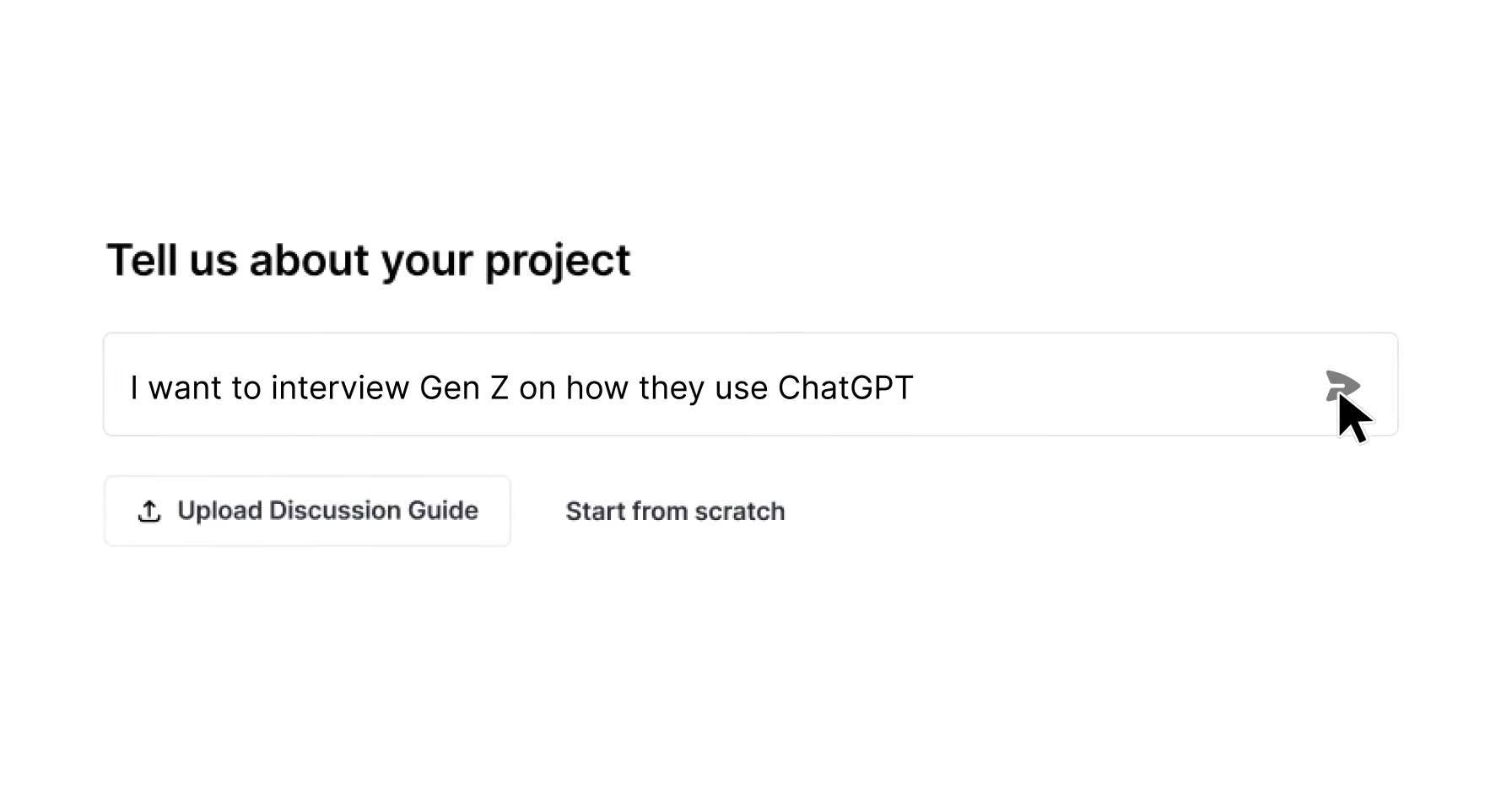
With objectives locked, the next step turns those goals into an interview structure that can capture the specific perceptions and behaviors you care about.
Design Adaptive Interview Guides with Stimuli and Logic
Required inputs: finalized objectives, stimuli assets such as images, video, audio, PDFs, prototypes, or live URLs, and any branching or quota logic. Stakeholders: insights lead and creative or product team supplying stimuli. Decision points: monadic versus sequential exposure, randomization order, skip logic, and version control. Time and cost drivers: number of stimuli conditions and branching complexity.
Adaptive interview guides move beyond static question lists. The AI moderator probes deeper on short or unexpected answers, generating responses three times longer than average through intelligent probing. Stimuli appear inline during the interview, and participant reactions, both verbal and nonverbal, are captured in real time against each asset.
Once the guide is ready, you need qualified people in front of it, at the right scale and in the right markets.
Source Verified Participants Across 45+ Countries
Required inputs: screener criteria, target demographics, geographic markets, and an incidence rate estimate. Stakeholders: insights lead and recruitment ops. Decision points: general population versus niche segment, bring-your-own-participants versus panel sourcing. Time and cost drivers: audience difficulty and geographic spread.
Listen Labs’ global panel of 50M+ verified respondents spans 45+ countries and 120+ languages. Quality Guard, an AI orchestration layer, matches participants on behavioral and intent data rather than self-reported demographics alone, and monitors every interview in real time for fraud, low-effort responses, and repeat respondents. Participants are capped at three studies per month, which removes professional survey-takers. A dedicated recruitment ops team handles segments below 1% incidence rate, including enterprise decision-makers, healthcare workers, and highly specialized consumer profiles that commodity panels cannot reliably reach.
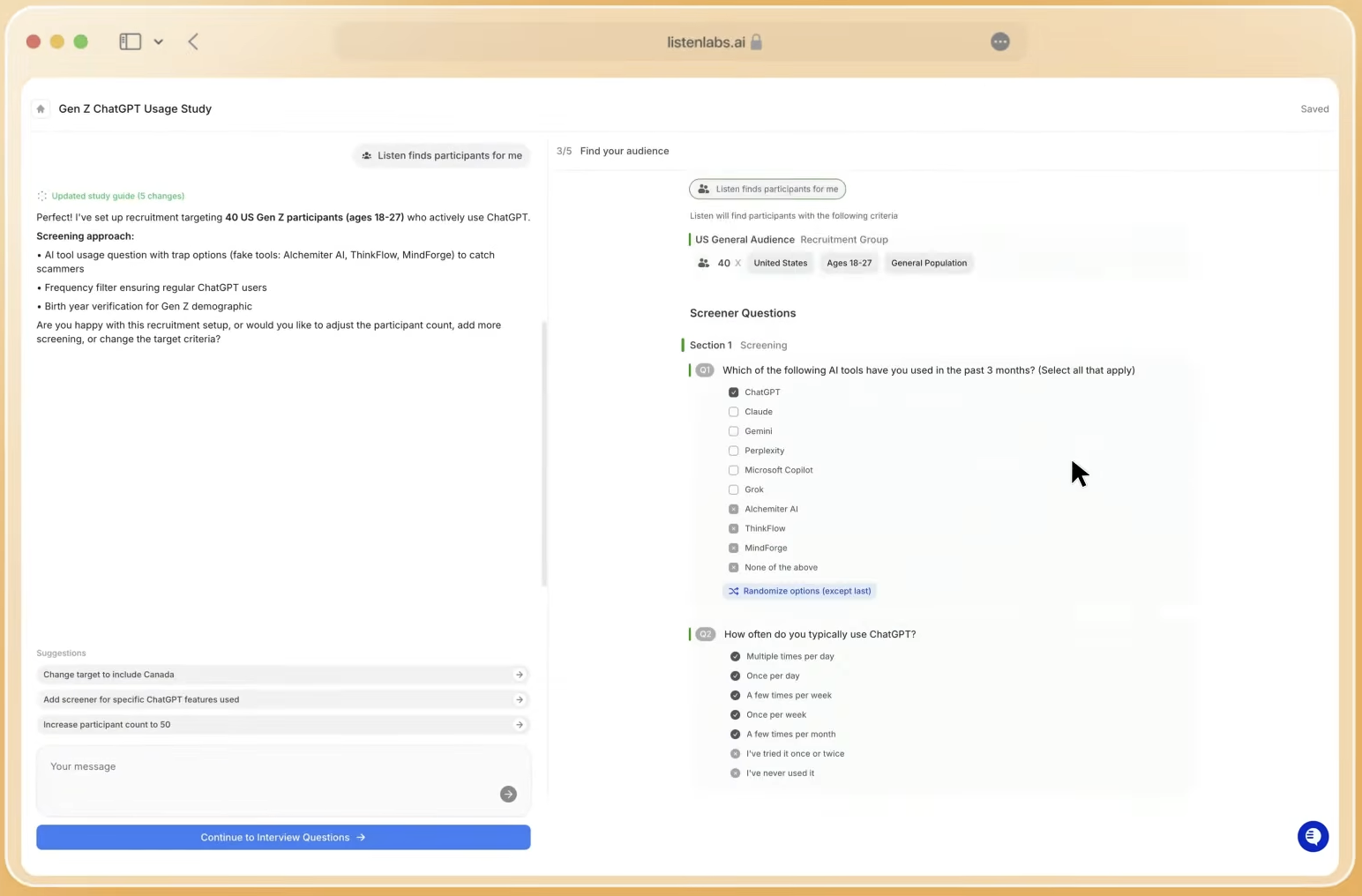
With the right participants in place, the next step is to run interviews that adapt in real time instead of following a rigid script.
Conduct AI-Moderated Video Interviews That Probe in Real Time
Required inputs: finalized guide, recruited participants, and any screen-sharing or task-based components. Stakeholders: insights lead, with no moderator headcount required. Decision points: video-only versus screen capture enabled, mobile versus desktop. Time and cost drivers: interview length and number of parallel sessions.
Platforms like Listen Labs layer on auto-recruiting, transcription, sentiment tagging, and insight summarization so teams jump from question to findings in hours, not weeks. The AI Interviewer conducts personalized, adaptive conversations with dynamic follow-up questions. With Visual Insights enabled, it also observes on-screen behavior. When a participant’s stated preference contradicts their actual behavior mid-session, the moderator probes the contradiction in real time instead of following the pre-written script past it. A video model writes a timestamped, second-by-second log that tags every meaningful on-screen change, which enables quantified friction analysis across sessions.
These rich interviews then feed into emotional analysis that reveals how people feel, not just what they say.
Layer Emotional Intelligence Analysis Using Ekman’s Framework
Required inputs: completed video interview recordings. Stakeholders: insights lead and any creative or brand team interpreting emotional response. Decision points: which questions or stimuli to prioritize for emotional analysis, and which segments to compare. Time and cost drivers: number of interviews and languages.
Listen Labs’ Emotional Intelligence analyzes three signals: tone of voice, word choice, and subconscious micro-expressions. Every emotion is quantified per question and concept, with every label traceable to the exact timestamp, verbatim quote, and AI reasoning behind it. The framework uses Ekman’s seven universal emotions, which are anger, contempt, disgust, enjoyment, fear, sadness, and surprise, the same standard used in clinical psychology and UX research. A researcher can ask “which concept triggered the most confusion?” and receive a side-by-side emotional breakdown across stimuli, segments, and markets, with every data point linked to the moment it occurred. Emotional Intelligence is available across 50+ languages.
Once emotional and behavioral signals are in place, the next step is to synthesize themes and expose the say-do gap at scale.
Run Automated Theme Extraction, Segmentation, and Say-Do Gap Synthesis
Required inputs: completed interviews with transcripts, emotional scores, and behavioral logs. Stakeholders: insights lead and downstream decision-makers. Decision points: segmentation variables, theme taxonomy, and which say-do contradictions to prioritize. Time and cost drivers: number of interviews and segmentation complexity.
AI is particularly suited to say-do gap analysis because it can cross-reference large volumes of qualitative data with quantitative behavioral data at the level of individual customers or narrow segments, surfacing inconsistencies that humans cannot process at scale. Listen Labs’ Research Agent processes all interview data objectively, identifies patterns and themes across hundreds of responses without human bias, and separates signal from noise using proprietary data from tens of thousands of studies. Visual Insights automatically identifies say-do gaps, off-task moments, and decision reasoning across every session without requiring anyone to re-watch video.
These synthesized insights then flow directly into deliverables that stakeholders can use immediately.
Generate Traceable Slide Decks, Highlight Reels, and Research Library Queries
Required inputs: analyzed interview data and a stakeholder brief. Stakeholders: insights lead, executive sponsors, and any team receiving the deliverable. Decision points: output format such as deck, memo, highlight reel, or chart, branding requirements, and distribution audience. Time and cost drivers: number of output formats requested.
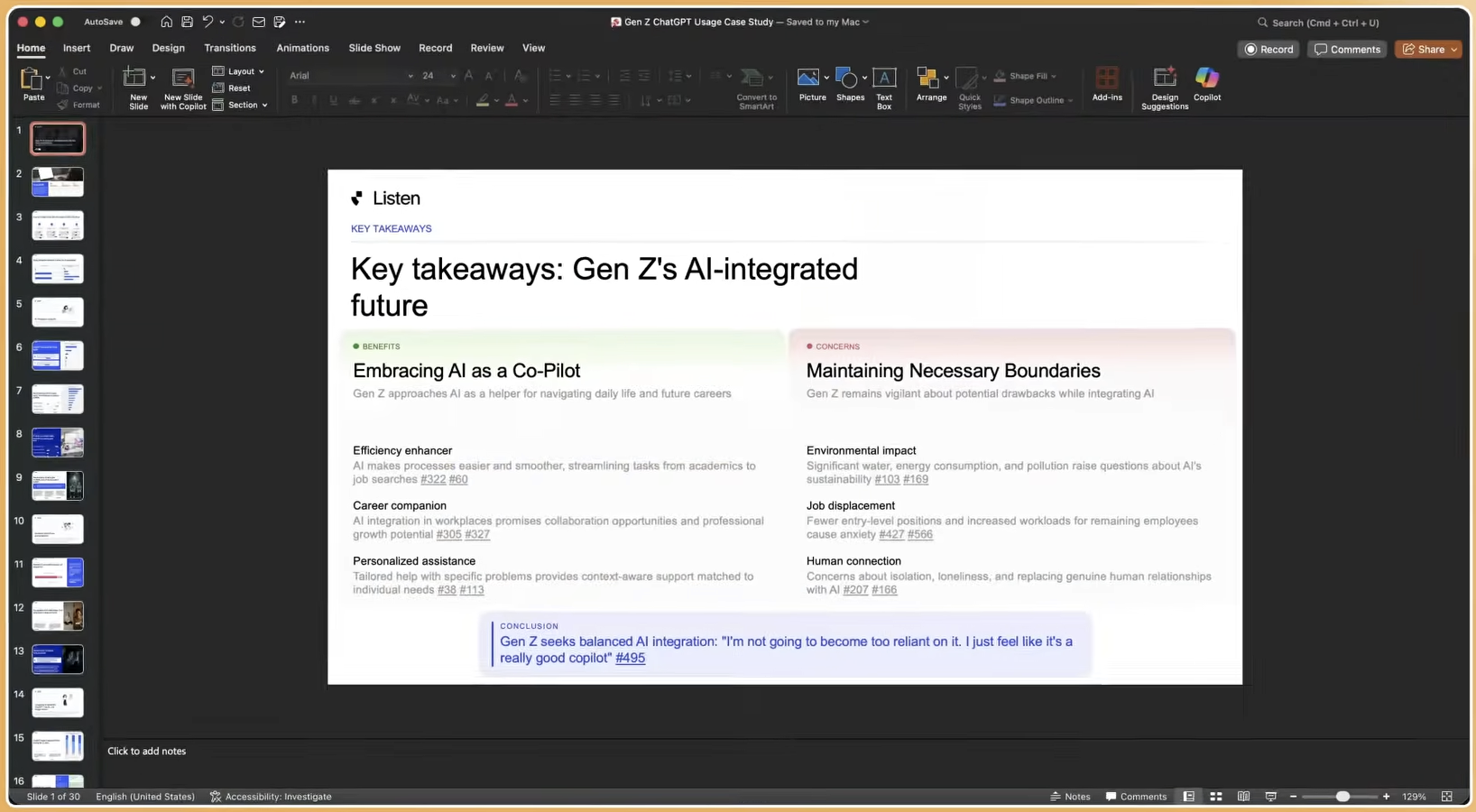
Research Agent handles the full analysis workflow, from raw data to final output. It generates a slide deck in a company’s branded template and a downloadable report, alongside video highlight reels, statistical charts, and segmentation breakdowns, all in under a minute. Every insight links directly to the underlying response data, so stakeholders can inspect the evidence themselves. Research Library then indexes every completed study and enables cross-study queries in natural language with full source attribution, so institutional knowledge compounds rather than expiring with each project.
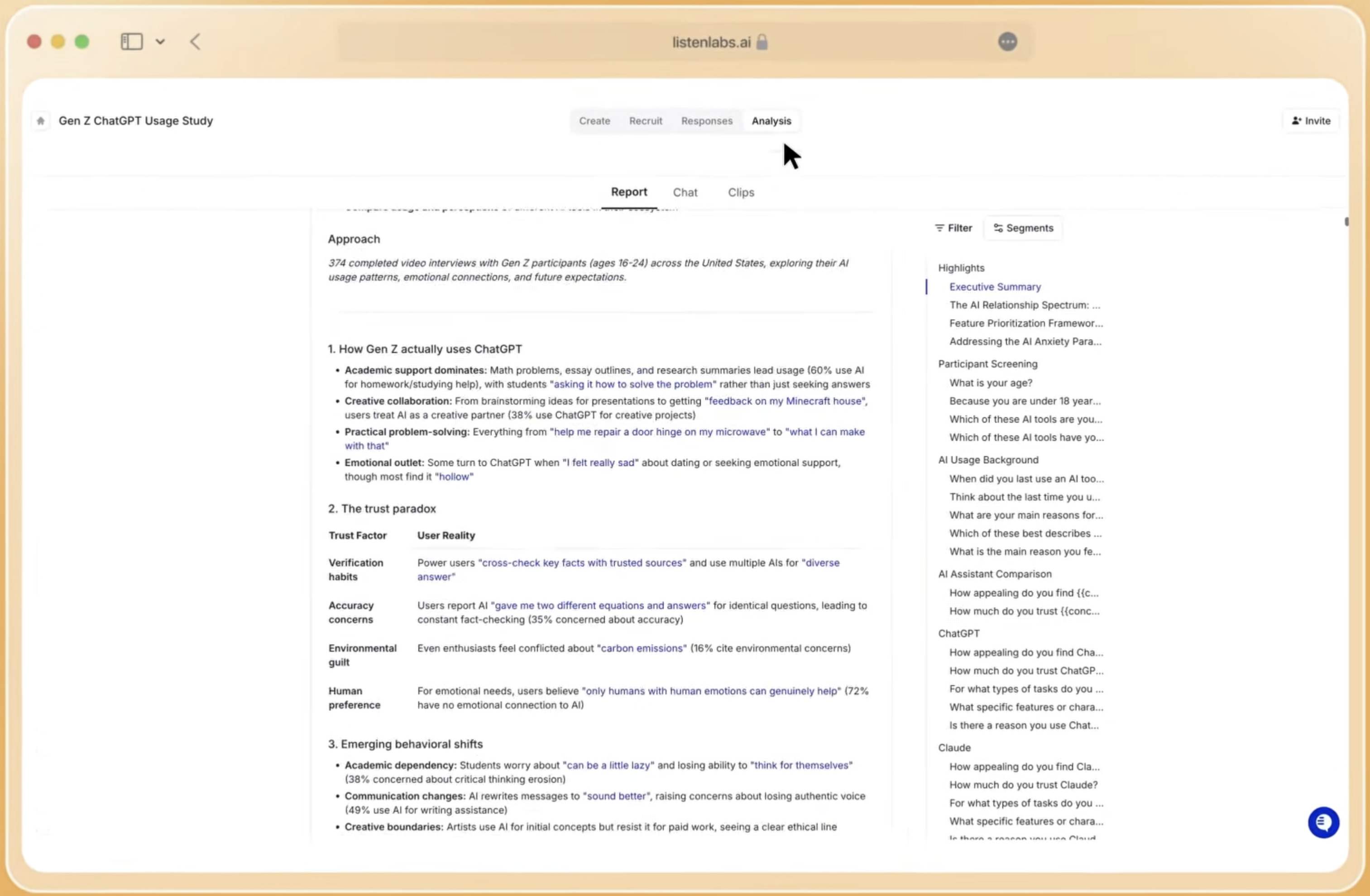
Now that you have the full seven-step framework, the next move is to see where your current process breaks down.
Map Your Current Study Backlog Against This Framework
Auditing the current state reveals which steps will benefit most from AI. List the studies in the backlog and assign each one to the step in this framework where it currently stalls, whether that is participant sourcing, moderation capacity, analysis bandwidth, or deliverable production. Studies that stall at multiple steps become the highest-priority candidates for an AI-powered approach. Walk through your backlog with a Listen Labs researcher and identify which studies can move to under-24-hour turnaround immediately.
Common Pitfalls in AI Consumer Perception Analysis and How To Avoid Them
Four failure modes account for the majority of low-quality AI perception studies:
- Unclear objectives: Studies scoped to a topic rather than a decision produce findings no one acts on. The mitigation is to define the specific business choice the study must inform before writing a single question.
- Low-quality panels: Commodity panels risk professional survey-takers, fraudulent respondents, and incentive-driven answers that inflate stated intent and widen the say-do gap artificially. Behavioral matching and real-time fraud detection are the observable signals of a quality-controlled panel.
- Confirmation bias in analysis: Human analysts unconsciously emphasize findings that confirm pre-existing hypotheses. AI analysis engines that process all responses objectively and flag unexpected patterns provide structural mitigation.
- Siloed studies: When each study lives in a separate report, teams repeatedly research the same questions. A cross-study research library that indexes every completed study eliminates this waste.
Avoiding these pitfalls is necessary but not sufficient. To know whether your AI-powered consumer perception program is actually working, you also need to measure the right outcomes.
Measure Success of AI-Powered Consumer Perception Studies
Four metrics reliably indicate whether an AI consumer perception program is delivering value:
- Study cycle time: Measure days from brief to final deliverable. A well-configured AI-powered study should consistently deliver in under 24 hours for standard audiences.
- Completion rate: Low completion rates signal screener mismatch, interview length problems, or panel quality issues, all correctable before the next wave.
- Cross-study query usage: If the research library is being queried regularly, institutional knowledge is compounding. If it is not, findings are siloing.
- Downstream decisions influenced: Track how many product, brand, or go-to-market decisions cite a specific study as evidence. This metric serves as the ultimate measure of research impact.
These four metrics work together to give you a complete picture of research program health. To get started, audit one recent study against all four metrics and identify the single largest gap, which becomes your first improvement target. Many organizations achieve 50% to 60% cost reduction versus prior research spend within 12 months of AI consumer research implementation.
Advanced Considerations for Scaling Consumer Perception Analysis with AI
Three capabilities define mature, always-on consumer perception programs. First, continuous tracking: Listen Pulse runs the same study with the same screeners wave after wave, combining quantitative KPI tracking with open-ended conversation so every metric movement arrives with its explanation in the same wave, before the shift shows up as a KPI decline. Second, global multi-market studies: with the global coverage established earlier, a single study design can field simultaneously across markets, with automatic translation and transcription, which enables perception comparisons that previously required separate agency engagements in each region. Third, integration with quantitative platforms: Listen Pulse connects with Qualtrics and Decipher, so teams keep the KPIs they already report while adding the qualitative narrative behind them.
For teams new to AI-powered consumer perception analysis, the recommended entry point is a single pilot study, taken from the existing backlog, run end-to-end on the platform, and measured against the cycle time and quality of the equivalent traditional study. Design your pilot study with a Listen Labs researcher.
Frequently Asked Questions
How long does a consumer perception study actually take on Listen Labs?
The full cycle, from study design through participant recruitment, AI-moderated interviews, emotional intelligence analysis, theme extraction, and final deliverables, completes in under 24 hours for standard audience profiles, as outlined earlier. Hard-to-reach segments below 1% incidence rate may require additional recruitment time, which the dedicated recruitment ops team manages. Microsoft, for example, collected hundreds of user video stories within a single day using Listen Labs, replacing a prior six-to-eight-week process.
What incentive ranges should I expect for participants?
Incentive levels vary by audience difficulty, interview length, and geography. General population studies in major markets carry lower incentive requirements than niche professional segments such as enterprise decision-makers, healthcare workers, or engineers. Listen Labs’ recruitment ops team advises on appropriate incentive ranges for each study during the design phase, and incentive costs are factored into the credit model rather than billed separately.
What privacy and security certifications does Listen Labs hold?
Listen Labs maintains SOC 2 Type II, ISO 27001, ISO 27701, and ISO 42001 certifications and is GDPR compliant. All data is protected with 256-bit encryption. Critically, Listen Labs never trains its AI models on customer data, which has become a non-negotiable requirement for enterprise procurement teams handling sensitive consumer research.
Can Listen Labs reach hard-to-find or low-incidence audiences?
Yes. The dedicated recruitment ops team partners with niche communities, micro-creators, and specialized networks to source audiences below 1% incidence rate. This includes enterprise C-suite decision-makers, licensed healthcare professionals, engineers with specific technical profiles, and highly specialized consumer segments. The 50M+ verified respondent network, combined with AI orchestration across multiple panel partners, means that audiences unavailable through a single commodity panel are routinely fielded within standard turnaround windows.
When should a consumer perception study be repeated or retired?
A study should be repeated when a significant market event, such as a product launch, a competitor move, a campaign, or a macroeconomic shift, is likely to have changed consumer perceptions since the last wave. Listen Pulse handles this systematically through always-on tracking with consistent core questions that protect trend-line integrity. A study should be retired when the business decision it was designed to inform has been made and is no longer reversible, or when Research Library cross-study queries consistently return the same answer from existing data, which indicates the question has already been answered.
Ready to Run Your Next Consumer Perception Study in Under 24 Hours?
The 7-step framework above, from natural-language objective definition through traceable slide decks and cross-study library queries, forms the operational architecture that separates consumer perception programs that influence decisions from those that produce reports no one reads. The gap between what people say, what they feel, and what they do is measurable. Emotional intelligence analysis built on Ekman’s framework, real-time say-do gap detection through Visual Insights, and automated theme extraction across hundreds of simultaneous AI-moderated interviews make that measurement repeatable, scalable, and defensible.
Listen Labs is the end-to-end platform that delivers the complete lifecycle described above in the same sub-24-hour window. Enterprises including Microsoft, Nestlé, and Sweetgreen run consumer perception analysis with AI on Listen Labs today.