Written by: Anish Rao, Head of Growth, Listen Labs
Key Takeaways
- Traditional sentiment tools miss emotional nuance and the say-do gap, so brand perception insights stay incomplete.
- A five-step workflow turns vague brand questions into clear objectives, adaptive guides, verified participants, AI interviews, and traceable outputs.
- AI-moderated interviews capture words, tone shifts, and micro-expressions to reveal the real emotional drivers behind brand preference.
- AI synthesis converts hundreds of interviews into emotional heat-maps and stakeholder-ready deliverables in under 24 hours.
- Listen Labs supports continuous perception tracking at scale, and you can book a demo to compress your next study from weeks to hours.
Why Traditional Sentiment Analysis Misses Brand Reality
Surface-level sentiment tools struggle with accuracy in real-world language. Models can score well on training data yet drop sharply on validation once sarcasm and ambiguity appear. Sarcasm, double negatives, cultural idioms, and domain-specific jargon remain consistent failure points. Phrases like “I can’t believe how quickly this processed my payment” are routinely misclassified as negative by automated systems.
The core limitation is structural, not just technical. Document-level sentiment scoring flattens mixed feedback, such as positive comments on price and negative comments on onboarding, into one misleading average. That flattening erases topic-level say-do gaps. No classifier can recover a reason the customer never typed, so short survey text fields only support a surface read even with strong models.
The emotional layer widens the gap further. About 70% of decisions are driven by emotions, with only 30% based on rational factors. Standard polarity scoring compresses that reality into positive, negative, or neutral. That compression discards anger, contempt, or quiet confusion that actually shape brand preference.
Teams are shifting from periodic trackers to continuous, always-on perception programs. Monthly tracking has become the baseline, and always-on tracking now sets the competitive bar. AI-moderated interviews make this shift viable by removing the depth-versus-scale trade-off. Traditional surveys show what people do, while conversations reveal why. The five-step workflow below shows how to operationalize that conversational approach at scale.
Step 1: Turn Broad Brand Questions into Specific Perception Objectives
Brand perception studies fail at analysis when objectives stay vague at design. The research lead must convert broad questions into specific, measurable perception objectives before writing any interview guide.
Required inputs at this stage include:
- The business decision the study must inform, such as campaign direction, positioning refresh, or competitive response
- The perception dimensions to measure, typically four to six, such as salience, differentiation, trust, relevance, and emotional association
- The target segments, such as loyal customers, lapsed users, competitor loyalists, or prospective buyers
- The incidence rate of the target audience, which shapes recruitment complexity and timing
Stakeholders from brand, marketing, and insights should align on these objectives before fieldwork begins, because misalignment here is the leading cause of deliverables that generate no downstream action. With a structured briefing template, this alignment usually takes two to four hours and sets up the rest of the workflow. Defining four to six key perception dimensions upfront creates a foundation for AI brand perception research that drives positioning and messaging changes instead of generic summaries.
Step 2: Build an Interview Guide That Balances Structure and Exploration
An effective AI-moderated interview guide behaves differently from a survey. It combines structured anchor questions, which keep responses comparable across participants and waves, with open-ended prompts that let the AI moderator explore unexpected directions.
Key design decisions at this stage include:
- Opening with unaided recall questions before any brand stimulus appears, which protects unprompted associations
- Using projective and metaphor-elicitation prompts to reach emotional and associative layers that direct questions miss
- Building adaptive probing context into each question so the AI moderator knows when to ladder deeper and when to move on
- Including quantitative anchor formats such as Likert scales, NPS, or MaxDiff alongside open conversation to deliver both trendable metrics and qualitative depth
The why is what separates acceptable customer research from research that changes decisions, and the interview guide is where that why is either built in or left out. Guide design typically takes two to four hours with AI-assisted co-design, which drafts structured objectives, questions, and probing context from a natural-language brief in seconds.
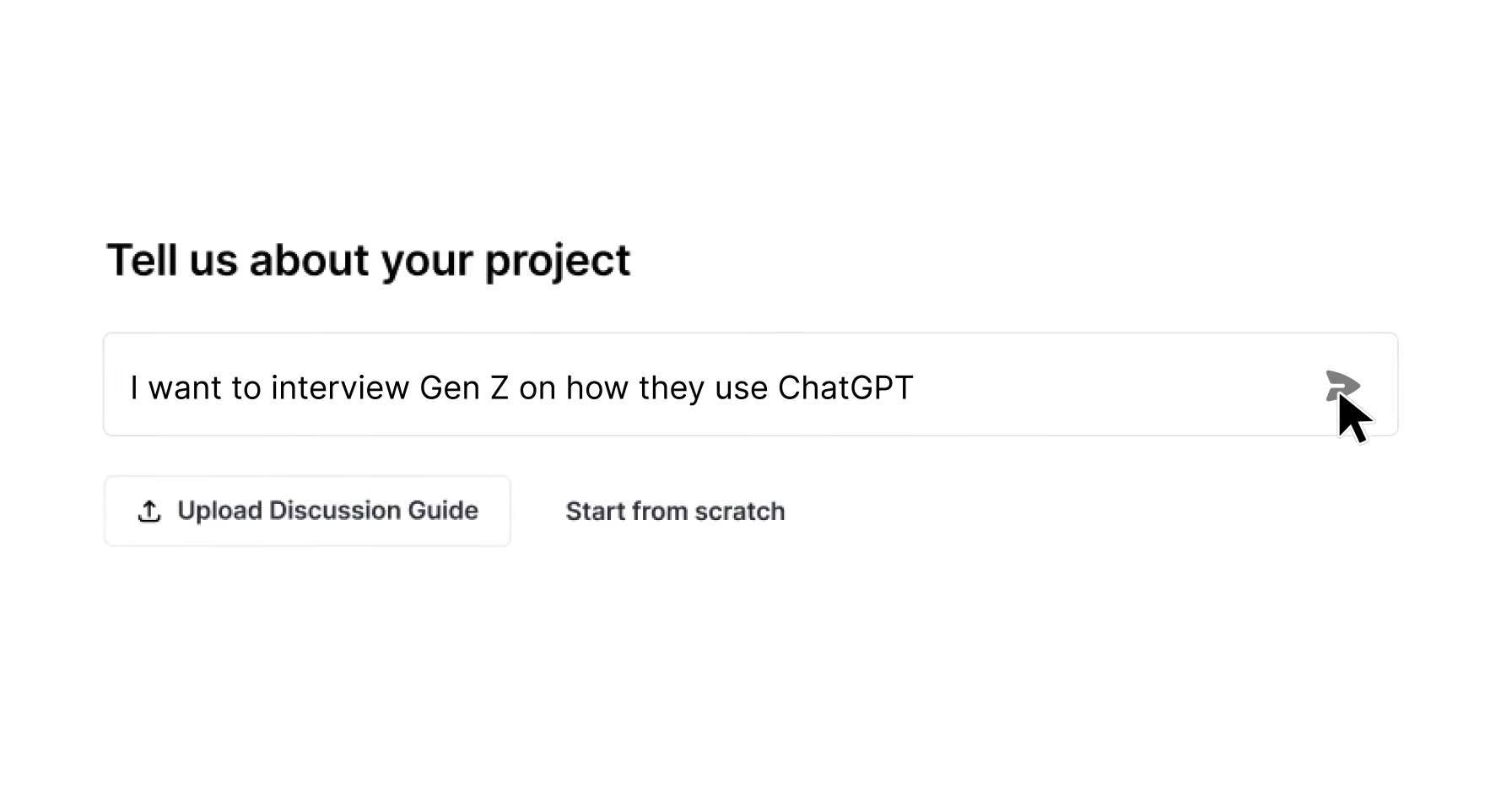
Step 3: Recruit and Screen Participants Who Reflect Real Perception Segments
Participant quality drives most of the variance in brand perception data. Researchers discard an average of 38% of survey data from online panels because of quality concerns, including fraud.
A quality-first sourcing approach requires:
- Behavioral matching on intent and past actions, not only self-reported demographics
- Real-time fraud detection across video, voice, content, and device signals during the interview
- Participant frequency limits, such as no more than three studies per month per respondent, to avoid professional survey-takers
- Dedicated recruitment operations for low-incidence segments, including enterprise decision-makers, healthcare workers, and audiences below 1% incidence
When these quality controls are in place, most AI-moderated brand studies use 30 to 60 interviews per key segment to reach thematic saturation. Teams that need quantitative confidence on language patterns typically field several hundred interviews across segments. With behavioral matching and real-time fraud detection handling quality at intake, recruitment and screening usually complete in the same day to 24 hours for general population segments, or 24 to 72 hours for niche or low-incidence audiences.
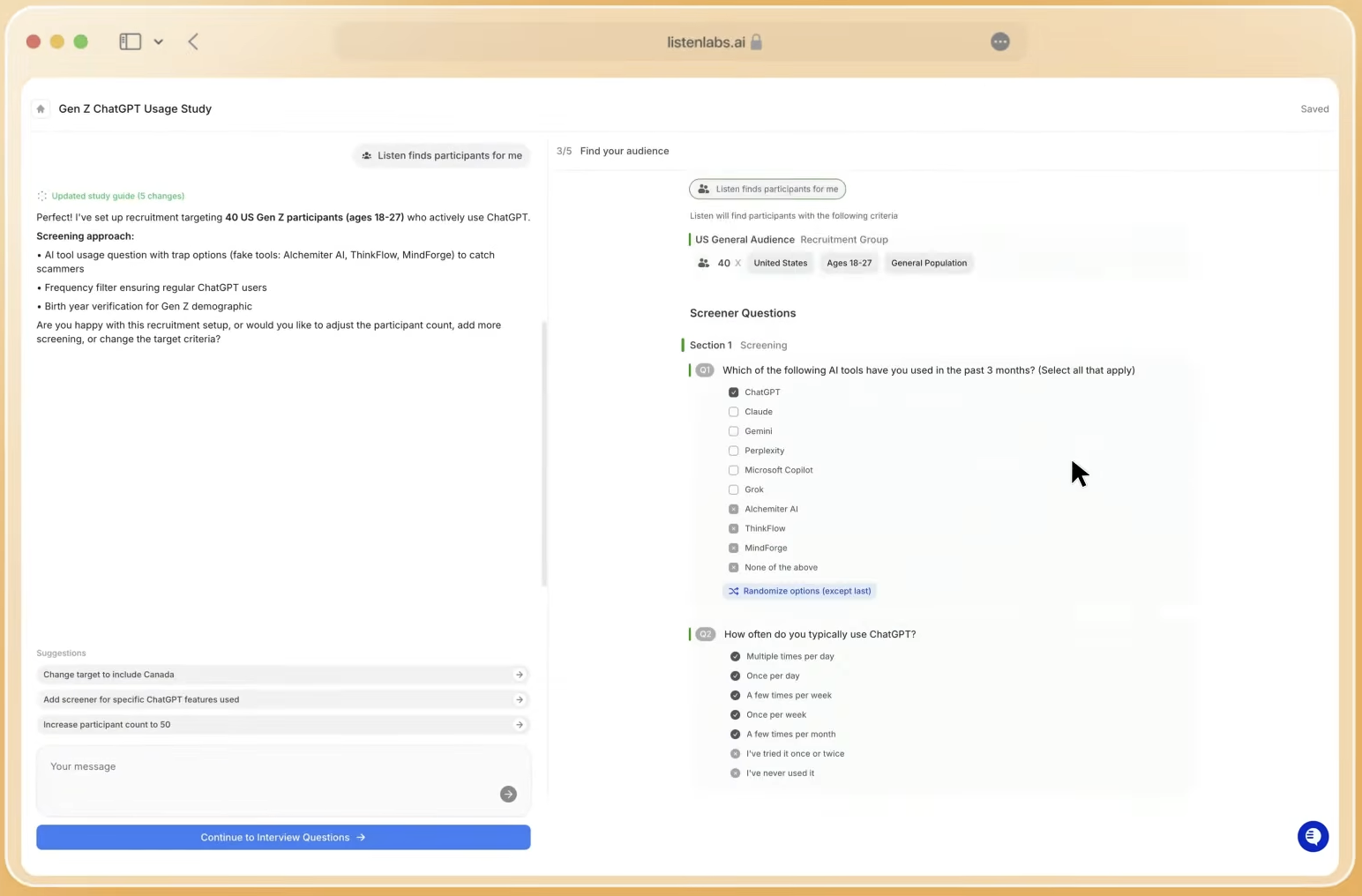
Step 4: Run Adaptive AI Interviews That Capture Words, Tone, and Micro-Expressions
AI-moderated brand perception research diverges sharply from traditional methods at the interview stage. The AI moderator conducts personalized, one-on-one conversations with dynamic follow-up questions, probing short or ambiguous answers the way a trained human interviewer would, without fatigue or inconsistency across hundreds of parallel sessions.
Adaptive moderation captures three layers of signal that static surveys cannot reach:
- Stated answers: verbatim language, metaphors, and associations that participants consciously share
- Tone and word choice: hesitation, reframing, hedging, and emotional loading in how participants construct responses
- Micro-expressions: subconscious facial signals that appear and disappear in fractions of a second and can contradict stated sentiment
Quantifying these signals requires a validated framework. Listen Labs’ Emotional Intelligence uses Ekman’s universal emotions framework, the standard in clinical psychology and UX research, to track anger, contempt, disgust, enjoyment or happiness, fear, sadness, and surprise. Every emotion is quantified per question and per concept. Every label is traceable to the exact timestamp, verbatim quote, and AI reasoning behind it, so stakeholders can see not just that “happiness” appeared, but when, in whose response, and why the system made that classification.
Visual Insights extends this approach when on-screen behavior matters, such as during tests of digital touchpoints. The AI moderator observes participant behavior in real time and probes contradictions between what participants say and what they do, which closes the say-do gap at scale.
Fieldwork typically covers 100 to 300 individual 20-to-40-minute interviews within 24 hours through parallel execution. Book a demo to see how AI-moderated interviews capture emotional nuance at enterprise scale.
Step 5: Turn Raw Interviews into Themes, Heat-Maps, and Decision-Ready Outputs
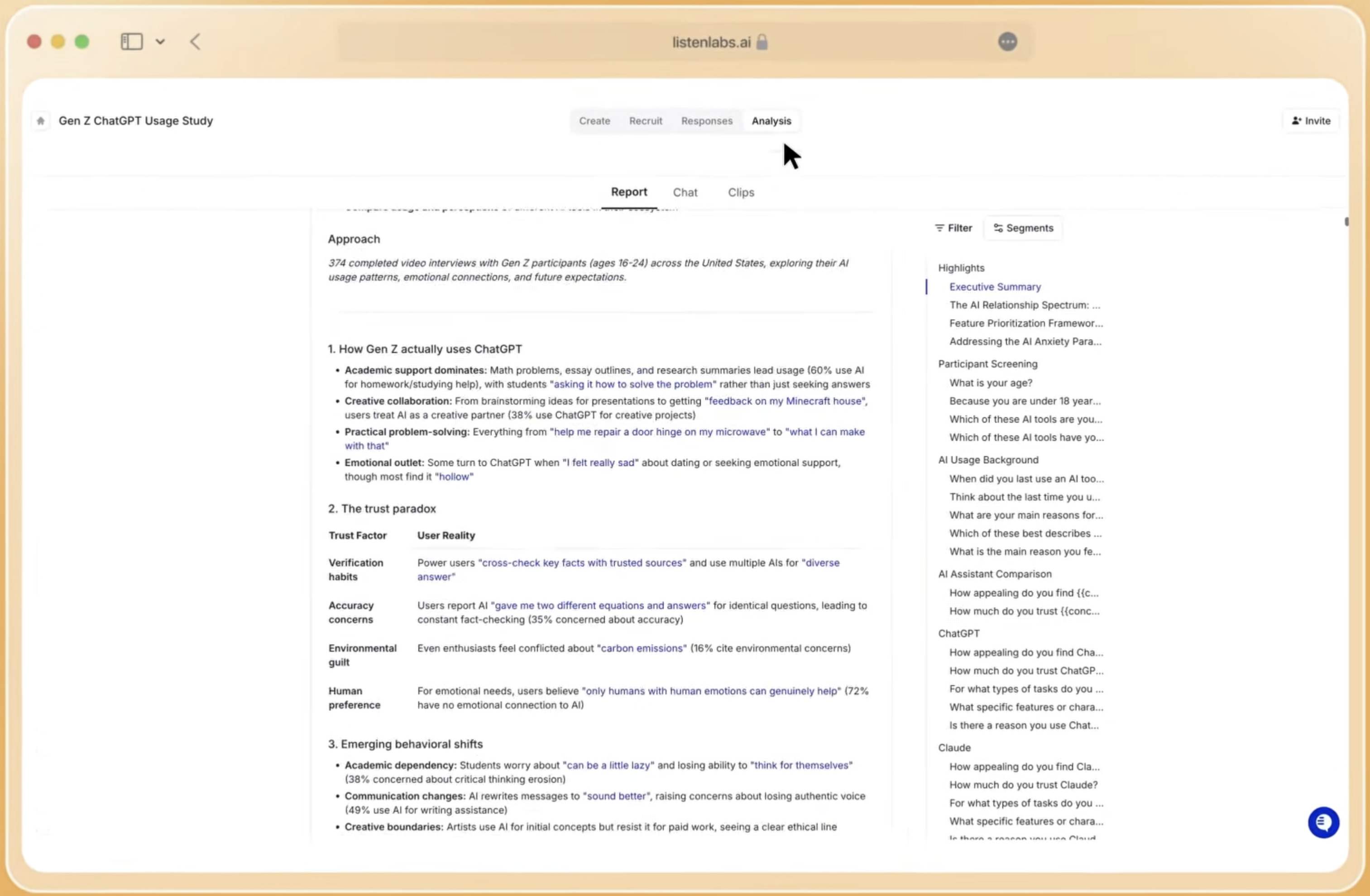
With AI-moderated interviews, talking to participants at scale becomes straightforward, and the main challenge shifts to understanding what they mean. Synthesis must convert hundreds of interview transcripts, emotion scores, and behavioral observations into findings that stakeholders can use without revisiting raw data.
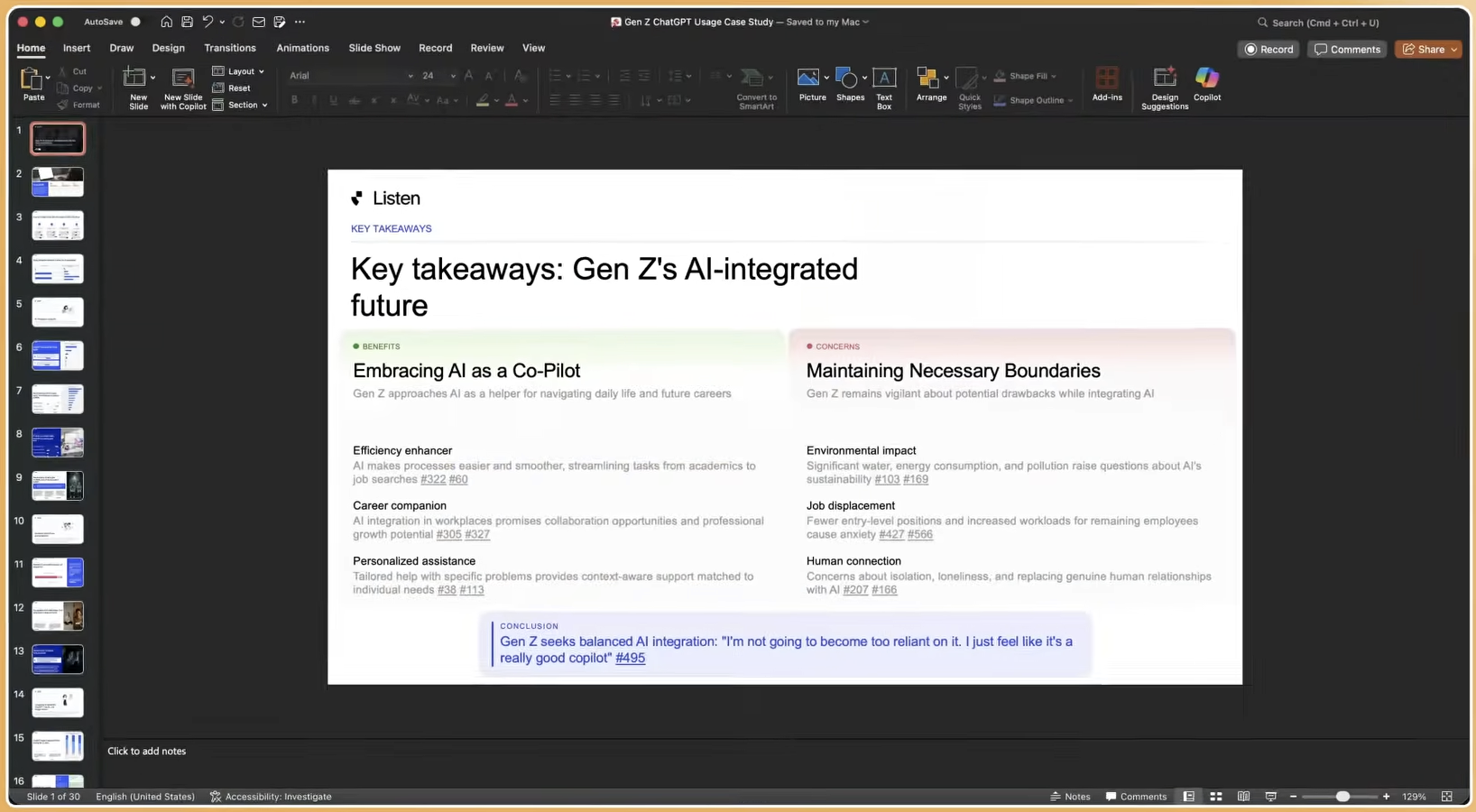
The synthesis workflow produces:
- Theme extraction: automated identification of recurring language patterns, metaphors, and perception clusters across responses, with every theme traceable to the verbatim quotes that generated it
- Emotional heat-maps: per-question and per-concept emotion scores that show where participants light up, disengage, or express confusion, segmented by audience group and market
- Stakeholder-ready deliverables: consultant-quality slide decks, memo-style reports, video highlight reels of emotionally significant moments, and statistical charts generated in under a minute
Success metrics for this stage include study cycle time, with a target of under 24 hours from fieldwork close to final deliverable, completion rate, inter-rater reliability of emotion labels, and downstream usage such as product, campaign, or positioning decisions influenced by the findings. Each insight links back to the underlying response data described in Step 4, which gives skeptical stakeholders the visible evidence they need to act.
Apply the Five-Step Workflow to Your Current Brand Questions
Teams can start by mapping existing brand perception questions against each step above. This mapping highlights where the current process breaks down, such as unclear objectives at Step 1, low-quality panel respondents at Step 3, or analysis bottlenecks at Step 5. A single perception question, for example “How do target buyers emotionally associate our brand versus our primary competitor?”, can serve as a pilot to validate the workflow before scaling to a full program.
Common Pitfalls in AI Brand Perception Studies
Unclear objectives. Studies that begin with “we want to understand brand perception” without specifying dimensions, segments, and decisions produce deliverables that spark discussion but not action. The remedy is the structured briefing approach described in Step 1, which ensures stakeholders sign off on perception dimensions before any guide is written.
Low-quality panel respondents. Incentive-driven or fraudulent respondents create data that looks complete yet points in the wrong direction. Observable signals include very short response times, generic answers that never reference the brand or category, and emotional signals that stay flat across all questions. Behavioral matching and real-time quality monitoring during the interview, rather than post-hoc transcript screening, provide the remedy.
Analysis bottlenecks. Manual coding of large volumes of free-text responses can consume many analyst days, while AI completes the same analysis in minutes. Human-only analysis also introduces confirmation bias, as analysts unconsciously emphasize findings that confirm existing hypotheses. AI-automated theme extraction with human review focused on strategic interpretation, not initial coding, resolves this bottleneck and builds consistency.
Stakeholder misalignment. Deliverables that do not clearly connect emotional findings to business decisions often get archived instead of used. Involving key stakeholders in objective-setting at Step 1 and structuring deliverables around the specific decisions those stakeholders must make keeps the work actionable.
Advanced Strategies for Always-On Brand Perception Programs
Always-on conversational trackers. A single brand perception study offers only a snapshot. Consumer perceptions shift quietly, competitors reposition, and brand equity can erode without warning. Continuous tracking programs run the same core questions wave after wave to preserve trend lines while adding timely questions on new campaigns, competitive moves, or cultural moments. Listen Pulse supports this use case by combining quantitative KPI tracking with open-ended conversation so every metric movement arrives with its explanation in the same wave.
Multi-market localization. Brand perception often varies sharply across markets. A single global study that averages across geographies hides regional drivers that matter for local campaigns. AI-moderated interviews support 120+ languages with automatic translation and transcription, which enables simultaneous fieldwork across markets without coordinating multiple local vendors.
Integration with existing quantitative dashboards. AI-moderated interview data complements, rather than replaces, quantitative brand trackers. Quantitative tracking measures what changed, and qualitative interviews explain the mechanisms and emotional drivers behind that change. Listen Pulse integrates with platforms such as Qualtrics and Decipher, so teams keep the KPIs they already report while adding the narrative behind them.
Phased pilots. Teams new to AI-moderated brand perception research can run a pilot on one perception question and compare interview-based findings against legacy sentiment scores on the same topic. This comparison usually surfaces emotional nuance and say-do gaps that sentiment scores missed, which builds internal confidence before scaling to a full program.
Frequently Asked Questions
How long does a typical AI-moderated brand perception study take from brief to final deliverable?
A study covering 100 to 300 interviews across one to three segments typically completes in under 24 hours on Listen Labs. That window includes AI-assisted study design, participant recruitment and screening, parallel interview execution, automated analysis, and generation of stakeholder-ready deliverables. Studies that require niche or low-incidence audiences may extend to 48 to 72 hours for recruitment, while analysis and delivery still complete within hours of fieldwork close. Traditional qualitative research cycles often run four to six weeks for the same scope.
How does Listen Labs protect participant privacy and enterprise data security?
Listen Labs holds SOC 2 Type II, ISO 27001, ISO 27701, and ISO 42001 certifications and complies with GDPR. All data is protected with 256-bit encryption. Listen Labs never trains its AI models on customer data, so study content, participant responses, and proprietary brand information remain within the client’s environment. Enterprise SSO supports secure access control.
Can AI-moderated interviews reach niche or hard-to-find brand perception segments?
Yes. Listen Labs’ recruitment operations team partners with niche communities, micro-creators, and specialized networks to source audiences below 1% incidence rate, including enterprise decision-makers, healthcare workers, engineers, and highly specific consumer segments. This approach builds on a verified global respondent network that already supports multi-country, multi-language fieldwork without separate local vendors.
When should a brand perception study be repeated or retired?
Teams should repeat a study after significant business events that could shift perception in the target segment, such as a campaign launch, competitive repositioning, product change, or cultural moment. For ongoing programs, quarterly AI-moderated waves provide early warning of perception shifts that appear in language months before they register on quantitative tracking scales. A study should be retired or redesigned when its perception dimensions no longer connect to active business decisions, or when the target segment definition has changed enough to break historical comparisons.
What does a brand perception study on Listen Labs cost?
Listen Labs uses a subscription model. Enterprises pay for platform access, which includes a set number of studies and credits, and then spend credits per participant recruited. Credit cost varies by audience difficulty, so general population studies use fewer credits than niche or low-incidence segments. The platform usually delivers brand perception research at roughly one third the cost of traditional agency-delivered qualitative programs, which makes continuous tracking financially realistic for teams that previously ran only one or two studies per year.
Conclusion: Start with One Focused Perception Question
Surface-level sentiment tools record what customers say, while the five-step workflow above captures what they feel, where stated preferences contradict behavior, and which emotional signals drive brand perception below conscious awareness. The result is traceable, action-ready findings delivered in hours instead of weeks, without forcing a trade-off between qualitative depth and quantitative scale.
The most effective starting point is a single, well-defined perception question mapped against the five steps. That question needs a clear objective, an adaptive interview guide, verified participants matched to the target segment, AI-moderated interviews with multimodal emotional signal capture, and synthesis into a deliverable that connects directly to a business decision. That pilot creates the internal evidence needed to scale into a continuous program.