Written by: Anish Rao, Head of Growth, Listen Labs
Key Takeaways
AI replaces slow, periodic brand surveys with real-time, continuous intelligence that captures what people say, feel, and do at scale.
Listen Labs delivers 300-participant studies in under 24 hours, which is far faster and more cost-effective than traditional 4–12 week, $5,000–$50,000 projects.
Multimodal Emotional Intelligence detects nuanced reactions like micro-expressions and tone that traditional surveys miss, providing deeper sentiment insights across 50+ languages.
Visual Insights and predictive theme analysis close the say-do gap and surface emerging brand perception shifts weeks before they appear in KPI dashboards.
Seven Ways AI Upgrades Brand Perception Research
1. Real-Time Listening at Scale for Modern Brand Teams
Research on the intention-behavior gap shows that stated intentions are often only weakly predictive of actual future behavior, with some studies finding that intentions explain as little as 20–30 percent of variance in actions. Conventional moderated sessions can catch contradictions but do not scale. Unmoderated testing scales but records behavior nobody has time to watch.
Listen Labs’ Visual Insights resolves this problem by letting the AI Interviewer observe on-screen behavior during the interview itself. When a participant’s stated preference contradicts their observed action, the AI probes the contradiction in real time. A video model writes a timestamped, second-by-second log of every meaningful on-screen change, so friction can be quantified across sessions and every metric links to the exact moment behind it.
5. Predictive Brand Perception Insights from Emerging Narratives
Listen Pulse replaces that model with an always-on conversational tracker that analyzes tens of thousands of responses around the clock. Core questions stay constant to protect the trend line. Timely add-on questions cover new campaigns and competitors without breaking historical comparability. Every metric movement arrives with the qualitative explanation behind it, traceable to the interview, verbatim quote, and video clip. Pulse integrates with Qualtrics and Decipher so teams keep the KPIs they already report.
Skims needed to validate campaign direction with thousands of high-income buyers overnight before a global launch. Traditional recruiting and panel sourcing would have taken weeks. Using Listen Labs, the team identified and qualified thousands of premium consumers overnight, tested campaign direction before launch, and delivered qualitative clarity that translated customer reactions into insights leadership could trust, which enabled board-level buy-in.
“I always struggled with understanding the why and Listen Labs nails this for me.” — SVP Data, Insights, Loyalty at Skims
The result compressed weeks of recruiting into hours, eliminated campaign risk before spend, and created a direct line from consumer emotion to executive decision-making.
Implementation: How Listen Labs Runs End-to-End Brand Research
AI-powered brand perception research on Listen Labs follows a structured lifecycle that replaces fragmented multi-vendor setups with a single workflow.
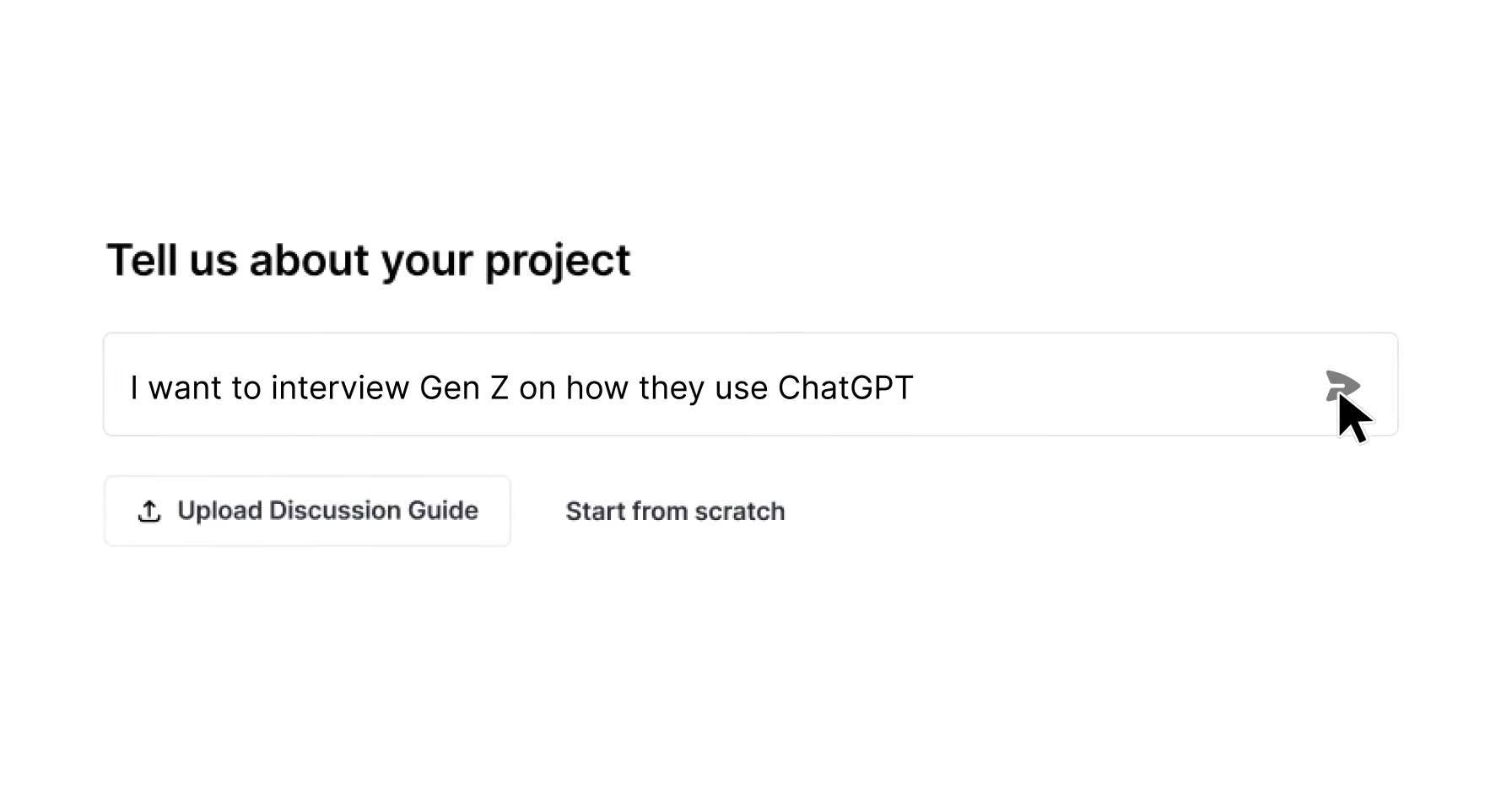
Our AI helps you go from idea to implemented discussion guide in seconds.
Study design: Teams describe research goals in natural language, and the AI drafts structured objectives, questions, and probing context in seconds. Auto-QA flags issues before launch. Stimuli such as images, video, packaging concepts, logos, and live URLs embed directly into the interview flow with monadic or sequential randomization.
Participant sourcing and quality control: Quality Guard matches participants across behavioral and intent data, not just self-reported demographics, so recruited participants actually match the target profile. To protect data during the interview, real-time AI monitoring across video, voice, content, and device signals detects fraud and low-effort or AI-generated responses before they enter the dataset. Participants are also capped at three studies per month to prevent panel fatigue, and a dedicated recruitment ops team handles hard-to-reach segments such as enterprise decision-makers and consumers below 1% incidence rate.
Cross-study querying: Research Library searches every study simultaneously and returns synthesized answers with full source attribution, tracing every finding back to the original study, screener, and individual respondent. Brand perception intelligence compounds over time instead of expiring with each project.
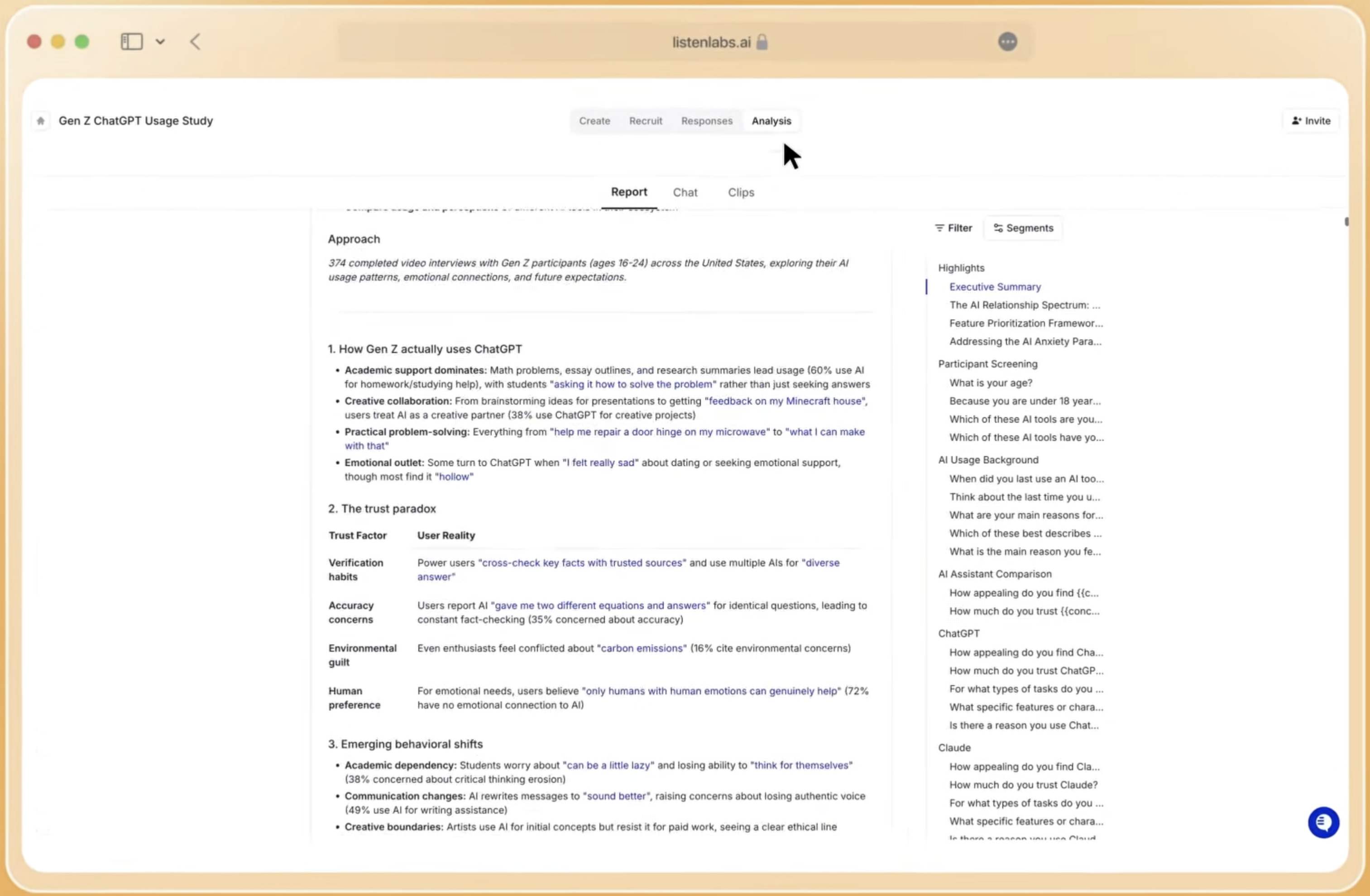
Listen Labs auto-generates research reports in under a minute
Traditional vs. AI-Enabled Brand Perception Research
Traditional brand perception research relies on slow cycles and limited emotional data, while AI-enabled approaches change both speed and depth. As noted earlier, traditional approaches require 4–6 weeks and significant budget, while AI-enabled approaches like Listen Labs deliver results in under 24 hours but cost around $300–$400 per participant. Traditional tracking occurs only a few times a year for many marketers, whereas Listen Labs enables always-on, continuous monitoring. Emotional signal capture in traditional methods relies on self-reported ratings only, while Listen Labs quantifies tone, word choice, and micro expressions per question with timestamp traceability.
Frequently Asked Questions
How does AI maintain data quality and prevent fraudulent responses in brand perception studies?
Listen Labs applies three layers of quality control. First, it works exclusively with high-quality, non-commodity panel sources, so professional survey-takers are excluded. Second, Quality Guard monitors every interview in real time across video, voice, content, and device signals to detect fraud, low-effort responses, AI-generated scripts, and mismatched profiles. Third, a dedicated recruitment ops team adds human review, and participants are capped at three studies per month to eliminate panel fatigue. The result is a zero-fraud guarantee backed by a reputation scoring system that compounds across every interview the platform conducts.
How does Listen Labs handle data privacy and enterprise compliance?
Listen Labs holds SOC 2 Type II, ISO 27001, ISO 27701, and ISO 42001 certifications and is fully GDPR compliant. All data is protected with 256-bit encryption. Listen Labs never trains its AI models on customer data, which is a non-negotiable data policy for enterprise deployments. The platform also supports enterprise SSO. For teams operating across the EU, this architecture aligns with the EU AI Act’s transparency obligations entering force in August 2026.
Can non-researchers use the platform without methodology expertise?
Brand managers, product managers, and marketing leaders without formal research backgrounds can describe their goals in natural language, and the platform handles study design, participant recruitment, interview moderation, and analysis automatically. AI-assisted study co-design drafts structured objectives and questions in seconds. Auto-QA flags issues before launch. The Research Agent delivers consultant-quality slide decks, memos, and highlight reels without requiring manual analysis. The platform acts as a force multiplier for existing research teams and a self-serve tool for non-researchers alike.
How does continuous AI tracking differ from a traditional brand tracker like Kantar or YouGov BrandIndex?
Traditional trackers are wave-based and quantitative only, so they report that awareness or consideration moved but carry no diagnostic for why. By the time a KPI declines, the underlying shift has typically been building for months, and explaining it requires commissioning a separate qualitative study. Listen Pulse keeps core questions constant to protect the trend line and adds open-ended conversation to every wave. It charts emerging themes directly alongside the KPIs teams already report, so the metric change and the reason behind it arrive in the same wave. Pulse deploys alongside an existing tracker or as the primary tracking system and integrates with Qualtrics and Decipher.
What does the research output look like, and how quickly is it delivered?
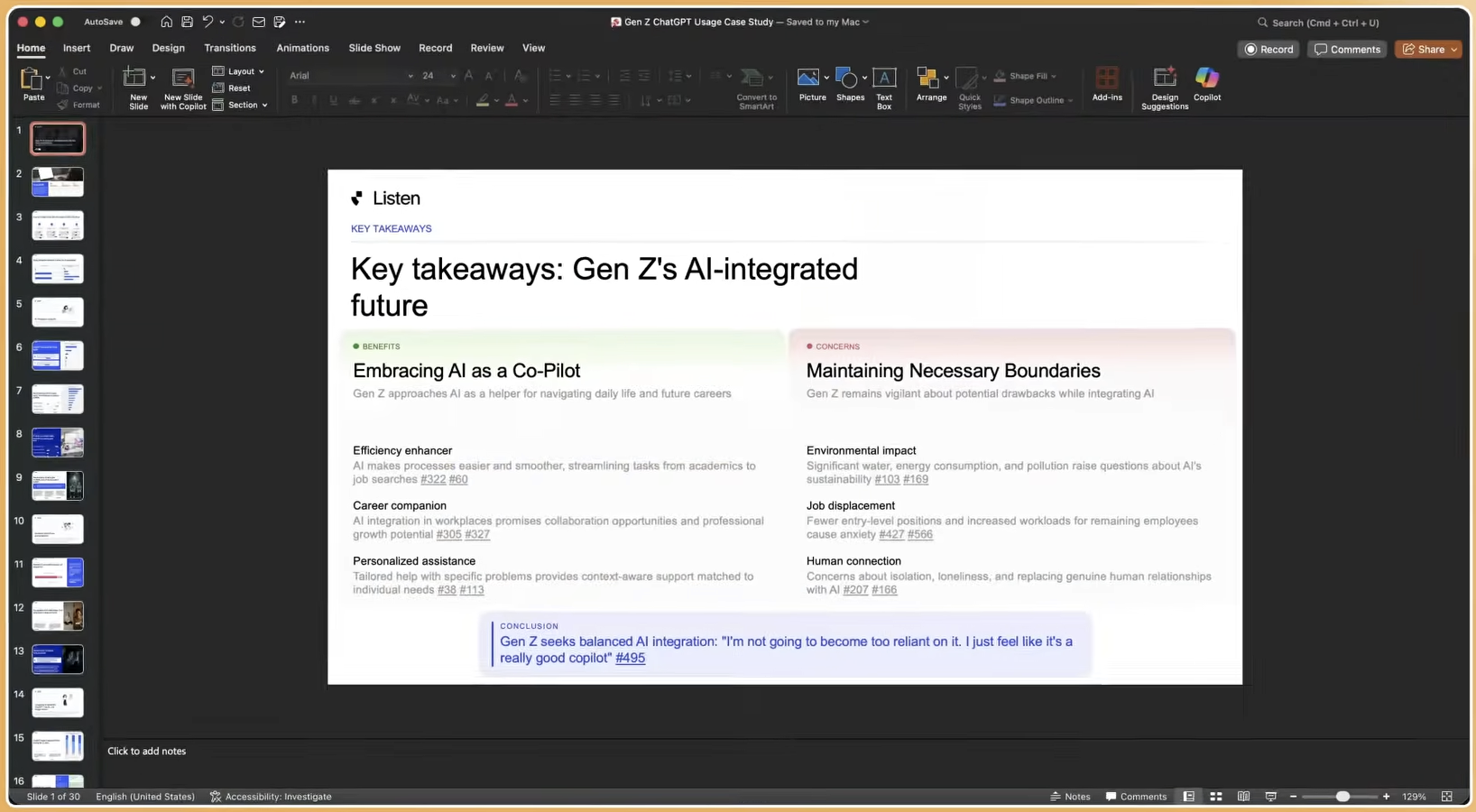
Listen Labs delivers results in under 24 hours, which keeps insights aligned with live decisions. The Research Agent automatically generates key findings and theme analysis, consultant-quality PowerPoint slide decks, memo-style reports, video highlight reels of the most emotionally significant moments, statistical charts with significance testing, and segmentation breakdowns by demographics, cohorts, or custom audience groups. Every output is traceable, and any chart, quote, or theme links back to the original interview, screener, and individual respondent. Teams can also query the full body of research in natural language through Research Library, which searches every study ever run simultaneously and returns synthesized answers with full source attribution.
Listen Labs' Research Agent quickly generates consultant-quality PowerPoint slide decks
Conclusion: Moving from Periodic Snapshots to Continuous Brand Intelligence
Listen Labs is the only end-to-end platform that combines AI-moderated video interviews at scale, Ekman-based multimodal emotional intelligence, Visual Insights for say-do gap detection, predictive theme analysis, and always-on conversational tracking within a single enterprise-grade system trusted by Microsoft, P&G, Skims, and roughly 15% of the Fortune 100. Every insight is traceable, and every number links to a real person, their words, and the clip behind it.