
Written by: Anish Rao, Head of Growth, Listen Labs
Key Takeaways for Retail Insights Leaders
- Retail insights teams fall behind when traditional 4–6-week research cycles cannot keep pace with assortment validation, campaign pre-testing, and shopper-journey mapping.
- End-to-end AI interview platforms bring study design, recruitment, moderation, analysis, and deliverables into one workflow, cutting timelines from weeks to less than 24 hours.
- AI-moderated interviews now match human comfort levels while removing interviewer variance, so teams get consistent data across hundreds of simultaneous sessions and sensitive topics.
- Listen Labs’ Emotional Intelligence reads tone, word choice, and micro-expressions to surface emotions that surveys miss, with every label tied to exact timestamps and verbatim quotes.
- Retail and CPG teams that want faster, deeper consumer insights can see sub-24-hour research cycles in action with a Listen Labs demo.
How to Evaluate Retail Research Platforms
Retail insights leaders make better platform choices when they align on clear evaluation criteria first. The following nine dimensions reflect what enterprise teams say most directly affects assortment validation, campaign pre-testing, and shopper-journey mapping at retail decision speed. Each platform category in this guide maps back to these dimensions.
- Research speed: Time from study brief to actionable findings, including setup, recruitment, fieldwork, and analysis.
- Depth versus scale: Whether the method captures nuanced motivations or only surface-level responses, and how many participants it can reach at once.
- Participant quality and fraud controls: Verification rigor, fraud detection mechanisms, and protections against professional survey-takers or incentive-driven responses.
- Global and language reach: Coverage across markets and languages that matter for multi-region retail programs.
- Emotional-signal capture: Ability to surface what participants feel, not only what they say, through tone, expression, or behavioral signals.
- Analysis effort: Whether analysis is automated, semi-automated, or manual, and how much researcher time it consumes.
- Deliverable speed: Time from data collection to stakeholder-ready outputs such as slide decks, memos, and video reels.
- Security and compliance: Enterprise certifications, data residency controls, and privacy frameworks relevant to retail consumer data.
- Total cost of ownership: Combined impact of platform fees, recruitment costs, analyst time, and vendor management overhead.
Study Setup and Recruitment Across Tool Categories
Traditional research agencies rely on manual recruitment through proprietary panels and third-party brokers, which triggers briefing calls, proposal rounds, and sequential approvals before fieldwork can begin. This sequential process drives the 3–5-week timelines and $4,000–$12,000 per 90-minute session typical of focus-group formats. When retail teams need assortment validation across multiple SKU sets or simultaneous seasonal campaign tests, these long cycles create backlogs that force trade-offs about which studies move forward and which get deferred.
Point solutions such as Prolific, User Interviews, and Respondent speed up participant sourcing but stop at that step. They do not moderate interviews, analyze responses, or generate deliverables, so retail teams still stitch together separate tools for each later stage. Survey platforms like SurveyMonkey and Qualtrics scale recruitment efficiently but lock research into pre-set questions with no adaptive follow-up, which limits their value for shopper-journey mapping or open-ended concept exploration where unexpected findings matter.
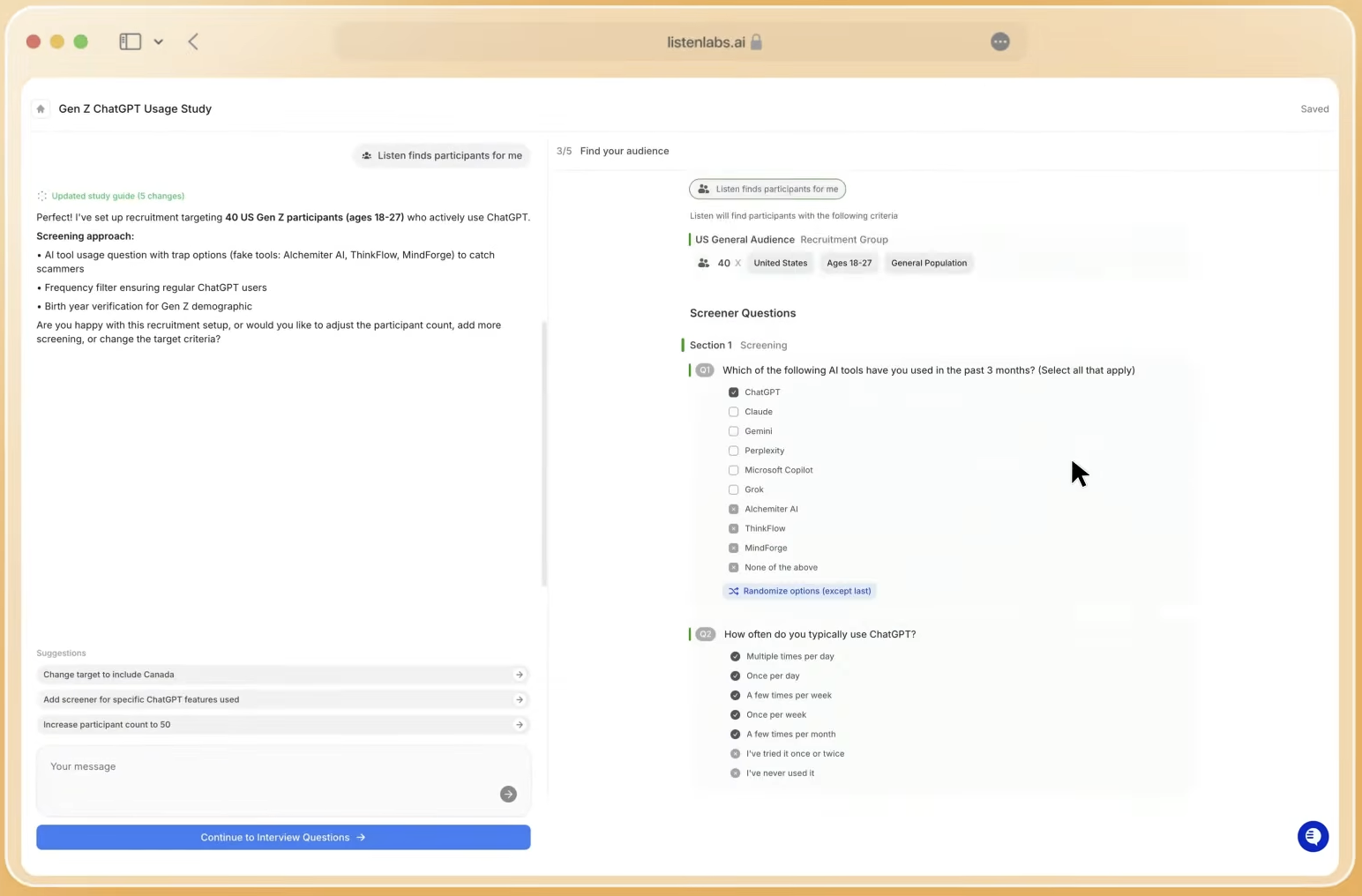
These fragmentation costs in time and quality explain why more enterprise teams now look at end-to-end AI interview platforms. These platforms consolidate study design, recruitment, moderation, and analysis into a single workflow. AI can schedule and conduct the interview, analyze transcripts for themes, and generate quantitative insights from those interviews, removing handoffs that slow work and introduce inconsistency. Listen Labs operates a global panel of 30M verified respondents across 45+ countries and 100+ languages, with an AI orchestration layer that matches and bids across multiple panel partners automatically, plus a dedicated recruitment operations team for segments below 1% incidence rate.
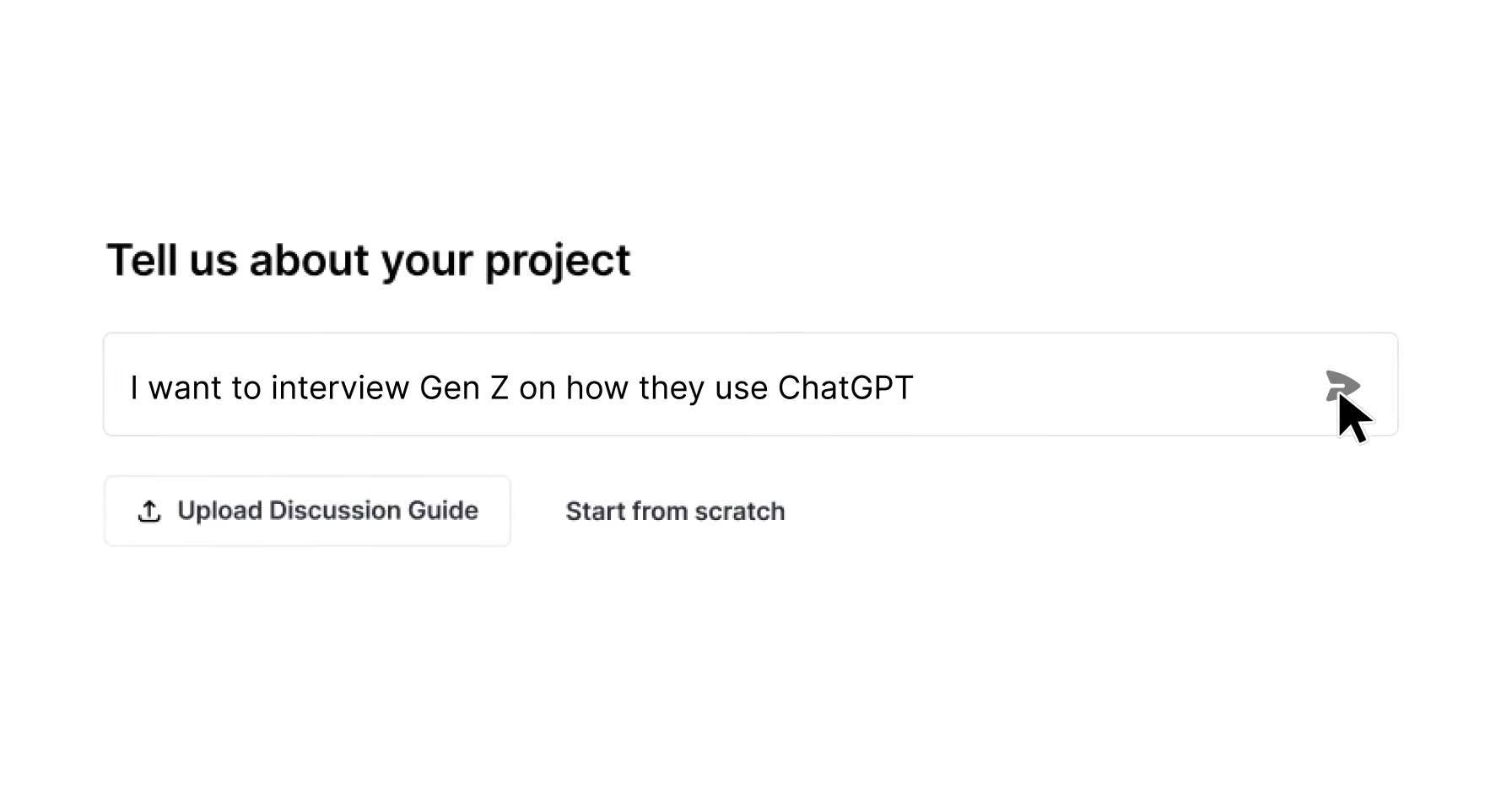
Moderation, Data Quality, and Emotional Signals
Human moderators in agency settings bring methodological expertise but create variability across sessions, cannot run parallel interviews at scale, and rarely operate outside business hours. Focus groups add group dynamics, dominant voices, and social desirability bias, which distort individual responses and make them unreliable for sensitive topics such as price sensitivity or brand switching.
AI-moderated interviews address these constraints directly. 92% of participants report top comfort levels in AI-moderated sessions, matching the comfort levels reported in human-moderated sessions, and participants often prefer AI moderation on sensitive topics. The consistency of AI moderation also removes interviewer variance across hundreds of simultaneous sessions, which matters when retail teams need comparable data across shopper segments or regional markets.
Participant comfort and interviewer consistency only create value when participants themselves are legitimate. Fraud controls vary widely across categories. Commodity quantitative panels carry elevated risk of professional survey-takers and incentive-driven responses because they prioritize scale over verification. Listen Labs’ Quality Guard layer addresses this by applying real-time monitoring across video, voice, content, and device signals to detect fraud, low-effort responses, and mismatched profiles as interviews occur. To prevent the panel fatigue that drives low-quality responses, participant frequency is capped at three studies per month.
Emotional-signal capture now separates modern platforms from legacy tools. Surveys and rigid questionnaires capture only self-reported ratings. Listen Labs’ Emotional Intelligence analyzes three layers of signal: tone of voice, word choice, and subconscious micro expressions, to surface emotions that transcripts alone miss. Built on Ekman’s universal emotions framework, the same standard used in clinical psychology and UX research, every emotion is quantified per question and concept, with every label traceable to the exact timestamp, verbatim quote, and AI reasoning behind it. For creative testing and concept comparison, teams can pinpoint where a campaign triggers confusion or where a product claim generates skepticism, instead of relying on aggregate ratings that hide those signals.
Analysis, Deliverables, and Knowledge Management in Practice
Manual analysis of qualitative interview data takes significant time, introduces subjectivity, and often reinforces confirmation bias. In enterprise retail settings, analysts may overweight findings that support existing hypotheses, especially under deadline pressure. Analysis repositories such as Dovetail organize and surface past research effectively but do not conduct new studies, so teams still depend on separate recruitment and moderation vendors for fresh insight generation.
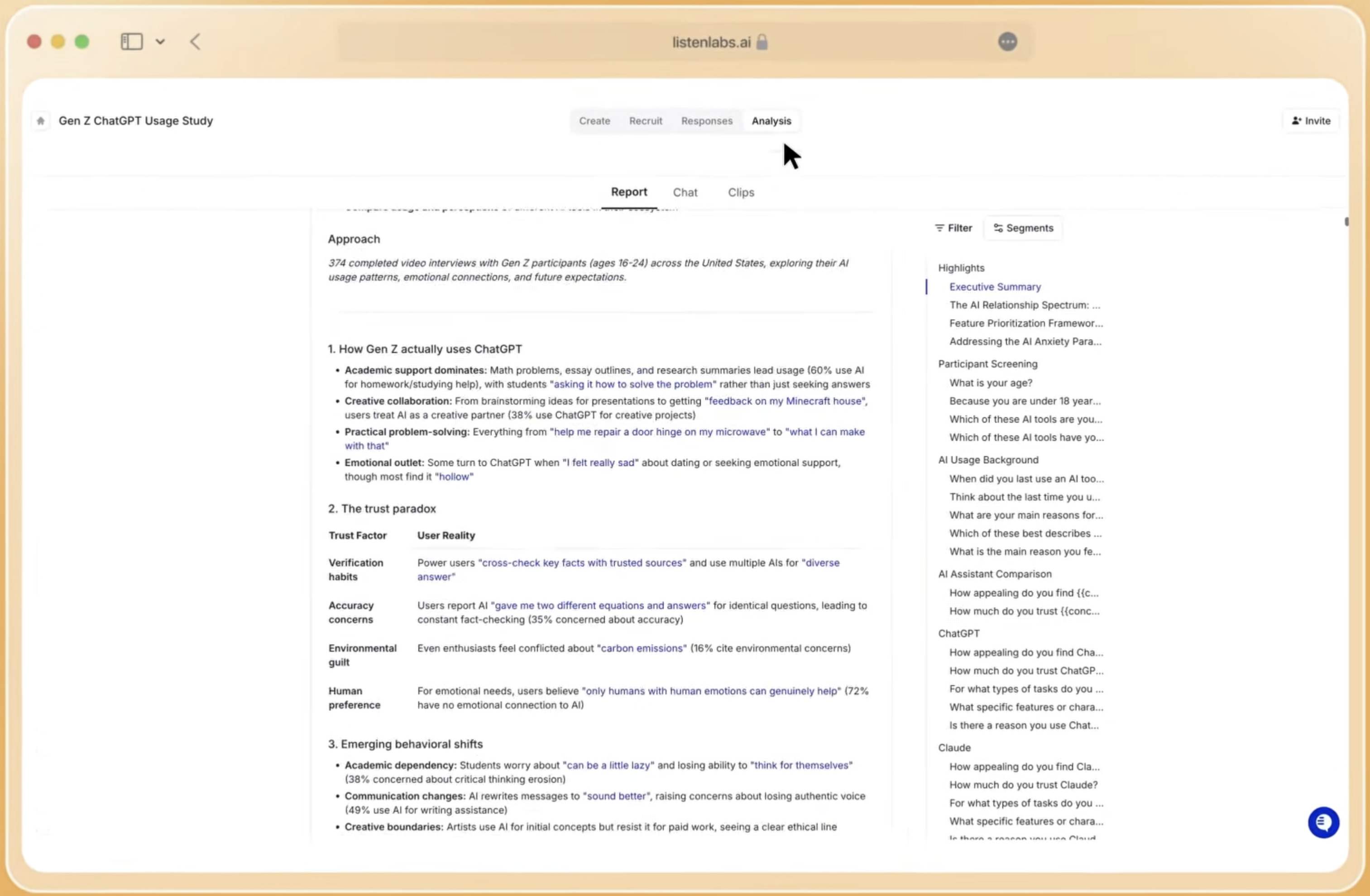
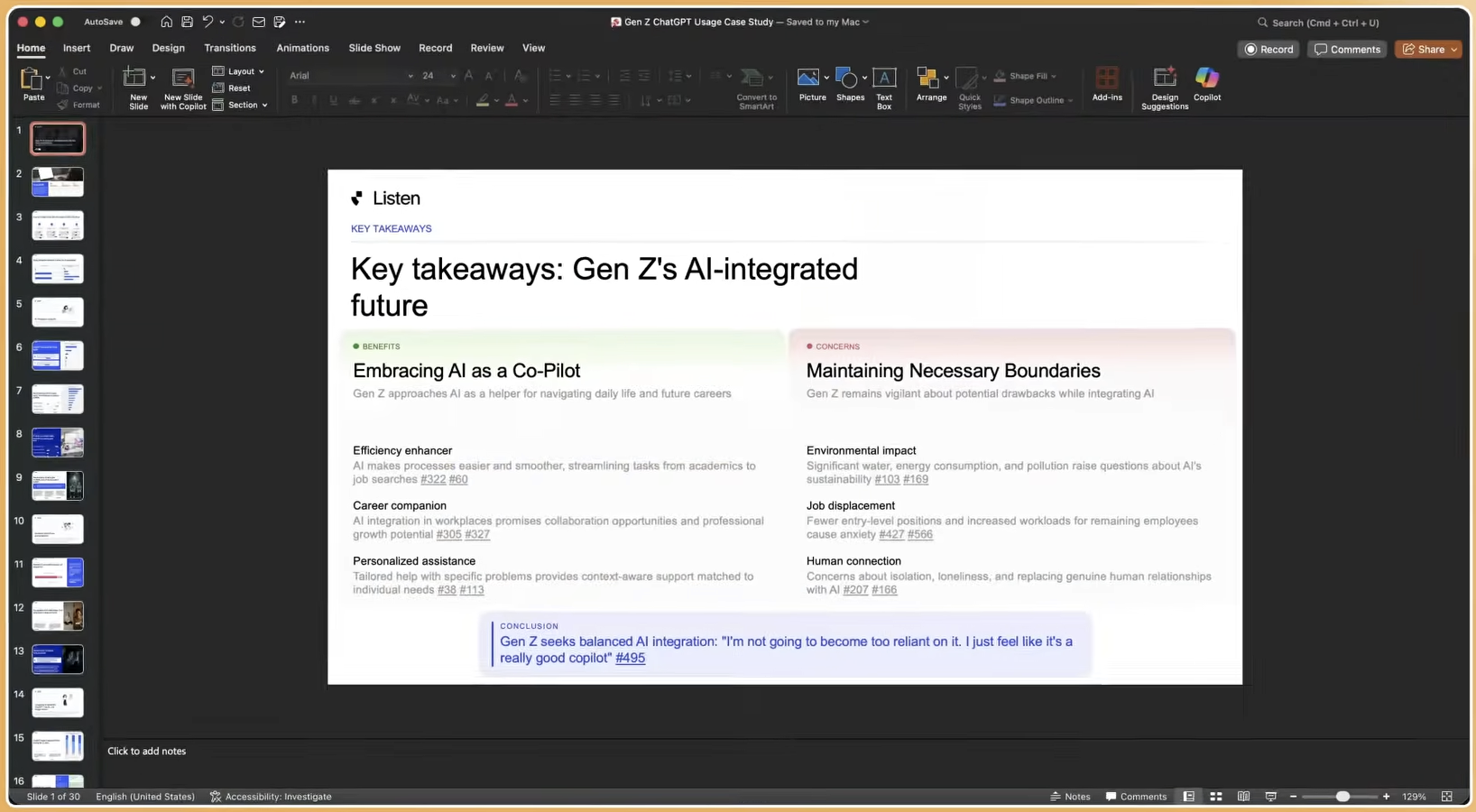
Listen Labs’ Research Agent handles the full analysis workflow from raw data to final output, producing automated key findings, theme analysis, segmentation breakdowns, and statistical comparisons. One researcher ran a full buying intent analysis across three user segments in under a minute. The platform generates branded slide decks, memo-style reports, and video highlight reels on demand, which cuts the time between data collection and stakeholder presentation from days to minutes.
Retail teams that run repeated studies across global markets gain compounding value from strong knowledge management. Listen Labs’ Mission Control acts as a cross-study repository, so teams can query findings from past research in natural language, track sentiment trends over time, and avoid re-running questions that already have clear answers. Each new study expands the knowledge base instead of sitting in isolation.
Best-Fit Scenarios for Different Retail Teams
The evaluation criteria and category comparisons above translate into distinct best-fit scenarios based on team structure, study volume, and research objectives. Match your organization to the scenarios below to see which platform category will deliver the highest return.
- Enterprise insights groups at Fortune 500 retailers and CPG companies that run 20+ studies per year gain most from end-to-end AI platforms that remove vendor fragmentation, compress cycle times, and build institutional knowledge across studies. Listen Labs has run over 1 million AI-powered customer interviews for enterprises including Microsoft, Perplexity, and Sweetgreen, which shows proven scale at the Fortune 500 level.
- Mid-market brands without dedicated research teams need self-serve simplicity and AI-assisted study design that non-researchers can run confidently.
- UX and product teams validating digital commerce experiences or app flows benefit from screen-sharing, rapid participant recruitment, and the ability to test with 50–100+ users instead of the 5–10 typical of manual scheduling.
- Agencies and consultancies running client research on compressed timelines need global reach, niche audience access, and turnaround measured in days rather than weeks.
Ready to see qual-at-scale in action for your retail insights program? Schedule a qual-at-scale demo with the Listen Labs team.
Operational Considerations and Common Risks
New research infrastructure only succeeds when stakeholders across insights, IT, legal, and procurement align on requirements. Enterprise security and compliance standards are non-negotiable for retail organizations that handle consumer data at scale. Listen Labs holds SOC 2 Type II, GDPR, ISO 27001, ISO 27701, and ISO 42001 certifications, uses 256-bit encryption, and maintains a policy against using customer data for AI model training.
Change management also shapes outcomes when teams shift away from agency relationships or fragmented tool stacks. Teams should plan a pilot period that compares output quality against existing benchmarks before committing to platform-wide adoption.
Several objective limitations cut across the category landscape, and teams should factor them into platform evaluations. Rigid survey methods produce shallow data that cannot surface unexpected findings or emotional nuance, which limits their value for exploratory work. Recruitment complexity often gets underestimated for low-incidence audiences such as premium shoppers in specific geographies or category-exclusive buyers, which usually requires dedicated operations support instead of simple self-serve panels.
Fraud risk in commodity panels remains high without multi-layer verification, so panel source and fraud controls become critical procurement criteria. Automation capabilities now remove the old trade-off between depth and scale, yet they do not replace the need for researchers to interpret findings in business context. Strategic judgment remains a human responsibility.
Decision Framework and Practical Checklist
This decision checklist helps teams move from general evaluation to a concrete platform choice that aligns with the best-fit scenarios above.
- Define the maximum acceptable time from study brief to stakeholder-ready findings. If that threshold is under 48 hours, only end-to-end AI platforms reliably meet it.
- Clarify whether the study needs adaptive follow-up questions to uncover motivations or whether a fixed question set is enough. Adaptive moderation requires AI-led or human-led interviews, not surveys.
- Estimate the target audience incidence rate. Audiences below 5% incidence need dedicated recruitment operations rather than basic self-serve panel access.
- Confirm whether the study must run across multiple languages or markets at the same time. Validate language coverage and localization capabilities before selecting a platform.
- Decide if emotional-signal capture is required for campaign pre-testing or concept comparison. Check whether the platform analyzes tone, expression, and word choice, or only transcripts.
- List the enterprise security certifications required by legal and IT. Confirm SOC 2, GDPR, and ISO compliance before procurement.
- Assess whether your team needs cross-study knowledge management or runs each study as a standalone project. Repository and trend-tracking capabilities matter most for continuous insight programs.
- Calculate total cost of ownership, including platform fees, recruitment, analyst time, and vendor management. Compare that figure against the full cost of the current fragmented stack, not just the platform license.
Frequently Asked Questions
How quickly can AI platforms deliver retail shopper insights compared with traditional methods?
Traditional qualitative research cycles in retail and CPG often run 4–6 weeks from study design to final report, and in large enterprises with internal prioritization backlogs, timelines can stretch to several months. End-to-end AI interview platforms compress this to less than 24 hours by automating study design, participant recruitment, interview moderation, analysis, and deliverable generation within a single platform. This speed difference determines whether insights arrive in time to influence an assortment decision, a campaign launch, or a product iteration cycle. Listen Labs has delivered global customer research for enterprise clients within a single business day, including multi-market studies with translation and localization across more than 100 languages.
What participant quality controls matter most for assortment and campaign testing?
Three layers of quality control matter most for retail research. First, panel source quality reduces the risk of professional survey-takers and incentive-driven responses that distort findings, so high-quality platforms work only with verified, non-commodity panel sources. Second, real-time fraud detection during interviews, across video, voice, content, and device signals, catches low-effort responses and mismatched profiles that pre-screening alone misses. Third, participant frequency limits prevent panel fatigue and repeat respondents from skewing data.
Listen Labs caps participation at three studies per month per respondent and applies a reputation scoring system that improves as more studies run on the platform. For niche retail audiences such as premium shoppers, category-exclusive buyers, or regional segments, a dedicated recruitment operations team adds a human review layer that self-serve panels cannot match.
Can AI-moderated interviews capture emotional signals that surveys miss?
AI-moderated interviews can capture emotional signals that surveys overlook, which matters in campaign pre-testing and concept evaluation. Two concepts may receive identical average ratings while generating very different emotional responses, such as genuine enthusiasm versus polite but flat reactions. Surveys and rigid questionnaires only record self-reported ratings and cannot detect these gaps. The Emotional Intelligence capability described earlier addresses this gap by analyzing tone, expression, and word choice together instead of relying on ratings alone, and it keeps emotional labels auditable through links to timestamps and verbatim quotes.
How do global language and compliance requirements affect retail research programs?
Multi-market retail research programs must balance native-language interviewing with strict data privacy and security rules in each jurisdiction. On the language side, Listen Labs supports more than 100 languages for interview moderation with automatic translation and transcription, so retail teams can run simultaneous studies across North America, Europe, APAC, and MEA without juggling separate regional vendors. On the compliance side, enterprise-grade certifications such as SOC 2 Type II, GDPR, ISO 27001, ISO 27701, and ISO 42001 are often prerequisites for procurement approval at large retailers.
Teams should verify that any platform under consideration holds current certifications across all relevant frameworks, not just a subset, and confirm that customer data is not used for AI model training, which many retail and CPG enterprise agreements now require.
Conclusion: Turning Evaluation into Action for Retail Timelines
Retail insights teams can now resolve the speed-versus-depth trade-off by matching their constraints to the right platform category. Traditional agencies still deliver strong quality but cannot compress timelines or scale across dozens of simultaneous studies. Survey tools still scale efficiently but sacrifice the adaptive, conversational depth that assortment validation and campaign pre-testing need. Point solutions still address single steps without solving the full workflow.
End-to-end AI platforms instead connect study design, participant recruitment, AI-moderated interviews, emotional-signal analysis, and stakeholder-ready deliverables into a cycle measured in hours. The enterprise scale demonstrated earlier, with more than 1 million interviews for Fortune 500 clients, shows that qual-at-scale depth and enterprise controls can coexist.
Teams ready to move from evaluation to execution can see 24-hour retail insights delivery in a Listen Labs demo and translate this framework into a concrete research roadmap.