
Written by: Anish Rao, Head of Growth, Listen Labs
Key Takeaways for Enterprise Research Leaders
- Traditional consumer insights workflows force a trade-off between depth and scale. Studies often take 4–6 weeks or longer because of sequential processes and internal approvals.
- Enterprise teams now expect platforms that deliver time-to-insight in under 48 hours while still maintaining qualitative depth, sample quality, and fraud prevention across global audiences.
- Listen Labs tackles recruitment, moderation, and analysis through AI orchestration, real-time Quality Guard monitoring, and Emotional Intelligence that captures tone, word choice, and micro-expressions.
- The Research Agent automates analysis and deliverables, linking every insight to source data, while Mission Control serves as a searchable institutional knowledge base across all studies.
- Listen Labs helps enterprise teams clear research backlogs by compressing full research cycles into under 24 hours; see the platform in action to understand how this works in practice.
How Enterprise Teams Evaluate Consumer Insights Platforms
Enterprise research stacks in 2026 span five broad categories: traditional research agencies and consultancies, quantitative survey tools, panel and recruitment platforms, analysis and repository tools, and emerging end-to-end AI interview platforms. Each category solves a different slice of the research problem, and most enterprises currently use several simultaneously, which creates delay, cost, and quality risk.
A rigorous evaluation framework must reflect what enterprise teams prioritize when replacing legacy research infrastructure. Based on procurement patterns across Fortune 500 organizations, the following criteria determine platform fit and map to the sections below:
- Research speed and time-to-insight (Study Setup and Recruitment)
- Depth of qualitative insight (Moderation Approach and Qualitative Depth)
- Sample quality and fraud prevention (Study Setup and Recruitment)
- Participant sourcing and global reach (Study Setup and Recruitment)
- Methodological flexibility (Moderation and Decision Framework)
- Language support (Moderation Approach and Qualitative Depth)
- Analysis effort and bias reduction (Analysis Workflow, Deliverables, and Knowledge Management)
- Reporting transparency and traceability (Analysis Workflow, Deliverables, and Knowledge Management)
- Security, governance, and compliance (Operational and Long-Term Considerations)
- Scalability and total operational burden (All sections, with emphasis on Decision Framework)
The 2026 benchmark for time-to-insight in enterprise consumer insights for AI-moderated qualitative interviews is 48 hours from study brief to complete deliverables. Platforms that cannot meet this benchmark create structural bottlenecks regardless of their other capabilities.
The following sections apply this criteria framework across the research lifecycle, starting with how quickly a platform can move from study brief to live interviews.
Study Setup and Recruitment Speed for Global Samples
Traditional research agencies rely on a briefing process, internal scoping, and manual recruitment operations before a single interview begins. Recruitment alone can take several weeks for standard studies, and multi-market studies with global interviews can take longer because of coordination and translation requirements.
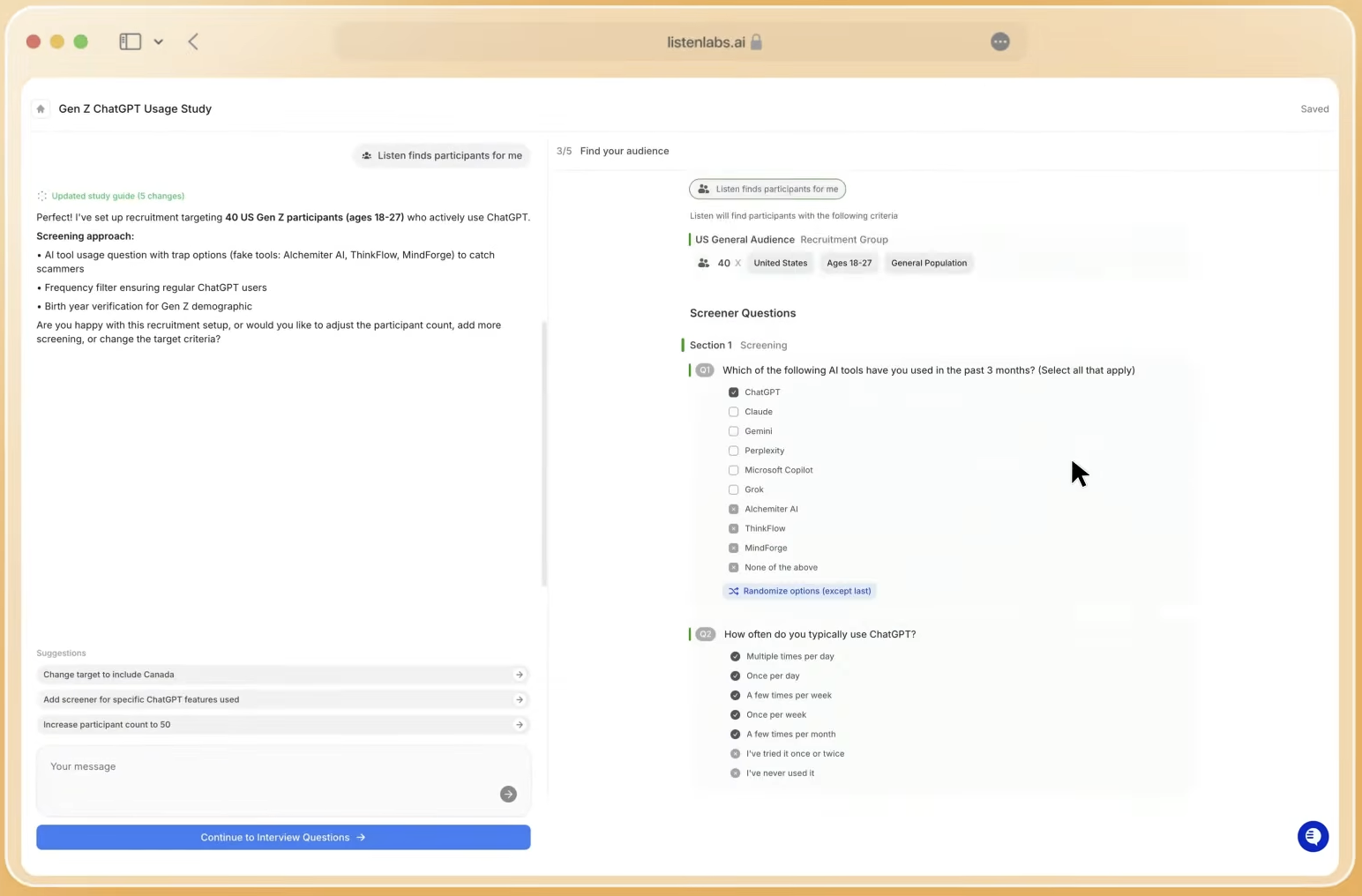
Quantitative survey tools offer faster setup but depend on commodity panels that carry significant quality risk. Without active controls, 20–40% of online panel completes contain some form of quality problem, ranging from mild inattention to organized fraud rings and AI-generated responses. These problems are increasingly difficult to catch because standard survey attention checks, the primary defense in legacy platforms, are now often passable by AI agents, which makes traditional fraud detection methods unreliable.
Panel and recruitment platforms such as Prolific, User Interviews, and Respondent solve the sourcing problem but hand off to separate tools for moderation, transcription, and analysis. Each handoff introduces delay and quality risk. UserTesting panel renewals dropped 31% year-over-year in 2026 as enterprise teams shifted toward integrated AI moderation alternatives.
Listen Labs addresses recruitment through a three-layer system. Listen Atlas, an AI orchestration layer, matches and sources participants across its network of 30M verified respondents spanning 45+ countries and 100+ languages. Quality Guard then monitors every interview in real time across video, voice, content, and device signals to detect fraud, low-effort responses, and repeat respondents, with participants limited to three studies per month to eliminate professional survey-takers. For segments that automated matching cannot reach, a dedicated recruitment operations team handles hard-to-reach audiences such as enterprise decision-makers, healthcare workers, and sub‑1% incidence segments without requiring a separate vendor relationship. Listen Labs compresses end-to-end qualitative research timelines to under 24 hours at roughly one-third the cost of traditional methods.
Moderation Approach and Qualitative Depth at Scale
Human moderation from traditional agencies produces high-quality individual interviews but does not scale for modern enterprise demand. A team of three researchers cannot complete 60 studies per year under traditional manual moderation because each study requires substantial human effort for moderation, transcription, and synthesis. Focus groups add further distortion: group dynamics, dominant voices, and social desirability bias systematically alter what participants say. Traditional focus groups cost $4,000–$12,000 per 90-minute session and take 3–5 weeks to complete.
Quantitative survey tools replace moderation with pre-set questions. This structure removes the follow-up probing that surfaces unexpected findings, emotional nuance, and the reasoning behind stated preferences. Teams receive data that explains what respondents chose but not why they chose it.
UserTesting uses a human-dependent moderation model that limits the number of parallel sessions and constrains turnaround time. The platform was not designed for conversational depth at the scale enterprise programs now require.
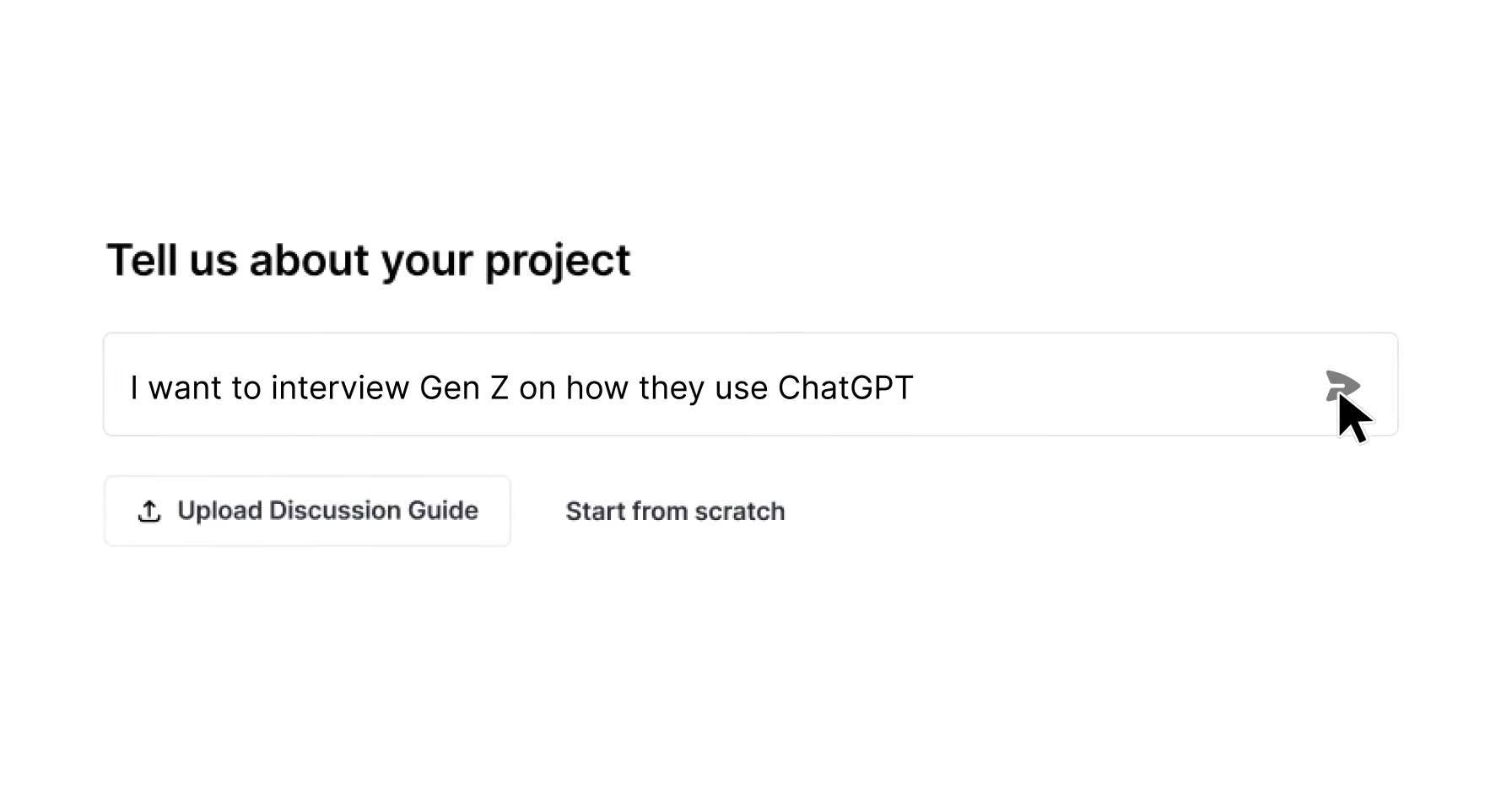
Listen Labs conducts AI-moderated interviews that adapt in real time and probe deeper on short or interesting answers the same way a trained human interviewer would. 92% of participants report top comfort levels in AI-moderated sessions, equivalent to human-moderated sessions, with AI preferred for sensitive topics including personal finances, politics, and mental health. With qual-at-scale, the old trade-off between depth and scale no longer applies. Hundreds of personalized, adaptive interviews run simultaneously, which delivers the statistical confidence of large samples alongside the rich detail of one-on-one conversations.
Listen Labs’ Emotional Intelligence layer adds a dimension no survey tool or transcript-based platform captures. It analyzes three signals, tone of voice, word choice, and subconscious micro expressions, to surface emotions that transcripts alone miss. Every emotion is quantified per question and concept, with every label traceable to the exact timestamp, verbatim quote, and AI reasoning behind it. The framework is built on Ekman’s universal six emotions framework, the same standard used in clinical psychology and UX research, and is available across 50+ languages.
Analysis Workflow, Deliverables, and Knowledge Management
Traditional agency analysis relies on manual review, which is time-consuming and subject to confirmation bias. Analysts may unconsciously emphasize findings that confirm pre-existing hypotheses. Analysis and reporting often account for a significant portion of a standard traditional research cycle.
Analysis and repository tools such as Dovetail organize research that has already been conducted elsewhere. These tools reduce the effort of synthesizing past studies but do not conduct new research, source participants, or generate deliverables from raw interview data. They address the knowledge management problem without addressing the backlog problem.
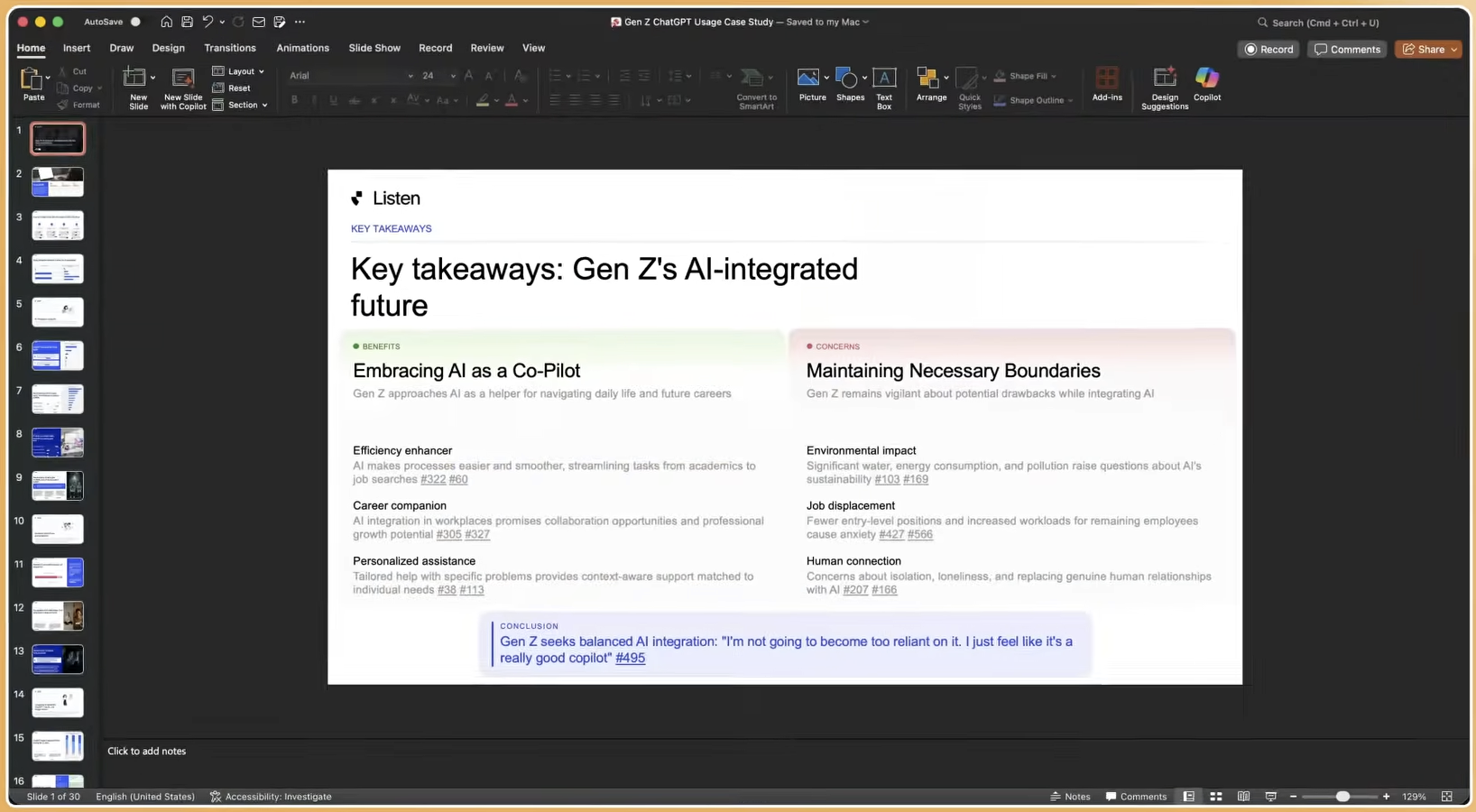
Listen Labs’ Research Agent handles the full analysis workflow from raw interview data to final output. Every insight links directly to the underlying response data, which maintains full traceability. One researcher ran a full buying intent analysis across three user segments in under a minute. One-click deliverables include consultant-quality slide decks, memo-style reports, video highlight reels, statistical charts, and segmentation breakdowns, all generated without manual report writing.
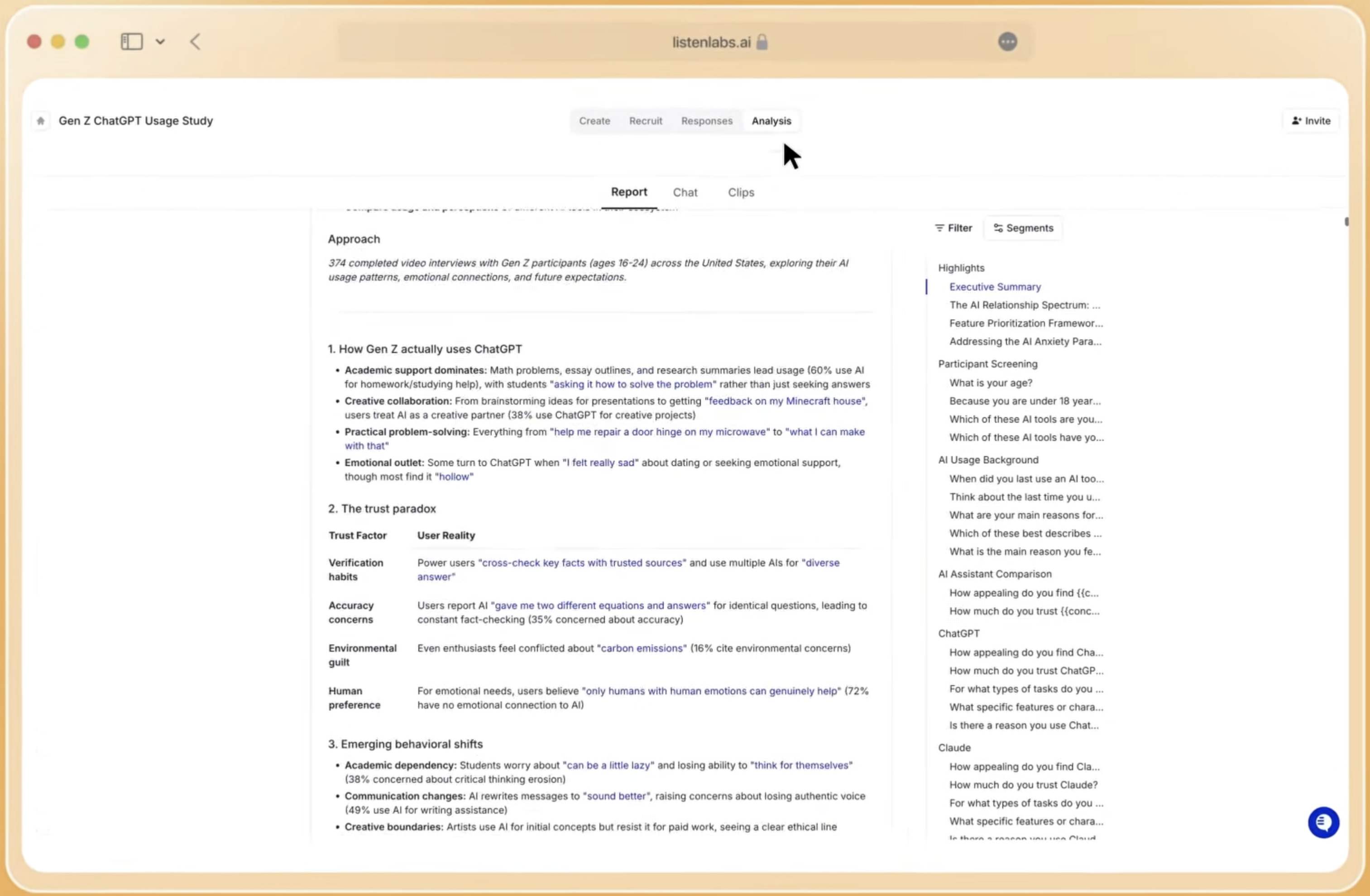
Mission Control serves as the organization’s source of truth for everything learned from customers across all studies. Cross-study queries return answers from past research in seconds, which eliminates repeated re-researching of questions that institutional knowledge loss causes. Each new study compounds the knowledge base rather than sitting in a disconnected slide deck.
Teams that replaced a survey-and-panel stack with conversational AI research platforms achieved significant net tooling savings while increasing study throughput. These savings come from consolidating recruitment, moderation, analysis, and knowledge management into a single workflow.
Best-Fit Use Cases by Team Type
This section translates the capability evaluation into practical applications for different teams. The examples below illustrate how specific organizations use Listen Labs to meet their research goals.
Consumer Insights Leaders at Fortune 500 enterprises managing growing research backlogs benefit most from Listen Labs’ end-to-end platform. The ability to run concept testing, brand research, shopper insights, and customer feedback studies in under two days without adding headcount directly addresses the core constraint. A Director of Data Science at Microsoft noted: “I can reach out to hundreds of users at one third of the cost.” Anthropic’s Director of Product Strategy used Listen Labs to surface churn drivers from 300+ user interviews in 48 hours, five times faster than previous methods. P&G delivered 250+ interviews with quantified themes and verbatim proof in hours to shape product and brand strategy before market launch.
UX research leads at mid-to-large technology companies gain faster feedback loops for sprint cycles. Screen-sharing and usability testing capabilities, combined with Emotional Intelligence that catches hesitation and frustration participants do not verbalize, replace the logistical overhead of scheduling and moderating individual sessions. Robinhood used Listen Labs to identify that users who view prediction markets as entertainment drive 2.4x higher weekly re-engagement, delivering insights five times faster than prior methods.
Product managers and marketing leaders without dedicated research teams can describe research goals in natural language and have the platform handle study design, recruitment, moderation, and analysis automatically. Skims validated campaign direction with thousands of high-income buyers overnight, which eliminated weeks of recruiting and enabled board-level buy-in before launch.
Agencies and consultancies operating under client timelines measured in days rather than weeks use Listen Labs to reach niche audiences such as enterprise decision-makers, engineers, and healthcare workers without building bespoke recruitment operations for each engagement. These firms package Listen Labs outputs into their own strategic recommendations.
Operational and Long-Term Considerations for Enterprise Rollout
Enterprise-scale adoption requires more than feature comparison. Stakeholder alignment across research, product, brand, legal, and IT is a prerequisite for successful deployment. Listen Labs holds SOC 2 Type II, GDPR, ISO 27001, ISO 27701, and ISO 42001 certifications, with enterprise SSO support and 256-bit encryption. Customer data is never used for AI model training. Enterprise consumer insights platforms must meet these baseline security and compliance requirements to pass procurement review at Fortune 500 organizations.
Repeatability matters for ongoing programs and connects directly to the scalability and operational burden criteria. Listen Labs supports continuous customer intelligence programs, not just one-off studies, with trend tracking, cross-study queries through Mission Control, and the ability to clone past study designs. The Quality Guard reputation scoring system compounds over time. The more studies conducted on the platform, the stronger the audience quality becomes, which creates a flywheel that point solutions and commodity panels cannot replicate.
AI-moderated interview platforms saw a 312% year-over-year increase in spend in 2026, becoming the fastest-growing category in research tooling, while enterprise buyers cut average seat counts for legacy CXM platforms by 38%. This directional shift in enterprise investment reflects a structural reassessment of what a research platform needs to deliver.
Risks, Limitations, and Common Misconceptions
Rigid survey methods produce shallow data. Pre-set questions with no adaptive follow-up cannot surface unexpected findings, and the absence of probing means analysts work with what respondents chose to say rather than what they actually mean. This limitation is structural, not a function of sample size.
Manual workflows create turnaround risk independent of platform quality. A platform that conducts excellent interviews but requires human analysis and manual report writing will still produce a multi-week cycle. Speed requires automation across the full workflow, not just one stage.
Recruitment complexity is frequently underestimated. Sourcing verified participants for niche audiences, particularly B2B decision-makers and low-incidence consumer segments, requires infrastructure that panel-only platforms do not provide. Responses about the same product category can differ substantially between standard panel respondents and verified B2B decision-makers, which makes participant quality a direct determinant of insight quality.
Faster tools do not automatically produce better research. Speed without methodological rigor produces fast, wrong answers, which is why Listen Labs’ approach starts with research expertise rather than pure engineering optimization. The platform is built by researchers with 50+ years of combined in-house expertise, and the study design, moderation logic, and analysis engine reflect that foundation. The Research Agent’s outputs link to underlying response data, which makes every finding auditable rather than opaque.
Automation does not eliminate the need for research expertise. Listen Labs functions as a force multiplier for existing research teams, enabling them to run more studies with the same headcount while focusing on strategic interpretation rather than logistics.
Decision Framework for Selecting a Research Platform
Traditional research agencies fit highly sensitive, legally complex, or methodologically novel studies where bespoke human expertise is the primary requirement and turnaround time is not a constraint. These agencies do not fit teams managing backlogs or needing repeatable, scalable output.
Quantitative survey tools fit large-scale structured data collection where depth is not required and the research question has a known answer space. These tools do not fit concept testing, brand perception, shopper insights, or any use case where the underlying why matters.
Panel and recruitment platforms fit as a sourcing layer when a team already has moderation and analysis infrastructure. They do not fit as a standalone solution for teams that need end-to-end workflow coverage.
Analysis and repository tools fit organizing and querying past research. They do not address the backlog problem and do not replace a research execution platform.
End-to-end AI interview platforms, and Listen Labs specifically, fit enterprise teams that need to run consumer insights, customer feedback, concept testing, product testing, brand research, user research, or shopper insights at scale with verified participants, rapid turnaround, traceable deliverables, and institutional knowledge management. Listen Labs has run over 1 million AI-powered customer interviews for companies including Microsoft, Perplexity, and Sweetgreen and is trusted by enterprises including Google, Sony, Anthropic, P&G, Skims, Levi’s, Robinhood, and Nestlé.
Frequently Asked Questions
How long does it take to get results from Listen Labs?
Listen Labs delivers results in under 24 hours because the platform runs study design, participant recruitment, AI-moderated interviews, analysis, and deliverables as a single integrated workflow rather than sequential handoffs. Traditional qualitative research takes 4–6 weeks for standard studies and up to 12 weeks for multi-market studies. Enterprise internal approval processes can extend that further, which makes integrated automation a meaningful advantage.
How does Listen Labs source and verify participants?
Listen Labs sources participants through Listen Atlas, which uses AI to match study requirements against 30M verified respondents. The platform works with high-quality, non-commodity panel partners and maintains a proprietary participant database, covering 45+ countries and 100+ languages. A dedicated recruitment operations team handles hard-to-reach segments including enterprise decision-makers, healthcare workers, and audiences below 1% incidence rate. Organizations can also bring their own participants from their user base at reduced cost.
What prevents fraudulent or low-quality respondents from entering a study?
Quality Guard applies real-time monitoring across video, voice, content, and device signals throughout every interview to detect fraud, low-effort responses, AI-generated scripts, and mismatched profiles. Participants are limited to three studies per month, which eliminates professional survey-takers. Listen Labs does not use commodity quantitative panels. A dedicated recruitment operations team adds a human review layer. The Quality Guard reputation scoring system compounds across every study conducted on the platform, so audience quality improves over time as a structural advantage.
How is AI moderation different from a survey or a human interviewer?
Surveys use pre-set questions with no ability to follow up or probe. Human interviewers are skilled but cannot conduct hundreds of simultaneous sessions, and quality varies across moderators. Listen Labs’ AI conducts personalized, adaptive conversations that probe deeper on short or interesting answers in real time, similar to a trained human interviewer, while running at scale across hundreds of parallel sessions. Emotional Intelligence adds a layer that neither surveys nor transcripts provide through analysis of tone of voice, word choice, and subconscious micro expressions to surface emotions that participants do not explicitly state.
What deliverables does Listen Labs produce, and how quickly?
The Research Agent generates automated key findings and theme analysis, consultant-quality PowerPoint slide decks, memo-style reports, video highlight reels, statistical charts and comparisons, segmentation breakdowns, and custom reports based on natural-language queries in under a minute from completed interview data. Every insight links to the underlying response data for full traceability. Mission Control stores all findings across studies, which enables cross-study queries and trend tracking so teams can access institutional knowledge in seconds without searching through past reports.
Conclusion
The consumer insights platform decision in 2026 no longer requires a choice between depth and scale, speed and quality, or automation and rigor. The right platform removes all three trade-offs at once. The evaluation criteria that matter, including research speed, sample quality, fraud prevention, qualitative depth, emotional intelligence, analysis transparency, global reach, and governance, point consistently toward end-to-end AI interview platforms as the appropriate infrastructure for enterprise consumer insights programs.
Listen Labs delivers consultant-quality insights in under 24 hours, sources verified participants from a 30M+ global network, conducts adaptive AI-moderated interviews with built-in Emotional Intelligence, and generates traceable deliverables through the Research Agent within a single platform that meets enterprise security and compliance requirements. Enterprises that have already made this shift, including Microsoft, Anthropic, P&G, Skims, and Robinhood, run more research, faster, with the same teams.