Written by: Anish Rao, Head of Growth, Listen Labs
Key Takeaways
- Brand awareness erosion is the gradual loss of mental availability, which differs from simple name recognition and usually appears months or years before revenue declines.
- Five measurable drivers fuel erosion: information overload, media fragmentation, short-term marketing pressure, declining distinctiveness of brand assets, and the gap between claimed and actual recall.
- Each driver requires a specific diagnostic lens, from attention-threshold metrics to Fame and Uniqueness scores for brand assets.
- A five-step measurement framework using baseline mental availability, continuous conversational tracking, emotional-intelligence signals, on-screen behavioral observation, and cross-study synthesis detects erosion early enough to reverse it.
- Listen Labs is the only platform that executes all five steps end-to-end in under 24 hours; see how continuous AI-moderated tracking surfaces and explains erosion before it reaches sales.
Driver 1: Information Overload and Attention Scarcity
The volume of content competing for consumer attention has reached a structural ceiling. Around 85% of digital ads fail to reach the 2.5-second attention-memory threshold needed to create memory, while US adults will spend 13 hours and 26 minutes per day with media in 2026 across fragmented, stacked, and ambient attention patterns. Most content now appears in clipped, skimmed, or second-screened form, so only a small share receives focused attention. A 2026 systematic review of 146 peer-reviewed studies confirmed that this fragmentation prevents memory encoding: when information overload exceeds cognitive capacity, even high-volume exposure fails to create recall. When a brand message does not clear the attention threshold, no memory encoding occurs, and recall erodes regardless of impression volume.
Diagnostic question: What percentage of your media placements achieve sufficient active viewing time to generate measurable brand memory, and how does that figure trend quarter over quarter?
Driver 2: Media Fragmentation and Share of Voice Loss
Media fragmentation spreads audience attention across more surfaces than any single media plan can saturate. Eighty-four percent of purchases worldwide are driven by preexisting brand bias, and this influence does not fall below 70% across shopping categories, while research from the Ehrenberg-Bass Institute shows that brands grow by building and maintaining mental availability through broad and repeated exposure. Fragmentation compounds the attention problem from Driver 1: when media budgets stretch across too many surfaces, effective frequency per surface falls below the threshold required for memory formation. A decline in Share of Voice first appears as reduced mental presence, with fewer people thinking of the brand and fewer conversations including it, before it compounds into reduced consideration and eventual market share loss. The beauty category illustrates this pattern clearly: the Morning Consult May 2026 Category Advantage study found that legacy mass brands lost an average of 15 to 24 points of awareness among Gen Z across fragrance, skincare, haircare, and makeup as budgets spread thin while digitally native brands concentrated where Gen Z attention lives.
Diagnostic question: Across which surfaces does your brand maintain sufficient Share of Voice to stay within reach of memory, and which surfaces represent gaps where a competitor is building mental availability you are ceding?
Driver 3: Short-Term Marketing Pressure on Brand Equity
Short-term financial metrics, accelerated by digital analytics, AI, and real-time dashboards, now dominate decision-making and quietly erode brand equity, according to David Aaker, Vice Chairman at Prophet. The financial impact is measurable: Interbrand’s Best Global Brands 2024 report found that prioritizing short-term performance tactics over long-term brand investment equated to $200 billion in lost revenue potential for the world’s top 100 brands in the 12 months preceding publication, and at least $3.5 trillion in cumulative unrealized brand value since 2000. Recent industry reports show that a growing share of marketing budgets now flows to short-term performance tactics while the brand-building portion has declined, which inverts the 60/40 split that Les Binet and Peter Field’s IPA research identifies as optimal for sustained market share growth. This inversion is not random; real-time dashboards make short-term tactics easy to defend in quarterly reviews while long-term brand investment appears less tangible, creating a structural bias toward the very tactics that erode mental availability over time.
Diagnostic question: What share of your marketing investment builds future mental availability versus capturing intent that already exists, and how has that ratio shifted over the past three years?
Driver 4: Declining Distinctiveness of Brand Assets
Byron Sharp and the Ehrenberg-Bass Institute have shown that distinctive brand assets create mental availability only when teams repeat them consistently over time; inconsistency causes gradual erosion of brand equity without obvious early signals. When brands rotate visual identities, refresh sonic logos, or adapt tone of voice to platform-specific trends, they weaken the associative links that connect category entry points to brand memory. The Morning Consult May 2026 skincare data illustrates the downstream consequence: leading mass skincare brands carry an Awareness–Mental Market Share gap, which indicates that consumers recognize the brand but do not surface it when a purchase need arises. Recognition without retrieval signals eroded distinctiveness and shows that assets no longer trigger the brand at the moment of choice.
Diagnostic question: For each of your distinctive brand assets, what is its Fame score, meaning the percentage of category buyers who link the asset to your brand, and its Uniqueness score, meaning the exclusivity of that link, and how have both trended over the past four quarters?
Driver 5: The Say-Do Gap Between Claimed and Actual Brand Recall
Standard brand tracking surveys measure what consumers report about their awareness and preferences, not what they actually do when a purchase need arises. The gap between stated and behavioral recall remains structurally invisible to survey-only trackers. Morning Consult’s 2026 skincare research found that trending brands such as The Ordinary, Drunk Elephant, and Glow Recipe remain far below second-tier mass brands in Mental Market Share despite strong cultural attention, which aligns with a pattern where consumers claim awareness of culturally salient brands while defaulting to established brands at the point of purchase. AI-moderated brand tracking interviews with CPG and retail brands found that awareness gains most commonly masked perception erosion, with consumers knowing the brand but trusting it less than twelve months prior. Survey data reported awareness as stable, while behavioral and emotional signals revealed a different story beneath the surface.
Diagnostic question: Where in your research program do you observe actual consumer behavior alongside stated recall, and what mechanism exists to detect contradictions between the two in real time?
See the platform in action to understand how Listen Labs detects all five drivers simultaneously in a single continuous tracking program.
A Five-Step Measurement Framework for Detecting and Reversing Erosion
Understanding the five drivers is necessary but not sufficient; detecting them before they reach sales requires a measurement framework designed to surface each mechanism as it begins to operate. The following framework addresses each driver with a specific methodological requirement. Step 1 establishes the baseline needed to detect Driver 4, declining distinctiveness, and Driver 5, the say-do gap. Step 2 catches Driver 2, media fragmentation, and Driver 3, short-term pressure, as they erode mental availability over time. Steps 3 and 4 isolate Driver 5 by comparing stated and observed behavior. Step 5 synthesizes all signals to detect Driver 1, information overload, patterns across waves. No single step is sufficient in isolation, and the five steps function as an integrated diagnostic system.
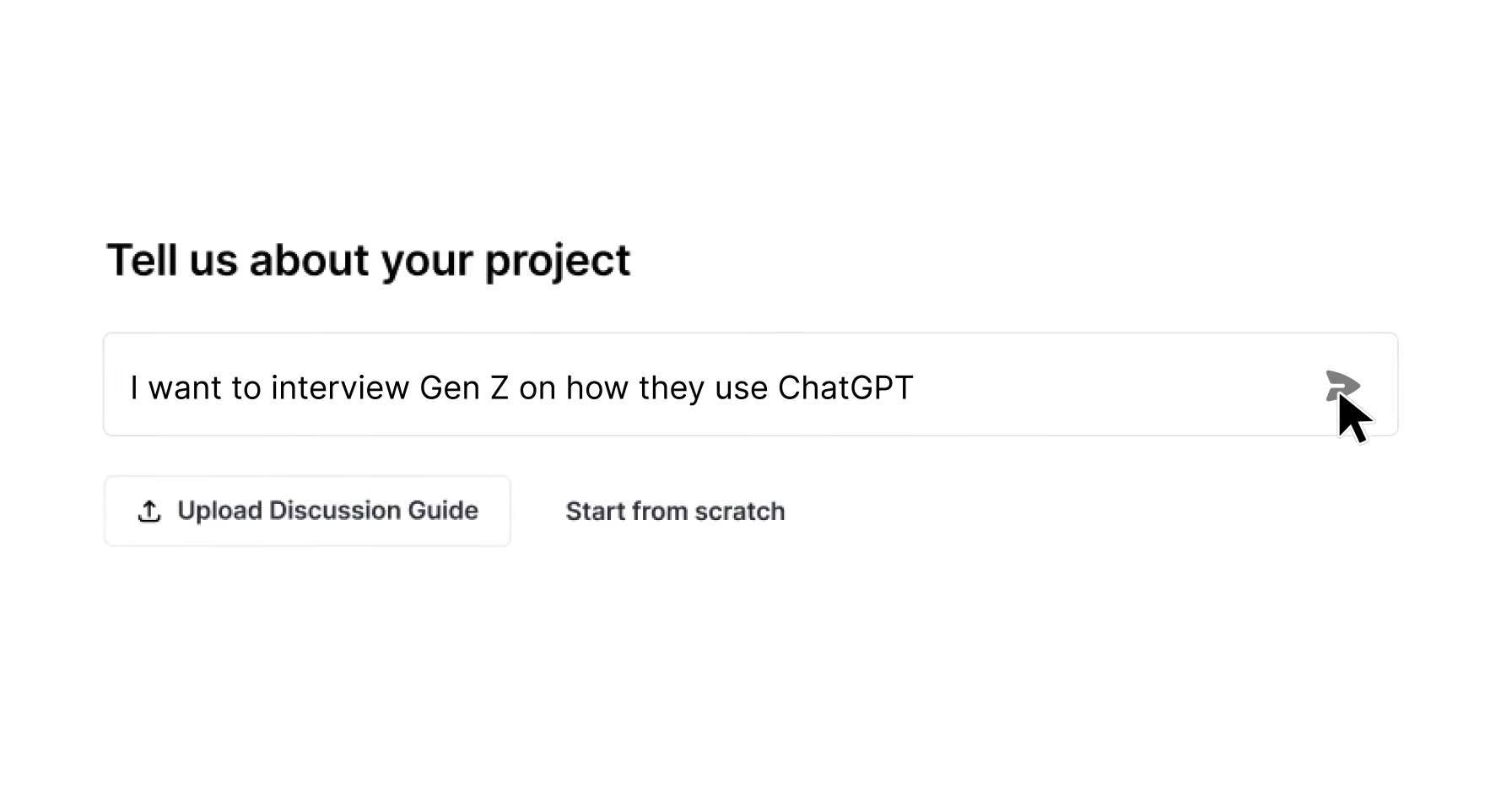
- Establish baseline mental availability. Teams must define a clear starting point before they can track erosion. A baseline study maps Mental Market Share, Network Size, and Category Entry Point (CEP) coverage for the brand and its named competitor set. Research shows that the number of links category buyers can make to a brand correlates with purchase likelihood, which makes CEP coverage the most commercially consequential metric in the baseline. The baseline requires large-sample qualitative depth, with enough respondents to produce statistically stable CEP scores by segment and market, and verbatim responses that reveal the language consumers use to describe category entry points. Listen Labs conducts hundreds of AI-moderated video interviews in under 24 hours, which generates the sample depth required for a defensible baseline without the four to six week timeline of traditional qualitative research.
- Run continuous conversational tracking. A 2-point decline in consideration that appears as noise within the margin of error in a single annual wave becomes a detectable declining trend across four consecutive quarterly waves and reaches revenue impact within 6–12 months. Continuous tracking requires wave-over-wave consistency in question wording, screener criteria, and audience definition, combined with open-ended conversational questions that surface the reasoning behind metric movements. Listen Pulse keeps core questions constant to protect the trend line while adding timely questions for new campaigns and competitors, and charts emerging themes directly alongside the KPIs teams already report, so the metric change and its explanation arrive in the same wave.
- Incorporate emotional-intelligence signals. Stated perceptions and emotional responses represent different data points that often diverge. A consumer can report positive brand sentiment while displaying micro-expressions of confusion or contempt during a brand stimulus. Listen Labs’ Emotional Intelligence analyzes tone of voice, word choice, and subconscious micro-expressions across more than 50 languages, built on Ekman’s universal emotions framework. Every emotion label is quantified per question and concept and is traceable to the exact timestamp, verbatim quote, and reasoning behind it, so brand teams can identify the precise moment and stimulus that triggered a negative emotional response, not just that one occurred.
- Isolate the say-do gap via on-screen observation. Closing the gap between claimed and actual brand recall requires direct observation of behavior, not only recording of statements. Visual Insights enables the AI Interviewer to observe on-screen behavior during the interview and probe contradictions in real time. When a participant’s stated preference diverges from their observed action, the moderator catches it and asks follow-up questions in the moment rather than following a pre-written script past the contradiction. A video model writes a timestamped, second-by-second log of every meaningful on-screen change, which produces quantified behavioral data that teams can compare across sessions and trace to the exact moment behind each metric.
- Use cross-study synthesis in a living research library. Individual tracking waves produce point-in-time findings, while institutional knowledge compounds only when findings from every wave and every adjacent brand study are queryable together. Research Library searches every study an organization has ever run simultaneously and returns synthesized answers in natural language, with every answer traced back to the original study, discussion guide, screener, and individual respondent. Teams can track how specific CEP associations evolve across waves, identify when a competitor first began gaining ground on a particular attribute, and validate whether a proposed new study repeats a question the organization has already researched.
Why Only One Platform Meets All Five Requirements Simultaneously
Each step in the framework imposes specific methodological requirements, including large-sample qualitative depth, real-time adaptive moderation, emotional-intelligence analysis traceable to verbatim clips, on-screen behavioral observation with real-time intervention, and cross-study synthesis with full source attribution. Traditional brand trackers satisfy the quantitative consistency requirement but provide no diagnostic for why metrics move. Qualitative agencies provide depth but cannot operate at the sample size or speed required for continuous tracking. Analysis repositories organize past research but do not conduct new research. No platform other than Listen Labs executes all five requirements end-to-end in under 24 hours.
Listen Labs conducts hundreds of adaptive, video-based interviews simultaneously from its network of more than 50 million verified respondents across over 45 countries and more than 120 languages. Quality Guard monitors every interview in real time for fraud, low-effort responses, and repeat respondents. The Research Agent generates consultant-quality deliverables such as slide decks, memos, highlight reels, and statistical charts in under a minute. Listen Pulse deploys alongside an existing tracker or as the primary tracking system and integrates with Qualtrics and Decipher, so teams keep the KPIs they already report while adding the narrative behind them. The entire system compounds over time, as every study strengthens Research Library, every wave of Pulse refines the trend line, and every emotional-intelligence label adds to the organization’s understanding of how consumers feel about the brand at the moment of stimulus, not just what they say about it afterward.
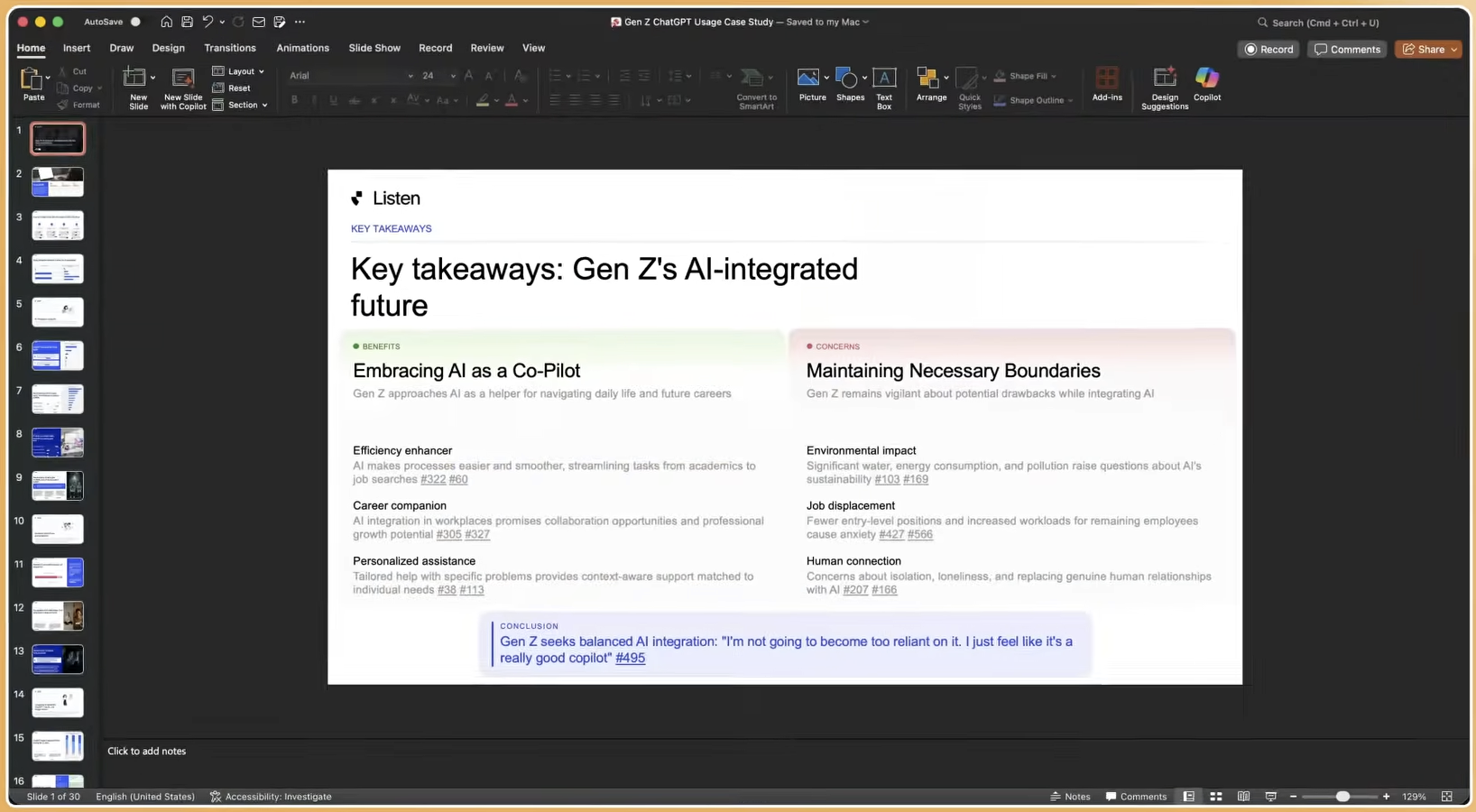
One well-known clothing brand, famous for its big logos, was quietly losing customers. Its existing tracker caught the drop but could not explain it. Listen Pulse found the cause: a growing group of customers felt the big logos were too loud for their changing lifestyles. The insight revealed a style identity shift rather than price sensitivity, which a quantitative-only tracker had no mechanism to surface.
Downloadable Measurement Checklist for Brand Tracking Leaders
The five-step framework above translates into a repeatable operational checklist for VPs of Consumer Insights and Heads of Brand who need to audit their current tracking program against each methodological requirement. To receive the checklist and discuss how Listen Labs maps to your existing research infrastructure, schedule a conversation with the Listen Labs team.
Frequently Asked Questions
Does continuous AI-moderated brand tracking produce data quality comparable to human-moderated studies?
Listen Labs AI-moderated interviews generate responses three times longer than the industry average through intelligent probing, which mirrors the adaptive follow-up behavior of skilled human moderators. Quality Guard applies real-time monitoring across video, voice, content, and device signals to detect and eliminate fraudulent responses, low-effort answers, and AI-generated scripts before they enter the dataset. Participants are limited to three studies per month, which removes professional survey-takers from the pool. The platform is built by a team with over 50 years of combined research expertise and has conducted more than one million AI-moderated interviews since launch, serving enterprises including Procter and Gamble, Microsoft, and Nestlé. For brand tracking specifically, Listen Pulse maintains strict wave-over-wave consistency in question wording, screener criteria, and audience definition, which provides the methodological foundation that makes time-series comparison valid.
How does Listen Labs handle privacy and compliance for continuous brand-tracking data?
Listen Labs maintains enterprise-grade security with 256-bit encryption and holds SOC 2 Type II, ISO 27001, ISO 27701, and ISO 42001 certifications. The platform is GDPR compliant and supports enterprise SSO. Listen never trains its AI models on customer data, so research findings, verbatim quotes, video recordings, and emotional-intelligence labels generated from your studies remain exclusively yours. For organizations operating across multiple markets, Listen Labs covers more than 45 countries and supports over 120 languages for interview moderation, with automatic translation and transcription, so compliance requirements can be addressed at the local level without fragmenting the global tracking program.
Can Listen Labs integrate with our existing brand tracker rather than replacing it?
Listen Pulse deploys alongside an existing tracker or as the primary tracking system. It integrates directly with Qualtrics and Decipher, so the quantitative KPIs your organization already reports, such as awareness, consideration, favorability, and NPS, continue uninterrupted. Pulse adds open-ended conversational questions to every wave and charts the emerging themes those conversations surface directly next to the KPIs, so the metric movement and its explanation arrive together rather than requiring a separate qualitative study to diagnose a number that already moved. Core questions stay constant to protect the trend line, while timely add-on questions address new campaigns, competitors, or news events without breaking historical comparability.
Are emotional-intelligence labels traceable to the specific verbatim clips that generated them?
Every emotional-intelligence label produced by Listen Labs is traceable to the exact timestamp, verbatim quote, and the reasoning behind the classification. The system analyzes three layers of signal simultaneously, including tone of voice, word choice, and subconscious micro-expressions, using Ekman’s universal emotions framework, the same standard used in clinical psychology and UX research. For brand tracking, this means a team can identify not only that confusion spiked during a specific brand stimulus but can click through to the precise moment in the interview recording where the expression occurred, read the verbatim statement the participant made at that timestamp, and review the reasoning the system used to classify the emotion. The Research Agent surfaces emotionally significant moments through natural-language queries, and highlight reels of those moments can be generated in under a minute for stakeholder presentations.
Conclusion: Act Before Erosion Reaches Sales
Brand awareness erosion is not a single event. It is the cumulative result of five measurable mechanisms, including information overload, media fragmentation, short-term marketing pressure, declining distinctiveness of brand assets, and the say-do gap between claimed and actual recall, operating simultaneously and compounding over time. An Ehrenberg-Bass Institute study tracking competitive brands over 20 years found average sales declines of 16% after one year of reduced media presence and 25% after two years, and the rate of decline was fastest for brands already in retreat before the erosion began. The five-step framework using baseline mental availability, continuous conversational tracking, emotional-intelligence signals, on-screen behavioral observation, and cross-study synthesis provides the diagnostic infrastructure to detect each mechanism before it reaches the sales line.
The Listen Labs platform delivers on all five requirements, with hundreds of adaptive video interviews from a verified global panel, real-time emotional-intelligence analysis traceable to verbatim clips, on-screen behavioral observation with real-time intervention, and a queryable research library that compounds institutional knowledge across every wave. The result is a continuous, defensible, and actionable brand-tracking program that tells you not only that a number moved but why it moved and what to do before it moves further.
See how Listen Labs detects and reverses brand awareness erosion before it reaches your sales data.