Written by: Anish Rao, Head of Growth, Listen Labs
Key Takeaways
- Traditional qualitative research timelines of 4–6 weeks lag behind compressed CPG product cycles and create growing research backlogs.
- AI-moderated interviews at scale deliver 400–800 conversations per project with verified participants, cutting turnaround to same-day results while maintaining depth.
- Seven high-value CPG use cases, including concept testing, packaging validation, creative testing, brand tracking, usage studies, innovation research, and competitive intelligence, benefit from AI-moderated video interviews with Emotional Intelligence.
- Effective implementation depends on clear study design, quality-controlled recruitment from 30M+ verified respondents, real-time fraud detection, and automated delivery of reports, slide decks, and highlight reels.
- Listen Labs enables CPG teams to run always-on consumer intelligence programs that compound institutional knowledge; see how to compress your next study from weeks to hours.
Replacing Slow Qualitative Cycles with AI-Moderated Interviews
The shift from traditional qualitative research to AI-moderated interviews compresses the entire research lifecycle into a single end-to-end platform rather than replacing qualitative methods outright. Listen Labs handles study design, global participant recruitment from a network of 30M+ verified respondents, AI-moderated video interviews with dynamic follow-up questions, automated analysis, and delivery of consultant-quality reports, slide decks, and video highlight reels, all inside one workflow.
With qual-at-scale, the old trade-off between depth and scale no longer blocks fast decision-making. The AI schedules and conducts interviews, analyzes transcripts for themes, and generates quantitative insights from qualitative conversations. Qual-at-scale works best when research needs large sample sizes or broad geographic reach, because AI tools engage hundreds or thousands of participants remotely and asynchronously.
The seven use cases below show where CPG consumer insights teams gain the most value from this shift.
1. Concept Testing for New CPG Ideas
Business objective: Validate new product concepts before committing development investment, and identify which concepts resonate and why.
AI capability: AI-moderated interviews combine verbatim consumer reactions with rating scales to measure emotional resonance and purchase likelihood at the same time. The AI probes deeper on hesitation, confusion, or enthusiasm and captures the reasons behind a score that a survey cannot reach.
Data inputs: Product concept descriptions, visual stimuli, prototype images, or video demonstrations shown directly within the interview interface using monadic or sequential randomization.
Measurable outcome: For CPG concept testing, AI-moderated interviews with verified purchasers deliver comparative preference data within a single working day. Procter & Gamble used Listen Labs to conduct 250+ interviews evaluating how men respond to new product claims, surfacing where claims felt exaggerated or unclear before market, and delivering quantified themes with verbatim proof that directly shaped product and brand strategy in hours instead of weeks.
2. Packaging and Claims Validation Before Production
Business objective: Confirm that packaging design and on-pack claims communicate intended benefits clearly and compliantly before production runs.
AI capability: Digital mockups appear within the interview, and the AI probes for first impressions, comprehension of claims, and purchase triggers. This approach preserves nuance that self-completion surveys flatten into simple ratings.
Data inputs: Packaging mockups as images or PDFs, competitive shelf sets, and specific claims language for evaluation.
Measurable outcome: Packaging research in AI-moderated video interviews compresses timelines compared with traditional multi-week studies. A mid-size CPG brand running a packaging refresh on a $400M salty snacks line faced 4–6 week turnarounds for traditional ad-hoc qualitative follow-up. AI-moderated confirmation waves completed the same validation in under 48 hours, enabling the team to finalize packaging before the production deadline.
3. Creative and Ad Testing with Emotional Signals
Business objective: Evaluate advertising creative, campaign messaging, and brand communications before committing media spend.
AI capability: Video, audio, or image stimuli appear directly in the interview. The AI captures moment-by-moment reactions, probes for confusion or disengagement, and quantifies emotional response across creative variants using Emotional Intelligence. It analyzes tone of voice, word choice, and micro-expressions to surface signals that transcripts alone miss.
Data inputs: Ad cuts, storyboards, animatics, or finished creative assets shown in sequential or monadic rotation.
Measurable outcome: Ad and message testing with AI-moderated video interviews delivers results in days instead of the multi-week cycles common with traditional methods. Two ads may both receive positive ratings, yet Emotional Intelligence reveals which one triggered genuine delight versus flat or confused expressions, so teams avoid investing in creative that scores well but underperforms in market.
4. Brand Perception and Health Tracking in Real Time
Business objective: Monitor brand equity dimensions such as quality, trust, value, premium, and relevance continuously rather than in quarterly waves that arrive long after fieldwork closes.
AI capability: Automated theme extraction from unstructured interview data, sentiment shift detection on core equity dimensions, and competitive attribution modeling that quantifies brand equity overlap by comparing consumer language across rivals.
Data inputs: Rolling waves of 50–200 AI-moderated interviews per week with verified category purchasers, structured around consistent equity dimensions to enable longitudinal comparison.
Measurable outcome: Traditional CPG syndicated brand trackers can be costly with multi-week turnaround times. AI analytics platforms compress both cost and timeline by automating data collection and analysis. Continuous tracking detects a packaging-driven drop in the “premium” equity dimension with supporting verbatims within two weeks of launch, compared to 6–8 weeks for a syndicated wave, which gives teams a 4–6 week advantage to course-correct before a full quarter of sales data arrives.
5. Usage and Attitude Studies at Category Depth
Business objective: Understand how consumers actually use a product category, which occasions drive purchase, and which attitudinal barriers or motivators shape behavior.
AI capability: AI-moderated interviews apply consistent 5–7 level laddering across every conversation without moderator fatigue, so teams reach core motivations rather than surface opinions. Thirty-plus minute AI-moderated conversations produce richer need-state maps than survey instruments by using 5–7 level laddering to uncover motivations beyond surface-level responses.
Data inputs: Category usage screeners, occasion-based prompts, and product interaction tasks conducted asynchronously across geographies.
Measurable outcome: Usage and attitude studies with AI-moderated interviews benefit from the same timeline compression as other qual-at-scale work. AI-moderated research lets CPG teams complete usage testing rounds in days, enabling two or three iteration cycles within the same planning window that previously held a single round.
6. Innovation and White-Space Identification for Pipelines
Business objective: Surface unmet consumer needs and category white space so 12–18 month innovation pipelines rely on consumer evidence rather than internal assumptions.
AI capability: Large-sample AI-moderated interviews surface edge cases and emerging need-states that small-sample traditional studies often miss. Larger sample sizes enabled by AI reveal patterns that would remain invisible in limited qualitative work.
Data inputs: Open-ended exploration of category occasions, unmet needs prompts, and competitive product reactions across consumer segments and markets.
Measurable outcome: Product innovation research for CPG often uses 100–200 annual interviews with category users to identify unmet needs and white space opportunities, feeding 12–18 month innovation pipelines with consumer evidence. AI-powered tools have accelerated research, concept development, or full innovation cycles by 60–70% or more for CPG companies such as Reckitt, Coca-Cola, and L’Oréal.
7. Competitive and Category Intelligence from Live Voices
Business objective: Understand how consumers perceive competitor brands, identify switching triggers, and detect category shifts before they appear in sales data.
AI capability: Competitive attribution modeling quantifies brand equity overlap by comparing consumer language across rivals. AI-moderated interviews capture unprompted competitive references and probe switching behavior with adaptive follow-up questions that a structured survey cannot replicate.
Data inputs: Competitive brand stimuli, category usage patterns, and switching occasion prompts across target consumer segments.
Measurable outcome: Anthropic used Listen Labs to identify where former users migrate and what triggers switching, delivering a prioritized list of must-fix items in 48 hours, the same compression advantage that enabled P&G’s concept testing work. AI-powered brand tracking demonstrates stronger predictive accuracy than traditional methods for forecasting how shifting consumer perceptions will affect CPG sales.
Implementation Checklist for Running Studies on Listen Labs
Successful implementation follows four sequential phases. Study design translates your research question into a structured interview guide. Recruitment then sources the right participants from verified panels or your own user base. Quality controls ensure every interview meets depth and authenticity standards. Finally, deliverables package findings into formats stakeholders can use immediately.
Study Design
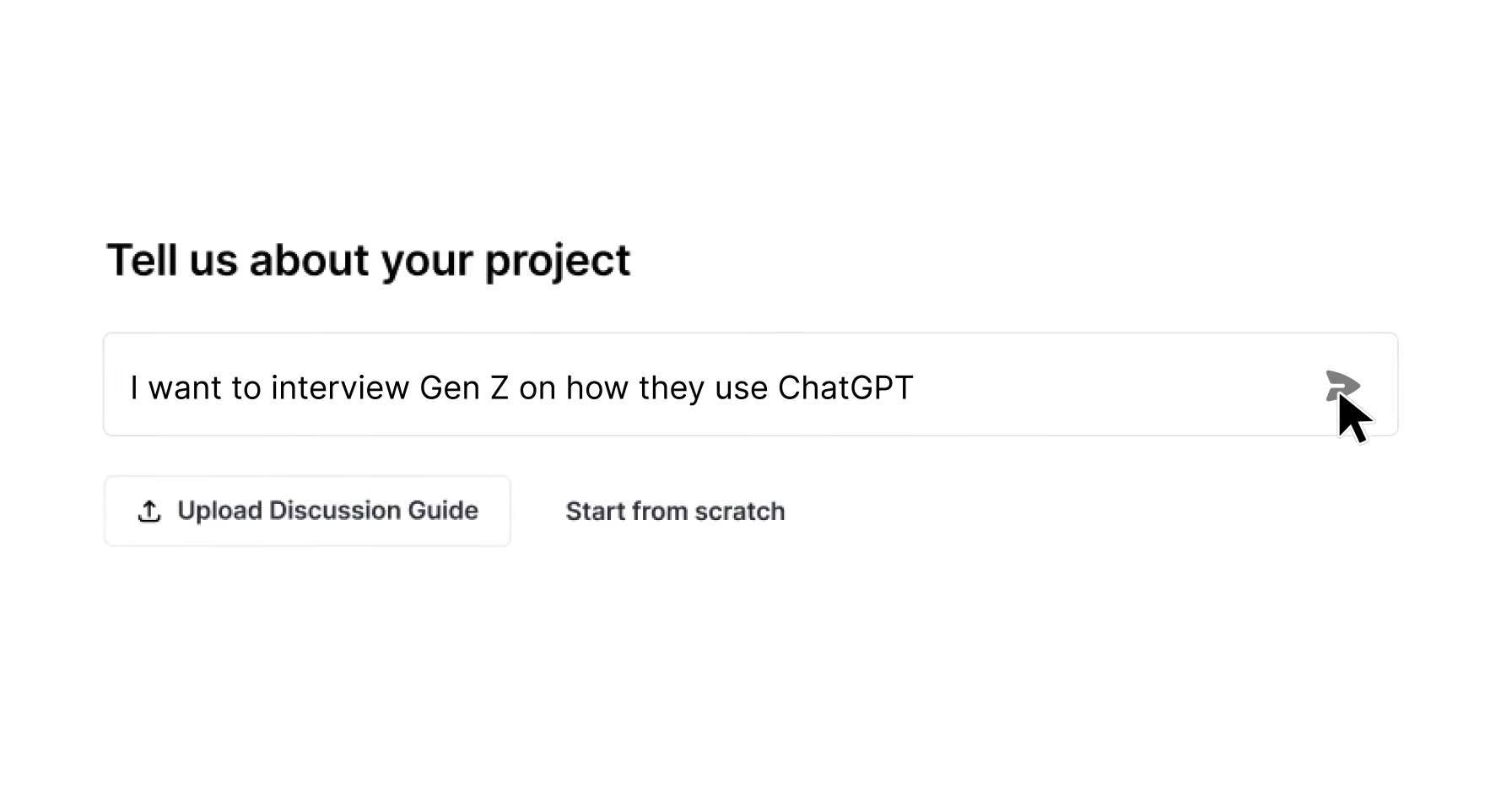
- Define the research objective in one sentence before opening the platform, so the AI co-design tool generates relevant questions.
- Use AI-assisted study co-design to draft structured objectives, questions, and probing context from your natural-language brief.
- Select stimuli format (images, video, audio, PDFs, prototypes, or live URLs) based on what participants need to evaluate.
- Configure monadic or sequential randomization, quotas, branching, and skip logic to control how stimuli appear and which participants see each variant.
- Run Auto-QA to flag issues in the study guide before launch, catching logic errors or unclear prompts that would compromise data quality.
Recruitment
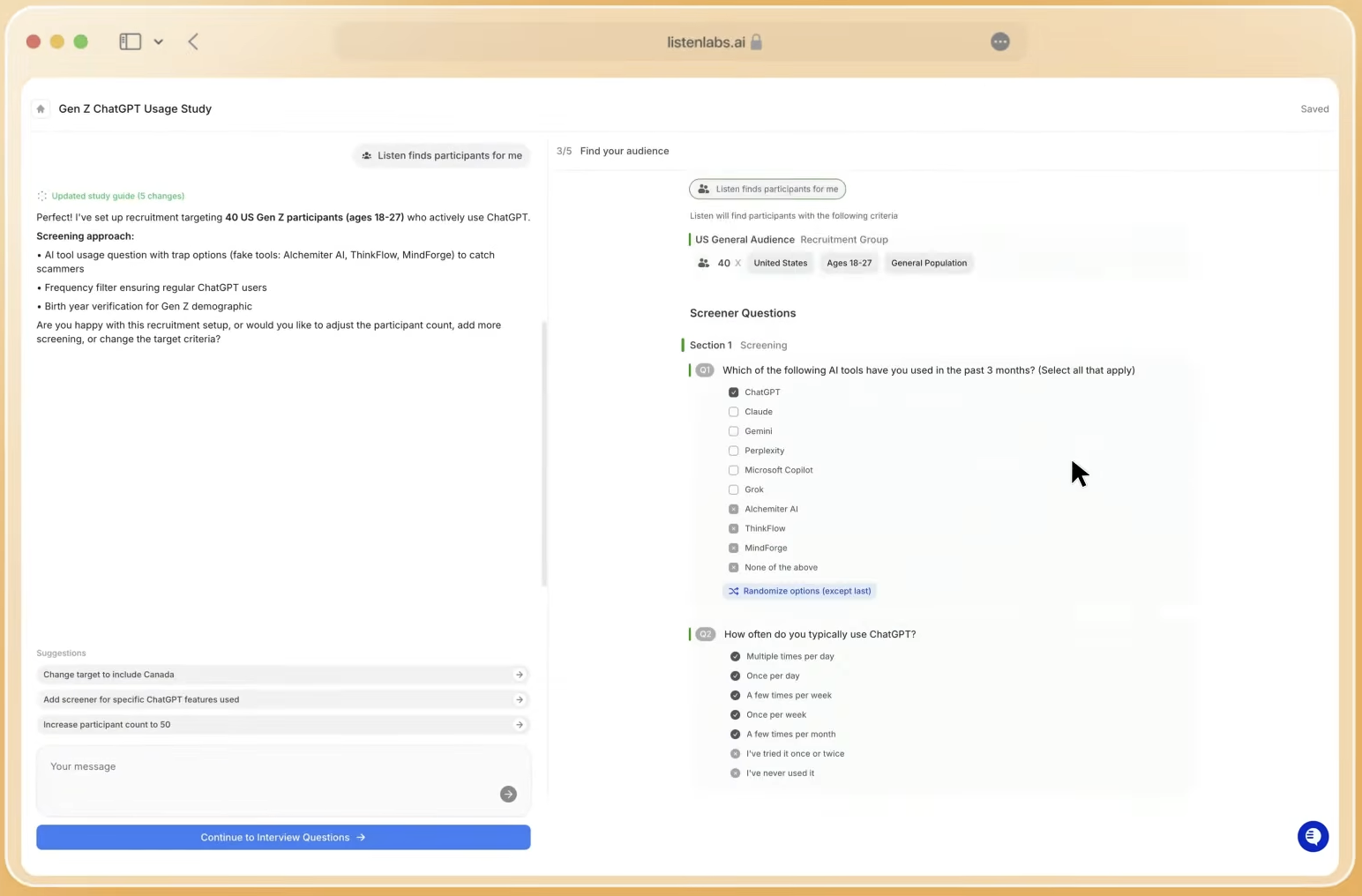
- Define the target audience by behavioral and intent signals, not only demographics, to match real purchase behavior.
- Specify incidence rate and engage dedicated recruitment operations for audiences below 1% incidence.
- Choose between Listen Labs’ 30M+ verified panel, self-recruitment from your own user base, or a combination that balances reach and cost.
- Set quotas by segment, geography, and language to ensure representative coverage across 45+ countries.
Quality Controls
- Activate Quality Guard for real-time monitoring across video, voice, content, and device signals.
- Confirm participant frequency limits are enforced, with a maximum of three studies per month per participant.
- Review behavioral matching criteria to eliminate professional survey-takers and fraudulent profiles.
- Set minimum interview length and depth thresholds, and count only interviews that pass these standards.
Deliverables
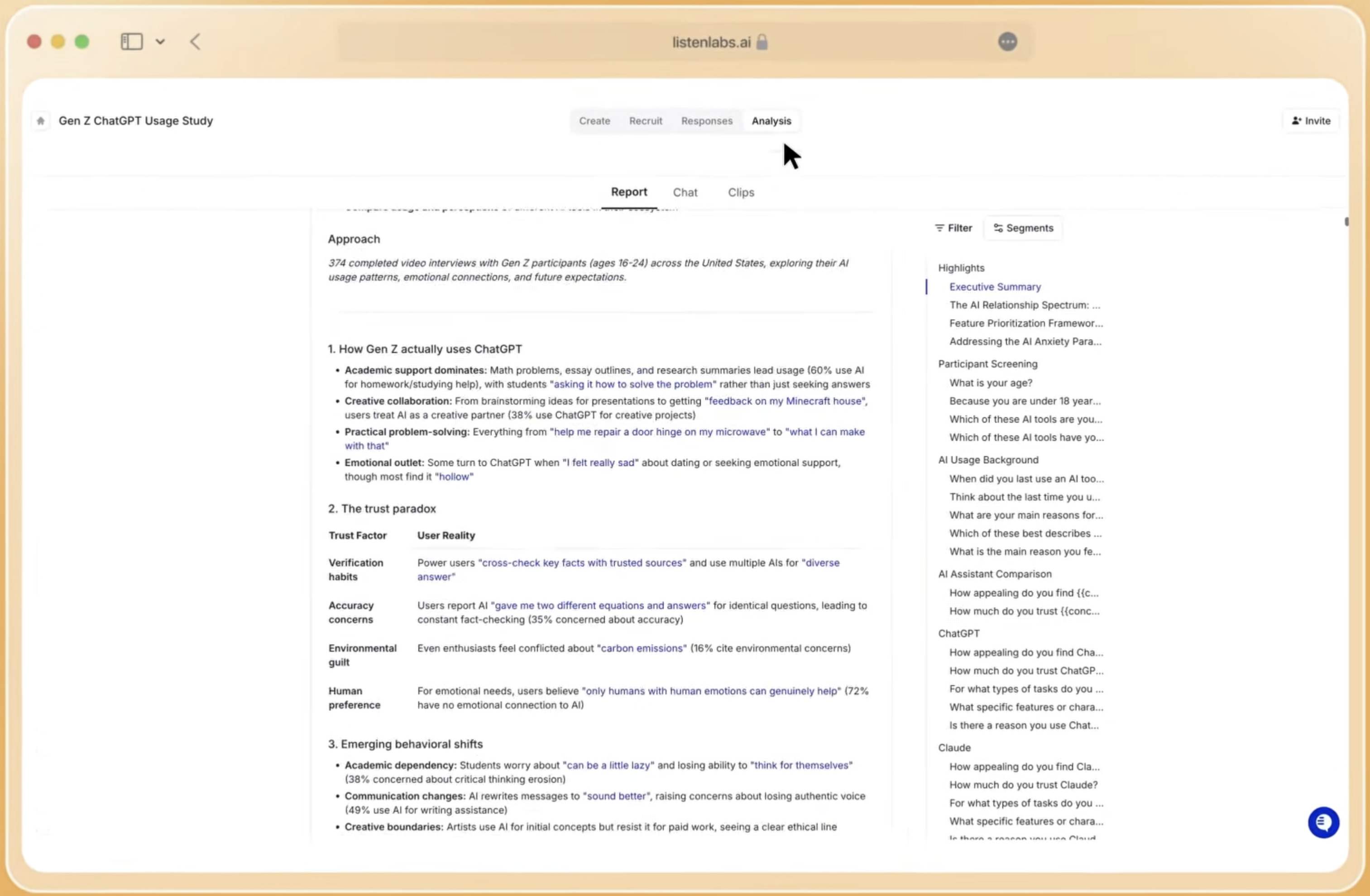
- Generate automated key findings, themes, and personas from interview data.
- Receive consultant-quality PowerPoint slide decks and memo-style reports via the Research Agent.
- Create video highlight reels of the most significant moments, including emotionally flagged timestamps.
- Access statistical charts, segmentation breakdowns, and custom reports via natural-language queries.
- Store all study data in Mission Control for cross-study queries and longitudinal tracking.
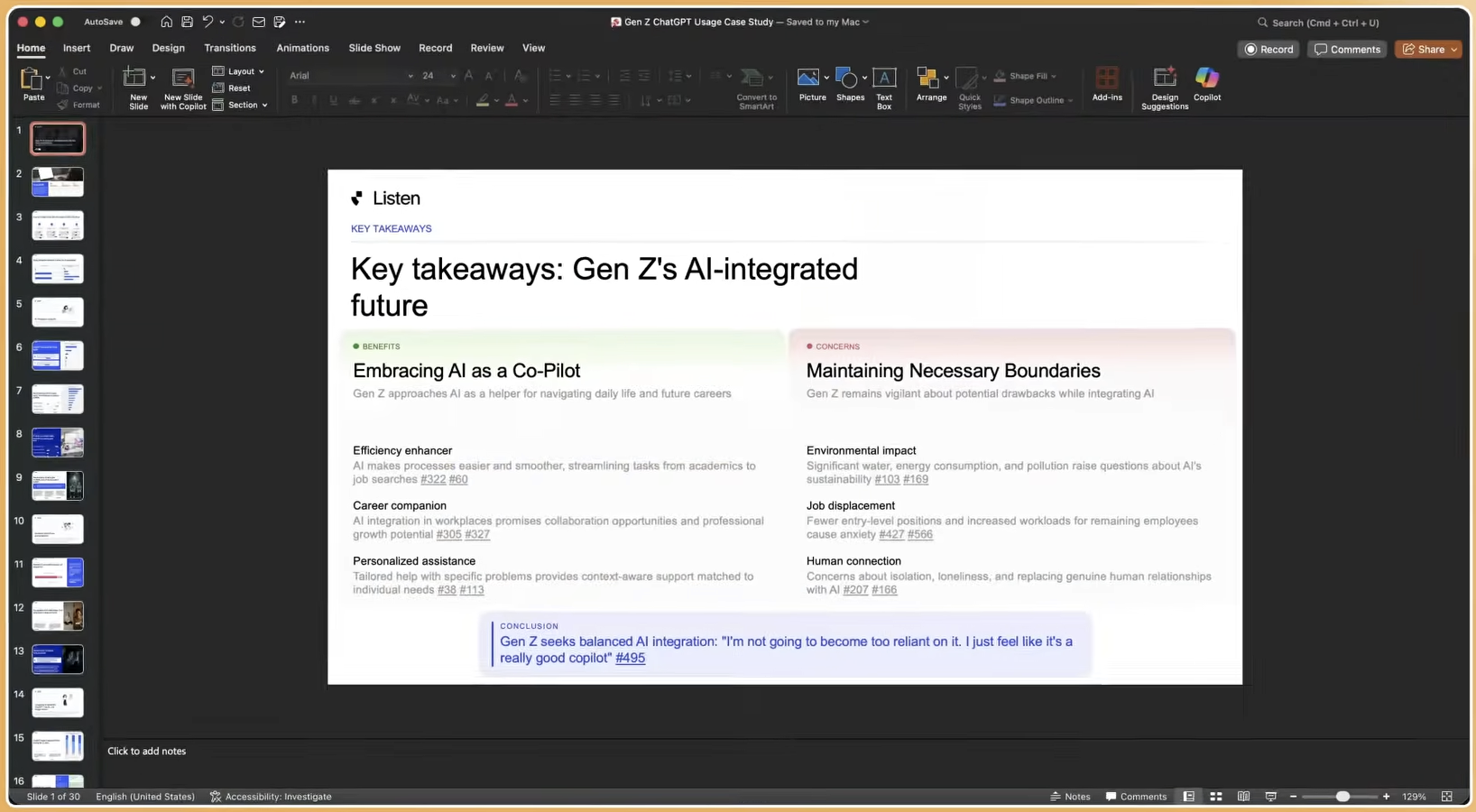
Map One Upcoming Project to This Workflow
Take one study currently sitting in your research backlog, such as a concept test, a packaging validation, or a brand health wave, and run it through the checklist above. Define the objective, identify the target audience, and estimate the sample size. Then compare the projected timeline and cost with your current vendor quote.
Walk through your study design with our team and receive a same-day estimate on timeline, sample size, and deliverables.
Capturing Emotional Signals That Transcripts Miss
Across all seven use cases, from concept testing to competitive intelligence, transcripts capture what consumers say but miss critical emotional signals. They do not capture the half-second frown before a participant recovers and says “I like it,” the vocal hesitation before endorsing a claim, or the widened pupils when a concept genuinely surprises. Two concepts can receive identical average ratings while triggering entirely different emotional profiles, and that difference often determines in-market performance.
Listen Labs’ Emotional Intelligence analyzes three layers of signal simultaneously: tone of voice, word choice, and subconscious micro-expressions. Built on Ekman’s universal emotions framework, the same standard used in clinical psychology and UX research, it tracks anger, anticipation, disgust, fear, joy, sadness, trust, and surprise. Every emotion is quantified per question and concept, and every label is traceable to the exact timestamp, verbatim quote, and reasoning behind it.
For concept and creative testing, this capability lets a CPG team ask which concept triggered the most confusion and receive a side-by-side emotional breakdown across stimuli, segments, and markets. For packaging validation, it identifies the moment a consumer’s expression shifts from interest to uncertainty while reading a specific claim. For brand research, it surfaces how consumers feel about a brand versus competitors in ways that self-reported ratings systematically underreport.
Emotional Intelligence works across 50+ languages and integrates directly with the Research Agent for natural-language queries, charts, and highlight reels of emotionally significant moments.
Building an Always-On Consumer-Intelligence Program
Project-based research produces point-in-time snapshots, while an always-on program produces a continuously updated view of consumer sentiment, need-states, and competitive perception that compounds in value as each study adds to the knowledge base. To build this capability, a growing number of insights teams run always-on studies with rolling samples.
A continuous CPG consumer intelligence program in Year 1 often includes quarterly brand health tracking at 200+ interviews per wave, per-launch concept testing at 50–100 interviews per concept, and annual innovation research as detailed in the white-space identification section above, with all studies feeding into a centralized Intelligence Hub.
Listen Labs’ Mission Control serves as the organization’s source of truth for everything learned from consumers across all studies. Cross-study queries return answers from past research in seconds without digging through old reports. Trend tracking monitors consumer sentiment, need-states, and pain points over time. Each new study grows the institutional knowledge base, so teams focus on net-new insights rather than re-researching questions already answered.
Teams adopting continuous AI-moderated research models report identifying 3–5x more product and customer experience issues per quarter while catching them weeks earlier than project-based equivalents. Researchers using AI qual shift from covering two or three projects per month with traditional moderation to designing and interpreting eight to ten projects per month with broader segment coverage and faster delivery.
The practical architecture for a CPG always-on program combines a standing brand health tracker running 50–100 interviews per week, triggered ad-hoc studies for concept tests and packaging validation as needed, and an annual innovation wave of 100–200 interviews. Mission Control connects all three, enabling a brand manager to query “what have consumers said about our sustainability claims across all studies in the last 12 months” and receive a sourced, timestamped answer in seconds.
See how Mission Control connects your studies into a searchable consumer intelligence program.
Frequently Asked Questions
How long does it actually take to get results from an AI-moderated study on Listen Labs?
The full research lifecycle, from study design through recruitment, fieldwork, analysis, and deliverables, completes within a single day for most standard studies. Study design takes minutes using AI-assisted co-design. Recruitment runs in parallel to study setup using the 30M+ verified panel. Interviews are conducted asynchronously, so 100 or 500 conversations can run simultaneously rather than sequentially. The Research Agent generates slide decks, memos, highlight reels, and charts automatically once fieldwork closes. For complex multi-market studies or hard-to-reach audiences, timelines extend to 48–72 hours, still a fraction of traditional multi-week methods.
How does Listen Labs ensure participant quality for CPG-specific audiences?
Quality is enforced through three layers. First, Listen Labs only works with high-quality, non-commodity panel sources, avoiding professional survey-takers from commodity quant panels. Second, Quality Guard monitors every interview in real time across video, voice, content, and device signals to detect fraud, low-effort responses, AI-generated scripts, and mismatched profiles. Third, participants are limited to three studies per month to reduce panel fatigue and incentive-driven responses. For CPG-specific audiences such as verified category purchasers, health-conscious segments, or shoppers below 1% incidence, a dedicated recruitment operations team sources participants through niche communities, micro-creators, and specialized networks.
How does Listen Labs handle data privacy and enterprise security requirements?
Listen Labs maintains enterprise-grade security with 256-bit encryption. Customer data is never used for AI model training. The platform holds SOC 2 Type II, GDPR, ISO 27001, ISO 27701, and ISO 42001 certifications. Enterprise SSO is supported. For CPG companies operating across multiple markets, all data handling complies with regional privacy regulations, and participant consent is built into the interview flow across all supported languages.
Can Listen Labs reach hard-to-find CPG audiences, such as heavy category users or specific shopper segments?
Yes. The dedicated recruitment operations team partners with niche communities, micro-creators, and specialized networks to source audiences below 1% incidence rate. This includes heavy category users, specific dietary or lifestyle segments, premium shoppers, and regional consumer groups. Organizations can also self-recruit from their own CRM, loyalty program, or DTC customer base at reduced cost, combining first-party audiences with Listen Labs’ panel for broader reach. Listen Atlas, the AI orchestration layer, matches across behavioral and intent data rather than self-reported demographics, which improves the precision of audience targeting for CPG studies.
When should a CPG insights team expand an always-on study versus retiring it?
A team should expand an always-on study when it consistently surfaces new themes, when a market event or product launch creates a need for additional segment coverage, or when cross-study queries in Mission Control reveal gaps in geographic or demographic representation. A study should be retired or restructured when thematic saturation has been reached across all target segments and the weekly data confirms known findings without generating new hypotheses. Mission Control’s trend tracking makes this decision visible: when sentiment and theme distributions stabilize across consecutive waves, the study has served its purpose and resources are better allocated to a new research question. The institutional knowledge built in Mission Control persists regardless of whether the study continues.
Conclusion: Deliver Consultant-Quality Consumer Insights at AI Speed
The 4–6 week qualitative research cycle reflects the limits of traditional research infrastructure, including fragmented vendors, sequential workflows, manual moderation, and human-paced analysis. Listen Labs has run over 1 million AI-powered customer interviews for companies including Microsoft, Perplexity, and Sweetgreen, proving that the depth and quality of one-on-one consumer conversations can match the speed and scale that modern CPG innovation cycles require.
“Companies use it for all kinds of large decisions. This AI interviewer means that you can have hundreds of one-on-one interviews run at scale,” said Alfred Wahlforss, CEO of Listen Labs.
For VP and Director-level Consumer Insights leaders at CPG enterprises, this shift means a research program that runs more studies per quarter with the same team, delivers findings before the product brief moves on, and builds a compounding institutional knowledge base that survives team changes. Platforms like Listen Labs layer on auto-recruiting, transcription, sentiment tagging, and insight summarization so teams move from question to findings in hours instead of weeks.
Listen Labs is the end-to-end platform that sources the right participants inside its 30M+ network, conducts thousands of in-depth consumer interviews simultaneously, and delivers consultant-quality reports, slide decks, and video highlight reels with enterprise-grade security, zero-fraud guarantees, and Emotional Intelligence that captures what transcripts miss.
See the platform in action and learn how Listen Labs compresses your next consumer insights study from weeks to hours.