Written by: Anish Rao, Head of Growth, Listen Labs
Key Takeaways for CPG Insights Leaders
- Traditional CPG qualitative research carries hidden costs beyond the $25,000–$75,000 agency invoice, including internal researcher time and 4–6 week delays that leave insights outdated.
- Listen Labs delivers equivalent qualitative depth at one-third the cost with results in under 24 hours through its subscription-plus-per-interview model.
- The platform replaces fragmented vendor stacks by handling recruitment, AI-moderated interviews, analysis, and consultant-quality deliverables in a single end-to-end system.
- Enterprise deployments at P&G, Microsoft, Skims, and Anthropic validate the platform’s ability to scale qualitative research while maintaining quality and compliance certifications.
- See how Listen Labs can transform your CPG consumer insights program with faster, more cost-effective research.
How to Evaluate CPG Consumer Insights Platforms
A rigorous platform comparison uses consistent criteria before any vendor is named. The nine criteria that matter most to CPG insights leaders are:
- Speed to insight: Wall-clock time from study brief to final deliverable, including recruitment, fieldwork, analysis, and reporting.
- Cost per completed interview: All-in per-interview cost including recruitment, moderation, incentives, transcription, and analysis, not just the platform fee.
- Participant quality and fraud protection: Screening methodology, behavioral verification, real-time fraud detection, and panel fatigue controls.
- Global and language reach: Number of countries covered, languages supported for moderation, and ability to recruit niche or low-incidence audiences.
- Depth versus scale trade-off: Ability to conduct adaptive, probing conversations at large sample sizes instead of forcing a choice between depth and scale.
- Analysis effort: Internal researcher hours required to move from raw interview data to actionable findings.
- Deliverable quality: Whether outputs are consultant-quality slide decks and reports or raw transcripts that require manual synthesis.
- Security and compliance: SOC 2, GDPR, ISO certifications, data encryption standards, and AI model training policies.
- Long-term operational burden: Number of vendors, tools, and handoffs required to sustain a continuous research program.
Recruitment and Study Setup: Largest Hidden Cost
Recruitment is the largest hidden cost driver in traditional CPG qualitative research. Recruiting verified CPG category purchasers through a traditional agency can cost thousands of dollars and take several weeks, driven by panel provider fees, screening ratios, incentives, and no-show buffers. For niche segments, that timeline extends further.
Agency-moderated in-depth interviews for CPG research total several hundred dollars per interview all-in, covering recruitment, moderation, incentives, transcription, and analysis. A standard 30-interview study therefore costs tens of thousands before the reporting phase. Full-service agency concept testing also runs tens of thousands of dollars with multi-week timelines.
Listen Labs uses a subscription-plus-per-interview credit model that simplifies budgeting. Platform access includes a set number of studies and credits. Additional credits are consumed per recruited participant, with cost varying by audience difficulty. General population studies consume fewer credits than niche, hard-to-reach segments such as enterprise decision-makers or healthcare workers.
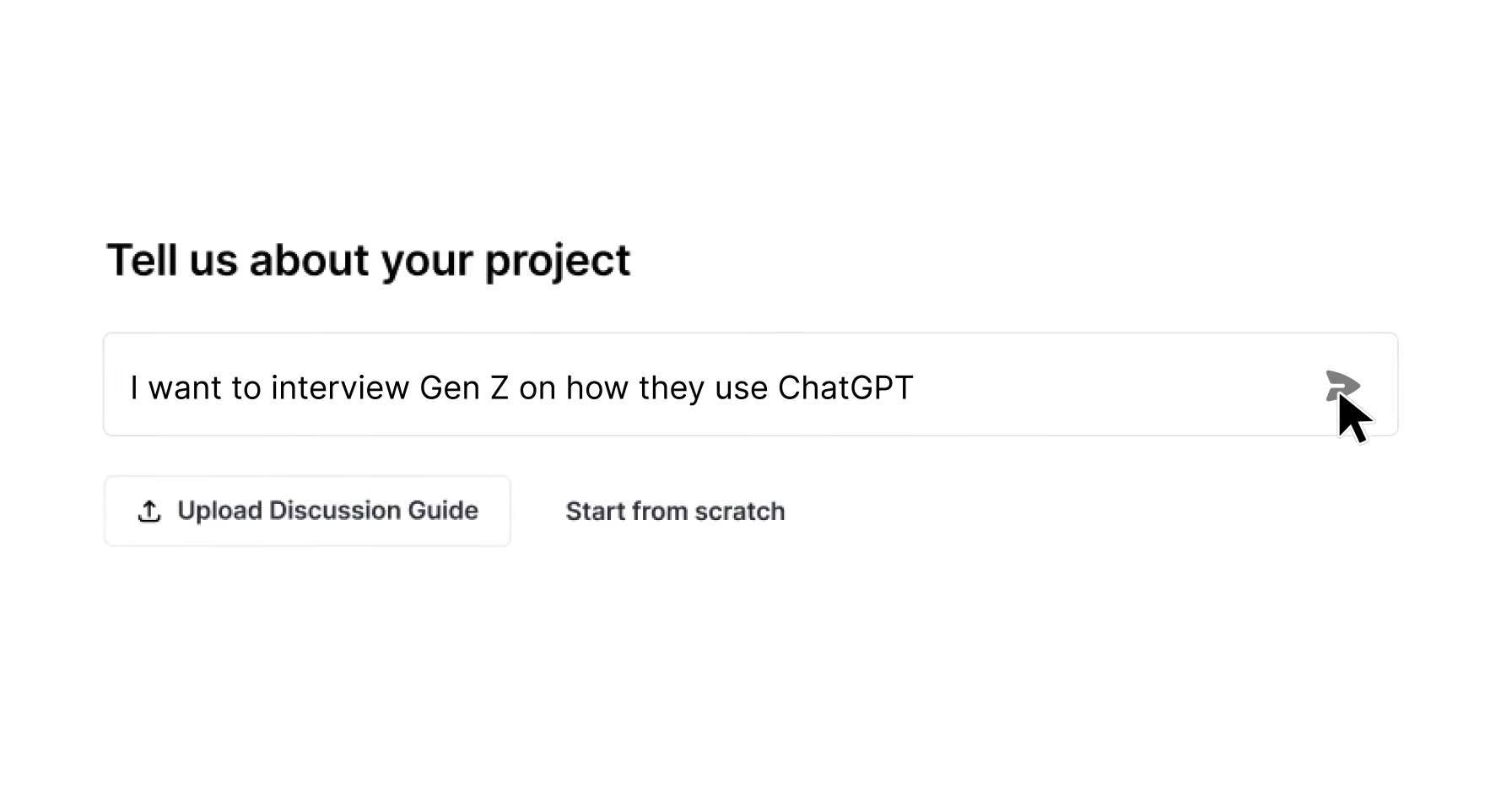
Recruitment happens entirely within the platform through Listen Atlas, an AI orchestration layer that matches and bids across Listen Labs’ proprietary network of 30M verified respondents spanning 45+ countries and 100+ languages, plus vetted panel partners. A dedicated recruitment operations team handles sub-1% incidence audiences that automated matching cannot fill.
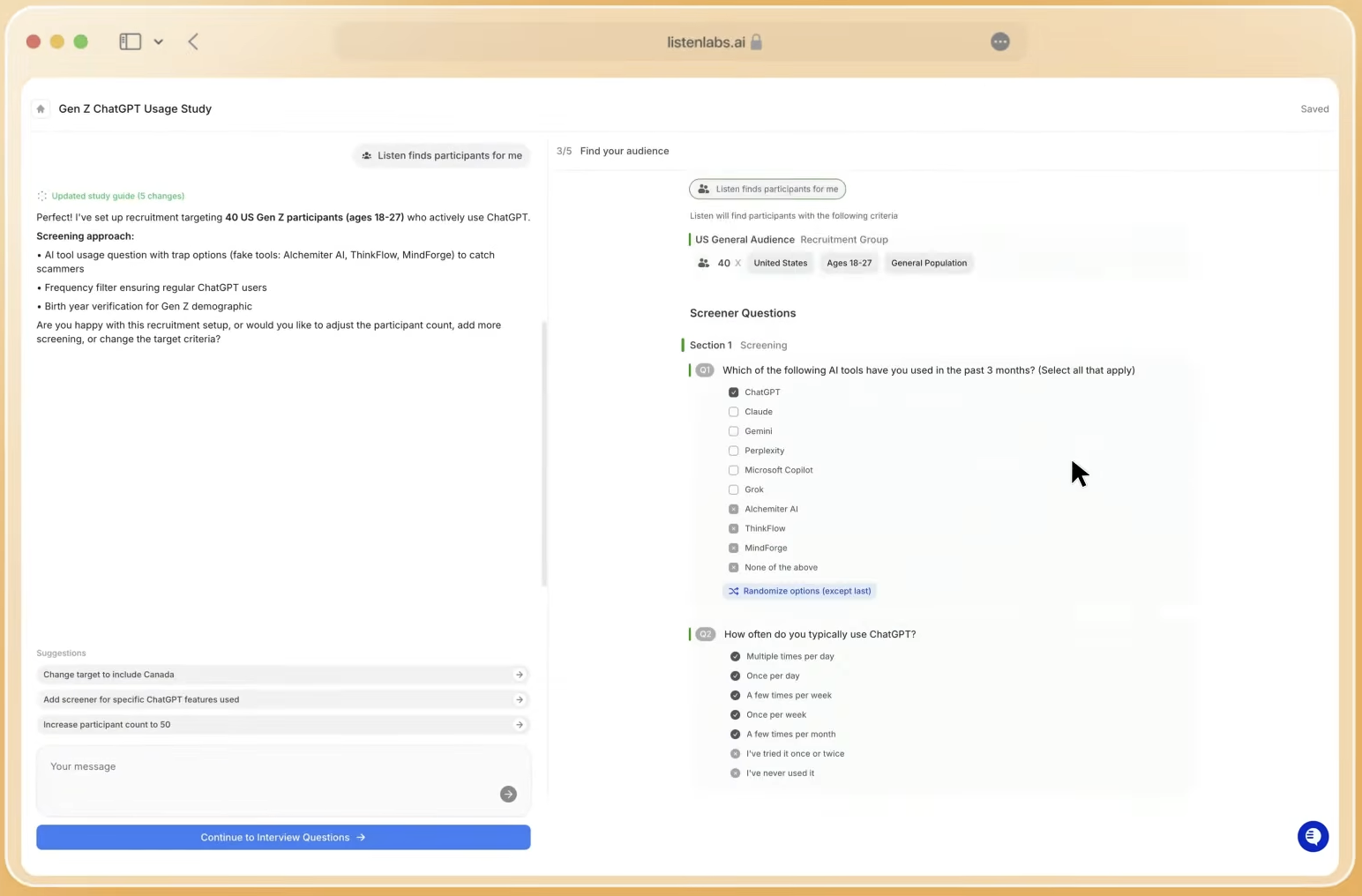
The net result: enterprises using Listen Labs reach hundreds of participants at one-third the cost of traditional methods, with recruitment measured in hours rather than weeks. Quality Guard, Listen Labs’ real-time fraud detection layer, monitors video, voice, content, and device signals across every interview and limits participants to three studies per month, eliminating the professional survey-taker problem that inflates costs and degrades data quality on commodity panels.
Moderation, Analysis, and Deliverables: Second Major Cost Driver
With recruitment costs addressed, the second-largest cost driver in traditional CPG qualitative research is human moderation. A 30-interview study requires moderator fees of roughly $2,250–$4,500 at $75–$150 per hour, plus discussion guide development and, for multi-market studies, local moderator coordination and translation premiums of 20–50%. A human moderator can conduct only 3–5 interviews per day, creating a fieldwork bottleneck that compounds the timeline problem.
Traditional qualitative studies also require substantial internal researcher time for design, fieldwork oversight, analysis, and delivery. These hours add uncounted internal costs per study. AI-moderated platforms reduce that internal burden significantly.
Listen Labs’ AI moderator conducts personalized video interviews with dynamic follow-up questions. It probes deeper on short or interesting answers the same way a trained human interviewer would. Hundreds of interviews run simultaneously, so a 200-interview study completes in the same wall-clock time as a 20-interview study.
The Emotional Intelligence layer adds a dimension unavailable in any human-moderated workflow. It performs multimodal analysis of tone of voice, word choice, and subconscious micro-expressions, built on Ekman’s universal emotions framework, quantified per question and traceable to the exact timestamp and verbatim quote. Every emotion label includes the reasoning behind it.
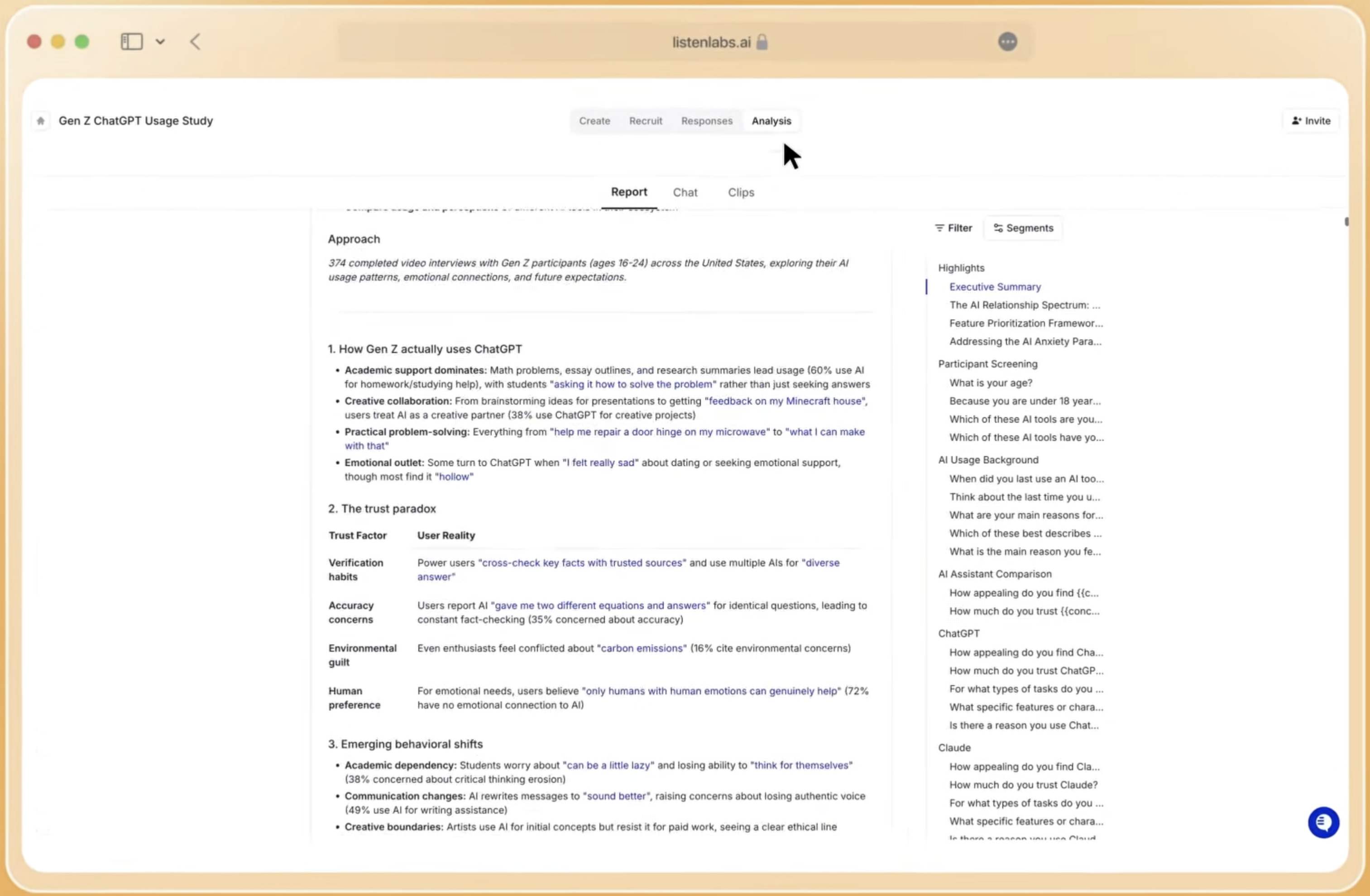
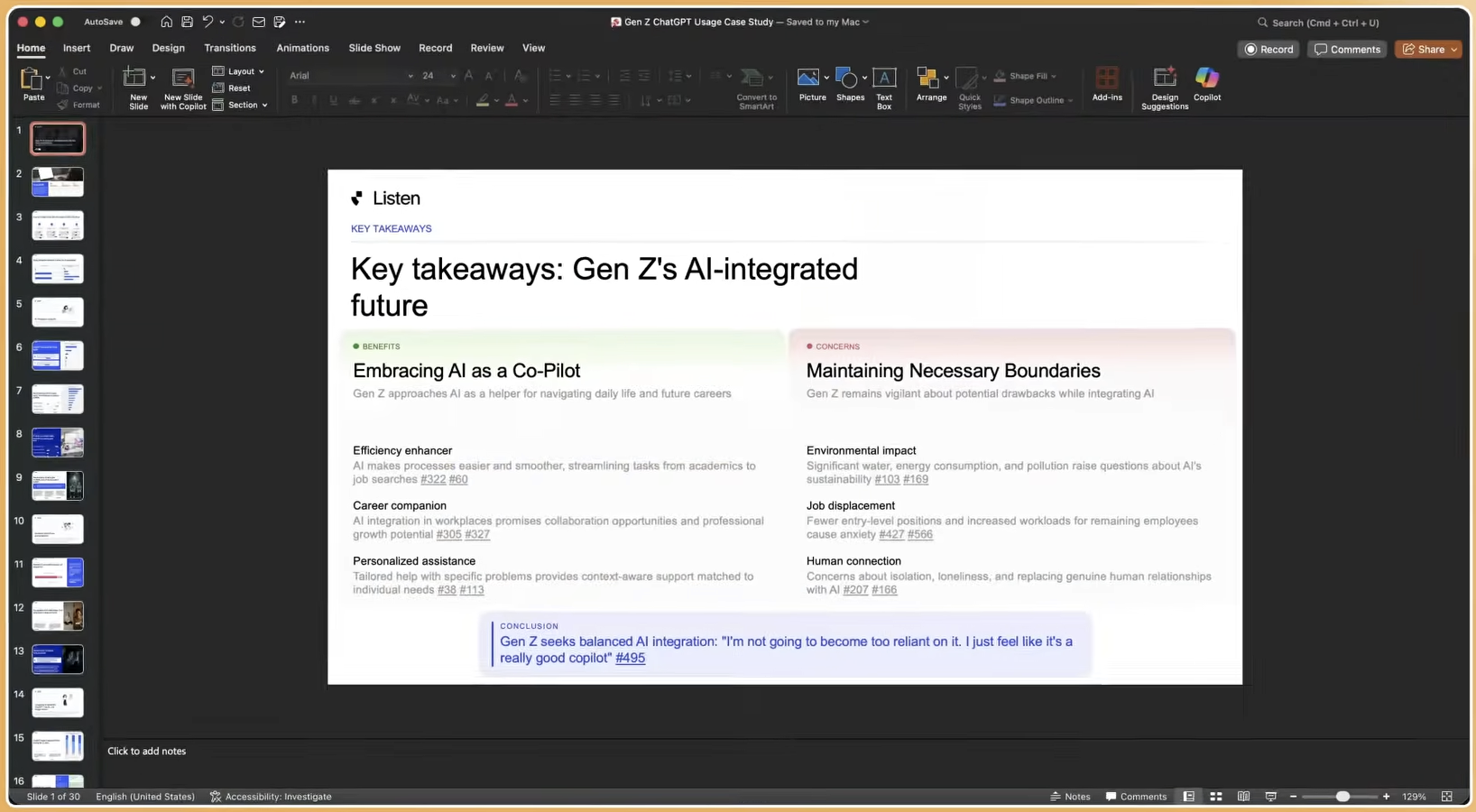
The Research Agent then generates automated key findings, themes, and personas from all interview data. One-click deliverables, including consultant-quality slide decks, memo-style reports, video highlight reels, statistical charts, and segmentation breakdowns, are produced in under a minute. Teams move from question to findings in hours, not weeks, without manual synthesis.
Quantitative Layer and Knowledge Management Costs
CPG insights programs operate as ongoing systems, not isolated projects. Brand health tracking, concept testing, segmentation, and ad testing generate findings that should compound over time. In traditional agency workflows, each study produces a siloed report that lives in a shared drive and is forgotten when the brand manager turns over. Knowledge loss from 18–24 month brand manager turnover is a documented hidden cost of the traditional model.
Legacy SaaS platforms such as Qualtrics address the quantitative layer. Enterprise licenses typically start at $25,000–$50,000 per year, yet these tools do not conduct qualitative interviews or connect survey data to conversational insight. Repository tools such as Dovetail organize past research but do not generate new research. The result is a fragmented stack: one vendor for recruitment, another for moderation, another for transcription, another for analysis, and another for storage.
Listen Labs replaces that stack with a single platform. Mixed-methods studies combine AI-moderated qualitative interviews with Likert scales, NPS, sliders, MaxDiff, and other quantitative formats in one instrument. Mission Control serves as the organization’s source of truth for everything ever learned from customers across all studies. Teams can run cross-study queries in natural language, track trends over time, and preserve institutional knowledge through personnel changes. Each new study grows the knowledge base rather than adding another siloed report.
Enterprise Case Studies: Proven Time and Cost Impact
Microsoft needed to collect global customer stories for its 50th anniversary celebration and required both speed and scale. Using Listen Labs, the team collected user video stories within a day. The Director of Data Science at Microsoft stated: “We wanted users to share how Copilot is empowering them to bring their best self forward, and we were able to collect those user video stories within a day. Our leadership team was very thrilled at both the speed and the scale that Listen Labs enabled. I can reach out to hundreds of users at one third of the cost.”
Anthropic needed to understand why Claude users cancel their subscriptions and what might bring them back. Listen Labs delivered 300+ user interviews in 48 hours, surfacing churn drivers 5x faster, identifying where former Claude users migrate, and producing a prioritized list of 10 must-fix items. The Director of Product Strategy at Anthropic noted: “Listen Labs lets us understand user churn with a level of clarity and speed we’ve never had before.”
Procter & Gamble used Listen Labs to evaluate how men respond to new product claims before market launch. The platform delivered 250+ interviews with quantified themes and verbatim proof in hours, surfacing where claims felt exaggerated or unclear and confirming that comfort, safety, and reliability matter more than novelty. The Analytics and Insight Leader at P&G confirmed: “Listen Labs has been a huge help.”
Skims needed to validate campaign direction with thousands of high-income buyers overnight before a global launch. Listen Labs identified and qualified premium consumers overnight, eliminating weeks of recruiting, and delivered qualitative clarity that secured board-level buy-in. The SVP of Data, Insights, and Loyalty at Skims stated: “I always struggled with understanding the why and Listen Labs nails this for me.”
Request a custom cost analysis based on your current research volume and timeline requirements.
Pricing Scenarios: Single Study to Annual Program
The following scenarios show how Listen Labs’ subscription-plus-per-interview model compares to agency baselines at different research volumes. All agency figures reflect 2026 market pricing for full-service qualitative studies including recruitment, moderation, analysis, and deliverables.
For a single 30-interview concept test, a traditional agency charges tens of thousands of dollars before reporting, with reporting and internal researcher time adding more. Total all-in cost is significantly higher over 4–8 weeks. On Listen Labs, the same study runs at a fraction of that cost within 24 hours, with deliverables included.
As research volume increases, the cost advantage compounds. For a 200-interview annual program, traditional agency qualitative research costs $25,000–$75,000 per study and takes 4–6 months of sequential fieldwork. Listen Labs compresses that to the same sub-24-hour timeline at the same cost advantage, with the subscription covering platform access and credits that scale with interview volume.
At continuous research cadences, the efficiency gap widens further. For a continuous 12-study annual program, a mid-market CPG company with a limited annual research budget can complete only a limited number of traditional studies. Shifting to Listen Labs enables 38+ studies in the same budget window, including 12 monthly brand health pulses, 4 quarterly deep studies, and 20 ad-hoc studies, because the per-study cost drops by roughly two-thirds and the 24-hour turnaround eliminates the queue.
To calculate your specific spend, focus on three variables: number of studies per year, interviews per study, and audience difficulty (general population versus niche segments). Contact Listen Labs for a custom estimate based on your research portfolio.
Operational, Compliance, and Scaling Requirements
Switching from a fragmented agency-and-SaaS stack to a single end-to-end platform requires stakeholder alignment across research, IT, legal, and finance. For enterprises with more than 100 employees, Listen Labs uses a demo and pilot process before full deployment. This deliberate quality gate ensures the platform is configured correctly for the organization’s research methodology and compliance requirements before scaling.
On the compliance side, Listen Labs holds SOC 2 Type II, GDPR, ISO 27001, ISO 27701, and ISO 42001 certifications. All data is encrypted at 256-bit, and customer data is never used for AI model training. Enterprise SSO is supported. These certifications satisfy the procurement requirements of Fortune 500 CPG organizations and address the data governance concerns that typically delay vendor approvals.
Scaling from one-off studies to a continuous research program depends on platform design rather than additional services. Mission Control accumulates institutional knowledge with each study, so the value of the platform compounds over time. BCG research on GenAI adoption in CPG marketing organizations found that employees who adopted AI tools spent 25–40% less time on key workflows and that products reached market twice as fast, providing a directional benchmark for the operational efficiency gains available when AI replaces manual research workflows at scale.
Risks and Limitations of an AI-First Approach
The pilot requirement for enterprises over 100 employees adds a pre-deployment step that agencies do not require. Teams accustomed to briefing an agency and receiving a report will need to invest time in learning how to configure study design, set screening criteria, and interpret AI-generated deliverables. The learning curve is real, though Listen Labs’ in-house research team provides methodology support throughout onboarding.
AI-moderated interviews are not the right tool for every research context. Traditional qualitative research retains its premium in 10–15% of cases, including highly regulated studies requiring IRB oversight, in-person ethnographic observation, and board-level presentations where third-party agency credibility is a procurement requirement.
Decision Framework: When Each Method Fits Best
Traditional agencies remain the appropriate choice when the research requires in-person sensory or physical product testing, regulated-category compliance with IRB documentation, or normative benchmarking against legacy tracking data that predates AI-moderated methodologies.
Legacy SaaS survey platforms fit best when the research question requires only structured quantitative data and no qualitative follow-up. The documented 31% raw response fraud rate on commodity survey panels remains a material quality risk for CPG brand decisions.
Listen Labs is the appropriate choice when the research requires qualitative depth at scale, results within 24 hours, global reach across 45+ countries, mixed-methods capability in a single instrument, emotional signal capture beyond what transcripts provide, or a continuous program that builds institutional knowledge over time. It is the only platform that covers the entire research lifecycle, including study design, recruitment, moderation, analysis, and deliverables, without requiring a separate vendor for any step.
Schedule a consultation to map your annual research plan to the right methodology mix.
Frequently Asked Questions
How long does a Listen Labs study actually take from brief to deliverable?
The full research cycle, including study design, participant recruitment, AI-moderated interviews, automated analysis, and deliverable generation, completes in under 24 hours for most studies. Recruitment through the Listen Atlas network typically takes hours depending on audience difficulty. Interviews run simultaneously rather than sequentially, so a 200-interview study completes in the same wall-clock time as a 20-interview study. The Research Agent generates slide decks, memos, highlight reels, and charts in under a minute after fieldwork closes.
How does Listen Labs source participants, and what prevents fraud?
Participants are sourced through Listen Atlas, an AI orchestration layer that matches and bids across Listen Labs’ proprietary database of 30M verified respondents and vetted panel partners including B2B specialists. Matching uses behavioral and intent data, not just self-reported demographics. Quality Guard monitors every interview in real time across video, voice, content, and device signals to detect fraud, low-effort responses, AI-generated scripts, and mismatched profiles. Participants are capped at three studies per month to eliminate professional survey-takers. A dedicated recruitment operations team adds a human review layer for hard-to-reach segments below 1% incidence rate. Organizations can also bring their own participants from their customer base at reduced credit cost.
What is the difference between Listen Labs’ AI moderation and a human moderator?
Listen Labs’ AI moderator conducts personalized video interviews with dynamic follow-up questions, probing deeper on short or ambiguous answers the same way a trained human interviewer would. It runs hundreds of conversations simultaneously with no fatigue, no scheduling constraints, and no geographic limitations. The Emotional Intelligence layer captures tone of voice, word choice, and subconscious micro-expressions, signals that human moderators observe but rarely quantify systematically. The platform’s methodology is built and continuously refined by an in-house research team, so the rigor behind the AI reflects deep qualitative research practice rather than general-purpose language modeling.
What security and compliance certifications does Listen Labs hold?
Listen Labs holds SOC 2 Type II, GDPR, ISO 27001, ISO 27701, and ISO 42001 certifications. All customer data is encrypted at 256-bit. Customer data is never used to train AI models. Enterprise SSO is supported. These certifications satisfy the procurement and data governance requirements of Fortune 500 CPG organizations operating across the US, EU, and other regulated markets.
Can Listen Labs support multilingual and multi-market CPG research programs?
Yes. The platform supports 100+ languages for interview moderation, with automatic transcription and translation across all supported languages. Emotional Intelligence is available across 50+ languages. Listen Atlas covers 45+ countries across the Americas, Europe, APAC, and MEA. Multi-market studies run in parallel rather than sequentially, so a three-market study does not take three times as long. A dedicated recruitment operations team handles local audience sourcing for markets where panel coverage is thinner or where audience specifications are highly specific.
Conclusion: Total Cost and Speed in One View
The total cost of CPG qualitative research extends far beyond the agency invoice. It includes the invoice, internal researcher time, the opportunity cost of decisions delayed by 4–6 weeks, and the knowledge lost when findings sit in siloed reports. When those costs are counted, the case for Listen Labs’ subscription-plus-per-interview model becomes straightforward: equivalent qualitative depth, one-third the cost, and results in under 24 hours instead of weeks.
The enterprise deployments detailed earlier demonstrate this value in production environments. Listen Labs has conducted over 1 million AI-powered customer interviews for enterprises across industries. The platform covers the entire research lifecycle, including study design, recruitment, moderation, analysis, and deliverables, in a single end-to-end system that compounds in value with every study run.
Get a custom pricing estimate tailored to your research program’s specific needs.