
Written by: Anish Rao, Head of Growth, Listen Labs
Key Takeaways for Faster Travel-App Research
- Travel-app teams often face slow research cycles and low-quality participants. A structured 7-step playbook compresses this process from weeks to hours.
- Effective user research for travel apps uses travel-specific screeners, behavioral personas, and mixed methods that reflect fragmented, high-stakes travel decisions.
- Recruitment is the biggest bottleneck, so strong quality signals and real-time fraud detection are essential for reliable participants on tight timelines.
- AI-powered platforms run moderation, transcription, sentiment analysis, and insight synthesis in parallel, so teams no longer trade depth for speed.
- Listen Labs delivers end-to-end user research for travel apps in under 24 hours. See how it works.
Step 1: Define Objectives and Success Metrics
Every study starts with a clear research question. Qualitative research explains why and how by uncovering motivations, mental models, and friction points. Quantitative research explains how many and how often. Most travel-app studies benefit from both, but the primary objective decides which method leads.

Concrete objectives for a travel app might include understanding why users abandon checkout, identifying what information families need before confirming a hotel, or mapping the emotional arc of a solo traveler from inspiration to booking. These qualitative goals become actionable when paired with quantitative success metrics that track execution quality. Each objective should map to a measurable success metric such as study cycle time (target under five business days with AI tooling), participant completion rate (above 80%), and insight adoption rate (percentage of findings actioned in the next sprint).
Traditional user research studies typically require weeks to months to complete, and the decision-making window often closes before results arrive. Tight, specific objectives at the outset prevent scope creep and keep the study focused on decisions the team must make now.
Step 2: Build Travel-Specific Screeners and Personas
Behavioral screeners produce sharper findings than generic demographic filters. Travel-app screeners should capture concrete behaviors. Inclusion criteria should prioritize people who have recently traveled internationally rather than those who only express interest in travel, because past experience shapes mental models and predicts future behavior.
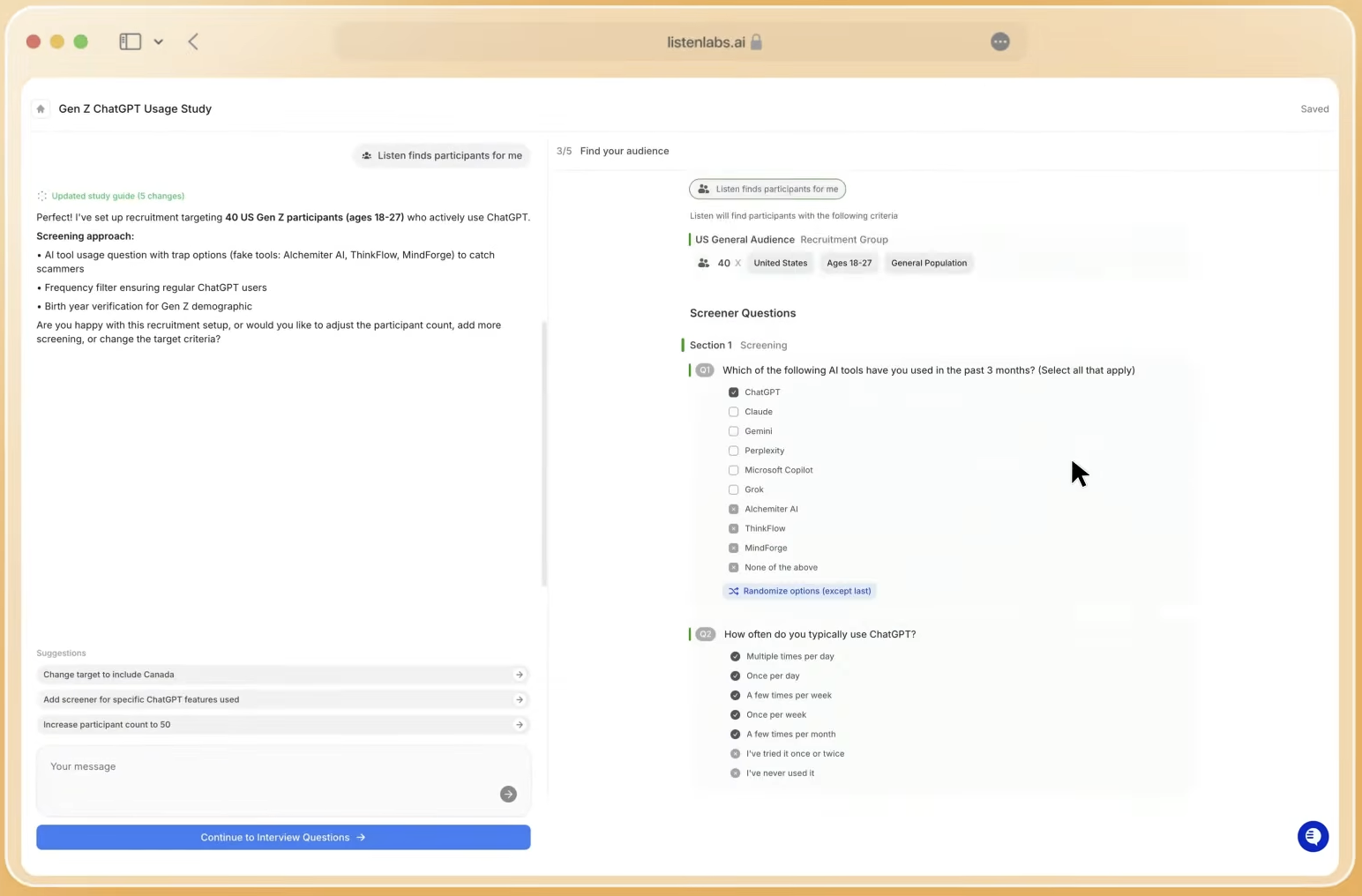
A strong travel screener checklist includes:
- Recency: trips taken within the last three to six months, or an upcoming trip already in planning
- Trip type: domestic vs. international, leisure vs. business, solo vs. group
- Booking method: direct supplier, OTA, corporate travel tool, or travel agent
- Platform usage: specific apps or sites used for research and booking
- Loyalty program membership and tier status
- Device type: mobile-only, desktop, or both
Business and leisure travelers must be recruited and tested separately because they have fundamentally different priorities. Business travelers emphasize efficiency and policy compliance, while leisure travelers focus on value comparison and group coordination. Core personas for most travel-app studies include:
- Family travelers: booking for three or more people including children, prioritizing joint decision-making tools and clear total-cost visibility
- Solo travelers: focused on safety, flexibility, and authentic local experience
- Business travelers: prioritizing speed, loyalty benefits, and policy compliance
- Budget travelers: price-first decision-making with high sensitivity to hidden fees
Plan for five to eight participants per segment and use a recruitment matrix to balance primary behavioral segments against diversity criteria like age and location. Exclusion criteria should rule out UX professionals and industry insiders, who tend to give expert reviews instead of realistic user feedback. Screener finalization usually takes one to two days.
Step 3: Choose and Sequence Research Methods
Travel-app research works best with a mixed-method design that moves from broad context to specific validation. A practical sequence starts with a diary study, continues with in-depth interviews, and ends with moderated usability testing.
Diary studies work well for behaviors that are recurring, context-dependent, emotionally variable, or multi-step, which matches travel booking and itinerary management. Running diary studies for two to four weeks with participants actively planning an upcoming trip captures the full multi-platform decision journey. Diary prompts should ask participants to log every platform visited, screenshots of options considered, moments of confusion or delight, and the tipping factor behind the final booking decision.
For real-time disruption research such as flight delays, itinerary changes, or connectivity failures, the Experience Sampling Method prompts participants at random or event-triggered moments to capture brief reports about their current experience. This approach avoids the recall bias that distorts retrospective interviews. Several prompts per day over a few days can generate dozens of data points per participant without causing fatigue.
In-depth interviews follow the diary phase and probe patterns from entries. Questions about specific past behaviors such as “Tell me about the last trip you planned” or “Show me how you searched for accommodation” yield higher-quality data than hypothetical preference questions. Structure thirty-to-forty-five-minute sessions into four phases: recent trip context (five minutes), current planning behavior and tools (fifteen minutes), specific pain points (ten minutes), and prototype or wireframe reactions (ten minutes).
Moderated usability testing closes the sequence with realistic scenarios such as planning a four-night beach vacation for a family of four on a $3,000 budget or booking a round-trip flight for a business meeting with date flexibility. Think-aloud comparison sessions in which participants evaluate three to five options while narrating decision criteria surface information needs and comparison behavior that analytics alone cannot explain.
Step 4: Recruit Quality Participants at Speed
Once you have defined your methods, the next challenge is finding the right people to participate. Recruitment is the single largest bottleneck in travel-app research. Recruitment often accounts for a substantial portion of total cycle time in most programs, and niche B2B audiences can take several weeks through traditional channels.
Strong quality signals during recruitment include screener completion time (very fast responses suggest low effort), open-text response length and specificity, and consistency between screener answers and interview behavior. Early-warning signs of low-quality participants include generic answers that could apply to any product, inability to recall specific trip details, and contradictions between stated travel frequency and booking platform knowledge.
Teams can address low incidence rates, such as travelers who used a specific airline app within the last thirty days, by broadening the recency window, adding alternative qualifying behaviors, or using a dedicated recruitment operations team. That team can source from niche communities including travel subreddits, digital-nomad Slack groups, and LinkedIn profiles that mention frequent travel.
Listen Labs’ global network of 30M verified respondents across 45+ countries, combined with its Quality Guard system that monitors every interview in real time for fraud and low-effort responses, removes the manual quality-assurance burden that usually falls on researchers.
Schedule a demo to see how Listen Labs sources verified travel-app users for user research in hours, not weeks.
Step 5: Moderate Sessions and Capture Rich Data
Effective moderation for travel-app studies uses a semi-structured guide that covers required topics while leaving room for adaptive follow-up. Think-aloud protocols, where participants narrate their actions and reasoning as they move through a booking flow, reveal hesitation points, tab-switching behavior, and decision criteria that post-task recall often misses.
A moderation checklist for travel-app sessions includes:
- Opening with a recent specific trip to establish behavioral context before introducing the product
- Using task-based scenarios anchored to realistic trip parameters rather than abstract feature demonstrations
- Probing silences and hesitations with neutral prompts such as “What are you thinking right now?”
- Capturing screen recordings alongside video to connect verbal reactions with interface interactions
- Closing with a retrospective walkthrough of the session to surface any unreported friction
AI can schedule and conduct the interview, analyze the transcripts for themes, and generate quantitative insights from those interviews. This approach enables twenty concurrent sessions to complete in parallel rather than the fourteen days of calendar coordination required for human-moderated sequential scheduling.
Step 6: Analyze Themes and Emotional Signals
Researchers spend the bulk of their time in analysis: finding patterns, quantifying insights, testing significance, adding macro context, and formatting results for stakeholders who each need something different. Once recruitment is complete, analysis becomes the next major time investment. For travel apps, analysis should surface both functional friction, such as a five-step checkout that loses users at step three, and emotional friction, such as anxiety triggered by unclear cancellation policies.
A practical theme-identification framework for travel-app data prioritizes patterns mentioned by three or more participants without prompting. It then ranks those patterns by frequency, impact on key booking decisions, and feasibility within the product roadmap. Identifying patterns only when three or more participants mention the same issue without prompting prevents over-indexing on outlier feedback.
Emotional signal analysis adds a layer that transcripts alone cannot provide. Travel app users face fragmentation across flights, hotels, activities, planners, maps, rideshare, and restaurant apps, and this context generates frustration that participants often normalize and never verbalize. Listen Labs’ Emotional Intelligence feature analyzes tone of voice, word choice, and micro-expressions to surface emotions like confusion and hesitation at timestamp-level precision, using Ekman’s universal emotions framework from clinical psychology and UX research.
One researcher ran a full buying intent analysis across three user segments in under a minute using Listen Labs’ Research Agent, compressing what traditionally requires a two-day synthesis task into a four-hour workflow.
Step 7: Turn Insights into Stakeholder-Ready Deliverables
Synthesis turns raw themes into prioritized, actionable recommendations. Structure deliverables around the decision each stakeholder must make. Product managers need prioritized friction points mapped to the booking funnel. Designers need annotated session clips that show specific interaction failures. Executives need a one-page summary that connects research findings to retention and conversion metrics.
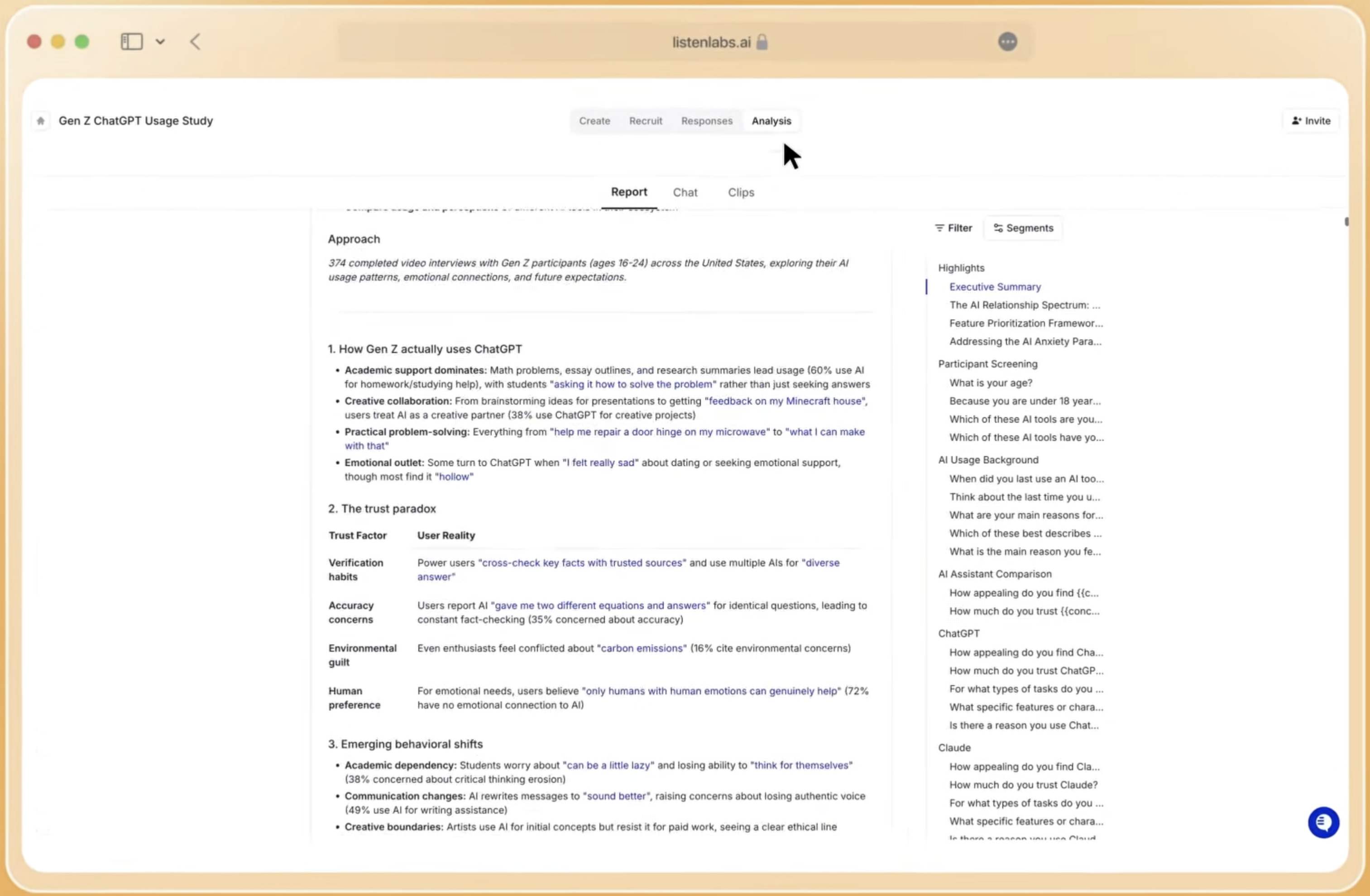
Insight adoption tracking stays simple and visible. Log each recommendation in a shared document with a status field such as under review, in sprint, shipped, or deprioritized, and review it at the start of each planning cycle. This rhythm creates accountability and builds the case for continued research investment.
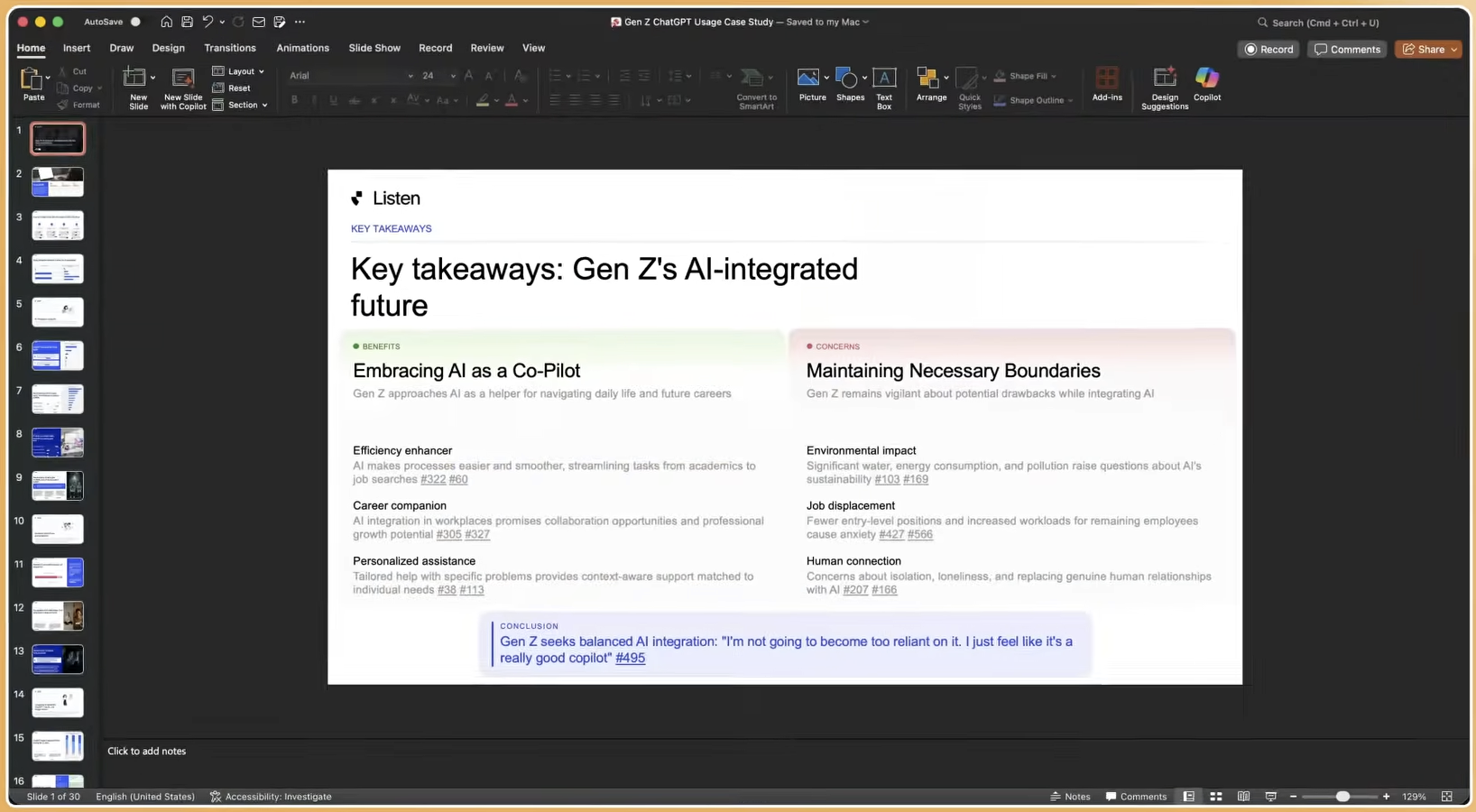
Platforms like Listen Labs layer on auto-recruiting, transcription, sentiment tagging, and insight summarization so teams jump from question to findings in hours, not weeks. The Research Agent generates consultant-quality slide decks, memos, video highlight reels, and statistical charts in under a minute, which removes the manual report-writing phase that traditionally adds one to two weeks to the cycle.
Advanced Strategies for Mature Travel-App Research Programs
Teams running mature travel-app research programs gain leverage from three advanced approaches. First, always-on research programs replace infrequent annual studies with continuous monthly studies segmented by traveler type. This structure provides a rolling view of how user needs shift with seasonality, competitive moves, and product changes. An always-on AI-powered voice-of-the-guest program automates moderation and thematic analysis so a single researcher can run continuous studies segmented by guest type or property.
Second, global multi-market studies recruit across top source markets because booking norms, payment preferences, trust signals, and price sensitivity vary significantly by region. Qual-at-scale is ideal when research requires large sample sizes or broad geographic reach, as AI tools can engage hundreds or thousands of participants remotely and asynchronously. This capability makes it practical to run simultaneous studies across North America, Europe, and APAC within a single research cycle.
Third, emotion-signal analysis becomes especially valuable for travel apps because more than half of travelers abandon travel bookings before paying due to bad digital experiences such as sudden price changes and insecure payment flows. These moments often register emotionally before users can articulate them, so emotion data reveals friction that standard questioning misses.
Frequently Asked Questions
How long does user research for a travel app typically take?
Timeline depends heavily on method and tooling. A traditional qualitative study that covers screener finalization, recruitment, moderated sessions, analysis, and reporting often takes several weeks end-to-end and can stretch longer for niche audiences. With AI-moderated platforms like Listen Labs, the same scope compresses to the timeline mentioned earlier for the interview and analysis phases, with recruitment from a verified panel completing in hours rather than weeks. Diary studies remain the exception because their value comes from the longitudinal observation period described in Step 3, although AI analysis of diary entries can begin on day two and run progressively throughout the study.
What screener criteria matter most for travel-app user research?
Behavioral criteria outperform demographics. The most predictive screener attributes for travel-app studies are the behavioral criteria outlined in Step 2, particularly recency of travel and booking method, rather than demographic filters like age and income. Demographics should support diversity balancing instead of serving as primary qualification criteria. Excluding UX professionals and travel-industry insiders also prevents expert-review bias from contaminating findings.
How many participants do I need per traveler segment?
For qualitative discovery and usability testing, five to eight participants per segment usually surface the primary themes within each group. When comparing two or more segments, such as solo travelers versus family travelers, aim for at least eight to ten per segment to support reliable cross-segment comparisons. Diary studies work well with a modest number of participants and should prioritize engagement level over sample size. If the goal is statistical confidence across a large population, AI-moderated platforms make it realistic to run 100 to 300 or more qualitative interviews per segment within a single study cycle, which collapses the traditional trade-off between depth and scale.
What is the best method for studying in-trip disruptions in travel apps?
The Experience Sampling Method (ESM) works best for capturing real-time reactions to disruptions such as flight delays, itinerary changes, or connectivity failures. ESM prompts participants at random or event-triggered moments during the trip and generates in-context data free from the recall bias that distorts retrospective interviews. Several prompts per day over multiple days can produce dozens of data points per participant. The strongest design pairs a one-week ESM study that surfaces high-frustration moments with follow-up interviews that reference participants’ own contemporaneous responses. Mobile ethnography apps that capture video, photo, and screen recordings complement ESM by providing visual evidence of the disruption context.
How does Listen Labs handle participant quality for travel-app research?
Listen Labs applies three layers of quality control. First, its recruitment infrastructure draws from a network of 30M verified respondents and works only with high-quality, non-commodity panel sources, which removes professional survey-takers. Second, the Quality Guard system described earlier monitors every interview in real time and adds checks for AI-generated scripts and mismatched profiles beyond the fraud and low-effort detection mentioned in Step 4. Third, participants are limited to three studies per month to prevent panel fatigue and incentive-driven behavior. For hard-to-reach travel segments such as frequent international business travelers or luxury travelers above a specific spend threshold, a dedicated recruitment operations team sources from niche communities and specialized networks, reaching audiences below 1% incidence rate.
Conclusion: Turn Research into Faster Travel-App Wins
Effective user research for travel apps follows a structured sequence. Teams define objectives and success metrics, build travel-specific screeners and personas, sequence methods from diary studies through interviews to usability testing, recruit quality participants with behavioral criteria, moderate sessions to capture rich verbal and emotional data, analyze themes and emotional signals together, and synthesize findings into stakeholder-ready deliverables. Each step addresses a distinct failure mode. Vague objectives produce unfocused findings. Demographic-only screeners produce mismatched participants. Single-method designs miss the longitudinal complexity of travel decisions.
The traditional version of this process takes four to six weeks and forces trade-offs between depth and scale. AI platforms remove both constraints. Listen Labs handles the entire research lifecycle, including study design, global recruitment from 30M verified respondents, AI-moderated interviews with adaptive follow-up, automated theme and emotion analysis, and consultant-quality deliverables, in the rapid timeframe described above and is trusted by enterprises including Microsoft, Google, and Anthropic.
Book your demo to run your first AI-accelerated user research study for your travel app and move from question to findings in hours, not weeks.