Written by: Anish Rao, Head of Growth, Listen Labs
Key Takeaways
- Traditional qualitative research cycles of four to six weeks move too slowly for 2026 CPG insights leaders who need segment-specific verbatims overnight.
- AI-moderated interview platforms compress the full research cycle to under 24 hours while still delivering hundreds of in-depth consumer conversations.
- Seven ready-to-use research questions address the dominant 2026 forces: value-seeking, GLP-1 adoption, private-label switching, AI agent commerce, clean-label priorities, sustainability transparency, and personalization expectations.
- Each question is paired with a Listen Labs tactic that uses quota splits, verified respondent panels, and emotional-intelligence analysis to surface actionable language by income tier, channel preference, or medication duration.
- Book a demo with Listen Labs to run your first 24-hour pilot and receive segment-specific consumer verbatims before your next leadership brief.
How 2026 CPG Consumer Insight Trends Are Colliding
CPG consumer insights trends in 2026 reflect four forces that now collide in every basket and trip. Value-seeking and private-label switching accelerate under record-high everyday price inflation. GLP-1 medication adoption restructures food and beverage category demand. Private-label quality perceptions erode national-brand loyalty across income segments. AI agent commerce rewrites product discovery before a human shopper ever sees a shelf. Insights leaders who surface segment-specific consumer language across all four forces at once build a durable competitive advantage.
Seven High-Impact CPG Consumer Questions for 2026
Question 1: Value-Seeking and Price Sensitivity Language
Ask: “When you last switched a grocery or household product to save money, walk me through exactly what triggered that decision and what you told yourself to justify it.”
This question targets the gap between price-driven behavior and the motivation behind it. Approximately 60-70% of US consumers prioritize price over brand or have switched brands due to price in 2026, per multiple surveys, yet the emotional narrative behind that switch rarely appears in survey data. A Deloitte study found that up to 40% of perceived brand value comes from factors beyond price, such as quality, trust, and experience. The language consumers use to rationalize switching is therefore as strategically important as the switch itself.
Listen Labs tactic: Deploy AI-moderated interviews with quota splits across household income bands and retail channel preference. The AI probes follow up on any mention of guilt, relief, or brand loyalty to surface the emotional permission structure behind trade-down decisions.
Question 2: GLP-1 Impact on CPG Categories and Rejection Cues
Ask: “Since starting your medication, describe the last time you stood in a grocery aisle and put something back that you would have bought before. What went through your mind?”
GLP-1 adoption has more than doubled in 16 months, with 21% of US households now including a current user. This rapid adoption already reshapes purchase behavior, as many current users report buying fewer sweet treats and salty snacks. That shift could put $30 billion to $55 billion in annual food and beverage industry sales at risk by 2030. The verbatim language users apply to rejected categories, and the replacement products they describe with enthusiasm, becomes raw material for repositioning briefs that respond to this disruption.
Listen Labs tactic: Recruit verified GLP-1 users from Listen Labs’ 30M+ panel, segmented by duration of use (under six months vs. over one year). Run parallel interview streams to capture how purchase language and category attitudes evolve across the adoption journey.
Question 3: Private Label vs. National Brand Win-Back Conditions
Ask: “Pick a store-brand product you now buy regularly that you used to buy as a name brand. What would the name brand have to do, specifically, to get you back?”
US private-label CPG sales reached $330 billion in 2026, capturing a 24% unit share. Forty-four percent of higher-income US shoppers earning $5,000 or more per month are buying more private label compared with 2025, which signals that switching no longer sits purely in budget behavior. The specific conditions under which a consumer would return to a national brand give brand teams the clearest playbook for win-back strategy.
Listen Labs tactic: Segment interviews by income tier and retailer loyalty (club channel vs. conventional grocery). This structure isolates whether return conditions are price-based, innovation-based, or identity-based.
Question 4: AI Agent Commerce and Trust in Recommendations
Ask: “Describe the last time an AI tool, such as a chatbot, a voice assistant, or a shopping app, recommended a product you ended up buying. What made you trust that recommendation over your own search?”
Only about 7% of U.S. consumers start their shopping journeys on ChatGPT, with Google leading at 57%, yet agentic shoppers are projected to drive $190–$385 billion in US e-commerce spending by 2030. Consumer trust in AI-mediated recommendations is forming now, and the language consumers use to describe that trust or distrust directly informs how CPG brands should structure product data and claims for machine-readable discovery.
Listen Labs tactic: Use AI-moderated interviews with screen sharing enabled so participants can walk through an actual AI-assisted shopping session in real time. This approach generates behavioral evidence alongside self-reported attitudes.
Question 5: Clean-Label Decision Triggers and Disqualifiers
Ask: “When you read a nutrition label or ingredient list, describe the exact moment you decide a product is clean enough to buy. What are you looking for and what immediately disqualifies it?”
This question captures the decision architecture behind clean-label purchases. Shoppers are reviewing labels more closely and using third-party label-scanning apps such as Yuka. The disqualification language consumers use is more actionable than approval language because it maps directly to formulation and labeling decisions.
Listen Labs tactic: Show participants actual product labels as stimuli during the AI-moderated interview. Listen Labs’ Emotional Intelligence layer captures micro-expressions at the moment of label review, surfacing hesitation and disgust signals that transcripts alone miss.
Question 6: Proving Sustainability Claims and Earning Trust
Ask: “When a brand makes a sustainability claim on packaging, walk me through whether you believe it, how you check it, and what would make you trust it completely.”
Transparency, sustainability, and inclusivity are becoming more important across demographics in 2026, not just among younger consumers, yet many consumers cite paying more as a key tradeoff when pursuing clean living. The verification behaviors consumers describe, such as QR code scanning, app checking, and retailer trust transfer, define where brands must invest in proof infrastructure.
Listen Labs tactic: Run parallel interview streams across Gen Z, Millennial, and Gen X cohorts. This structure isolates generational differences in verification behavior and willingness to pay for verified sustainability claims.
Question 7: Personalization Boundaries Across Omnichannel Journeys
Ask: “Think about the last time a brand or retailer felt like it actually knew you, your preferences, your budget, your routine. Describe that experience and what made it feel personal rather than creepy.”
Consumer experiences with CPG brands often feel impersonal, while many shoppers want clear rules for when an AI assistant acts on their behalf. The boundary between welcome personalization and surveillance-adjacent intrusion appears in consumer language, and that language becomes the brief for every loyalty and CRM team in CPG.
Listen Labs tactic: Segment by channel preference (in-store primary vs. e-commerce primary) and loyalty program membership. This segmentation isolates how data-sharing comfort varies by shopping context and existing brand relationship.
Launch a 24-Hour Pilot on Any of These Seven Questions
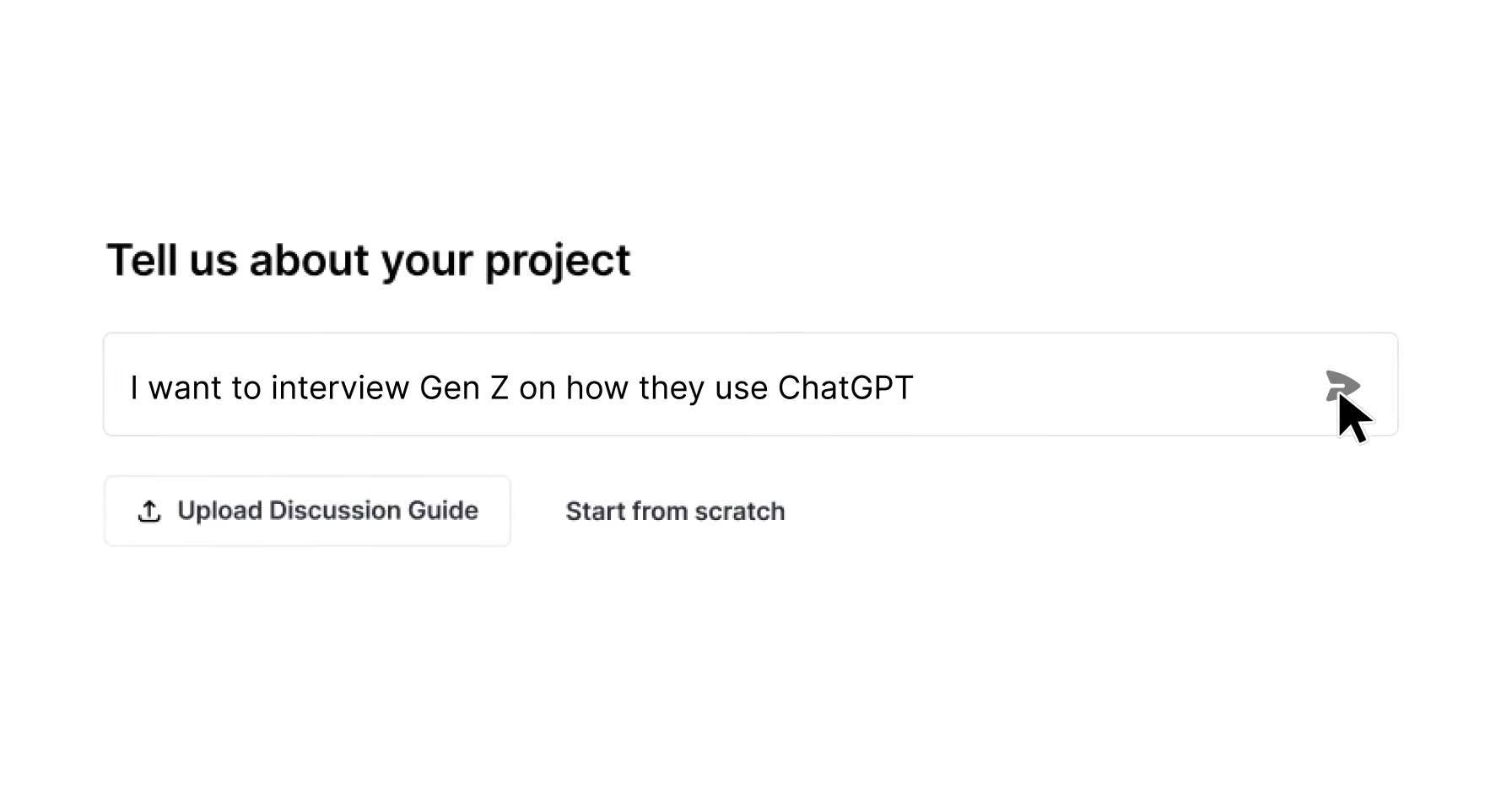
Listen Labs sources the right participants from its 30M+ verified respondent network, conducts AI-moderated video interviews with dynamic follow-up, and delivers a consultant-quality report, all in under 24 hours. One researcher ran a full buying intent analysis across three user segments in under a minute using the Research Agent. Listen Labs has run over 1 million AI-powered customer interviews for companies including Microsoft, Perplexity, and Sweetgreen.
Frequently Asked Questions
How quickly can Listen Labs deliver results on a CPG consumer insights study?
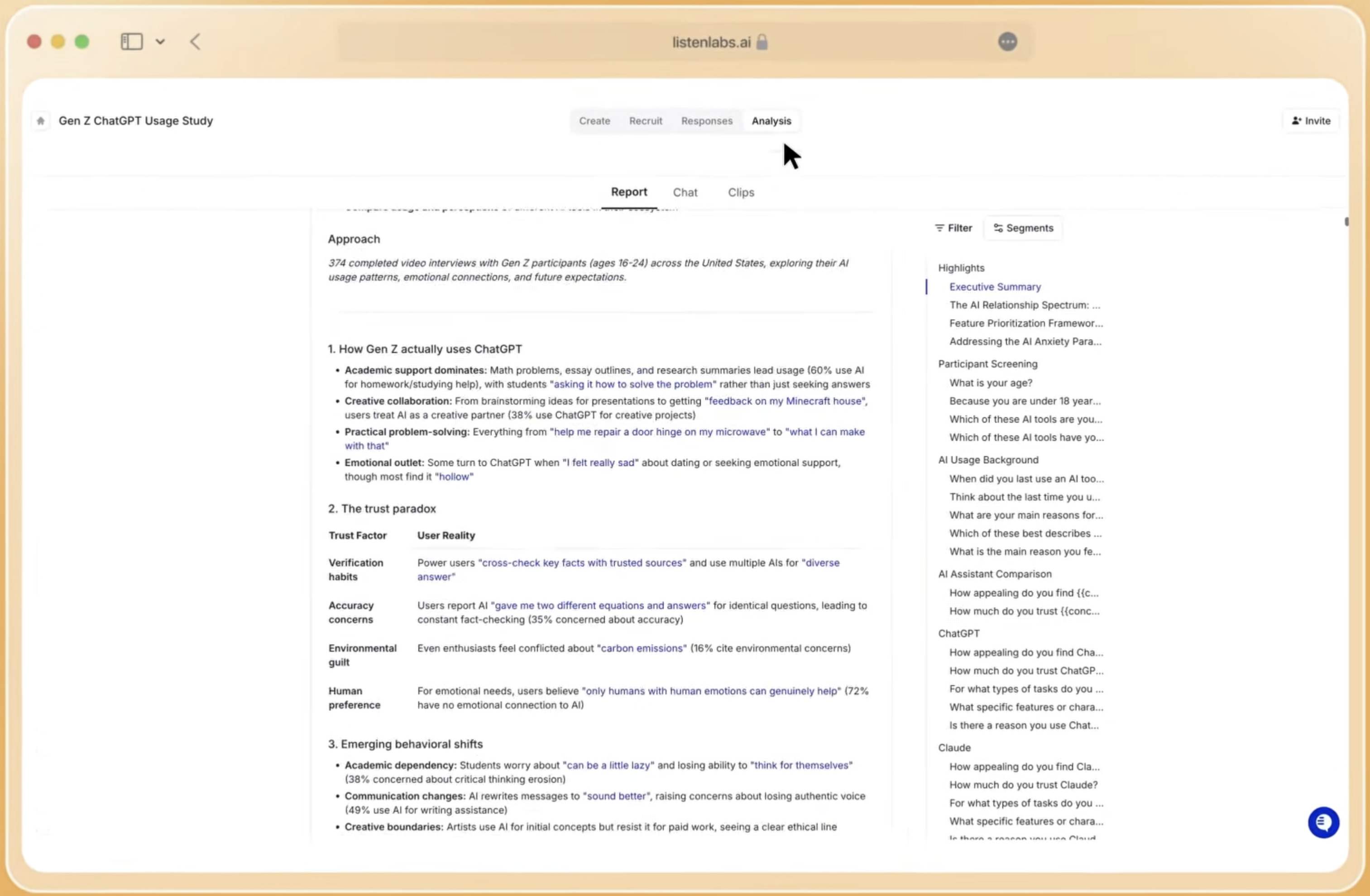
Listen Labs compresses the full research lifecycle, including study design, participant recruitment, AI-moderated interviews, analysis, and deliverables, to under 24 hours. A traditional qualitative research cycle runs four to six weeks, and in large enterprise settings can stretch to six months when internal prioritization and budget approval are factored in. Listen Labs replaces that entire process with a single end-to-end platform. The Research Agent generates slide decks, memos, video highlight reels, and statistical charts automatically from interview data, so insights leaders can brief leadership the same day results arrive.
How does Listen Labs ensure the CPG consumer sample is high quality and not filled with professional survey-takers?
Listen Labs operates three layers of quality control. First, the platform works exclusively with high-quality, non-commodity panel sources, not professional survey-taker pools. Second, Quality Guard monitors every interview in real time across video, voice, content, and device signals to detect fraud, low-effort responses, AI-generated scripts, and mismatched profiles. Third, participants are capped at three studies per month, which eliminates panel fatigue and incentive-driven answers. A dedicated recruitment operations team adds a human review layer for hard-to-reach segments, including GLP-1 users, club-channel-primary shoppers, or high-income private-label adopters below 1% incidence rate.
Can Listen Labs reach specific CPG consumer segments, such as verified GLP-1 users or high-income private-label switchers?
Yes. Listen Atlas, Listen Labs’ AI orchestration layer, matches and recruits across behavioral and intent data, not just self-reported demographics, across a global network of 30M verified respondents in 45+ countries. The dedicated recruitment operations team partners with niche communities and specialized networks to source audiences below 1% incidence rate. For CPG-specific studies, this includes verified GLP-1 users segmented by duration of use, high-income shoppers who have increased private-label purchasing, AI-assisted shoppers, and clean-label-prioritizing consumers across age cohorts. Organizations can also bring their own participants, such as loyalty program members, at a reduced cost.
How does Listen Labs handle data privacy and security for consumer interview data?
Listen Labs maintains enterprise-grade security with 256-bit encryption. Customer data is never used for AI model training. The platform holds SOC 2 Type II, GDPR, ISO 27001, ISO 27701, and ISO 42001 certifications. For Fortune 500 CPG companies with strict data governance requirements, Listen Labs supports enterprise SSO and integrates with existing security infrastructure. All participant data is handled in compliance with applicable privacy regulations across the 45+ countries the platform covers.
What deliverables does a CPG insights team receive at the end of a Listen Labs study?
The Research Agent generates a full suite of stakeholder-ready outputs automatically. Deliverables include automated key findings and theme analysis, consultant-quality PowerPoint slide decks in the company’s branded template, memo-style reports, video highlight reels of the most relevant interview moments, statistical charts and segment comparisons with significance testing, and segmentation breakdowns by demographics, cohorts, or custom audience groups. Every insight links back to the underlying verbatim response and timestamp, so insights leaders can trace any claim to its source before presenting to leadership. Custom reports can be generated by asking any natural-language question of the full interview dataset through the Research Agent’s chat interface.