
Written by: Anish Rao, Head of Growth, Listen Labs
Key Takeaways
- AI brand perception measurement combines LLM audits across visibility, favorability, prominence, and citation share with continuous customer interviews to explain why perception shifts.
- Four core metrics (Visibility, Favorability, Prominence, and Citation Share) form the foundation of any LLM brand audit, with benchmarks varying by category and competitive set.
- Standardized prompt libraries of 30–50 queries run across ChatGPT, Claude, Gemini, and Perplexity, repeated three times per engine, provide reliable share-of-voice and sentiment data.
- LLM-only scores can mislead because of the Say-Do Gap; pairing audits with real customer interviews closes this gap and surfaces the emotional truth behind the numbers.
- Listen Labs delivers an end-to-end solution that audits LLM outputs and validates perception shifts through continuous AI-moderated interviews — see how the platform works to get started.
1. Core AI Metrics and 2026 Benchmarks for Brand Teams
Four metrics form the foundation of any LLM brand audit. Semrush defines AI visibility as two separable signals, mention share and citation share, tracked across ChatGPT, Google Gemini, Google AI Mode, and Google AI Overviews. The IAB’s August 2026 framework “Measuring Visibility in the AI Era” organizes these into four dimensions it calls the 4 P’s: Presence, Prominence, Portrayal, and Persuasion.
Visibility (Presence / Mention Rate) is the percentage of relevant queries where a brand appears in any LLM response. Formula: (Queries with Mention ÷ Total Queries) × 100. Higher mention rates indicate stronger visibility, though specific thresholds vary by category and competitive set.
Favorability (Portrayal / Net Sentiment) captures whether characterizations are accurate and positive. Formula: (Recommended + Positive − Negative) ÷ Total Mentions × 100. Analyses of brand-mentioning AI responses have found that most mentions tend to be neutral or positive, with negative mentions less frequent. Higher scores indicate more favorable framing, while lower scores can signal negative narratives.
Prominence reflects where within a response a brand appears. First-mentioned brands capture disproportionate mindshare. First-position citations can earn significantly higher click-through rates than lower-position ones.
Citation Share is the percentage of AI-generated answers that cite a brand’s domain as a source. Formula: (Citation Slots Earned ÷ Total Slots Tracked) × 100. Higher citation shares are generally better. Brands are roughly 6.5× more likely to be cited via third-party sources than through their own domain, so coverage in analyst reports, review platforms, and major editorial outlets becomes the highest-ROI lever for improving citation share.
| Metric | What it measures | Example question |
|---|---|---|
| Visibility | How often your brand appears | In how many “best [category]” answers are we named? |
| Favorability | How positively you are framed | Are we recommended or just listed? |
| Prominence | Where you appear in the answer | Do we show up first or after competitors? |
| Citation Share | How often your domain is cited | Do AI answers link to our site or third parties? |
Run your first audit with Listen Labs and see these four metrics in one view.
Now that these core metrics are defined, the next step is building a consistent way to measure them across models.
How to Audit Brand Perception in ChatGPT, Claude, Gemini, and Perplexity
A practical cross-model methodology runs the same fixed prompt set across ChatGPT (GPT-4o), Claude (Sonnet), and Gemini (1.5 Pro) within the same 24-hour window, with temperature set to 0 or as deterministic as possible, using English language and US region settings. Add Perplexity for retrieval-augmented citation data.
For each run, record the full response text, every brand name mentioned, position of first mention, sentiment classification, and any URLs or domains cited. Store short evidence snippets, the surrounding text for each brand mention, to avoid black-box scoring and to support later diagnosis of narrative reasons such as pricing or security concerns.
Repeat each prompt three times in fresh logged-out sessions to account for response variability. One LLM response is not a reliable measure, because answers can vary across runs in brand inclusion, answer order, recommendations, claims, citations, and favorability.
Average citations per AI answer vary by platform. For example, Claude names brands in 97.3% of responses, ChatGPT in 73.6%, and AI Overviews in 48.5%. Treat each platform as a separate channel with its own baseline.
See how Listen Labs automates cross-model prompt execution and scoring.
2. Standardized Prompt Library for Reliable AI Benchmarks
A reliable baseline requires 30–50 standardized prompts per product line, split across high-intent themes such as “best,” “alternatives,” “pricing,” and “integrations”. This volume ensures you capture how your brand appears across different buyer questions. Avoid brand-name prompts, which artificially inflate share-of-voice results, because they force the AI to mention you.
Structure your prompt library across three intent types:
- Navigational / Best-in-class: “What are the best [category] tools for [use case]?” / “Which [category] platforms do enterprise teams use?” / “What software do Fortune 500 companies use for [function]?”
- Problem-aware: “How do I solve [pain point]?” / “What’s the fastest way to [achieve outcome]?” / “What should I look for when choosing a [category] vendor?”
- Comparison-focused: “[Brand A] vs [Brand B] for [use case]” / “What’s the difference between [Brand A] and [Brand B]?” / “Which is better for [specific need]: [Brand A] or [Brand B]?”
Score each brand mention on a five-level rubric:
- Recommended — active endorsement using language such as “best option” or “I recommend”
- Positive framing — favorable description without explicit recommendation
- Neutral listing — named without evaluation
- Hedged — qualified or conditional mention
- Negative — unfavorable characterization or active warning
Start your prompt audit and explore Listen Labs’ template library.
Once you have a stable prompt set and scoring rubric, you can translate raw answers into clear favorability scores.
AI Brand Favorability Scoring Across LLM Responses
Favorability scoring combines three sub-signals: sentiment polarity, accuracy, and recommendation rate.
Sentiment Polarity uses the net sentiment formula above. Track wrong claims, such as hallucinations about pricing or discontinued products, as a separate accuracy error count rather than blending them into sentiment scores, since a factually incorrect positive claim is a different problem than a negative characterization.
Accuracy is evaluated by running a secondary LLM pass against a ground-truth brand fact sheet to flag mischaracterizations. Sentiment Accuracy evaluates whether an LLM’s brand characterization is factually correct and on-brand, catching errors like wrong use cases or outdated pricing before they influence buyer decisions.
Recommendation Rate measures the percentage of AI answers that actively recommend a brand. Benchmarks: 5–10% = minimal, 15–25% = moderate, 35%+ = strong. These benchmarks reveal how often being mentioned translates into being endorsed. In one athleisure analysis, New Balance was recommended in only 3.4% of “best athleisure” answers despite high identification rates, while Lululemon appeared in approximately 90%, which illustrates the gap between visibility and favorability.
Pilot Listen Labs today and see your favorability scorecard in real time.
After scoring favorability, you need a repeatable rhythm for tracking changes over time.
3. 30-Day Audit Cadence for Ongoing AI Visibility Tracking
Weekly automated tracking is the recommended cadence for detecting shifts in AI share of voice, with monthly deep-dive audits using expanded prompt sets. The following checklist turns this into a repeatable four-week cycle.
Week 1 — Baseline:
- Define your 30–50 prompt set across navigational, problem-aware, and comparison-focused intent types
- Run prompts across ChatGPT, Claude, Gemini, and Perplexity in a single 24-hour window
- Record full responses, brand positions, sentiment classifications, and cited domains
- Establish baseline scores for all four core metrics
- Identify top 5 third-party domains driving citations for your category
Week 2 — Competitive Mapping:
- Re-run the same prompt set and compare brand mention rates against 3–5 competitors
- Calculate share of voice per engine: (Your Mentions ÷ Total Brand Mentions) × 100
- Flag any accuracy errors or hallucinations for remediation
- Identify which competitor content is being cited and why
Week 3 — Qualitative Validation:
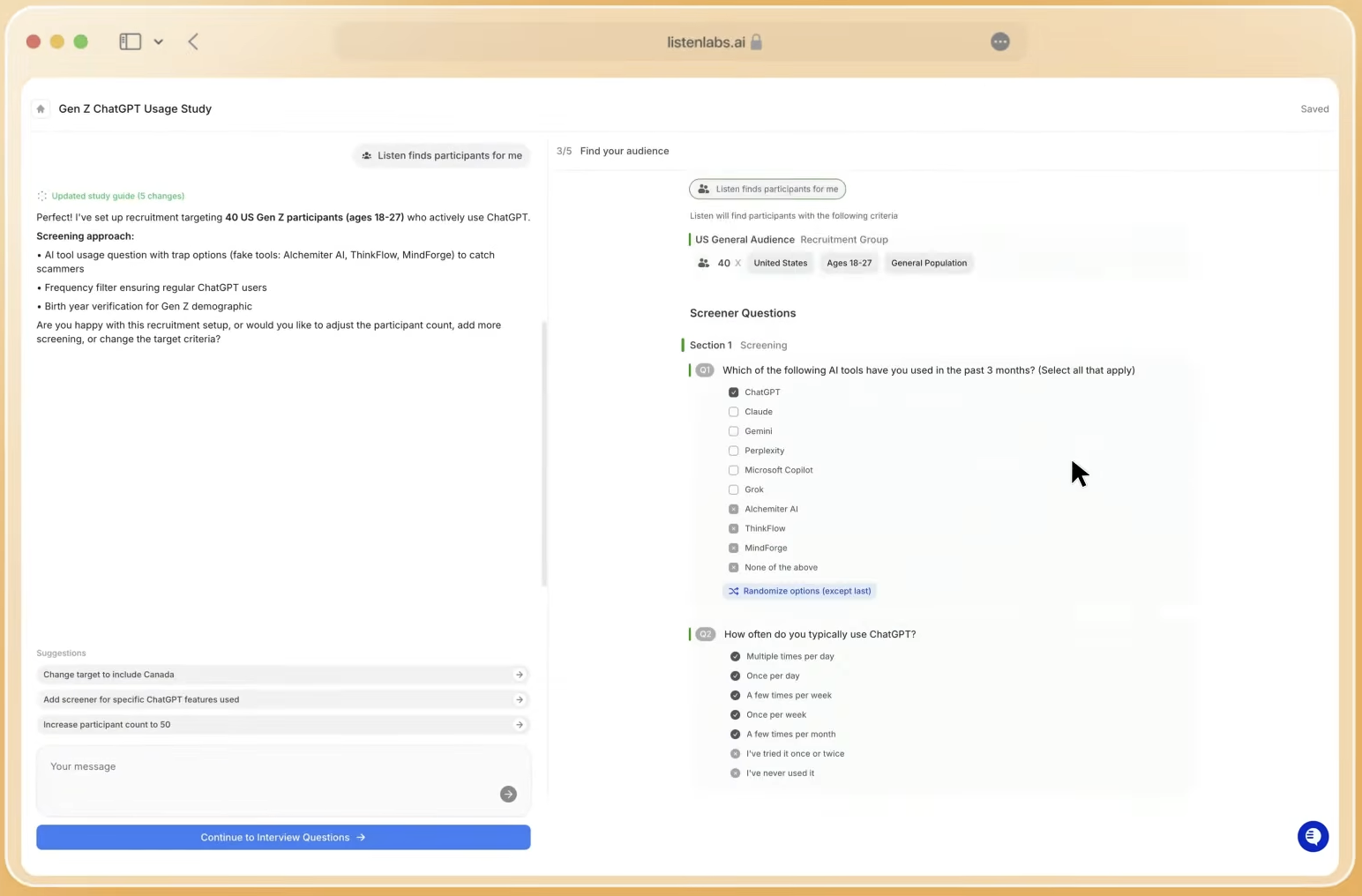
- Launch AI-moderated customer interviews on the themes surfaced in Weeks 1–2
- Test whether LLM-identified brand attributes match what real customers say and feel
- Capture emotional signals such as hesitation, confusion, and delight that LLM outputs cannot surface
Week 4 — Synthesis and Action:
- Re-run the full prompt set to measure any movement from content or PR actions taken
- Produce a trended report comparing Week 1 and Week 4 scores across all four metrics
- Document the narrative reasons behind any perception shifts using interview verbatims
- Set alert thresholds for the following month’s automated monitoring
Launch your 30-day audit and review a sample cadence report.
The 30-day cadence provides the rhythm for tracking. To make that tracking reliable, you also need a clear framework for how each prompt run is executed and logged.
Prompt Testing Framework for Consistent Brand Perception Audits
A durable prompt testing framework separates three operational layers. Layer 1 is Share of Voice by Engine, Layer 2 is Citation Source Attribution, identifying which domains AI engines pull from, and Layer 3 is Brand Accuracy and Sentiment Scoring.
Log every run in a structured spreadsheet or platform that captures prompt text, engine, run date, full response, brand mentions with position, sentiment level on the 1–5 rubric, cited URLs, and accuracy flags. Trend these fields monthly. Run the audit monthly as a baseline, bi-weekly while actively repairing a perception problem, and re-run within a week of major model releases. Apply the three-run minimum described earlier to every prompt in your library.
For high-priority citation analysis, repeated testing across 30 to 50 runs per narrative provides a stronger view of recurring URLs, citation frequency, and cross-model source patterns. This volume distinguishes durable patterns from intermittent outputs and model-specific behavior.
Explore Listen Labs’ prompt testing framework in action.
4. Why LLM-Only Scores Can Mislead: The Say-Do Gap
The audit framework above gives you reliable LLM perception scores, but those scores alone do not tell the full story. LLM outputs are leading indicators, not ground truth, and treating them as equivalent to customer sentiment creates a dangerous blind spot. LLMs systematically rate established brands lower on equity metrics than human consumers do. As Janu Lakshmanan, VP of Professional Services at BERA, states: “[LLMs] systematically see brand equity differently than consumers do…for over a dozen brands that I’ve looked at, the AI models have a different perception than consumers.”
Three structural reasons explain this divergence and together they create the Say-Do Gap. First, LLMs over-index on third-party earned media and negative sentiment from review sites and forums, so unresolved complaints depress AI brand perception more aggressively than they affect human sentiment scores. Second, LLMs lack emotional bias and evaluate brands through structured feature vectors, which means they flag pricing discrepancies or missing verifiable data points that human consumers often overlook because of brand loyalty or heritage. Third, LLM brand perception typically lags changes in published content by weeks to months overall, with retrieval engines updating in days to weeks and training-based models taking 3–18 months depending on the system and signal strength.
LLMs also systematically underrepresent minority dissent because they trend toward consensus patterns in training data. A brand tracker that only reads LLM outputs will miss the early signal of a loyalty problem forming in a specific customer segment.
Close the Say-Do Gap with Listen Labs and align AI scores with real customer sentiment.
5. Closing the Gap with Continuous Qualitative Research
The missing layer in every LLM audit is emotional truth. Listen Labs’ Emotional Intelligence analyzes three simultaneous signal streams, tone of voice, word choice, and subconscious micro expressions, to surface emotions that transcripts alone miss. Built on Ekman’s universal emotions framework, every emotion is quantified per question and concept, and every label is traceable to the exact timestamp, verbatim quote, and reasoning behind it. This is available across more than 50 languages.
For brand perception research specifically, real customer interviews are required because reactions to a specific brand name are shaped by lived experiences, such as support interactions and prior competitor use, that no training corpus captures. The recommended workflow uses an LLM audit first to generate hypotheses, followed by AI-moderated interviews with participants recruited from the target segment to validate or refute those hypotheses with decision-grade data.

Listen Pulse operationalizes this as an always-on conversational tracker. It runs the same study with the same screeners wave after wave, analyzes open-ended answers, sorts them into themes, quantifies them, and charts each theme next to the KPIs already being reported. Core questions stay constant to protect the trend line while timely questions cover new campaigns and competitors. One clothing brand’s traditional tracker caught a sales drop but could not explain it. Pulse found it was not price, it was style. A growing group of customers felt the brand’s signature logos were too loud for their changing lifestyles. That finding required human voices, not LLM outputs.
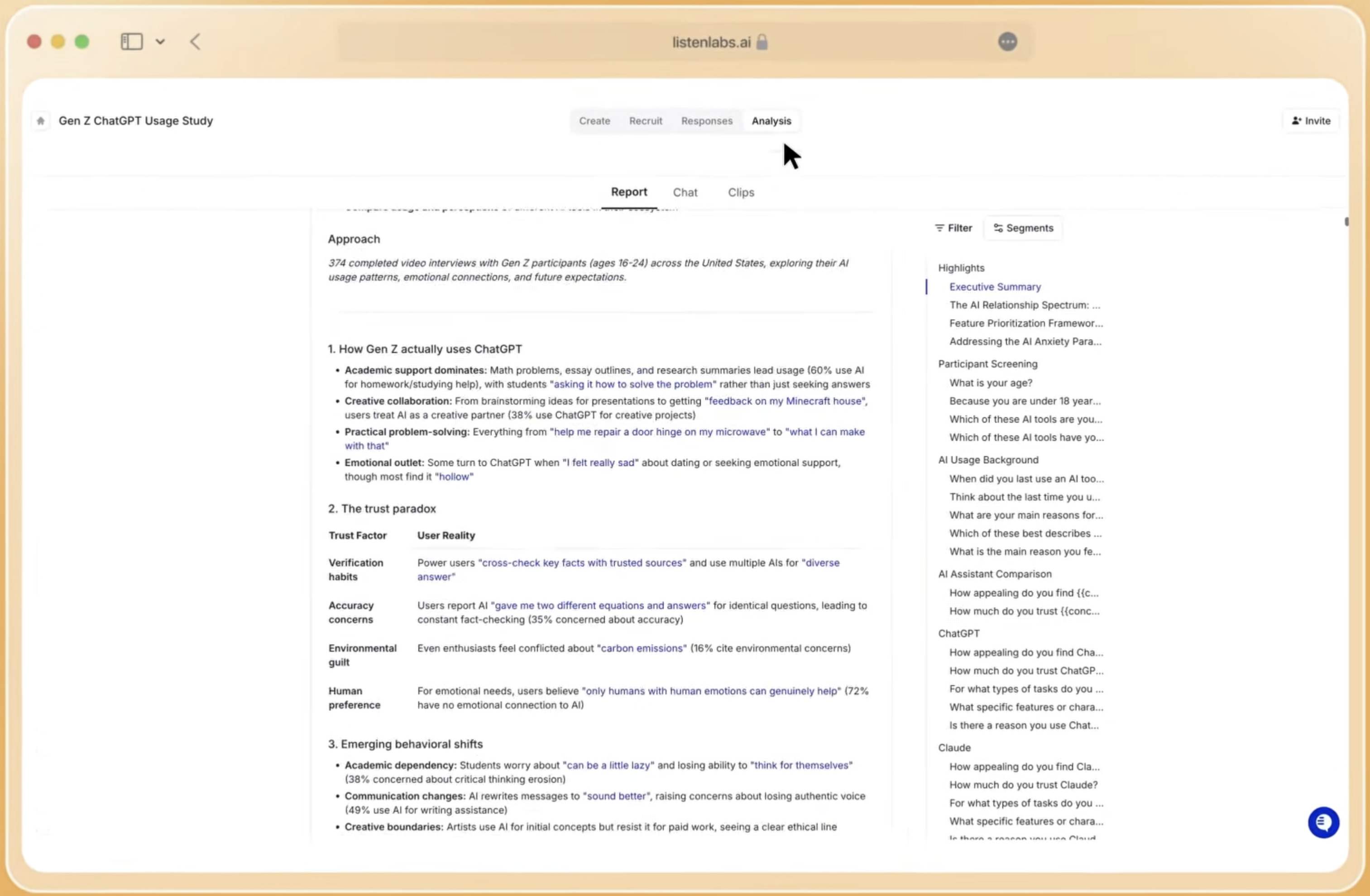
AI interviewers enable 500 interviews at roughly the cost of five human-led ones while applying uniform follow-up logic to every participant, which makes continuous brand perception tracking economically viable at enterprise scale.
Run continuous tracking with Listen Labs and connect AI scores to real emotions.
6. Common Pitfalls and Accuracy Checks in LLM Brand Audits
Six pitfalls consistently undermine LLM brand audits.
- Running the audit only once. A single prompt execution cannot distinguish durable patterns from stochastic variation. Mitigation: run each prompt at minimum three times per engine per wave.
- Using brand-name prompts. Brand-name prompts artificially inflate share-of-voice results. Mitigation: build the prompt library from category, problem-aware, and comparison-focused queries only.
- Conflating mentions with citations. As noted earlier, brands with strong organic visibility often have high mention rates but low citation shares. Mitigation: track mention rate and citation share as separate metrics.
- Blending accuracy errors into sentiment scores. A hallucination about pricing is a data quality problem, not a sentiment signal, and if you treat it as negative sentiment you will misdiagnose the issue and waste effort on reputation management when the real fix is correcting the AI’s source data. Mitigation: log accuracy errors in a separate column and remediate them through content correction before re-scoring sentiment.
- Optimizing for one model only. As the platform-specific mention rates above demonstrate, response behavior varies significantly across engines. Mitigation: always run the full cross-model prompt set.
- Treating LLM scores as equivalent to consumer sentiment. The BERA perception gap data above demonstrates this is structurally false. Mitigation: pair every LLM audit wave with a Listen Pulse wave to validate signals against real customer emotion and behavior.
Validate your audit with Listen Labs and avoid the most common LLM pitfalls.
Frequently Asked Questions
How long does it take to see results from an LLM brand audit?
A baseline audit across ChatGPT, Claude, Gemini, and Perplexity using a 30–50 prompt set can be completed within 24 hours when using an automated platform. Manual execution takes one to two days of analyst time. The first meaningful trend data, showing whether scores are moving directionally, is available after two to four monthly waves. Listen Labs compresses the qualitative validation layer to less than 24 hours as well, so the full audit-plus-validation cycle that previously took four to six weeks can be completed in under two days.
How does Listen Labs protect data privacy during brand perception research?
Listen Labs maintains enterprise-grade security with 256-bit encryption and holds SOC 2 Type II, ISO 27001, ISO 27701, and ISO 42001 certifications. The platform is GDPR compliant. Critically, Listen Labs never trains its AI models on customer data, which is a non-negotiable policy for enterprise clients handling proprietary brand intelligence.
Can Listen Labs reach hard-to-find audiences for brand validation interviews?
Yes. Listen Labs’ dedicated recruitment operations team partners with niche communities, micro-creators, and specialized networks to source participants below 1% incidence rate, including enterprise decision-makers, engineers, healthcare workers, and highly specialized consumer segments. The platform’s 50M+ verified respondent network spans more than 45 countries and 120+ languages, which enables brand perception validation with the exact customer segments that matter most to a given brand.
When should a brand repeat its LLM audit?
The standard cadence is monthly for baseline tracking, bi-weekly during active perception repair, and within one week of a major model release such as a new GPT or Gemini version. Listen Pulse runs continuously, so qualitative validation does not need to be scheduled separately, and it surfaces emerging themes before they appear in tracked KPIs, giving teams a lead indicator rather than a lagging one.
How does this framework integrate with existing brand trackers like Qualtrics?
Listen Pulse integrates directly with Qualtrics and Decipher, so teams keep the KPIs they already report while adding the narrative explanation behind each metric movement. The LLM audit layer sits alongside existing trackers as a leading indicator channel. Teams do not need to replace their current infrastructure, because Listen Labs deploys alongside it or as the primary tracking system, depending on the organization’s needs.
Conclusion
LLM audits remain directional until paired with continuous qualitative research. The four core metrics, visibility, favorability, prominence, and citation share, tell a brand where it stands inside AI-generated answers. They do not explain why a number moved, which customer segment is driving the shift, or what emotional truth sits behind the data. That explanation requires real customer voices, captured at scale, with the emotional intelligence to surface what transcripts alone miss.
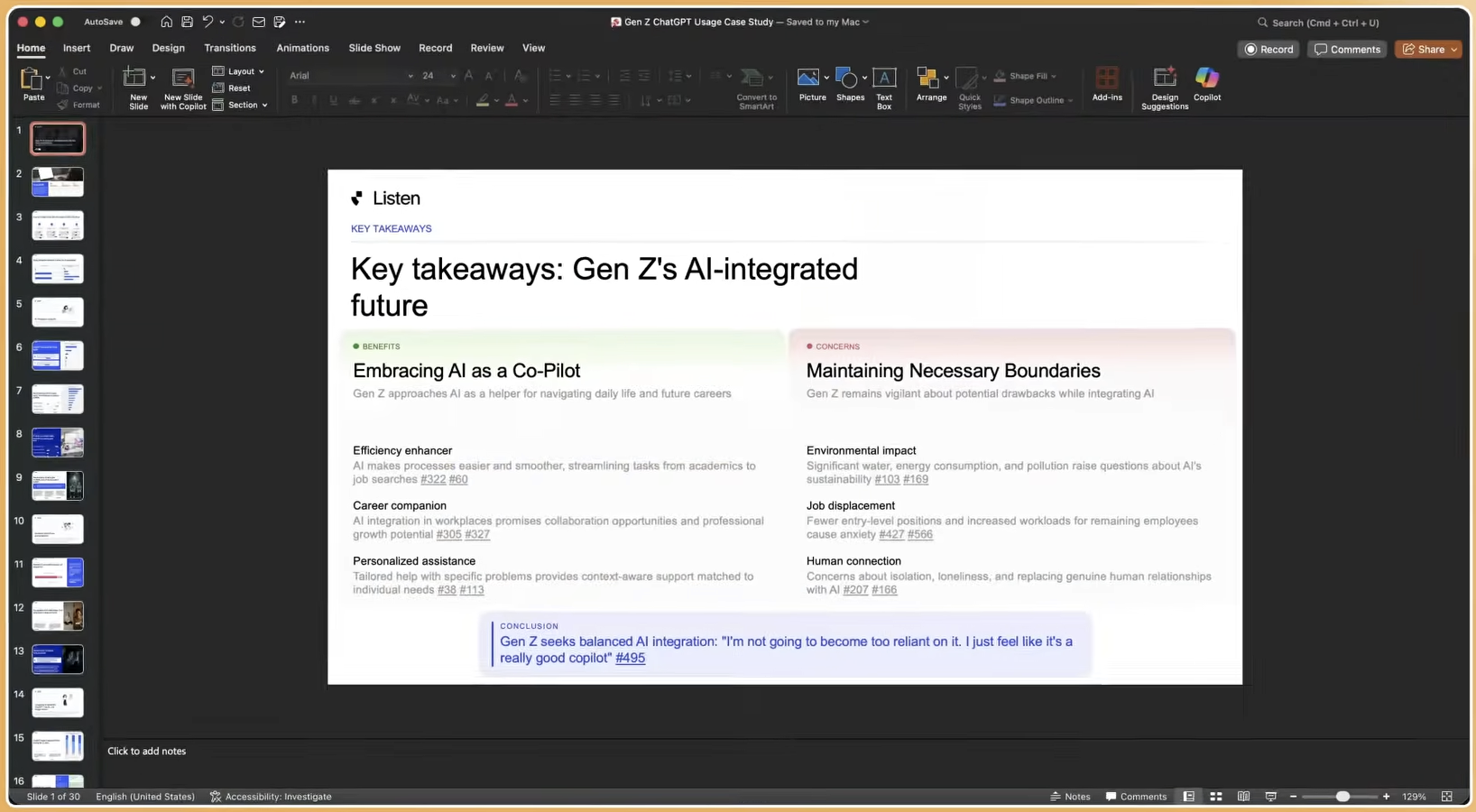
Listen Labs is the only platform that audits LLM outputs and explains perception shifts through continuous AI-moderated customer interviews, combining Emotional Intelligence analysis, Listen Pulse conversational tracking, and a 50M+ verified respondent network into a single end-to-end solution. Enterprises including Microsoft, P&G, Nestlé, and Skims already use it to turn brand perception from a lagging indicator into a strategic advantage.
Run your first complete brand perception audit in under 24 hours — book a demo at Listen Labs.