
Written by: Anish Rao, Head of Growth, Listen Labs
Key Takeaways for 2026 Brand Tracking Decisions
- Traditional brand trackers like Latana, Tracksuit, and Attest report metric shifts but cannot explain why they occur due to closed-ended survey limitations.
- Listen Pulse pairs quantitative KPIs with open-ended conversational questions in every wave, surfacing emerging themes before they register as KPI movement.
- Listen Pulse delivers enterprise-grade sample quality through real-time behavioral monitoring, fraud detection, and a 50-million verified respondent network across 45+ countries.
- Listen Pulse offers cross-study querying via Research Library and holds SOC 2 Type II, ISO 27001, ISO 27701, and ISO 42001 certifications, and none of the comparison platforms match this security profile.
- Teams seeking continuous KPIs plus traceable qualitative explanation at one-third the cost of legacy solutions should see how Listen Pulse delivers both in a single platform.
Cost and Contract Structures by Platform
Latana publishes two named tiers. The Essential and Pro plans use annual pricing that scales with brands tracked, audience segments, and add-ons such as funnel metrics, trend-line models, and KPI predictions. Final pricing also reflects market complexity, audience incidence rates, and brand size. A Custom tier supporting multiple brands and segments is available on request.
Tracksuit offers brand tracking at $19,000 annually, sold as an annual subscription. Multi-market and multi-brand programs carry higher pricing.
Attest uses a credit-based model across a self-serve platform. The absence of a forced annual contract gives mid-market teams flexibility but makes total cost of ownership harder to forecast at enterprise scale.
Listen Pulse is positioned at one-third the cost of legacy solutions, with flexible enterprise subscriptions that avoid rigid annual wave commitments. Enterprises including Microsoft, P&G, and Sweetgreen, which achieved 5x the research scale at one-third the cost, have validated this pricing model in production. Listen Labs has raised $100 million in total funding, including a $69 million Series B led by Ribbit Capital in January 2026, which provides the financial stability enterprise procurement teams require. Cost alone, however, does not determine tracking ROI, because sample quality and recruitment controls directly affect whether the data justifies the spend.
Sample Size, Quality Controls, and Recruitment Systems
Latana completes 100,000 interviews per brand and year, using MRP statistical modeling to generate audience-specific metrics from smaller raw samples. The methodology remains survey-based and closed-ended, which limits fraud detection to panel-level controls rather than real-time behavioral monitoring.
Tracksuit surveys thousands of consumers monthly via census-weighted panels. Reviewers note that monthly sample sizes are frequently described as too thin to support reliable segment analysis or significance testing for smaller brands. This constraint becomes acute when teams need to break results out by region, demographic cohort, or purchase occasion.
Attest draws on a global panel of 150 million consumers across 59 countries, with users setting their own sample sizes and cadence. The self-serve model places quality-assurance responsibility largely on the researcher rather than the platform.
Listen Pulse recruits from Listen Labs’ network of 50 million verified respondents across 45+ countries and 120+ languages. To ensure this scale does not compromise quality, Quality Guard matches participants on behavioral and intent signals rather than self-reported demographics, then monitors every interview in real time for fraud, low-effort responses, and repeat respondents. The platform enforces a hard limit of three studies per month per participant, which eliminates the professional survey-taker problem that inflates commodity panels. For hard-to-reach segments, including enterprise decision-makers and audiences below 1% incidence rate, a dedicated recruitment operations team adds a human review layer that automated matching alone cannot provide.
Explaining Metric Movement Before KPIs Shift
Wave-based quantitative brand trackers such as Latana, Tracksuit, and Attest detect shifts in awareness, consideration, or trust but cannot explain why those shifts occur. Closed-ended survey instruments carry no dynamic follow-up capability, so a tracker can record that awareness rose from 68% to 71% or that trust declined 3 points among women 25–34 without capturing the underlying reasons. A 2-point decline in consideration registers as noise within the margin of error in a single annual wave and is reported as “stable,” while the same decline repeated across four consecutive quarters reveals a trend that will reach revenue within 6–12 months.
Without diagnostic layers, teams answer “why” questions with speculation instead of evidence. Many enterprise programs cover this gap unevenly or not at all at the diagnostic and predictive levels.
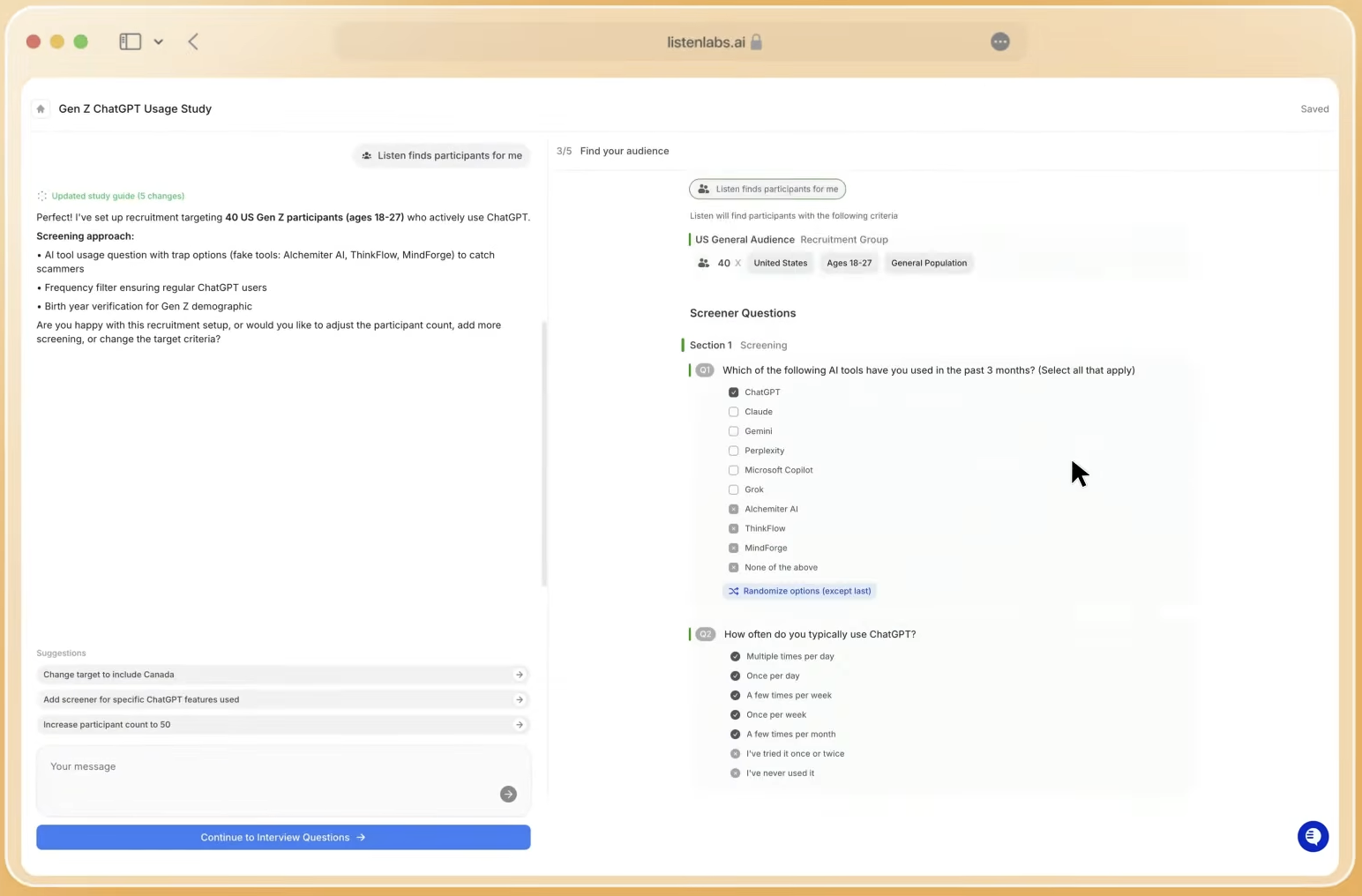
Listen Pulse addresses this diagnostic gap by pairing quantitative KPI questions with open-ended conversational waves in the same instrument. Core questions stay constant wave over wave to protect the trend line. Timely add-on questions cover new campaigns, competitors, or news events without breaking historical comparability. The platform analyzes tens of thousands of responses continuously and surfaces emerging themes before they register as KPI movement.
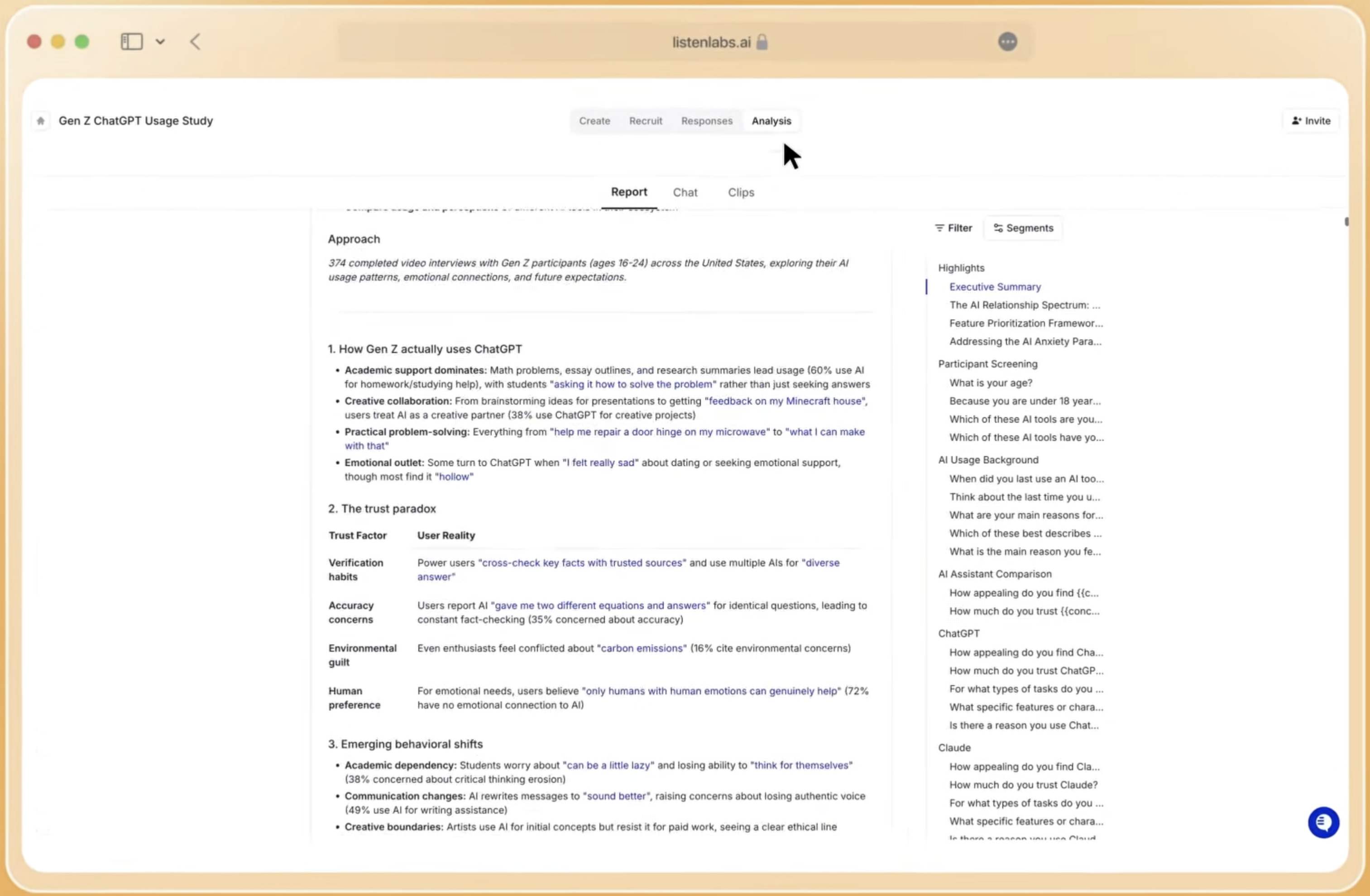
One well-known clothing brand discovered through Pulse that customer attrition was driven not by price but by a shift in style perception. Its legacy tracker detected the metric drop but could not explain it. With Pulse, every number traces back to the interview, verbatim quote, and audio or video clip behind it. Pulse also integrates directly with Qualtrics and Decipher, so teams keep the KPIs they already report while adding the narrative behind them.
See how Listen Pulse surfaces emerging themes before they appear in your KPI dashboard.
Cross-Study Querying and Enterprise-Grade Security
Latana, Tracksuit, and Attest deliver study-level dashboards that operate in isolation. None of the three platforms offers native cross-study querying that synthesizes findings across multiple waves or research programs in natural language.
Listen Pulse runs on Listen Labs’ Research Library, which searches every study an organization has ever run simultaneously and returns synthesized answers with full source attribution. Teams can trace every answer back to the original study, discussion guide, screener, and individual respondent. This structure allows teams to compare findings across waves, track how sentiment evolves over time, and confirm whether a question has already been answered before commissioning new research.
On security, Listen Labs holds SOC 2 Type II, ISO 27001, ISO 27701, and ISO 42001 certifications, operates with 256-bit encryption and enterprise SSO, is GDPR compliant, and never trains its AI models on customer data. None of the three comparison platforms publicly discloses an equivalent combination of certifications at the ISO 42001 AI management systems level.
Study Setup, Wave Cadence, and Analysis Speed
Latana and Tracksuit both use continuous collection models with monthly or quarterly dashboard refreshes. This approach reduces the wave-gap problem but does not add qualitative depth. Attest allows users to set trackers to recur, with the next survey pre-populated as a draft. All three platforms deliver quantitative outputs such as awareness, consideration, preference, and NPS without conversational follow-up.
Listen Pulse runs the same screeners and core questions wave after wave, then adds open-ended conversation to every wave. The Research Agent generates slide decks, memos, highlight reels, and stat tests automatically. A consumer brand client reported that their legacy agency tracker delivered results with significant lag, while Listen Pulse delivered results in under 24 hours.
Platform Fit for Enterprise and Mid-Market Teams
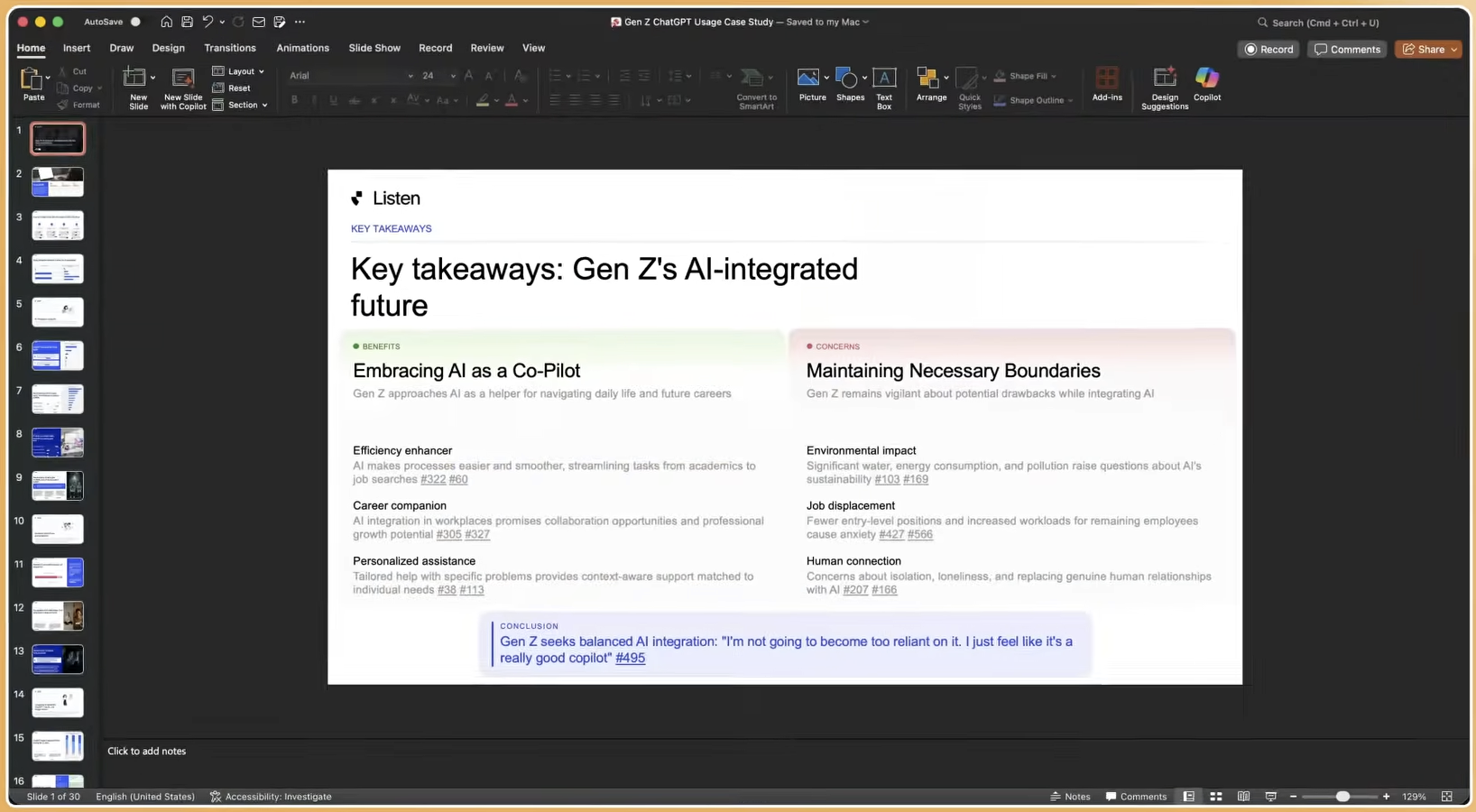
Enterprise consumer insights teams with heavy internal demand, such as Fortune 500 organizations in tech, CPG, retail, or food and beverage, are best matched to Listen Pulse. The platform multiplies research output without proportional headcount increases, integrates with Qualtrics and Decipher for continuity with existing reporting infrastructure, and covers 45+ countries and 120+ languages for multi-market programs. Microsoft cut research wait time from weeks to hours, and P&G shaped product and brand strategy from 250+ interviews delivered in hours, not weeks.
Mid-market teams on tight budgets running a single brand in a single market, and without a need for qualitative explanation, may find Tracksuit or Attest adequate for scoreboard-level KPI monitoring. Tracksuit’s continuous collection and Attest’s flexible credit model both serve teams that need awareness and consideration data without the overhead of enterprise contract negotiation.
Global brands that need both scale and explanation, tracking across multiple markets and languages while understanding the consumer reasoning behind metric movement, align with Listen Pulse. It is the only platform in this comparison that delivers both capabilities in a single instrument.
Where Each Brand Tracking Option Falls Short
Latana’s fees accumulate quickly in multi-market programs, and the platform carries no built-in qualitative explanation for why metrics shift. Latana’s survey-based methodology shares the structural “why” limitation of survey trackers and cannot explain the drivers behind metric movements.
Tracksuit’s monthly sample is frequently described as too thin to support reliable segment analysis or significance testing for smaller brands, and the platform offers no emotional-signal capture or qualitative follow-up. For teams that require segment-level reliability and diagnostic depth, these two constraints compound each other.
Attest’s self-serve model places quality assurance on the researcher, and the credit-based structure makes total cost of ownership difficult to forecast for teams running frequent waves across multiple markets. Like Tracksuit, it captures no emotional signals and offers no conversational follow-up.
Listen Pulse functions as an enterprise product. Teams that need a lightweight, no-contract scoreboard for a single market and have no requirement for qualitative depth will find the platform’s capabilities exceed their current need and should evaluate Tracksuit or Attest instead.
Decision Checklist for Selecting a Tracker
Use the criteria below to match your team’s situation to the right platform and move from options to a short list.
- Single market, tight budget, scoreboard KPIs only: Tracksuit or Attest (credit-based).
- Multiple markets, MRP modeling, established brand portfolio: Latana Pro, with the understanding that qualitative explanation requires a separate study.
- Enterprise team, heavy internal demand, need to explain why metrics move: Listen Pulse, which delivers continuous KPIs plus traceable qualitative explanation at one-third the cost of legacy solutions, is SOC 2 Type II and ISO 27001/27701/42001 certified, and integrates with Qualtrics and Decipher.
- Global brand, multi-market, multi-language, need both scale and diagnostic depth: Listen Pulse, with 50 million-plus verified respondents across 45+ countries and 120+ languages.
- Need cross-study querying across past waves: Listen Pulse via Research Library, because none of the three alternatives offer this natively.
Frequently Asked Questions
What are the 2026 per-market pricing ranges for Latana versus Listen Pulse?
Latana offers tiered annual pricing for its plans. Listen Pulse is positioned at one-third the cost of legacy brand tracking solutions, with flexible enterprise subscriptions. Exact Listen Pulse pricing is scoped through a demo and pilot process for organizations with more than 100 employees, reflecting the platform’s enterprise configuration and integration requirements.
Can Listen Pulse run alongside an existing tracker rather than replacing it?
Yes. Listen Pulse deploys alongside an existing tracker or as the primary tracking system. It integrates directly with Qualtrics and Decipher, so teams keep the KPIs they already report and add the qualitative narrative behind them in the same wave. This structure removes any requirement to terminate an existing contract before piloting Pulse.
What sample quality guarantees does Listen Pulse offer compared to Latana and Tracksuit?
Listen Pulse recruits from a network of 50 million verified respondents. Quality Guard enforces real-time behavioral monitoring across video, voice, content, and device signals, limits participants to three studies per month to eliminate professional survey-takers, and builds a reputation score across every interview that compounds over time. Latana completes 100,000 interviews per brand and year via panel-level controls. Tracksuit surveys thousands of consumers monthly via census-weighted panels, a sample size reviewers describe as thin for reliable segment analysis.
What data privacy certifications does Listen Labs hold?
Listen Labs holds SOC 2 Type II, ISO 27001, ISO 27701, and ISO 42001 certifications. The platform operates with 256-bit encryption, enterprise SSO, and full GDPR compliance, and Listen Labs never trains its AI models on customer data. As detailed in the security section above, ISO 42001, the AI management systems standard, is not publicly disclosed by Latana, Tracksuit, or Attest as of 2026.
How does Listen Pulse explain why a brand metric moved, when traditional trackers cannot?
Traditional wave-based trackers use closed-ended survey instruments that can report a metric shift but cannot branch to ask why it occurred. Listen Pulse adds open-ended conversational questions to every wave alongside the core quantitative KPIs. The platform analyzes responses continuously, sorts them into themes, quantifies each theme, and charts it next to the KPI it explains, so the metric change and the reason behind it arrive in the same wave. Every number traces back to the interview, verbatim quote, and audio or video clip behind it. Core questions stay constant to protect the trend line, while timely add-on questions cover new campaigns and competitors without breaking historical comparability.
Conclusion: Matching Your 2026 Needs to the Right Tracker
The central challenge with traditional brand tracking in 2026 is the absence of diagnostic context, not cost or cadence. Traditional wave-based trackers force brand teams to build post-hoc hypotheses in conference rooms using social listening or NPS data rather than directly asking the consumers who reported the metric shift to explain the underlying cause. Latana, Tracksuit, and Attest function as capable scoreboard tools but do not resolve this diagnostic gap.
Listen Pulse is the only conversational tracker in this comparison that delivers continuous KPIs plus traceable qualitative explanation in a single instrument, at one-third the cost of legacy solutions, with enterprise-grade security certifications, cross-study querying via Research Library, and native integration with Qualtrics and Decipher. It suits consumer insights leaders who need to understand not just that a number moved, but why, and what is coming next.
Get a scoped Listen Pulse proposal for your markets, languages, and existing tracking stack.