Written by: Anish Rao, Head of Growth, Listen Labs
Key Takeaways
- Qualitative brand tracking uses structured, repeatable depth interviews to uncover psychological associations and equity drivers that explain shifts in brand health metrics beyond what surveys alone can reveal.
- Traditional quantitative trackers often leave teams blind by delivering static KPI outputs weeks after fieldwork, creating dangerous lags between sentiment shifts and executive visibility.
- Continuous qualitative tracking pairs always-on open-ended conversations with quantitative KPIs so every metric movement arrives with diagnostic context, including verbatim quotes, timestamps, and video clips in the same wave.
- AI-moderated platforms like Listen Pulse enable 100–300+ interviews per wave at a fraction of traditional cost while preserving trend integrity through a 70/30 fixed-rotating question architecture.
- Listen Labs helps enterprise teams replace slow, fragmented research cycles with always-on consumer intelligence, and you can book a demo to start your continuous qualitative brand tracking pilot with Listen Pulse.
How Brand Tracking Works in Practice
Brand tracking means continuously measuring how a brand is perceived, discussed, and positioned in the minds of its audience. Teams use surveys, social data, or AI analysis to monitor changes in sentiment, awareness, and cultural relevance over time. Two distinct methodological traditions operate within that definition.
Quantitative brand tracking uses surveys and panels to monitor metrics such as unaided awareness, aided awareness, consideration, preference, and NPS at scale. Quantitative tracking tells teams that something moved, such as awareness rising from 68% to 71%, while qualitative tracking tells them what happened in consumers’ minds and which specific associations or messages changed.
Qualitative brand tracking fills the diagnostic role. It surfaces equity drivers, competitive associations consumers hold spontaneously, the actual language consumers use to describe brands, perception gaps between intended positioning and received perception, and vulnerability signals, which are categories of insight that quantitative methods cannot reach structurally.
A mature program combines both in a detection-and-diagnosis framework. Quantitative tracking detects changes in metrics. Qualitative tracking then diagnoses the underlying reasons those shifts occurred.
Why Traditional Quant Trackers Leave Teams Blind
Traditional brand trackers deliver static KPI outputs in a 60-page deck that arrives six weeks after fieldwork, forcing consumer insights teams to commission separate qualitative studies after the metric has already moved. The lag compounds over time. A two-point quarterly decline in brand consideration can remain invisible in annual data and produce an undetected eight-point drop by the next annual measurement.
A quarterly trust survey using traditional quantitative methods detects directional changes in consumer sentiment roughly 90 days after the change occurs, followed by another 30 to 45 days before the board pack is updated, which creates a four-month lag between audience sentiment shift and executive visibility. Changes in brand equity often surface 6–12 months before they impact financial performance.
Survey-based trackers cannot follow up with “why do you feel that way?” or probe five levels deeper, which creates an insight gap where teams receive confirmation that perception changed but no explanation for the change. When qualitative insights arrive after decisions are made, marketing and product teams at large organizations often stop requesting research and revert to gut-feeling decisions, incurring downstream operational costs from reversals.
Traditional closed-ended brand trackers leave more than half of B2C marketing decision-makers reporting that the insights their teams deliver are not actionable. The solution to this diagnostic gap requires a fundamental shift in how qualitative and quantitative methods work together.
The Value of Continuous Qualitative Brand Tracking
Traditional surveys reveal what people do, while conversations reveal why they do it. That diagnostic layer translates directly into faster decisions. At Sweetgreen, replacing months-long research cycles with days-long cycles scaled consumer research across more than 300 US locations and achieved five times the research scale at one-third the previous cost.
Continuous qualitative tracking also surfaces competitive threats before they register in KPIs. Continuous qualitative depth interviews combined with quantitative metrics can detect a rival brand increasing ownership of a key association from 12% to 31% over three quarters, surfacing the competitive threat six months before awareness or consideration metrics register any change.
Qualitative brand tracking ROI turns open-ended customer conversations into measurable revenue outcomes such as price premium tolerance, CAC reduction, and retention lift. Teams that adopt AI-first insight workflows report cycle time dropping 5–10x, sample sizes increasing 5–20x, and research shifting from episodic quarterly projects to continuous, always-on listening.
Qualitative Brand Tracking Methods at AI Scale
Laddering is the core qualitative technique in brand tracking and moves conversations from surface-level brand attributes to underlying psychological values and identity drivers by systematically probing associations 5–7 levels deep. AI moderation delivers this consistently across every interview without interviewer fatigue or social cues.
A fixed-rotating question architecture preserves trend integrity while accommodating timely topics. Enterprise brand tracking programs should lock a stable core of five to eight metrics, including unaided awareness, aided awareness, consideration, preference, quality perception, trust, and Net Promoter Score, before wave one and never change their wording, scale anchors, or position to protect trend-line integrity.
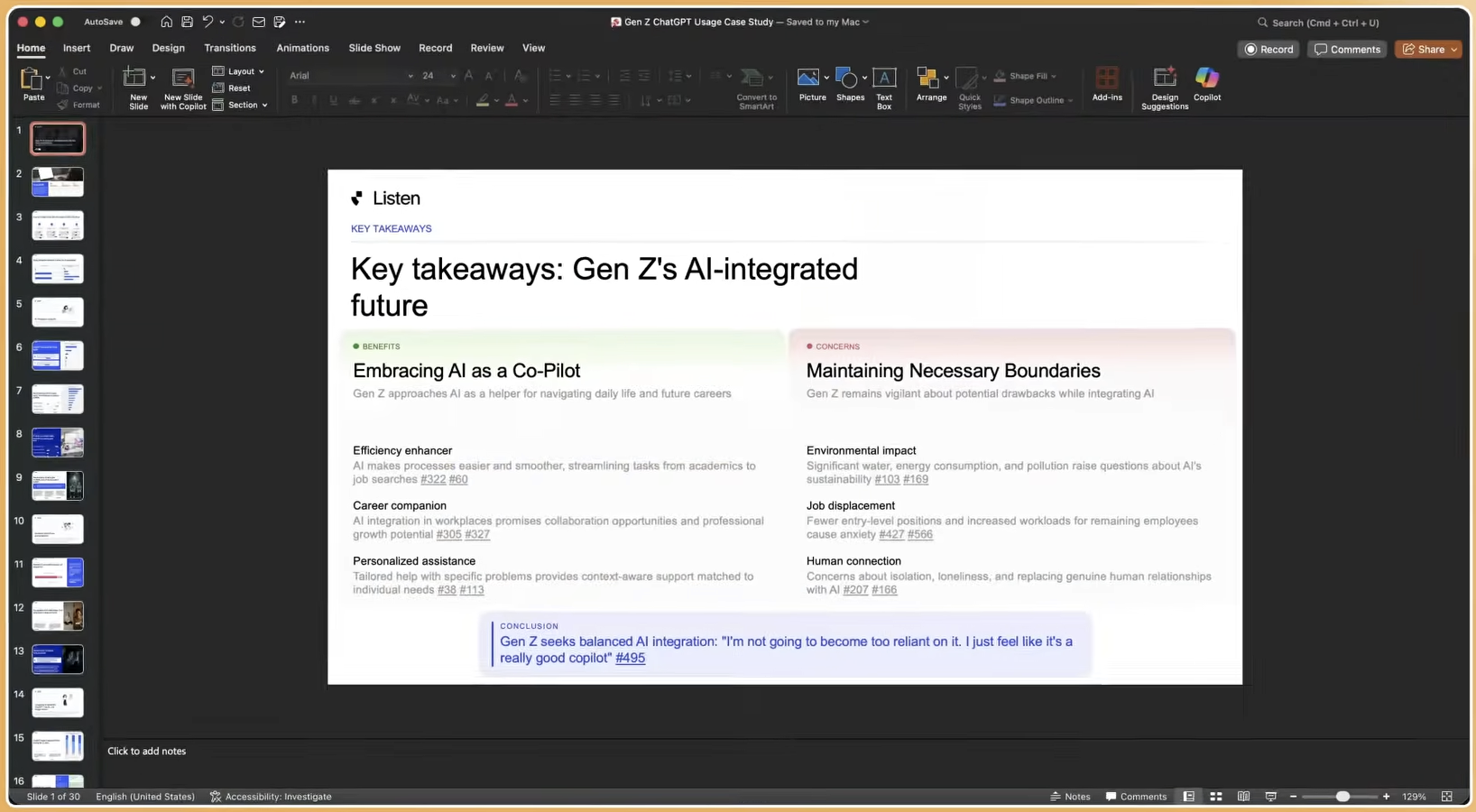
Emotional intelligence closes the gap between stated and felt perception. Listen Pulse’s Emotional Intelligence module analyzes tone of voice, word choice, and micro-expressions simultaneously using Ekman’s universal emotions framework to detect anger, contempt, disgust, happiness, fear, sadness, and surprise, with each label traceable to the exact timestamp and quote.
Say-do gap detection adds a behavioral layer. When a participant states one preference and behaves differently on screen, AI moderation catches the contradiction in real time and probes it. That process produces evidence that self-reported ratings alone would never surface.
The Listen Pulse Brand Tracking Process
Listen Pulse is Listen Labs’ conversational tracker and combines quantitative KPIs with AI-moderated open-ended conversation so every metric movement arrives with its explanation. This diagnostic integration depends on a specific structural design, and Listen Pulse implements a 70/30 fixed-rotating question architecture in which 70% of each wave uses a locked core battery of questions on awareness, consideration, attribute associations, and brand promise that remain identical wave over wave, while 30% rotates to address timely topics such as campaigns or competitors.
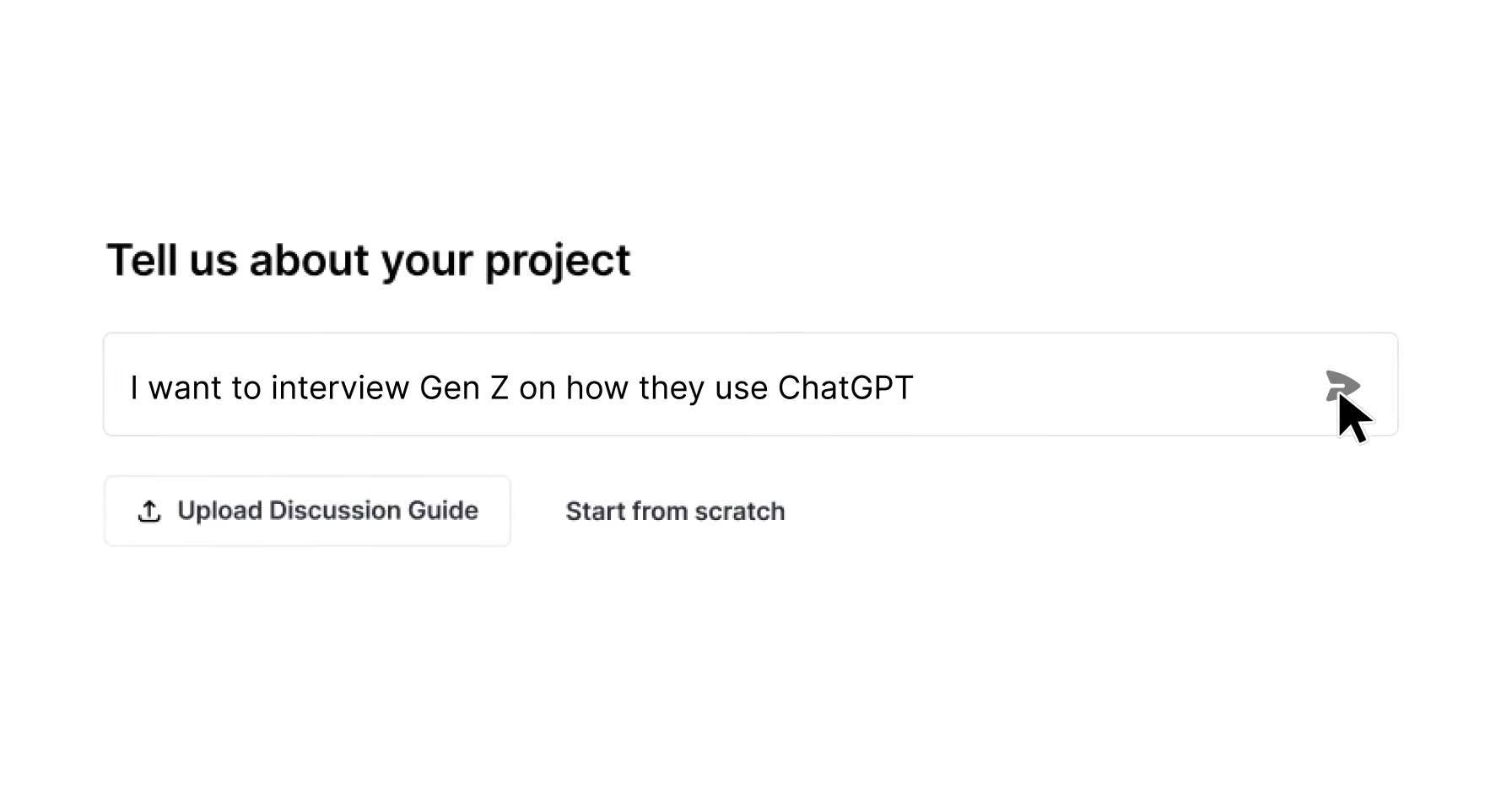
The following five steps outline how to run continuous qualitative brand tracking using the Listen Pulse process.
- Lock core metrics. Define five to eight KPIs, such as unaided awareness, aided awareness, consideration, preference, trust, and NPS, and freeze their wording, scale anchors, and sequence before wave one. These questions never change.
- Define sample and cadence. Establish a representative sample of verified target buyers. A practical cadence combines weekly pulses of 10–25 interviews, monthly deep-dives of 50–100 interviews, and quarterly strategic waves of 100–300 interviews to surface emerging themes before KPI declines appear.
- Deploy AI-moderated interviews. Listen Pulse conducts parallel AI-moderated video interviews across Listen Labs’ 50M+ verified respondent network spanning 45+ countries and 120+ languages. The AI probes 5–7 levels deep on each association and generates responses three times longer than average.
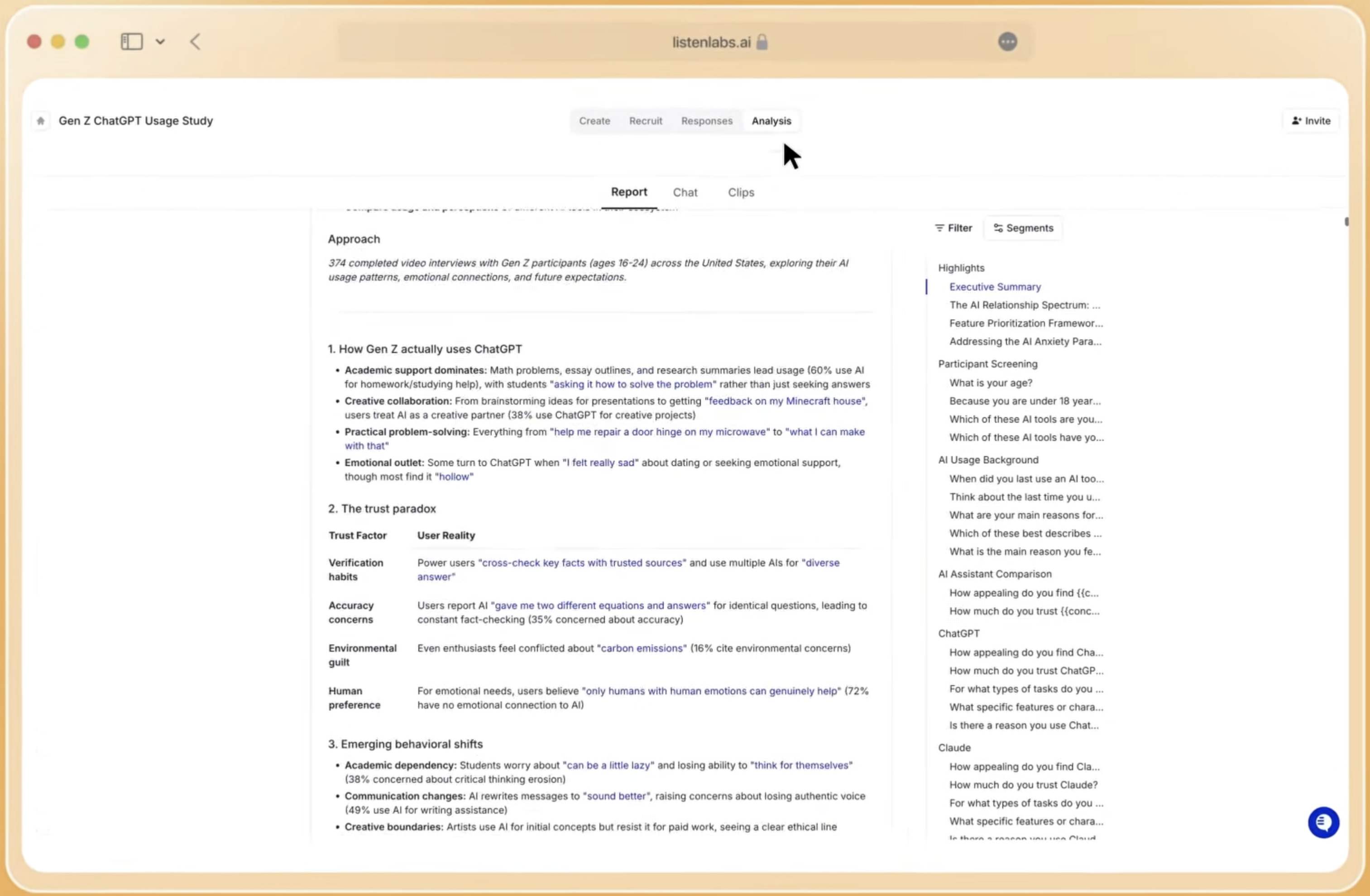
- Analyze themes and emotions. The Research Agent automatically clusters open-ended responses into quantified themes and charts them alongside KPIs. Emotional Intelligence simultaneously scores tone, word choice, and micro-expressions per question, with every label traceable to its source clip.
- Trace every movement to source evidence. Every KPI shift links directly to the interview, verbatim quote, and video clip that explains it. Stakeholders can inspect the underlying interview data rather than relying on aggregate summaries.
Book a demo to see the Listen Pulse brand tracking process in action for your program.
Enterprise Case Studies by Value Pattern
Enterprise implementations of Listen Labs show three recurring value patterns: speed to insight, scale economics, and diagnostic depth. Each case below illustrates one or more of these outcomes in practice.
Microsoft illustrates speed to insight at global scale. The team needed global customer stories for its 50th anniversary celebration within a single day. A Director of Data Science at Microsoft reported, “We were able to collect those user video stories within a day. Our leadership team was very thrilled at both the speed and the scale that Listen Labs enabled. I can reach out to hundreds of users at one third of the cost.”
Procter & Gamble demonstrates diagnostic depth that shapes product and brand strategy. The company used Listen Labs to evaluate how men respond to new product claims before market launch. The program delivered 250+ interviews with quantified themes and traceable proof in hours, surfaced where claims felt exaggerated or unclear, and showed that comfort, safety, and reliability matter far more than novelty. Those findings directly shaped product and brand decisions.
Skims highlights both speed and executive alignment. The team validated campaign direction with thousands of high-income buyers overnight and removed weeks of recruiting and panel sourcing. The SVP of Data, Insights, and Loyalty at Skims stated, “I always struggled with understanding the why and Listen Labs nails this for me.” The qualitative clarity helped secure board-level buy-in before launch.
Sweetgreen showcases scale economics and faster decision cycles. The company replaced months-long research cycles with days-long cycles and scaled consumer research across 300+ US locations. Brian Davia, Head of Consumer and Business Insights at Sweetgreen, summarized the outcome: “By having the speed to insight, insights can lead to actions. Those actions are then showing up in the real world at real Sweetgreen restaurants within weeks or months instead of years.” The program delivered the scale and cost improvements mentioned earlier while compressing decision cycles from years to weeks.
One well-known clothing brand, famous for its big logos, illustrates diagnostic depth that quantitative metrics alone would miss. The brand was quietly losing customers, and its existing tracker caught the drop but could not explain it. Listen Pulse found that price was not the issue. Style was the problem. A growing group of customers felt the big logos were too loud for their changing lifestyles, a finding that would have remained invisible in a quantitative-only instrument.
What Brand Tracking Costs Today
Traditional annual brand trackers with quarterly waves involve substantial costs driven primarily by repeated sample acquisition, analysis, and reporting. Adding a separate qualitative diagnostic layer with human-moderated depth interviews that are costly and time-intensive makes systematic quarterly qualitative tracking economically impractical for most brands under the traditional model.
AI-moderated qualitative brand studies can run hundreds of depth interviews rapidly at a fraction of the traditional cost, enabling more frequent programs with significant savings of over 90% versus traditional methods, while still maintaining deep laddering and extended conversations.
Listen Pulse amplifies these savings further by delivering the combined quantitative and qualitative instrument in a single wave and removing the cost of commissioning a separate diagnostic study after every KPI movement. AI-assisted platforms deliver the greatest cost reductions on recurring projects such as quarterly brand trackers because infrastructure, programming, and analysis do not need to be rebuilt each wave.
Many companies conducting brand tracking studies find that brand measurement delivers positive ROI through improved marketing decisions and competitive threat identification. The ROI case for continuous qualitative tracking rests on three compounding advantages: earlier detection of equity erosion, reduced backlog costs from eliminated follow-on studies, and faster action cycles that translate insight into in-market decisions within weeks rather than years.
How to Start a Continuous Qualitative Brand Tracker
The fastest path to a continuous qualitative brand tracking program is a pilot wave that runs alongside an existing quantitative tracker. Listen Pulse deploys alongside an existing tracker or as the primary tracking system, preserving the Qualtrics and Decipher integrations described earlier so existing KPI dashboards remain unchanged.
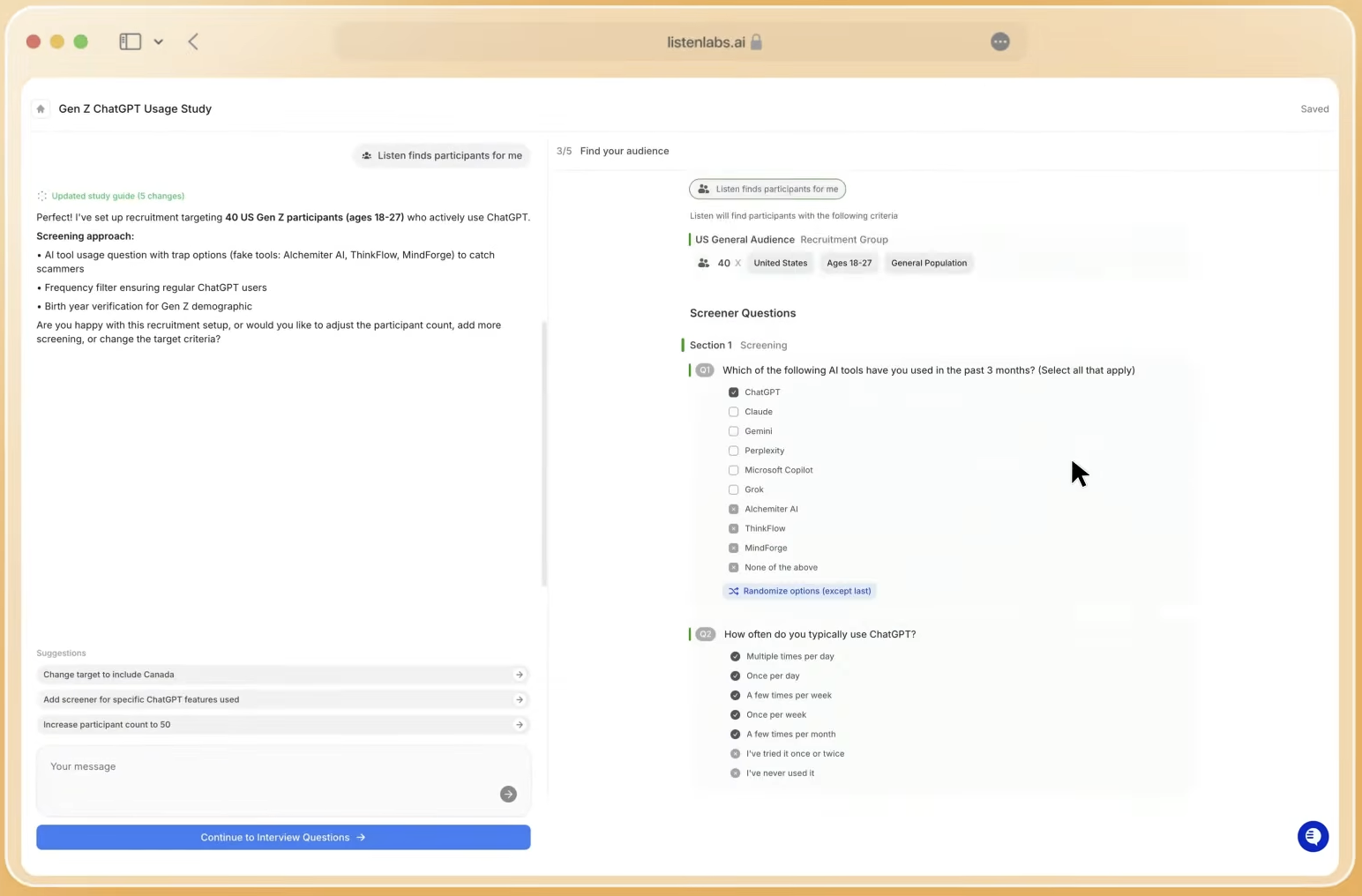
A pilot wave typically involves locking the core question battery, defining a representative sample of 100–300 verified target buyers, and running the first AI-moderated wave within 24 hours. The output, which includes quantified themes, emotion scores, and traceable proof mapped to each KPI, gives consumer insights leaders an immediate demonstration of the diagnostic layer that quantitative-only instruments cannot provide.
Listen Labs sources participants from its network of 50M+ verified respondents across 45+ countries and 120+ languages, with Quality Guard monitoring every interview in real time for fraud, low-effort responses, and repeat respondents. Participants are limited to three studies per month, which removes professional survey-takers from the sample.
For enterprise teams managing existing research backlogs, the pilot also demonstrates the backlog reduction benefit. A single Listen Pulse wave replaces the separate qualitative diagnostic study that would otherwise be commissioned weeks after a KPI alert.
Frequently Asked Questions
What is the difference between qualitative brand tracking and social listening?
Qualitative brand tracking conducts structured depth interviews with verified, representative samples of target buyers at regular intervals. Social listening monitors unstructured public conversation from the vocal minority who post publicly online and produces a U-shaped perception distribution that overrepresents enthusiastic advocates and frustrated detractors. Qualitative brand tracking reaches the representative majority who do not post publicly and uses consistent question sets that enable wave-over-wave comparison, which social listening cannot provide.
How many interviews are needed per wave for qualitative brand tracking to be reliable?
Traditional human-moderated qualitative programs typically use 30–50 depth interviews per wave to identify consistent themes and map association structures, prioritizing directional and contextual intelligence over statistical significance. AI-moderated platforms enable 100–300+ interviews per wave at a fraction of the cost, which improves both theme stability and the ability to segment findings by demographics, geography, or behavioral cohort. Listen Pulse supports weekly pulses of 10–25 interviews, monthly deep-dives of 50–100 interviews, and quarterly strategic waves of 100–300 interviews, depending on the cadence and diagnostic depth required.
How does Listen Pulse preserve trend integrity while still covering new topics each wave?
Listen Pulse uses a 70/30 fixed-rotating question architecture. Approximately 70% of each wave consists of a protected core battery that covers awareness, consideration, key attribute associations, and brand promise probes and is asked word for word in the same sequence every wave. The remaining 30% rotates to cover timely topics such as new campaigns, competitor moves, or news events. This structure keeps the quantitative trend line clean and comparable across waves while ensuring each wave can address what is happening in the market right now. Core questions never change wording, scale anchors, or position.
Can Listen Pulse replace an existing quantitative tracker, or does it only supplement one?
Listen Pulse deploys in either mode. It integrates directly with Qualtrics and Decipher, allowing teams to retain existing KPI trend lines and dashboards while adding the qualitative diagnostic layer alongside them. It also operates as the primary tracking system for teams building a new program or replacing a legacy tracker. In both cases, the output remains the same. Every metric movement arrives with the traceable proof that explains it in the same wave rather than weeks later.
What skills or team resources are required to run a continuous qualitative brand tracking program with Listen Pulse?
Listen Labs is designed as a force multiplier for existing consumer insights teams, not a replacement. AI handles study design assistance, participant recruitment, interview moderation, transcription, theme clustering, emotion scoring, and deliverable generation. Consumer insights leaders retain responsibility for defining research objectives, interpreting strategic implications, and communicating findings to stakeholders. The platform compresses a process that previously required specialized moderators, recruitment operations, transcription vendors, and analysis teams into a single end-to-end workflow that delivers results in less than 24 hours. Teams that previously ran four to six studies per quarter can run significantly more with the same headcount.
Conclusion: Closing the Diagnostic Gap
Traditional quantitative brand trackers catch the drop but cannot explain it. By the time a KPI declines, the underlying shift in consumer perception has been building for months, and the diagnostic study needed to explain it adds another six to eight weeks of lag. The result is reactive decision-making based on lagging indicators with no traceable evidence attached.
Continuous qualitative brand tracking with Listen Pulse closes that diagnostic gap. The 70/30 fixed-rotating architecture preserves trend integrity wave over wave. AI-moderated depth interviews run 200–300+ conversations in 24 hours across 45+ countries and 120+ languages. Emotional Intelligence quantifies tone, word choice, and micro-expressions per question. Every metric movement, including each point of consideration decline or trust score shift, traces directly to the interview, verbatim quote, and video clip behind it and arrives in the same wave rather than weeks later.
Microsoft, P&G, Skims, and Sweetgreen have each used Listen Labs to replace slow, fragmented research cycles with always-on consumer intelligence that reaches leadership in hours. The diagnostic gap between what a number does and why it moved no longer needs to be a structural limitation of brand tracking. It is now a solved problem.
Book a demo to start your continuous qualitative brand tracking pilot with Listen Pulse.