Written by: Anish Rao, Head of Growth, Listen Labs
Key Takeaways
- Traditional consumer research often takes 4–6 weeks, so insights arrive after product, pricing, and campaign decisions are already locked.
- A repeatable 7-step workflow compresses the cycle from brief to deliverable into less than 24 hours while maintaining research rigor.
- AI-moderated interviews, real-time quality controls, and automated analysis remove the sequential handoffs that slow traditional studies.
- Fortune 500 companies and AI-native startups use this approach to run hundreds of interviews and ship polished deliverables in hours instead of weeks.
- Listen Labs turns research from a bottleneck into an always-on intelligence system. See the platform in action and watch the 7-step workflow end to end.
Why Mastering a 24-Hour Research Cycle Matters
Traditional qualitative research typically takes 4–6 weeks from study design to final report, which closes three critical decision windows: pre-launch concept validation, in-flight campaign optimization, and post-launch performance diagnosis. Product roadmaps lock, campaigns ship, and competitive windows close before findings arrive. Many consumer insights teams have launched a product, price change, or campaign without supporting insight because they could not complete research quickly enough.
A sub-24-hour cycle keeps research aligned to sprint cadences instead of fighting them. Stakeholders receive findings before decisions lock rather than after. The research function shifts from a bottleneck to a competitive advantage, and researchers who adopt AI-moderated interviews complete more studies per quarter without adding headcount. The platform that enables this shift compresses the full research lifecycle into a single integrated system.
See the platform in action and explore how Listen Labs unifies design, fieldwork, analysis, and reporting.
Step 1: Define a Single Decision and Scope in Natural Language
The fastest studies start with a sharp decision focus. If no decision would change as a result of the insight, the study should not be run. Effective scoping anchors every project to one specific business decision.
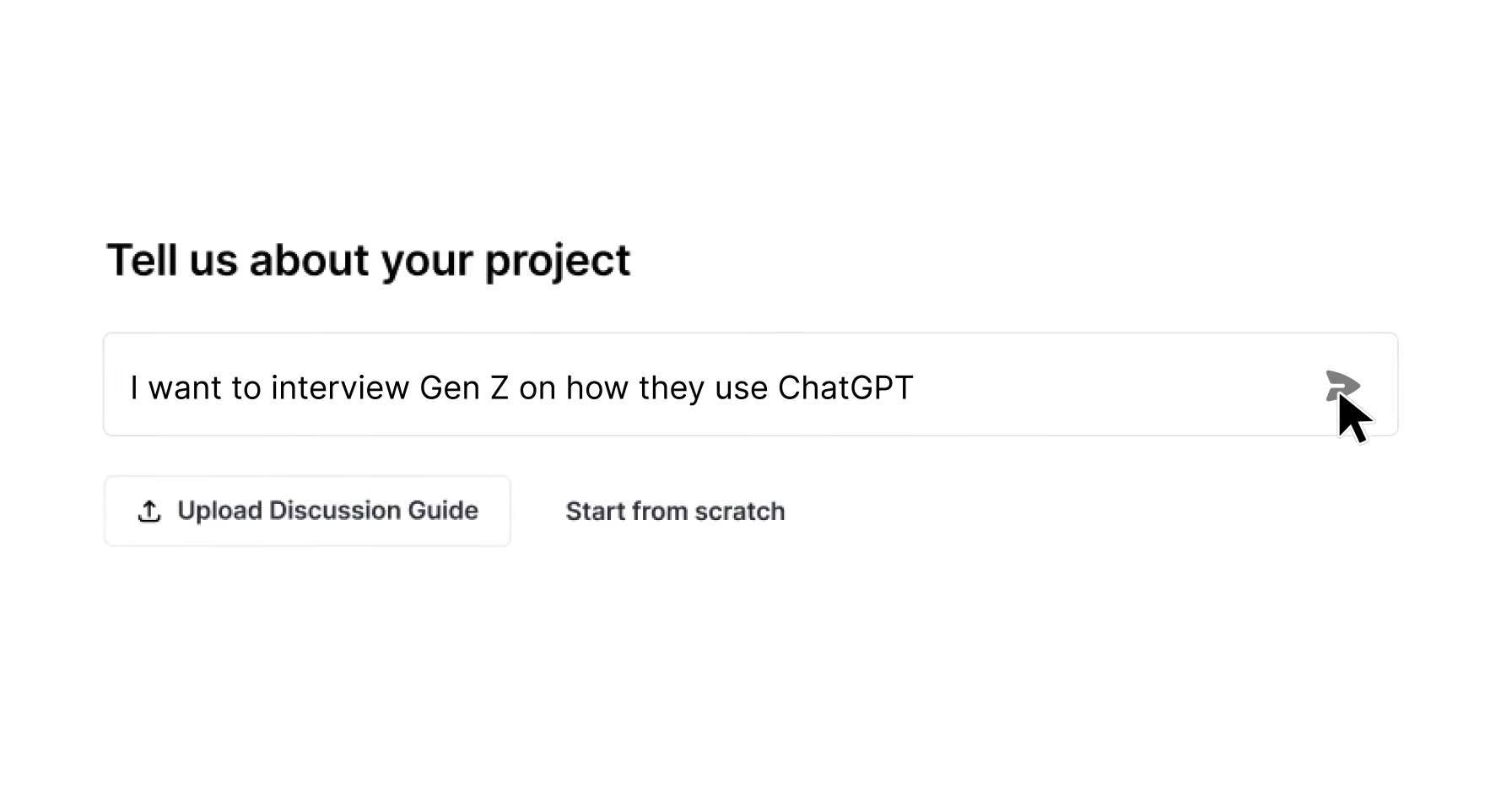
On Listen Labs, researchers describe their goals in plain language, and the AI drafts structured objectives, discussion questions, and probing context in seconds. This speed is possible because the platform’s proprietary data, drawn from tens of thousands of completed studies, has already identified which question types produce the richest analysis for each objective. Before advancing, researchers confirm three elements: the primary research question, the target audience definition, and the success criteria. Studies with a single focused hypothesis close faster and produce sharper deliverables than multi-topic briefs that attempt to answer several questions at once.
Step 2: Auto-Generate and QA the Discussion Guide
Manual discussion guide writing and internal review cycles consume days. AI can schedule and conduct the interview, analyze transcripts for themes, and generate quantitative insights from those interviews, but only when the guide follows a sound structure from the start.
Listen Labs auto-generates a discussion guide from the scoped objectives, then runs an Auto-QA pass that flags ambiguous questions, leading phrasing, and coverage gaps before launch. Researchers review and approve instead of building from scratch. At this stage, they confirm stimulus materials such as images, video, prototypes, or live URLs and set randomization logic. Skipping Auto-QA introduces analysis noise that later costs hours to untangle.
Step 3: Source and Screen Participants from a Verified Global Network
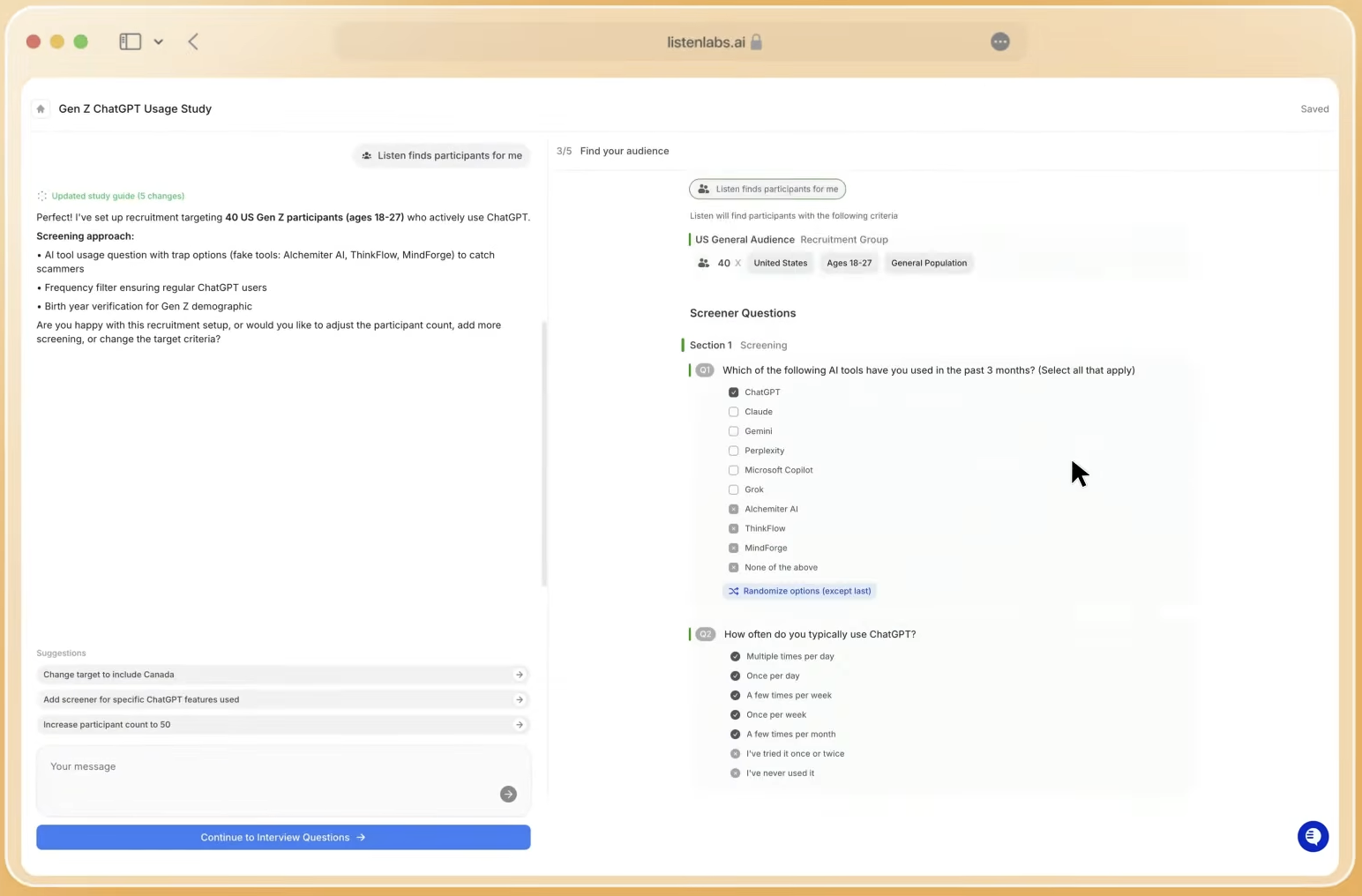
Recruitment often consumes a large share of total cycle time and creates the biggest bottleneck in traditional workflows. Listen Labs removes this bottleneck through Listen Atlas, an AI orchestration layer that matches and bids across a global network of 30M verified respondents across 45+ countries.
Behavioral matching runs on intent and past actions instead of self-reported demographics. A dedicated recruitment ops team handles hard-to-reach segments such as enterprise decision-makers, healthcare workers, and consumers below 1% incidence rate without manual sourcing delays. Organizations can also self-recruit from their own user base at reduced cost. Researchers set quotas, screening criteria, and participant frequency limits, and Listen Labs caps participants at three studies per month to prevent professional survey-takers. Niche B2B audiences benefit from earlier panel launch, while general population studies typically field within hours.
Once participants are recruited and screened, the study moves into its fieldwork phase, where Listen Labs’ approach diverges most from traditional methods.
Step 4: Run Adaptive AI-Moderated Video Interviews
Platforms like Listen Labs layer on auto-recruiting, transcription, sentiment tagging, and insight summarization so teams jump from question to findings in hours, not weeks. The AI moderator conducts personalized, adaptive conversations across hundreds of simultaneous sessions and probes deeper on short or unexpected answers the way a trained human interviewer would.
AI-moderated platforms with parallel recruitment and automated synthesis compress the full cycle to 24 hours by removing the sequential fieldwork bottleneck of human moderation. Listen Labs captures video, audio, text, and screen recordings, and supports mixed methods such as Likert scales, NPS, sliders, and MaxDiff within the same interview. Researchers confirm session length, language settings across 100+ supported languages, and whether mobile screen recording is required. Longer sessions increase depth but extend the fieldwork window, and 30-minute sessions typically balance depth with sub-24-hour turnaround.
Watch AI-moderated interviews in action and see how teams run hundreds of sessions in parallel.
Beyond capturing what participants say, Listen Labs’ AI-moderated interviews also analyze how they say it through Emotional Intelligence features that track tone, word choice, and micro-expressions during each session.
Emotional Intelligence: Capturing What Transcripts Miss
Transcripts capture what participants say, not how they react in the moment. They miss a frown during a product demo, a pause before answering a pricing question, or a flat expression that follows a concept that receives a positive verbal rating. Two ads can both score well on stated preference while triggering very different emotional responses.
Listen Labs’ Emotional Intelligence feature analyzes three layers of signal at once: tone of voice, word choice, and subconscious micro-expressions. Built on Ekman’s universal emotions framework, the same standard used in clinical psychology, it tracks anger, anticipation, disgust, fear, joy, sadness, trust, and surprise. Every emotion is quantified per question and concept, and each label links to the exact timestamp, verbatim quote, and reasoning behind it. Available across 50+ languages, Emotional Intelligence connects directly to the Research Agent for natural-language queries, charts, and highlight reels of the most emotionally significant moments. Common uses include creative testing to pinpoint where audiences disengage, concept testing with side-by-side emotional breakdowns, usability testing that surfaces unspoken hesitation and frustration, and brand research.
Step 5: Apply Real-Time Quality Guardrails
Rising bot activity, synthetic respondents, professional survey-takers, and AI-generated open-ended answers have made post-fieldwork quality assurance more time-consuming and less reliable. Effective workflows now embed quality controls earlier in the process instead of relying on checks after data collection closes.
Listen Labs’ Quality Guard monitors every interview in real time across video, voice, content, and device signals, and it detects and removes fraudulent responses, low-effort answers, AI-generated scripts, and mismatched profiles without researcher intervention. This real-time filtering is reinforced by a reputation scoring system that compounds across every interview conducted on the platform, so audience quality strengthens with each study. Before advancing to analysis, researchers review Quality Guard flags and make final inclusion decisions. Borderline sessions are routed to human review instead of being auto-included, which ensures that only high-quality data enters the analysis phase. Studies with tighter screening criteria produce cleaner data and require less QA review time.
Step 6: Run Automated Thematic and Statistical Analysis
60.3% of research practitioners cite time-consuming manual work as their biggest synthesis pain point, followed by difficulty synthesizing large volumes of data and spotting patterns across multiple sources. Machine-assisted qualitative analysis reduces total analysis time significantly compared with human-only workflows.
Listen Labs’ Research Agent processes all interview data objectively and identifies patterns, themes, and insights across hundreds of responses without human confirmation bias. One researcher ran a full buying intent analysis across three user segments in under a minute. Researchers query findings in natural language, run statistical significance tests, and generate segmentation breakdowns by demographics, cohorts, or custom audience groups. Defining primary segments and comparison cuts before analysis prevents scope creep at this stage. Pre-defined segments also produce faster, cleaner outputs than open-ended exploratory cuts requested after the initial pass.
Step 7: Generate One-Click Deliverables
Report writing often becomes the final bottleneck and can add 3–5 days to every study. Research Agent generates a slide deck in a company’s branded template and a downloadable report in under a minute, along with video highlight reels, statistical charts, memo-style summaries, and custom outputs.
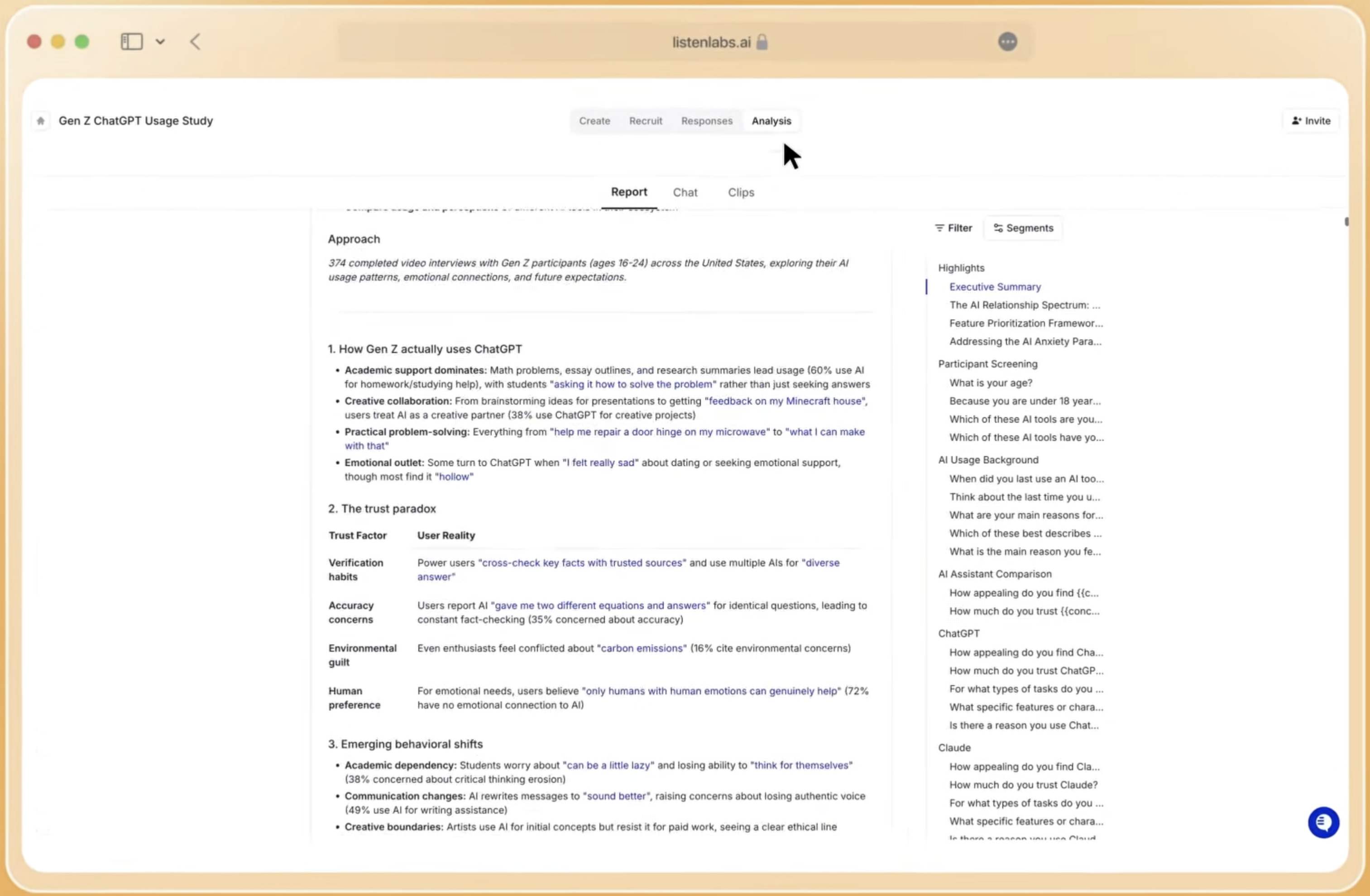
Every deliverable links back to the underlying response data, so stakeholders can inspect verbatim quotes and timestamped video clips instead of accepting summary conclusions on faith. This traceability closes the credibility gap that often prevents insights from influencing decisions. Researchers confirm the required output formats, such as deck, memo, and highlight reel, before the analysis run so the Research Agent generates everything in a single pass. Requesting additional formats after initial delivery adds minutes rather than hours, and pre-specifying outputs removes revision cycles entirely.
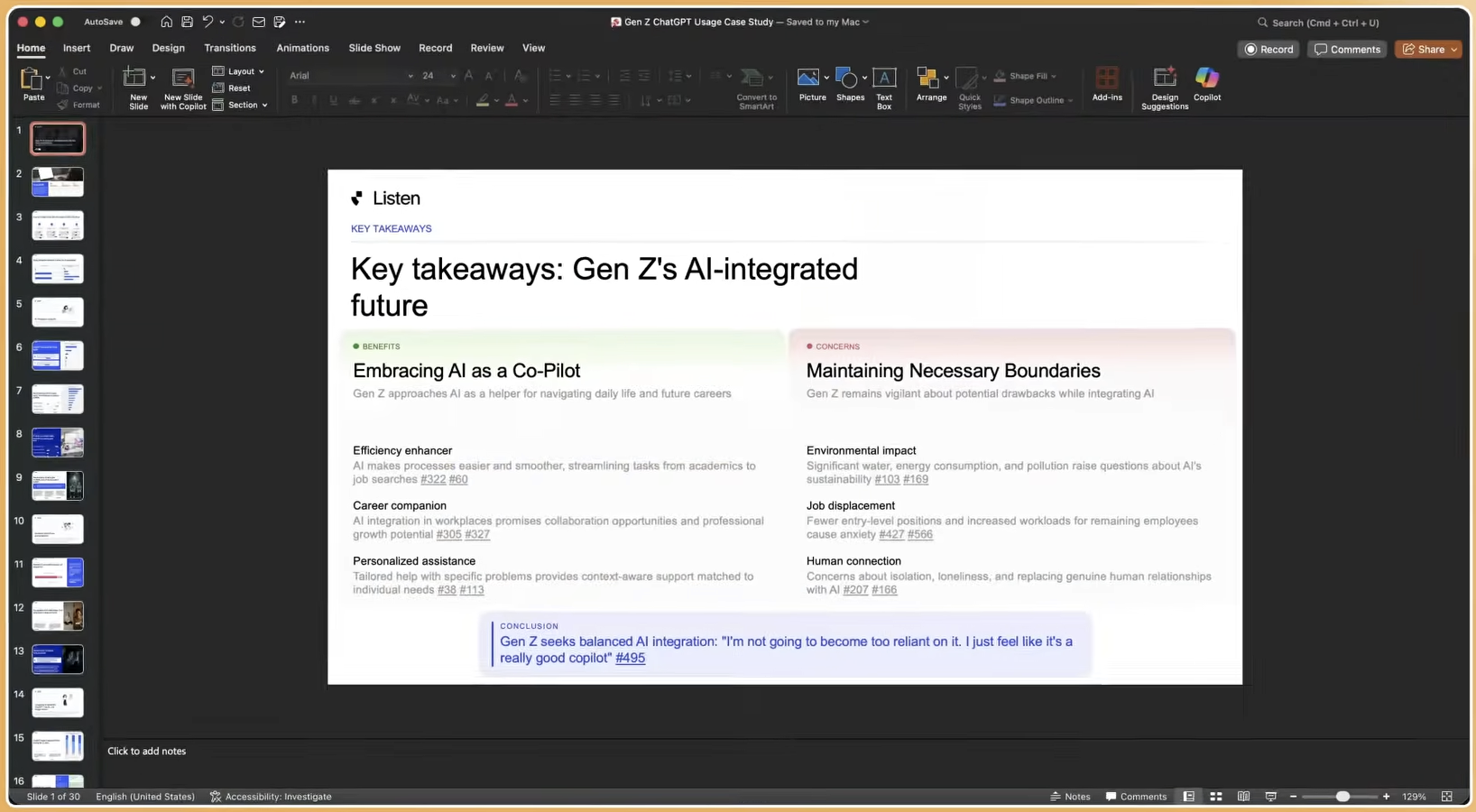
See one-click deliverables from a live study and review decks, memos, and highlight reels tied to raw data.
24-Hour Research Workflow Checklist
- Define a single research question tied to a specific business decision.
- Describe objectives in natural language, then review the AI-generated discussion guide and Auto-QA output.
- Set audience criteria, quotas, and screening logic, and launch Listen Atlas recruitment.
- Configure AI-moderated interview settings, including session length, language, stimuli, and mixed-method formats.
- Monitor Quality Guard flags in real time and approve or remove flagged sessions.
- Run Research Agent analysis and define segments and comparison cuts before the analysis pass.
- Generate one-click deliverables such as slide deck, memo, highlight reel, and statistical charts.
Common Pitfalls and Early-Warning Signals
- Scope creep: Multi-topic briefs inflate session length, dilute findings, and push turnaround past 24 hours. Mitigation: enforce a single primary research question per study and route secondary questions to a follow-on sprint.
- Stakeholder delays: Late stimulus approvals or guide revisions after launch restart the fieldwork clock. Mitigation: require all materials to be finalized before recruitment opens and use version control to manage iterations.
- Panel fatigue: Oversampling the same audience segment across consecutive studies degrades response quality. Mitigation: Listen Labs’ three-study-per-month participant cap prevents repeat exposure, and rotating audience sources protects longitudinal programs.
- Confirmation bias: Researchers who pre-define expected themes before analysis risk anchoring the Research Agent’s output. Mitigation: run an open-ended thematic pass first, then apply hypothesis-driven segmentation cuts, and treat unexpected themes as primary signals rather than noise.
- Deliverable mismatch: Generating a 40-slide deck for an executive audience that needs a 5-minute read buries actionable findings. Mitigation: confirm the stakeholder’s preferred format and decision timeline before the analysis run.
Frequently Asked Questions
How long does it actually take to run a study on Listen Labs from brief to deliverable?
The full cycle, including study design, participant recruitment, AI-moderated interviews, automated analysis, and deliverable generation, completes in less than 24 hours for most studies. General population studies with standard audience criteria typically field within hours of launch. Studies targeting niche or hard-to-reach segments, such as enterprise decision-makers or healthcare workers below 1% incidence rate, may require a longer recruitment window, but analysis and reporting remain automated and complete in under two hours once fieldwork closes.
What compliance certifications does Listen Labs hold, and how is participant data protected?
Listen Labs maintains SOC 2 Type II, GDPR, ISO 27001, ISO 27701, and ISO 42001 certifications. All data is encrypted at 256-bit, and customer data is never used to train AI models. Enterprise SSO is supported. The platform meets the security and privacy requirements of Fortune 500 procurement and legal review processes.
Can Listen Labs reach niche or low-incidence audiences that traditional panels cannot source?
Yes. Listen Atlas, the platform’s AI recruitment orchestration layer, matches on behavioral and intent data instead of relying only on self-reported demographics and bids across multiple consumer and B2B panel partners at the same time. A dedicated recruitment ops team partners with niche communities, micro-creators, and specialized networks to source audiences below 1% incidence rate, including enterprise decision-makers, engineers, and highly specialized consumer segments. Organizations can also self-recruit from their own customer base at reduced cost.
Does Listen Labs replace an existing research team?
No. Listen Labs acts as a force multiplier for existing research teams. The platform handles the logistics-heavy, time-consuming phases of the research lifecycle, including recruitment, moderation, transcription, coding, and report writing, so researchers can focus on strategic analysis, stakeholder communication, and study design. Teams using Listen Labs run significantly more studies with the same headcount rather than shrinking the team.
What study types does Listen Labs support beyond standard in-depth interviews?
Listen Labs supports concept and prototype testing, usability testing with screen sharing and mobile screen recording, creative testing, brand perception studies, consumer journey mapping, multi-market segmentation and localization studies, ad testing, pricing research, and survey open-end analysis. The platform handles both one-off studies and ongoing continuous research programs. Diary studies, ethnographic formats, and task-based UX testing are also supported through flexible study configuration.
Conclusion: Turn Research into an Always-On Intelligence System
The 7-step workflow described above, covering scope definition, AI-assisted guide generation, verified global recruitment, adaptive AI-moderated interviews, real-time quality guardrails, automated thematic analysis, and one-click deliverables, removes the sequential bottlenecks that slow traditional consumer research. Listen Labs has run over 1 million AI-powered customer interviews for companies including Microsoft, Perplexity, and Sweetgreen, delivering decision-ready results in less than 24 hours.
The Microsoft team collected global customer stories for the company’s 50th anniversary celebration within a single day. Anthropic surfaced churn drivers across 300+ user interviews in 48 hours, which moved five times faster than their previous process. P&G delivered 250+ interviews with quantified themes and verbatim proof that directly shaped product and brand strategy in hours, not weeks. With qual-at-scale, the old trade-off between depth and scale no longer blocks fast decisions.
Research teams that adopt this workflow stop operating as a bottleneck and start functioning as an always-on intelligence system that answers the next business question before the current decision window closes. Explore the full 7-step workflow on your own objectives and see how Listen Labs changes the pace of insight.