
Written by: Anish Rao, Head of Growth, Listen Labs
Key Takeaways for Retail Insights Teams
- Retail consumer research panels suffer from widespread fraud, professional respondents, and speeders that contaminate datasets and undermine statistical integrity.
- Panel fatigue, stale profiles, and demographic selection bias systematically distort samples away from the true shopper population.
- Stated-versus-actual behavior gaps and social desirability bias mean panel responses reflect aspirations rather than real purchase decisions.
- Traditional panel studies are slow and expensive, taking 4–6 weeks and costing hundreds of thousands of dollars, while AI-moderated interviews deliver results in under 24 hours.
- Listen Labs replaces broken panel infrastructure with end-to-end AI research that eliminates every documented failure mode. See how it works in a live demo.
Data Quality and Fraud in Online Panels
Online panels are structurally vulnerable to fraudulent participation. Bot networks, identity farms, and incentive-aggregator communities have learned to pass standard screening questions, producing responses that appear legitimate but carry no authentic consumer signal. S&P 500 companies spend tens of billions of dollars annually on consumer polling to test new products and gauge public mood, and a portion of that budget is absorbed by fraudulent data that distorts findings before analysis even begins.
The fraud problem persists because commodity panel economics reward volume over verification. Panel providers are paid per completed response, which creates a financial incentive to accept completions rather than reject them. Quality-assurance layers such as attention checks, red-herring questions, and IP deduplication are reactive and easily gamed by experienced fraudsters.
Insights teams receive datasets contaminated by an unknown proportion of non-human or incentive-optimized responses, which makes every finding statistically suspect. No amount of weighting or cleaning fully recovers the integrity of a compromised sample.
Professional Respondents and Speeders as a Second Threat
Beyond outright fraud, panels face a second data-quality threat from legitimate participants whose economic incentives distort their responses. A subset of panel members treat survey participation as a primary income source. These professional respondents have completed thousands of studies and memorized the demographic profiles and attitudinal patterns that qualify them for high-value screeners. Their responses reflect learned optimization, not genuine shopper behavior.
Speeders compound the problem. Participants who rush through surveys, clicking through Likert scales in seconds, produce random or patterned responses that pass automated quality checks but add noise rather than signal. Standard completion-time thresholds catch only the most egregious cases.
Both behaviors are rational responses to incentive structures that reward completion speed and screener success. Until the underlying economics change, professional respondents and speeders remain a permanent feature of commodity panel ecosystems.
Panel Fatigue and High Dropout Rates in Shopper Studies
Repeated participation across many studies creates panel fatigue, which reduces engagement, response thoughtfulness, and survey completion rates. Fatigued respondents provide shorter open-ended answers, default to midpoint scale responses, and abandon surveys at higher rates, introducing non-response bias into the final dataset.
Dropout rates are particularly damaging in retail consumer research because attrition is rarely random. Participants who disengage mid-survey often share demographic or attitudinal characteristics, so the completed sample systematically underrepresents certain shopper segments. The resulting data reflects who stayed, not who was recruited.
Panel providers manage fatigue through invitation throttling, but the structural problem remains a fixed pool of willing respondents receiving repeated study invitations. The pool itself is the constraint.
Stated-versus-Actual Behavior Mismatch in Retail
Consumer panels capture what people say they do, not what they actually do. The gap between stated and actual behavior is one of the most replicated findings in behavioral science. The gap is especially pronounced in retail contexts where social norms, aspirational self-image, and purchase rationalization all distort self-reporting.
A shopper may report strong purchase intent for a premium sustainable product while their transaction history shows consistent price-driven switching. A panel study captures the aspiration, while the register captures the reality. Insights built on stated behavior systematically overestimate willingness to pay, brand loyalty, and category engagement.
This mismatch is not a failure of survey design. It is a fundamental limitation of asking people to predict or recall behavior in an artificial research context. No question wording or scale change eliminates the gap between self-report and observed action.
Stale and Outdated Panelist Profiles
Panel member profiles are typically updated at enrollment and refreshed infrequently thereafter. Life circumstances change, including household income, family composition, and shopping channel preferences, but the profile used to target and qualify respondents may reflect a consumer who no longer exists.
In retail consumer research, where channel behavior, basket composition, and brand relationships shift rapidly, stale profiles produce samples that are misaligned with the actual shopper population. A study targeting “primary grocery shoppers” may recruit respondents whose shopping behavior has migrated substantially since their profile was last verified.
The staleness problem compounds over time. Long-tenured panel members, who are often the most reliable completers, are also the most likely to have profiles that diverge from their current reality. This creates an inverse relationship between respondent reliability and profile accuracy.
Demographic and Selection Bias in Panel Membership
Panel membership is not a random sample of the consumer population. Individuals who opt into research panels skew toward specific demographic and psychographic profiles, including higher digital literacy, greater comfort with surveys, stronger opinions about brands, and above-average engagement with consumer culture. These characteristics are correlated with the very attitudes and behaviors that retail consumer research seeks to measure.
This selection bias is structural. Panels recruit willing participants, and willingness to participate in research is itself a non-random trait. Hard-to-reach segments such as lower-income households, older non-digital-native shoppers, recent immigrants, and rural consumers are chronically underrepresented regardless of quota targets, because the panel infrastructure cannot reach them at sufficient scale.
Quota balancing on age, gender, and geography addresses surface-level representation but does not correct for the underlying attitudinal and behavioral differences between panel members and the broader shopper population. A demographically balanced panel sample is not a representative consumer sample.
Limited Omnichannel Coverage from Panel Surveys
Even if panels could recruit perfectly representative samples, they would still face a fundamental measurement limitation, because they cannot observe actual behavior across channels. Modern retail behavior spans physical stores, e-commerce platforms, social commerce, subscription services, and buy-online-pick-up-in-store flows. Panel surveys are designed to ask about these channels, but they cannot observe them. The result is a research instrument that asks consumers to mentally reconstruct complex, multi-touchpoint journeys from memory.
Recall accuracy degrades rapidly for routine, low-involvement purchases, which dominate retail volume. Consumers cannot reliably report which channel they used for a specific purchase three weeks ago, which promotional trigger influenced a decision, or how they navigated between digital discovery and physical trial.
Panel-based omnichannel research produces a simplified, retrospective account of behavior that flattens the complexity of actual shopper journeys. Strategic decisions built on this account carry significant execution risk.
Cost and Speed Failures in Traditional Research Cycles
A traditional qualitative research cycle, from study design through panel recruitment, moderation, analysis, and reporting, typically runs four to six weeks. In enterprise settings, internal prioritization queues and budget approval cycles can extend this to six months, which means insights often arrive after the business decision has already been made.
The cost structure reflects a fragmented vendor ecosystem with separate providers for recruitment, scheduling, moderation, transcription, analysis, and reporting. Each handoff introduces delay, coordination overhead, and quality-loss risk. The total cost of a research program is rarely visible in a single line item, which obscures the true return on investment.
Speed and cost failures are not incidental. They are the direct consequence of a research infrastructure built before AI-moderated interviews existed as a category. The architecture was designed for a world where every step required human labor.
Conditioning and Social Desirability Bias in Panels
Repeated panel participation conditions respondents to research conventions. Experienced panel members learn which answer patterns satisfy screeners, how to navigate skip logic, and which response styles generate follow-up invitations. This conditioning produces responses that are optimized for the research context rather than reflective of genuine attitudes.
Social desirability bias operates in parallel. Respondents adjust their answers toward what they perceive as socially acceptable, particularly on topics involving health, finances, sustainability, and brand loyalty. 32% of participants explicitly state they feel less judged with AI moderation, and participants report that AI moderation reduces the sense of being evaluated, which traditional panel surveys cannot replicate.
The combination of conditioning and social desirability bias means that panel responses systematically overrepresent socially approved attitudes and underrepresent authentic, sometimes inconvenient consumer truths. Insights built on this foundation carry a directional distortion that is difficult to detect and impossible to fully correct in analysis.
How AI-Moderated Interviews Replace Failing Panels
End-to-end AI research platforms address each failure mode documented above through architectural changes, not incremental tweaks to the panel model.
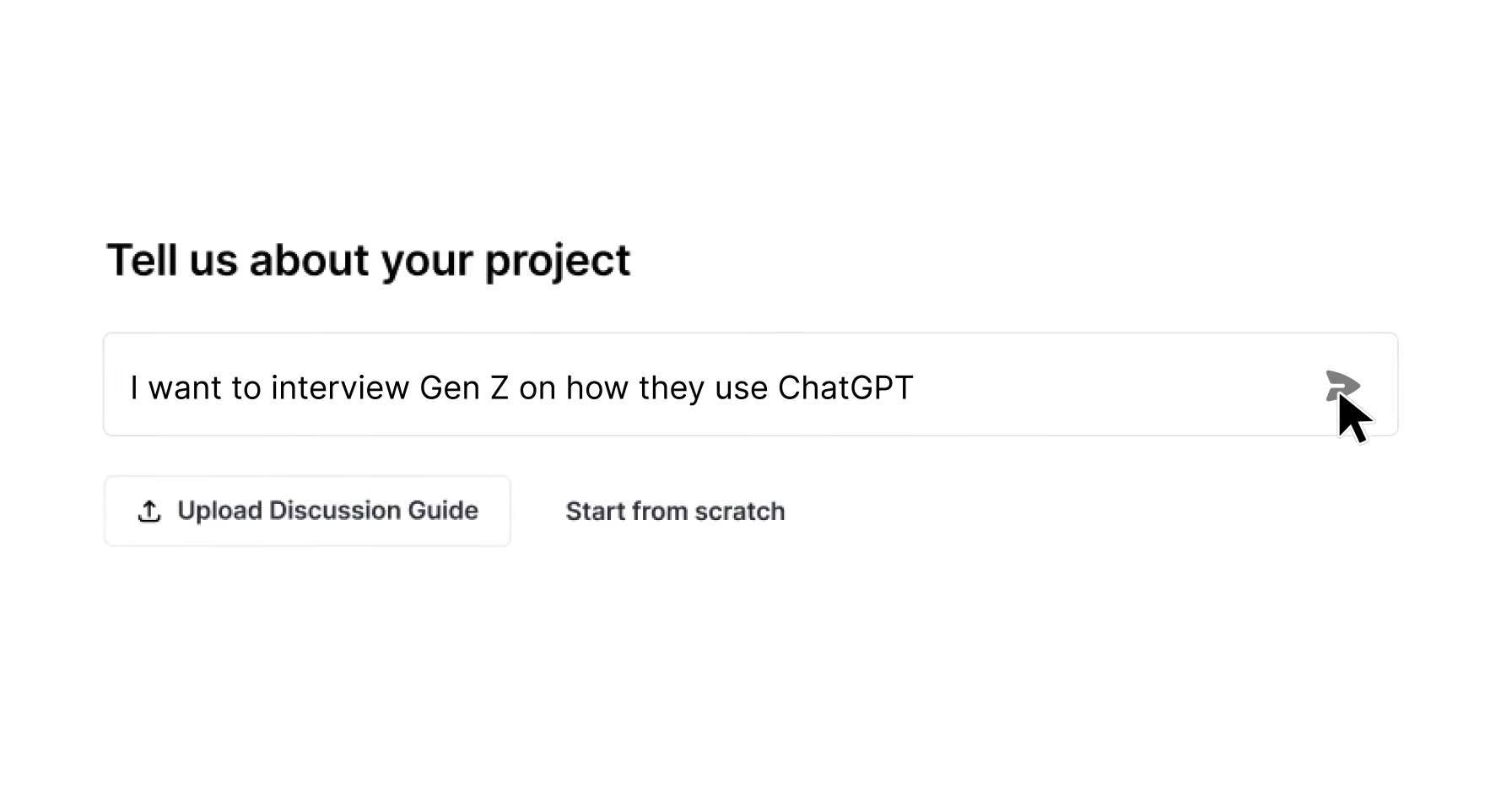
AI Co-Designed Study Setup
AI-assisted study co-design translates research objectives into structured interview guides in seconds. Built-in methodology review flags quality issues before launch. This workflow removes the weeks of back-and-forth between insights teams and research agencies.
Global Participant Sourcing Without Panels
AI platforms solve the panel recruitment problem through three architectural changes.
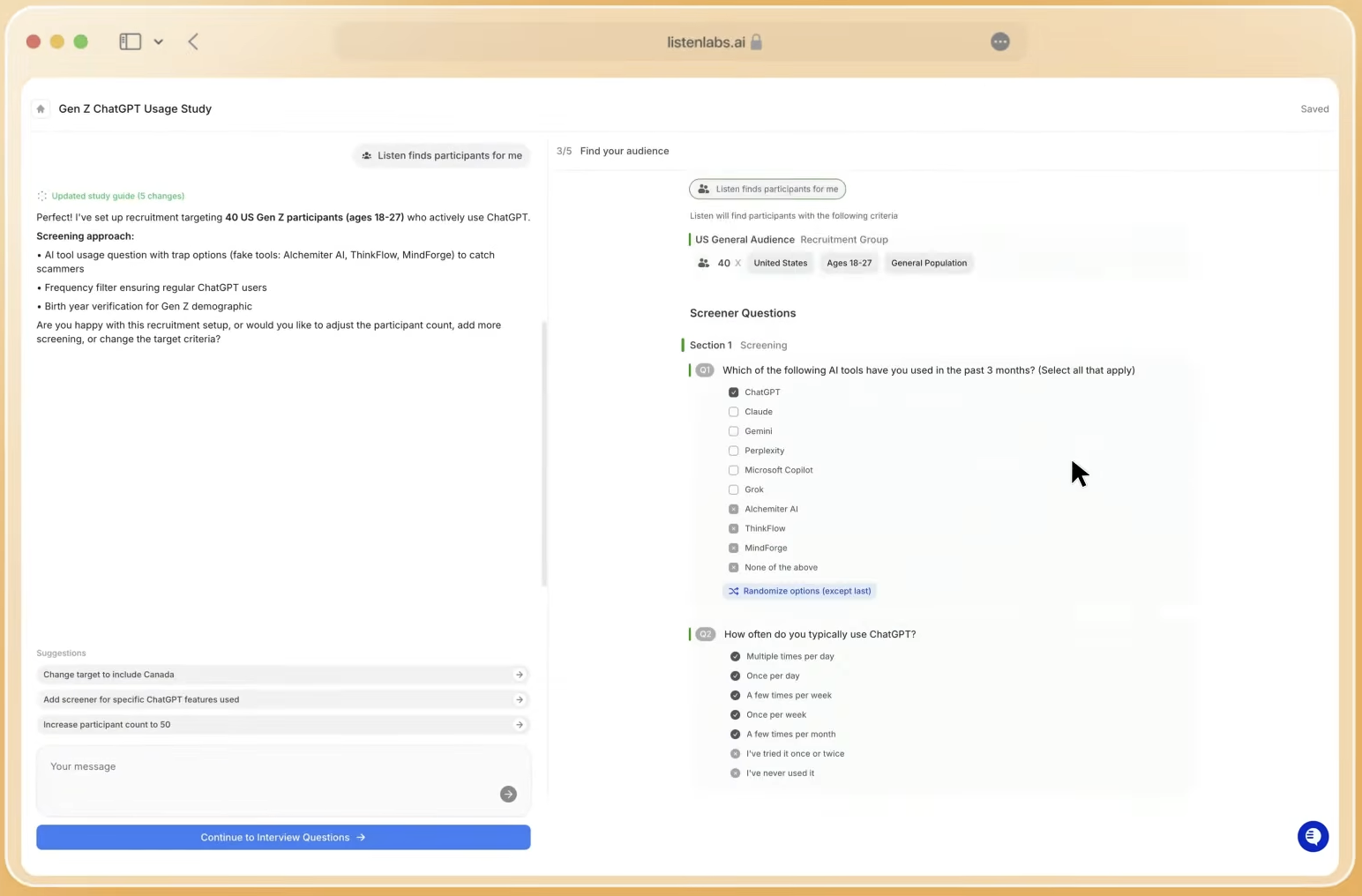
- First, access to verified respondent networks spanning 45+ countries and 100+ languages removes the demographic ceiling of domestic panels.
- Second, behavioral and intent-based matching replaces self-reported profile targeting, which reduces the stated-versus-actual gap at the recruitment stage.
- Third, participant frequency limits, typically no more than three studies per month, structurally prevent professional respondent behavior that emerges when the same individuals complete dozens of studies.
AI-Moderated Interviews with Emotional Signal
- Adaptive video interviews probe unexpected answers in real time, the way a trained human interviewer would, and capture nuance that fixed-format surveys cannot reach.
- Participants report feeling less judged because AI does not have opinions, which reduces social desirability bias at the point of data collection.
- Emotional intelligence analysis, covering tone of voice, word choice, and micro-expressions, surfaces what people feel as well as what they say, which further closes the stated-versus-actual gap.
Automated Analysis and Decision-Ready Deliverables
AI platforms automate the entire analysis workflow and remove the bottlenecks that make traditional research slow.
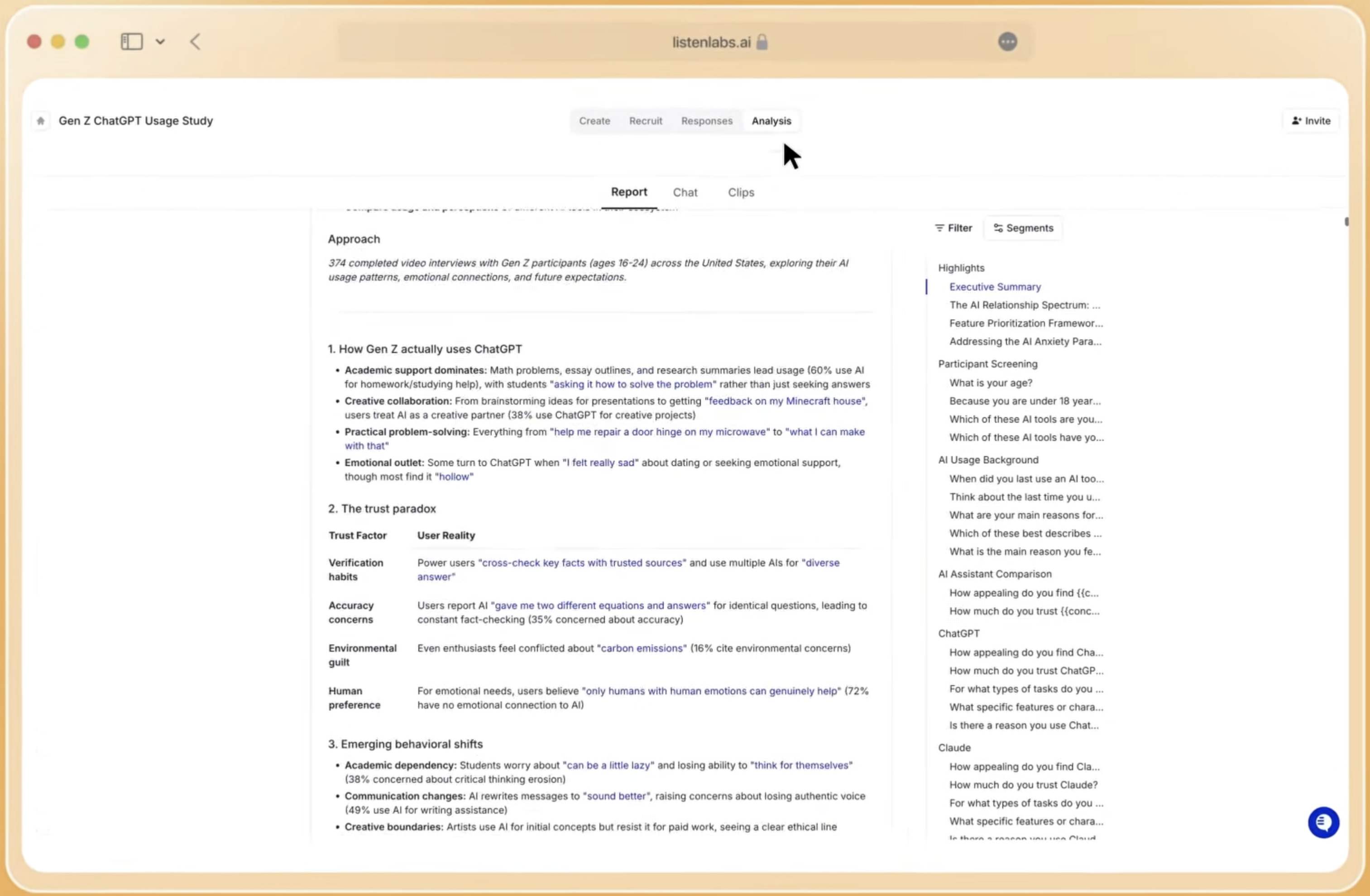
- AI analysis processes all interview data objectively and identifies themes and patterns across hundreds of responses without confirmation bias.
- These insights are then packaged into consultant-quality slide decks, memos, highlight reels, and statistical charts that generate in under a minute.
- The result is qual-at-scale, where hundreds of adaptive qualitative interviews deliver both statistical confidence and rich consumer narrative without weeks of manual synthesis.
Institutional Knowledge Storage Across Studies
A cross-study knowledge base stores every finding, which enables teams to query past research in seconds and build cumulative consumer intelligence rather than re-researching the same questions. Listen Labs has run over 1 million AI-powered customer interviews for companies including Microsoft, Perplexity, and Sweetgreen, compressing research cycles that previously took weeks into results delivered in under 24 hours.
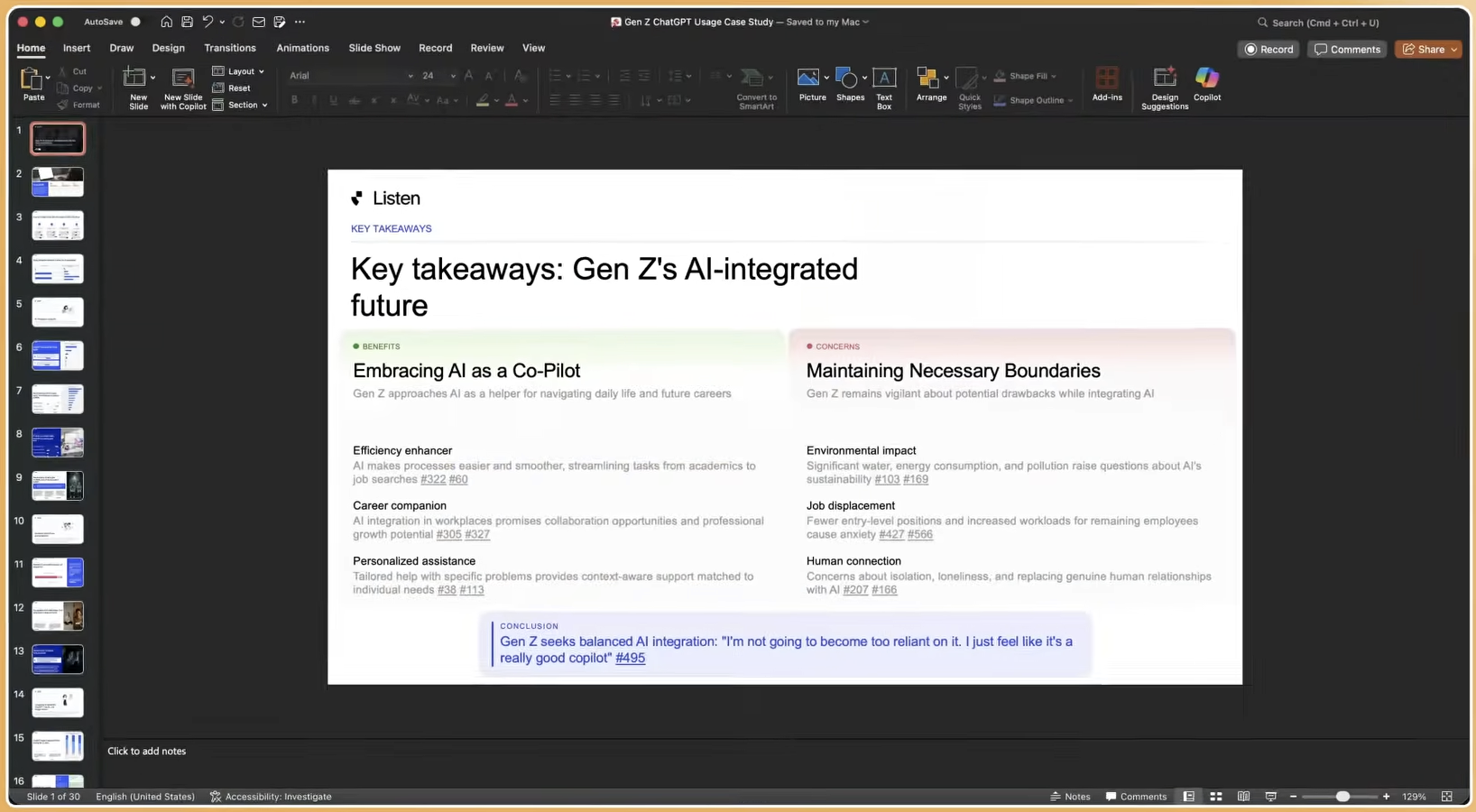
See the 24-hour research cycle in action and learn how Listen Labs eliminates every panel failure mode in a single end-to-end platform.
Frequently Asked Questions
What makes retail consumer research panel data unreliable in 2026?
Several compounding factors degrade panel data quality. Fraud and bot activity introduce non-human responses that pass standard quality checks. Professional respondents optimize for incentives rather than honest reporting. Panel conditioning trains experienced members to respond in ways that satisfy research conventions rather than reflect genuine attitudes. Stale demographic profiles misalign samples with the actual shopper population. Social desirability bias skews responses toward socially approved answers, particularly on sensitive topics. Together, these factors mean that a panel dataset may appear clean by conventional metrics while carrying systematic distortions that undermine every insight derived from it.
How does AI moderation reduce social desirability bias compared to traditional panels?
Social desirability bias occurs when participants adjust their answers toward what they perceive as acceptable to the researcher or the broader social context. AI moderation reduces this effect because participants do not perceive the AI as a social actor capable of judging them. This effect is strongest for sensitive topics. Studies comparing AI and human moderation show that participants are more willing to discuss personal finances, health behaviors, and political views with an AI moderator than with a human one, because they do not expect the AI to form opinions about their choices. This produces more candid responses on topics that matter most for retail consumer research, including price sensitivity, brand switching, and purchase rationalization.
Can AI-moderated interviews match the methodological rigor of traditional qualitative research?
AI-moderated interviews built on a rigorous methodology framework deliver comparable depth to human-moderated sessions for the vast majority of consumer research objectives. The key differentiator is adaptive questioning. The AI probes unexpected or short answers in real time and follows the logic of a trained interviewer rather than executing a fixed script. Emotional intelligence layers that analyze tone, word choice, and micro-expressions add a signal channel that traditional panel surveys cannot access at all. For enterprise research teams, AI moderation multiplies research output without sacrificing the qualitative depth that drives strategic decisions.
How does an end-to-end AI research platform handle participant fraud prevention?
Effective fraud prevention in AI research platforms operates across three layers. First, participant sourcing excludes commodity panel providers known for professional survey-takers and incentive-optimized respondents. Second, real-time quality monitoring analyzes video, voice, content, and device signals during the interview itself and flags fraudulent responses, AI-generated scripts, and mismatched profiles before they enter the dataset. Third, participation frequency limits, which cap each respondent at a small number of studies per month, structurally prevent the repeat-participation behavior that enables professional respondents to game screening criteria. This architecture addresses fraud at the source rather than attempting to clean contaminated data after collection.
What is the realistic cost and time comparison between panels and AI-moderated interviews?
End-to-end AI research platforms compress the full cycle, including study design, recruitment, moderation, analysis, and deliverable generation, to under 24 hours at approximately one-third the cost of traditional approaches. This cost reduction reflects the elimination of multiple vendor relationships and the automation of steps that previously required specialized human labor at every stage. For a typical enterprise study, this translates to roughly $30,000–$50,000 instead of $150,000–$300,000, with delivery in days rather than months.
Conclusion: Replacing Panels with End-to-End AI Research
Retail consumer research panels fail on every dimension that enterprise consumer-insights leaders depend on, including data integrity, respondent authenticity, behavioral accuracy, demographic representation, omnichannel coverage, speed, and cost. These are not marginal inefficiencies. They are structural properties of a panel model built before AI-moderated interviews existed as a viable alternative.
Evaluation criteria for a replacement platform should include verified participant sourcing with behavioral matching, real-time fraud prevention, adaptive interview moderation that captures emotional signal, automated analysis free from confirmation bias, and an institutional knowledge layer that compounds value across studies. Listen Labs is the end-to-end AI research platform that meets every one of these criteria, deployed by enterprises across retail, technology, and consumer goods to replace panel-dependent research programs with qual-at-scale delivered in under 24 hours. Schedule an evaluation demo to see if Listen Labs is the right replacement for your panel-dependent research program.