
Written by: Anish Rao, Head of Growth, Listen Labs
Key Takeaways: BrandIndex Voices vs. Listen Pulse
- YouGov BrandIndex Voices layers AI conversations onto a legacy quarterly quant engine. Listen Pulse is built from the ground up to deliver both metrics and the diagnostic “why” in a single mixed-methods wave.
- Listen Pulse’s Quality Guard and recruitment operations layer provide behavioral matching, real-time fraud prevention, and access to 30M+ verified global respondents, which extends beyond the demographic weighting of the YouGov panel.
- Listen Pulse’s AI moderator adapts in real time, captures multimodal emotional signals (tone, word choice, micro-expressions) via Ekman’s framework, and detects say-do gaps as they occur. BrandIndex Voices does not offer these capabilities.
- Automated theme quantification, consultant-grade deliverables, and a growing Research Library enable cross-wave synthesis and institutional memory that BrandIndex’s dashboard outputs do not provide.
- Enterprise teams needing continuous diagnostic depth alongside existing quant trackers should see how Listen Pulse closes the gap their current brand tracker cannot explain.
Study Setup and Wave Management for Ongoing Trackers
YouGov BrandIndex Voices inherits the BrandIndex wave cadence, which typically runs quarterly. Adding Voices to an existing deployment avoids rebuilding the study architecture, but it also constrains flexibility. The core question battery remains locked to BrandIndex’s instrument, and timely add-on questions must fit within that structure.
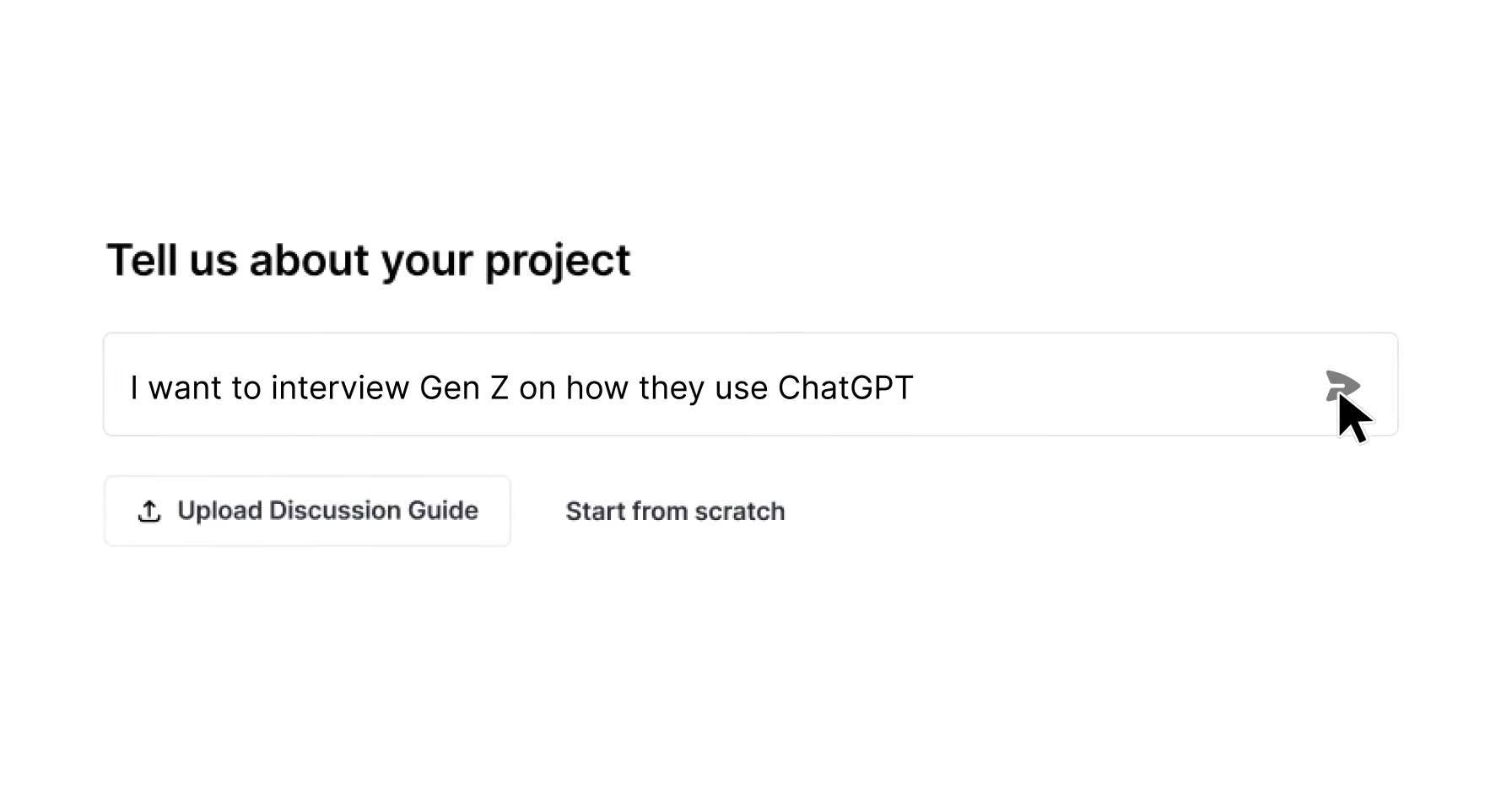
Listen Pulse operates as a purpose-built tracker from the start. Setup takes days rather than weeks, with AI-assisted study co-design drafting objectives, core questions, and probing context from a plain-language brief. Core questions stay constant wave over wave to protect the trend line. Timely questions on new campaigns, competitors, or news events slot in without breaking historical comparability. The platform supports awareness scales, NPS, MaxDiff, rankings, and closed-ended questions alongside open-ended conversational interviews in the same wave, a mixed-methods architecture that BrandIndex Voices, as a quant-first system, does not natively replicate.
Participant Sourcing and Quality Controls at Scale
BrandIndex draws from YouGov’s proprietary panel, which is large and well-established for population-level tracking. Panel-based brand tracking remains the default method because it is the only sampling approach that can hold the demographic mix constant wave over wave, which is a prerequisite for a credible trend line. YouGov’s panel has been calibrated for this purpose over many years.
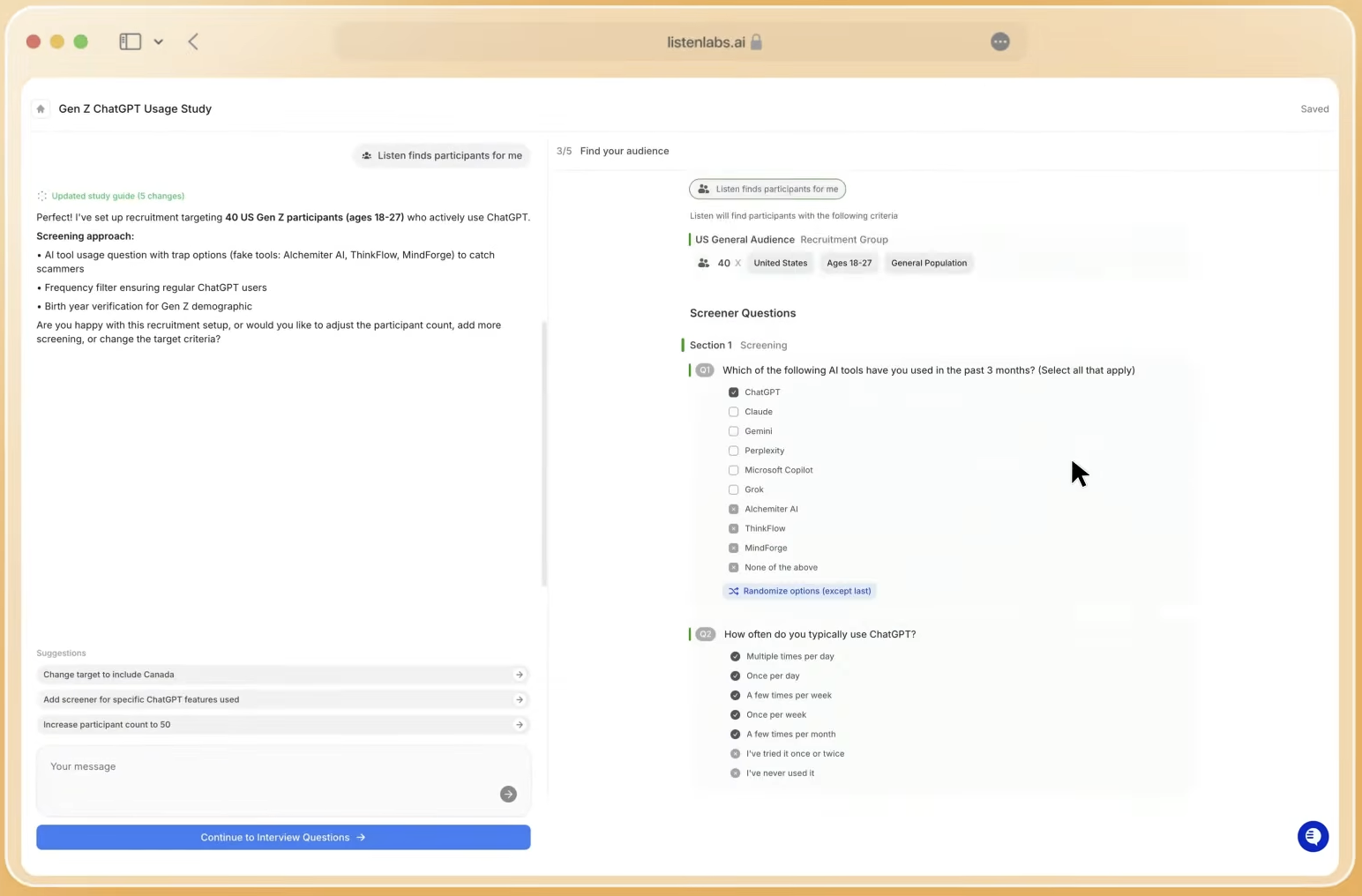
Listen connects to a network of 30M+ verified global respondents across 45+ countries and 100+ languages from top-tier white-label qualitative panels. Quality Guard, Listen Labs’ AI orchestration layer, matches participants on behavioral and intent data rather than self-reported demographics alone. It monitors every interview in real time for fraud and low-effort responses and limits participants to three studies per month to eliminate professional survey-takers. A dedicated recruitment operations team manages hard-to-reach segments such as enterprise decision-makers, category-specific buyers, and consumers below 1% incidence rate that commodity panels frequently cannot fill reliably.
AI-moderated interview tools deliver high depth per response but low structured validity when samples are not inclusive. Any conversational add-on that cannot control sourcing independently faces this risk. Listen Pulse addresses it directly through Quality Guard’s behavioral matching and the recruitment operations layer, instead of relying solely on a single panel provider’s demographic weighting.
Moderation Style and Emotional Intelligence Signals
BrandIndex Voices uses AI to guide participants through follow-up questions appended to the standard BrandIndex battery. The moderation follows the existing instrument rather than adapting dynamically to what a participant says.
Listen Pulse’s AI moderator conducts personalized, adaptive conversations. When a participant gives a short or vague answer, the moderator probes deeper, similar to a trained human interviewer. Ninety-two percent of participants report top comfort levels in AI-moderated sessions, and 32% explicitly state they feel less judged by an AI moderator. This comfort produces more honest emotional responses on sensitive brand perceptions than a typical human-led session.
Listen Labs’ Emotional Intelligence analyzes three layers of signal, including tone of voice, word choice, and subconscious micro expressions, to surface emotions that transcripts alone miss. It uses Ekman’s universal emotions framework, the same standard used in clinical psychology, and tracks anger, contempt, disgust, enjoyment, fear, sadness, and surprise. Every emotion is quantified per question and concept, with each label traceable to the exact timestamp, verbatim quote, and AI reasoning behind it. BrandIndex Voices does not publish an equivalent multimodal emotional analysis capability.
Multimodal emotion recognition that fuses text, audio, and visual modalities produces richer emotional signals and more contextually appropriate responses than text-only methods. This evidence highlights how single-signal moderation leaves emotional data unused.
Data Quality, Fraud Prevention, and Say-Do Gap Detection
BrandIndex’s fraud controls operate at the panel level and apply YouGov’s standard quality protocols. These controls work well for survey-based data but were not designed to monitor video-based conversational sessions in real time.
Listen Pulse applies Quality Guard continuously across video, voice, content, and device signals throughout every interview. Visual Insights extends this coverage. The AI moderator observes on-screen behavior during task-based sessions and probes contradictions between stated preference and observed behavior in the moment. Traditional surveys may tell us what people do, but it takes a conversation to understand why. Visual Insights closes that loop by catching the say-do gap as it happens rather than after the session ends. BrandIndex Voices, as a survey-adjacent instrument, does not offer real-time behavioral observation or say-do gap detection at this level.
Analysis Workflow, Deliverables, and Knowledge Management
BrandIndex delivers dashboard outputs tied to its standard metric set. Voices adds qualitative themes to those dashboards, but the analysis pipeline does not support cross-wave synthesis of open-ended conversational data at scale.
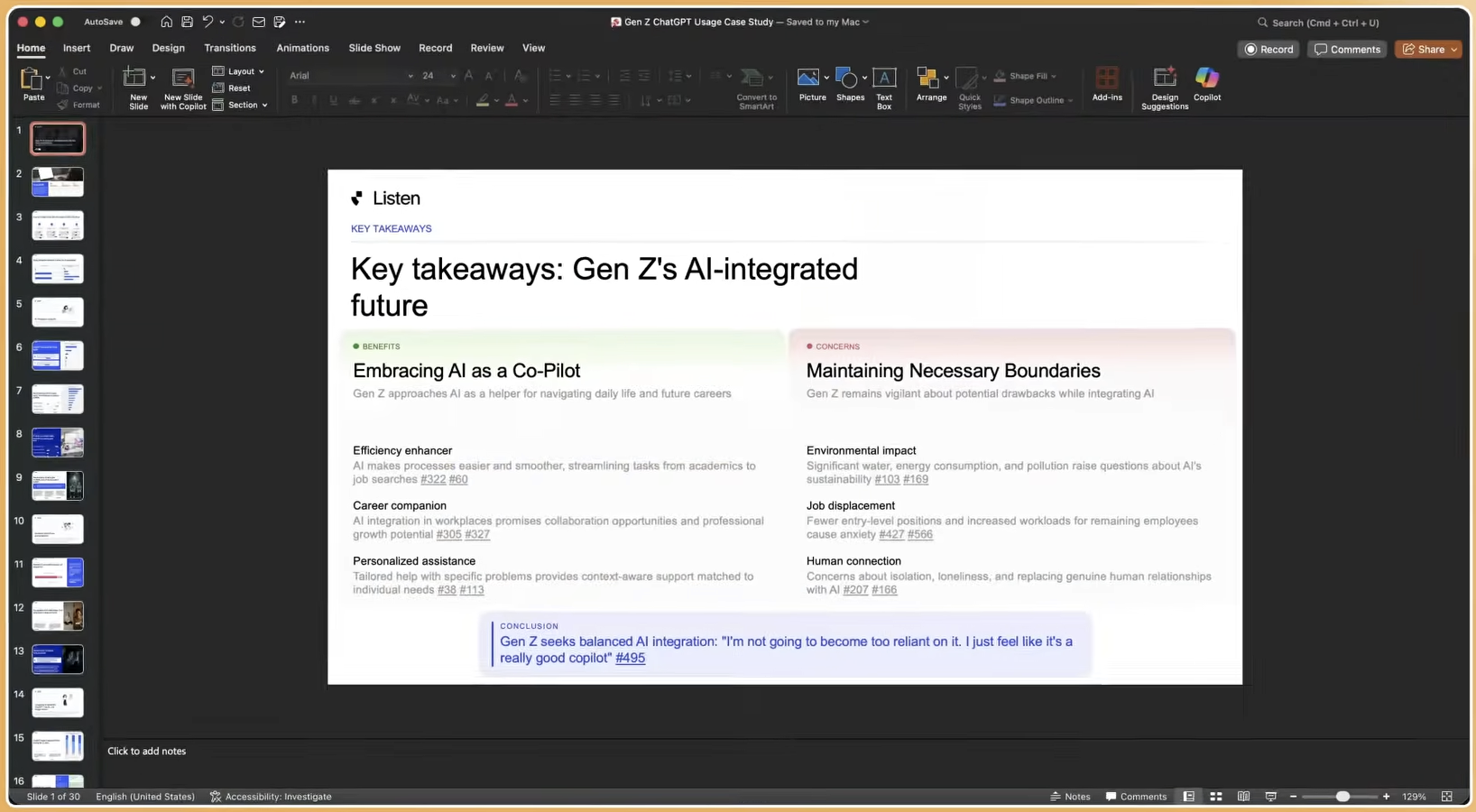
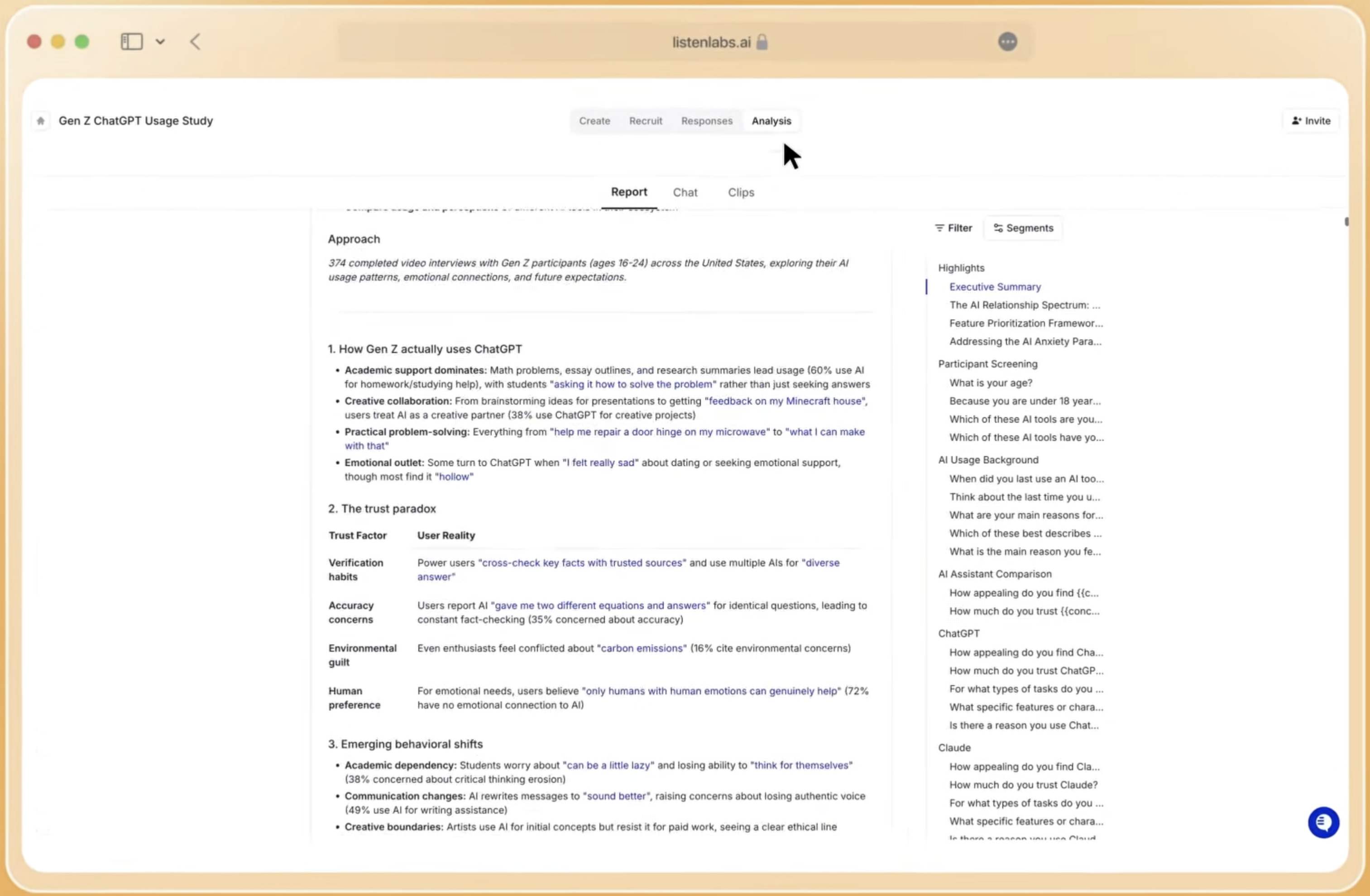
Listen Pulse feeds into Listen Labs’ Research Agent, which automatically quantifies themes, generates consultant-quality slide decks, memos, highlight reels, and statistical charts, and answers natural-language queries against the full dataset. Research Library extends this capability. Every wave grows a searchable knowledge base that supports cross-wave synthesis, trend tracking, and institutional memory that compounds over time. Open-ended responses in AI-moderated brand interviews are often substantially longer than those from equivalent survey items. That depth makes automated theme quantification materially more valuable.
Best-Fit Use Cases for Enterprise Teams
Several deployment scenarios clarify where each tool fits in practice.
Continuous tracking teams at enterprises like P&G, which need to surface why a claim feels exaggerated before it reaches market, benefit from Listen Pulse’s always-on wave architecture and automated theme quantification. A well-known clothing brand used Pulse to diagnose a tracker drop that its legacy quant instrument could not explain. The issue was not price but style, as a growing segment felt the brand’s prominent logos were too loud for their changing lifestyles. That finding required conversational depth rather than a standard survey.
Sweetgreen replaced months-long research cycles with days using Listen Labs, scaling consumer insights across 300+ US locations at one-third the cost. Similarly, Microsoft used the same infrastructure to collect global customer stories within a single day, a timeline that traditional methods cannot match. Both examples demonstrate the platform’s capacity for enterprise-scale deployment, not a pilot-stage tool.
Mid-market teams supplementing an existing BrandIndex deployment can layer Listen Pulse alongside it. Pulse integrates with Qualtrics and Decipher, so teams keep the KPIs they already report while adding the narrative behind them. Agencies running diagnostic layers for clients can use Pulse to explain metric movements that a client’s primary tracker flags but cannot diagnose.
Operational Requirements and Global Program Support
BrandIndex Voices operates within YouGov’s existing compliance and data infrastructure. This structure benefits teams already contracted with YouGov and operating in markets where BrandIndex has established panel coverage.
Listen Pulse supports research across multiple countries and languages with automatic translation and transcription. The platform holds SOC 2 Type II, ISO 27001, ISO 27701, and ISO 42001 certifications and is GDPR compliant. Customer data never trains Listen Labs’ AI models. For research teams concerned about change management, Listen Pulse deploys alongside an existing tracker rather than forcing a full platform migration, which reduces internal friction during adoption.
Risks and Limitations for Each Approach
BrandIndex Voices carries the sample constraints of the BrandIndex panel. Teams that need to reach audiences outside YouGov’s panel coverage, or that require behavioral matching rather than demographic weighting alone, encounter limitations that the Voices add-on does not resolve. Real-time emotional analysis and say-do gap detection are not documented capabilities of the Voices product.
Listen Pulse operates on a subscription model, which requires budget commitment and an initial calibration period to establish baseline wave data before trend lines become meaningful. Teams switching from a long-running BrandIndex deployment will need to rebuild historical comparability over time. The platform’s depth advantage becomes most pronounced at scale. Programs with very small wave sizes may not fully utilize automated theme quantification and Research Library capabilities.
Criteria-Based Decision Framework for Research Leaders
Teams already running BrandIndex with stable trend lines and a primary need for light qualitative color on existing metrics may view Voices as a low-friction addition. The case for staying with Voices is strongest when the existing BrandIndex panel covers the target audience adequately. In that situation, if the research team’s primary deliverable is a dashboard update rather than a diagnostic report, the lighter qualitative layer Voices provides may be sufficient. This approach works best when the organization has no near-term need for emotional signal analysis or say-do gap detection.
Teams whose core problem is the diagnostic gap, meaning they must understand why a metric moved rather than simply that it moved, are better served by Listen Pulse. The case for Pulse is strongest when the program requires multimodal emotional analysis, behavioral observation, cross-wave theme quantification, or integration with Qualtrics and Decipher to preserve existing KPI reporting. Enterprises operating across multiple markets, or those needing to reach niche audiences that a single panel provider cannot reliably cover, also benefit from Pulse’s Quality Guard and recruitment operations infrastructure.
The hybrid model, a thin quarterly quant tracker for audit-grade trend lines plus a continuous conversational layer for qualitative depth, reflects the approach leading brand teams are running in 2026. Listen Pulse is designed for this architecture and integrates with existing quant infrastructure rather than replacing it.
Ready to close the diagnostic gap in your brand tracker? See Listen Pulse in action with a personalized demo.
Frequently Asked Questions
How does Listen Pulse handle sample representativeness for ongoing brand tracking?
The platform uses the same global respondent network described earlier, with Quality Guard’s behavioral matching ensuring that sample quality extends beyond demographic weighting. Quality Guard monitors every interview in real time for fraud, low-effort responses, and repeat participation, and participants are capped at three studies per month to prevent panel fatigue. A dedicated recruitment operations team manages hard-to-reach segments that standard panels frequently cannot fill. For teams that need to maintain a statistically weighted trend line, Listen Pulse integrates with Qualtrics and Decipher, allowing the existing quant tracker to carry the representativeness burden while Pulse adds the conversational diagnostic layer.
Can Listen Pulse integrate with an existing BrandIndex or Qualtrics deployment?
Yes. Listen Pulse connects with Qualtrics and Decipher, so teams keep the KPIs they already report while adding open-ended conversational data to each wave. It deploys alongside an existing tracker rather than forcing a full platform migration. Teams can run Pulse as a supplementary diagnostic layer triggered by metric movements in their primary tracker, or as the primary tracking system with quant KPIs embedded directly in the Pulse wave instrument.
How does Emotional Intelligence work, and what emotions does it detect?
The Emotional Intelligence capability described earlier operates across 50+ languages and integrates with the Research Agent for natural-language queries. Every emotion label is quantified per question and concept and is traceable to the exact timestamp, verbatim quote, and AI reasoning behind it, so teams can see not just that a participant expressed confusion, but precisely when and why the system identified it. Research Agent can surface charts and highlight reels of emotionally significant moments for rapid stakeholder sharing.
How quickly does Listen Pulse deliver results, and what deliverables are included?
The Research Agent described earlier delivers those outputs in under a minute after field close. This speed advantage becomes material when tracking programs require weekly or bi-weekly updates rather than quarterly cycles. For context, AI-moderated conversational brand interviews typically deliver first synthesis reports within hours to a few days of field start, compared to several weeks for traditional panel tracker waves. Every metric in a Pulse report traces back to the interview, verbatim quote, and audio or video clip behind it, so teams can drill into any finding without re-watching raw footage.
When should a team keep its existing BrandIndex deployment rather than switching to Listen Pulse?
Teams with long-running BrandIndex deployments and a primary need for audit-grade longitudinal trend lines on a fixed metric battery should maintain that infrastructure. BrandIndex’s panel calibration and weighting models have been built over many years and provide defensible population-level comparability that a new deployment cannot replicate immediately. The stronger case for Listen Pulse lies in using it as a diagnostic layer running alongside BrandIndex, capturing the conversational “why” that the quant tracker flags but cannot explain, rather than as an immediate full replacement. Teams whose programs are newer, whose audiences fall outside BrandIndex’s panel coverage, or whose primary deliverable is a diagnostic report rather than a dashboard update are candidates for Pulse as the primary system from the outset.
Conclusion: Choosing the Right Conversational Layer for Your Brand Tracker
YouGov BrandIndex Voices and Listen Pulse address the same diagnostic gap from different architectural starting points. Voices extends an established quant tracker with a conversational layer constrained by that tracker’s panel, instrument, and cadence. Listen Pulse is purpose-built to deliver the metric movement and its explanation in the same wave, with multimodal emotional analysis, real-time fraud controls, say-do gap detection, and flexible integration with existing quant infrastructure.
Consumer insights leaders whose trackers are catching drops they cannot explain, whose emotional signal data is missing from every wave report, and whose research teams are fielding more diagnostic requests than the current stack can answer, gain a direct path forward with Listen Pulse. Evidence from Microsoft, Sweetgreen, and P&G shows that the platform performs at enterprise scale, not just in controlled pilots.
Evaluate Listen Pulse against your current program and see how the conversational diagnostic layer fits your existing infrastructure.