
Written by: Anish Rao, Head of Growth, Listen Labs
Key Takeaways for Brand and Insights Teams
- YouGov BrandIndex Lite provides a single Buzz Score, a net sentiment metric that cannot explain why brand perception shifts occur or which segments drove the change.
- Full BrandIndex expands to 16 metrics across 56 markets but still relies on closed-ended surveys, so teams often commission separate qualitative studies when numbers move.
- Listen Pulse combines structured tracking metrics with AI-moderated open-ended conversation in the same wave, delivering both the metric movement and the diagnostic explanation within 24 hours.
- Sample quality, fraud controls, and multilingual coverage differ significantly. Listen Labs’ 50M+ verified panel and Quality Guard system support niche audiences and global programs more reliably than standard survey panels.
- Enterprise teams needing both quantitative KPIs and qualitative context should see how Listen Pulse closes the gap between detecting brand changes and understanding why they happened.
What the Buzz Score Really Captures
The Buzz Score rests on two survey questions. Respondents select brands they heard something positive about in the past two weeks and then select brands they heard something negative about in the same period. The net score, calculated as positive percentage minus negative percentage, is reported as an 8-week moving average to smooth daily volatility.
YouGov weights BrandIndex data using a propensity scoring methodology with targets from the American Community Survey (ACS). This approach ensures representation by age, gender, race, education, and region. The same weighting applies across BrandIndex Lite’s 54-market footprint, where users can filter by industry, demographic characteristics, and market for cross-country comparisons. Within the full BrandIndex framework, Buzz sits alongside Aided Brand Awareness, Ad Awareness, and Word of Mouth as one of four Media and Communication Metrics. That placement signals its role as a communication signal rather than a complete brand health read.
Why BrandIndex Lite Struggles on Sample Depth and Metrics
BrandIndex Lite delivers one metric. Brand strength rarely fails in a single place, and a single net sentiment score cannot distinguish between a brand gaining awareness through negative press and one gaining it through genuine advocacy. Modern brand health tracking platforms typically incorporate at least 15 distinct metrics, including unaided recall, consideration, purchase intent, trust, and brand associations, because each metric isolates a different failure mode.
For niche brands, sample constraints compound the metric limitation. A 1,000-person sample yields a ±7% margin of error for subgroups after splitting across five segments, which makes it hard to detect real movement in demographic or category-specific reads. Lite does not publish segment-level sample sizes. For brands with narrow category penetration or regional concentration, the effective base can fall well below the threshold needed for reliable trend detection.
Teams that should skip Lite include those tracking niche B2B brands, regional brands with concentrated audiences, or any team that needs to act on subgroup-level movement. B2B infrastructure and institutional services operate in niche, high-trust, long-cycle environments where standard survey panels struggle to obtain representative samples. Lite also provides no qualitative layer, no driver analysis, and no mechanism to surface what consumers are actually saying. It only reports whether the net of what they heard was positive or negative.
Full BrandIndex: Expanded Metrics, Same Survey Limits
Full YouGov BrandIndex tracks 16 brand health metrics for over 27,000 brands across 56 markets, at enterprise pricing of roughly $50,000–$200,000 per year. The expanded metric set, covering awareness, consideration, quality, value, satisfaction, recommendation, and impression alongside Buzz, addresses the single-metric limitation of Lite. It enables teams to see where in the funnel a brand is losing ground.
The daily tracking cadence creates a real operational advantage. YouGov’s always-on tracker measures 16 brand health metrics across 27,000+ brands in 54 markets, which enables category-level comparisons that episodic studies cannot match. However, the core structural constraint of survey-based tracking remains. Quantitative brand tracking tools such as YouGov BrandIndex excel at detecting perception changes through trend lines but cannot explain why those changes occurred because surveys are closed-ended instruments.
Traditional enterprise brand trackers with large monthly samples often deliver results 6–8 weeks after fieldwork. The diagnostic gap, the distance between detecting that a metric moved and understanding why, usually requires commissioning a separate qualitative study. Traditional qualitative research to diagnose brand metric movements costs $15,000–$50,000 per study and takes 4–8 weeks. These delays force brand teams to respond based on guesswork before diagnostic insights arrive, a structural gap that Listen Pulse eliminates by embedding qualitative diagnosis directly into each tracking wave.
Listen Pulse: Tracking Metrics with Built-In Conversation
Listen Pulse is a conversational tracker built on Listen Labs’ end-to-end AI research platform. It runs repeated waves with a constant core of structured tracking questions, such as awareness, consideration, NPS, and custom KPIs, alongside open-ended AI-moderated conversation in the same instrument. Every metric movement arrives with the thematic explanation behind it, charted in the same report.
The operational architecture differs from survey-based trackers in three ways. Core questions remain constant wave over wave to protect trend line integrity, while timely add-on questions cover new campaigns, competitors, or news events without breaking historical comparability. The open-ended conversation layer lets respondents raise what actually matters to them, which makes it possible to track abstract constructs like cultural relevance without perfect question design upfront. Every number is traceable to the interview, verbatim quote, and audio or video clip behind it, so a brand team can drill into any metric and hear the original explanation in the respondent’s own words.
Listen Pulse draws from Listen Labs’ panel of 50M+ verified respondents across 45+ countries and 120+ languages, providing the global reach required for enterprise tracking programs. Beyond scale, the Emotional Intelligence layer analyzes tone of voice, word choice, and subconscious micro-expressions across 50+ languages, built on Ekman’s universal emotions framework. Teams capture not only what respondents say but what they feel, a depth that closed-ended surveys cannot replicate. For teams already running tracking programs, Pulse integrates with Qualtrics and Decipher, allowing them to keep the KPIs they already report while adding the narrative behind them. It deploys alongside an existing tracker or as the primary tracking system.
One clothing brand known for its prominent logos was quietly losing customers. Its existing tracker detected the decline but could not explain it. Pulse identified the cause. A growing segment of customers felt the brand’s signature aesthetic no longer fit their evolving lifestyle, a perception shift that had been building for months before it registered in quantitative metrics.
Research Speed and Day-to-Day Workflow
BrandIndex Lite requires no setup. Access is immediate and the Buzz score is pre-calculated. Full BrandIndex requires a contract and onboarding, with data available on a rolling basis once the subscription is active. Neither option requires the buyer to design a study, recruit participants, or manage fieldwork. That structure reduces operational burden but also removes flexibility.
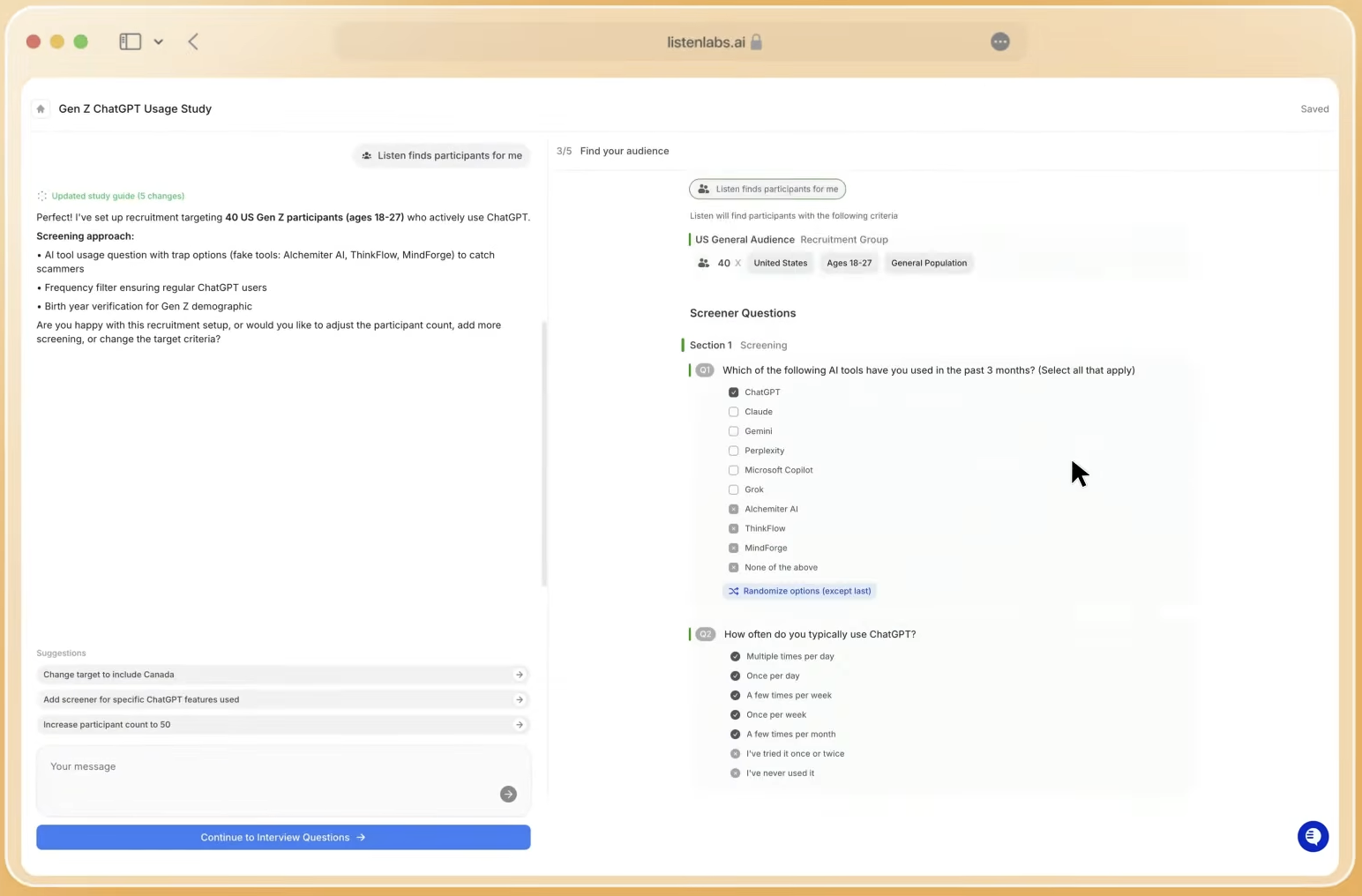
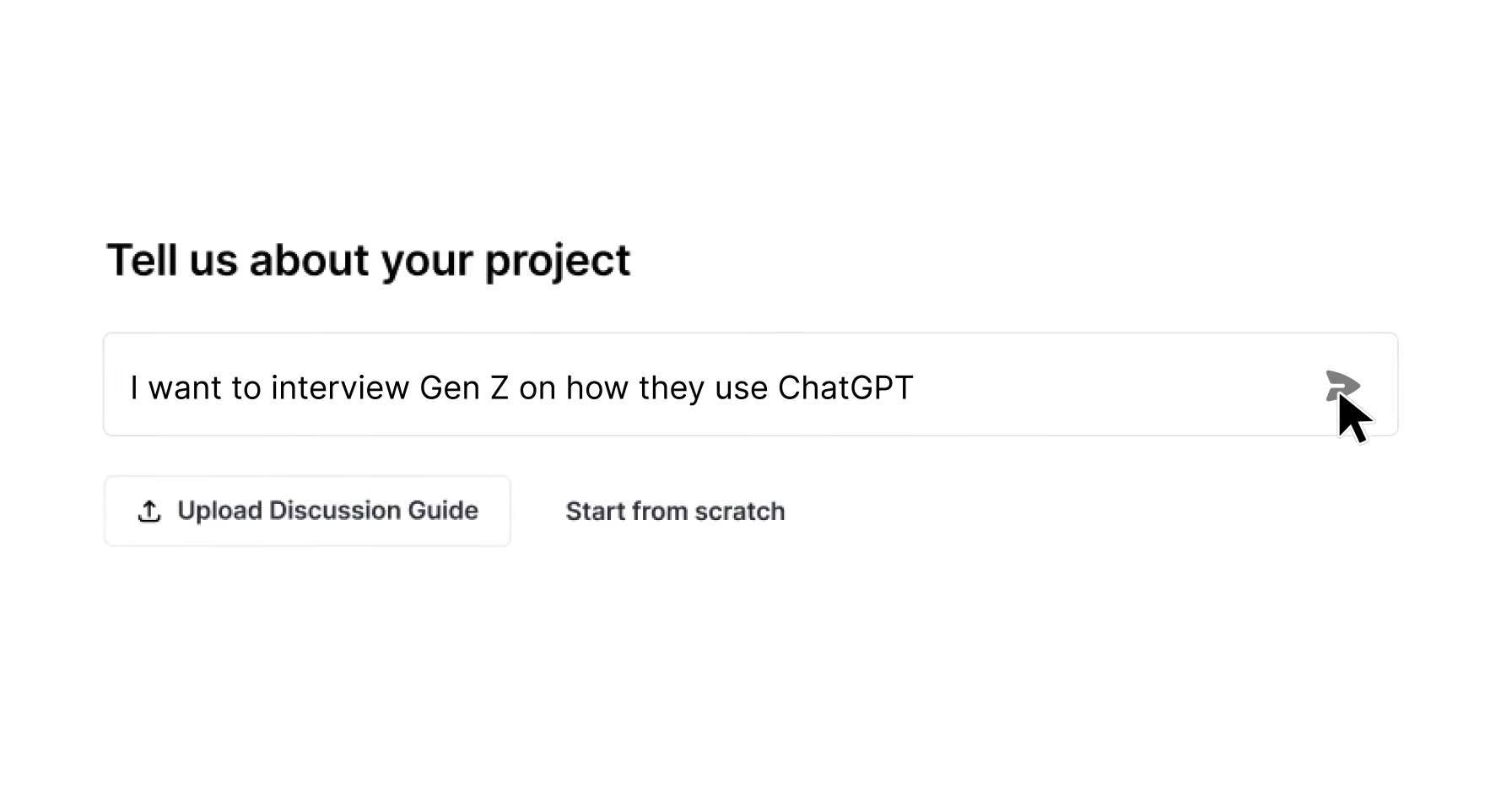
Listen Pulse requires initial study design, including core tracking questions, screeners, and wave cadence. AI-assisted study co-design compresses this work to hours rather than weeks. Once configured, waves run continuously and results are available in under 24 hours per wave.
The workflow implication is significant. With BrandIndex, a metric movement triggers a separate research commission to diagnose the cause, which adds weeks and budget to every actionable finding. With Pulse, the diagnostic arrives in the same wave, compressing the detect-to-act cycle from months to days.
Depth, Sample Quality, and Global Reach
BrandIndex Lite and full BrandIndex both draw from YouGov’s base of more than 30 million registered members, weighted to census targets. The panel is large and the methodology is transparent, but the instrument is closed-ended. Respondents answer pre-set questions with no ability to elaborate, qualify, or introduce topics the survey did not anticipate.
Listen Pulse collapses the need for multiple tools into one instrument by embedding open-ended conversation directly into the tracking wave.
On fraud controls, Listen Labs’ Quality Guard uses real-time AI monitoring across video, voice, content, and device signals to detect fraudulent responses. Participants are limited to three studies per month, which eliminates professional survey-takers. Many online survey responses can be low quality or fraudulent, a structural risk that commodity panels carry and that Listen Labs’ recruitment infrastructure is specifically designed to address.
On global reach, BrandIndex covers 54–56 markets. Listen Pulse covers 45+ countries across the Americas, Europe, APAC, and MEA, with 120+ languages supported for interview moderation and 50+ languages for Emotional Intelligence analysis. This coverage creates a meaningful advantage for enterprise teams running simultaneous multi-market tracking programs.
Analysis Effort and Knowledge Compounding
BrandIndex delivers pre-built dashboards. Analysis effort stays low for top-line reads but increases sharply when teams need to explain metric movement, segment findings, or connect brand data to campaign activity. Traditional brand trackers document metric movement but fail to diagnose why changes occur, which turns debriefs into unresolved debates among brand, communications, and regional teams.
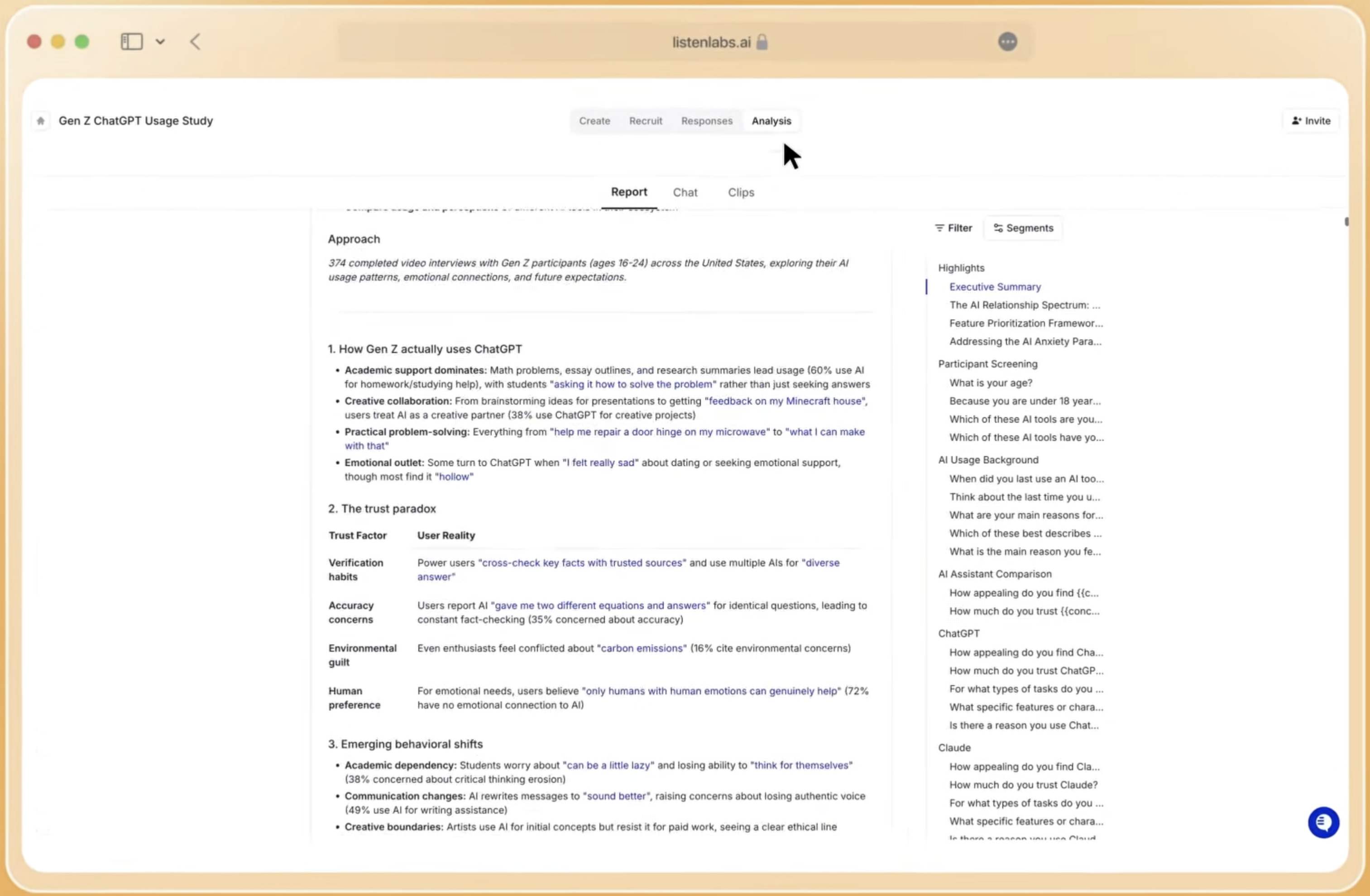
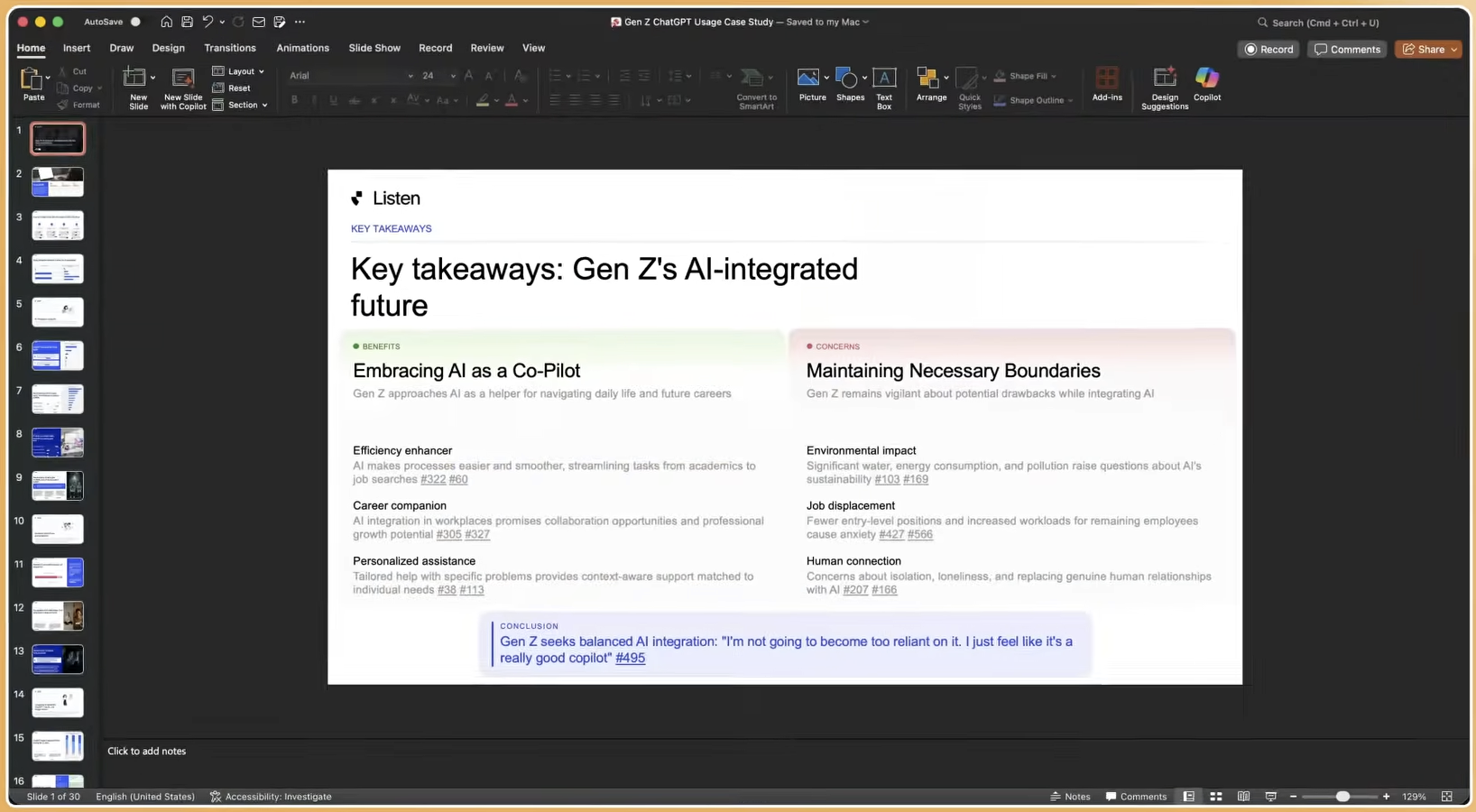
Listen Pulse’s Research Agent generates automated key findings, theme analysis, slide decks, memos, and highlight reels from each wave. Cross-study querying through Research Library allows teams to search every wave simultaneously in natural language, track how themes evolve over time, and onboard new team members against the full corpus of institutional knowledge. Each wave compounds the value of the previous one rather than expiring as a standalone report.
A modular structure in which stable core funnel metrics remain unchanged for trend integrity while diagnostic modules rotate in and out answers current business questions without commissioning separate studies. Listen Pulse implements this design principle natively. See how Research Library turns every Pulse wave into a compounding knowledge asset.
Scenario-Based Guidance by Team Type
Enterprise insights teams running global brand programs with established KPI frameworks benefit most from Listen Pulse as a primary tracker or as a layer added to an existing quant tracker. The integration with Qualtrics and Decipher preserves existing reporting infrastructure while adding the conversational diagnostic that quant-only systems cannot supply.
UX research leads and product teams without dedicated researchers gain from Pulse’s self-serve study design and AI moderation, which remove the logistics overhead of recruiting, scheduling, and moderating sessions. The ability to run concept testing, message testing, and brand perception studies within the same platform that handles tracking reduces the vendor fragmentation that slows most research programs.
Agencies and consultancies operating on client timelines measured in days rather than weeks benefit from Pulse’s sub-24-hour turnaround and the Research Agent’s one-click deliverable generation. Slide decks, memos, and highlight reels translate directly into client-ready outputs.
Teams with very limited budgets and no need for diagnostic depth, such as a startup monitoring top-line brand sentiment across a single market, may find BrandIndex Lite sufficient as a directional signal. The constraint is that Lite provides no path to explanation when the number moves.
Where Each Option Falls Short
BrandIndex Lite’s primary limitation is structural. One metric cannot diagnose brand health. A brand with 60% awareness as “the cheap one” is in a structurally different position than a brand with 60% awareness as “the premium choice.” The number matches, but the P&L does not. Buzz does not surface that distinction.
Full BrandIndex addresses the metric depth problem but not the diagnostic gap. As discussed in the BrandIndex analysis, the diagnostic gap remains. Teams relying on BrandIndex alone will still need to commission separate qualitative research when a metric moves unexpectedly.
Listen Pulse requires more upfront configuration than a pre-built dashboard product. Teams that want a zero-setup brand signal with no diagnostic requirement may find the onboarding investment disproportionate. Pulse also assumes a research program with enough wave cadence to build a meaningful trend line. It is not designed for one-off brand audits.
Decision Framework: Matching Options to Your Goals
The right tool depends on what decisions the data must inform. Before selecting a tracker, teams should evaluate their situation against the following criteria. The decision rules below map each scenario to the most appropriate tool.
- If the primary need is a free, directional sentiment signal across a single market with no requirement for explanation, BrandIndex Lite is a functional starting point.
- If the need is daily multi-metric tracking with category benchmarks across 50+ markets and the team has budget for a separate qualitative program to diagnose movement, full BrandIndex is a credible option.
- If the need is a tracker that delivers both the metric and the diagnostic “why” in the same wave, supports multi-market programs in 45+ countries and 120+ languages, integrates with existing KPI infrastructure, and compresses the detect-to-act cycle from months to hours, Listen Pulse is the appropriate choice.
- If the team is already running a quant tracker and wants to add conversational depth without replacing existing reporting, Pulse deploys as a complementary layer alongside the existing system.
- If the brand operates in a niche category, a regional market, or a B2B segment where standard panels produce insufficient sample sizes, neither Lite nor full BrandIndex will reliably detect subgroup-level movement, and a platform with dedicated recruitment operations and fraud controls is required.
Frequently Asked Questions
How fast is turnaround time across the three options?
BrandIndex Lite provides immediate access to pre-calculated Buzz scores with no fieldwork delay. Full BrandIndex delivers daily updated metrics once a subscription is active. Listen Pulse delivers wave results, including quantitative KPIs and qualitative theme analysis, in under 24 hours per wave. For teams that need to act on brand data within a business cycle rather than a research cycle, the 24-hour turnaround is the operationally meaningful benchmark. A metric movement detected on Monday can be diagnosed and briefed to leadership by Tuesday.
Where does participant sourcing and sample quality differ?
YouGov BrandIndex draws from a registered panel of 30M+ members weighted to census targets, which is a well-documented and transparent methodology for general population tracking. Listen Pulse’s 50M+ verified panel, mentioned earlier, differs from YouGov’s approach in two key ways. Quality Guard provides real-time fraud detection across video, voice, content, and device signals, and participants are limited to three studies per month to eliminate professional survey-takers. For niche or hard-to-reach audiences, such as enterprise decision-makers, healthcare workers, or consumers below 1% incidence rate, Listen Labs’ dedicated recruitment operations team handles sourcing that standard panels cannot fulfill.
How much analysis effort is required after data collection?
BrandIndex Lite and full BrandIndex deliver pre-built dashboards that require minimal analysis effort for top-line reads. The effort increases substantially when teams need to explain metric movement, build stakeholder presentations, or connect brand data to campaign decisions, tasks that typically require a separate analyst or research commission. Listen Pulse’s Research Agent automates theme identification, generates slide decks and memos, and produces video highlight reels from each wave. Research Library enables cross-wave querying in natural language, so institutional knowledge compounds rather than expiring with each report.
Which option supports multilingual and global programs most effectively?
Full BrandIndex covers 55+ markets with a standardized metric set, which provides a strong foundation for global benchmarking. As noted in the platform overview, Pulse’s 120+ language interview coverage and 50+ language Emotional Intelligence analysis exceed BrandIndex’s standardized approach. That difference matters for teams that need localized diagnostic depth alongside global KPI benchmarking.
What security, privacy, and governance standards apply?
YouGov operates under GDPR and standard panel privacy frameworks. Listen Labs holds SOC 2 Type II, ISO 27001, ISO 27701, and ISO 42001 certifications, is GDPR compliant, and uses 256-bit encryption. Listen Labs never trains its AI models on customer data, which satisfies a governance requirement that enterprise procurement and legal teams increasingly mandate before approving research platforms that handle proprietary brand and consumer data.
How scalable is each approach for continuous tracking?
BrandIndex is designed for continuous tracking and scales well for brands that need daily metric monitoring across large markets. The constraint is that scaling the diagnostic layer, understanding why metrics move, requires proportionally more qualitative research investment outside the platform. Listen Pulse is built for continuous tracking with the diagnostic layer embedded. Core questions stay constant to protect the trend line, timely questions rotate in without breaking historical comparability, and the platform analyzes tens of thousands of responses continuously. The more waves a team runs, the more powerful Research Library becomes as a cross-wave intelligence system.
Conclusion: Choosing the Right Tracker for 2026
YouGov BrandIndex Lite delivers a fast, free Buzz snapshot that works as a directional signal and falls short as a decision-making instrument. Full BrandIndex expands the metric set and adds daily tracking cadence but retains the fundamental constraint of all closed-ended survey trackers. It detects that a number moved without explaining why. In 2026, brand teams that need to act on tracking data, not just report it, require both the metric and the diagnostic context in the same wave.
Listen Pulse is built for that requirement. It keeps core questions constant to protect the trend line, embeds open-ended AI-moderated conversation in every wave, surfaces emerging themes next to the KPIs teams already report, and delivers results in under 24 hours. Every number traces back to a real person, their words, and the clip. It deploys alongside an existing tracker or as the primary tracking system and integrates with Qualtrics and Decipher so existing reporting infrastructure is preserved.
Enterprise insights leaders, UX research leads, and agency teams who need a tracker that closes the gap between the number and the explanation should schedule a demo to see Listen Pulse in action.