
Written by: Anish Rao, Head of Growth, Listen Labs
Key Takeaways
- The telecom industry is shifting fast, with 3.1 billion 5G subscriptions and 77% of consumers feeling no loyalty to their provider, so timely consumer research now shapes competitive position.
- Traditional syndicated reports handle infrastructure forecasting well but cannot explain why consumers churn or how they react to new services, so primary research must close that gap.
- AI-moderated interview platforms deliver hundreds of conversational interviews with emotional intelligence analysis in under 24 hours instead of weeks, which changes how teams plan research.
- Telecom leaders should evaluate research partners on speed, data depth, sample quality, methodological range, and total cost of ownership across recruitment and analysis.
- Listen Labs runs enterprise-grade consumer interviews on 5G adoption, churn drivers, and private network perception in under 24 hours, so see the platform in action.
Practical Criteria for Evaluating Telecom Research Partners
Telecom teams need a consistent scoring framework before reviewing any vendor. The ten criteria below apply to both syndicated report providers and AI-first primary research platforms.
- Research speed: Time from study brief or report purchase to delivery of insights that stakeholders can act on.
- Data depth: Whether outputs reveal motivations, emotional signals, and behavioral context or only provide aggregate statistics.
- Sample quality and reach: Verification rigor, fraud controls, geographic coverage, and ability to recruit niche or hard-to-reach audiences.
- Methodological flexibility: Support for qualitative interviews, quantitative surveys, mixed methods, concept testing, and longitudinal tracking in one relationship.
- Qualitative-quantitative balance: Ability to deliver both conversational depth and statistical confidence at meaningful scale.
- Analysis workflow: Level of automation in coding, theming, segmentation, and cross-study synthesis versus manual analyst hours.
- Deliverable quality and transparency: Clarity of methodology documentation, traceability of findings to source data, and formats tailored to different stakeholder groups.
- Security and compliance: Certifications for data privacy, information security, and AI governance that satisfy enterprise procurement standards.
- Scalability and repeatability: Capacity to run continuous research programs without proportional increases in cost or headcount.
- Total cost of ownership: All-in cost across recruitment, moderation, transcription, analysis, and reporting, not only the license or report fee.
Top Telecom Consumer Research Companies 2026
The table below maps ten specialized firms across focus area, data depth, and best use case. Notice how the first six firms focus on infrastructure and market sizing, while the last four specialize in primary consumer research, which reflects the difference between forecasting what markets will do and understanding why consumers behave as they do.
| Firm | Focus Area | Data Depth | Best Use Case |
|---|---|---|---|
| Juniper Research | Digital telecoms, fintech, IoT forecasting | Quantitative market sizing and forecasts, limited primary consumer interviews | Revenue forecasting, TAM sizing for digital telecom services |
| Dell’Oro Group | RAN, core network, optical transport infrastructure | Vendor revenue and shipment data, forecasts global RAN revenues at 1% CAGR for the remainder of the 2020s | Infrastructure capex planning, vendor market share tracking |
| Omdia | Telecoms, media, technology, semiconductor, connectivity | Specialist syndicated data, recognized benchmark for TMT markets by major consulting firms | Operator strategy, technology adoption benchmarking, competitive intelligence |
| Analysys Mason | Telecom strategy, regulation, network economics | Quantitative forecasts plus consulting-grade qualitative analysis | Regulatory strategy, network investment modeling, operator benchmarking |
| Frost & Sullivan | Broad technology and telecom verticals | Syndicated growth opportunity reports, generalist coverage across verticals | Executive briefings, growth pipeline identification |
| ABI Research | 5G, Open RAN, private networks, IoT, edge | Deep segmented forecasts, vendor benchmarks, and competitive rankings for private networks and 5G | Infrastructure vendor selection, private network business case development |
| CCS Insight | Connected devices, mobile networks, enterprise transformation, telecom services | Syndicated reports combining expert interviews, sales data, and consumer surveys, covers eSIM, FWA, private mobile networks | Device strategy, operator service benchmarking, consumer mobile behavior |
| Escalent | Consumer behavior, brand, and customer experience across utilities and telecom | Primary quantitative surveys and qualitative studies, stronger on consumer sentiment than infrastructure | Brand tracking, customer satisfaction, churn driver analysis |
| Kantar | Brand equity, media, and consumer panels globally | Large-scale quantitative panels, qualitative capability varies by market | Brand health tracking, media measurement, consumer segmentation |
| Ipsos | Consumer and public opinion research across sectors including telecom | Mixed-method primary research, broad geographic reach with variable telecom specialization | Consumer satisfaction studies, product concept testing, multi-market tracking |
Request a walkthrough to see how Listen Labs delivers enterprise-grade consumer interviews on 5G adoption, churn drivers, and private network perception in under 24 hours.
How Research Approaches Differ Across the Project Lifecycle
The overview below compares syndicated reports, traditional qualitative studies, and AI-moderated interview platforms across key operational dimensions. Each approach fits specific research needs, so the comparison clarifies when one method suits a telecom question better than another.
Study Setup
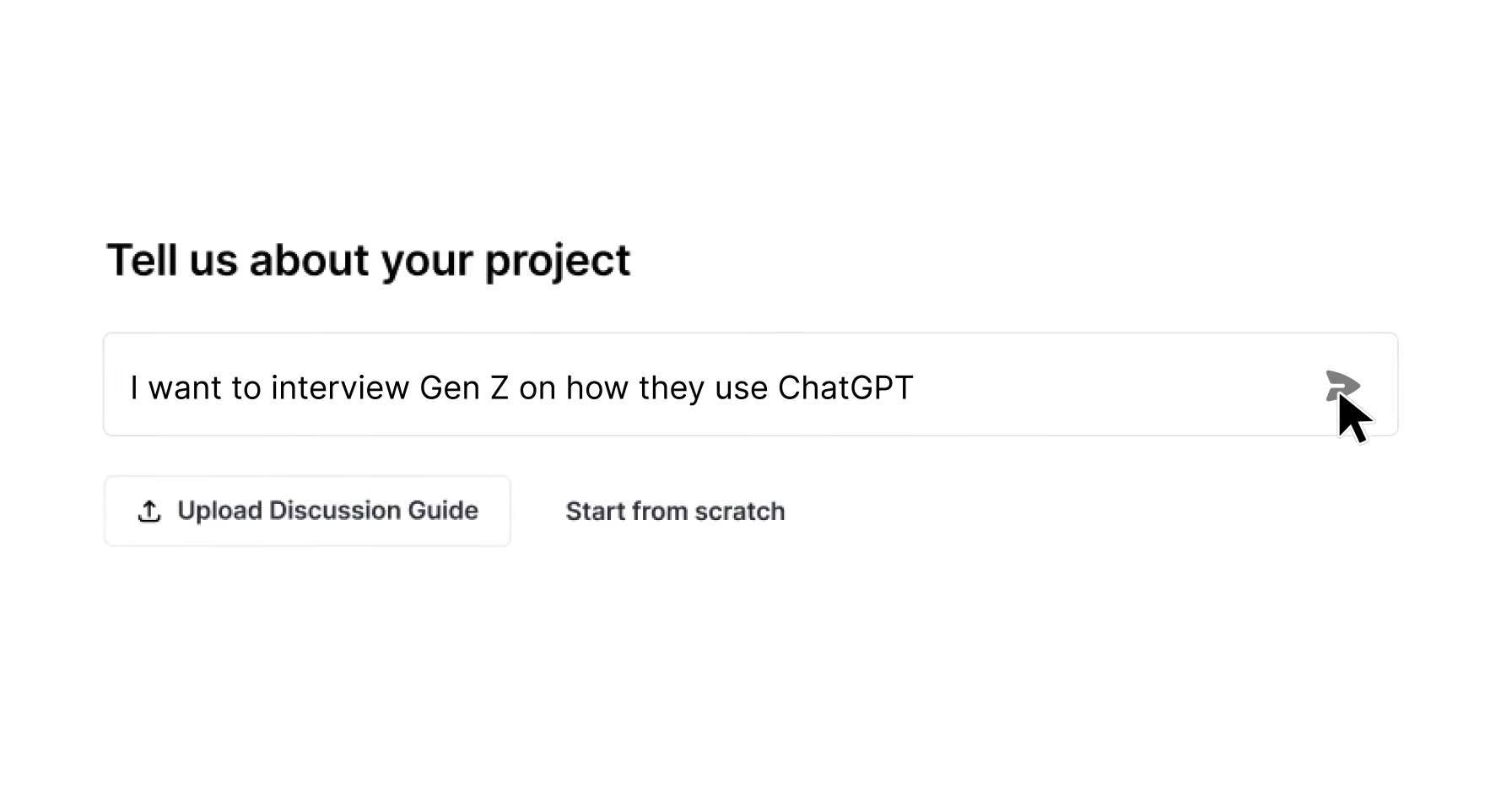
Syndicated report vendors publish pre-built studies on fixed schedules, so buyers receive whatever scope was defined months earlier. Custom qualitative studies using traditional agencies require scoping, proposals, and contracting before fieldwork, and a standard 20-interview in-depth interview project can take several weeks from kickoff to final deliverable. AI-first platforms support natural-language study design, with AI drafting structured objectives and discussion guides in minutes, which removes weeks from the setup phase.
Recruitment
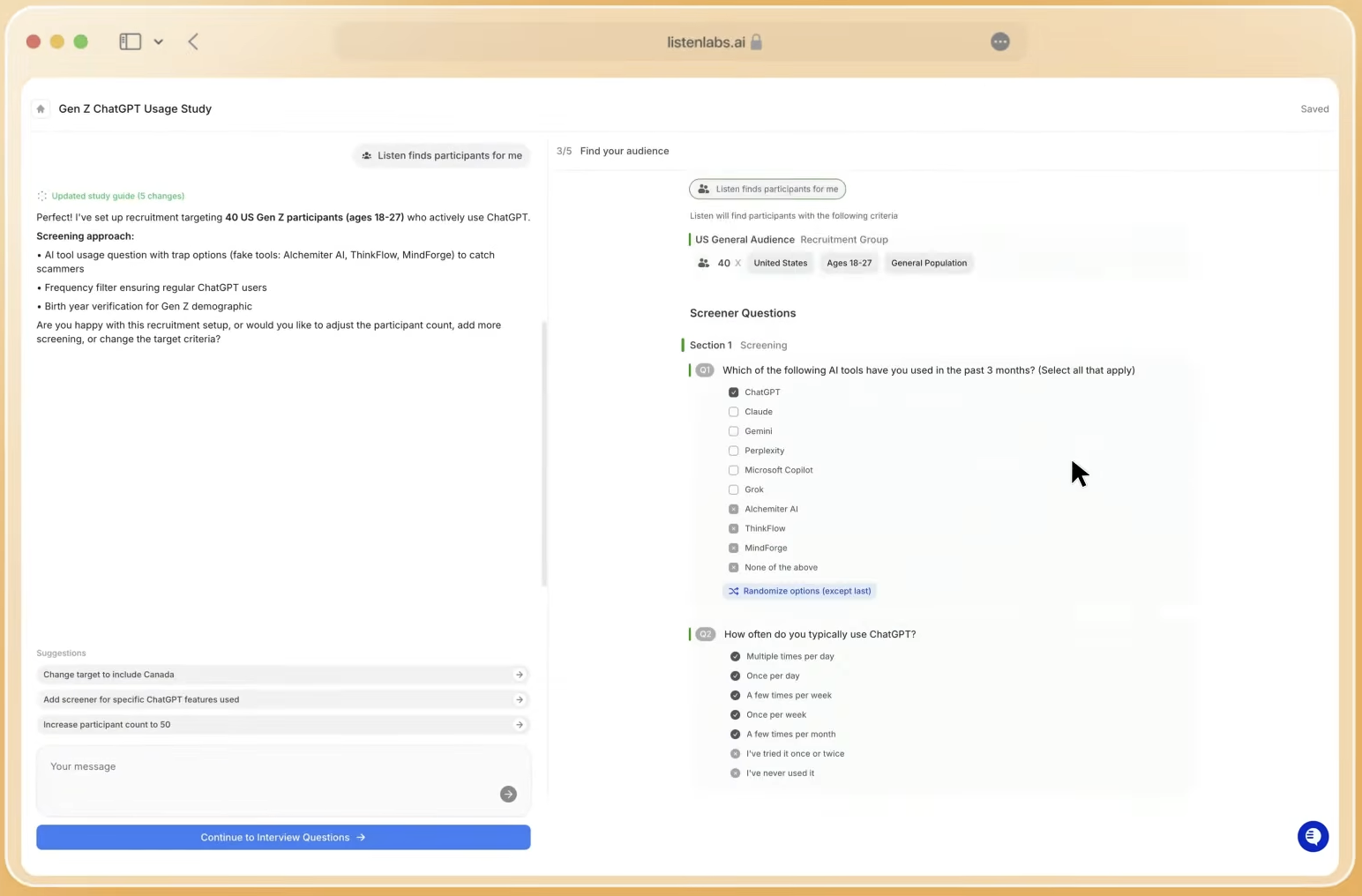
Recruiting niche or senior B2B audiences can increase screening costs on traditional projects, especially for highly targeted segments. Syndicated vendors usually draw on proprietary analyst networks instead of consumer panels. AI platforms with integrated recruitment infrastructure, such as Listen Labs with its 30M verified respondent network across 45+ countries, automate participant matching and sourcing, including hard-to-reach segments, without separate vendor contracts.
Moderation
Human moderators introduce variability because quality depends on individual skill, availability, and consistency across markets. AI-moderated interviews apply the same probing logic to every participant at once, which scales to hundreds of parallel conversations without scheduling constraints or no-show risk.
Data Quality
Commodity panels carry fraud risk from professional survey-takers and incentive-driven responses. Specialist syndicated firms reduce this risk through analyst-curated data, although consumer-level primary data rarely appears in their outputs. AI platforms with real-time quality controls that monitor video, voice, content, and device signals address fraud at the point of collection instead of relying on post-processing.
Qualitative vs. Quantitative Balance
Syndicated reports remain predominantly quantitative. Traditional qualitative studies provide rich insight but at small scale. AI-moderated platforms remove this trade-off by running hundreds of adaptive, conversational interviews at once, which combines large-sample confidence with the motivational depth of one-on-one interviews.
Analysis Workflow
Manual transcript coding for a 20-interview qualitative study requires substantial analyst time plus additional hours for thematic synthesis. AI analysis engines process all interview data in parallel, identify patterns and themes across hundreds of responses, and reduce both timeline and bias risk compared with manual coding.
Deliverable Creation
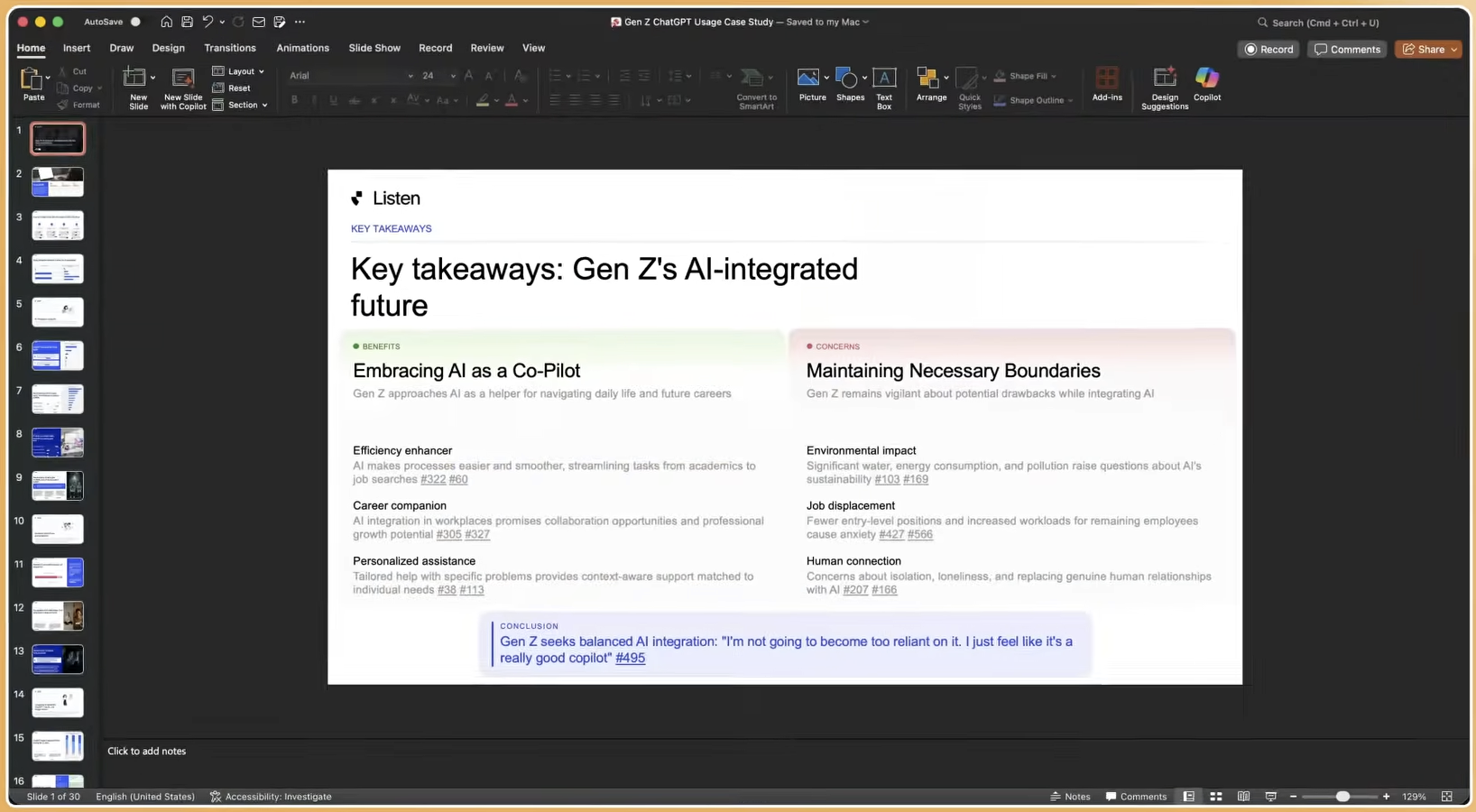
Traditional agencies produce reports on fixed timelines and often need several revision rounds. AI platforms generate slide decks, memos, video highlight reels, and statistical charts in under a minute from completed interview data, with full traceability from each finding to the source verbatim.
When AI Interview Platforms Beat Syndicated Reports for Telecom Questions
Syndicated reports answer questions about market size, vendor share, and infrastructure forecasts. They do not explain why a specific consumer segment churns, how enterprise buyers perceive a new private 5G proposition, or which messaging triggers real enthusiasm instead of polite agreement.
Those questions require primary consumer interviews, and the speed, scale, and depth that Listen Labs provides change what telecom insights teams can support in a typical quarter.
With many consumers feeling no loyalty to their telecom provider and only 47% of consumers remaining with their primary operator for more than five years, teams must treat emotional and behavioral drivers of loyalty as a continuous operational input, not a quarterly project. Listen Labs addresses this through an integrated research infrastructure that removes traditional bottlenecks.
- Participant access: 30M verified respondents across 45+ countries, with AI orchestration that matches participants on behavioral and intent signals instead of self-reported demographics alone.
- Geographic reach: Support for more than 100 languages in interview moderation, which enables simultaneous multi-market studies without separate vendors per region.
- Speed: Same-day turnaround from study brief to findings, compared with four to eight weeks for traditional qualitative projects.
- Depth of insight: An Emotional Intelligence layer based on Ekman’s universal emotions framework that analyzes tone of voice, word choice, and micro-expressions to reveal what participants feel, not only what they say, which matters for creative testing, concept comparison, and churn research.
- Analysis and reporting: A Research Agent that produces consultant-quality slide decks, memos, highlight reels, and segmentation breakdowns through natural-language queries, with every finding traceable to the source timestamp and verbatim quote.
In the context of 2026 telecom priorities, where 89% of operators plan to increase AI spending and autonomous networks rank as the top ROI use case, teams need consumer understanding of AI-native service propositions, 5G Standalone value perception, and private network adoption barriers at the speed of product decisions.
Schedule a consultation to see how Listen Labs runs telecom consumer interviews at scale, from 5G churn drivers to private network adoption, in hours instead of weeks.
Best-Fit Use Cases by Telecom Role
Different teams inside and around telecom operators face distinct research questions, yet they share the need for reliable consumer insight.
- Enterprise consumer insights leaders running continuous churn, loyalty, and brand perception programs benefit from Listen Labs repeatability and the Mission Control cross-study knowledge base, which prevents re-running the same questions every quarter.
- UX and product teams validating 5G service interfaces, app flows, or device onboarding experiences need fast feedback from 50 to 100 or more participants instead of the 5 to 10 typical of traditional usability studies.
- Agencies and consultancies conducting due diligence on telecom market entries or operator strategy shifts require niche audience access, such as enterprise decision-makers, network engineers, and procurement leads, delivered within client timelines measured in days.
- Investors assessing private 5G or infrastructure plays need rapid primary consumer and enterprise buyer validation that complements infrastructure forecasts from ABI Research or Dell’Oro Group.
- Syndicated report vendors remain the right choice when the question involves infrastructure capex sizing, vendor market share, or technology adoption curve forecasting that depends on longitudinal analyst-curated data.
Operational Requirements: Compliance, Change Management, and Repeatable Learning
Enterprise procurement teams must confirm security and compliance posture before approving any primary research platform. Listen Labs holds SOC 2 Type II, GDPR, ISO 27001, ISO 27701, and ISO 42001 certifications. Customer data never trains AI models, and all data uses 256-bit encryption. Enterprise SSO supports centralized identity management.
Platform-based research also introduces structural advantages in repeatability. Each study that runs through Listen Labs expands the Mission Control knowledge base, which enables cross-study queries, trend tracking over time, and institutional memory that survives team turnover. For telecom operators running continuous loyalty, brand, and product research, this compounding knowledge base replaces the fragmented report archive common in traditional research operations.
Risks and Limitations Across Research Options
Every research approach carries limitations that buyers should weigh against their specific telecom decisions.
- Syndicated reports risk shallow consumer data: Infrastructure forecasts from specialist firms are rigorous, but consumer motivation and emotional response to telecom propositions rarely appear at the depth needed for product or messaging decisions.
- Traditional qualitative studies risk slow turnaround: Complex projects can take several weeks or longer, which makes them a poor fit for decisions tied to product launch or campaign timelines.
- Hidden recruitment complexity: Recruitment and screening represent a significant portion of a qualitative project budget, and niche B2B audiences multiply that cost. Platforms without integrated recruitment shift this complexity and spend to the buyer.
- Fraud risk in commodity panels: Professional survey-takers and incentive-driven respondents undermine data quality, and platforms without real-time behavioral monitoring and participation limits cannot guarantee sample integrity.
- Overestimating automation: AI moderation handles adaptive probing and scale, yet strong study design still requires methodological expertise. Platforms built without in-house research experience may produce technically functional but methodologically weak studies.
Decision Framework and Vendor Checklist for Telecom Teams
Teams should match the research approach to the specific question, timeline, budget, and internal capability profile.
- Use a specialized syndicated firm such as ABI Research, Dell’Oro Group, Omdia, or Analysys Mason when the question involves infrastructure market sizing, vendor share, technology adoption curves, or regulatory landscape and when a scheduled published report fits the decision window.
- Use a generalist primary research firm such as Escalent, Kantar, or Ipsos when the question requires large-scale quantitative consumer tracking across multiple markets and the team can work with a four to eight week timeline.
- Use Listen Labs when the question focuses on why consumers behave as they do, including churn drivers, 5G value perception, private network adoption barriers, concept reactions, and brand sentiment, and when the decision timeline is measured in days. Listen Labs also fits recurring research programs that must repeat across quarters without proportional cost increases, or multi-market projects that require coverage in more than 100 languages within a single study.
Before finalizing any vendor selection, telecom leaders should confirm answers to a short checklist.
- Can the provider explain exactly how they collected their data and how each finding traces to source responses?
- What fraud controls operate at the point of data collection instead of only in post-processing?
- Can the platform scale the same study design across multiple markets at once without separate vendor engagements?
- What certifications cover data privacy, information security, and AI governance?
- What is the all-in cost across recruitment, moderation, analysis, and reporting, not only the headline fee?
Frequently Asked Questions
How quickly can Listen Labs deliver consumer interview findings for a telecom study?
Listen Labs compresses the entire research cycle, including study design, participant recruitment, AI-moderated interviews, analysis, and deliverable generation, to less than 24 hours. Traditional qualitative studies with human moderators typically take four to eight weeks from kickoff to final report, and complex multi-market projects can extend to twelve weeks. For telecom teams making decisions tied to product launches, campaign timelines, or quarterly planning, the difference between hours and weeks changes what they can test.
How does Listen Labs source and verify participants for telecom consumer research?
Listen Labs operates the global respondent network described earlier, with Listen Atlas matching participants on behavioral and intent data instead of demographics alone. Quality Guard monitors every interview in real time across video, voice, content, and device signals to detect fraud, low-effort responses, and mismatched profiles. Participants can join only three studies per month, which prevents panel fatigue and discourages professional survey-takers. A dedicated recruitment operations team manages hard-to-reach segments such as enterprise decision-makers, network engineers, and procurement leads, including audiences below 1% incidence rate. Organizations can also bring their own participants from existing customer lists.
Can Listen Labs conduct telecom consumer research across multiple languages and markets simultaneously?
Yes. The platform supports more than 100 languages for interview moderation, with automatic translation and transcription across all supported languages. Multi-market studies run in parallel instead of sequentially, so a five-market study does not take five times as long as a single-market study. This structure suits telecom operators assessing 5G consumer perception or private network adoption across Asia Pacific, Europe, and North America within one research cycle.
What security and compliance certifications does Listen Labs hold?
Listen Labs holds SOC 2 Type II, GDPR, ISO 27001, ISO 27701, and ISO 42001 certifications. All data uses 256-bit encryption, and customer data never trains AI models. Enterprise SSO is supported. These certifications cover data privacy, information security management, privacy information management, and AI management systems that enterprise telecom procurement and legal teams expect.
What deliverables does Listen Labs produce from a completed consumer interview study?
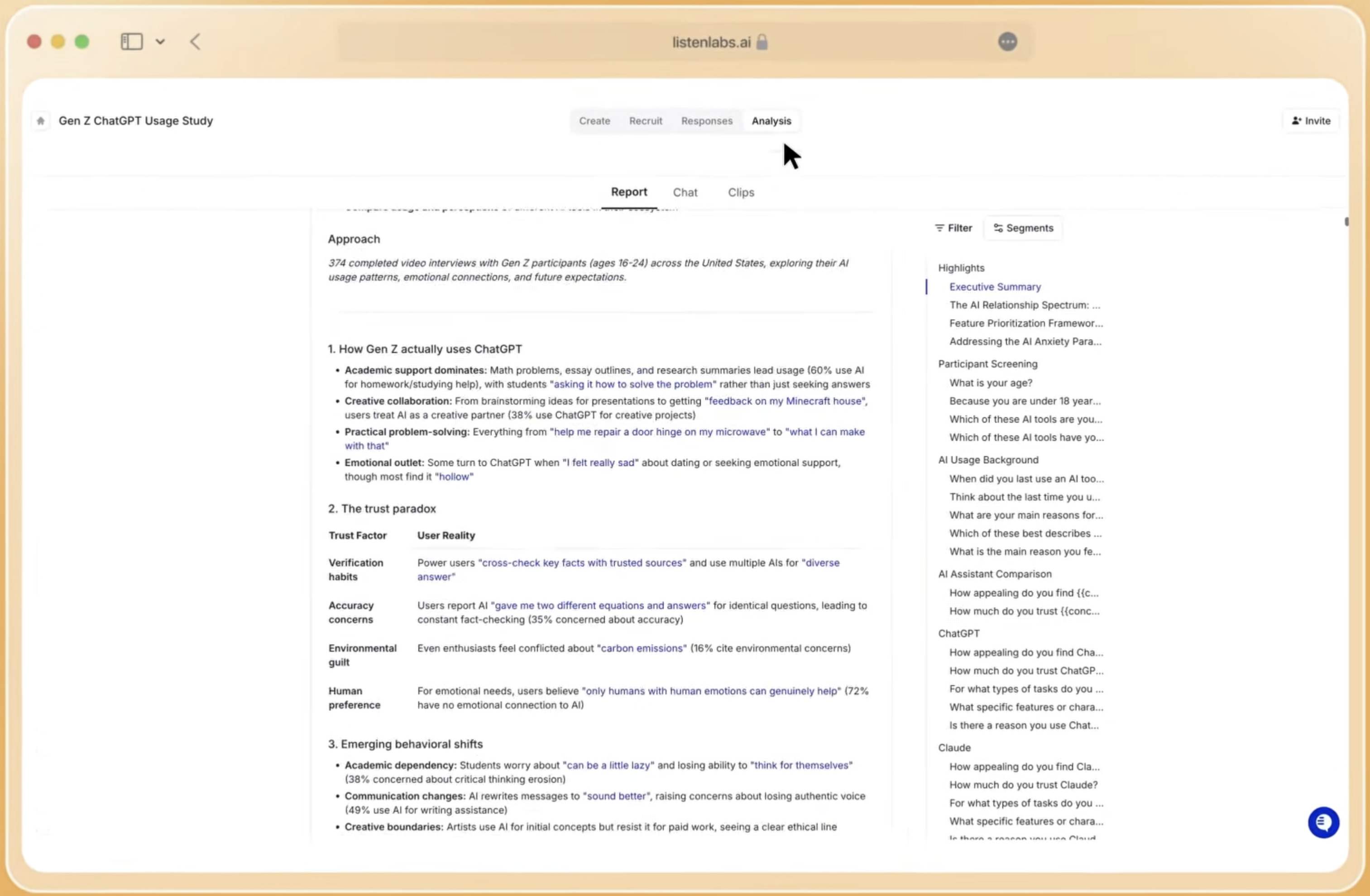
The Research Agent generates consultant-quality PowerPoint slide decks, memo-style reports, video highlight reels, statistical charts, segmentation breakdowns, and custom outputs based on natural-language queries in under a minute from completed interview data. Every finding is traceable to the source timestamp, verbatim quote, and the reasoning behind any AI-generated label, including emotional signals captured through the Emotional Intelligence layer. Mission Control stores all outputs in a searchable knowledge base, which enables cross-study queries and trend tracking without digging through archived reports.
Conclusion: Aligning Research Choices with 2026 Telecom Priorities
The top telecom market research companies in 2026 serve distinct and mostly non-overlapping needs. Specialized syndicated firms such as ABI Research, Dell’Oro Group, Omdia, Analysys Mason, and CCS Insight provide infrastructure forecasts, vendor benchmarks, and technology adoption data that telecom strategy and procurement teams rely on for capital planning and competitive positioning. Primary consumer research platforms do not replace those outputs, and teams should not evaluate them on identical criteria.
The gap that syndicated reports cannot fill involves consumer understanding at speed and scale. With notable churn rates and the potential for loyalty programs to reduce churn, the commercial value of understanding why consumers stay, leave, or switch is measurable. With the private cellular market experiencing strong growth and enterprise buyers evaluating unfamiliar propositions, teams that can run rapid concept and adoption research across markets gain a clear competitive edge.
Listen Labs delivers enterprise-grade consumer interviews with verified participants, AI moderation, emotional signal capture, and consultant-quality deliverables in hours instead of weeks, at a fraction of traditional qualitative research cost. Microsoft, Google, P&G, and Anthropic already rely on the platform for the research volume and speed that 2026 telecom priorities demand.
Get started with a demo to see how Listen Labs can run your next telecom consumer interview study on 5G adoption, churn drivers, private network perception, or brand loyalty and deliver findings before your next stakeholder meeting.