
Written by: Anish Rao, Head of Growth, Listen Labs
Key Takeaways for 2026 Research Budgets
- Financial services consumer insight projects in 2026 typically range from $15,000 to $80,000+ under traditional agency delivery, driven by specialized moderation, compliance screening, and premiums for hard-to-reach audiences.
- Costs shift meaningfully by study type. Concept testing often starts near $15,000, while complex multi-market localization can reach $225,000 as scope and localization needs expand.
- Audience difficulty drives the largest pricing swings. High-net-worth individuals, RIAs, and bank executives require specialized verification and longer fieldwork, which raises recruitment and incentive costs.
- Traditional research stacks manual costs at every step, including moderation, recruitment, incentives, transcription, and analysis. Compliance and legal review add another layer of expense for regulated financial services work.
- Listen Labs delivers comparable qualitative depth at roughly one-third of traditional agency costs while turning complete studies around in under 24 hours. See how AI-moderated research changes your financial services insights program.
2026 Cost Ranges by Study Type and Complexity
Traditional agency pricing in 2026 scales with study complexity, audience difficulty, and the number of markets covered. The table below highlights how costs rise as interviews increase and localization requirements stack across markets.
Use these ranges as a planning benchmark. Smaller single-market concept tests sit at the low end, while multi-market localization work can cost 5–10 times more because each country adds recruitment, moderation, and translation overhead.
| Study Type | Low | Mid | High |
|---|---|---|---|
| Concept Testing (30 interviews) | $15,000 | $20,000 | $24,000 |
| Pricing Sensitivity / Van Westendorp (40 interviews) | $20,000 | $26,000 | $32,000 |
| Brand Perception / Competitive Positioning (80 interviews) | $40,000 | $52,000 | $64,000 |
| Churn Diagnosis (40 interviews) | $20,000 | $26,000 | $32,000 |
| Digital UX / Usability (50 interviews) | $25,000 | $32,000 | $40,000 |
| Segmentation / Comprehensive Satisfaction (100 interviews) | $50,000 | $65,000 | $80,000 |
| Multi-Market Localization (5 markets, 30 interviews each) | $75,000 | $150,000 | $225,000 |
For B2B financial services work that targets senior decision-makers across several markets with mixed methods, total project costs routinely exceed $100,000. A mixed-method engagement that combines 20 in-depth interviews across two markets with a 200-response survey typically runs $60,000 to $120,000+.
Ready to compare these ranges with AI delivery? Get a side-by-side cost estimate for your next financial services study.
Audience and Methodology Cost Drivers in Financial Services
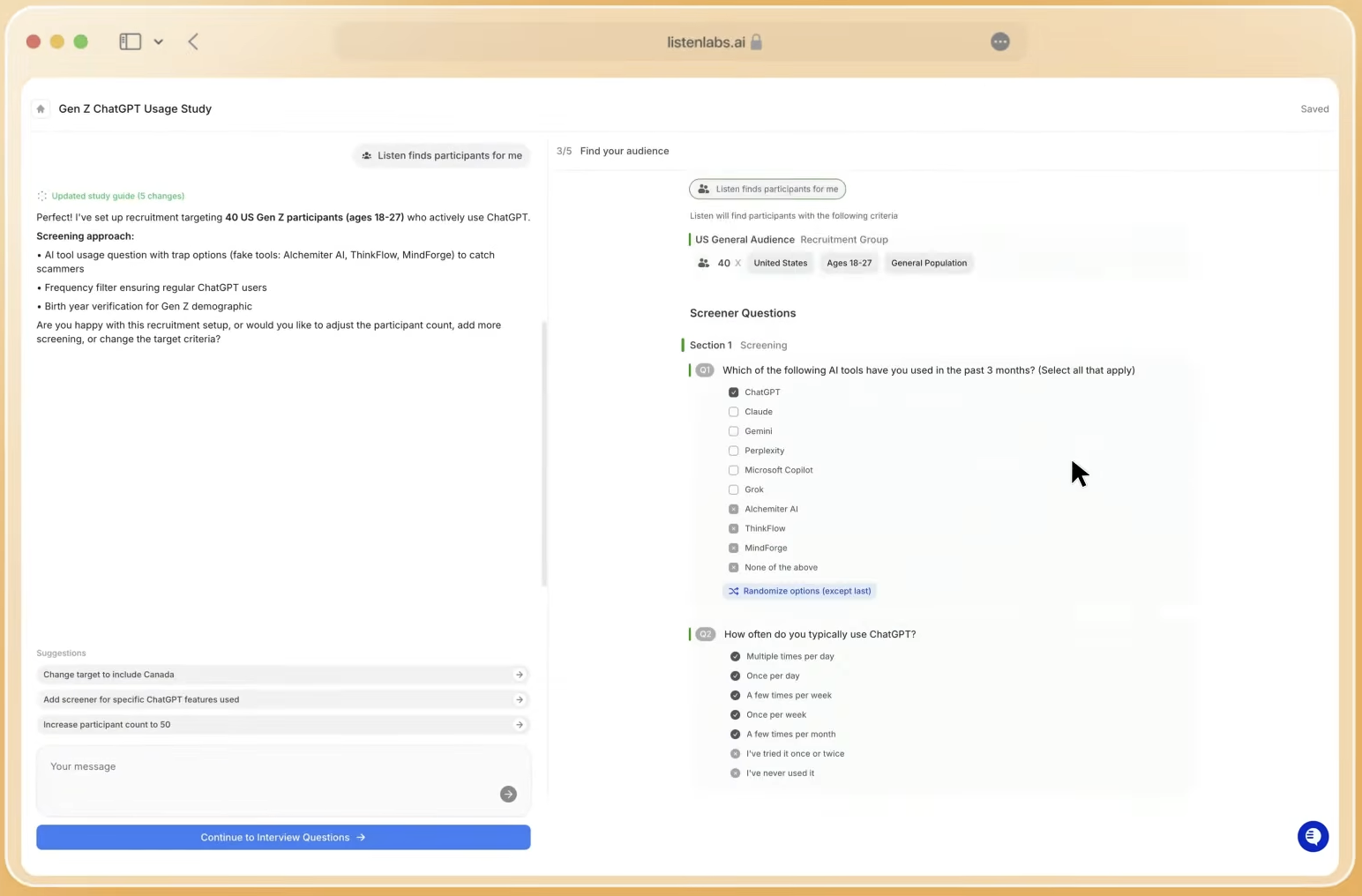
Audience difficulty shapes both recruitment and incentive costs more than any other factor. Screening that goes beyond demographics into product usage, account types, and compliance requirements raises recruitment effort compared with general consumer studies.
Incentive benchmarks reflect this gradient directly. Retail banking customers often receive $20–$50 per 30-minute interview, wealth management mass-affluent participants $50–$100, high-net-worth individuals $100–$250, and B2B financial decision-makers $100–$200.
Registered Investment Advisors, bank C-suite leaders, and fintech executives qualify as hard-to-reach audiences because genuine qualification cannot rely on self-reporting alone and requires verification of professional credentials. Specialist recruitment for these groups often runs for several weeks, while consumer panel fielding can finish in a few days.
Geography and language add another layer of cost. A four-to-six market traditional qualitative study typically costs $30,000–$80,000 total (or $120,000–$250,000 for four markets with 16 in-person groups), because each market needs its own local recruitment partners, native-language moderators, and translation support. Fast-turnaround requirements amplify these premiums further, and short timelines for senior audiences require higher incentives, more intensive recruitment, and greater fieldwork risk. These audience-specific premiums compound the baseline cost structure that sits under traditional research delivery.
Why Traditional Research Costs So Much in Financial Services
Traditional financial services consumer insight studies carry high price tags because costs stack across every step of a manual workflow. Each project pays separately for moderator time, recruitment, incentives, transcription, analysis, and reporting.
Each of these steps also requires coordination among the client, research team, recruitment firm, and analysis team. That coordination creates project management overhead that often adds 15–25% to the direct cost of execution.
Financial services specialization adds another premium over general market research rates due to domain expertise and compliance requirements. This specialization shows up in two ways. Experienced human moderators with financial services fluency command higher hourly rates, and compliance overhead requires legal teams to approve vendor data handling, consent forms, and interview guides, which adds both time and cost for new vendor relationships.
Manual transcript coding for qualitative work consumes substantial analyst time. Teams must code responses, build thematic frameworks, and synthesize findings into executive-ready outputs. These costs are structural and do not fall meaningfully with volume under traditional agency models.
AI Platforms vs. Traditional Agencies: Cost and Speed Tradeoffs
Traditional research agencies charge $15,000–$40,000 for a small qualitative project and up to six figures for multi-market studies, with timelines of 4–12 weeks from brief to final report. Listen Labs delivers comparable qualitative depth at roughly one-third of those costs while compressing the full research lifecycle to under 24 hours.
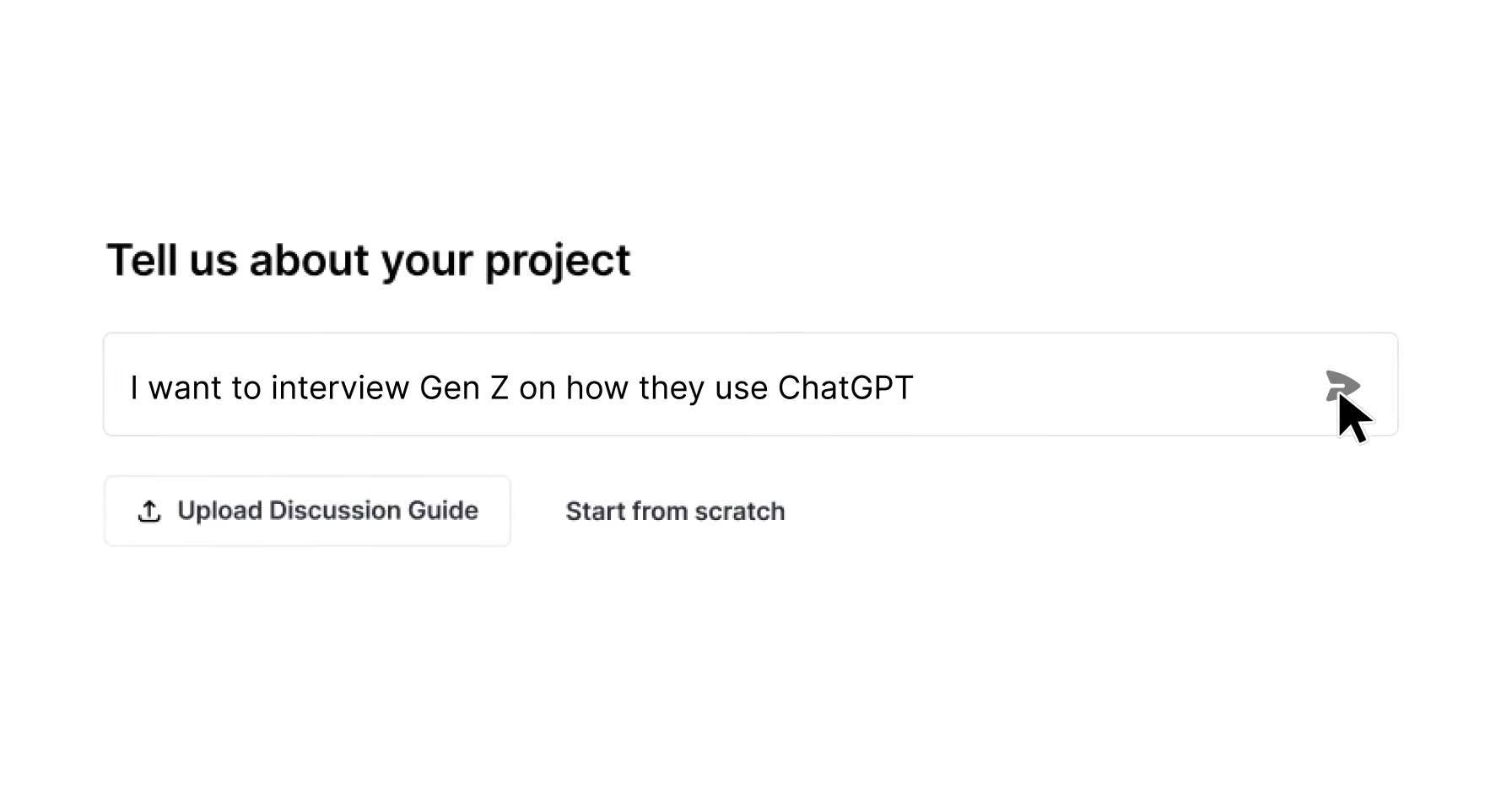
The cost gap becomes most visible when teams run multiple studies each year. A mid-market bank that relies on agencies for recurring research absorbs far higher annual spend than a comparable AI-moderated program. Wealth management firms see an even steeper difference when they maintain continuous coverage of affluent and high-net-worth clients.
Listen Labs sources participants from a verified network of 30 million respondents across 45+ countries and 100+ languages. Its AI moderation applies consistent adaptive probing to every participant and uses Emotional Intelligence analysis, built on Ekman’s universal emotions framework, to capture tone, word choice, and micro-expressions that transcripts alone miss. Full-service agency projects often cost $25,000-$100,000+ each with 6–8 week timelines, while Listen Labs’ Research Agent generates consultant-quality slide decks, memos, and charts in under one minute.
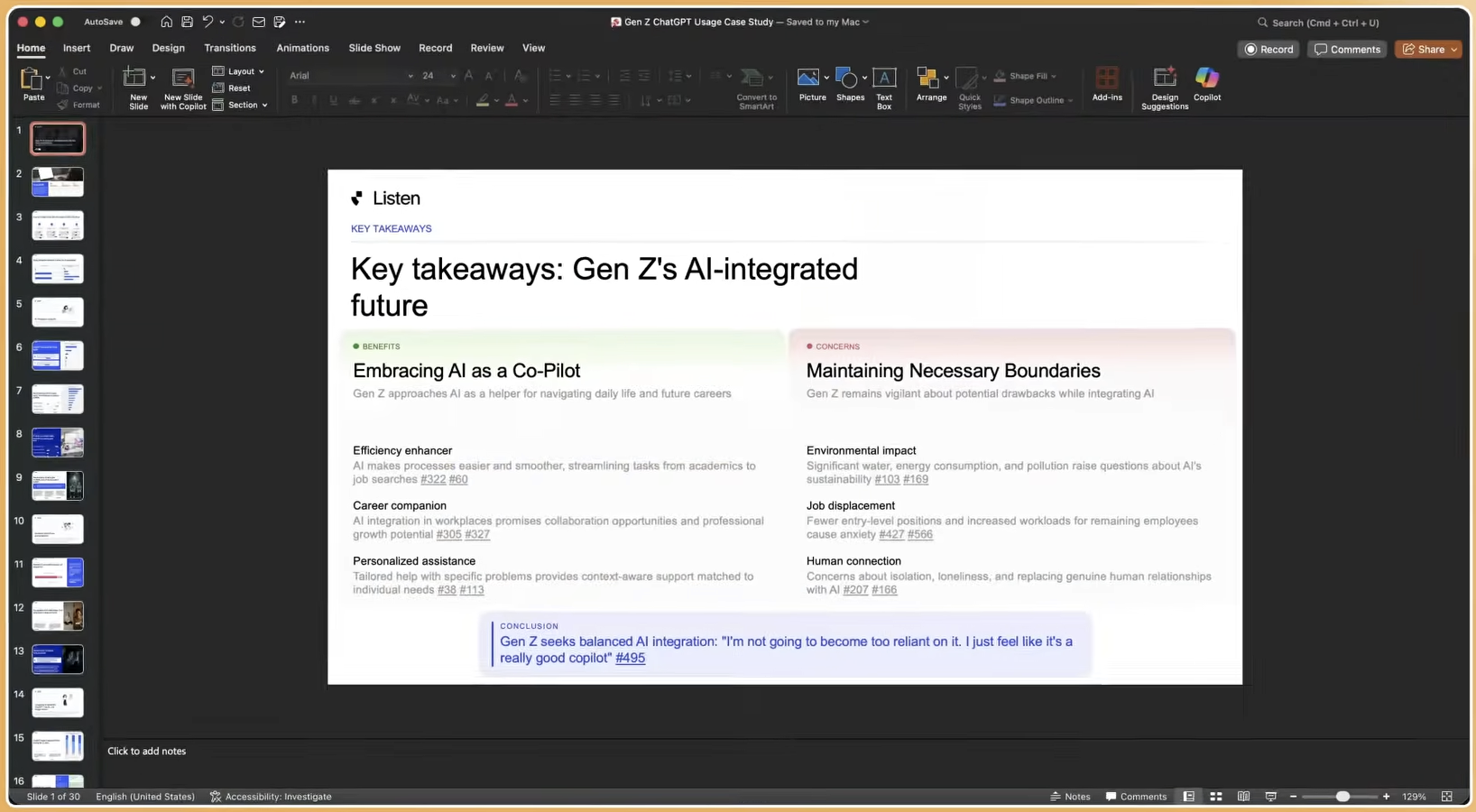
Anthropic used Listen Labs to complete 300+ user interviews in 48 hours, surfacing churn drivers roughly five times faster than traditional methods.
See how Listen Labs delivers financial services insights with the cost and speed advantages described above.
ROI Calculator Framework for Research Leaders
Cost per completed interview and cost per actionable insight provide a clear way to compare platforms with agencies. Under traditional delivery, fully loaded costs per interview sit far higher than on AI platforms.
On an AI-moderated platform, that figure can drop to approximately $1–$12 per interview before participant incentives. This shift changes how often teams can run studies without expanding budget.
For a churn diagnosis study that requires 40 interviews, traditional agency costs are substantial, while the same study on an AI-moderated platform costs significantly less. That per-project savings compounds when research velocity increases. A traditional study that delivers findings in six weeks can produce insights that feel stale, while a 24-hour cycle enables decisions within the same business week.
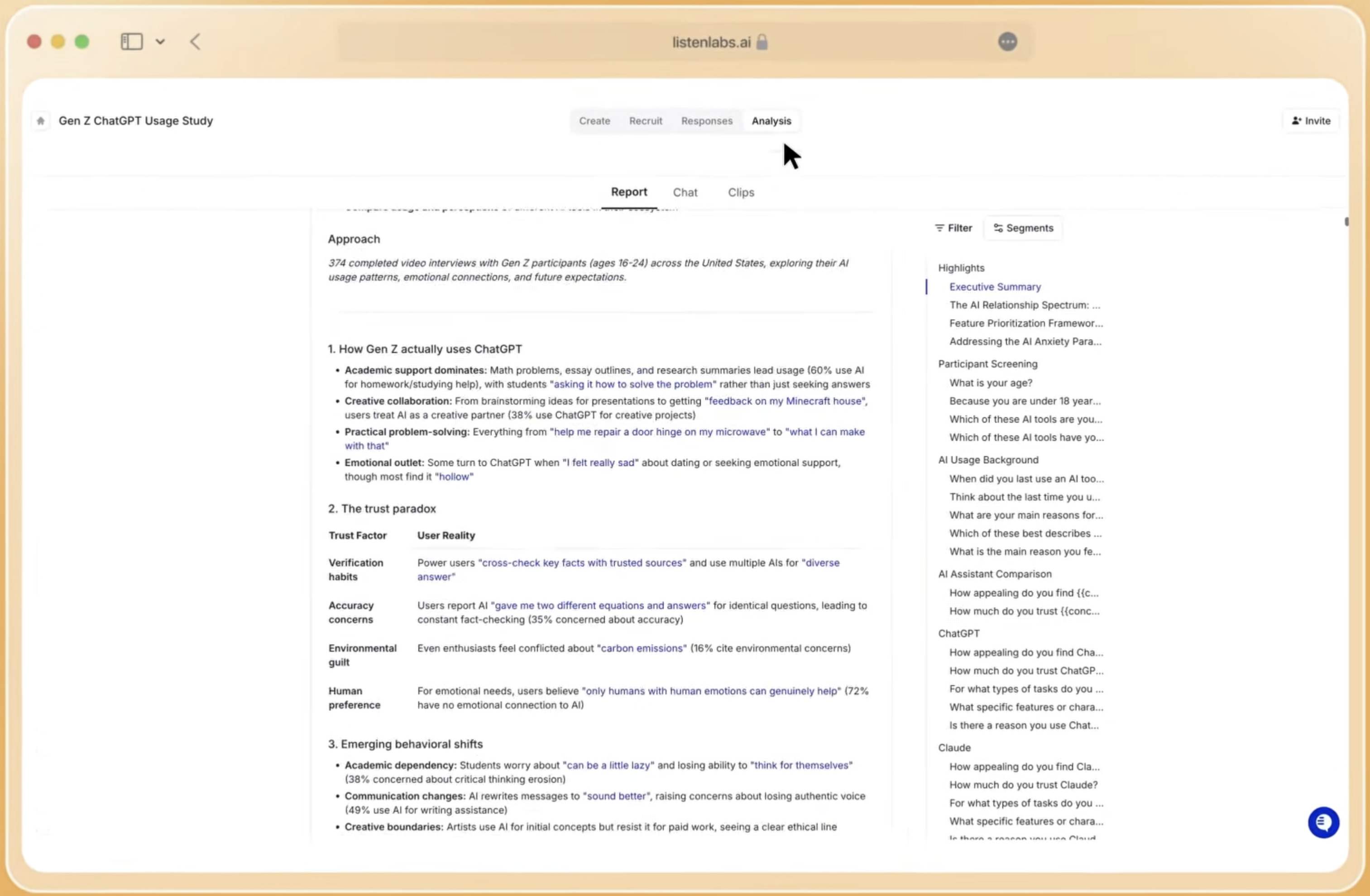
For teams that run four studies per year, this dual advantage of lower cost per study and faster turnaround reshapes research economics. The budget that once covered four traditional projects can now fund a continuous insight program with broader sample sizes and more frequent pulse checks.
ChatGPT and Claude Limits vs. Listen Labs’ Proprietary Data
General-purpose large language models such as ChatGPT and Claude help with tasks like drafting discussion guides or summarizing transcripts, yet they lack the proprietary data infrastructure that makes AI-moderated research reliable at scale. Listen Labs builds on tens of thousands of completed studies, which gives the platform a tested view of which question types drive better analysis, which methodologies fit which objectives, and how to separate signal from noise in financial services specifically.
General LLMs also touch only one slice of the research lifecycle. They do not recruit verified participants, conduct adaptive video interviews, apply real-time fraud detection, or generate statistically grounded deliverables. Listen Labs’ Quality Guard monitors every interview in real time across video, voice, content, and device signals to detect fraudulent responses, low-effort answers, and repeat respondents, which no general-purpose LLM currently provides.
The platform’s recruitment flywheel compounds this advantage. Every study feeds a reputation-scoring system that strengthens audience quality over time, creating a moat that general AI tools cannot match. S&P 500 companies spend tens of billions of dollars annually on consumer polling. The key decision now centers on whether the infrastructure delivering those insights is purpose-built for research rigor or repurposed from general AI.
Decision Framework for Choosing Your Research Model
The choice between traditional agencies and an AI-moderated platform maps directly to three variables: study urgency, audience difficulty, and budget constraints. Studies that must land within days rather than weeks, or that require more than 30 interviews, generally favor AI platforms on both cost and speed.
Studies that target ultra-niche audiences below 1% incidence, such as bank C-suite leaders or RIAs at specific AUM thresholds, benefit from Listen Labs’ dedicated recruitment operations team. That team sources these segments through professional associations and curated networks rather than commodity panels.
Budget-constrained teams that run more than two studies per year often find that traditional per-project agency fees of $15,000–$80,000+ make continuous consumer insight programs unrealistic. Listen Labs’ subscription model supports always-on research at a fraction of that annual spend.
Traditional agencies still hold an edge for a narrow set of studies that require embedded regulatory legal review with new vendor onboarding. In those cases, compliance timelines remain fixed regardless of the research platform used.
Frequently Asked Questions
How long does a financial services consumer insight study take on Listen Labs versus a traditional agency?
Listen Labs compresses the full research lifecycle, including study design, participant recruitment, AI-moderated interviews, analysis, and deliverable generation, to under 24 hours. Traditional agencies typically require 4–8 weeks for a standard qualitative study and up to 8–12 weeks for multi-market or complex B2B engagements.
In enterprise settings with internal prioritization queues, total elapsed time can stretch to six months before insights reach decision-makers.
How does Listen Labs ensure participant quality for hard-to-reach financial services audiences like HNW individuals, RIAs, or bank C-suite leaders?
Listen Labs applies three layers of quality control to protect sample integrity. First, the platform works only with high-quality, non-commodity panel sources, which avoids professional survey-takers.
Second, Quality Guard monitors every interview in real time across video, voice, content, and device signals to detect fraud, low-effort responses, AI-generated scripts, and mismatched profiles. Participants can join a maximum of three studies per month, which reduces panel fatigue.
Third, a dedicated recruitment operations team manages hard-to-reach segments, including financial executives, wealth managers, and audiences below a 1% incidence rate, through professional associations, curated networks, and multi-channel outreach. Organizations can also self-recruit from their own client or user base at reduced cost.
What does a Van Westendorp pricing sensitivity study cost on Listen Labs compared to a traditional agency?
A traditional agency-delivered pricing sensitivity study with 40 interviews in financial services typically costs $20,000–$32,000, including recruitment, moderation, incentives, transcription, and analysis, with a 4–8 week timeline. On Listen Labs, the equivalent study, with AI-moderated adaptive interviews, automated analysis, and consultant-quality deliverables, is delivered at roughly one-third of that cost in under 24 hours.
The platform supports Van Westendorp, Gabor-Granger, and other pricing methodologies natively, with results segmented by audience cohort and market.
How does Listen Labs handle data security and compliance for financial services clients?
Listen Labs maintains enterprise-grade security with 256-bit encryption, and customer data never trains AI models. The platform holds SOC 2 Type II, GDPR, ISO 27001, ISO 27701, and ISO 42001 certifications, which match the compliance stack required for adoption in regulated financial services environments.
Enterprise SSO is supported. For financial services teams that manage vendor approval processes, Listen Labs’ existing certifications often shorten legal review timelines compared with onboarding a new traditional agency vendor.
Can Listen Labs conduct multi-market financial services research across different languages?
Listen Labs supports 100+ languages for AI-moderated interviews, with automatic translation and transcription across all supported languages. The platform covers 45+ countries across the Americas, Europe, APAC, and MEA.
Multi-market studies run in parallel rather than sequentially, which removes much of the per-market recruitment, local moderator, and translation cost that makes traditional multi-market qualitative research cost $75,000–$225,000 for a five-market study. Deliverables are synthesized across markets in a single Research Agent output, which enables cross-market comparison without extra analyst hours.
See how Listen Labs delivers financial services consumer insights with the speed and cost advantages outlined above.