
Written by: Anish Rao, Head of Growth, Listen Labs
Key Takeaways
- AI continuous brand monitoring tracks how your brand appears in AI-generated answers, while social listening focuses on human posts and comments.
- Key signals include brand presence, share of model versus competitors, sentiment and framing, citation sources, factual accuracy, and emerging narratives.
- Effective programs use buyer-intent prompts organized into category, competitor comparison, use-case, and brand-specific tiers, run on a consistent cadence with multiple observations per prompt.
- Alerting works best with clear thresholds, human review, and routing to the right teams, with responses focused on content or product fixes rather than PR statements.
- Listen Labs connects AI narrative shifts to customer research insights that explain why changes are happening and guide corrective action.
See how Listen Labs closes the loop
Signals Every AI Brand Monitoring Program Should Track
A continuous AI brand monitoring program should track six core signals. Together they show how AI systems perceive and represent your brand.
Brand Presence
Track whether you are mentioned at all for your core category prompts. A shift from present to absent usually means a competitor has published content that now outranks yours in the retrieval corpus, or a new source has entered the model’s citation set. A 2026 AI visibility study of 98 funded B2B SaaS companies found that 48% were not named once by any of four major AI engines tested. Invisibility affects brand health, not just marketing performance.
Share of Model Versus Competitors
Measure how often you appear relative to named rivals when buyers ask for recommendations. A declining share of model typically signals that competitors are earning citations on third-party sources the AI trusts more than your owned pages. An analysis of approximately 500 million citations found that 89% of unbranded prompts are fulfilled by third-party sources rather than brand-owned content, so most of this battle plays out on sites you do not control.
Sentiment and Framing
Watch the language and adjectives attached to your brand. A shift from neutral to caveated framing, such as “X is good for small teams, but…,” often precedes a measurable decline in consideration by months. A 2026 analysis of 1,800 factual and reputational prompts across 240 brands found that 34% of AI brand mentions carried neutral or negative framing, even for brands with strong reputations on their own channels.
Citation and Source Tracking
Identify which pages, reviews, and third-party sites the AI uses when it describes you. A shift toward sources you do not control means your narrative is being shaped by content you did not write and may not have reviewed. 85% of brand mentions in AI answers originate from third-party pages rather than owned domains, and the highest source-citation agreement between any two major AI engines is just 12.7%, so each engine draws from a largely different pool.
Factual Accuracy
Check whether the AI states wrong pricing, wrong features, outdated leadership, or discontinued products as current. Semrush’s May 2026 guide identifies pricing as especially vulnerable to AI error because it changes frequently but persists on old blog posts, comparison pages, and review sites long after it has been updated. Factual errors compound over time as they get scraped into other AI content and future training data.
Emerging Narratives
Track new themes forming before they hit your KPIs. Emerging narratives act as a leading indicator. By the time a tracked metric declines, the underlying shift has often been building for months. A brand dropping from 60% to 40% share of answer on category prompts between two monthly runs is a common early signal of a competitor content push or a new negative source entering the retrieval corpus.
Designing A Representative Prompt Set And Cadence
A strong prompt set mirrors how real buyers search, and a stable cadence turns snapshots into usable trend lines.
Build from actual buyer-intent questions. Your prompt set should mirror how real buyers ask for solutions in your category. Pull language from sales calls, search console queries, comparison and “best X for Y” searches, and “is X good for Z” questions. SEO and AI search consultant Aleyda Solis recommends sourcing real audience language from non-branded search demand, Google Search Console long-tail queries, People Also Ask questions, internal site search, sales calls and CRM notes, support tickets, reviews, and Reddit and niche communities.
Organize prompts into tiers. A defensible prompt set includes four categories:
- Category prompts: Non-branded questions about your product category (“What are the best tools for X?”)
- Competitor comparison prompts: Head-to-head questions (“How does X compare to Y?”)
- Use-case prompts: Problem-oriented questions asked before a buyer knows your brand exists (“What is the best solution for [specific problem]?”)
- Brand-specific reputation prompts: Direct questions about your brand (“Is X good for enterprise?” “What are X’s limitations?”)
Set a defensible cadence. Run a stable core prompt set on a fixed recurring schedule so the trend line stays clean, and add a rotating set of timely prompts covering new campaigns, launches, and competitor moves. Freezing the prompt set for the measurement period, creating a new version when the set changes, and preserving the old baseline keeps visibility trends tied to real shifts rather than test changes.
Protect consistency over volume. Version your prompt set and preserve the old baseline. LLM sentiment is 6.7 times noisier than mention status across resampling, prompt paraphrases, models, and languages, so repeated runs against a frozen prompt set are the only reliable way to separate signal from noise.
Size the prompt set to your business complexity. A single product in a single market may need 30–60 prompts. A multi-product SaaS or services company with multiple personas and competitors may need 100–250. Start with a focused set and expand as you find gaps.
Account for model variance. Because LLM answers have high run-to-run variability, statistically reliable share-of-voice data requires approximately 50 observations per prompt to reach a 90% or greater confidence level. A single snapshot does not qualify as monitoring.
See how Listen Labs connects AI signals to customer insight
Setting Alerting Thresholds And Human Review
Alerting works when you focus on material changes and pair automation with clear human decisions.
Alert on material changes. Set thresholds for:
- Significant drops in brand presence or share of model
- New negative framing or sentiment shifts
- Citation shifts toward sources you do not control
- Factual errors in AI-generated descriptions
Route alerts to a named owner. The owner depends on the signal type, because the team that can fix the problem is rarely the team that first sees the alert. Narrative and sentiment shifts go to Insights, positioning and framing changes go to Brand, factual errors and reputation risks go to Comms, and feature and pricing inaccuracies go to Product.
Require a triage decision within a defined window. Every alert should trigger one of three decisions: ignore, investigate, or act. Document the decision and the rationale to create an audit trail and prevent silent dismissal.
Focus responses on content and product fixes. AI models learn from the web, so you influence them by changing the source material they draw from. Corrections to AI responses can take weeks to months to appear, depending on the platform, update frequency, and how widely the corrected information spreads across the web.
Closing The Loop From Narrative Shift To Research-Backed Fix
Loop closure starts when you detect a narrative shift and trace it back to the sources the AI uses.
Content gap. The correct story does not exist anywhere the model retrieves. Publish authoritative, structured content that answers the question the AI is trying to answer. Brands whose own up-to-date pages were frequently cited by AI models had a 62% lower error rate than brands the model described from memory alone.
Source-quality problem. Third-party pages outrank your own. Correct or displace those sources through outreach, earned coverage, or publishing counter-content that earns citations instead. AI often trusts third-party sources more than official websites because official content is perceived as promotional while third-party content is perceived as independent.
Real product or experience problem. Customers are actually reporting the issue the AI surfaces. The fix is a product or experience change, not a content update.
The only reliable way to know which of these three issues you face, and to produce corrective content, is to ask customers directly at scale and at speed.
Listen Labs provides that path. Listen Labs and Profound published a study of 100 CMOs finding that 90% use large language models daily and 22% now begin vendor research inside an LLM versus 16% using traditional search. Brands that fall short in those AI answers lack a fast route from detection to diagnosis.
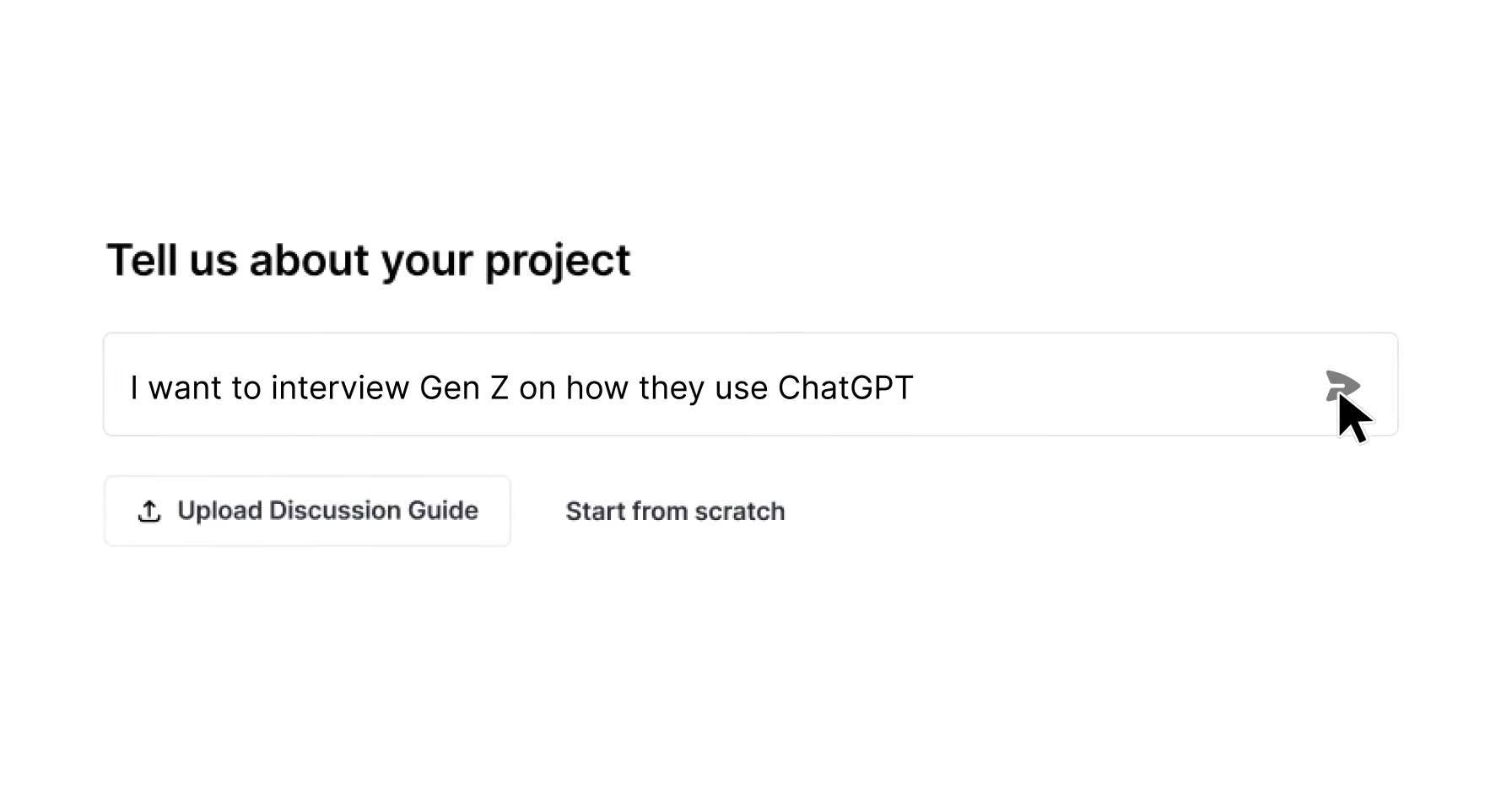
Listen Pulse is the conversational tracker that runs the same study wave after wave, keeps core questions constant to protect the trend line, adds open-ended conversation to every wave, and charts emerging themes next to the KPIs you already report. A metric movement arrives with its explanation in the same wave. One well-known clothing brand, famous for its big logos, was quietly losing customers. Its old tracker caught the drop but could not explain it. Pulse revealed that customers were reacting to style, not price, and felt the big logos were too loud for their changing lifestyles.
Research Library then queries your entire body of past research in natural language with full source attribution. You can check whether a topic has already been studied before commissioning new work and track how sentiment has evolved over time.
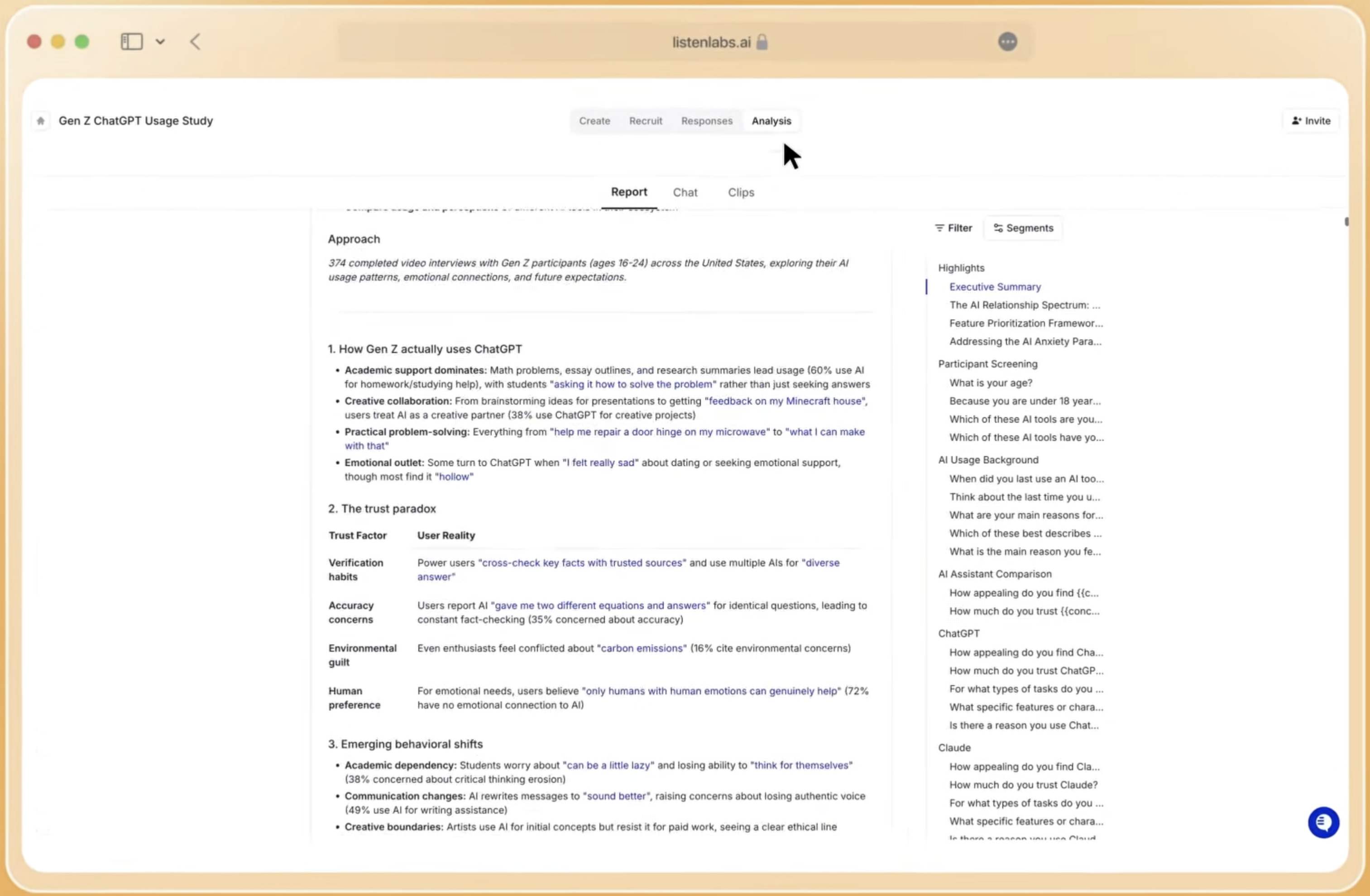
The loop works like this. Monitoring shows that the AI narrative moved. Listen Pulse explains why customers feel that way. Research Library surfaces what you already know.
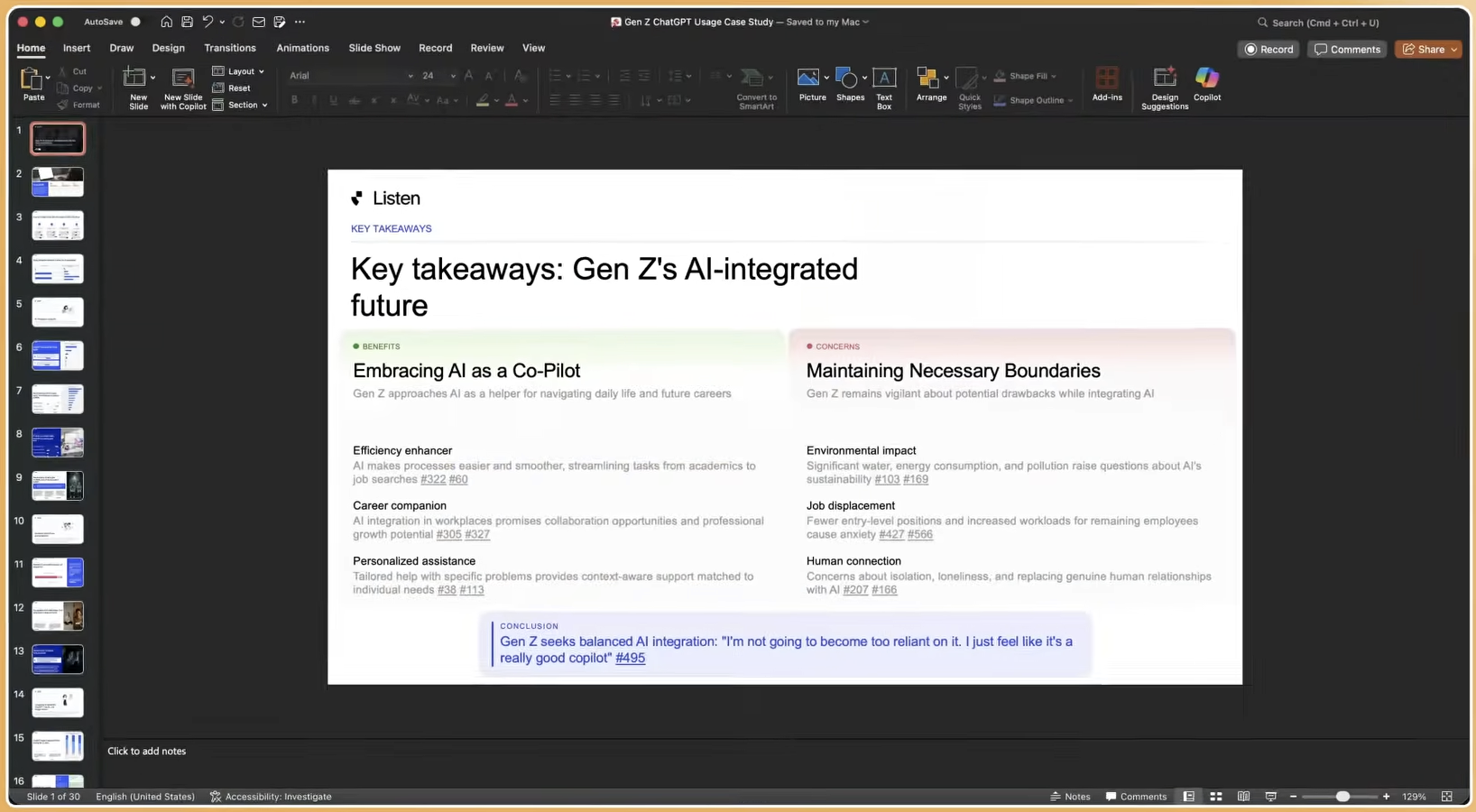
Listen Labs runs the full research lifecycle, from study design and recruitment to AI-moderated interviews, analysis, and deliverables. It draws on a 50M+ verified respondent network across 45+ countries and 120+ languages, and compresses a 4–6 week research cycle to less than 24 hours. Since launch, the platform has conducted over 1 million AI-moderated customer interviews. In January 2026, Listen Labs raised a $69 million Series B led by Ribbit Capital, bringing total funding to $100 million.
Start a continuous AI brand monitoring program
How AI Brand Monitoring Works With Your Existing Tracker
AI-answer monitoring belongs alongside your brand tracker as a complementary signal.
Traditional trackers show that a number moved, while AI monitoring shows how AI now describes you and which sources shaped that story. Bain & Company recommends that brands measure generative engine performance across top personas, categories, and prompts, tracking share of voice, citation frequency, and sentiment trajectory across engines, then connect those signals to customer research that explains them.
Listen Pulse keeps core questions constant to protect the trend line while adding open-ended conversation. The metric change and the reason behind it arrive in the same wave, and every number traces back to a real person’s words and clip. Pulse deploys alongside an existing tracker or as the primary tracking system, and integrates with Qualtrics and Decipher.
Together, AI-answer monitoring and a conversational tracker create a detection-plus-response system that turns brand monitoring from a static dashboard into a program that actively changes what AI says about you.
See the Listen Labs platform in action