Written by: Anish Rao, Head of Growth, Listen Labs | Last updated: July 20, 2026
Key Takeaways for 2026 Enterprise Research Teams
- Enterprise research backlogs have shifted from capacity issues to strategic liabilities, so four-to-six-week qualitative studies no longer match product and brand decision speed.
- AI-moderated studies now remove the old trade-off between depth and scale, running hundreds of adaptive interviews in under 24 hours with full methodological rigor.
- Enterprise teams evaluate AI research assistants across ten dimensions, including cycle time, participant quality, emotional signal analysis, analysis transparency, and enterprise security compliance.
- Specialized end-to-end AI interview platforms outperform traditional agencies, point solutions, and generic AI tools by delivering verified participants, multimodal emotional intelligence, cross-study knowledge retention, and full automation from brief to stakeholder-ready deliverables.
- Listen Labs leads the category with 30 million verified participants across 45+ countries, SOC 2 Type II and multiple ISO certifications, and proven results at Microsoft, Anthropic, and P&G, so you can see how these capabilities map to your team’s specific constraints in a live demo.
How Enterprises Evaluate AI Research Assistants in 2026
A rigorous enterprise evaluation covers ten connected dimensions that together determine whether an AI research assistant can clear backlogs and influence decisions. Research cycle time measures how quickly a study moves from brief to deliverable, which sets the ceiling on how many questions a team can answer each quarter. Qualitative depth at scale then tests whether the platform can run adaptive, probing conversations with hundreds or thousands of participants at once while preserving interview quality. Participant quality and fraud prevention ensure those conversations come from real, verified humans rather than professional survey-takers or synthetic profiles.
Global and multilingual reach matters next for teams running programs across regions, since language coverage and country footprint must expand without degrading interview quality. Emotional signal analysis adds a deeper layer by detecting tone, micro-expressions, and subconscious emotional responses instead of relying only on transcripts. Analysis transparency and bias reduction determine whether AI-generated themes stay traceable to specific quotes and timestamps, which protects credibility with stakeholders.
Deliverable generation evaluates how quickly the platform turns raw interviews into stakeholder-ready outputs that teams can present without heavy editing. Cross-study knowledge retention then shows whether past research becomes a searchable knowledge base that compounds over time. Enterprise security and compliance confirm that certifications, data residency, and contracts match internal risk standards. Total cost of ownership finally brings these factors together by accounting for platform fees, participant costs, and the headcount required to operate the system.
To see how Listen Labs performs against each of these criteria in your context, you can walk through a live evaluation with the team in a tailored demo.
How Traditional Research Agencies Compare on Speed and Scale
Traditional qualitative research agencies bring strong methodology and experienced moderators, yet their operating model no longer matches the pace of 2026 product and brand decisions. A standard qualitative study still takes several weeks end-to-end, and manual recruitment and screening often consume multiple weeks before interviews even begin. A skilled moderator can conduct perhaps 8–10 in-depth interviews per day, so large samples require long timelines or sharply higher costs.
Cost compounds the speed problem. Traditional focus groups run $4,000 to $12,000 per 90-minute session, and full qualitative projects can reach tens of thousands of dollars. For enterprise teams running dozens of studies per year, that math restricts research to only the highest-priority questions and leaves the rest of the backlog untouched. This structural constraint is precisely what AI-native platforms remove.
AI-native platforms compress the same work to under 24 hours. With qual-at-scale, the old trade-off between depth and scale no longer applies, because parallel AI-moderated interviews replace sequential human moderation while preserving adaptive probing.
How Generic AI Knowledge Tools Compare on Participant Quality and Emotional Depth
General-purpose AI tools such as large language model interfaces, survey summarization layers, and analysis-only repositories cover only a narrow slice of the research workflow. They do not source participants, conduct interviews, or apply fraud controls. When an enterprise team feeds transcripts from a commodity panel into a generic AI tool, the quality of the output stays limited by the quality of the input, and commodity panels carry well-documented risks such as professional survey-takers, incentive-driven responses, and mismatched profiles.
Emotional depth represents a second structural gap. Generic AI tools process text, so they cannot analyze tone of voice, detect micro-expressions, or pinpoint the moment a participant’s expression shifts from engagement to confusion. Emotional Intelligence from Listen Labs analyzes three signals, tone of voice, word choice, and subconscious micro-expressions, to surface nuanced emotions that transcripts alone miss. What people say and what people feel form two different data sets, and generic tools capture only one of them.
How Point Solutions Compare on Workflow and Knowledge Retention
Point solutions that cover recruitment, scheduling, moderation, transcription, or analysis in isolation solve individual steps but create integration overhead at every handoff. A team using Prolific for recruitment, a scheduling tool, a video platform, a transcription service, and Dovetail for analysis manages five vendor relationships, five data formats, and five potential failure points per study. Each handoff introduces delay and quality risk.
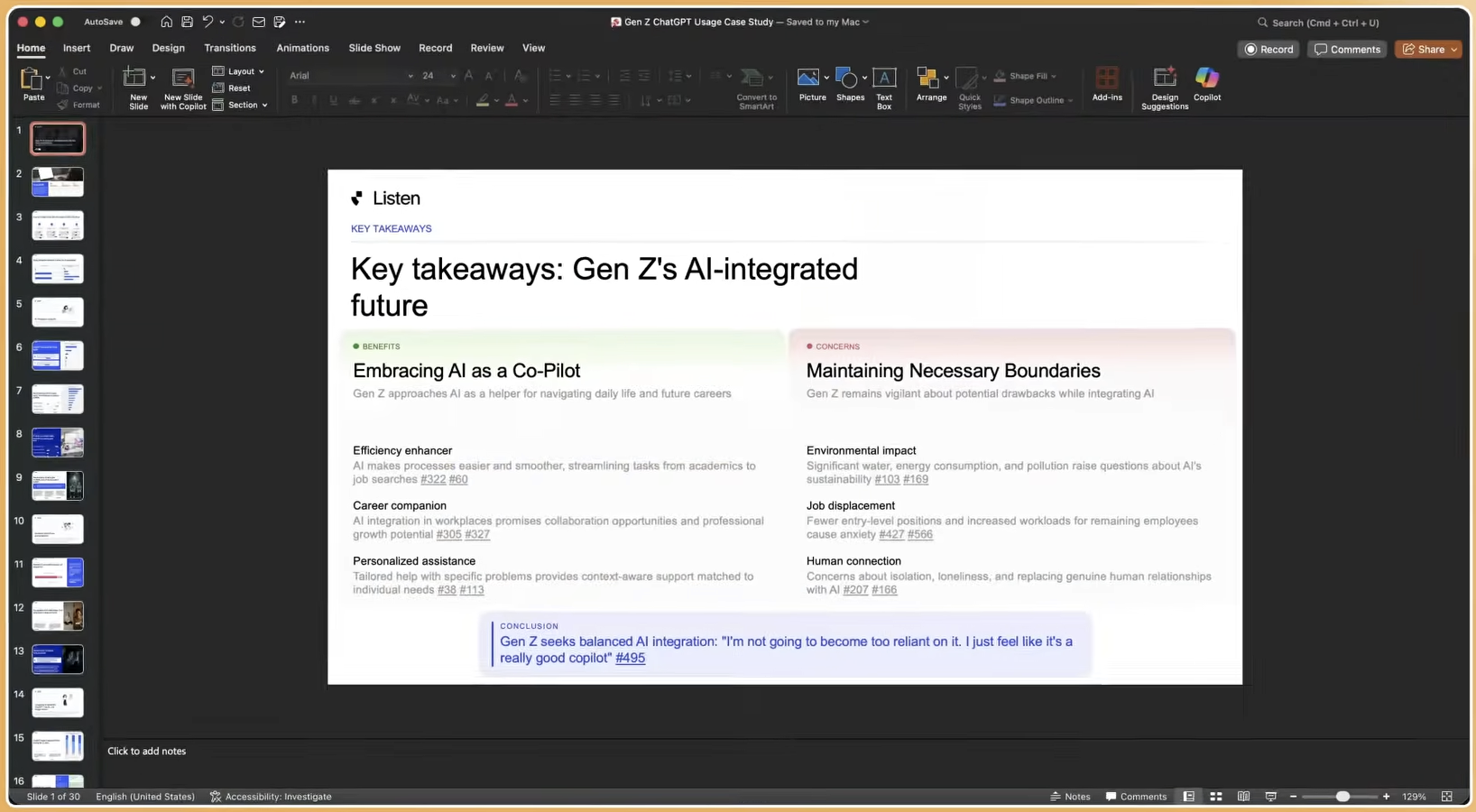
Institutional knowledge suffers most in this fragmented setup. Disconnected tools produce disconnected outputs such as slide decks in shared drives, transcripts in one platform, and themes in another. When a new stakeholder asks what the organization already knows about a customer segment, there is no single place to query, so research gets re-commissioned because past findings are effectively inaccessible. Research Agent from Listen Labs handles the full analysis workflow from raw data to final output, and Mission Control serves as a unified source of truth for everything ever learned from customers, enabling cross-study queries in seconds instead of hours of digging through old reports.
How End-to-End AI Interview Platforms Meet Enterprise Requirements
Purpose-built end-to-end AI interview platforms address the full evaluation list in a single system. Listen Labs leads this category with a verified participant network of 30 million respondents across 45+ countries and 100+ languages, enterprise security certifications including SOC 2 Type II, GDPR, ISO 27001, ISO 27701, and ISO 42001, and a track record with enterprises such as Microsoft, Google, Anthropic, Procter & Gamble, Skims, Robinhood, and Nestlé.
Listen Labs has run over one million AI-powered customer interviews for companies including Microsoft, Perplexity, and Sweetgreen. The platform’s Quality Guard layer applies real-time fraud detection across video, voice, content, and device signals, and participant frequency is capped at three studies per month to eliminate professional survey-takers. Every emotion detected by the Emotional Intelligence layer is quantified per question and concept, with every label traceable to the exact timestamp, verbatim quote, and AI reasoning behind it, and the system is built on Ekman’s universal emotions framework, the same standard used in clinical psychology.
Enterprise proof points from 2026 show how this plays out in practice. Microsoft’s Director of Data Science reports collecting global user video stories within a day, at roughly one third of the previous cost, which changed leadership expectations for research speed. Anthropic’s Director of Product Strategy describes running 300+ interviews in 48 hours and surfacing churn drivers 5x faster than before. Skims’ SVP Data, Insights, Loyalty highlights finally understanding the “why” behind behavior. Robinhood used the platform to identify that users who view prediction markets as entertainment drive 2.4x higher weekly re-engagement, with insights delivered 5x faster than traditional methods.
Best-Fit Recommendations by Team Type
Enterprise consumer insights teams with large backlogs and long stakeholder queues gain the most from an end-to-end platform that compresses cycle time while preserving rigor. The ability to run 250+ interviews with quantified themes and verbatim proof, as P&G did to evaluate product claims before launch, replaces months of agency work with hours of platform output.
UX research groups working inside sprint cycles benefit from AI-moderated usability testing with screen sharing, mobile recording, and parallel sessions that remove scheduling bottlenecks and no-show risk. Product managers and marketing leaders without dedicated research teams gain from natural-language study design, automated recruitment, and one-click deliverables that require no specialized training.
Agencies and consultancies facing tight client timelines use the platform’s global reach, niche audience sourcing below 1 percent incidence, and 24-hour turnaround to make bespoke research economically viable on individual engagements.
Operational Considerations for Global Enterprise Rollouts
Scaling an AI research assistant across a global enterprise requires more than picking a platform. Change management shapes whether research teams adopt the tool as a force multiplier or resist it as a threat. Many organizations now use AI to move researchers toward strategic work such as study design, synthesis, and stakeholder communication rather than to remove roles.
Compliance requirements for multi-country programs include data residency controls, GDPR-compliant consent mechanisms, and contractual guarantees that customer interview data never trains AI models. Listen Labs maintains the security certifications detailed earlier and applies 256-bit encryption with enterprise SSO. Ongoing multi-country programs also need consistent methodology across markets, and Listen Labs supports 100+ languages with automatic translation and transcription while maintaining interview quality parity across regions.
Risks and Limitations to Address Before Adoption
Rigid question structures still produce shallow data, even when platforms deliver results quickly. AI moderation works best when teams bring a reasonably well-defined research outline, and truly open-ended exploratory studies where the guide is not yet stable still benefit from senior human researchers who can pivot mid-conversation.
Recruitment complexity often gets underestimated. Platforms that rely on commodity panels introduce fraud risk and incentive-driven responses that can undermine the entire research investment. Hidden recruitment costs such as sourcing fees, quality assurance overhead, and re-fielding failed studies erode the apparent cost advantage of faster tools.
Adoption strategy also shapes outcomes. Faster tools do not automatically produce better insights, because methodology, participant quality controls, and analysis transparency determine whether speed turns into confident decisions or additional noise.
Decision Framework for Matching a Platform to Your Constraints
Teams with active research backlogs and long stakeholder queues should prioritize cycle time and end-to-end automation. The key test is whether the platform handles recruitment, moderation, analysis, and deliverables in a single system without extra integration work between vendors.
Once cycle time is under control, geographic scope becomes the next constraint. Teams with global programs should verify language support, data residency options, and whether the participant network covers their target markets at the required incidence rates. Teams in financial services, healthcare, or other regulated industries should also require SOC 2 Type II, ISO 27001, GDPR documentation, and a signed Data Processing Agreement before any data enters the vendor environment.
Teams that care about emotional depth should confirm that the platform captures multimodal signals such as tone, word choice, and facial expression, and that every emotional label traces back to a specific timestamp and verbatim quote. Teams focused on institutional knowledge should check whether past studies are queryable in natural language and whether the knowledge base compounds automatically as new studies are added.
If your team needs to eliminate research backlogs, scale qualitative interviews without adding headcount, and still meet enterprise security requirements, you can walk through your specific evaluation criteria with the Listen Labs team and see how the platform addresses each constraint.
Frequently Asked Questions
How quickly can an enterprise AI research assistant deliver results from hundreds of interviews?
Listen Labs compresses the full research cycle, including study design, participant recruitment, AI-moderated interviews, analysis, and deliverable generation, to under 24 hours. Anthropic’s team achieved the 48-hour turnaround mentioned earlier, with the Research Agent generating prioritized findings automatically. Microsoft collected global customer video stories within a single day. The platform runs interviews in parallel rather than sequentially, so larger sample sizes do not extend timelines the way they do with human moderation. The Research Agent then produces slide decks, memos, highlight reels, and statistical charts automatically, with every insight linked back to the underlying response.
How do platforms ensure participant quality and prevent professional survey-takers?
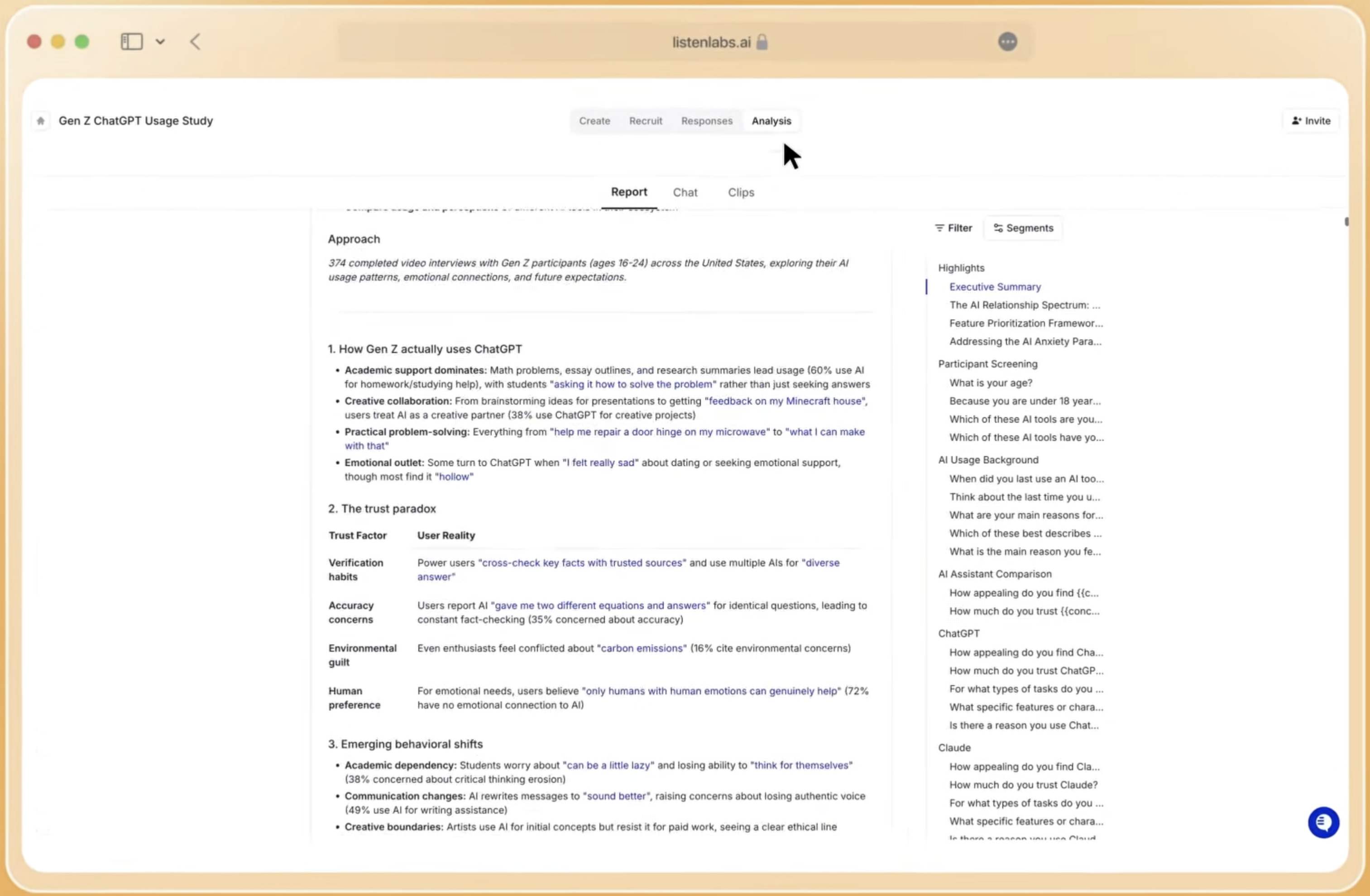
Listen Labs applies three layers of quality control. The platform works exclusively with high-quality, non-commodity panel sources, so no commodity quant panels enter the mix. Quality Guard monitors every interview in real time across video, voice, content, and device signals to detect fraud, low-effort responses, AI-generated scripts, and mismatched profiles. Participants are limited to three studies per month across the entire network, which structurally removes professional survey-takers. A dedicated recruitment operations team adds human review for hard-to-reach segments such as enterprise decision-makers, healthcare workers, and audiences below 1 percent incidence. Listen Atlas, the AI orchestration layer, matches participants on behavioral and intent data rather than only self-reported demographics, which produces more accurate screening than traditional panel sourcing.
Can AI-moderated interviews capture emotional signals that transcripts miss?
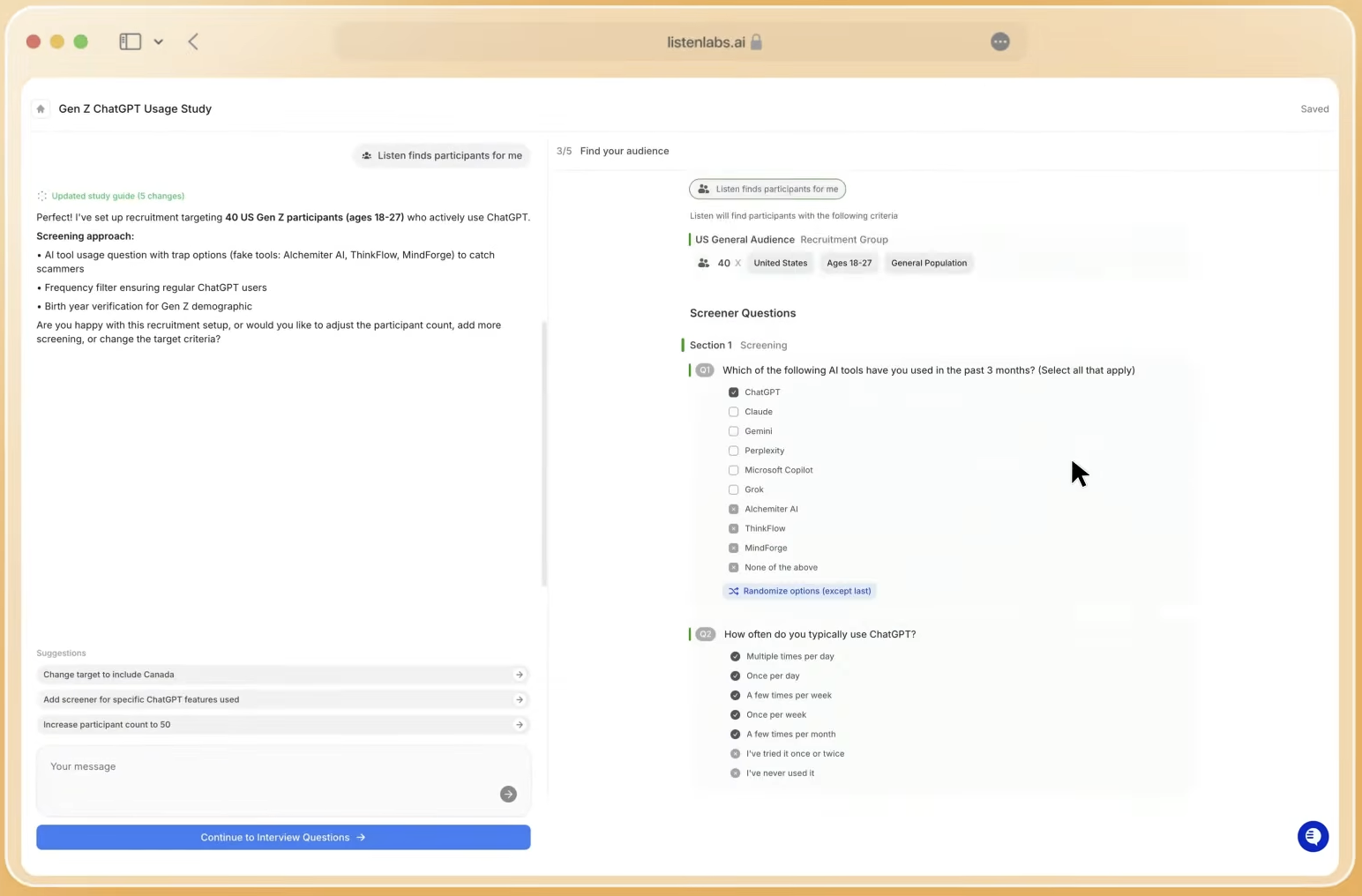
Listen Labs’ Emotional Intelligence feature analyzes three simultaneous signal layers, tone of voice, word choice, and subconscious micro-expressions. Building on Ekman’s framework described earlier, the feature tracks eight specific emotions, anger, anticipation, disgust, fear, joy, sadness, trust, and surprise. Teams can query the Research Agent in natural language, asking which concept triggered the most confusion or which ad creative generated genuine delight, and receive emotional breakdowns with video clips of the relevant moments. The feature is available across 50+ languages.
What security certifications should enterprises require for customer interview data?
Baseline requirements for enterprise AI research platforms handling customer interview data include SOC 2 Type II certification, ISO 27001, GDPR compliance with a signed Data Processing Agreement, and a contractual guarantee that customer data, including transcripts, video recordings, and metadata, never trains or fine-tunes AI models. Enterprises in financial services should also verify ISO 27701 and ISO 42001 certifications. Listen Labs meets all these baseline requirements, as detailed in the platform comparison section above. Data residency controls and sub-processor transparency documentation should be requested before any data enters the vendor environment.
How much implementation effort is required to move from pilot to production-scale programs?
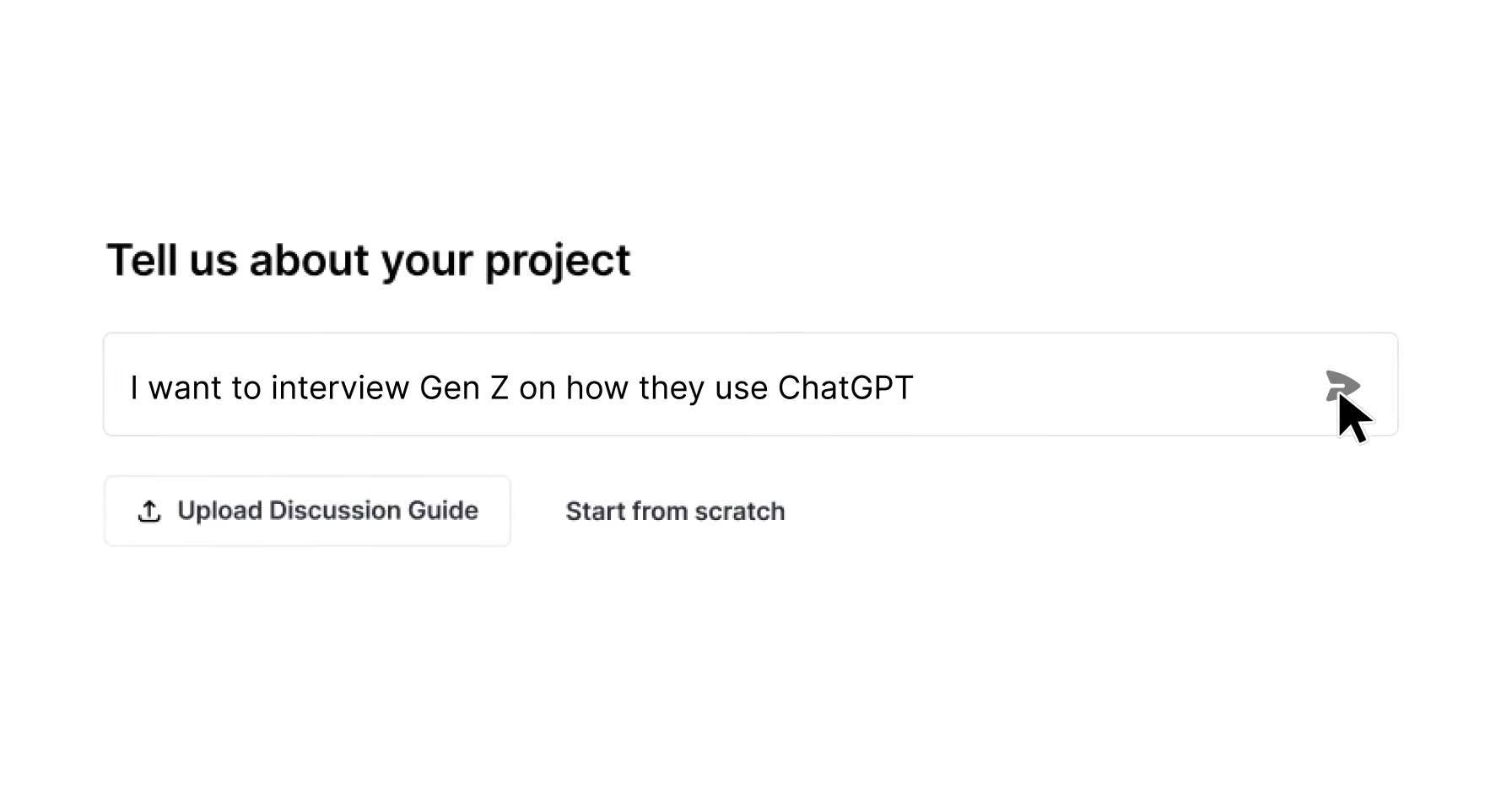
Listen Labs is designed to shorten the pilot-to-production timeline. The platform supports study design through AI-assisted co-design, where researchers describe goals in natural language and the system drafts structured objectives, questions, and probing context. Recruitment runs through Listen Atlas without extra vendor relationships, and self-recruitment is supported at reduced cost for enterprises that bring their own participants. The Research Agent generates deliverables automatically, so teams do not need to configure output formats for each study. Enterprise rollouts include support from Listen Labs’ in-house research team, which brings more than 50 years of combined expertise and works directly with clients on methodology, study design, and ongoing program management. Companies with more than 100 employees typically go through a structured demo and pilot process before moving to production-scale deployment.
Next Step for Teams Ready to Eliminate Research Backlogs
The evaluation criteria are clear, and the category differences are documented. Enterprise proof points from 2026, from Microsoft compressing global customer story collection to a single day, to Anthropic surfacing churn drivers 5x faster, to Skims validating a global campaign launch overnight, show what a purpose-built end-to-end AI interview platform delivers at scale.
The remaining decision is whether Listen Labs fits your audience, compliance requirements, research cadence, and stakeholder deliverable formats. The fastest way to answer that question is a live demonstration where you see the full platform, from study design through participant recruitment, AI-moderated interviews, Emotional Intelligence analysis, Research Agent deliverables, and Mission Control knowledge retention, applied to a research question your team is actually working on.