
Written by: Anish Rao, Head of Growth, Listen Labs | Last updated: June 30, 2026
Key Takeaways
-
Traditional qualitative research cycles take 4–6 weeks and create backlogs. Listen Labs compresses the full lifecycle into a same-day, end-to-end AI workflow.
-
The platform meets eleven enterprise evaluation criteria: speed, depth versus scale, participant quality, emotional signal capture, methodological rigor, global reach, analysis transparency, knowledge retention, security, cost, and proprietary data advantage.
-
AI-moderated interviews, multimodal Emotional Intelligence analysis, and Research Agent automate study design, data collection, theme extraction, and one-click branded deliverables without manual handoffs.
-
Quality Guard’s three-layer fraud prevention, 45+ country coverage, 100+ language support, and SOC 2 Type II / ISO certifications provide enterprise-grade participant quality and compliance at scale.
-
Book a demo with Listen Labs to see how the platform replaces fragmented toolchains and delivers statistically robust, emotionally rich insights faster than traditional methods.
Six-Step AI Research Workflow That Removes Bottlenecks
Listen Labs compresses the full research lifecycle into six sequential steps, each one removing a traditional bottleneck. Legacy workflows stall at every handoff between vendors and teams, which stretches timelines from weeks to months. This sequence keeps everything in a single environment so work flows instead of waiting in queues.
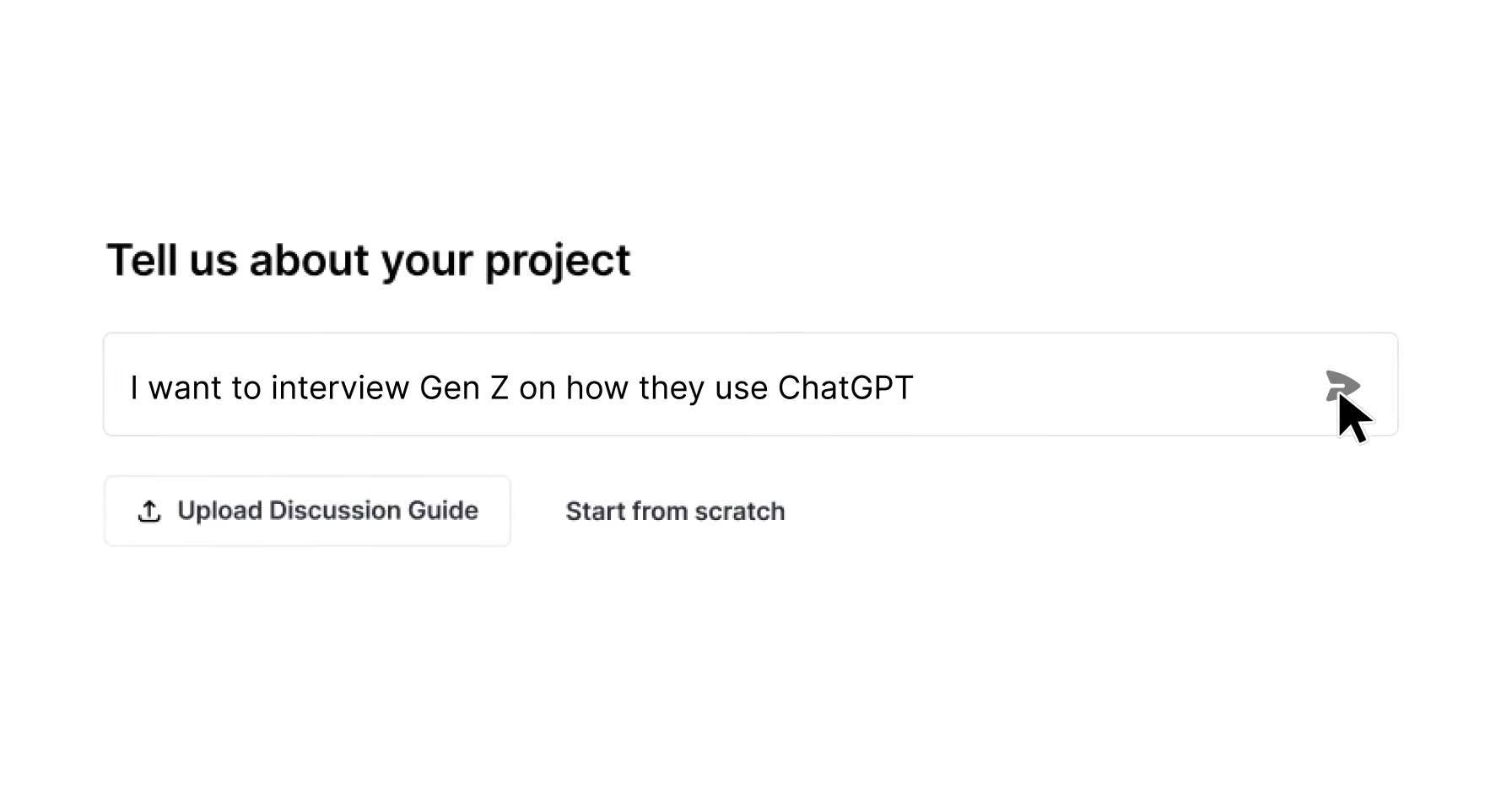
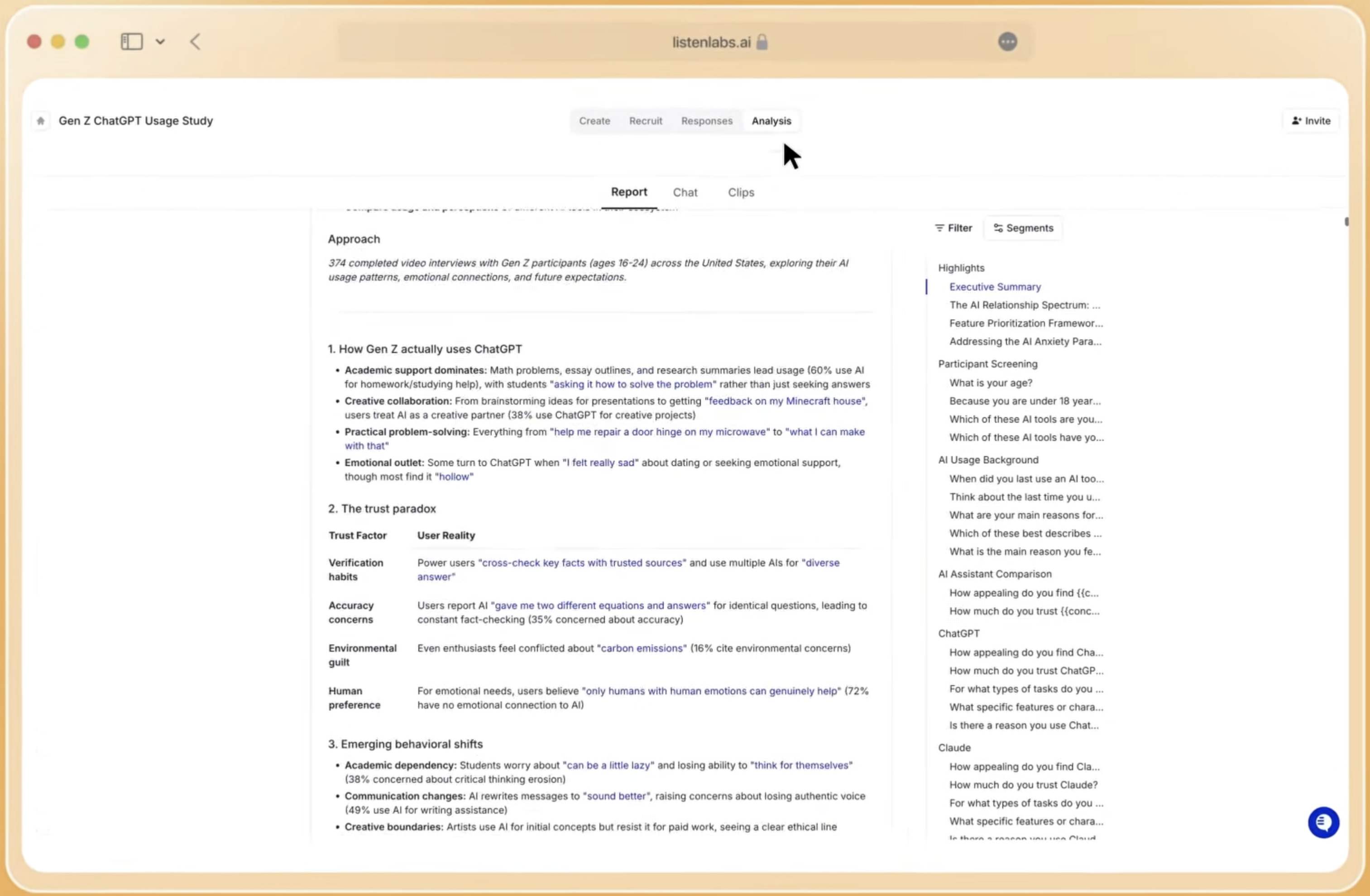
First, AI-assisted study design turns a plain-language research brief into structured objectives, questions, and probing context in seconds. Second, global participant sourcing taps a 30M verified panel across 45+ countries and 100+ languages, with an AI orchestration layer matching on behavioral and intent signals instead of self-reported demographics. Third, AI-moderated video interviews run personalized, adaptive conversations with dynamic follow-up questions across hundreds of participants at once.
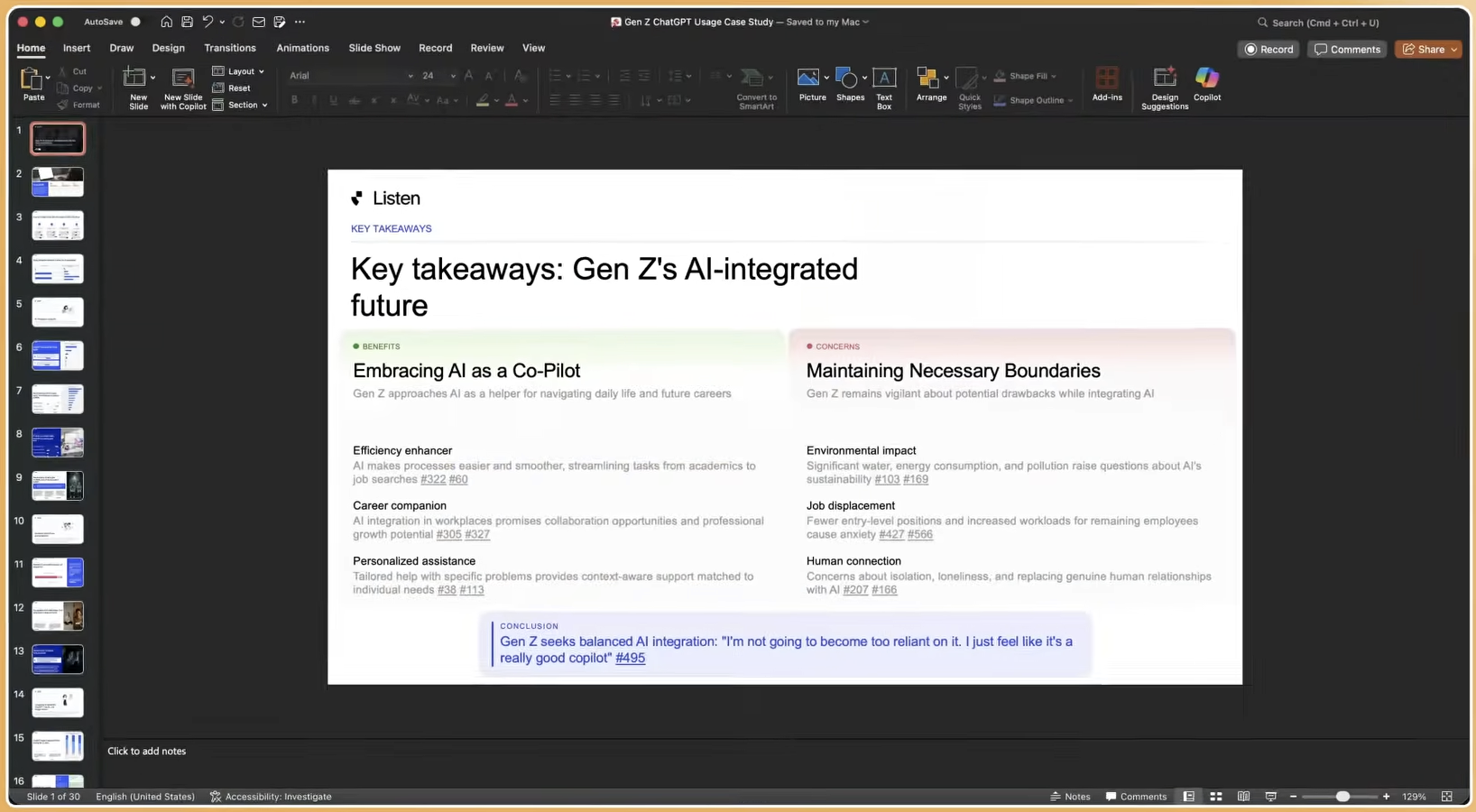
Fourth, multimodal Emotional Intelligence analysis quantifies tone of voice, word choice, and subconscious micro-expressions at the timestamp level, surfacing signals that transcripts alone miss. Fifth, automated theme extraction and statistical testing identify patterns across all responses while reducing human bias. Sixth, Research Agent generates one-click deliverables, including slide decks in branded templates, memo-style reports, highlight reels, and statistical charts in under a minute. The entire sequence finishes within a single day.
Book a demo to see the full six-step workflow live with your research objectives.
Evaluation Criteria: Research Speed
Research speed depends on how many handoffs a workflow removes. Traditional agency workflows rely on recruitment vendors, scheduling coordinators, human moderators, transcription services, and analyst teams. Each handoff introduces delay, so a typical cycle runs 4–6 weeks. In large enterprises with internal prioritization queues, the same cycle can stretch to six months.
Point solutions that automate a single step, such as recruitment or transcription, reduce friction at one node but leave the remaining handoffs intact. That structure produces only marginal time savings. Listen Labs has run over 1 million AI-powered customer interviews for companies including Microsoft, Perplexity, and Sweetgreen. Anthropic completed 300+ user interviews in 48 hours and surfaced churn drivers five times faster than prior methods. Microsoft collected global customer video stories for its 50th anniversary celebration within a single day. No fragmented toolchain produces comparable end-to-end turnaround.
Evaluation Criteria: Depth Versus Scale
Speed alone does not help if the sample size is too small to trust. Qualitative interviews deliver rich, nuanced understanding but have historically been limited to 5–15 participants per study, which is a sample too small for statistical confidence. Quantitative surveys scale to thousands of respondents but replace adaptive conversation with pre-set questions, removing the ability to probe unexpected answers.
With qual-at-scale, the old trade-off between depth and scale no longer blocks progress. AI can schedule and conduct interviews, analyze transcripts for themes, and generate quantitative insights from those interviews at the same time. Listen Labs runs hundreds of adaptive, personalized interviews in parallel, giving teams the statistical confidence of large samples and the contextual richness of one-on-one conversations.
With AI-moderated interviews, talking to users at scale is no longer the hard part. The real challenge is understanding what participants mean, which automated analysis addresses by turning raw conversation into structured findings.
Evaluation Criteria: Participant Quality and Fraud Prevention
Participant quality determines whether insights hold up under scrutiny. Commodity panels used by generic recruitment tools create risks such as professional survey-takers, repeat respondents, and fraudulent profiles that inflate sample sizes while degrading data quality. Listen Labs addresses this through Quality Guard, a three-layer system designed to catch problems at every stage.
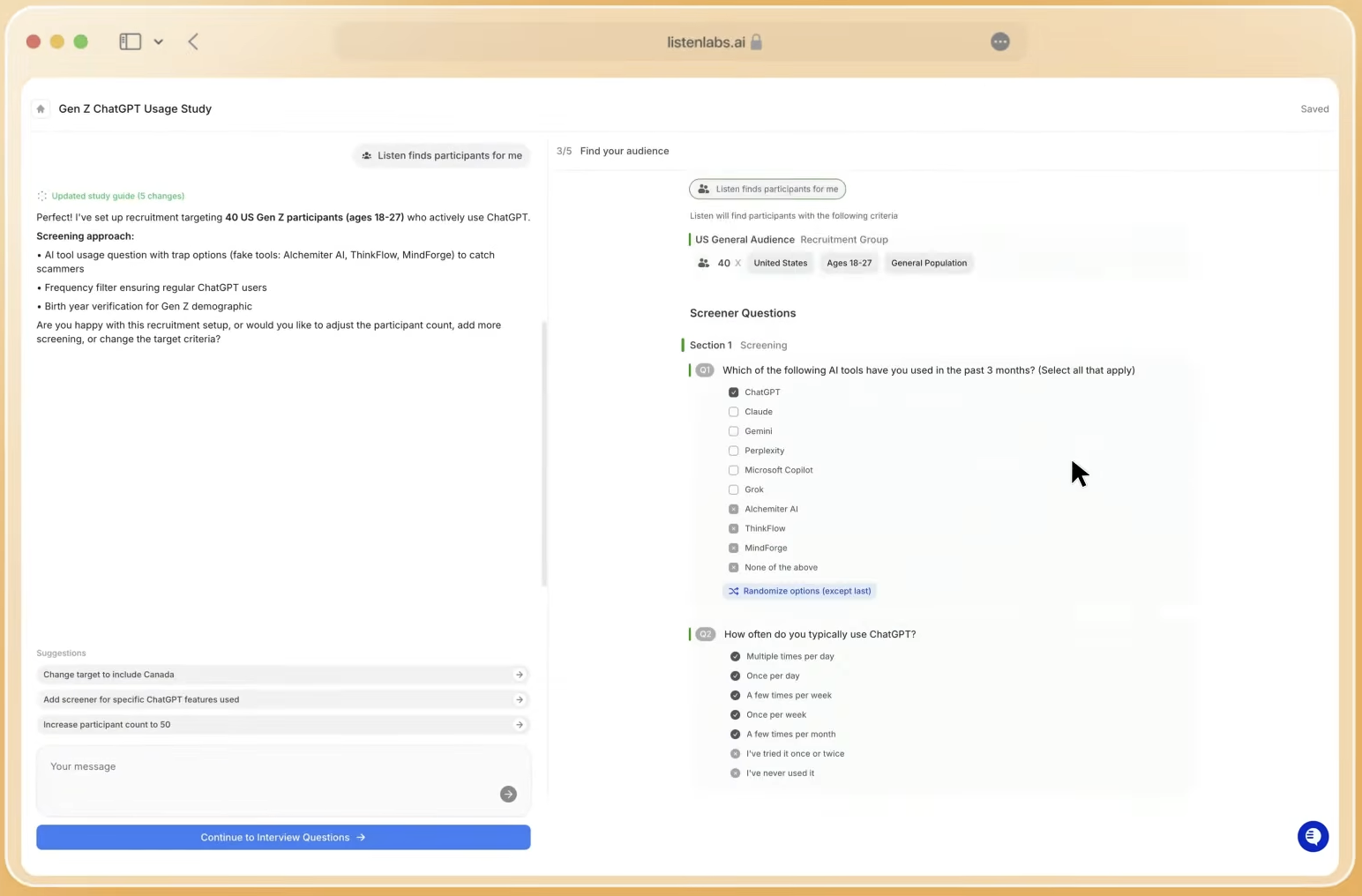
The first layer restricts sourcing to high-quality, non-commodity panel partners, which prevents many fraudulent profiles from entering the pool. Pre-screening alone cannot stop every bad actor, so the second layer applies real-time AI monitoring across video, voice, content, and device signals to detect fraud, low-effort responses, AI-generated scripts, and mismatched profiles during the interview itself. Even legitimate participants can become professional survey-takers when they join too many studies, so the third layer caps participation at three studies per month to reduce that risk.
A dedicated recruitment operations team adds human review for hard-to-reach segments such as enterprise decision-makers, healthcare workers, and audiences below 1% incidence rate. Automated matching alone cannot reliably source those groups, so human oversight closes the gap.
Evaluation Criteria: Emotional Signal Capture
Emotional signal capture separates surface-level feedback from true sentiment. Transcript-only tools and generic large language models record what participants say but not what they feel. A participant may rate a concept positively while displaying micro-expressions of confusion or hesitation that never enter the data.
Listen Labs’ Emotional Intelligence layer analyzes three simultaneous signal streams: tone of voice, word choice, and subconscious micro-expressions. The system relies on Ekman’s universal emotions framework, the same standard used in clinical psychology and UX research. Every emotion is quantified per question and concept, and every label is traceable to the exact timestamp, verbatim quote, and the reasoning behind the classification.
This traceability distinguishes the system from black-box sentiment scoring, which produces aggregate labels without audit trails. The capability works across 50+ languages and connects directly with Research Agent for natural-language queries and highlight reels of emotionally significant moments.
Evaluation Criteria: Methodological Rigor and Transparency
Methodological rigor ensures that AI output reflects sound research practice instead of plausible-sounding summaries. Generic AI tools applied to consumer research, such as prompting raw transcripts in a chat interface, lack the proprietary study data that shows which question types produce analyzable responses and which methodologies fit specific objectives.
Listen Labs is built on tens of thousands of completed studies, which creates a data moat that general-purpose LLMs cannot match. An in-house research team with more than 50 years of combined expertise reviews and refines the methodology framework continuously while working closely with engineering. Traditional agencies provide human expertise but often deliver inconsistent analyst quality across engagements. Listen Labs applies consistent methodology to every study, with traceable outputs that stakeholders can interrogate instead of accepting on faith.
Evaluation Criteria: Global and Multilingual Reach
Global reach matters when teams need consistent insights across markets. Most point solutions, including recruitment platforms, analysis repositories, and AI moderation tools, operate within narrow geographic and language boundaries. That limitation forces teams to manage separate vendors for multi-market programs.
Listen Labs covers 45+ countries across the Americas, Europe, APAC, and MEA. Interview moderation works in 100+ languages, with automatic translation and transcription across all supported languages. Platforms like Listen Labs add auto-recruiting, transcription, sentiment tagging, and insight summarization so teams move from questions to findings in hours, not weeks. Teams run this process across any market in a single unified workflow instead of a patchwork of regional vendors.
Evaluation Criteria: Analysis Transparency and Deliverable Quality
Transparent analysis and strong deliverables determine whether stakeholders act on research. Manual report writing by agency analysts introduces subjectivity, confirmation bias, and delays measured in days or weeks. BI dashboard exports from survey tools provide structured charts but no narrative synthesis, which leaves stakeholders to interpret raw data without context.
Research Agent handles the full analysis workflow from raw data to final output. It generates a slide deck in a company’s branded template, a downloadable memo-style report, video highlight reels, statistical charts, and segmentation breakdowns in under a minute. One researcher ran a full buying intent analysis across three user segments in less than sixty seconds, a benchmark that manual or semi-automated workflows do not approach.
Evaluation Criteria: Cross-Study Knowledge Retention
Cross-study knowledge retention prevents teams from repeating work. Research findings from agencies and fragmented tools often sit in scattered slide decks, shared drives, and individual researchers’ memories. Organizations then commission new studies on questions already answered in prior work because institutional knowledge is hard to access.
Mission Control serves as a unified source of truth for everything learned from customers across all studies on the platform. Cross-study queries return answers in seconds. Trend tracking monitors customer sentiment, needs, and pain points over time. Each new study compounds the knowledge base instead of existing in isolation. No agency relationship and no combination of point solutions replicates this compounding institutional memory.
Evaluation Criteria: Security, Compliance, and Total Cost of Ownership
Security and cost both influence enterprise adoption. Enterprise procurement teams require verifiable security certifications, not vendor self-attestation. Listen Labs holds SOC 2 Type II, GDPR, ISO 27001, ISO 27701, and ISO 42001 certifications, with 256-bit encryption and a policy that customer data is never used for AI model training. Enterprise SSO is supported.
Beyond security, procurement teams also evaluate total cost of ownership, which includes the full stack of tools a platform replaces. Listen Labs consolidates recruitment platforms, scheduling tools, moderation services, transcription providers, analysis software, and report writers into a single subscription. The cost advantage is proven in practice. The Microsoft deployment showed that enterprises can reach hundreds of users at one third of the cost of traditional methods. P&G delivered 250+ interviews with quantified themes and verbatim proof in hours, shaping product and brand strategy at a fraction of typical agency cost.
Book a demo to receive a cost comparison against your current research stack.
Evaluation Criteria: Proprietary Data Advantage in Build-vs-Buy Decisions
Proprietary research data creates a structural advantage over generic AI stacks. Teams that assemble workflows from general-purpose tools, such as using ChatGPT or Claude for study design, a commodity panel for recruitment, and an LLM for transcript analysis, start with a handicap. General-purpose LLMs have no exposure to the distribution of question types, methodology choices, and analysis patterns that separate high-quality consumer research from low-quality output.
Listen Labs is trained on tens of thousands of prior studies, which gives the platform deep understanding of which question structures lead to richer responses, which probing strategies surface unexpected findings, and how to weight themes across heterogeneous samples. Qual-at-scale uses AI to automate time-consuming aspects of qualitative research like recruiting, interviewing, and analysis, enabling deeper insights at larger scales without traditional barriers of cost and time. That outcome only holds when the AI is purpose-built for research rather than adapted from a general-purpose foundation.
Best-Fit Scenarios for Different Research Teams
Different teams apply the same platform to distinct problems. Consumer insights leaders at large enterprises use Listen Labs to multiply research output without proportional headcount increases, which clears backlogs and cuts internal wait times from weeks to hours. UX research groups rely on the platform for concept validation, prototype testing, and usability studies with 50–100+ participants per sprint cycle instead of the 5–10 that manual scheduling allows.
Product managers and marketing leaders without dedicated research teams use the self-serve study design workflow. They describe goals in natural language and receive structured findings without needing methodology expertise. Switching to AI-moderated interviews lets teams capture hundreds of candid, one-to-one conversations overnight, which previously required agency engagement.
Consultancies and agencies use Listen Labs for client engagements and due diligence projects where turnaround is measured in days and niche audience reach is non-negotiable. This group benefits from the same recruitment depth and analysis speed while delivering higher-margin, insight-led work.
Operational Considerations for Enterprise Rollout
Operational planning ensures that an end-to-end AI research platform delivers value quickly. Deploying Listen Labs requires alignment across research, product, legal, and IT functions. Security and compliance review moves faster because of the platform’s existing certifications.
Change management centers on repositioning the research team from logistics operators to strategic interpreters. The platform handles recruitment, moderation, and initial analysis, which frees researchers to focus on synthesis and decision support. Ongoing program use, where teams run continuous customer intelligence instead of one-off studies, benefits from Mission Control’s compounding knowledge base. That structure reduces redundant research and speeds onboarding for new team members.
Enterprises with more than 100 employees typically access the platform through a demo and pilot process. Smaller organizations can use the self-serve tier directly.
Decision Framework Checklist for AI Research Platforms
Teams can use a structured checklist to compare AI research platforms with point solutions and traditional workflows. This list helps reveal where vendors fall short and where fragmented toolchains reintroduce risk. Most tools fail on several of these requirements, which forces teams back into a stitched-together stack.
Apply the following criteria:
-
Does the platform cover the full lifecycle, including study design, recruitment, moderation, analysis, and deliverables, without external handoffs?
-
Can it deliver final reports and slide decks with same-day or next-day turnaround from study launch?
-
Does participant sourcing include fraud prevention beyond self-reported demographic screening?
-
Does analysis capture emotional and nonverbal signals, not only transcript content?
-
Are all analytical outputs traceable to source timestamps and verbatim quotes?
-
Does the platform support 45+ countries and 100+ languages natively?
-
Is there a cross-study knowledge repository that compounds with each new study?
-
Does the vendor hold SOC 2 Type II, ISO 27001, ISO 27701, ISO 42001, and GDPR certifications?
-
Is total cost of ownership demonstrably lower than the combined cost of equivalent point solutions?
-
Has the platform been validated at Fortune 500 scale with verifiable case studies?
-
Does the platform’s AI draw on a proprietary research dataset rather than a general-purpose LLM alone?
Frequently Asked Questions
How fast does Listen Labs actually deliver results?
The full research cycle, from study launch through participant interviews to final deliverables, completes in under 24 hours for most studies. Anthropic completed 300+ user interviews and received a prioritized findings report within 48 hours. Microsoft collected global customer video stories within a single day. Research Agent generates slide decks, memos, and highlight reels in under a minute once interviews are complete.
Can Listen Labs reach niche or hard-to-find audiences?
Yes. The dedicated recruitment operations team sources audiences below 1% incidence rate, including enterprise decision-makers, engineers, healthcare workers, and highly specialized consumer segments. The AI orchestration layer, Listen Atlas, matches across behavioral and intent data instead of relying only on self-reported demographics, and partners with niche communities and specialized networks when standard panel sourcing is insufficient.
Can I use my own participants instead of the Listen Labs panel?
Yes. Listen Labs supports self-recruitment, which allows organizations to study their own customer or user base at a reduced credit cost. Organizations can also bring their own panel provider. Self-recruited participants still go through Quality Guard monitoring during the interview itself.
What security and compliance certifications does Listen Labs hold?
Listen Labs maintains SOC 2 Type II, GDPR, ISO 27001, ISO 27701, and ISO 42001 certifications. All data is encrypted at 256-bit, enterprise SSO is supported, and customer data is never used to train AI models. These certifications cover both data security and AI governance, which matters for enterprises subject to emerging AI procurement requirements.
Does Listen Labs replace the internal research team?
No. The platform acts as a force multiplier for existing research teams, not a replacement. It handles logistics-intensive steps such as recruitment, scheduling, moderation, transcription, and initial analysis. Researchers then focus on strategic synthesis, stakeholder communication, and program design. Teams that previously ran a limited number of studies per quarter because of capacity constraints can run significantly more without adding headcount.
Conclusion
No point solution, generic AI workflow, or traditional agency relationship meets all eleven enterprise evaluation criteria at the same time. Fragmented toolchains require manual handoffs that reintroduce the delays and quality risks that automation should remove. Generic LLMs lack the proprietary research dataset that separates rigorous study design and analysis from plausible-sounding output. Traditional agencies provide expertise but not the speed, scale, or cost efficiency required at enterprise volume.
The platform’s enterprise adoption, spanning Microsoft, Google, Sony, Anthropic, P&G, Robinhood, Skims, Levi’s, and Nestlé, shows that this approach works at Fortune 500 scale rather than only in pilot programs. Listen Labs stands out as an end-to-end platform that compresses the full research lifecycle into a single day while preserving methodological rigor, participant quality, and deliverable depth.