Written by: Anish Rao, Head of Growth, Listen Labs | Last updated: July 20, 2026
Key Takeaways
- Generic AI tools like ChatGPT and Claude cover only small pieces of the research lifecycle. Product managers still juggle multiple point solutions, which slows projects and weakens data quality.
- Listen Labs manages everything in one place: participant sourcing from a 30M+ verified network, AI-moderated video interviews with emotional intelligence, and consultant-quality deliverables in under 24 hours.
- The four-step workflow, Discover, Synthesize, Decide, and Validate, replaces weeks of manual work with automated recruitment, adaptive moderation, traceable insights, and a persistent cross-study knowledge base.
- Enterprise-grade compliance (SOC 2, GDPR, ISO 27001, ISO 27701, ISO 42001) and results with Microsoft, Anthropic, P&G, and others show 5× speed and one-third cost compared with traditional methods.
- Product managers ready to replace slow research with a complete AI workflow can see the four-step workflow in action with a live Listen Labs demo.
Discover: Replace Manual Recruiting With Automated Sourcing
The first bottleneck in any customer research cycle is participant recruitment. A traditional customer feedback analysis workflow allocates 1–2 weeks to recruit and schedule participants alone, and recruiting a single participant takes approximately 1.15 work hours. A 5-participant study consumes nearly 6 hours of recruitment time before a single interview begins.
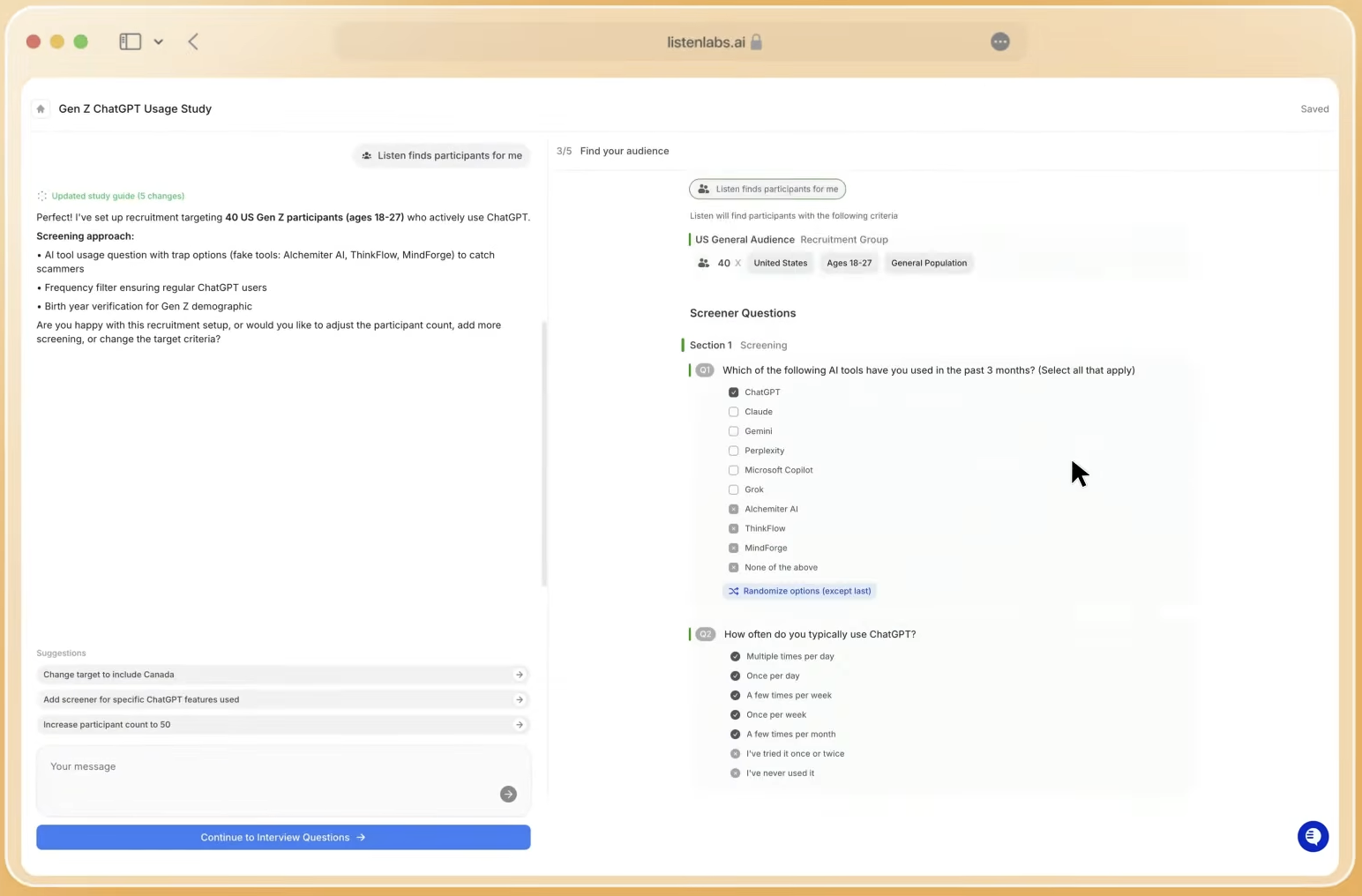
Generic LLMs offer no solution here. They cannot source, screen, or schedule real participants. Point solutions such as Prolific, User Interviews, and Respondent help with sourcing but hand off to separate tools for moderation and analysis, which introduces delays and quality loss at every transition.
Listen Labs replaces this fragmented process with Listen Atlas, an AI orchestration layer that automatically matches and bids across a 30M+ verified respondent network spanning 45+ countries and 100+ languages. This automated matching removes the manual sourcing step, yet recruitment still requires translating business questions into research design. AI-assisted study co-design fills that gap: product managers describe research goals in natural language, and the platform drafts structured objectives, questions, and probing context in seconds. For audiences that even a 30M+ panel cannot supply at scale, such as enterprise decision-makers, healthcare workers, and segments below 1% incidence rate, a dedicated recruitment operations team adds a human layer on top of the automated system. AI-led customer discovery cut median time-to-insight from interview-recruit to themed insight from 12 weeks to 18 hours in 2026 among teams using integrated AI research platforms.
Synthesize: Turn Conversations Into Deep Emotional Insight
Recruiting participants is only the start. The deeper problem is what happens during and after the interview. Generic AI moderators cannot read tone of voice, facial expressions, or body language, and will treat a sarcastic response the same as a sincere one. General-purpose LLMs exhibit sycophancy, agreeing with users 75–85% of the time in poorly designed interviews rather than challenging responses to achieve research depth. The result is surface-level data that cannot support confident product decisions.
To solve this depth problem, Listen Labs conducts AI-moderated video interviews with dynamic follow-up questions that probe deeper on interesting or short answers, the same way a trained human interviewer would. 92% of participants report top comfort levels in AI-moderated sessions, matching human-moderated benchmarks.
The platform’s Emotional Intelligence feature goes further than any generic LLM can. It analyzes three layers of signal, tone of voice, word choice, and subconscious micro expressions, to surface emotions that transcripts alone miss. Built on Ekman's universal emotions framework, every emotion is quantified per question and concept, with every label traceable to the exact timestamp, verbatim quote, and AI reasoning behind it. Point solutions without adaptive moderation produce transcripts. Listen Labs produces understanding.
After interviews complete, the Research Agent automatically surfaces themes, personas, and timestamped clips. The synthesis stage of customer discovery can be substantially accelerated among teams using integrated platforms, compared with 15–20 hours of deep work required to manually synthesize 10 user interviews.
Decide: Move From Raw Themes to Stakeholder-Ready Outputs
Raw themes and transcripts do not move product decisions. Stakeholders need slide decks, memos, and statistical evidence they can trust. Researchers spend the bulk of their time in analysis: finding patterns, quantifying insights, testing significance, adding macro context, and formatting results for stakeholders who each need something different. Generic LLMs can produce summaries, but those summaries are untraceable, with no link from a claim back to the participant who made it. Point solutions require manual export and formatting, which adds hours to every study.
Listen Labs' Research Agent turns raw interview data into consultant-quality deliverables in under a minute. It generates a slide deck in a company's branded template, a downloadable report, video highlight reels, charts, and statistical tests, and every insight links back to the underlying response data. Product managers can ask any question in natural language and receive answers, segmentations, and significance tests without opening a spreadsheet.
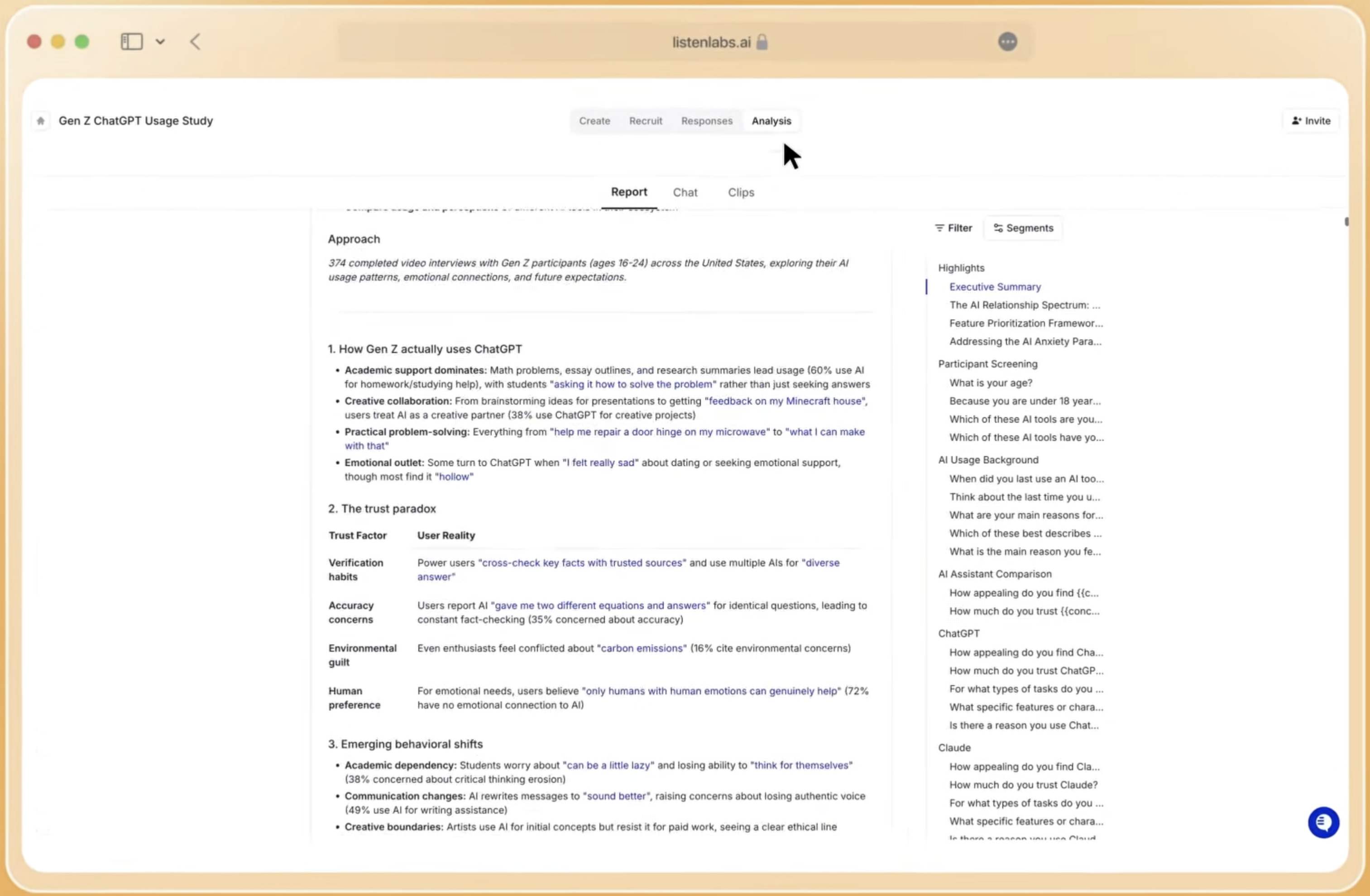
The contrast with generic LLMs is structural, not marginal. With AI-moderated interviews, talking to users at scale is no longer the hard part, the challenge is understanding what they mean. The Research Agent solves that challenge with traceable, stakeholder-ready outputs that generic tools cannot produce.
Validate: Build a Persistent Customer Knowledge Base
A single study answers one question. Durable product strategy requires knowing how customer sentiment shifts over time and whether new findings contradict or confirm what was learned six months ago. No McKinsey 2024 study or article reports that regaining customer context after a 4+ week gap in direct engagement requires 3–5 weeks, which means siloed research tools force teams to re-research questions they have already answered.
Listen Labs' Mission Control serves as the organization's single source of truth for everything ever learned from customers across all studies. Cross-study queries return answers from past research in seconds. Trend tracking surfaces how customer sentiment, needs, and pain points shift over time. Each new study grows the institutional knowledge base rather than creating another isolated report. Teams that previously re-ran the same foundational research every quarter can instead focus entirely on net-new questions.
No point solution, not Dovetail, not a folder of slide decks, not a shared Notion page, replicates this compounding advantage. Dovetail organizes research conducted elsewhere. Mission Control is the repository built into the same platform that conducted the research, with full fidelity to every transcript, clip, and emotional data point.
Quality Controls That Generic Tools Cannot Match
Participant quality determines whether research findings are trustworthy. Commodity panels are filled with professional survey-takers who optimize for incentives, and generic LLMs have no mechanism to detect or prevent this problem because they have no participants at all. They simulate responses from training data.
Listen Labs operates three quality layers that no generic tool can replicate. Quality Guard monitors every interview in real time across video, voice, content, and device signals to detect fraud, low-effort responses, AI-generated scripts, and mismatched profiles, catching bad actors during the session itself. Real-time monitoring cannot prevent someone from lying about their background before the interview, so behavioral matching qualifies participants on intent and past actions rather than self-reported demographics, filtering out mismatches in advance. Even with both layers in place, professional survey-takers could still pass screening over time, so participant frequency limits cap involvement at 3 studies per month per respondent, which removes repeat participation entirely. A dedicated recruitment operations team adds a human review layer on top of automated controls.
This quality infrastructure compounds over time. Every interview adds to a reputation scoring system that makes the Listen Labs audience stronger with each study, a flywheel that competitors relying on commodity panels or self-recruitment cannot replicate.
Enterprise Compliance Standards Backed by Real Deployments
Enterprise product teams cannot deploy research tools that fail security reviews. Listen Labs holds SOC 2 Type II, GDPR, ISO 27001, ISO 27701, and ISO 42001 certifications, with 256-bit encryption and a strict policy that customer data is never used to train AI models.
This compliance posture is validated by the enterprises that rely on it. Listen Labs has run over 1 million AI-powered customer interviews for companies including Microsoft, Perplexity, and Sweetgreen, and raised $69 million in a Series B round led by Ribbit Capital at a valuation over $500 million as of January 2026.
These enterprise case studies show the speed and cost advantages in practice. Microsoft's Director of Data Science reported: “I can reach out to hundreds of users at one third of the cost,” with global customer stories for Microsoft's 50th anniversary collected within a single day. Anthropic's Director of Product Strategy used Listen Labs to surface churn drivers from 300+ user interviews in 48 hours, 5× faster than previous methods, producing a prioritized list of 10 must-fix items. P&G delivered 250+ interviews with quantified themes and verbatim proof in hours, directly shaping product and brand strategy. Skims validated campaign direction with thousands of premium consumers overnight, securing board-level buy-in. Robinhood identified that users who view prediction markets as entertainment drive 2.4× higher weekly re-engagement, with insights delivered 5× faster and integration flows boosting uptake 30–40%.
Schedule a security-focused walkthrough to see how Listen Labs meets your compliance requirements.
Decision Checklist for Product Managers
The right research approach depends on team size, timeline, and audience complexity. Use this checklist to identify which Listen Labs capabilities solve your specific research bottlenecks. If several scenarios match your situation, the platform will deliver measurable time and cost savings over fragmented point solutions.
- No dedicated research team: Listen Labs' AI-assisted study design and automated moderation replace the need for research methodology expertise. Describe goals in natural language, and the platform handles design, recruitment, moderation, and analysis.
- Sprint-cycle timelines (days, not weeks): Listen Labs delivers themed, actionable insights in under 24 hours, matching the 18-hour median reported across integrated AI research platforms in Q1 2026.
- Hard-to-reach audiences (enterprise buyers, healthcare workers, sub-1% incidence): The Listen Atlas recruitment ops team sources niche segments that commodity panels cannot supply.
- Need for emotional depth beyond survey data: Emotional Intelligence captures tone, word choice, and micro expressions that text-based tools miss entirely.
- Enterprise security requirements: SOC 2, GDPR, ISO 27001, ISO 27701, and ISO 42001 certifications satisfy procurement reviews at Fortune 500 scale.
- Existing user base to study: Bring-your-own-participants support lets teams recruit from their own users at reduced cost while retaining full platform capabilities.
- Ongoing research programs (not one-off studies): Mission Control builds institutional knowledge across every study, enabling trend tracking and cross-study queries without re-running foundational research.
Frequently Asked Questions
This FAQ section addresses the practical concerns product managers raise most often after seeing the four-step workflow, from speed and quality to emotional depth and security.
How fast can I get insights from customer interviews?
Listen Labs compresses the full research cycle, study design, participant recruitment, AI-moderated interviews, analysis, and deliverables, to under 24 hours. Microsoft collected global customer video stories within a single day. Anthropic received synthesized findings from 300+ interviews within 48 hours. The Research Agent generates slide decks, memos, charts, and highlight reels in under a minute once interviews are complete. Teams that previously waited 4–6 weeks for a research readout now receive stakeholder-ready outputs the next morning.
How does Listen Labs ensure participant quality compared with generic AI tools?
Generic AI tools have no participants. They simulate responses from training data, which introduces variance collapse and demographic flattening that makes findings unreliable for real product decisions. Listen Labs operates three quality layers: Quality Guard monitors every interview in real time for fraud, low-effort responses, and mismatched profiles, behavioral matching qualifies participants on intent and past actions rather than self-reported demographics, and participant frequency limits cap involvement at 3 studies per month to eliminate professional survey-takers. A dedicated recruitment operations team adds human review on top of automated controls. This infrastructure compounds over time through a reputation scoring flywheel that strengthens the audience with every study completed on the platform.
Can the AI capture emotional intelligence that text-based LLMs miss?
Yes. The Emotional Intelligence feature described earlier captures nonverbal signals that text-based LLMs cannot access. Beyond the three-layer analysis, it also quantifies emotions per question and concept, with every label traceable to the exact timestamp, verbatim quote, and AI reasoning behind it. Product teams can compare concepts, segments, and markets based on emotional response rather than relying only on what participants say.
Can I use my own participants instead of the platform panel?
Yes. Listen Labs supports self-recruitment, allowing organizations to study their own user base at a reduced credit cost. Teams can also bring their own panel provider. In both cases, the full platform, AI-moderated interviews, Emotional Intelligence, Research Agent deliverables, and Mission Control, remains available. Self-recruitment works especially well for product teams that need to study existing customers or beta users without sourcing from the external panel.
What security certifications does Listen Labs hold?
Listen Labs holds SOC 2 Type II, GDPR, ISO 27001, ISO 27701, and ISO 42001 certifications. The platform uses 256-bit encryption, and customer data is never used to train or fine-tune AI models. Enterprise SSO is supported. These certifications cover data security (ISO 27001), privacy information management (ISO 27701), and AI management systems (ISO 42001), satisfying the layered compliance requirements of Fortune 500 procurement processes. Microsoft, Anthropic, P&G, Skims, and Robinhood have all deployed Listen Labs within their enterprise environments.
Conclusion: A Full-Stack AI Research Assistant for Product Managers
Generic LLMs handle one step of the research process at best. Point solutions handle one step each, which requires product managers to manage recruitment tools, moderation tools, transcription tools, analysis tools, and repository tools as separate workflows. That fragmentation reintroduces the delays that AI was supposed to remove.
Listen Labs covers the complete workflow: AI-assisted study design, verified participant recruitment from a 30M+ global network, adaptive AI-moderated video interviews with multimodal emotional intelligence, Research Agent deliverables generated in under a minute, and Mission Control as a persistent cross-study knowledge base. Platforms like Listen Labs layer on auto-recruiting, transcription, sentiment tagging, and insight summarization so teams jump from question to findings in hours, not weeks. The result is insights in under 24 hours at the cost savings described earlier, with enterprise compliance certifications that satisfy the most demanding security reviews.