
Written by: Anish Rao, Head of Growth, Listen Labs | Last updated: July 30, 2026
Why Fast AI Recruitment Changes UX Research
- AI recruitment for UX research replaces manual sourcing and scheduling with automated workflows that deliver qualified participants in hours instead of weeks.
- Listen Labs runs full research studies from brief to analyzed findings in under 24 hours through parallel AI-assisted design, recruitment, moderation, and analysis.
- Three-layer Quality Guard screening and behavioral matching across a 30M+ verified respondent network create high-quality, fraud-resistant participant pools.
- Enterprise teams at Microsoft, Anthropic, P&G, and Skims already use Listen Labs to move from study brief to board-ready insights overnight.
- Book a demo to see how Listen Labs delivers consultant-grade insights in under 24 hours.
5-Step Listen Labs Workflow From Brief to Insights
This workflow shows how Listen Labs completes an end-to-end research study within a single business day.
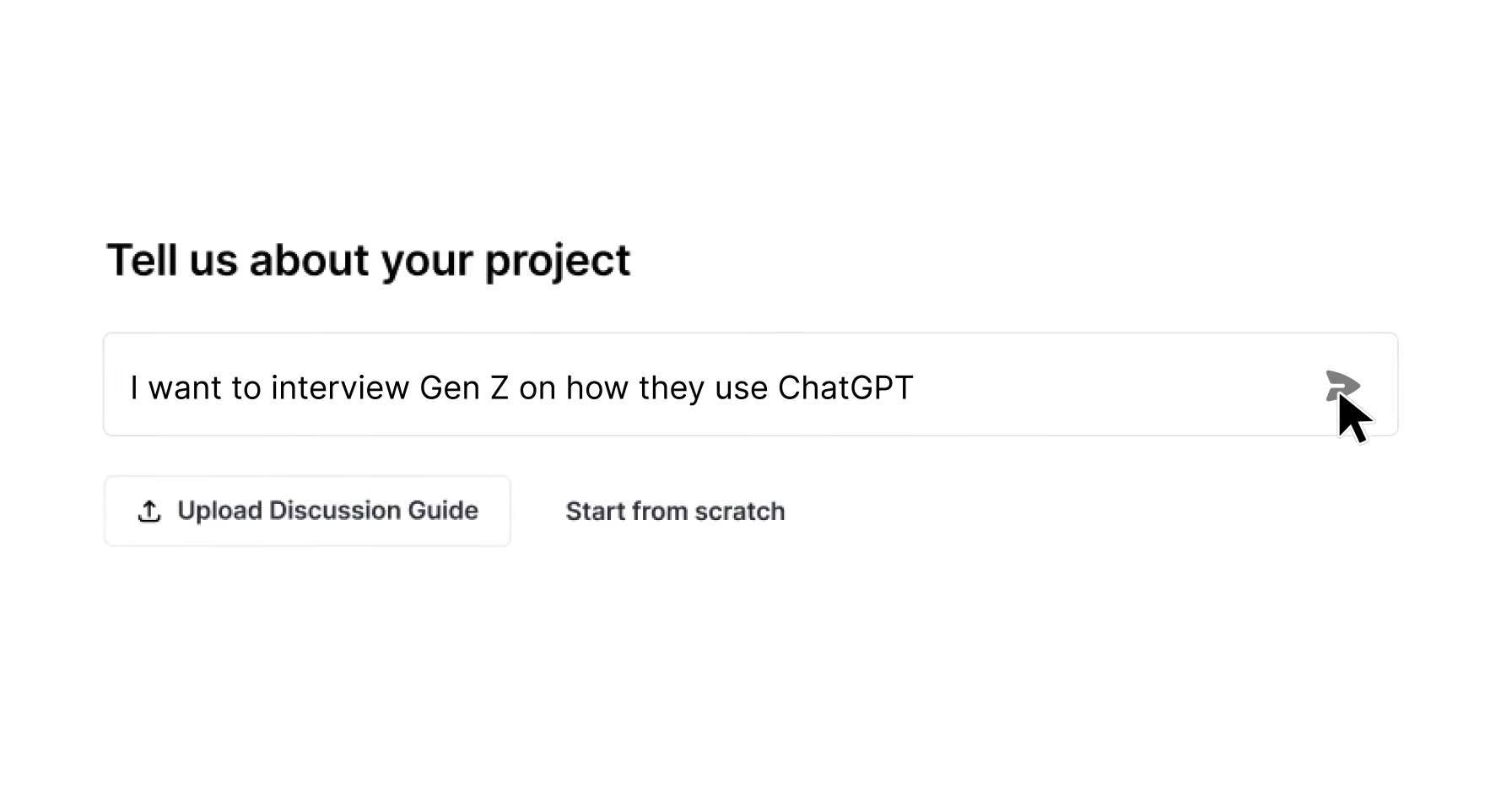
- AI-Assisted Study Design: Researchers describe their objectives in natural language. The platform drafts structured questions, probing context, screener logic, branching, and stimuli configuration in seconds, and auto-QA flags issues before launch.
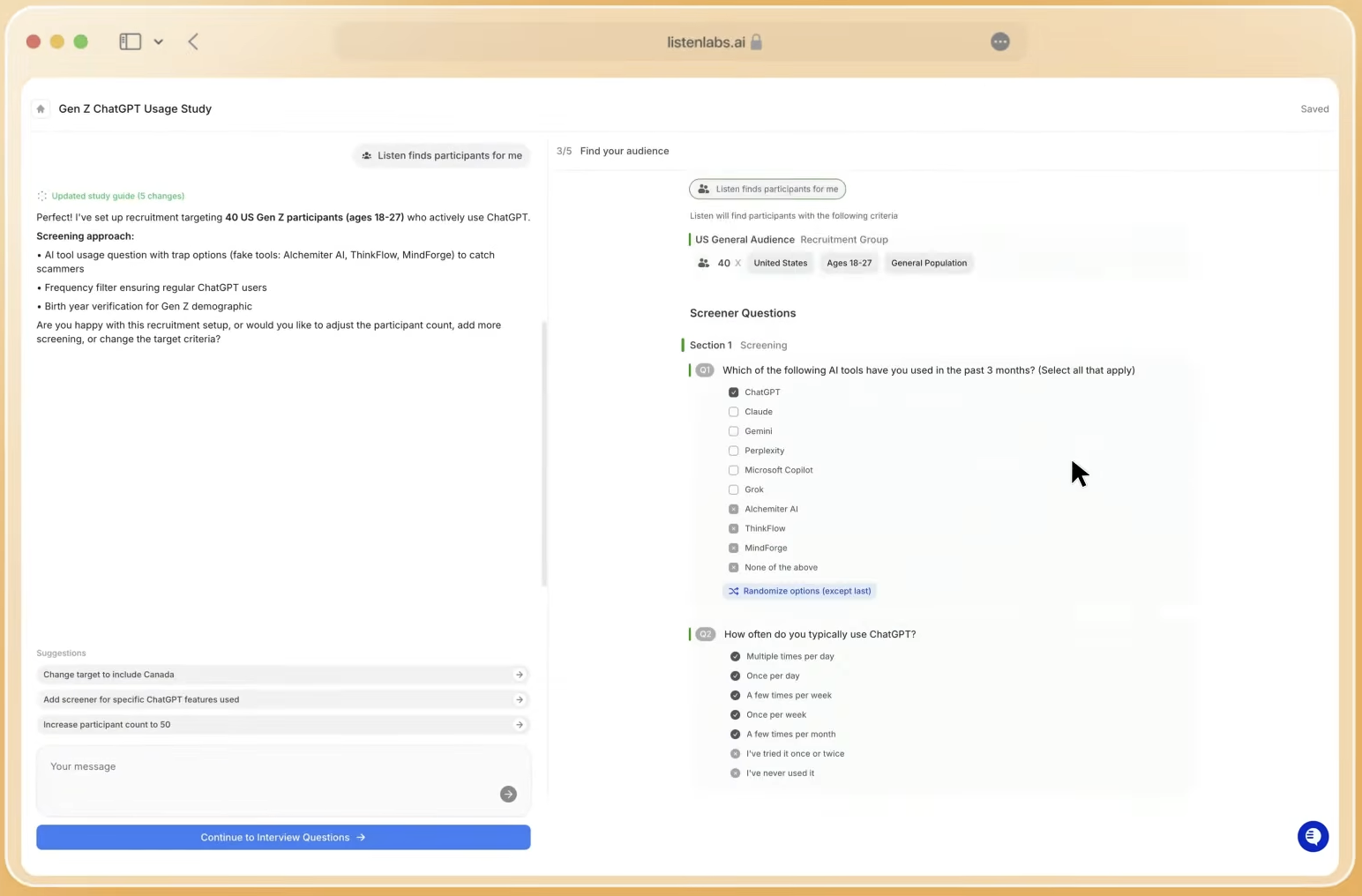
- Listen Atlas Recruitment: Listen Labs’ AI orchestration layer matches and bids across its network of 30M+ verified respondents across 45+ countries. It uses behavioral and intent signals, not just demographics, to identify the right participants within 2–24 hours of study launch.
- Quality Guard Screening: A three-layer system verifies participants in real time using video, voice, content, and device signals. Frequency caps limit each participant to three studies per month, which removes professional survey-takers.
- AI-Moderated Interviews: The platform conducts hundreds of simultaneous adaptive video interviews. It probes deeper on short or unexpected answers the way a trained human moderator would, with support for 100+ languages and mixed quantitative-qualitative formats.
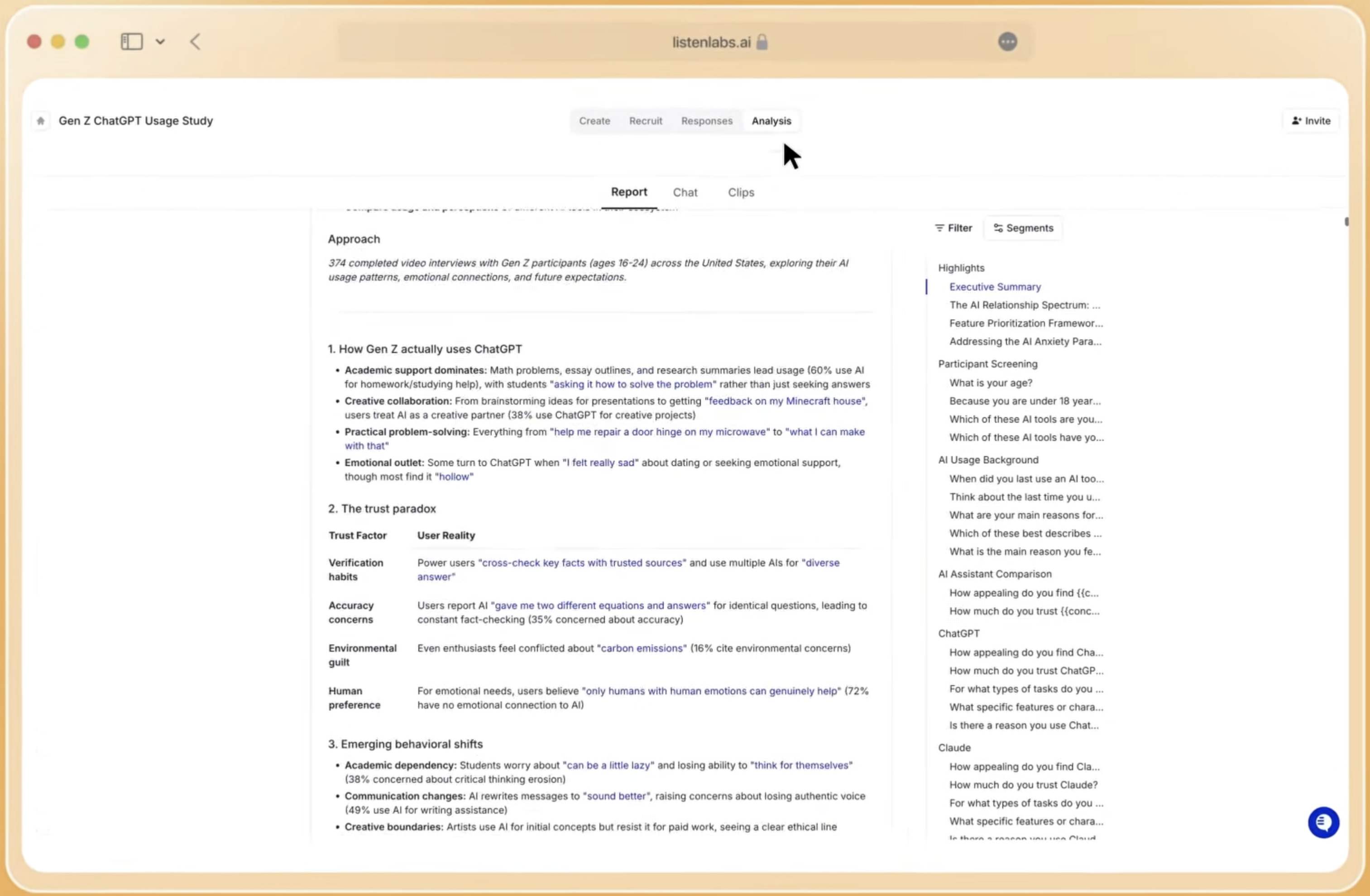
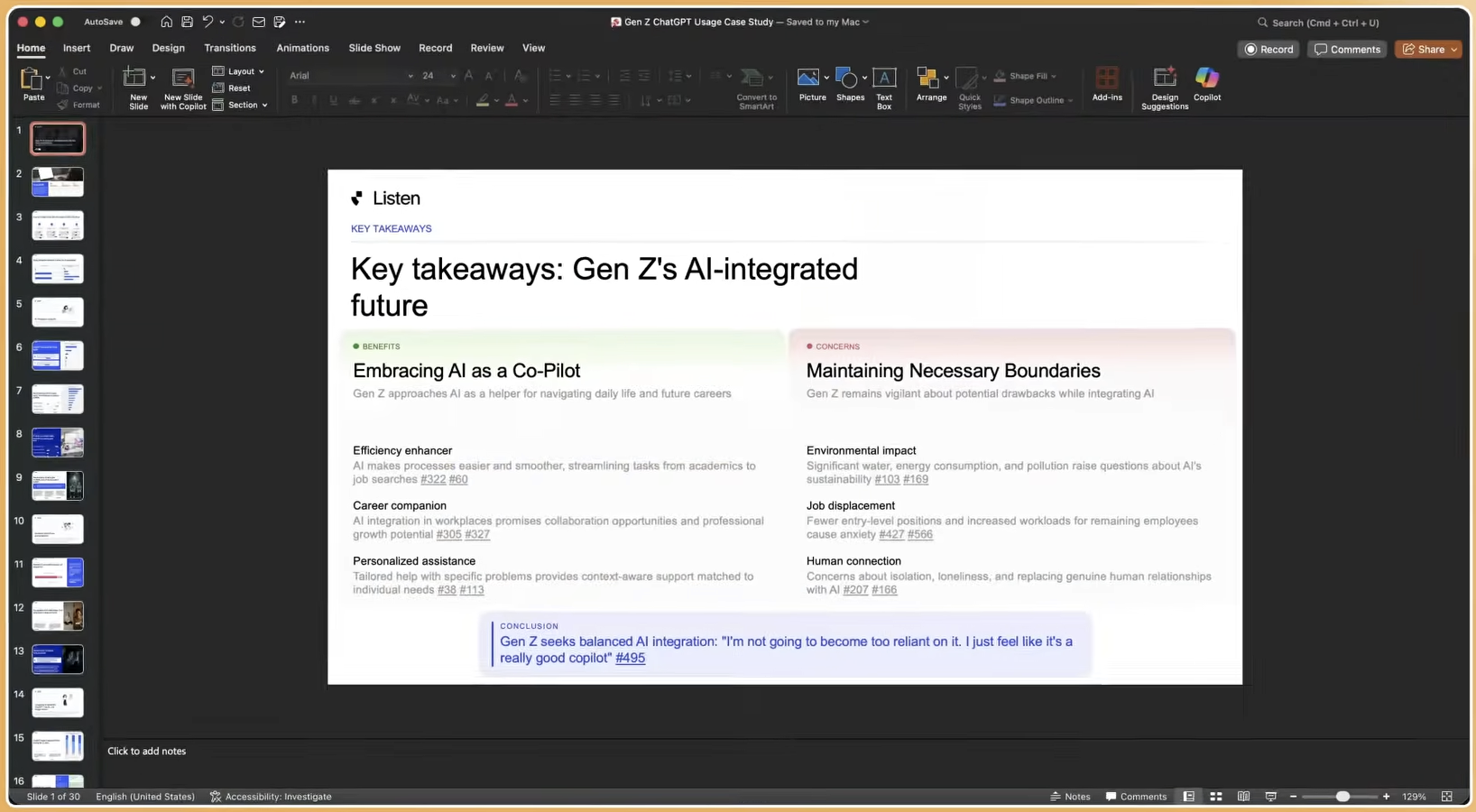
- Research Agent Analysis: Research Agent handles the full analysis workflow from raw data to final output. It generates slide decks, memos, highlight reels, and statistical comparisons in under a minute.
How AI Cuts UX Recruitment Timelines From Weeks to Hours
Traditional in-depth user interviews often require 4–6 weeks end-to-end, with recruitment alone consuming 1–2 weeks to source and screen 15–30 participants through sequential human coordination. Industry benchmark data from 2026 reports an average of 42 days for a typical user research project end-to-end.
AI-enabled platforms invert this structure. AI-moderated qualitative interviews deliver full results in 24 hours from study launch, with automated panel deployment filling recruitment in 2–24 hours, 200+ simultaneous 30-minute conversations running in parallel, automated analysis completing in 1–4 hours, and reporting finishing in 1–2 hours. Recruitment, fieldwork, and analysis run concurrently instead of in sequence, which creates the speed gain.
Listen Labs’ Listen Atlas layer drives this acceleration by matching participants on behavioral and intent data rather than self-reported demographics. Behaviorally profiled participant pools achieve higher incidence rates than demographic-only panels. That means fewer disqualifications, faster fill rates, and higher-quality samples from the first session.
AI UX Research Participant Quality and Data Integrity
An estimated 30–40% of online survey data shows signs of quality compromise, and a third of online survey takers say they have used tools like ChatGPT to answer questions. In qualitative research, a single fraudulent or disengaged respondent in a 12–20 person study can noticeably distort findings.
Listen Labs addresses this through three integrated layers of protection.
- Non-commodity panel sourcing: Listen Labs works only with high-quality, verified panel sources. Its respondent network excludes commodity panels where professional respondents treat participation as income and bot accounts inflate sample diversity.
- Quality Guard real-time monitoring: Every interview is monitored across video, voice, content, and device signals at the same time. AI-moderated interviews enable multi-signal analysis of response latency, linguistic complexity, reasoning depth, emotional markers, and cross-reference consistency, which exceeds human cognitive bandwidth. Participants are capped at three studies per month.
- Dedicated recruitment ops team: A human review layer handles hard-to-reach segments such as enterprise decision-makers, healthcare workers, and audiences below 1% incidence rate. This adds sourcing precision that automated systems alone cannot match.
Each completed study feeds a reputation scoring database. Participant quality improves over time, creating a compounding advantage that commodity panel providers cannot match.
End-to-End AI Research Platforms in 2026
Qual-at-scale uses AI to automate time-consuming aspects of qualitative research like recruiting, interviewing, and analysis, enabling deeper insights at larger scales without traditional barriers of cost and time. Most platforms in 2026 address only one phase of this lifecycle, which creates integration gaps that slow research teams. Panel providers solve sourcing but leave teams to handle moderation separately. Analysis tools organize past research but do not conduct new studies. AI moderation platforms conduct interviews but rely on external recruitment vendors, which reintroduces coordination overhead that automation should remove.
Listen Labs is the only platform that integrates five phases, including study design, recruitment, moderation, emotional intelligence analysis, and automated deliverable generation, into a single end-to-end workflow. One researcher ran a full buying intent analysis across three user segments in under a minute using Research Agent, the automated analysis layer. Mission Control then acts as a persistent knowledge base, enabling cross-study queries and trend tracking so institutional research knowledge compounds instead of disappearing into siloed reports.
Listen Labs holds SOC 2 Type II, GDPR, ISO 27001, ISO 27701, and ISO 42001 certifications. Customer data is never used for AI model training, which addresses core concerns among product teams using AI in research, including trust, ethics, privacy, and security.
Book a demo to explore Listen Labs’ full-stack research platform.
AI-Moderated UX Interviews and Participant Experience
Platforms like Listen Labs layer on auto-recruiting, transcription, sentiment tagging, and insight summarization so teams move from question to findings in hours, not weeks. The AI moderator conducts personalized video conversations with dynamic follow-up questions and probes deeper on short or unexpected answers instead of following a fixed script.
These capabilities support that speed and depth.
- Adaptive follow-up questioning that responds to participant answers in real time
- Screen sharing and mobile screen recording on iOS for usability and prototype testing
- Mixed-method formats that combine qualitative conversation with Likert scales, NPS, sliders, MaxDiff, and grids
- Support for 100+ languages with automatic transcription and translation
- Emotional Intelligence analysis built on Ekman’s universal emotions framework, tracking anger, anticipation, disgust, fear, joy, sadness, trust, and surprise through tone of voice, word choice, and facial micro-expressions, with every label traceable to the exact timestamp and verbatim quote
UX team adoption of AI customer research reached 73% in 2026, driven by screen-share and prototype-share capabilities that allow participants to walk through Figma files or live products during AI-moderated interviews. The same 2026 report notes that AI-moderated interview completion rates exceed 85%, compared to 22% for long-form surveys.
Enterprise Results From Rapid UX Research
Listen Labs has conducted over 1 million AI-powered customer interviews for companies including Microsoft, Perplexity, and Sweetgreen. Four enterprise case studies show the platform’s speed and quality at scale.
Microsoft needed global customer stories for its 50th anniversary celebration within a day. A Director of Data Science at Microsoft reported: “We were able to collect those user video stories within a day. Our leadership team was very thrilled at both the speed and the scale that Listen Labs enabled. I can reach out to hundreds of users at one third of the cost.”
Anthropic used Listen Labs to understand why Claude users cancel subscriptions. The platform delivered 300+ user interviews in 48 hours, surfaced churn drivers 5x faster, and produced a prioritized list of 10 must-fix items. A Director of Product Strategy at Anthropic stated: “Listen Labs lets us understand user churn with a level of clarity and speed we’ve never had before.”
Procter & Gamble evaluated how men respond to new product claims before market launch. Listen Labs delivered 250+ interviews with quantified themes and verbatim proof in hours. The findings shaped product and brand strategy by revealing that comfort, safety, and reliability matter more to consumers than novelty.
Skims needed to validate campaign direction with thousands of high-income buyers overnight before a global launch. Listen Labs identified and qualified premium consumers overnight, eliminating weeks of recruiting. An SVP of Data, Insights, and Loyalty at Skims noted: “I always struggled with understanding the why and Listen Labs nails this for me.”
UX Research Recruitment Fraud Prevention
Industry estimates place fraud rates between 10% and 30% of panel-based qualitative research participants, with some categories attracting even higher rates. The fraud rates mentioned earlier, ranging from roughly 10% to 40% depending on methodology, do not reduce accuracy in a simple linear way. Fraud contamination propagates through theme identification, frequency counts, and false pattern creation.
A 2025 study found that more than a third of respondents admitted to using AI tools like ChatGPT to help craft responses to open-ended survey questions, and a political scientist demonstrated an autonomous AI agent that passed 99.8% of attention checks across 6,000 trials while evading all existing detection methods.
Listen Labs’ Quality Guard system addresses this threat through behavioral fingerprinting, real-time multimodal monitoring, and post-study validation. AI-moderated conversations with adaptive emotional laddering create conditions structurally resistant to fraud because the unpredictable, response-dependent path requires genuine human experience and memory that automated systems cannot reliably simulate. The platform’s 98% participant satisfaction rate across thousands of studies serves as an additional signal of authentic engagement because bots do not report satisfaction.
Implementation Checklist for Your First AI UX Study
Teams ready to pilot AI-powered UX research recruitment can use this checklist to launch their first study.
- Define research objectives in plain language and identify the target participant profile, including any niche or hard-to-reach segments.
- Confirm whether the study will use Listen Labs’ verified respondent network, a bring-your-own-participants approach, or a combination.
- Set screener criteria using behavioral and intent signals rather than demographics alone.
- Configure stimuli such as images, video, prototypes, or live URLs, and enable screen sharing if the study involves usability or prototype testing.
- Review the AI-drafted study guide and activate auto-QA before launch.
- Enable Quality Guard monitoring and confirm frequency cap settings.
- Set target sample size, typically 50–300+ participants for statistical confidence with qualitative depth.
- Schedule Research Agent to generate deliverables such as slide decks, memos, and highlight reels upon fieldwork completion.
- Route findings to Mission Control to build institutional knowledge for cross-study queries.
Conclusion: From Multi-Week Cycles to Overnight Insights
With qual-at-scale, the old trade-off between depth and scale no longer blocks decision-making. The multi-week traditional UX research cycle described earlier, driven by sequential recruitment, human-moderated sessions, and manual analysis, now creates a structural disadvantage for teams operating on sprint cycles or competitive timelines. Listen Labs collapses that cycle into under 24 hours by combining AI-assisted study design, behavioral participant matching, three-layer fraud prevention, adaptive AI-moderated interviews in 100+ languages, and automated analysis in a single platform.
Enterprise teams at Microsoft, Anthropic, P&G, and Skims use this infrastructure to move from study brief to board-ready insights overnight. UX research leads, product managers, and insights directors can apply the same approach to remove the recruitment bottleneck.
Book a demo and run your first study in under 24 hours.
Frequently Asked Questions
How does AI recruitment for UX research actually prevent fraud, not just detect it?
Prevention and detection operate at different stages of the participant lifecycle. Listen Labs prevents fraud before a session begins by sourcing exclusively from non-commodity, verified panels and applying behavioral matching on intent and past actions rather than self-reported demographics. During sessions, Quality Guard monitors video, voice, content, and device signals simultaneously across every interview, which no human moderator can replicate at scale. Participants are capped at three studies per month, removing the professional survey-taker dynamic that plagues open panels. Post-study, behavioral fingerprinting and linguistic analysis flag duplicate accounts and AI-generated responses. The compounding effect is a reputation scoring system that strengthens with every study completed on the platform and creates a fraud-resistance advantage that grows over time.
Can AI-moderated interviews match the depth of human-moderated UX research sessions?
For most UX research objectives such as concept testing, usability studies, prototype validation, brand perception, and consumer journey mapping, AI-moderated interviews deliver comparable depth on planned questions while enabling 10–40x the throughput of human-moderated sessions. Listen Labs’ AI moderator probes deeper on short or unexpected answers, adapts its line of questioning based on participant responses, and captures emotional signals through tone of voice, word choice, and facial micro-expressions using Ekman’s universal emotions framework. The platform’s in-house research team, with 50+ years of combined expertise, continuously refines the methodology. Research teams can talk to 50–300+ participants per study instead of 5–10 and achieve statistical confidence without sacrificing qualitative depth.
What types of UX research studies does Listen Labs support?
Listen Labs supports a broad range of study types across the product and brand research lifecycle. These include concept and prototype testing, usability testing with screen sharing and mobile screen recording, creative and ad testing, brand perception studies, consumer journey mapping, multi-market segmentation and localization studies, pricing research, and survey open-end analysis. The platform handles both one-off studies and ongoing continuous research programs. Researchers can build free-flowing in-depth interviews, semi-structured sessions, diary studies, ethnographic formats, or task-based UX tests from scratch or from a template library. Advanced stimuli options include images, video, audio, PDFs, prototypes, and live URLs, with support for monadic or sequential randomization, quotas, branching, skip logic, and piping.
How does Listen Labs handle participant recruitment for niche or hard-to-reach audiences?
Listen Labs’ dedicated recruitment operations team handles sourcing for segments that automated panel matching cannot reach alone. This includes enterprise decision-makers, engineers, healthcare workers, and consumer segments below 1% incidence rate. The team partners with niche communities, micro-creators, and specialized networks to find the right participants. For organizations that want to study their own user base, Listen Labs supports self-recruitment at a reduced credit cost, which allows teams to bring their own participants while still using the platform’s moderation, analysis, and delivery infrastructure. The Listen Atlas AI orchestration layer also bids across multiple panel partners, including proprietary Listen Labs sources and partners like NewtonX for B2B audiences, to maximize fill rates for difficult-to-reach profiles.
What deliverables does Listen Labs produce, and how quickly are they available?
Research Agent generates a full suite of stakeholder-ready deliverables automatically upon fieldwork completion. These include automated key findings and thematic analysis, consultant-quality PowerPoint slide decks, memo-style reports, video highlight reels compiled from interview recordings, statistical charts and significance tests, segmentation breakdowns by demographics or custom cohorts, and custom reports generated through natural-language queries. Every insight links back to the underlying response data, including specific timestamps, verbatim quotes, and the reasoning behind each finding, so researchers can verify and interrogate outputs rather than accept summaries at face value. Deliverables are typically available within minutes of analysis completion, which keeps the full cycle within the 24-hour window from study launch to final report.