
Written by: Anish Rao, Head of Growth, Listen Labs | Last updated: July 24, 2026
Key Takeaways
- Traditional UX research cycles take 4–6 weeks. End-to-end AI platforms compress the full workflow to under 24 hours by removing manual handoffs between recruitment, moderation, and analysis.
- Adaptive AI moderation reaches the same depth as skilled human interviewers. It probes five to seven levels into motivations and mental models across hundreds of participants without fatigue.
- Enterprise-grade participant quality depends on real-time fraud detection, behavioral matching, and strict participation limits. Listen Labs’ Quality Guard and Listen Atlas deliver this across a verified 30-million-respondent network.
- Multimodal emotional intelligence captures tone, micro-expressions, and engagement signals that transcripts miss. It provides traceable, timestamped emotion labels for every question and concept.
- Listen Labs is the only platform that meets all seven core evaluation criteria in a single solution. See how it performs against your specific research objectives in a live environment.
Evaluation Criteria for UX Research AI Platform Selection
Enterprise buyers evaluate UX research platforms across multiple dimensions at once. A platform that delivers speed but sacrifices participant quality produces fast, unreliable data. A platform with strong emotional signal capture but no integrated recruitment pushes teams back into fragmented workflows. The seven core criteria below reflect the full research lifecycle and map directly to the pain points most commonly cited by heads of UX research and consumer insights leaders at mid-to-large organizations.
Research Speed: From Weeks to Hours
Traditional qualitative research cycles often run four to six weeks from study design to final report. In enterprise settings with internal prioritization queues, that timeline can stretch to six months.
Point solutions compress individual phases but leave handoff delays intact. A recruitment platform speeds sourcing, and an analysis tool speeds synthesis. The time lost transferring data between disconnected systems, exporting transcripts, reformatting files, and re-importing into an analysis tool consumes 30 to 50 percent of total research time when teams stitch separate tools together.
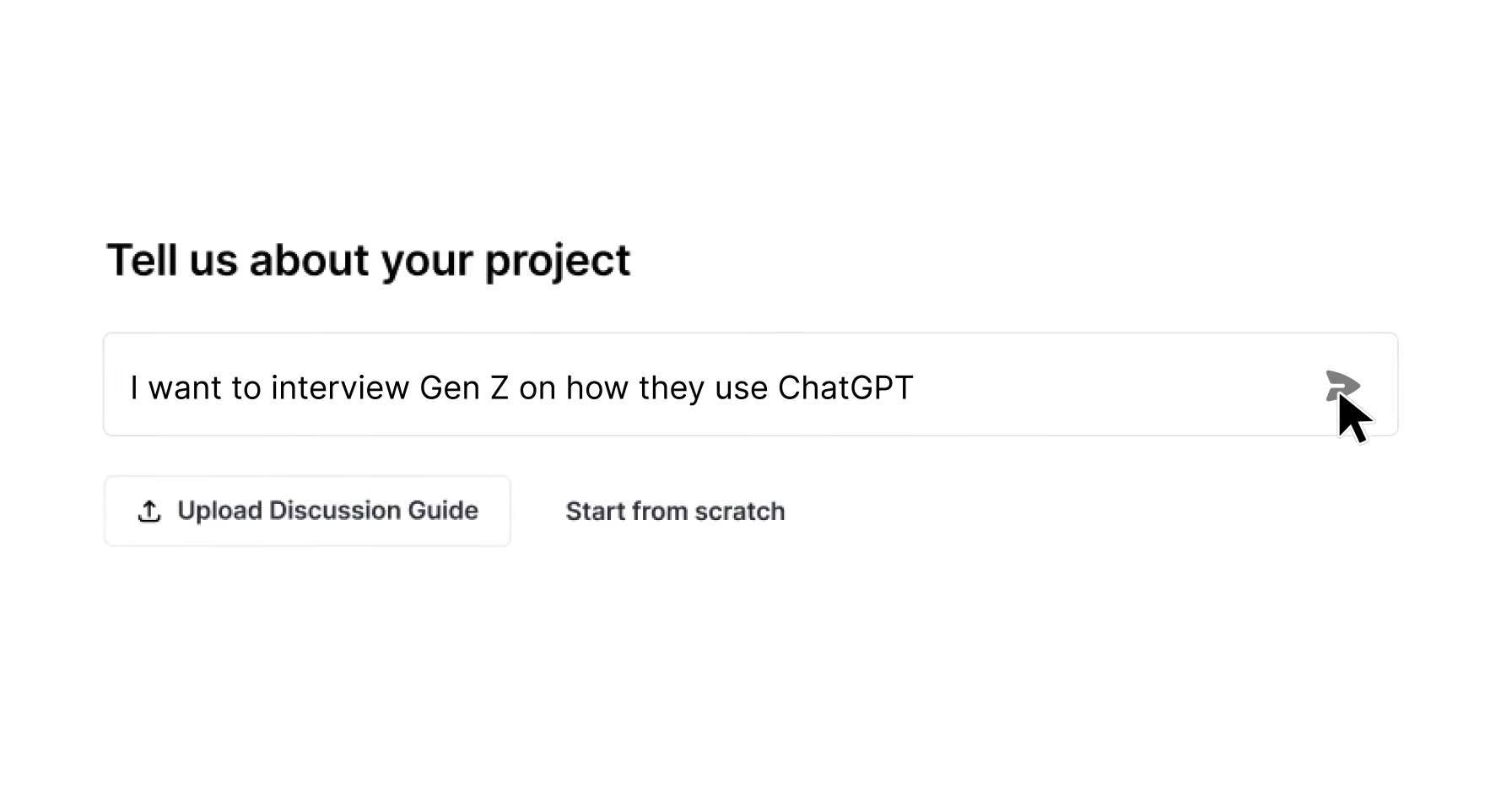
End-to-end platforms that integrate recruitment, moderation, and analysis into a single data model remove those handoffs. The 2026 AI Research Productivity Report, based on 217 AI-moderated studies conducted between January and April 2026, found that AI user research tools cut median time-to-insight by 84 percent versus 2024 baselines. Listen Labs compresses the entire cycle, from study design through final deliverables, to under 24 hours. Microsoft used the platform to collect global customer video stories for its 50th anniversary celebration within a single day.
Depth of Insight with Qual-at-Scale
Depth of insight determines whether research can guide product or brand decisions. Survey tools and unmoderated testing platforms scale easily but rely on pre-set questions with no adaptive follow-up. When a participant describes a feature as confusing, a fixed-script tool advances to the next question. An adaptive AI moderator asks what specifically felt confusing, then probes the answer to that question.
With qual-at-scale, the old trade-off between depth and scale is no longer a barrier. AI-moderated interviews that apply structured laddering methodology probe five to seven levels into motivations, blockers, and decision criteria. This matches the depth a skilled human moderator achieves and applies it consistently across every participant without fatigue. For UX leads validating prototypes, this reveals not only whether a flow is confusing but also why it triggers confusion and which mental model the user brings to the interaction. Anthropic used Listen Labs to surface churn drivers for Claude users across 300-plus interviews in 48 hours, identifying where former users migrate and producing a prioritized list of ten must-fix items.
Participant Quality at Scale
Participant quality often receives too little attention during platform evaluation and then becomes the main reason research fails. A Kantar report indicates researchers discard 38 percent of survey data on average due to quality concerns. Commodity panels introduce professional survey-takers, fraudulent profiles, and incentive-driven responses that bias findings before analysis begins.
Enterprise-grade participant quality requires multiple control layers that work together. Listen Labs operates a verified network of 30 million respondents across 45-plus countries. To ensure each participant matches the study’s behavioral profile, Listen Atlas uses an AI orchestration layer that evaluates intent signals and past engagement patterns instead of relying on self-reported demographics alone. Once matched, Quality Guard monitors every interview in real time across video, voice, content, and device signals, catching fraud, low-effort responses, and mismatched profiles before they contaminate the dataset. To prevent the panel fatigue that degrades commodity networks, participants are limited to three studies per month. For audiences that require specialized vetting, such as enterprise decision-makers, healthcare workers, and sub-1 percent incidence segments, a dedicated recruitment operations team adds a human review layer.
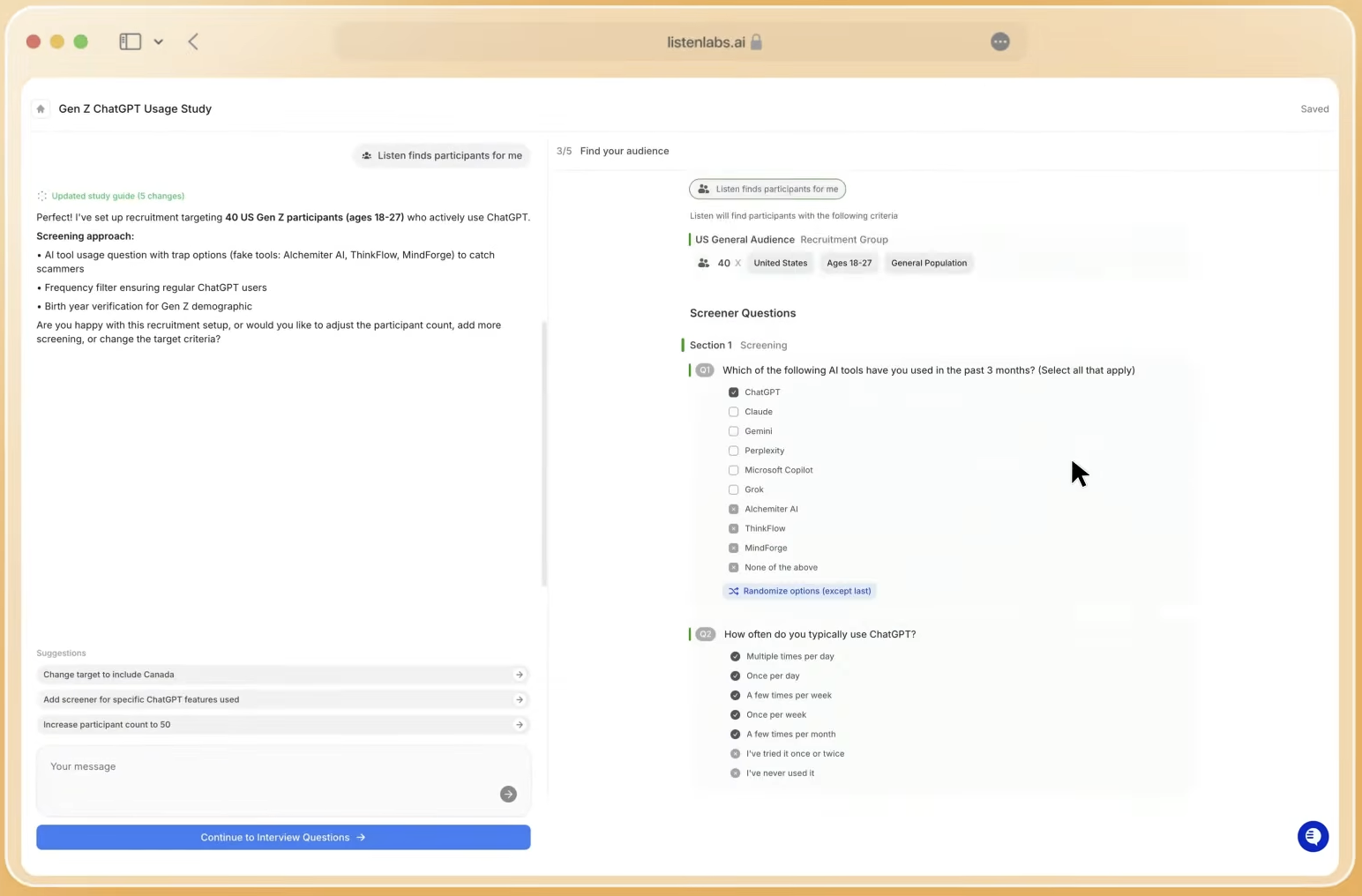
See how Quality Guard and Listen Atlas deliver verified participants for your audience in a live demo.
Emotional Signal Capture for Richer Insights
Emotional signal capture reveals what participants feel, not just what they say. Transcripts capture spoken words but miss hesitation before answering, a frown during concept exposure, or a flat vocal tone that contradicts a positive rating. Traditional interview methodology leaves emotional valence and engagement largely unmeasured, relying instead on post-hoc self-report or the subjective interpretation of a skilled moderator.
Most AI-moderated platforms operate on the verbal layer only. The emotional signal layer, which captures facial expression, voice modulation, and engagement intensity to reveal what users feel but do not articulate, is rare and appears mainly on multi-signal systems.
Listen Labs’ Emotional Intelligence analyzes three layers of signal: tone of voice, word choice, and subconscious micro expressions. It uses Ekman’s universal six emotions framework, the standard in clinical psychology and UX research, tracking anger, disgust, fear, happiness, sadness, surprise, and neutral states. Every emotion is quantified per question and concept, with each label traceable to the exact timestamp, verbatim quote, and AI reasoning behind it. For creative testing, this pinpoints where participants light up or disengage. For usability testing, it surfaces moments of hesitation and frustration that participants do not verbalize. Skims used this level of emotional clarity to validate a global campaign direction overnight with thousands of high-income buyers, securing board-level buy-in before launch.
Global Reach and Language Support
Global reach and language coverage determine whether research can scale beyond a single market. Consumer insights teams at Fortune 500 enterprises often need to run studies across multiple markets at the same time. Point solutions built for English-language markets create structural barriers, including limited geographic panel coverage, moderation only in the platform’s primary language, and manual translation workflows that add days to the cycle.
Listen Labs supports moderation, transcription, and translation across 100-plus languages and operates across 45-plus countries in the Americas, Europe, APAC, and MEA. The qual-at-scale approach described earlier proves especially valuable for global studies, where AI tools engage hundreds or thousands of participants remotely and asynchronously across markets. Procter and Gamble used Listen Labs to conduct 250-plus interviews evaluating how men respond to new product claims, with quantified themes and verbatim proof delivered in hours rather than weeks, directly shaping product and brand strategy before market.
Analysis Effort and Reporting Transparency
Manual thematic analysis of 30 interview transcripts takes an experienced researcher two to three weeks, while AI analysis platforms can process the same 30 transcripts in minutes, generating a codebook, tagging segments, detecting themes, calculating sentiment, and producing a draft synthesis document. The critical differentiator between analysis tools is not speed alone. Traceability determines whether stakeholders can trust the findings.
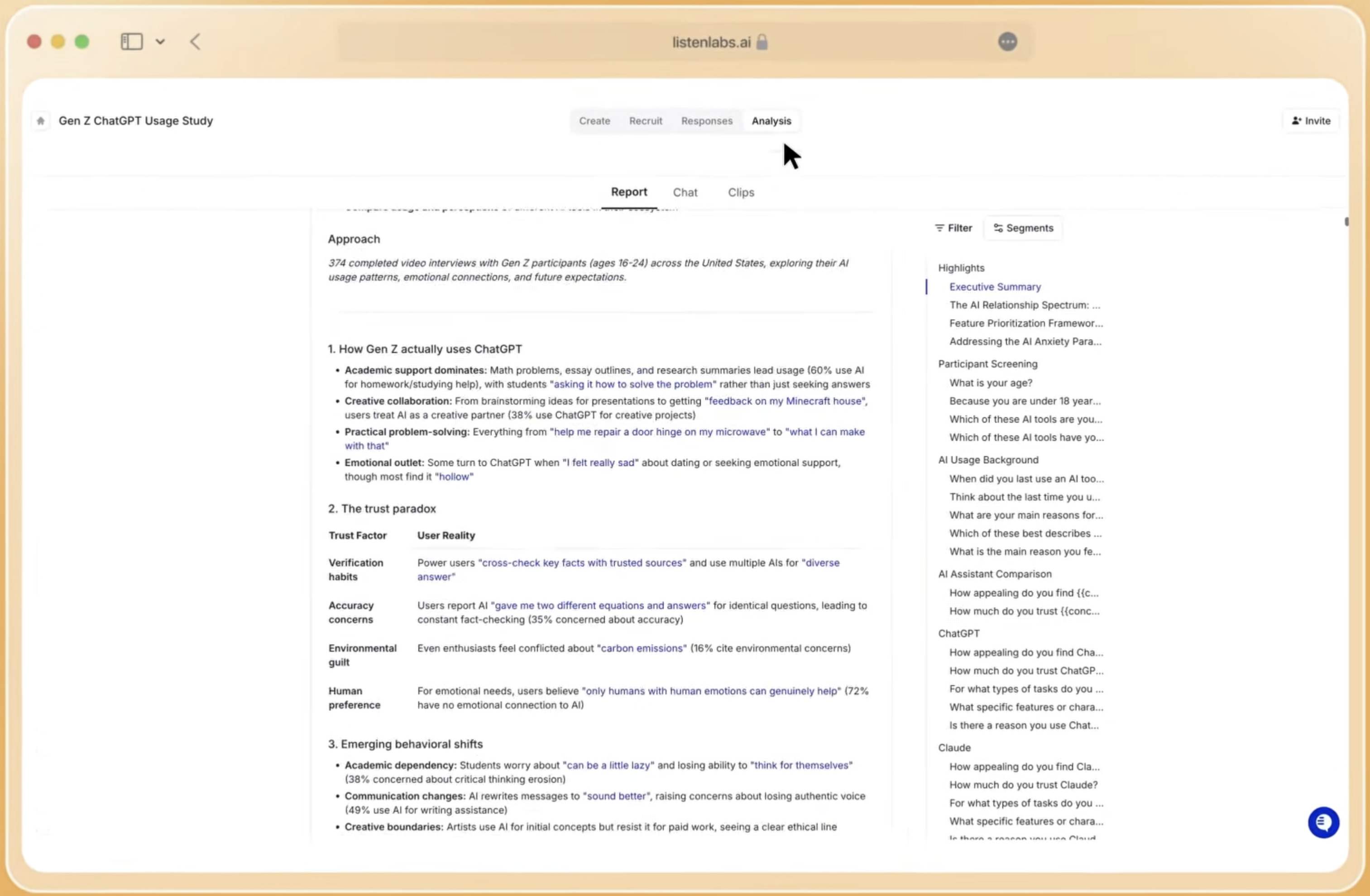
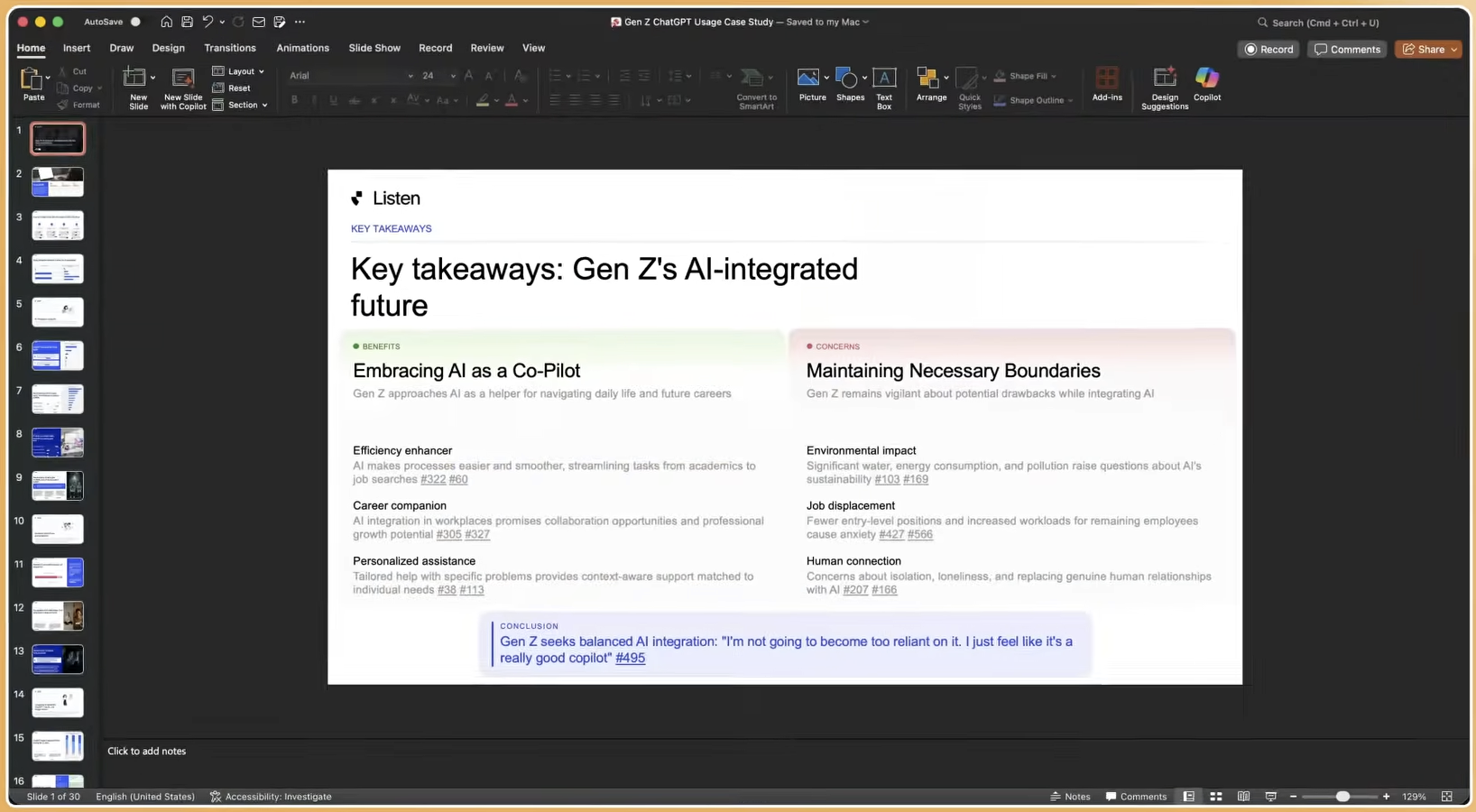
Listen Labs’ Research Agent handles the full analysis workflow from raw data to final output, with every insight linking directly to the underlying response data. Researchers can query findings in natural language, run segment comparisons with significance testing, and generate a slide deck in a company’s branded template and a downloadable report in under a minute. Robinhood used this capability to reveal that users who view prediction markets as entertainment rather than income drive 2.4 times higher weekly re-engagement. These insights arrived five times faster than traditional methods, and integration flows based on the findings boosted uptake 30 to 40 percent.
Security Certifications and Total Operational Burden
Security posture and operational burden shape whether a platform can pass enterprise procurement. Procurement teams require documented security before any platform handles participant data or proprietary research assets. Enterprise UX research buyers increasingly verify SOC 2 Type II compliance, requiring a current report available under NDA, before approving an AI research platform. Global deployments also require GDPR compliance, documented data processing agreements, and sub-processor transparency.
Listen Labs holds SOC 2 Type II, ISO 27001, ISO 27701, and ISO 42001 certifications. Customer data is never used for AI model training, and all data is protected with 256-bit encryption. ISO 42001, the first internationally certified AI management system standard, providing a structured framework for establishing, implementing, maintaining, and continually improving an organization’s AI management system, signals governance maturity that most point solutions cannot demonstrate.
Total operational burden extends beyond security certifications. Integration and data preparation consume 40 to 80 percent of data team time on connecting, cleaning, and transforming data. A single end-to-end platform eliminates vendor coordination costs, reduces the attack surface for security incidents, and simplifies compliance documentation across jurisdictions. This data preparation burden, mentioned earlier, produces no research value when teams stitch together fragmented tools.
Scenario-Based Guidance for Different Teams
The right platform depends on the team’s primary constraint. Four scenarios illustrate where end-to-end platforms and point solutions diverge most sharply.
Enterprise consumer insights leaders running 20-plus studies per quarter face a backlog problem, not a capability problem. Their constraint is throughput. An end-to-end platform that compresses the full cycle to under 24 hours multiplies research output without proportional headcount increases. This time reduction mentioned earlier translates to a 6.2 times increase in studies per researcher per quarter at constant headcount.
UX research leads at mid-to-large tech companies need faster feedback loops to keep pace with sprint cycles. Their constraint is speed to first insight with sufficient participant depth. Platforms that support screen sharing, usability task flows, and 50-plus concurrent sessions replace the five-to-ten-user studies that cannot produce statistically meaningful patterns.
Product and marketing teams without dedicated researchers need self-serve simplicity. Their constraint is methodology expertise. AI-assisted study design that translates natural-language research goals into structured discussion guides removes the barrier to entry while preserving rigor.
Agencies and consultancies need speed and niche audience access. Their constraint is turnaround time measured in days, not weeks. Platforms like Listen Labs layer on auto-recruiting, transcription, sentiment tagging, and insight summarization so teams jump from question to findings in hours, not weeks. These scenarios illustrate the technical fit. Successful adoption also requires addressing the organizational dimension.
Operational Considerations: Alignment, Governance, and Repeatability
Operational considerations determine whether an AI research platform sticks. Adopting an end-to-end AI research platform is not only a tooling decision. It represents an organizational change.
Stakeholder alignment depends on showing that AI-moderated interviews produce findings that hold up to scrutiny. Traceability, the ability to link every insight to a source quote and timestamp, provides the primary mechanism for building that confidence.
Governance requirements are tightening globally. The majority of the EU AI Act’s rules become applicable on 2 August 2026, with remaining obligations phased in through 2028. Platforms without documented AI management systems, data lineage controls, and consent management infrastructure create compliance exposure for enterprise buyers operating across jurisdictions.
Repeatability creates an operational advantage that compounds over time. Mission Control, Listen Labs’ cross-study knowledge base, means every completed study grows the organization’s institutional knowledge. Teams can query past research in seconds rather than re-running studies on questions already answered.
Risks and Limitations of Fragmented Approaches
Fragmented point-solution stacks carry four categories of risk that buyers often underestimate during platform evaluation.
- Participant fraud: The data quality problem mentioned earlier, where nearly two-fifths of survey responses prove unusable, compounds when commodity panels lack real-time behavioral monitoring.
- Shallow data: Fixed-script tools and unmoderated tests capture surface-level responses without the adaptive probing needed to uncover motivations, mental models, or emotional drivers.
- Hidden coordination costs: The data preparation burden mentioned earlier, which can consume up to 80 percent of team time, produces no research value when teams connect, clean, and transform data across fragmented tools.
- Governance gaps: Organizations with high shadow AI usage saw $670,000 higher breach costs on average compared to those with minimal unauthorized AI tools, and fragmented stacks increase the likelihood of ungoverned data flows.
Decision Framework and Checklist
A structured checklist helps teams compare platforms consistently. Evaluate each option against the questions below. A platform that cannot answer all of them affirmatively introduces risk at the corresponding stage of the research lifecycle.
- End-to-end coverage: Does the platform cover study design, recruitment, moderation, analysis, and reporting in a single data model, or does it require manual handoffs between stages?
- Fraud controls: What fraud prevention controls operate in real time during interviews, and how are flagged responses handled?
- Audience reach: Can the platform reach your specific audience, including niche or hard-to-find segments, without relying on commodity open-access panels?
- Emotional signals: Does emotional signal capture go beyond transcript sentiment to include facial expression and vocal tone analysis, with traceable reasoning per label?
- Traceable insights: Are insights linked to source quotes and timestamps, or does the analysis layer operate as a black box?
- Time to deliverables: What is the documented time from study launch to final deliverable for a 50-interview study?
- Security posture: Does the platform hold SOC 2 Type II, ISO 27001, and ISO 42001 certifications, and is customer data excluded from AI model training?
- Continuous learning: Can the platform support continuous research programs, not just one-off studies, with cross-study querying and trend tracking?
Frequently Asked Questions
How long does it actually take to get results from an AI-moderated interview study?
On an end-to-end platform like Listen Labs, the full cycle from study launch to final deliverables, including recruitment, moderation, analysis, and report generation, completes in under 24 hours for most studies. This compares to a traditional qualitative cycle of four to six weeks. The speed comes from removing handoffs between stages, since recruitment, moderation, and analysis run within a single platform rather than across separate tools with manual data transfers.
How are participants sourced, and what prevents fraudulent or low-quality responses?
Listen Labs sources participants from a verified network of 30 million respondents across 45-plus countries. Participant matching uses behavioral and intent data rather than self-reported demographics alone. Quality Guard monitors every interview in real time to detect fraud and low-effort responses, and strict participation limits reduce panel fatigue. For the full quality control framework, see the Participant Quality at Scale section above.
What is the difference between AI-moderated interviews and unmoderated usability tests?
Unmoderated tests capture behavioral data such as clicks, pauses, and task completion but cannot reveal why users behave as they do. AI-moderated interviews use adaptive probing to follow unexpected threads, ask clarifying questions based on participant responses, and probe five to seven levels deep into motivations and mental models. This produces qualitative depth equivalent to skilled human moderation, applied consistently across every participant without fatigue or variability, and scalable to hundreds of concurrent sessions within a single study.
How much analysis work is required after interviews are complete?
On Listen Labs, analysis is automated. The Research Agent processes all interview data as sessions complete, identifies themes and patterns, runs segment comparisons with significance testing, and generates stakeholder-ready deliverables, including slide decks, memos, video highlight reels, and charts, in under a minute. Every insight links to the underlying source data, so researchers can verify findings and drill into specific responses without manually re-reviewing transcripts. The platform also supports natural-language queries against the full dataset.
What security and compliance certifications should I require from an AI research platform?
Enterprise buyers should require SOC 2 Type II certification, GDPR compliance with a signed data processing agreement, and a documented sub-processor list. For global deployments subject to the EU AI Act, the majority of whose rules become applicable on 2 August 2026, with remaining obligations phased in through 2028, ISO 27001 (information security management) and ISO 42001 (AI management system) certifications provide evidence of governance maturity. Listen Labs holds all of these certifications. Customer data is never used for AI model training, and all data is protected with 256-bit encryption. Enterprise SSO is also supported.
Conclusion: Choosing the Right UX Research AI Platform
The seven core criteria in this guide, including research speed, depth of insight, participant quality, emotional signal capture, global reach and language support, analysis effort and reporting transparency, and security and operational burden, define what separates an end-to-end AI research platform from a point solution. Point solutions solve one slice of the workflow and force trade-offs at every handoff. End-to-end platforms collapse the entire cycle into a single data model, removing coordination costs, fraud risks, and shallow data that fragmented approaches create.
Listen Labs is the only platform that delivers all seven criteria in a single solution. It combines a 30 million-strong verified panel, AI moderation that probes five to seven levels deep, multimodal emotional intelligence built on Ekman’s framework, 100-plus language support across 45-plus countries, automated analysis with full source traceability, and SOC 2 Type II, ISO 27001, ISO 27701, and ISO 42001 certifications, with results in under 24 hours. Enterprises including Microsoft, Anthropic, Procter and Gamble, Skims, and Robinhood have used this infrastructure to run research that previously took weeks in a single day.
Evaluate Listen Labs against your research objectives, audience requirements, and security standards in a personalized demo that walks through the full cycle from study design to final deliverable.