
Written by: Anish Rao, Head of Growth, Listen Labs | Last updated: August 6, 2026
Key Takeaways for Research Leaders
- Combining separate recruitment and moderation tools like User Interviews and Outset creates persistent handoff delays, quality gaps, and coordination overhead that no integration layer fully resolves.
- Listen Labs removes these bottlenecks by handling recruitment, AI-moderated interviews, analysis, and deliverable generation in one platform, compressing the full research cycle to under 24 hours.
- Quality Guard provides real-time fraud detection across video, voice, content, and device signals, delivering a zero-fraud guarantee that stitched-together platforms cannot match.
- Emotional Intelligence captures tone, word choice, and micro-expressions using Ekman’s framework, quantifying emotional responses that transcript-only tools miss.
- Teams ready to eliminate tool-stacking can schedule a Listen Labs walkthrough and run their next study on a single end-to-end platform.
How This Comparison Evaluates Enterprise Qualitative Platforms
This analysis evaluates Outset, User Interviews, and Listen Labs across the workflow stages where tool-stacking creates the most friction. The focus is recruitment and study setup, moderation and quality controls, analysis and deliverables, and total operational burden. Within each stage, the comparison looks at cycle time, cost, participant quality, and scalability, because these dimensions drive enterprise insights performance in 2026.
Recruitment and Study Setup: Where Delays Begin
User Interviews is a participant recruitment and scheduling platform focused on panel access, automated scheduling, incentives, and participant management, with integrations rather than native support for interview moderation, transcription, or analysis. After participants are sourced, which can take multiple weeks with no-show rates that require rescheduling, the research team must configure Outset, transfer participant data, manage consent, and re-screen for quality before any interview begins.
Listen Labs removes this handoff. Listen Atlas, the platform’s AI orchestration layer, matches and recruits from a network of 30M verified respondents across 45+ countries, using behavioral and intent data instead of self-reported demographics. Quality Guard monitors every session in real time, so recruitment and quality control operate as one system. Listen Labs has conducted over one million AI-powered customer interviews for enterprises including Microsoft, Perplexity, and Sweetgreen, compressing the full brief-to-insights cycle to under 24 hours.
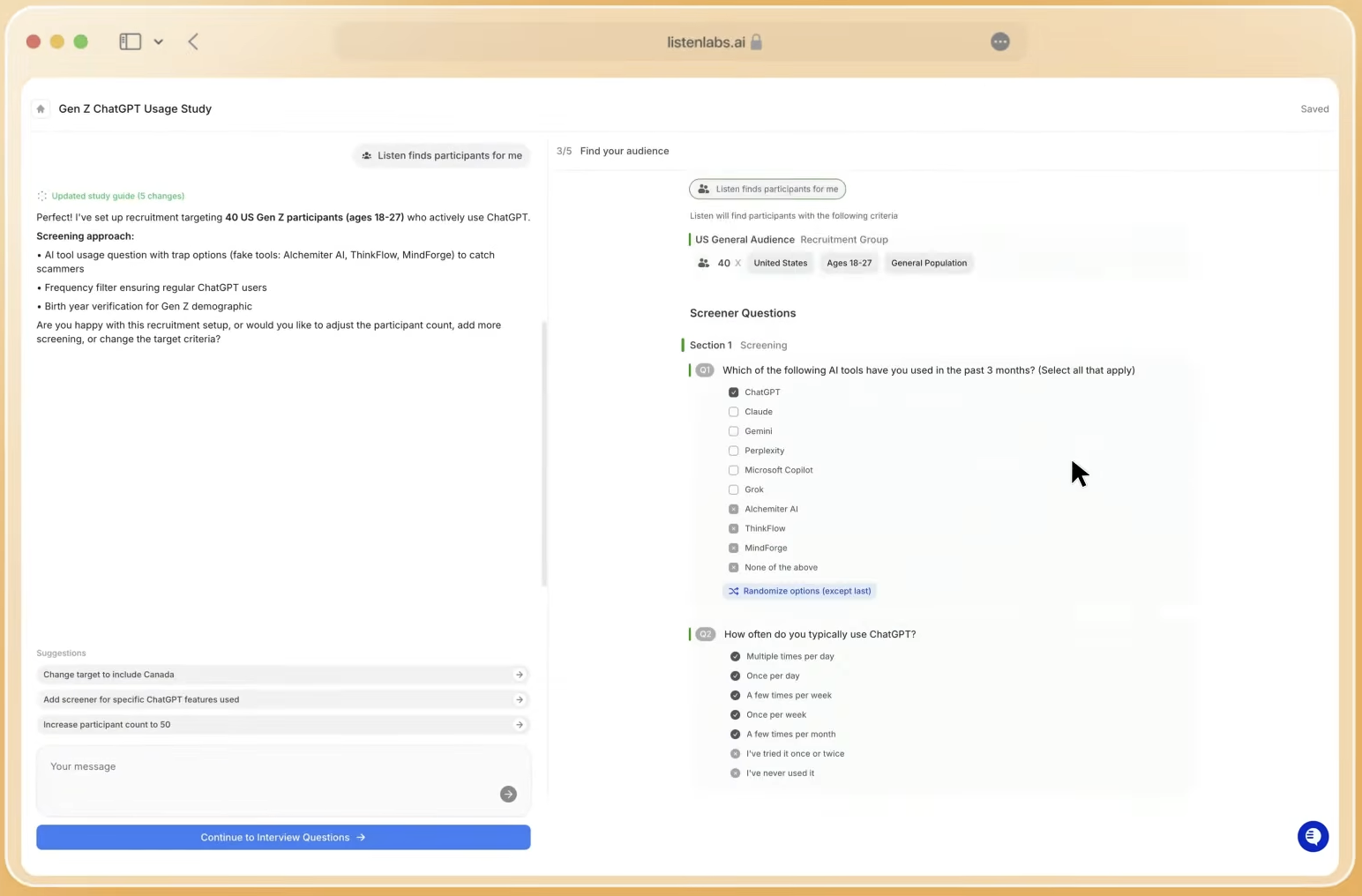
Teams that want to experience this recruitment-to-interview flow can see the full workflow in a live session and run their next study on a single platform.
Moderation Quality and Integrated Data Controls
Outset provides AI-moderated interviewing. Its “Leo” moderator conducts sessions and generates synthesis, but it is tuned for UX and product research rather than full recruitment-to-reporting workflows. When paired with User Interviews, the moderation layer receives participants sourced through a separate system with separate quality controls. That structural gap introduces compounding risk.
Qualitative studies face increased risk of fraudulent participation when they use online recruitment, online participation, and monetary incentives, which describes most commodity panel sourcing. Kantar’s best-practice materials state that sample quality is the non-negotiable foundation of qualitative research at scale, a dimension that AI moderation technology alone does not solve. An AI moderator running sessions with the wrong participants still produces fluent answers to the wrong questions.
Listen Labs addresses quality at the infrastructure level through three reinforcing layers. Quality Guard uses real-time AI monitoring across video, voice, content, and device signals to detect fraud, low-effort responses, and mismatched profiles during the session. Participation caps limit individuals to three studies per month, which blocks professional survey-takers before they can re-enter the pool. A dedicated recruitment operations team adds human review for hard-to-reach or nuanced segments, such as niche B2B audiences or regulated professions. These layers work together: automated monitoring catches in-session issues, participation caps prevent repeat offenders, and human review covers edge cases. The result is a quality flywheel that compounds with every study, creating a structural advantage that stitched-together platforms cannot replicate.
Depth, Scale, and Emotional Intelligence in One System
Qual-at-scale removes the old trade-off between depth and scale. Listen Labs conducts hundreds of AI-moderated qualitative interviews at the same time, with each conversation personalized through dynamic follow-up questions. Anthropic’s Claude Code team ran 300+ user interviews in 48 hours, surfacing churn drivers five times faster than prior methods.
Neither User Interviews nor Outset captures emotional signals. Listen Labs’ Emotional Intelligence feature analyzes tone of voice, word choice, and subconscious micro-expressions using Ekman’s universal emotions framework. Every emotion is quantified per question and linked to the exact timestamp, verbatim quote, and reasoning behind it. Two concepts can receive similar verbal ratings while triggering very different emotional responses, and transcript-only platforms miss that distinction. Emotional Intelligence works across 50+ languages and connects directly with the Research Agent for natural-language queries and highlight reels.
Analysis, Deliverables, and Knowledge That Compounds
The User Interviews model requires researchers to spend 5–10 hours on moderation, 2–3 hours on transcription, 8–15 hours on coding and analysis, and 4–8 hours on synthesis for a typical study. All of this work happens after recruitment completes. That sequential structure is the main reason traditional qualitative studies using separate recruitment and moderation tools require four to eight weeks end-to-end.
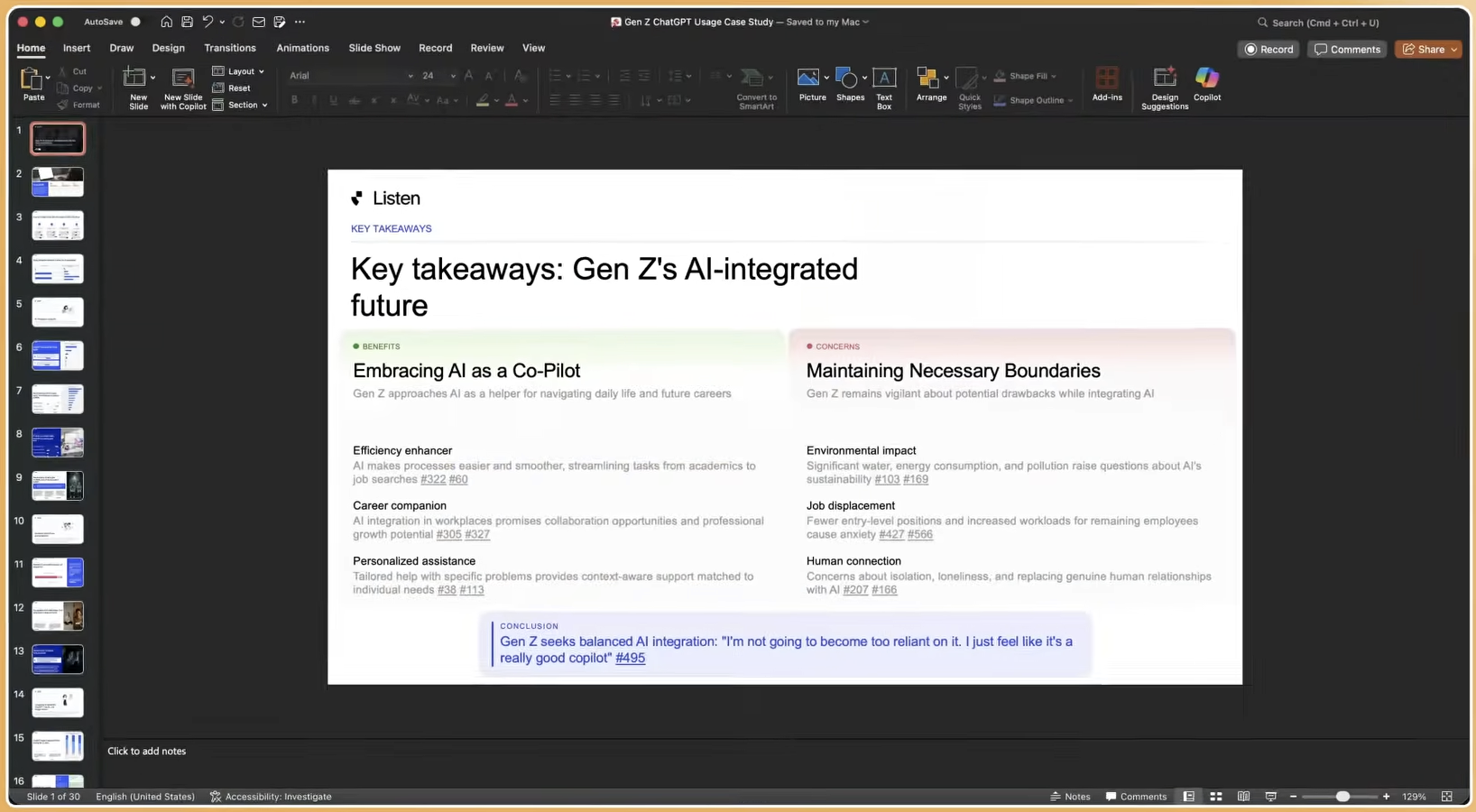
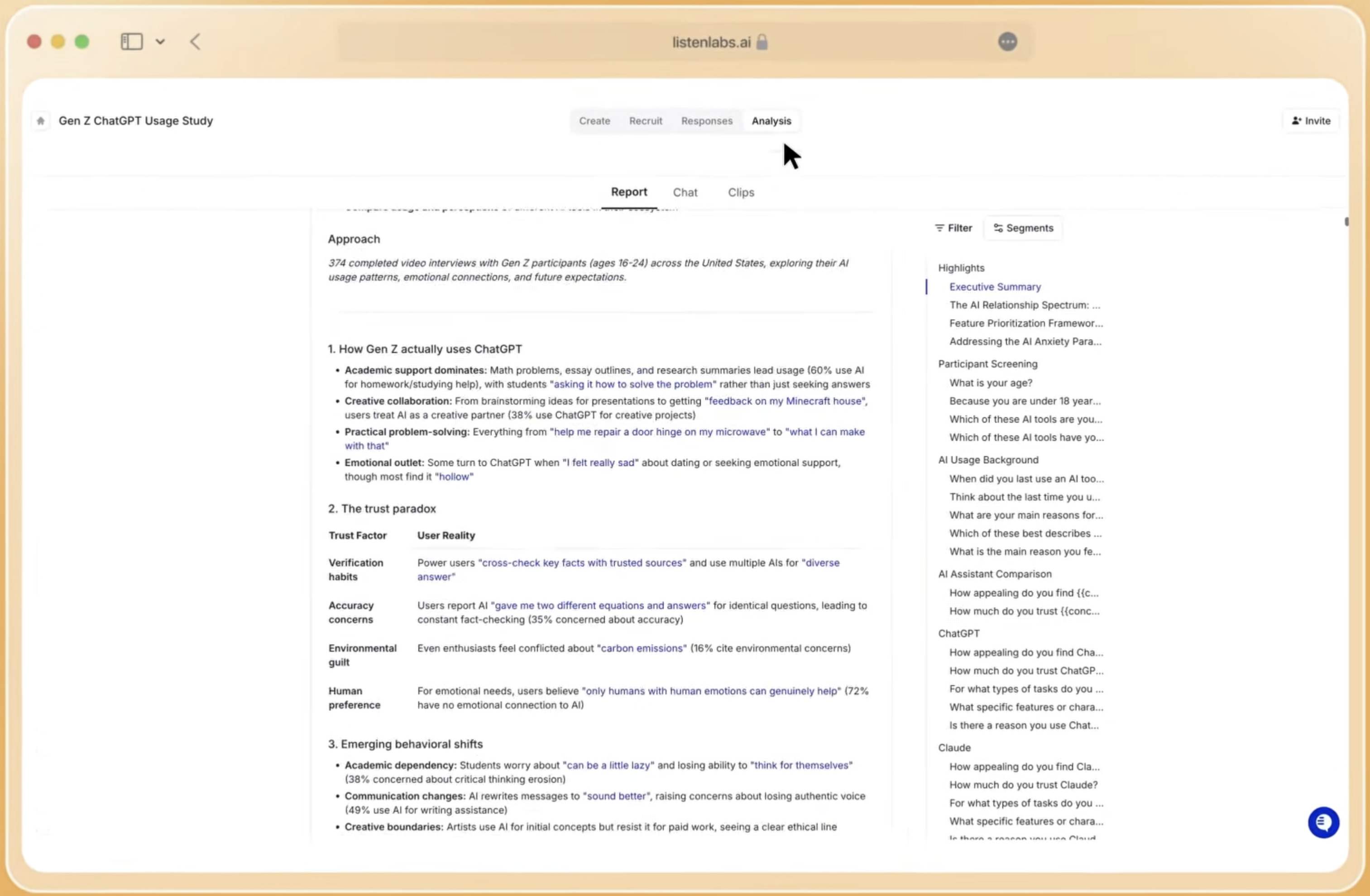
Listen Labs’ Research Agent processes interview data objectively, identifies patterns and themes across hundreds of responses, and generates consultant-quality slide decks, memos, video highlight reels, and statistical charts in under a minute. Mission Control serves as the organization’s permanent source of truth, enabling cross-study queries in natural language and preventing teams from re-running questions already answered in prior work. These efficiency gains at the analysis stage compound the time and cost savings achieved earlier in recruitment and moderation, which sets up a clear view of the total operational impact of tool-stacking. AI can schedule and conduct the interview, analyze the transcripts for themes, and generate quantitative insights from those interviews, all within a single platform session.
The Real Operational Cost of Stitching Outset and User Interviews
The hidden costs of tool-stacking accumulate across every stage of a study. A 50-participant traditional qualitative study using separate recruitment agencies and moderation tools involves substantial spend. Traditional qualitative research at enterprise scale of 200 interviews is rarely attempted because per-study costs become prohibitive.
Beyond direct spend, the coordination tax is heavy. Researchers managing two platforms must reconcile participant data across systems, re-verify quality controls that neither platform enforces end-to-end, and absorb no-show rates that add significant overhead through rescheduling. UserTesting panel renewals dropped 31% year-over-year in the 2026 mid-year report as teams shifted recruiting in-house, which signals that enterprise buyers are actively rejecting the multi-tool model.
Teams that replaced survey-and-panel stacks with conversational AI research platforms achieved significant net savings in tooling spend while increasing study throughput 3.4x. That outcome quantifies the cost of tool-stacking and the upside of removing it. Leaders who want to understand their own numbers can request a cost comparison that benchmarks their current stack against a single end-to-end alternative.
Where Full-Stack AI Research Delivers the Clearest Advantage
The scenarios below show where a full-stack AI research platform outperforms stitched-together tools.
- Consumer insights leaders at Fortune 500 enterprises running 10+ studies per quarter need to compress cycle times without adding headcount. Listen Labs delivers 300+ interviews in 48 hours at one-third the cost of traditional approaches, which matches the benchmark Microsoft’s Director of Data Science cited when describing the platform’s speed and scale for global customer story collection.
- UX research leads validating concepts across sprint cycles cannot wait through two-week recruitment windows. That 24-hour cycle enables research to inform decisions before the sprint closes, which keeps UX work aligned with two-week iterations.
- Product and marketing teams without dedicated researchers need self-serve simplicity. Natural-language study design, automated recruitment, and one-click deliverables remove the methodology barrier and let non-researchers run credible studies.
- Agencies and consultancies running client engagements on compressed timelines need global reach and niche audience access. Listen Labs’ recruitment operations team sources audiences below 1% incidence rate across 45+ countries.
Risks and Limitations Across Platform Categories
Each platform category carries structural limitations that research leaders should weigh carefully.
- Recruitment-only platforms (User Interviews, Prolific, Respondent) solve sourcing but leave moderation, transcription, and analysis to the research team. They do not shorten the overall analysis timeline and introduce handoff risk at every downstream stage.
- Moderation-only platforms (Outset) depend on the quality of participants sourced elsewhere. A well-conducted AI-moderated session with the wrong respondent produces fluent answers to the wrong questions.
- AI moderation at scale requires careful prompt design. Poorly designed prompts in AI moderation amplify errors because a flawed question can be executed across hundreds of interviews instantly. Listen Labs mitigates this through AI-assisted study co-design, auto-QA before launch, and 50+ years of combined in-house research expertise embedded in the platform’s methodology.
- Full-stack platforms require teams to trust that integrated recruitment meets audience specificity requirements. Listen Labs addresses this through behavioral matching, dedicated recruitment operations, and a zero-fraud guarantee backed by Quality Guard.
Decision Guide for Research Leaders
Research leaders choosing between tool-stacking and a full-stack platform should evaluate four dimensions: research goals, operational constraints, audience requirements, and internal capabilities.
Teams whose primary goal is speed and scale, such as running dozens of studies per quarter, compressing four-week cycles to 24 hours, or reaching global audiences in multiple languages at once, gain little from maintaining separate recruitment and moderation platforms. Coordination overhead alone consumes researcher capacity that should go toward strategic analysis.
Teams with highly specialized audience requirements, including sub-1% incidence rate B2B segments or regulated professional categories, need recruitment infrastructure that goes beyond self-serve panel access. Listen Labs’ dedicated recruitment operations team manages these segments directly, which removes the main argument for keeping a standalone recruitment platform.
Teams evaluating emotional depth alongside verbal data need a platform where emotional signal capture is native. Emotional Intelligence is built into Listen Labs’ analysis layer and available across 50+ languages, a capability that neither User Interviews nor Outset provides.
For teams currently running the Outset and User Interviews combination, the core issue is the combined cost in time, budget, and quality risk compared with a platform that handles the entire research lifecycle in one place.
Frequently Asked Questions
How long does a typical study take with each option?
Using Outset and User Interviews together, a typical enterprise qualitative study takes four to eight weeks end-to-end. Recruitment through User Interviews alone requires one to two weeks for standard audiences and two to three weeks for specialized segments. After that, researchers must configure Outset, transfer participant data, run interviews, transcribe, code, analyze, and synthesize, with each stage sequential and dependent on the last. Listen Labs compresses the entire cycle to under 24 hours by handling recruitment, AI-moderated interviews, analysis, and deliverable generation within a single platform session.
What hidden costs arise when integrating separate recruitment and moderation tools?
Visible costs of tool-stacking include platform subscription fees and participant incentives. Hidden costs include researcher time spent on cross-platform data reconciliation, no-show management and rescheduling overhead, duplicate quality assurance across systems that do not share controls, and the opportunity cost of delayed insights. A 50-participant study using separate recruitment and moderation tools costs $40,000–$75,000 in 2026 on a fully loaded basis. At enterprise scale of 200 interviews, that figure reaches $150,000–$270,000. Listen Labs delivers equivalent or greater scale at one-third the cost of traditional approaches, with no coordination overhead between tools.
How does participant quality and fraud prevention differ across these approaches?
User Interviews provides panel access with screening criteria but does not monitor session quality in real time. Outset moderates sessions but cannot control the quality of participants sourced externally. When these platforms are combined, quality assurance splits across two systems with no shared enforcement layer. Listen Labs integrates quality control at every stage. Listen Atlas uses behavioral and intent matching rather than self-reported demographics. Quality Guard monitors video, voice, content, and device signals in real time during every interview. Participation limits remove professional survey-takers, and a dedicated recruitment operations team adds human review for hard-to-reach segments. Together, these elements support a zero-fraud guarantee that neither User Interviews nor Outset can offer independently or in combination.
Can Listen Labs support multilingual research at enterprise scale?
Yes. Listen Labs supports 100+ languages for interview moderation with automatic translation and transcription across all supported languages. Emotional Intelligence is available across 50+ languages. The platform covers 45+ countries across the Americas, Europe, APAC, and MEA, with Listen Atlas sourcing participants locally rather than relying on translated screeners applied to English-language panels. This structure makes Listen Labs the operationally simpler choice for multi-market studies that would otherwise require separate recruitment vendors per region.
Which option best fits teams needing both depth and statistical confidence in 2026?
Recruitment-only and moderation-only platforms do not resolve the depth-versus-scale trade-off. User Interviews sources participants but cannot conduct adaptive interviews. Outset moderates interviews but depends on external recruitment for sample size and quality. Listen Labs conducts hundreds of AI-moderated qualitative interviews at once, with each conversation personalized through dynamic follow-up questions, while supporting quantitative formats including Likert scales, NPS, sliders, and MaxDiff in the same session. The Research Agent then generates statistical comparisons, segmentation breakdowns, and theme analysis across the full cohort. This architecture delivers qualitative richness and statistical confidence without requiring two separate platforms or a manual synthesis step between them.
Conclusion: Choosing a Platform That Scales Without Friction
The Outset versus User Interviews platform question has a structural answer. Combining them does not eliminate the research bottleneck, it relocates it. Recruitment delays, no-show rates, cross-platform quality gaps, and manual synthesis overhead persist regardless of how tightly the two tools integrate, because they were not built as a single system.
Platforms like Listen Labs add auto-recruiting, transcription, sentiment tagging, and insight summarization so teams move from question to findings in hours, not weeks. With over one million AI-powered interviews completed for enterprises including Microsoft, Google, Sony, P&G, and Anthropic, Listen Labs covers the full research lifecycle, from study design and global recruitment to AI-moderated interviews, emotional intelligence analysis, and consultant-quality deliverables, without a single handoff between tools.
AI-moderated interviewing platforms experienced a 312% year-over-year spend increase in 2026 as enterprise teams consolidated away from fragmented stacks. The research leaders driving that shift are not choosing between Outset and User Interviews. They are replacing both.
Teams evaluating an end-to-end qualitative research platform that eliminates tool-stacking, delivers 300+ interviews in 48 hours, and builds institutional knowledge across every study can move forward with a direct platform demonstration. Talk with the Listen Labs team and see how the platform replaces your current Outset and User Interviews stack in a single session.