Written by: Anish Rao, Head of Growth, Listen Labs
Key Takeaways
Here is what to remember about scaling brand tracking with AI interviews.
- AI-augmented brand tracking keeps a stable quantitative core and adds response-triggered AI interviews to explain why metrics move.
- A six-step wave workflow – Measure, Trigger, Probe, Code, Quantify, Trend – keeps the process repeatable and traceable across waves.
- Theme definitions stay stable across waves, and new themes are version-stamped and start trending only from the wave they enter.
- AI moderates the interviews while real customers answer, so longitudinal tracking avoids the compounding errors that synthetic respondents create.
- Listen Labs delivers results in under 24 hours, integrates with Qualtrics and Decipher, and protects trend-line integrity at scale.
How to Scale Brand Tracking with AI Interviews
The six-step wave workflow below keeps every wave concrete and repeatable. Each step maps to a specific action your team takes inside a single wave.
- Measure – Run your invariant quantitative core: awareness, familiarity, consideration, usage, preference, attributes, satisfaction, advocacy, and competitive perception.
- Trigger – Apply consistent trigger logic across the wave so a specific quant response, such as a drop in consideration or a low attribute score, flags that respondent for an adaptive AI follow-up.
- Probe – The AI interviewer conducts a response-triggered follow-up interview with that respondent and explores the reason behind the score in their own words.
- Code – Code the open-ended answers into a locked theme taxonomy such as price and value, product quality, availability, and brand relevance.
- Quantify – Convert coded themes into counts and percentages of respondents, keeping every number traceable back to the interview, the quote, and the clip.
- Trend – Chart each theme next to the KPIs you already report, wave over wave, so the metric change and the reason behind it arrive together.
The Wave Architecture for Scaling Brand Tracking with AI Interviews
The wave architecture rests on two layers that operate side by side. The first layer is the invariant quantitative core: the same awareness, familiarity, consideration, usage, preference, attribute, satisfaction, advocacy, and competitive-perception questions asked in identical wording every wave. A fixed instrument with fixed response categories is straightforward to re-administer to a new sample or at a later time point for comparison, so this layer only changes when a documented methodology event occurs.
The second layer is response-triggered AI probing. When a respondent scores consideration below a defined threshold or rates a brand attribute in the bottom quartile, the system flags that respondent and routes them into an adaptive AI interview. The AI interviewer asks open-ended follow-up questions in real time and captures the reason behind the score in the respondent’s own words. AI can schedule and conduct the interview, analyze the transcripts for themes, and generate quantitative insights from those interviews, all within the same wave window.
The sampling concern is real because selective triggering can pull the interview group away from the full wave. The fix is to apply the same threshold rules to every respondent and then track triggered respondents as a documented sub-sample. That way the quant core stays intact, and the qual layer gains a sampling frame you can defend.
Consider a worked example. In wave 3, consideration for a mid-market CPG brand drops four points. Triggered respondents, those who scored consideration at 3 or below on a 7-point scale, enter an AI follow-up interview. The AI probes what drove the lower score, what alternatives they considered, and what would need to change. Those responses are coded into themes. In wave 4, “packaging confusion” emerges as a new theme at 18% of triggered respondents. By wave 5, it has climbed to 31% and the consideration score has dropped another two points. The theme surfaced a full wave before the KPI movement.
See the wave architecture in action
How to Turn AI Interview Transcripts Into Trackable Themes
Once the AI interviewer has finished probing, the raw transcript still has to become a number you can chart. Open-ended interview answers become trackable only after they pass through a documented coding process. Open-ended responses can be difficult and time-consuming to code, categorise, and interpret because they vary considerably in length, detail, and clarity, which is exactly the problem AI-assisted coding solves at wave scale.
The standard workflow starts with a locked theme taxonomy: a codebook that defines each theme, specifies inclusion and exclusion criteria, and provides example verbatims. A well-designed coding process includes a codebook that defines each code, explains when to use it, provides inclusion and exclusion criteria, and gives examples from the data. For a brand tracker, the initial taxonomy typically covers themes like price and value, product quality, availability, brand relevance, and competitive alternatives, which stay stable enough to chart across waves.
Theme definitions stay stable across waves so the trend line holds. When a new theme emerges mid-program, such as “sustainability skepticism” in wave 6, it gets added to the taxonomy with a version stamp and a wave-of-introduction marker. Historical waves are not retroactively recoded. The new theme starts its trend line at wave 6 and is charted forward from there. This versioning discipline turns a stack of wave reports into a defensible longitudinal dataset.
Converting coded responses into counts and percentages of total respondents is the step that makes qual trendable. “Price and value appeared in 34% of triggered respondents this wave, up from 21% last wave” is a finding. “Several people mentioned price” is a vague impression. Every insight links directly to the underlying response data, so any stakeholder can drill from a theme percentage to the verbatim quote and the interview clip behind it.
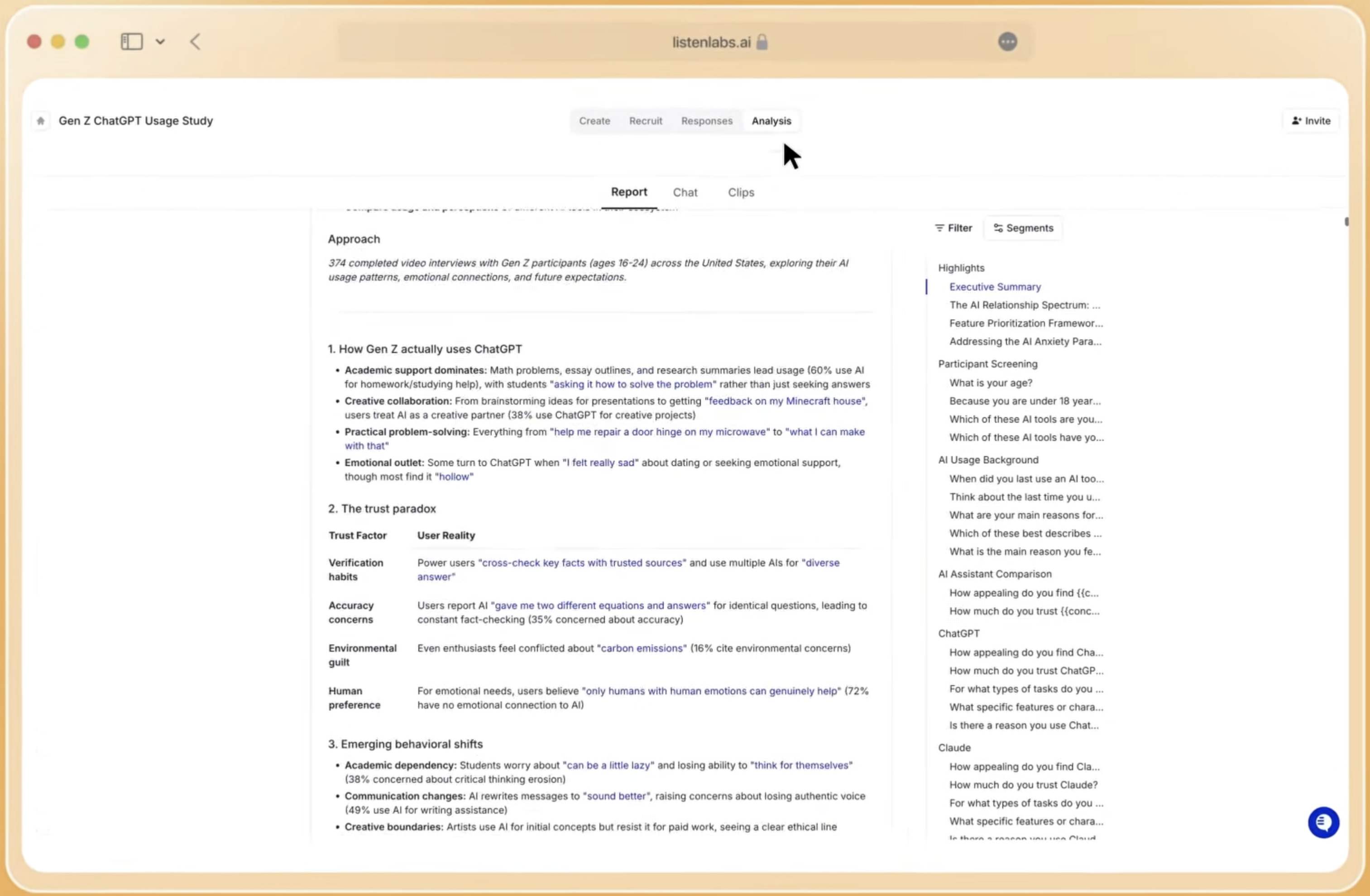
Watch Listen Pulse code and trend open-ended themes
How to Keep Trend Lines Comparable When Adding Qualitative Questions
Brand research leaders want richer context without losing historical comparability. In cross-sectional surveys such as brand trackers, question order must be kept consistent across all waves so that order effects are not mistaken for changes in trends. The same principle applies to the quant core of an AI-augmented tracker: core questions stay constant, in the same order, with the same wording.
Timely add-on questions, such as those covering a new campaign, a competitor move, or a news event, sit after the invariant core and are clearly documented as wave-specific additions. They leave the core series untouched. A large shift in mode mix should be treated the same way as a change in the sampling frame, as a break in the series that must be flagged. The same logic applies to any instrument change: document it, date-stamp it, and note it in every wave report that follows.
Methodology-change documentation serves legal, procurement, and skeptical internal stakeholders. The change log records what changed, when, why, and the expected effect on comparability. When a KPI moves and a stakeholder asks whether the methodology caused it, the change log becomes the first line of defense. With AI-moderated interviews, talking to users at scale is no longer the hard part, the challenge is understanding what they mean and defending that understanding to a skeptical CFO or legal team.
Learn how Listen Pulse protects trend-line integrity
AI Interviews vs Synthetic Respondents for Brand Tracking
Keeping the trend line comparable assumes the respondents are real. That assumption is exactly what synthetic data puts at risk. The editorial position here is direct: AI should moderate the interview while real customers answer. This distinction matters more for longitudinal brand tracking than for almost any other research format because synthetic errors accumulate wave after wave.
ESOMAR guidance does not prohibit the use of synthetic data but requires transparency: buyers must be informed when synthetic data is used, and suppliers must disclose the methods and minimum viable data thresholds applied. Researchers at ESOMAR’s 2025 Congress specified that synthetic data augmentation models should only be applied to segments comprising 15 percent or less of the total sample, and only with at least 300 real respondents as the base.
A study comparing AI-generated responses to actual human survey data found that 48 percent of statistical coefficients estimated from AI responses were significantly different from their human counterparts, and among those cases the direction of the relationship was reversed 32 percent of the time. For a brand tracker, a reversed directional relationship means a trend line pointing the wrong way, which no insights leader can accept when executives make brand investment decisions from the data.
The 2026 industry consensus on synthetic respondents is summarized as “pretesting yes, primary data no,” with the guidance that anything ending up in a board deck, regulatory filing, or investment decision must be backed by real human responses. A trend line built on synthetic answers cannot be validated against real behavior, and the error compounds. Listen Labs uses AI as the moderator across its 50M+ verified respondent network, and every conversation is with a real person.
See how Listen Labs governs real-respondent quality at scale
Integrating AI Interviews with Qualtrics and Decipher
Most brand research leaders want to improve their tracker without rebuilding it from scratch. Listen Pulse integrates directly with Qualtrics and Decipher, so the existing tracker keeps running and the AI interview layer attaches to it. Teams keep the KPIs they already report while adding the narrative behind them.
There are two deployment modes. In the first, Listen Pulse deploys alongside an existing Qualtrics or Decipher tracker. The quant core runs as it always has, and Pulse adds open-ended AI interviews triggered by quant responses, codes the themes, and feeds them into the same reporting cadence. In the second, Pulse deploys as the primary tracking system and runs the full wave, quant core plus adaptive qual, in a single instrument.
Quantitative questions should stay quantitative so dashboards keep charting. Because they produce the same structured values, a number for a scale or an option string for a choice, NPS, CSAT, and matrix distributions remain directly comparable to historical data, provided wording and scale ranges stay identical. This integration principle makes the transition operationally safe: the quant core is recreated verbatim, and the AI interview layer is additive.
Explore Listen Pulse’s Qualtrics and Decipher integration
Panel Quality and Fraud Governance at Scale
Commodity quant panels undermine longitudinal data in a specific way. Professional survey-takers and repeat respondents distort wave-over-wave comparisons because the same people answer differently once they learn the instrument. Bot-driven traffic now uses language models to generate plausible open-end text. Professional cheaters and repeat participants join multiple panels, and synthetic profiles are built from stolen or fabricated identity data. Each of these corrupts a trend line silently, wave by wave.
Listen Labs’ Quality Guard addresses this in layers. Real-time monitoring across video, voice, content, and device signals catches fraud during the interview, while a three-studies-per-month cap removes professional survey-takers before they enter. Behavioral matching selects participants on intent and past actions, so the sample reflects actual behavior instead of panel-optimized self-description. For hard-to-reach segments such as enterprise decision-makers, healthcare workers, and consumers below 1% incidence rate, a dedicated recruitment operations team adds human review.
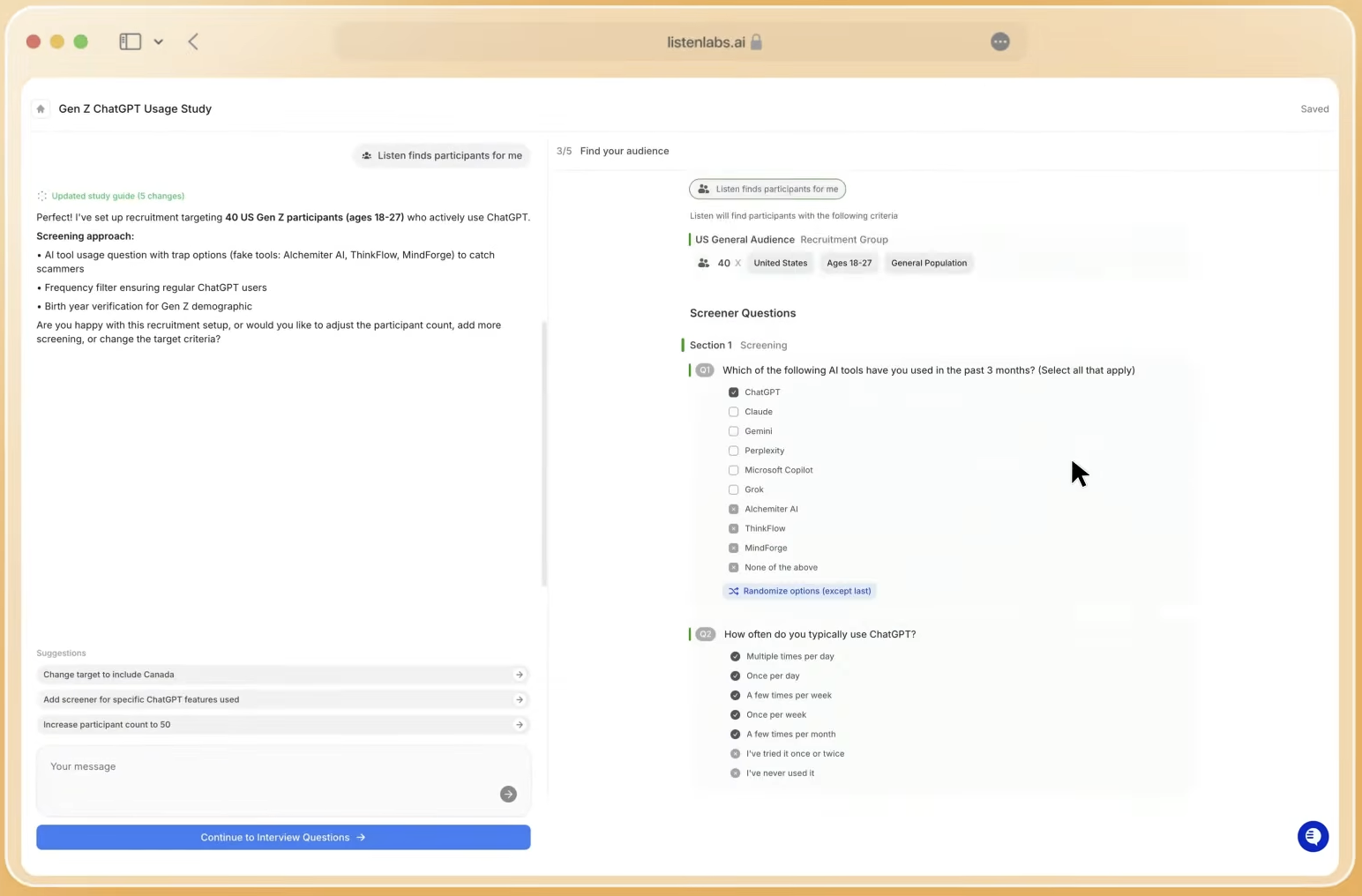
Credible panels apply quality controls before, during, and after a study, including quality scoring, response-pattern analysis, VPN detection, and identity checks such as phone verification, ID document checks, or location checks. Listen Labs applies all of these layers, and its reputation scoring compounds across every interview conducted on the platform. The more clients it serves, the stronger the audience quality becomes, creating a flywheel competitors cannot easily match.
See Quality Guard’s fraud governance in action
Human Oversight and Where Researchers Stay in the Loop
AI handles the logistics of brand tracking at scale, including recruiting, moderating, transcribing, coding, and quantifying. Researchers stay involved in three places where judgment remains essential.
The first is connecting findings to strategy. A theme at that scale is a data point. Whether it represents a structural brand problem or a temporary campaign artifact requires a researcher who understands the brand’s competitive context, its recent marketing activity, and its historical KPI patterns.
The second is validating and versioning the theme taxonomy. When a new theme emerges, a researcher decides whether it is real or noise, whether it merits a new code or belongs under an existing one, and when it has accumulated enough evidence to be added to the locked taxonomy. This judgment call determines whether the trend line is trustworthy.
The third is deciding when a KPI movement requires a deeper diagnostic study beyond what the triggered interviews can explain. AI surfaces the signal, and researchers decide what to do with it.
Researchers spend the bulk of their time in analysis: finding patterns, quantifying insights, testing significance, adding macro context, formatting results for stakeholders who each need something different. Listen Labs compresses the logistics so that time goes to interpretation rather than transcription and coding. The team runs more waves with the same headcount and spends its time on the work that requires human judgment.
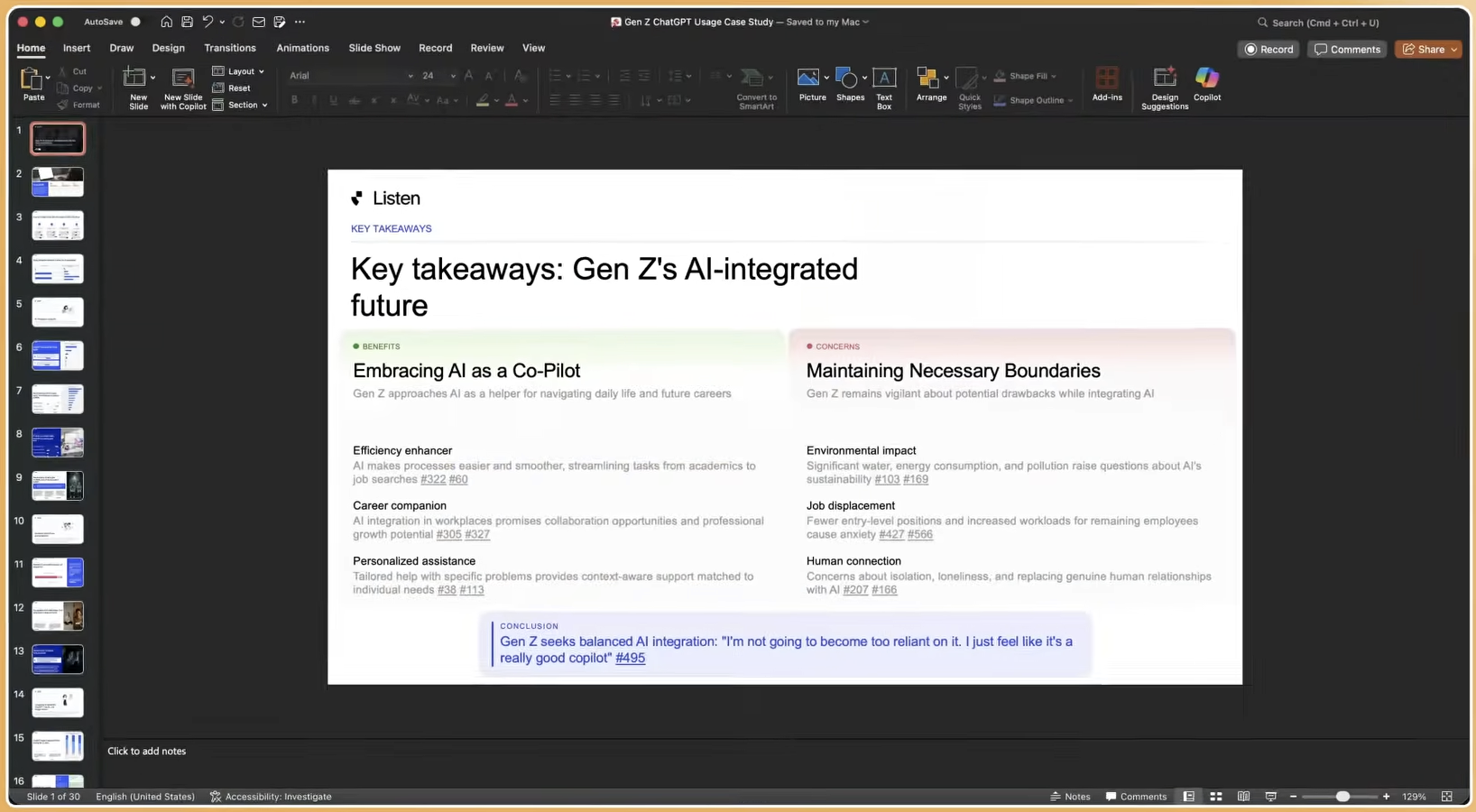
Why Listen Labs Is the Platform for Scaling Brand Tracking with AI Interviews
Listen Pulse is the conversational tracker built for this operating model. It runs the same study with the same screeners wave after wave, keeping core questions constant so the trend line holds. On top of that core, it adds open-ended conversation, sorts the answers into themes, quantifies them, and charts each theme next to the KPIs the team already reports. It integrates with Qualtrics and Decipher, deploys alongside an existing tracker or as the primary tracking system, and delivers results in less than 24 hours versus the 4–6 weeks of traditional research.
Consider an illustrative case. A well-known clothing brand famous for its big logos was quietly losing customers. Its old tracker caught the drop but could not explain it. Pulse found that style, not price, was driving the loss. A growing group of customers felt the big logos were too loud for their changing lifestyles. That finding arrived in the same wave as the KPI movement, so the team could act before a separate qualitative study would have delivered.
Listen Labs has run over 1 million AI-powered customer interviews for companies including Microsoft, Perplexity, and Sweetgreen. Sweetgreen scaled research across 300+ US locations at 5x the scale and one third the cost. Anthropic now runs 100 studies in the time it previously took to run five or six. Procter & Gamble, Skims, Robinhood, and Simple Modern use Listen Labs for consumer insights, with case studies showing results delivered in hours rather than weeks. The platform covers 50M+ verified respondents across 45+ countries and 120+ languages. In AI-moderated sessions, 92% of participants report top comfort levels, equivalent to human-moderated sessions.
For teams already running qualitative brand tracking at scale, Pulse is the operational layer that makes it trendable.
See Listen Pulse scale your brand tracker with AI interviews
Frequently Asked Questions
These are the questions brand research leaders ask most often when moving a tracker to AI interviews.
How Do You Trigger AI Interviews Off Quant Responses Without Biasing the Sample?
Apply a single, pre-set trigger rule to every respondent and track triggered cases as a documented sub-sample. That discipline keeps the follow-up group consistent and protects the full-wave quant results.
How Do You Code Open-Ended Themes So They Can Be Charted Wave Over Wave?
Use a locked codebook, apply the same definitions every wave, and version-stamp any new themes. Then quantify each theme as a count and percentage so it can sit beside KPIs.
How Do You Keep Trend Lines Comparable When Adding Qualitative Questions?
Keep the quantitative core identical in wording and order, and log every instrument change in a methodology record. Add new questions only after the core and mark them as wave-specific.
Can Synthetic Respondents Replace Real Ones for Brand Tracking?
No. ESOMAR caps synthetic augmentation at 15% of the sample with a 300-respondent real base, and the industry consensus reserves synthetic data for pretesting. Longitudinal brand tracking relies on real respondents.
How Does Integration with Qualtrics and Decipher Work?
Pulse recreates your existing quant questions verbatim and connects to your Qualtrics or Decipher tracker. The AI interview layer then triggers off those responses and feeds coded themes into the same reporting cadence.
How Is Panel Quality Governed at Scale for Continuous Tracking?
Quality Guard combines behavioral matching, real-time fraud monitoring, participation caps, and human recruitment review. Together these layers keep repeat cheaters, bots, and fake profiles out of your trend line.
How Long Does a Wave Take?
Listen Labs delivers results in under 24 hours, the same figure cited earlier, rather than the 4–6 weeks of traditional research. That speed lets teams run more waves per quarter with the same headcount.
Where Must Researchers Stay in the Loop?
The three oversight areas described above, strategy connection, taxonomy versioning, and diagnostic escalation, are where human judgment stays essential.
Scale your brand tracker with AI interviews