Written by: Anish Rao, Head of Growth, Listen Labs
What You Will Get From This 7-Day Interview Plan
- Traditional market research is too slow and expensive for early-stage startups, often taking 6–12 weeks and costing $20k–$100k.
- A structured 7-day playbook lets founders complete 30 problem interviews, test willingness to pay, and build a bottom-up customer model before burning runway.
- Effective interviews rely on open-ended, past-behavior questions and on recruiting skeptics alongside enthusiasts to avoid confirmation bias.
- Ground pricing discussions in current workaround spend, use Van Westendorp and Gabor-Granger methods, and discount stated willingness-to-pay by 30–50% to predict real behavior.
- Listen Labs compresses the entire research cycle, including recruitment, AI-moderated interviews, and analysis, into under 24 hours; see how to scale from 30 interviews to hundreds overnight.
Why Traditional Research Fails Early-Stage Startups
Traditional full-service market research projects typically cost $20,000–$100,000 and take 6–12 weeks from briefing to final deliverable. These timelines exceed the runway of most pre-MVP teams. By the time insights arrive, the business context has changed and the findings are stale. Skipping research entirely creates a different risk and often produces the product-market fit failures cited above. The 7-day playbook below closes that gap by giving founders a clear path to complete 30 interviews in one week.
Once you have validated the playbook manually, Listen Labs lets you run the same process at scale. The platform compresses the entire customer research cycle into under 24 hours so you can move from 30 interviews to hundreds overnight. See how Listen Labs delivers on the speed claim above.
Customer Discovery for Startups: The 7-Day Playbook
Each day produces a concrete output that builds on the previous one. Complete the steps in sequence.
- Day 1: Hypothesis document. Write one page that states the target customer, the problem they have, the current workaround, and three specific statements that would disprove the hypothesis. Define disconfirming evidence before any interview begins.
- Day 2: Interview script. Draft a 30-question guide using open-ended, past-behavior questions only. See the copy-paste script block in the Problem Interviews section below.
- Day 3: Screener and recruitment list. Build a screener that filters for incidence rate above 30%. Source candidates from Reddit, LinkedIn groups, and niche communities. Recruit skeptics and non-adopters alongside enthusiasts.
- Days 4–5: 30 completed interviews. Run 30–45 minute sessions. PMC thematic saturation research shows full saturation typically occurs between interviews 9 and 17, so patterns will emerge well before interview 30. Continue to 30 for statistical confidence in willingness-to-pay data.
- Day 6: Validation scorecard. Score each interview against the numeric thresholds in the Willingness to Pay section below. Tally pass and fail counts across the full sample.
- Day 7: Bottom-up customer model. Use interview-verified segment counts, validated ARPU, and a 2–3% three-year penetration rate to build the model. See the Customer Sizing section below for a worked example.
Startup Customer Validation: Framing Hypotheses and Avoiding Bias
Write the hypothesis before any interview takes place and define what evidence would disprove it. Researchers who hold a strong hypothesis before conducting interviews can be more likely to code participant responses in favor of that hypothesis. Structuring disconfirmation in advance counteracts this effect.
Use open-ended, past-behavior questions exclusively. Specific past-behavior questions such as “Tell me about the last time this happened” produce higher-signal evidence than generic opinion questions like “How often does this happen?” because actual behavior reveals more than stated preferences.
Recruit skeptics, churned users, and non-adopters alongside enthusiasts. A product team convinced an advanced analytics feature would win deals asked leading questions and highlighted only glowing quotes, and after shipping, adoption was near zero because most teams never used existing analytics. Diverse recruitment prevents that outcome. Saturation typically occurs between interviews 9 and 17, but running 30 interviews provides the sample depth needed for reliable willingness-to-pay analysis.
Problem Interviews for Founders: Scripting and Moderation
Customer discovery interviews should last 30–45 minutes to balance depth with participant attention. The structure below is a copy-paste starting point. Adapt the bracketed fields to your specific problem domain. The script moves from broad context to specific past events, then explores workarounds and switching costs before closing with a referral ask.
- Introduction (3 min): “I am not selling anything today. I want to understand how you currently handle [problem area]. There are no right or wrong answers.”
- Context setting: “Walk me through your role and how [problem area] shows up in your day-to-day work.”
- Past-behavior anchor: “Tell me about the last time [problem] occurred. What happened?”
- Frequency and severity: “How often does this come up? What does it cost you in time or money when it does?”
- Current workaround: “What do you do today to deal with it? How much does that solution cost you per month?”
- Switching costs: “What would have to be true for you to replace your current approach?”
- Failed attempts: “What have you already tried that did not work?”
- Stakeholders: “Who else is affected by this problem? Who controls the budget for solving it?”
- Urgency: “If this problem disappeared tomorrow, what would change for you?”
- Close: “Is there anyone else I should speak with who experiences this problem?”
Rob Fitzpatrick’s Mom Test framework states that effective problem interviews should focus on the customer’s life, workflow, and context rather than pitching an idea, because asking directly about a business idea leads to polite but unreliable feedback. Keep the product out of the conversation until the close, if it is mentioned at all.
Willingness to Pay Tests: Turning Conversations into Pricing Data
Ground every price discussion in current workaround spend before introducing any price point. The recommended interview flow for willingness-to-pay testing starts by establishing current spending on workarounds, then explores switching costs, introduces the solution concept and asks what the customer would expect it to cost, followed by reactions to specific price points and trade-off questions.
After open-ended probing, apply Van Westendorp Price Sensitivity Analysis and Gabor-Granger testing. Van Westendorp asks four questions at what price the product would be too expensive, expensive but worth it, a good value, and so cheap quality would be questioned, and plotting cumulative distributions identifies the optimal price point and acceptable range. Gabor-Granger testing produces a conversion curve by presenting respondents with a sequence of fixed price points and recording accept or reject responses, which enables calculation of the revenue-maximizing price.
Surveys systematically overestimate willingness to pay by 2–5x due to hypothetical bias, context vacuum, and social desirability effects. To correct for this inflation, apply a 30–50% discount to mean stated willingness to pay before using it in your model.
If you want to validate pricing with actual payment behavior rather than stated intent, run a micro-deposit test. Validate price if payment success reaches at least 2% of paid traffic within 7 days. If payment success falls below 0.2%, pivot messaging or target ICP before higher-fidelity tests.
Free Customer Research Tools for Startups: Sourcing Participants
Reddit, LinkedIn groups, and niche online communities are the lowest-cost recruitment channels for pre-MVP founders. Post in problem-specific subreddits, lead with value rather than a recruitment pitch, screen for incidence rate above 30%, and limit each participant to three studies to avoid panel fatigue. Sending respondents an async AI conversation link instead of scheduling live calls can increase completion rates compared to live calls.
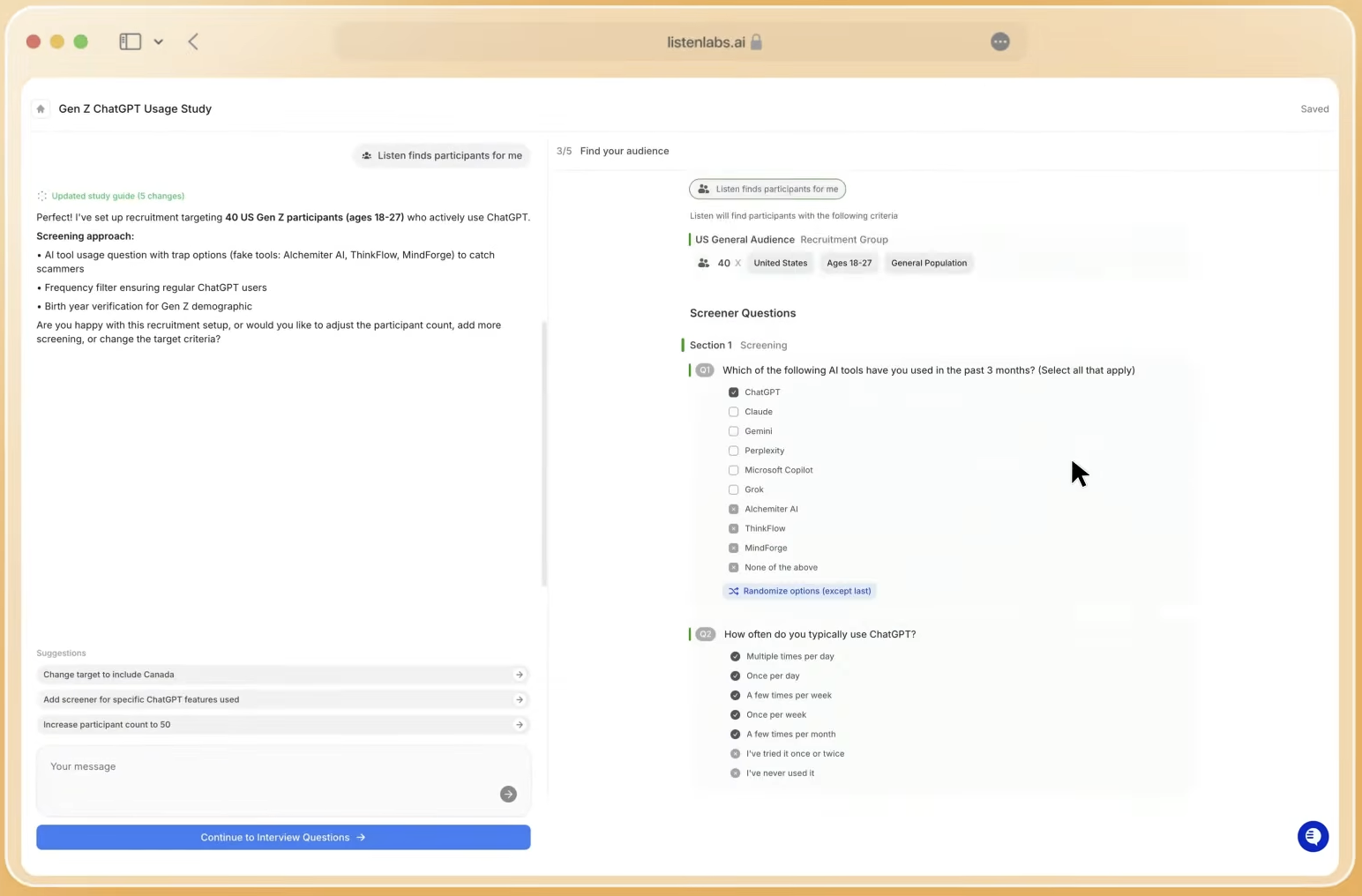
For B2B audiences or segments below 1% incidence rate, community-based sourcing alone is insufficient. Listen Labs’ dedicated recruitment operations team sources enterprise decision-makers, healthcare workers, engineers, and other hard-to-reach segments from its network of 30M verified respondents across 45+ countries, audiences that Reddit threads cannot reliably produce.
Customer Sizing for Early-Stage Startups: Building a Bottom-Up Model
Top-down market sizing lets founders borrow credibility from Statista or Gartner reports without defending their own assumptions. That is why 2026 investors prefer bottom-up customer sizing for pre-seed and seed startups. This approach forces founders to defend ICP, ARPU, channels, and conversion assumptions with evidence from their own research.
Build the model in four steps after completing 30 interviews. Each step translates interview findings into a specific financial assumption so every number in your model traces back to real customer conversations.
- Count addressable ICPs from interview-verified segments using Census Bureau, SBA, or industry association data.
- Set ARPU from the willingness-to-pay data collected in interviews, discounted by 30–50% from stated figures.
- Apply a realistic 2–3% three-year penetration rate for SOM.
- Triangulate the bottom-up SOM against a top-down estimate. Flag as a red signal if the bottom-up model implies more than 25% penetration in 18 months.
A worked example from interview data: 36,000 target clinics at $1,800 ARR yields $5.184M Year-1 SOM at 8% penetration, which aligns with the bottom-up acquisition plan built by channel and month.
Scaling from 30 Interviews to Hundreds in Under 24 Hours
The 7-day playbook above produces a validated hypothesis, a tested interview script, and a bottom-up customer model. At that point, the constraint shifts from methodology to sample size. Thirty interviews confirm patterns, and hundreds confirm statistical significance across segments, geographies, and price points. With qual-at-scale, the old trade-off between depth and scale is no longer a barrier.
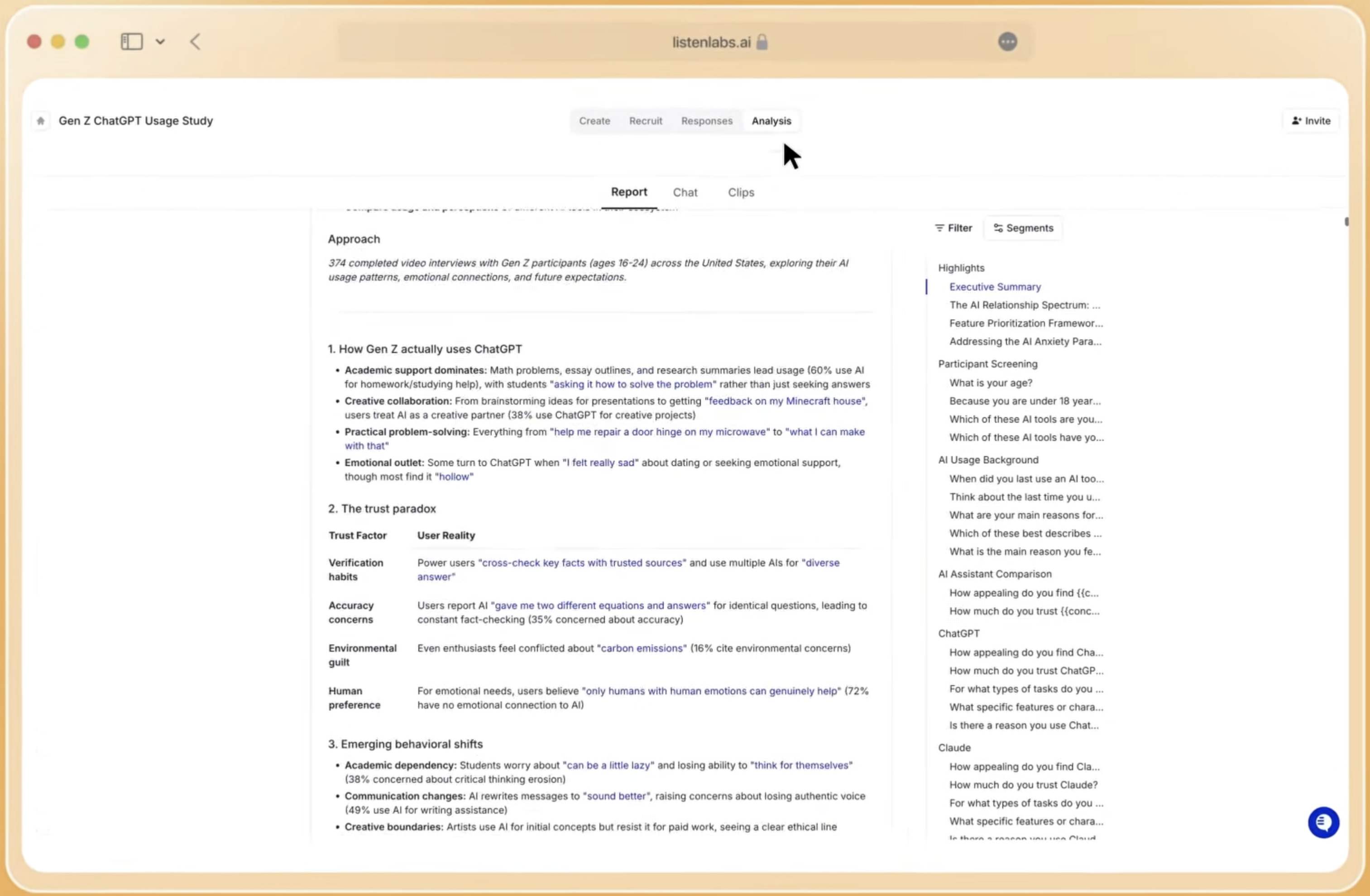
Platforms like Listen Labs layer on auto-recruiting, transcription, sentiment tagging, and insight summarization so teams jump from question to findings in hours, not weeks. Listen Labs has run over 1 million AI-powered customer interviews for companies including Microsoft, Perplexity, and Sweetgreen.
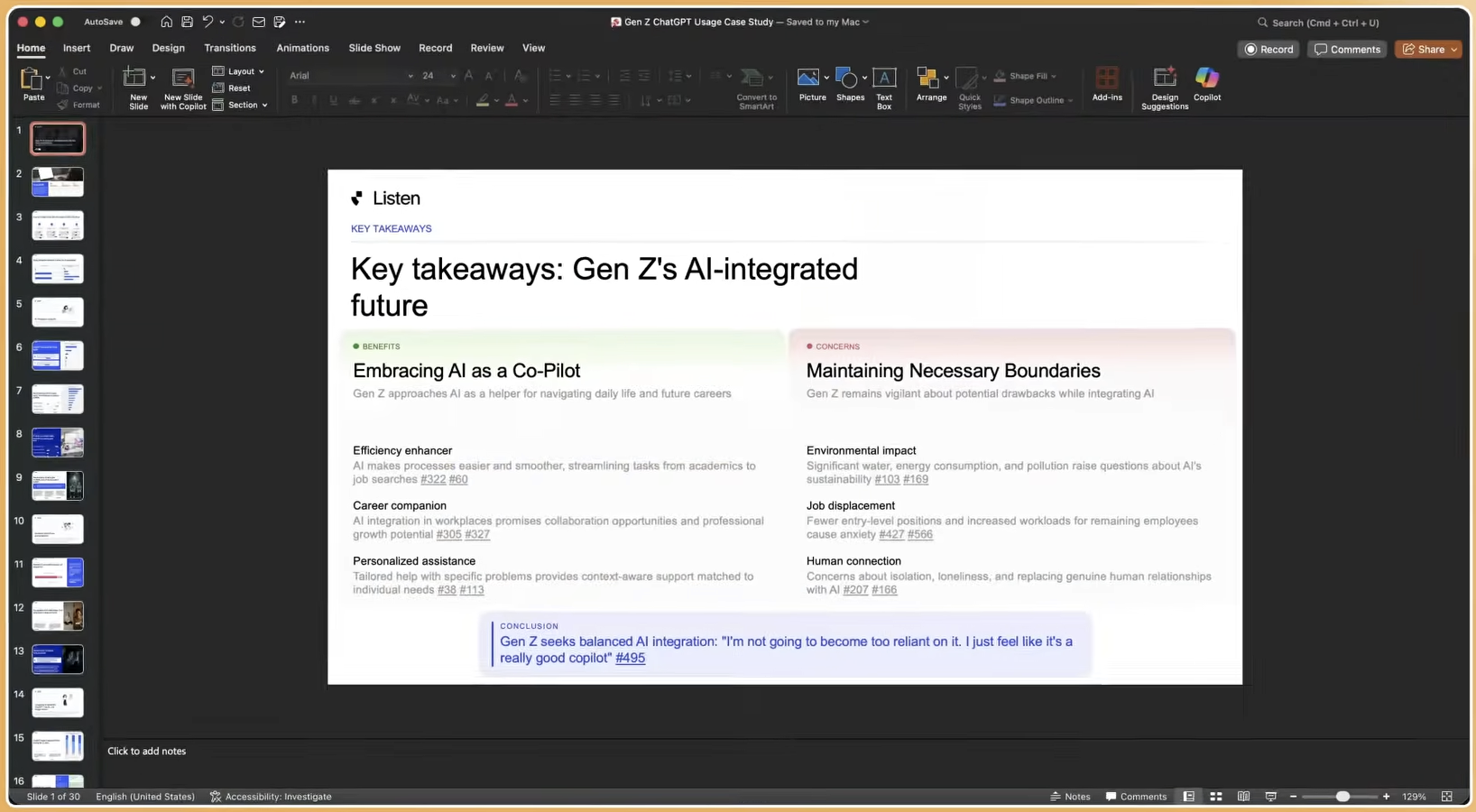
Median time-to-first-insight for customer research can drop from several weeks using manual interviews plus synthesis to under a day using AI-moderated interviews plus auto-synthesis. Listen Labs compresses that further, and the full cycle of recruitment, AI-moderated interviews, analysis, and deliverables completes in under 24 hours.
Run your first scaled study on Listen Labs.
Frequently Asked Questions
How many interviews are enough for early-stage validation?
For problem validation within a tightly defined customer segment, thematic saturation occurs in the 9–17 interview range, as noted earlier. A minimum of 30 interviews is recommended before drawing conclusions about willingness to pay, because pricing analysis requires a larger sample to identify stable price ranges and conversion elasticity. Fewer than 10–15 interviews cannot reliably separate signal from noise or distinguish a real pain point from individual frustration. Once the 7-day playbook is complete, scaling to 100–300 interviews on Listen Labs confirms segment-level patterns with statistical confidence.
How much does traditional research cost compared to AI-moderated interviews?
Traditional in-depth interview studies carry the cost and timeline burdens described earlier, often tens of thousands of dollars and several weeks from kickoff to delivery. This total includes recruitment, incentives, moderator fees, transcription, and analysis. AI-moderated qualitative interviews on platforms like Listen Labs deliver comparable depth at a fraction of that cost and complete in under 24 hours. Enterprises using Listen Labs report running more studies at roughly one-third of the cost of the traditional research approach.
Can Listen Labs reach niche audiences below 1% incidence rate?
Yes. Listen Labs’ dedicated recruitment operations team partners with niche communities, micro-creators, and specialized networks to source participants that commodity panels cannot reliably produce. This group includes enterprise decision-makers, healthcare workers, engineers, and highly specialized consumer segments. The AI orchestration layer, Listen Atlas, matches and bids across multiple consumer and B2B panel partners in addition to Listen Labs’ proprietary database of 30M verified respondents across 45+ countries.
How does Listen Labs prevent professional survey-takers from contaminating results?
Three layers of protection operate simultaneously. First, Listen Labs works exclusively with high-quality, non-commodity panel sources, not professional survey-taker pools. Second, Quality Guard uses real-time AI monitoring across video, voice, content, and device signals to detect fraud, low-effort responses, AI-generated scripts, and mismatched profiles during every interview. Third, participants are limited to a maximum of three studies per month, which eliminates the incentive-driven repeat participation that degrades commodity panel data. A dedicated recruitment operations team adds a human review layer on top of these automated controls.
When should a founder rerun the study after launch?
Post-launch customer discovery should never drop to zero. A focused round of 5–8 problem-focused interviews quarterly helps evaluate whether core pain points remain the highest-severity ones and whether the product is solving them as intended. The Sean Ellis benchmark provides a quantitative signal: if fewer than 40% of active users say they would be “very disappointed” if the product disappeared, the product has not yet achieved sustainable product-market fit and additional discovery rounds are warranted. Listen Labs’ Mission Control stores all past study data, enabling cross-study queries so founders can track how customer sentiment shifts over time without re-researching questions already answered.
Conclusion: Run Your First 30 Interviews This Week
The 7-day playbook replaces founder assumptions with evidence. You create a hypothesis document on Day 1, a tested interview script on Day 2, 30 completed interviews by Day 5, a validation scorecard on Day 6, and a bottom-up customer model on Day 7. Every output is traceable to direct customer conversations rather than surveys or secondary data.
AI can schedule and conduct the interview, analyze the transcripts for themes, and generate quantitative insights from those interviews, which removes the three biggest bottlenecks in customer research: scheduling, moderation, and analysis. Switching to Listen Labs AI-moderated interviews lets teams capture hundreds of candid, one-to-one conversations overnight.
Founders who complete the full validation sequence see measurably better go or no-go decisions. The only variable is whether those 30 interviews happen this week or never. Scale the exact process from 30 interviews to hundreds in under 24 hours on Listen Labs.